R E V I E W
Open Access
Efficacy and safety of angiogenesis
inhibitors in advanced gastric cancer: a
systematic review and meta-analysis
Jing Yu
1*†, Yue Zhang
1†, Lai-Han Leung
2, Lian Liu
1, Fan Yang
1and Xiaojun Yao
2*Abstract
Monoclonal antibodies and small molecule tyrosine kinase inhibitors (TKIs) directed against the vascular endothelial growth factor (VEGF) or its receptors have been investigated in several studies for the treatment of advanced gastric cancer (GC). In the present study, we aimed to evaluate the efficacy and safety of angiogenesis inhibitors in advanced GC. We searched published randomized controlled trials (RCTs) comparing angiogenesis inhibitors with non-angiogenesis inhibitors for the treatment of GC. MEDLINE, EMBASE, and the Cochrane Controlled Trials Register were searched. The extracted data on progression-free survival (PFS) and overall survival (OS) were measured in terms of hazard ratios (HR) and corresponding 95 % confidence intervals (CIs). In addition, risk ratios (RR) and corresponding 95 % CIs were pooled for objective response rate (ORR), disease control rate (DCR), and risk of adverse events (AEs). Ten RCTs involving 2786 patients were included. Compared with non-angiogenesis inhibitor-containing regimens, angiogenesis inhibitor-inhibitor-containing regimens resulted in a significant improvement in OS (HR 0.80, 95 % CI 0.69–0.93,P= 0.004), prolonged PFS (HR 0.66, 95 % CI 0.51–0.86,P= 0.002), and superior ORR (RR 1.34, 95 % CI 1.09–1.65,P= 0.005) and DCR (RR 1.37, 95 % CI 1.17–1.61,P= 0.0001). Angiogenesis inhibitors were associated with a greater number of AEs, but most of these were predictable and manageable. However, hand-foot syndrome, diarrhea, and gastrointestinal (GI) perforation were significantly increased in patients treated with angiogenesis inhibitors. In summary, angiogenesis inhibitor-containing regimens were superior to non-angiogenesis inhibitor-containing regimens in terms of OS, PFS, RR, and DCR in patients with advanced GC.
Keywords:Angiogenesis, Gastric cancer, Monoclonal antibodies, Tyrosine kinase inhibitors
Background
Gastric cancer (GC) is the fifth most common malignancy worldwide and is the third leading cause of cancer deaths in both sexes, accounting for 723,000 deaths (8.8 % of the total), with the highest estimated mortality rates in East Asia and the lowest in North America [1–3]. Despite a significant decline in incidence worldwide over the last few decades, unfortunately, most GC patients are diag-nosed at an advanced stage with 5-year overall survival (OS) rates for all stages combined generally below 30 %. Palliative systemic chemotherapy usually represented by a
platinum-based doublet is the mainstay of treatment in advanced stages. The addition of a third drug such as an anthracycline or a taxane has been shown to improve response rate and provide modest survival benefits at the cost of significant toxicity. Progress in understanding GC cancer biology has led to the development of treatment targeting the epidermal growth factor receptor (EGFR), human epidermal growth factor receptor-2 (HER-2), and angiogenesis, which has changed the therapeutic paradigm of GC.
Recent studies have shown that angiogenesis in GC is a key step in metastasis. It has been confirmed that the vascular endothelial growth factor (VEGF) family is a crucial mediator of angiogenesis [4]. Approximately 50 % of GCs express VEGF, and the overexpression of VEGF-A and VEGF-D in GC is associated with a poor prognosis [4, 5]. Two categories of agents have been * Correspondence:[email protected];[email protected]
†Equal contributors
1
Department of Oncology, Beijing Friendship Hospital, Capital Medical University, No. 95 Yong An Road, Xicheng District, Beijing 100050, China
2State Key Laboratory of Quality Research in Chinese Medicine, Macau
Institute for Applied Research in Medicine and Health, Macau University of Science and Technology, Taipa, Macau 999078, China
developed to target this family: antibody-based agents and VEGF receptor (VEGFR) tyrosine kinase inhibitors (TKIs) [6–8].
Many clinical trials have demonstrated that GC pa-tients can benefit from angiogenesis inhibitors [9–14]. Ramucirumab (a type of monoclonal antibody) or apati-nib (a type of TKI), which binds to VEGFR-2, are re-ported to increase progression-free survival (PFS) and OS in patients treated with one or two previous lines of therapy [9–11, 13]. However, many phase I/II studies of anti-angiogenic TKIs do not show satisfactory outcomes when added to chemotherapy [15–21]. The major stud-ies of angiogenesis inhibitors for gastric cancer were showed in Additional file 1: Table S5. Therefore, the overall efficacy and safety of anti-angiogenic agents in GC are still unknown. In this study, we performed an updated meta-analysis to summarize the efficacy and safety of angiogenesis inhibitors in patients with advanced GC.
Materials and methods
Search strategy
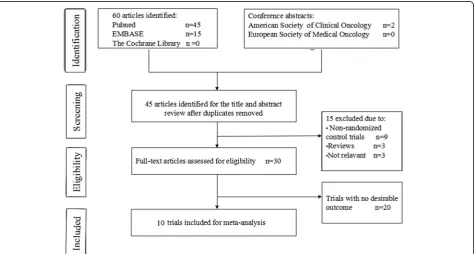
An electronic search of the PubMed, MEDLINE, Cochrane Central Register of Controlled Trials (CEN-TRAL), and EMBASE databases as well as the American Society of Clinical Oncology (ASCO) and the European Society of Medical Oncology (ESMO) databases was per-formed from inception to February 2016. The detailed search strategy is described in Fig. 1. The search strategy included a combination of the MeSH term“angiogenesis
inhibitors” OR the keywords “angiogenetic inhibitors,” “angiogenic antagonists,” “angiogenic inhibitors,” “ angio-static agents,” “antiangiogenetic agents,” “angiogenesis factor inhibitor”; the MeSH term “gastric neoplasms” OR the keywords “gastric tumor*,” “gastric neoplasm*,” “gastric cancer*”. All potentially relevant studies were retrieved, and their references were checked for add-itional eligible studies. Furthermore, we also searched http://www.clinicaltrials.gov/ for information on regis-tered RCTs to identify trials regisregis-tered as completed but whose results had not yet been published. This review was conducted and reported according to the Preferred Reporting Items for Systematic Reviews and Meta-Analysis (PRISMA) Statement issued in 2009.
Definition of angiogenesis inhibitors
We defined angiogenesis inhibitors as those drugs which targeted VEGF and its receptors, which are the key me-diators of angiogenesis.
Inclusion criteria
Studies which met the following criteria were included: (1) patients must be cytologically or pathologically con-firmed as having GC at a clinically advanced stage; (2) randomized controlled trials (RCTs) comparing angio-genesis inhibitors with non-angioangio-genesis inhibitors were deemed eligible; (3) one or more of the following were reported in the trials: overall response rate (ORR) (the sum of complete [CR] and partial responses [PR]),
Fig. 1Flow chart of search process
disease control rate (DCR) (the sum of CR, PR and stable disease [SD]), PFS, OS, and adverse events.
Data extraction
Two independent investigators extracted data from the included studies on the basis of PRISMA [22]. When the two investigators disagreed, a third investigator partici-pated in the discussion to resolve the disagreement. In-formation collected from these trials included the first author, year of publication, study design, number of pa-tients, median age, ECOG performance status, thera-peutic regimen, drug doses, and outcomes. Clinical outcomes collected from the trials included median PFS and OS, hazard ratios (HR) for OS and PFS and their 95 % confidence intervals (CIs), DCR and ORR, risk ratios (RR) for DCR and ORR, and their 95 % CIs, numbers, and rate of each type of adverse event stratified by sever-ity. The response was evaluated according to the Re-sponse Evaluation Criteria in Solid Tumors (RECIST, version 1.1) and classified as a CR, PR, SD, or progres-sive disease (PD). ORR was defined as CR plus PR and DCR was defined as ORR plus SD.
Quality assessment
The risk of bias in each study was assessed using the Cochrane Collaboration tool. The following evaluation domains were assessed accordingly: randomization se-quence generation, allocation concealment, blinding of participants and study personnel, blinding of outcome assessors, incomplete outcome data, selective reporting, and other biases. The risk of each domain was rated as high risk, unclear risk, or low risk according to the match level between information extracted and evalu-ation criteria.
Statistical analysis
A statistical analysis was conducted, and forest plots were performed using Review Manager 5.3. RRs and their 95 % CIs were calculated for DCR, ORR, and grade 3 and 4 toxicity as dichotomous outcomes. HRs were summarized and their corresponding standard errors were computed to analyze the time-to-event data as gen-eric inverse variance outcomes. The inverse variance al-gorithm and Mantel-Haenszel alal-gorithm were used.
Heterogeneity between studies was assessed with
Cochrane’s X2 statistics and the inconsistency statistic (I2
). We considered I2< 50 % as low-level heterogeneity and I2> 50 % as significant heterogeneity. A fixed-effect model was used when I2< 50 % and a random-effect model was used when I2> 50 %. P values <0.05 were regarded as statistically significant in all included studies.
Results
Characteristics of the included studies
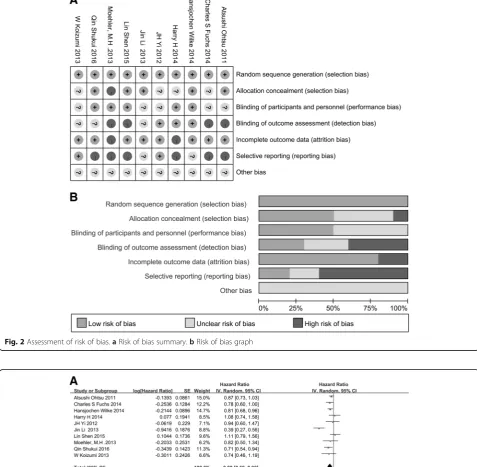
Figure 1 shows the flow chart of study selection. A total of 60 relevant studies were identified by comprehensive search, and two conference abstracts were obtained by manual searching of the ASCO. Fifteen articles were ex-cluded as they were duplicates, leaving 45 articles poten-tially eligible for inclusion, of which 15 were eliminated after reading the abstracts and titles. The full texts of the remaining 30 articles were then reviewed, and ten trials [9–11, 13, 18, 23–27] involving 2786 patients were fi-nally included in the meta-analysis. The sample size in the included trials varied from 91 to 774, the median age of the enrolled patients ranged from 52 to 65 years. Of these, two studies [25, 26] enrolled patients who were treated with anti-VEGF-based drugs, five studies [9–11, 13, 27] en-rolled patients who were treated with anti-VEGFR-2 agents, and three trials [18, 23, 24] enrolled patients who were treated with inhibitors of multiple tyrosine kinases (one of the targets is VEGFR-2). Four trials [18, 25–27] were conducted in the first-line setting and the other six trials [9–11, 13, 23, 24] in the pretreatment setting. Table 1 and Fig. 2 summarize the characteristics and qualities of both the included agents and articles.
Assessment of methodological quality
We critically appraised the methodological quality of the included studies in accordance with the Cochrane Collaboration Risk of Bias Tool. All included trials were rated as low bias risk in randomization, as the authors stated the principles of randomization in detail. Other bias sources were not identified. The graphical results of methodological quality are shown in Fig. 2.
Overall survival (OS) and progression-free survival (PFS)
Table 1Characteristics of the included studies
Study Agents Year Phase Line Regimens No. of patients Median age (years) mOS (months) mPFS (months) DCR (%) ORR (%)
Charles S. Fuchs Ram 2014 3 2 Ram + BSC 238 60 5.20 2.10 49 3
Placebo + BSC 117 60 3.80 1.30 23 3
P= 0.76 P< 0.0001
Hansjochen Wilke Ram 2014 3 2 Ram + PTX 330 61 9.60 4.40 80 28
Placebo + PTX 335 61 7.40 2.90 64 16
P< 0.0001 P= 0.0001
Harry H. Ram 2014 2 1 Ram + mFOLFOX6 84 65 6.40 11.70 85 45
Placebo + mFOLFOX6 84 60 6.70 11.50 67 46
P= 0.008
Jin Li Apatinib 2013 2 >2 Apatinib 47 55 4.83 3.67 7.32 6.38
Apatinib 46 53 4.27 3.20 15 13.04
Placebo 48 54 2.50 1.40 0 0
Shukui Qin Apatinib 2016 3 >2 Apatinib 176 58 6.50 2.60 42.05 2.84
Placebo 91 58 4.70 1.80 8.79 0
P= 0.1695 P< 0.001
Atsushi Ohtsu Bev 2011 3 1 Bev + CDP + Cap 387 58 12.10 6.70 76.9 46
Placebo + CDP + Cap 387 59 10.10 5.30 67.7 37.4
P= 0.0315
Lin Shen Bev 2015 3 1 Bev + CDP + Cap 100 54.2 10.50 6.30 75.3 41
Placebo + CDP + Cap 102 55.5 11.40 6.00 72.1 34 P = 0.35 Markus Hermann Moehler Sunitinib 2013 2 2 Sunitinib + FOLFIRI 45 NR 10.50 3.60 58 20
Placebo + FOLFIRI 46 NR 9.00 3.30 56 29
JH Yi Sunitinib 2012 2 2 Sunitinib + docetaxel 56 54 8.00 3.90 (TTP) 75 41.1
Docetaxel 49 52 6.60 2.60 (TTP) 51 14.3
W Koizumi TSU-68 2013 2 1 TSU-68 + S-1/CDDP 45 62 16.6 6.9 NR 62.2
S-1/CDDP 46 63.5 15.45 7.1 NR 56.5
RamRamucirumab,BSCbest supportive care,mOSmedian overall survival,mPFSmedian progression-free survival,HRhazard ratio,DCRdisease control rate,ORRobjective response rate,PTXpaclitaxel,Bev bevacizumab,CDP/CDDPcisplatin,Capcapecitabine,TTPtime to progression,NRno report
Yu
et
al.
Journal
of
Hematolo
gy
&
Oncolog
y
(2016) 9:111
Page
4
of
Fig. 2Assessment of risk of bias.aRisk of bias summary.bRisk of bias graph
weight (about 15.0 %) in Fig. 3a, the study of Moehler HM which had the minimum relative weight (about 6.2 %) in Fig. 3a, the study of Atsushi Ohtsu that had the maximum relative weight (about 12.9 %) in Fig. 3b, and the study of W Koizumi which had the minimum relative weight (about 9.0 %) in Fig. 3b, and the survival outcome was similar.
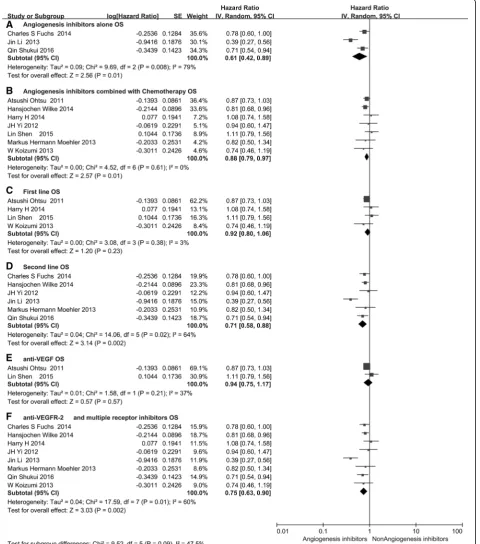
In the subgroup analyses of medication administered, both treatment with angiogenesis inhibitors alone (HR 0.61, 95 % CI 0.42–0.89,P= 0.01, Fig. 4a) and angiogen-esis inhibitors combined with chemotherapy (HR 0.88, 95 % CI 0.79–0.97, P= 0.01, Fig. 4b) led to significantly improved OS, but only the treatment with angiogenesis inhibitors alone prolonged PFS (HR 0.36, 95 % CI 0.22– 0.57, P< 0.0001, Fig. 5a). With regard to the line of treatment, a significant PFS (HR 0.50, 95 % CI 0.34–
0.73, P= 0.0004, Fig. 5d) and OS (HR 0.71, 95 % CI
0.58–0.88, P= 0.002, Fig. 4d) benefit was found in ≥ the second-line treatment. Disappointingly, no PFS (HR 0.87, 95 % CI 0.75–1.01, P= 0.08, Fig. 5c) and OS (HR 0.92, 95 % CI 0.80–1.06, P= 0.23, Fig. 4c) benefits were observed with the first-line treatment. When stratified by drug class, anti-VEGF-based agents led to longer PFS (HR 0.82, 95 % CI 0.71–0.93, P= 0.003, Fig. 5e) but did not significantly improve OS (HR 0.94, 95 % CI 0.75– 1.17, P= 0.57, Fig. 4e) compared with non-angiogenesis inhibitors. Anti-VEGFR-2 and multiple receptor inhibi-tor based agents resulted in longer PFS (HR 0.61, 95 % CI 0.43–0.88, P= 0.007, Fig. 5f ) and OS (HR 0.75, 95 % CI 0.63–0.90,P= 0.002, Fig. 4f ). Besides, due to the inci-dence of GC is region-specific and treatment approaches are different between eastern and western countries, so the patients enrolled in the study were also divided into two subgroups: the Asian group and the non-Asian group. Angiogenesis inhibitors increased PFS in both Asian patients (HR 0.62, 95 % CI 0.42–0.93, P= 0.02, Additional file 2: Figure S1C) and non-Asian patients (HR 0.61, 95 % CI 0.53–0.69,P< 0.00001, Additional file 2: Figure S1D), but only improved OS (HR 0.82, 95 % CI 0.70–0.95, P< 0.007, Additional file 2: Figure S1C) in non-Asian patients.
Overall response rate (ORR) and disease control rate (DCR)
All ten trials reported ORR, and nine studies reported DCR. The DCR ranged from 0 to 85 %, and the ORR varied from 0 to 46 % in the angiogenesis inhibitors group. The pooled data showed that angiogenesis inhibi-tors resulted in superior ORR (HR 1.34, 95 % CI 1.09– 1.65, P= 0.005, Fig. 6b) and a high DCR (HR 1.37, 95 % CI 1.17–1.61, P= 0.0001, Fig. 6a) compared with non-angiogenesis inhibitors.
Subgroup analysis of medication administration
indicated that both angiogenesis inhibitors alone and angiogenesis inhibitors combined with chemotherapy led to a statistically significant improvement in DCR
(RR 2.93, 95 % CI 1.79–4.80, P< 0.0001, Fig. 7a and RR 1.19, 95 % CI 1.10–1.29, P< 0.0001, Fig. 7b). However, we only found an improvement in ORR (RR 1.29, 95 % CI 1.14–146, P< 0.0001, Fig. 8B) for pa-tients treated with angiogenesis inhibitors combined with chemotherapy. In addition, angiogenesis inhibi-tors increased DCR and ORR in both the first-line (RR 1.13, 95 % CI 1.02–1.26, P= 0.02, Fig. 7c and RR 1.16, 95 % CI 1.00–1.33, P= 0.04, Fig. 8d) and ≥ the second-line therapy (RR 1.81, 95 % CI 1.27–2.58, P= 0.001, Fig. 7d and RR 1.75, 95 % CI 1.36–2.25, P< 0.0001, Fig. 8d). When stratified by drug class, im-provement in ORR and DCR were observed with both anti-VEGF-based drugs (RR 1.22, 95 % CI 1.02–1.45, P= 0.03, Fig. 8e and RR 1.10, 95 % CI 1.00–1.21, P= 0.04, Fig. 7e) and anti-VEGFR-2-based and multiple receptor tyrosine kinase inhibitor drugs (RR 1.42, 95 % CI 1.19–1.70,P< 0.0001, Fig. 8f and RR 1.63, 95 % CI 1.27– 2.09,P= 0.0001, Fig. 7f).
Safety
The toxicity reported in the included studies, summa-rized according to the National Cancer Institute Com-mon Toxicity Criteria is shown in Table 2 (only grade ≥3 toxicities are presented). In general, grade≥3 adverse events were more frequent in patients treated with angiogenesis inhibitors and included hand-foot syn-drome, hemorrhage, hypertension, proteinuria, and GI perforation for anti-angiogenic-induced events, and neu-tropenia, leukopenia, and fatigue for chemotherapy-induced events. In addition, hand-foot syndrome (RR 2.17, 95 % CI 1.48–4.97,P= 0.001, Table 2), diarrhea (RR 1.66, 95 % CI 1.11–2.50, P= 0.01, Table 2), and GI per-foration (RR 4.13, 95 % CI 1.14–15.05,P= 0.03, Table 2) were significantly increased in patients treated with angiogenesis inhibitors. However, anemia (RR 0.73, 95 % CI 0.54–0.98, P= 0.03, Table 2) was less frequent in the
angiogenesis inhibitor group. The RRs of grade ≥3
adverse events are summarized in Table 2.
Discussion
GC is one of the most common malignant tumors of the digestive tract worldwide. With the development of therapeutic strategies, the survival time of GC patients has significantly increased over the past 20 years. How-ever, the prospects for the treatment of GC are not opti-mistic. Chemotherapy is currently the main treatment for advanced GC; however, there is no standard first-line chemotherapy regimen for advanced GC. Moreover, traditional chemotherapy has reached an efficacy plat-eau. Therefore, it is necessary to identify a more effective treatment for advanced GC.
In the last 10 years, the rapid development of molecu-lar biology has provided new directions for the
treatment of GC. Many studies on immunotherapy and anti-angiogenic therapy are underway [28]. For example, the results of KEYNOTE-012 and KEYNOTE-028
way to go before patients can benefit from this treat-ment. Among the novel target treatment strategies, the most widely studied, the most extensive, and the most in-depth is the study of angiogenesis. The angiogenic pathway modulated by the VEGF family has been
extensively studied in many tumors [29]. Angiogenesis contributes to the progression, invasion, and metastasis of malignancy and the importance of anti-angiogenesis therapy in inhibiting malignant tumor growth has been confirmed. Targeting the VEGF pathway in GC started Fig. 5Forest plot and pooled HR and 95 % CI for subgroup PFS: anti-angiogenesis therapy versus non-anti-angiogenesis therapy.HRhazard ratios, CIconfidence intervals,PFSprogression-free survival. (a: PFS of subgroups of angiogenesis inhibitors alone threapy;b: PFS of subgroups of angiogenesis inhibitors combined with chemotherapy threapy;c: PFS of subgroups of the first line threapy;d: PFS of subgroups of the second line threapy;e: PFS of subgroups of anti-VEGF threapy;f: PFS of subgroups of anti-VEGFR and multiple receptor inhibitors threapy)
to receive more attention when the results from phase III trials confirmed its efficacy in inducing superior survival outcome beyond standard therapy [9, 10, 13]. Ramuciru-mab, a monoclonal antibody, can selectively bind to VEGFR-2 and block the downstream effects of the VEGF pathway in angiogenesis. The REGARD [9] and RAIN-BOW [10] studies reported that advanced GC patients
may benefit from treatment with ramucirumab (HROS
0.776, 95 % CI 0.603–0.998, P= 0.047, HROS0.807, 95 %
CI 0.678–0.962,P< 0.0001, respectively, and HRPFS0.483,
95 % CI 0.376–0.620, P< 0.0001, HRPFS 0.635, 95 % CI
0.536–0.752, P< 0.0001, respectively). The survival bene-fits in the REGARD and RAINBOW studies led to the ap-proval of ramucirumab by the FDA for the treatment of advanced GC. Apatinib, a small molecule oral TKI, can in-hibit the intracellular function of VEGFR by blocking the receptors of tyrosine kinases expressed by endothelial cells. A phase II [11] and phase III [13] trial explored the effects of apatinib in patients with advanced GC and the results showed that the patients benefited from apatinib treatment. Bevacizumab, a monoclonal antibody, can bind VEGF-A ligand, thus inhibiting VEGF-mediated angiogen-esis. The results of the AVAGAST [25] study showed that
bevacizumab can improve ORR (HR 8.61, 95 % CI 0.6–
16.6, P= 0.0315) and prolong PFS (HR, 0.80; 95 % CI 0.68–0.93,P= 0.0037), but there was no significant differ-ence in OS (HR 0.87, 95 % CI 0.73–1.03,P= 0.1002) when compared with the placebo. In addition, the outcomes of the AVATAR [26] study were similar to those of the AVAGAST study.
Fontana et al. [30] summarized the clinical efficacy of bevacizumab and ramucirumab in advanced GC and dis-cussed the results of clinical trials but paid little attention on other angiogenic inhibitors, such as apatinib and suni-tinib. Aprile et al. [31] mainly focused on the current sta-tus of novel angiogenesis inhibitors in advanced GC, the underlying biology, their mechanism of action, and recent clinical trial results. They suggested that VEGFR-2 plays a key role in GC, and VEGFR-2 blockade may be associated with improved outcomes. Future efforts in translational research should aim to clarify which patients may benefit from the anti-angiogenic therapy. The aforementioned re-views extensively describe the major clinical results of the angiogenic inhibitors, their efficiency and disadvantages in advanced GC. However, they are all narrative reviews and may lead to a number of methodological flaws without a clear and objective methods section. Furthermore, there is still controversy regarding the effects of angiogenesis in-hibitors on advanced GC. Hence, we performed this up-dated meta-analysis to provide valuable clues for the clinical application of angiogenesis inhibitors.
angiogenesis inhibitor monotherapy (HR 0.61, 95 % CI 0.42–0.89, P= 0.01, Fig. 4a) or combined with chemo-therapy (HR 0.88, 95 % CI 0.79–0.97, P= 0.01, Fig. 4b)
when compared with placebo and chemotherapy alone. However, angiogenesis inhibitor monotherapy was un-able to prolong PFS (HR 0.86, 95 % CI 0.71–1.03, P= Fig. 7Forest plot and pooled RR and 95 % CI for subgroup DCR: anti-angiogenesis therapy versus non-anti-angiogenesis therapy.RRrisk ratios, CIconfidence intervals,DCRdisease control rate. (a: DCR of subgroups of angiogenesis inhibitors alone threapy;b: DCR of subgroups of angiogenesis inhibitors combined with chemotherapy threapy;c: DCR of subgroups of the first line threapy;d: DCR of subgroups of the second line threapy;e: DCR of subgroups of anti-VEGF threapy;f: DCR of subgroups of anti-VEGFR and multiple receptor inhibitors threapy)
0.1, Fig. 5a) in patients with advanced GC. The reason may be the anti-VEGF-based drugs combined with chemotherapy can prolong PFS (HR 0.82, 95 % CI 0.71–0.93, P= 0.003), while anti-VEGFR-2 and mul-tiple tyrosine kinase receptor inhibitors combined with chemotherapy failed to improve PFS (HR 0.92, 95 % CI 0.65–1.03, P= 0.63). With regard to the line of treatment, the efficacy of angiogenesis inhibitor therapy may be different in the first-line and≥the second-line set-ting. Significant PFS (HR 0.50, 95 % CI 0.34–0.73, P= 0.0004, Fig. 5d), OS (HR 0.71, 95 % CI 0.58–0.88, P= 0.002, Fig. 4d), ORR (RR 1.75, 95 % CI 1.36–2.25, P< 0.0001, Fig. 8d), and DCR (RR 1.81, 95 % CI 1.27–2.58,P = 0.001, Fig. 7d) benefits were observed in ≥the second-line setting. However, there were ORR (RR 1.16, 95 % CI 1.00–1.33,P= 0.04, Fig. 8c) and DCR (RR 1.13, 95 % CI 1.02–1.26,P= 0.02, Fig. 7c) gains, but no OS (HR 0.92, 95 % CI 0.80–1.06,P= 0.23, Fig. 4c) and PFS (HR 0.87, 95 % CI 0.75–1.01,P= 0.08, Fig. 5c) benefits in the first-line set-ting. This may be due to the results of the most RCTs showed no significant survival benefits regarding OS and PFS, which included in this meta-analysis. With respect to the anti-angiogenic drug class, subgroup analysis showed that anti-VEGFR-2 and multiple tyrosine kinase receptor inhibitor treatment was more efficacious than anti-VEGF treatment in terms of OS, PFS, ORR, and DCR. One pos-sible explanation is the differences in the targets of the angiogenesis inhibitors. Anti-VEGFR-2 and multiple
tyrosine kinase receptor inhibitor drugs selectively bind to VEGFR-2, which plays a key role in the VEGF/VEGFR pathway. Anti-VEGF drugs only bind to VEGF-A and thus cannot block other members of the VEGF family binding to VEGFR-2. Another possible reason is related to the two clinical trials included in the anti-VEGF subgroup, which included patients treated with bevacizumab who had negative survival outcomes. Ramucirumab and apatinib were included in the VEGFR-2 and multiple tyrosine kin-ase receptor inhibitor group. The mechanistic advantage of ramucirumab, which binds to VEGFR-2 and has a long half-life, may be better than bevacizumab. In addition, the recent phase III study of apatinib [13], an oral small mol-ecule VEGFR-2 TKI, in Chinese patients with advanced GC, demonstrated prolonged median OS in the apatinib arm of 195 versus 140 days in the placebo arm (HR 0.71, 95 % CI 0.54–0.94, P< 0.0001). The reason for these dif-ferences is a current challenge, and further studies may elucidate the pharmacological differences and possibly im-prove clinical outcome.
As the incidence of GC is region-specific, and treat-ment approaches are different between eastern and west-ern countries, we divided the patients into two subgroups: the Asian group and the non-Asian group. The results show that angiogenesis inhibitors increased PFS in both Asian patients (HR 0.62, 95 % CI 0.42–0.93, P= 0.02, Additional file 2: Figure S1C) and non- Asian patients (HR 0.61, 95 % CI 0.53–0.69, P< 0.00001,
Table 2RR of grade≥3 adverse events in patients with advanced gastric cancer treated with angiogenesis inhibitors Grade≥3 adverse
events
No. of trials
Events/total RR (95 % CI) Pvalue Analysis
model Treatment group Control group
Decreased appetite 5 55/1095 60/973 0.86 (0.61, 1.22) 0.39 Fixed
Vomiting 5 62/1051 67/975 0.94 (0.48, 1.82) 0.84 Random
Anemia 8 118/1419 125/1161 0.91 (0.55, 1.50) 0.7 Random
Hypertension 6 105/1318 22/1066 2.85 (0.87–9.30) 0.08 Random
Hemorrhage 4 27/898 31/698 0.65 (0.39–1.09) 0.11 Fixed
Thromboembolic events 4 42/778 56/598 0.68 (0.46, 1.00) 0.05 Fixed
Proteinuria 5 147/1218 141/529 1.07 (0.76–1.34) 0.94 Fixed
GI perforation 3 12/985 2/496 4.1 (1.14–15.05) 0.03 Fixed
Neuropathy 3 30/318 27/312 1.11 (0.68–1.82) 0.67 Fixed
Diarrhea 7 60/1135 35/1044 1.66 (1.11, 2.50) 0.01 Fixed
Nausea 6 45/996 58/952 0.77 (0.53, 1.11) 0.16 Fixed
Fatigue 7 79/904 55/627 0.91 (0.44, 1.88) 0.75 Random
Leukopenia 6 83/797 45/665 1.23 (0.61, 2.48) 0.58 Random
Thrombocytopenia 5 33/797 16/665 1.74 (0.96, 3.12) 0.07 Fixed
Neutropenia 7 217/842 118/711 1.53 (0.99, 2.37) 0.06 Random
Hand-foot syndrome 4 51/711 14/569 2.83 (1.57, 5.11) 0.0005 Fixed
Electrolyte disturbance 3 23/662 26/574 0.8 (0.32–1.99) 0.63 Fixed
Pain 6 42/694 31/676 1.06 (0.30, 3.79) 0.93 Random
Liver damage 4 56/414 19.287 1.59 (1.01, 2.51) 0.04 Fixed
RRrisk ratios,GIgastrointestinal
Additional file 2: Figure S1D) but only improved OS in non-Asian patients (HR 0.82, 95 % CI 0.70–0.95, P< 0.007, Additional file 2: Figure S1B). Given that angio-genesis is a host mechanism, the observed differences between Asian patients and non-Asian patients may be attributed to the inherent differences in these ethnic populations. This should be confirmed in future clinical trials by focusing on the influence of racial/ethnic factors.
Another focus in the treatment of GC patients is safety and tolerability. Angiogenesis inhibitors have more ad-verse reactions, such as hemorrhage, hypertension, and proteinuria, and most are predictable and manageable [12]. However, hand-foot syndrome (RR 2.83, 95 % CI 1.57–5.11, P= 0.0005), diarrhea (RR 1.66, 95 % CI 1.11–2.50, P= 0.01), and GI perforation (RR 4.10, 95 % CI 1.14–15.05, P= 0.03) were significantly increased in patients treated with angiogenesis inhibitors. VEGF is also a vital factor in angiogenesis in normal tissues. Consequently, anti-angiogenic agents can destroy the network of capillaries in healthy tissues, and this is the major reason underlying the adverse reactions of these drugs. In this meta-analysis, the safety of angio-genesis inhibitors was similar to previous results for non-small cell lung carcinoma. Gastrointestinal per-foration and diarrhea are due to damage to the blood flow in normal tissues by angiogenesis inhibitors and lead to intestinal ischemia and necrosis, resulting in GI perforation and diarrhea. Hand-foot syndrome, a type of skin toxicity, is a known adverse reaction of angiogenesis inhibitors, although the mechanism of this reaction is unknown, it may be associated with the effects of angiogenesis inhibitors on endothelial cells, resulting in vascular bed degradation. The hands and feet are rich in capillaries and capillary degrad-ation is likely to lead to abnormal sensdegrad-ation and changes in the skin.
Although the toxicity profiles of biologics (bevacizu-mab, ramucirumab) and small molecule TKIs (afatinib, sunitinib, and TSU-68) overlap but are not the same, we conducted a subgroup analysis. This analysis showed that the biologics are more likely to lead to hypertension (RR 5.87, 95 % CI 3.34–10.34,P< 0.0001, Additional file 3: Table S4), neutropenia (RR 1.56, 95 % CI 1.27–1.93, P< 0.0001, Additional file 3: Table S4), diarrhea (RR 1.83, 95 % CI 1.14–2.94,P= 0.01, Additional file 3: Table S4), and gastrointestinal perforation (RR 4.14, 95 % CI 1.14–10.09, P= 0.03, Additional file 3: Table S4), while small molecule TKIs are more likely to lead to hand-foot syndrome (RR 7.70, 95 % CI 1.83–32.39, P= 0.005, Additional file 4: Table S3) and thrombocytopenia (RR 0.68, 95 % CI 0.46–1.00, P= 0.04, Additional file 4: Table S3).
Although angiogenesis inhibitors can improve OS and PFS and achieve a better response rate in advanced GC,
the clinical effect is quite different in individuals due to heterogeneity of the tumor. It is unclear which patients benefit most from angiogenesis inhibitors. In an effort to limit the toxicity and cost of therapy, a large number of basic and clinical studies need to be conducted, in order to identify biomarkers which can be used to predict effi-cacy and choose the most suitable patients to reduce the blindness of clinical medication.
There are many limitations in this meta-analysis. Firstly, a small number of trials were included, and there were no subgroups related to tumor pathological staging or pathological types. Moreover, the subgroup analysis included in the literature was limited to one type of angiogenesis inhibitor, and the conclusions were limited. Secondly, the differences between statistical quality, follow-up period, courses, and race in patients receiving
angiogenesis inhibitors resulted in heterogeneity.
Thirdly, the angiogenesis inhibitors included mainly tar-geted VEGF and its receptor family, thus the conclusions do not cover all types of angiogenesis inhibitors. Finally, this is a trial-level meta-analysis based on studies and not on individual patient data. Confounding variables such as patient co-morbidities, extent of disease, and dif-ferences in other possible prognostic factors could not be incorporated into this analysis. Therefore, future re-search should focus on high-quality studies and clinical features in patients with comprehensive evaluation, thus resulting in more standardized research and more accur-ate conclusions.
Conclusions
Anti-angiogenic treatment was better than non-anti-angiogenic treatment in terms of OS, PFS, ORR, and DCR in patients with advanced GC. Further studies are needed to explore the timing and potentially predictive biomarkers of angiogenesis inhibitors to improve the se-lection of patients and improve clinical benefit.
Additional files
Additional file 1: Table S5.The major trails of angiogenesis inhibitors in use for gastric cancer. (DOC 95.0 kb)
Additional file 2: Figure S1.Forest plot and pooled HR and 95 % CI for Asian patients OS (A) non-Asian patients OS (B) and Asian patients PFS (C) and non-Asian patients PFS (D): anti-angiogenesis therapy versus non-anti-angiogenesis therapy. HR, hazard ratios; CI, confidence intervals; PFS, progression-free survival; OS, overall survival. (DOC 72800 kb)
Additional file 3: Table S4.RR of grade≥3 adverse events in patients with advanced gastric cancer treated with biologics of angiogenesis inhibitors. (DOC 42.0 kb)
Additional file 4: Table S3.RR of grade≥3 adverse events in patients with advanced gastric cancer treated with TKI of angiogenesis inhibitors. (DOC 40.5 kb)
Acknowledgements
Funding
This work was supported by National Natural Science Foundation of China (Grant No. 81272615 and 81101737) and Beijing Municipal“215”High-level Health Person Foundation Project (2014-3-004).
Availability of data and material
The database supporting the conclusions of this article is included within the article.
Author’s contributions
YZ, JY, and XJY contributed to the conception and design this study. LHL and LL carried out the development of the methodology. FY and LL analyzed and interpreted the data. JY and YZ wrote the manuscript and approved the final submission of the study. All authors read and approved the final manuscript.
Competing interests
The authors declare that they have no competing interests.
Consent for publication
Not applicable.
Ethics approval and consent to participate
Not applicable.
Received: 12 August 2016 Accepted: 8 October 2016
References
1. Ferlay J, Soerjomataram I, Dikshit R, Eser S, Mathers C, Rebelo M, Parkin DM, Forman D, Bray F. Cancer incidence and mortality worldwide: Sources, methods and major patterns in GLOBOCAN 2012. Int J Cancer. 2014;136:E359–86.
2. Siegel R, Ma J, Zou Z, Jemal A. Cancer statistics, 2014. Ca A Cancer J Clin. 2014;64:9–29.
3. Sultana N: Globocan 2012: Estimated Cancer Incidence, Mortality and Prevalence Worldwide in 2012. Available from http://globocan.iarc.fr/Default. aspx. Accessed on 31 Aug. 2014.
4. Lieto E, Ferraraccio F, Orditura M, Castellano P, Mura AL, Pinto M, Zamboli A, Vita FD, Galizia G. Expression of Vascular Endothelial Growth Factor (VEGF) and Epidermal Growth Factor Receptor (EGFR) is an Independent Prognostic Indicator of Worse Outcome in Gastric Cancer Patients. Ann Surg Oncol. 2007;15:69–79.
5. Peng L, Zhan P, Zhou Y, Fang W, Zhao P, Zheng Y, Xu N. Prognostic significance of vascular endothelial growth factor immunohistochemical expression in gastric cancer: a meta-analysis. Mol Biol Rep. 2012;39:9473–84. 6. Kerbel RS. Tumor angiogenesis. New Engl J Med. 2008;358:2039–49. 7. Ferrara N, Hillan KJ, Gerber HP, Novotny W. Discovery and development of
bevacizumab, an anti-VEGF antibody for treating cancer. Dressnature Rev Drug Discov. 2004;3:391–400.
8. Ferrara N, Kerbel RS. Angiogenesis as a therapeutic target. Nat Int Wkly J Sci. 2005;438:967–74.
9. Fuchs CS, Tomasek J, Yong CJ, Dumitru F, Passalacqua R, Goswami C, Safran H, Dos SL, Aprile G, Ferry DR, et al. Ramucirumab monotherapy for previously treated advanced gastric or gastro-oesophageal junction adenocarcinoma (REGARD): an international, randomised, multicentre, placebo-controlled, phase 3 trial. Lancet. 2014;383:31–9.
10. Wilke H, Muro K, Van Cutsem E, Oh S, Bodoky GR, Shimada Y, Hironaka S, Sugimoto N, Lipatov O, Kim T, et al. Ramucirumab plus paclitaxel versus placebo plus paclitaxel in patients with previously treated advanced gastric or gastro-oesophageal junction adenocarcinoma (RAINBOW): a double-blind, randomised phase 3 trial. Lancet Oncol. 2014;15:1224–35. 11. Li J, Qin S, Xu J, Guo W, Xiong J, Bai Y, Sun G, Yang Y, Wang L, Xu N, et al.
Apatinib for chemotherapy-refractory advanced metastatic gastric cancer: results from a randomized, placebo-controlled, parallel-arm, phase II trial. J Clin Oncol. 2013;31:3219–25.
12. Li J, Zhao X, Chen L, Guo H, Lv F, Jia K, Ke Y, Wang F, Li C, Qian J. Safety and pharmacokinetics of novel selective vascular endothelial growth factor receptor-2 inhibitor YN968D1 in patients with advanced malignancies. Bmc Cancer. 2010;10:529.
13. Li J, Qin S, Xu J, Xiong J, Wu C, Bai Y, Liu W, Tong J, Liu Y, Xu R, et al. Randomized, double-blind, placebo-controlled phase III trial of apatinib in patients with chemotherapy-refractory advanced or metastatic
adenocarcinoma of the stomach or gastroesophageal junction. J Clin Oncol. 2016;34:1448–54.
14. Moehler M, Mueller A, Hartmann JT, Ebert MP, Al-Batran SE, Reimer P, Weihrauch M, Lordick F, Trarbach T, Biesterfeld S. An open-label, multicentre biomarker-oriented AIO phase II trial of sunitinib for patients with chemo-refractory advanced gastric cancer. Eur J Cancer. 2011;47:1511–20.
15. Bang YJ, Kang YK, Kang WK, Boku N, Chung HC, Chen JS, Doi T, Sun Y, Shen L, Qin S. Phase II study of sunitinib as second-line treatment for advanced gastric cancer. Invest New Drug. 2011;29:1449–58.
16. Martin-Richard M, Gallego R, Pericay C, Foncillas JG, Queralt B, Casado E, Barriuso J, Iranzo V, Juez I, Visa L. Multicenter phase II study of oxaliplatin and sorafenib in advanced gastric adenocarcinoma after failure of cisplatin and fluoropyrimidine treatment. A GEMCAD study. Invest New Drug. 2013; 31:1573–9.
17. Sun W, Powell M, O'Dwyer PJ, Catalano P, Ansari RH, Rd BA. Phase II study of sorafenib in combination with docetaxel and cisplatin in the treatment of metastatic or advanced gastric and gastroesophageal junction adenocarcinoma: ECOG 5203. J Clin Oncol. 2010;28:2947–51.
18. Koizumi W, Yamaguchi K, Hosaka H, Takinishi Y, Nakayama N, Hara T, Muro K, Baba H, Sasaki Y, Nishina T. Randomised phase II study of S-1/cisplatin plus TSU-68 vs S-1/cisplatin in patients with advanced gastric cancer. Brit J Cancer. 2013;109:2079–86.
19. Wainberg ZA, Lin LS, Dicarlo B, Dao KM, Patel R, Park DJ, Wang HJ, Elashoff R, Ryba N, Hecht JR. Phase II trial of modified FOLFOX6 and erlotinib in patients with metastatic or advanced adenocarcinoma of the oesophagus and gastro-oesophageal junction. Brit J Cancer. 2011;105:760–5.
20. Ramanathan RK, Ms MD, Kennecke HF, Syma Iqbal MD, Baranda JC, Seery TE, Lim HJ, Hezel AF, Vaccaro GM, Blanke CD. Phase 2 study of MK-2206, an allosteric inhibitor of AKT, as second-line therapy for advanced gastric and gastroesophageal junction cancer: A SWOG cooperative group trial (S1005). Cancer-Am Cancer Soc. 2015;121:2193–7.
21. Tagawa ST, Milowsky MI, Jeske S, Mazumdar M, Kung S, Sung M, Lehrer D, Matulich D, Selzer J, Wright JJ. A phase I trial of sorafenib plus gemcitabine and capecitabine for patients with advanced renal cell carcinoma: New York Cancer Consortium Trial NCI 6981. Am J Clin Oncol. 2011;34:443–8.
22. Moher D, Liberati A, Tetzlaff J, Altman DG, Group TP. Preferred reporting items for systematic reviews and meta-analyses: the PRISMA statement. PLoS Med. 2009;7:889–96.
23. Yi JH, Lee J, Lee J, Park SH, Park JO, Yim DS, Park YS, Lim HY, Kang WK. Randomised phase II trial of docetaxel and sunitinib in patients with metastatic gastric cancer who were previously treated with fluoropyrimidine and platinum. Brit J Cancer. 2012;106:1469–74.
24. Moehler MH, Thusspatience PC, Schmoll HJ, Hegewischbecker S, Wilke H, Albatran SE, Weissinger F, Kullmann F, Siveke JT, Kanzler S. FOLFIRI plus sunitinib versus FOLFIRI alone in advanced chemorefractory esophagogastric cancer patients: a randomized placebo-controlled multicentric AIO phase II trial. 2013.
25. Ohtsu A, Shah MA, Van Cutsem E, Rha SY, Sawaki A, Park SR, Lim HY, Yamada Y, Wu J, Langer B, et al. Bevacizumab in combination with chemotherapy as first-line therapy in advanced gastric cancer: a randomized, double-blind, placebo-controlled phase III study. J Clin Oncol. 2011;29:3968–76.
26. Shen L, Li J, Xu J, Pan H, Dai G, Qin S, Wang L, Wang J, Yang Z, Shu Y, et al. Bevacizumab plus capecitabine and cisplatin in Chinese patients with inoperable locally advanced or metastatic gastric or gastroesophageal junction cancer: randomized, double-blind, phase III study (AVATAR study). Gastric Cancer. 2015;18:168–76.
27. Yoon HH, Bendell JC, Braiteh FS, Firdaus I, Philip AP, Cohn AL. Ramucirumab (RAM) plus FOLFOX as front-line therapy (Rx) for advanced gastric or esophageal adenocarcinoma (GE-AC): Randomized, double-blind, multicenter phase 2 trial. J Clin Oncol. 2014.
28. Goel G, Sun W. Advances in the management of gastrointestinal cancers—an upcoming role of immune checkpoint blockade. J Hematol Oncol. 2014;8:1–4.
29. Goel G, Sun W. Ramucirumab, another anti-angiogenic agent for metastatic colorectal cancer in second-line setting-its impact on clinical practice. J Hematol Oncol. 2015;8:1–3.
30. Fontana E, Sclafani F, Cunningham D. Anti-angiogenic therapies for advanced esophago-gastric cancer. Indian J Med Paediatr Oncol. 2014;35:253–62. 31. Aprile G. Angiogenic inhibitors in gastric cancers and gastroesophageal
junction carcinomas: A critical insight. Crit Rev Oncol Hematol. 2015;95:165–78.
• We accept pre-submission inquiries
• Our selector tool helps you to find the most relevant journal
• We provide round the clock customer support
• Convenient online submission
• Thorough peer review
• Inclusion in PubMed and all major indexing services
• Maximum visibility for your research
Submit your manuscript at www.biomedcentral.com/submit