S Y S T E M A T I C R E V I E W
Open Access
Cementless versus cemented total knee
arthroplasty in young patients: a
meta-analysis of randomized controlled trials
Chengyu Chen
1and Ruodong Li
2*Abstract
Purpose:Optimal type of prosthesis in total knee arthroplasty (TKA) remains controversial for young patients. The objective of this meta-analysis is to compare cementless and cemented fixation in TKA.
Methods:In this meta-analysis, we conducted electronic searches of PubMed, Embase, Cochrane Library, and Web of Science in December 2018. We collected randomized controlled trials (RCTs) comparing cementless and cemented TKA in young patients. The outcome measurements consisted of functional outcomes, Knee Society Score, range of motion, radiological outcomes, pain score, and complications. Stata 12.0 software was used for our meta-analysis. Quality assessment for RCTs was conducted according to the Cochrane Handbook for systematic review of interventions.
Results:Four RCTs met our inclusion criteria with 255 patients in cemented groups and 229 patients in cementless groups. The present meta-analysis indicated that there was a significant difference between the groups in terms of radiological outcomes and pain score. No significant difference was found regarding KSS, range of motion, or complications.
Conclusion:Cementless TKA was associated with superior outcomes in terms of radiological outcomes and pain score compared with cemented fixation. We found no significant difference regarding the functional outcome or aseptic loosening between groups. High-quality RCTs were still required for further investigation.
Keywords:Total knee arthroplasty, Cementless, Cemented, Meta-analysis
Introduction
Total knee arthroplasty (TKA) is a popular surgical proced-ure for treating knee osteoarthritis (OA) and rheumatoid arthritis (RA) [1, 2]. In the Australian Joint Replacement Register, patient demographics in TKA are slowly changing to younger patients, with the number of patients < 65 years of age increased by 40% from the start of the register in 2002 until 2007 [3]. The demand and stress are higher for young patients because of the longer life expectancy and higher quality of daily life [4]. For younger patients, the fail-ure of TKA is commonly due to the lack of fixation of tibial side implant and periprosthetic infection. Aseptic loosening is a major complication after TKA which may cause high
revision risk [5]. Currently, the optimal type of prosthesis remains controversial for young patients.
Cement prosthesis enhances early fixation and
prevents the periprosthetic bone resorption [6].
Cemented TKA has been the gold standard in TKA with improved outcome and implant survivorship as
long as 20 years [7]. However, toxic effect may be a
major concern and it is more difficult for revision surgery. Besides, young patients have a higher de-mand of stresses on implants. Cementless fixation in TKA has become more and more popular because it is associated with a long term of survival, particu-larly in younger patients. Previous studies reported that use of cementless fixation could achieve a physiological bond between bone and implant which results in a prolonged survival from aseptic
loosen-ing [8, 9]. However, evidence of osteolysis has also
© The Author(s). 2019Open AccessThis article is distributed under the terms of the Creative Commons Attribution 4.0 International License (http://creativecommons.org/licenses/by/4.0/), which permits unrestricted use, distribution, and reproduction in any medium, provided you give appropriate credit to the original author(s) and the source, provide a link to the Creative Commons license, and indicate if changes were made. The Creative Commons Public Domain Dedication waiver (http://creativecommons.org/publicdomain/zero/1.0/) applies to the data made available in this article, unless otherwise stated.
* Correspondence:[email protected]
2Department of Orthopedics, People’s Hospital of Liaocheng Dongchangfu,
Liaocheng 252000, Shandong Province, China
been shown with cementless implants; thus, it has not been widely accepted in the field of joint sur-gery. Few randomized controlled trials (RCT) have compared the clinical outcomes of cemented versus cementless TKA. It is unknown for us whether cemented prosthesis is superior to cementless pros-thesis. Therefore, we perform the meta-analysis from
recent published RCTs to evaluate the optimal mode
of fixation in young patients’ TKA.
Methods
The work has been reported in line with PRISMA (Preferred Reporting Items for Systematic Reviews and Meta-Analyses).
Fig. 1Flow chart of study selection
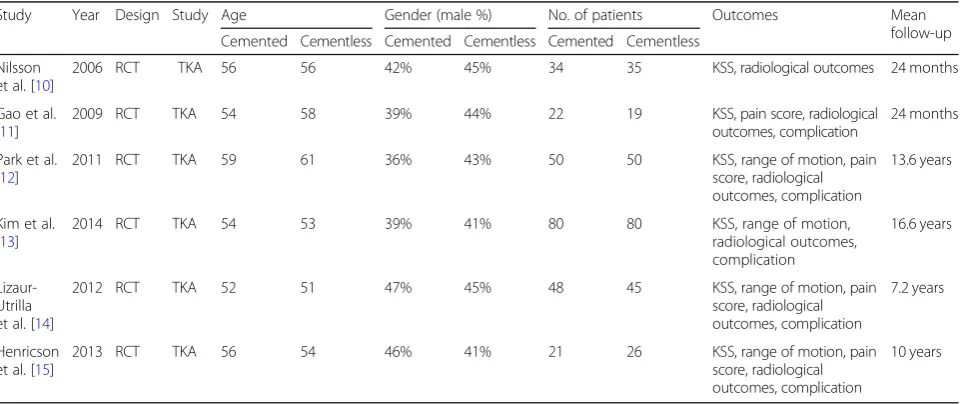
Table 1Characteristics of the included studies
Study Year Design Study Age Gender (male %) No. of patients Outcomes Mean
follow-up Cemented Cementless Cemented Cementless Cemented Cementless
Nilsson et al. [10]
2006 RCT TKA 56 56 42% 45% 34 35 KSS, radiological outcomes 24 months
Gao et al. [11]
2009 RCT TKA 54 58 39% 44% 22 19 KSS, pain score, radiological
outcomes, complication
24 months
Park et al. [12]
2011 RCT TKA 59 61 36% 43% 50 50 KSS, range of motion, pain
score, radiological outcomes, complication
13.6 years
Kim et al. [13]
2014 RCT TKA 54 53 39% 41% 80 80 KSS, range of motion,
radiological outcomes, complication
16.6 years
Lizaur-Utrilla et al. [14]
2012 RCT TKA 52 51 47% 45% 48 45 KSS, range of motion, pain
score, radiological outcomes, complication
7.2 years
Henricson et al. [15]
2013 RCT TKA 56 54 46% 41% 21 26 KSS, range of motion, pain
score, radiological outcomes, complication
10 years
Literature search
The following electronic databases were independently and extensively searched by two investigators from their inception through December 2018: Embase, Medline, the Cochrane Library, and Web of Science. The search key-words were centered on the terms“total knee arthroplasty OR total knee replacement,” “cementless,”and“cemented,
” which were adjusted to each database in necessity. In
addition, the bibliographies of the included studies and dissertations were searched for additional publications. The search language was restricted to English.
Inclusion and exclusion criteria
Eligible studies were considered if they met the following criteria: (1) population: patients aged 60 years or younger who received TKA; (2) intervention: cementless pros-thesis; (3) comparison: cemented prospros-thesis; (4) outcome measures: at least one of the following outcome mea-sures was reported: functional outcomes, radiological evaluation, pain score, and complication; and (5) study design: only RCTs. We excluded articles that were (1) duplicate reports and conference abstracts, (2) articles without available full-text versions, (3) no available outcomes data, and (4) review or case report.
Data extraction
Two researchers independently extracted the data from the included literature. The corresponding author was consulted for details in the case of incomplete data. The following information was extracted: first author name, year of publication, intervening measures, comparable baseline, sample size, and outcome measures. Other relevant parameters were also extracted from individual studies.
Risk of bias assessment
Quality assessment for RCT was conducted according to the Cochrane Handbook for systematic review of inter-ventions. To provide a qualification of bias risk, quality criteria included (i) details of randomization method, (ii) allocation concealment, (iii) blinding of participants and personnel, (iv) blind outcome assessment, (v) incomplete outcome data, (vi) selective outcome reporting, and (vii) other sources of bias. Each aspect could further be classi-fied as low, high, or unclear risk. The evidence grade was assessed using the guidelines of the Recommendations As-sessment, Development and Evaluation (GRADE) system. Disagreements were resolved through a discussion with a third review author.
Table 2Methodological quality of the randomized controlled trials
Study Random sequence
generation
Allocation concealment
Blinding of participants and personnel
Blinding of outcome assessment
Incomplete outcome data
Selective reporting
Other bias
Nilsson et al. [10] Low risk Low risk High risk Low risk Low risk Low risk Low risk
Gao et al. [11] Low risk Low risk High risk Low risk Low risk Low risk Low risk
Park et al. [12] Low risk Low risk High risk High risk Low risk Low risk Low risk
Kim et al. [13] Low risk Low risk High risk High risk Low risk Low risk Low risk
Lizaur-Utrilla et al. [14] Low risk High risk Low risk Low risk Low risk Low risk Low risk
Henricson et al. [15] Unclear risk High risk High risk Unclear risk Low risk Low risk Low risk
Random sequence generation (selection bias)
Allocation concealment (selection bias)
Blinding of participants and personnel (performance bias)
Blinding of outcome assessment (detection bias)
Incomplete outcome data (attrition bias)
Selective reporting (reporting bias)
Other bias
0% 25% 50% 75% 100%
Low risk of bias Unclear risk of bias High risk of bias
Statistical analysis
Continuous outcomes were expressed as the weighted mean differences (WMD) with 95% CI. Statistical
sig-nificance was set at P< 0.05 to summarize the
find-ings across the trials. Variables in the meta-analysis were calculated using Stata software, version 12.0 (Stata Corp., College Station, TX). Statistical hetero-geneity was evaluated using the chi-square test and the I2statistic. When there was no statistical evidence of heterogeneity (I2< 50%, P> 0.1), a fixed effects model was adopted; otherwise, a random effects model was chosen. Funnel plots to assess publication bias in the included studies were not constructed because of the limited number of studies.
Result
Search results
Figure1contains a flowchart that describes the process by which we screened and selected trials. The initial literature search yielded 186 articles in all. Duplicate checking and title and abstract screening resulted in 11 publications, and the full text of all 9 articles were available. Among these, 2 were excluded because the articles were
non-RCTs. In addition, manual search of relevant reference did not identify any additional studies. Finally, 6 [10–15] studies were eligible for inclusion in this review.
Study characteristics
The characteristic of the included RCTs is presented in Table 1. Of the included 484 patients, 255 patients were treated with cemented prosthesis and 229 patients were treated with cementless prosthesis. All RCTs were published between 2009 and 2016. The duration of follow-up ranged from 2 to 13.6 years. All RCTs did not use screws for additional reinforcement and resurfaced the patella.
Assessment of the methodological quality
The risk of bias assessed by the Cochrane tool in
each included studies is shown in Table 2. All
stud-ies reported the randomization, and five of them adopted computer-generated random sequence. Four RCTs used a sealed opaque envelope for allocation concealment. Only one study explicitly described blinding of both patients and personnel, and two studies conducted blinding to the outcome assessors.
NOTE: Weights are from random effects analysis Overall (I-squared = 62.3%, p = 0.021) Study
ID
Lizaur-Utrilla (2012) Nilsson (2006)
Gao (2009)
Park (2011)
Henricson (2013) Kim (2014)
-0.24 (-2.15, 1.68) WMD (95% CI)
-1.00 (-6.92, 4.92) 1.00 (-0.33, 2.33)
2.00 (-1.03, 5.03)
0.90 (-1.30, 3.10)
-1.50 (-6.10, 3.10) -5.00 (-8.29, -1.71)
100.00 %
Weight
7.78 26.42
17.21
21.60
11.03 15.97
-0.24 (-2.15, 1.68) WMD (95% CI)
-1.00 (-6.92, 4.92) 1.00 (-0.33, 2.33)
2.00 (-1.03, 5.03)
0.90 (-1.30, 3.10)
-1.50 (-6.10, 3.10) -5.00 (-8.29, -1.71)
100.00 %
Weight
7.78 26.42
17.21
21.60
11.03 15.97
0
-8.29 0 8.29
All the studies clearly reported follow-up results to avoid reporting bias, although the follow-up intervals were not consistent. However, the shortcomings of these six studies were the lack of intention-to-treat analysis. Each risk of the bias item was expressed in terms of the percentage across all the included stud-ies, which indicated the proportion of risk levels for each item bias (Fig. 2).
Meta-analysis of functional recovery
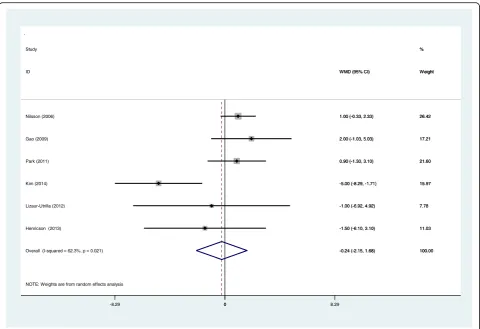
All included RCTs reported Knee Society Score (KSS). There was significant heterogeneity among
studies (I2= 62.3%, p= 0.021), and a random effects
model was adopted. The pooled results showed there was no significant difference between the two groups
in terms of functional outcome (WMD −0.239; 95%
CI −2.154 to −1.676; p= 0.807, Fig. 3).
Meta-analysis of range of motion
Four studies provided a postoperative range of
mo-tion at 5 years’ follow-up. Meta-analysis showed the
benefit of cementless fixation compared to cemented
fixation in range of motion (ROM) (WMD −5.284;
95% CI −9.430 to −1.139; p= 0.012, Fig. 4). A fixed
effects model was adopted because no significant heterogeneity was found (I2= 0%, p= 0.811).
Meta-analysis of pain score
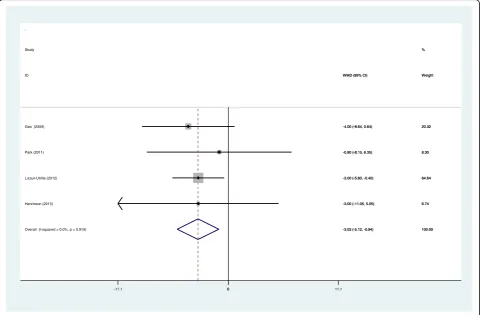
Four articles showed the outcome of postoperative pain score. There was no significant heterogeneity among studies (I2= 0%,p= 0.919), and a fixed effects model was used. Our study showed that cementless fixation was associated with a
significant improved pain score after TKA (WMD −3.029;
95% CI−5.119 to−0.939;p= 0.005, Fig.5).
Meta-analysis of radiological outcomes
A total of six studies showed the radiolucent line (< 1 mm) in the tibial component side. There was no significant het-erogeneity (I2= 20.3%,p= 0.281), and a fixed effects model was used. There was significant difference between groups regarding the radiological outcomes (RD 0.058; 95% CI 0.004 to 0.111;p= 0.034, Fig.6).
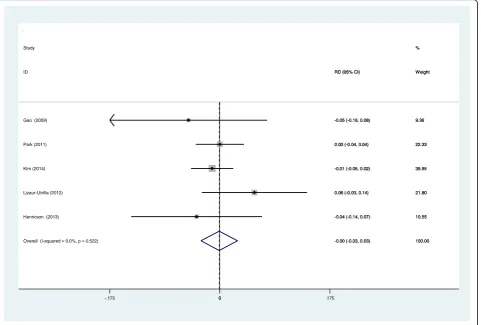
Meta-analysis of aseptic loosening
Aseptic loosening was reported in five RCTs. A fixed ef-fects model was used (I2= 0%,p= 0.522). We found that Overall (I-squared = 0.0%, p = 0.811)
Henricson (2013) Study
ID
Lizaur-Utrilla (2012) Park (2011)
Kim (2014)
-5.28 (-9.43, -1.14) -6.00 (-15.28, 3.28) WMD (95% CI)
-8.00 (-15.55, -0.45) -4.00 (-13.81, 5.81)
-3.00 (-10.32, 4.32)
100.00 19.96 %
Weight
30.14 17.87
32.04
-5.28 (-9.43, -1.14) -6.00 (-15.28, 3.28) WMD (95% CI)
-8.00 (-15.55, -0.45) -4.00 (-13.81, 5.81)
-3.00 (-10.32, 4.32)
100.00 19.96 %
Weight
30.14 17.87
32.04
0
-15.6 0 15.6
there was no significant difference between the groups
re-garding the incidence of aseptic loosening (RD −0.001;
95% CI−0.030 to 0.028;p= 0.946, Fig.7).
Meta-analysis of complications
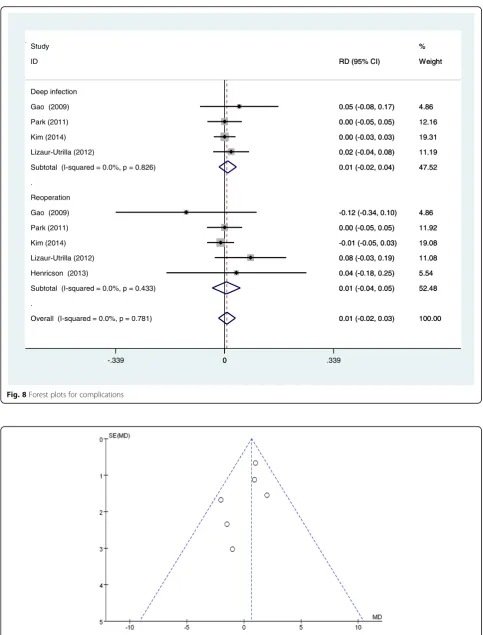
Five RCTs reported the postoperative complication in-cluding deep infection and reoperation. A fixed effects model was used (I2= 0%,p= 0.781). No significant differ-ence was identified in terms of postoperative complication (RD 0.007; 95% CI−0.019 to 0.033;p= 0.587, Fig.8).
Publication bias and evidence level
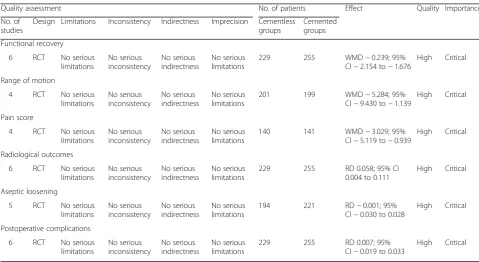
The funnel plot of KSS score was symmetrical, which in-dicated a low risk of publication bias (Fig. 9). However, publication bias cannot be excluded because positive re-sults were more likely to be published. Quality evidence of the meta-analysis was assessed by the GRADE system. The overall evidence was high, which indicated that fur-ther research is unlikely to alter confidence in the effect estimate (Table3).
Discussion
To the best our knowledge, this is the first meta-analysis from RCTs to compare the clinical outcomes between
cementless and cemented fixation after TKA. The most important result was that cementless TKA was associ-ated with better clinical outcomes such as pain score and radiological outcomes compared to cemented TKA in young patients. No significant difference was found regarding the KSS, range of motion, aseptic loosening, or complications. The overall evidence was high, which indicated that further research is unlikely to alter confi-dence in the effect estimate.
With the aging population, osteoarthritis (OA) is more and more common. It was reported that more than 50 million patients suffered from knee OA in the USA and the annual workload of TKA procedures was expected to reach 3.5 million by 2030 [16]. It has been a public health issue. TKA was widely accepted to be performed for patients aged 60 years or older. However, it was con-troversial in young patients. It is known that young pa-tients with TKA have a higher demand of mechanical strength and stability, and the optimal type of prosthesis remains controversial for young patients. Duffy et al. [17] showed that implant survival rate was estimated to be 96% at 10 years and 85% at 15 years of follow-up for patients aged less than 60 years. Functional outcome is an important parameter after TKA, and it is extremely Overall (I-squared = 0.0%, p = 0.919)
ID
Lizaur-Utrilla (2012)
Henricson (2013) Study
Gao (2009)
Park (2011)
-3.03 (-5.12, -0.94) WMD (95% CI)
-3.00 (-5.60, -0.40)
-3.00 (-11.05, 5.05) -4.00 (-8.64, 0.64)
-0.90 (-8.15, 6.35)
100.00 Weight
64.64
6.74 %
20.32
8.30
-3.03 (-5.12, -0.94) WMD (95% CI)
-3.00 (-5.60, -0.40)
-3.00 (-11.05, 5.05) -4.00 (-8.64, 0.64)
-0.90 (-8.15, 6.35)
100.00 Weight
64.64
6.74 %
20.32
8.30
0
-11.1 0 11.1
crucial for young patients. Mont et al. [18] reported no clinical differences between the cementless and cemen-ted replacements in young patients at a mean follow-up of 7 years, but it was a retrospective trial. In our study, KSS function and range of motion were used to assess the function recovery after TKA. The present meta-analysis indicated that there was no significant difference between groups after TKA.
Standard anteroposterior and lateral X-ray plain film with the beam tangential to the tibial component were used to describe the presence and size of radiolucent lines at the tibial component interface as introduced by the Knee Society and to assess potential osteolytic le-sions. Previous studies indicated that radiolucent lines may be associated with loosening or instability, includ-ing migration, and inadequate load distribution. Aebli et al. [19] reported that radiolucent lines may occur be-cause of the imperfect cuts of the tibial plateau or micromotions leading to the formation of gaps, which may prevent osteointegration in cementless TKA.
Smith et al. [20] showed that the radiolucency lines
around the tibial component were due to a failure to
inject cement into the sclerotic bone. Huddleston et al.
[21] found that when excellent initial stability was
obtained, uncemented femoral fixation yielded fewer radiolucent lines in the posterior femoral condylar
region compared with cemented fixation. Rand [22]
reported that radiolucent lines adjacent to the tibial component were similar in both groups. In our study, all RCTs with 484 patients reported the radiological outcomes. The present meta-analysis indicated that cementless fixation was associated with a significantly improved radiological outcome compared with the cemented group.
Pain control after TKA is important and has be-come a serious clinical problem. It was reported that about 50% of TKA patients suffered moderate to se-vere postoperative pain. Effective analgesic method en-hances the knee functional recovery and reduces hospitalization days. Opioid is commonly used for pain relief; however, several side effects including nau-sea, vomiting, constipation, and urine retention may
affect the prognosis [23, 24]. To reduce opioid
con-sumption, several analgesic strategies have been used.
Overall (I-squared = 20.3%, p = 0.281) Henricson (2013)
Gao (2009)
Kim (2014) ID
Park (2011) Nilsson (2006) Study
Lizaur-Utrilla (2012)
0.06 (0.00, 0.11) 0.07 (-0.15, 0.28) 0.08 (-0.15, 0.32)
0.02 (-0.07, 0.11) RD (95% CI)
-0.02 (-0.12, 0.09) 0.17 (0.05, 0.30)
0.06 (-0.05, 0.18)
100.00 10.60 10.28
28.69 Weight
17.57 16.35 %
16.52
0.06 (0.00, 0.11) 0.07 (-0.15, 0.28) 0.08 (-0.15, 0.32)
0.02 (-0.07, 0.11) RD (95% CI)
-0.02 (-0.12, 0.09) 0.17 (0.05, 0.30)
0.06 (-0.05, 0.18)
100.00 10.60 10.28
28.69 Weight
17.57 16.35 %
16.52
0
-.318 0 .318
Mutsuzaki et al. [25] showed that there was a close relationship between tibial radiolucent lines and con-tinual moderate knee pain. The present meta-analysis indicated that cementless fixation was associated with a significantly improved pain score after TKA. The mechanism is still unclear; we hypothesized that cementless prosthesis achieved stable fixation, while the cemented prosthesis may have progressive defects of fixation, and this may result in pain and mobility, although no evidence of loosening was found.
Aseptic tibial loosening is a common complication.
Nilsson et al. [10] indicated that the incidence of
loosening is similar between cementless and cemented fixation. Previous studies have reported that rates of aseptic tibial loosening is 0 to 1% in cementless im-plants compared to 1 to 12% in cemented
compo-nents [26, 27]. However, most studies have analyzed
the elderly patients with TKA. Young patients re-quired higher demand of daily activities, and perhaps there were higher rates of loosening. Thus, more
mechanical complications and potential revisions
could be expected over time. In our study, 5 RCTs reported the rate of loosening after TKA. The present
meta-analysis indicated that there was no significant difference between cementless and cemented fixation regarding the aseptic tibial loosening. Deep infection is a catastrophic complication following joint replace-ment which may cause reoperation and huge medical cost. Deep infection after TKA was diagnosed in 4 of the 229 knees (2%) in the cementless group and 2 of 255 knees (1%) in the cemented group. The rates of deep infection and reoperation were comparable regardless of the fixation. Thrombotic complication is severe and may develop to pulmonary embolism. No significant difference was found between the groups.
Although the inclusion criteria for this study were more stringent, there were still some limitations: (1) only six RCTs with small sample size were included, and statistical tests might be insufficient; (2) some studies did not show negative results, and some indi-cators might have higher heterogeneity; (3) publication bias is unavoidable because the identified language was restricted to English; and (4) combining clinical outcomes from different follow-up time points will introduce heterogeneities and potential biases.
Overall (I-squared = 0.0%, p = 0.522) Park (2011)
Henricson (2013) Study
Kim (2014) Gao (2009)
Lizaur-Utrilla (2012) ID
-0.00 (-0.03, 0.03) 0.00 (-0.04, 0.04)
-0.04 (-0.14, 0.07) -0.01 (-0.05, 0.02) -0.05 (-0.18, 0.08)
0.06 (-0.03, 0.14) RD (95% CI)
100.00 22.33
10.55 %
35.95 9.36
21.80 Weight
-0.00 (-0.03, 0.03) 0.00 (-0.04, 0.04)
-0.04 (-0.14, 0.07) -0.01 (-0.05, 0.02) -0.05 (-0.18, 0.08)
0.06 (-0.03, 0.14) RD (95% CI)
100.00 22.33
10.55 %
35.95 9.36
21.80 Weight
0
-.175 0 .175
. .
Overall (I-squared = 0.0%, p = 0.781) Lizaur-Utrilla (2012)
ID Study
Henricson (2013) Park (2011)
Kim (2014)
Subtotal (I-squared = 0.0%, p = 0.826)
Gao (2009) Reoperation Park (2011)
Kim (2014)
Subtotal (I-squared = 0.0%, p = 0.433) Gao (2009)
Deep infection
Lizaur-Utrilla (2012)
0.01 (-0.02, 0.03) 0.08 (-0.03, 0.19) RD (95% CI)
0.04 (-0.18, 0.25) 0.00 (-0.05, 0.05)
-0.01 (-0.05, 0.03) 0.01 (-0.02, 0.04)
-0.12 (-0.34, 0.10) 0.00 (-0.05, 0.05)
0.00 (-0.03, 0.03)
0.01 (-0.04, 0.05) 0.05 (-0.08, 0.17)
0.02 (-0.04, 0.08)
100.00 11.08 Weight %
5.54 11.92
19.08 47.52
4.86 12.16
19.31
52.48 4.86
11.19
0.01 (-0.02, 0.03) 0.08 (-0.03, 0.19) RD (95% CI)
0.04 (-0.18, 0.25) 0.00 (-0.05, 0.05)
-0.01 (-0.05, 0.03) 0.01 (-0.02, 0.04)
-0.12 (-0.34, 0.10) 0.00 (-0.05, 0.05)
0.00 (-0.03, 0.03)
0.01 (-0.04, 0.05) 0.05 (-0.08, 0.17)
0.02 (-0.04, 0.08)
100.00 11.08 Weight %
5.54 11.92
19.08 47.52
4.86 12.16
19.31
52.48 4.86
11.19
0
-.339 0 .339
Fig. 8Forest plots for complications
Conclusion
Cementless TKA was associated with superior outcomes in terms of radiological outcomes and pain score compared with cemented fixation. We found no significant difference regarding the functional outcome or aseptic loosening between groups. High-quality RCTs are still required for further investigation.
Abbreviation
KSS:Knee Society Score; OA: Osteoarthritis; RA: Rheumatoid arthritis; RCT: Randomized controlled trials; ROM: Range of motion; TKA: Total knee arthroplasty
Acknowledgements
Thank you Yin Wang for language editing.
Authors’contributions
CCY wrote the manuscript. LRD collected the data and designed the study. Both authors read and approved the final manuscript.
Authors’information
None
Funding
None
Availability of data and materials
Please contact author for data requests
Ethics approval and consent to participate
Not applicable
Consent for publication
Not applicable
Competing interests
The authors declare that they have no competing interests
Author details
1Department of Orthopedics, People’s Hospital of Yuncheng, Heze 274700,
Shandong Province, China.2Department of Orthopedics, People’s Hospital of Liaocheng Dongchangfu, Liaocheng 252000, Shandong Province, China.
Received: 1 February 2019 Accepted: 25 July 2019
References
1. Jin ZK, Yang Y, Xu CX, Yang B, Lammi MJ, Chang YH, Ling M, Guo X, Wang XQ. Outcomes of total knee arthroplasty in the adult Kashin-Beck disease with severe osteoarthritis. Int Orthop. 2019;43(2):323–31. doi:https://doi. org/10.1007/s00264-018-4029-1.
2. Kerner PJ, Clarke HD, Scuderi GR. Total knee arthroplasty for rheumatoid arthritis. Mod Rheumatol. 2003;13(4):289–92.
3. Aujla RS, Esler CN. Total knee arthroplasty for osteoarthritis in patients less than fifty-five years of age: a systematic review. J Arthroplasty. 2017;32(8): 2598–603 e2591.
4. Kim YH, Park JW, Kim JS. A comparison of 5 models of total knee arthroplasty in young patients. J Arthroplasty. 2016;31(5):994–9. 5. Miller MD, Peters CL, Allen B. Early aseptic loosening of a total knee
arthroplasty due to Gore-Tex particle-induced osteolysis. J Arthroplasty. 2006;21(5):765–70.
6. Blake SM, Cox PJ. Ann R Coll Surg Engl. 2006;88(3):317–9.
7. Labutti RS, Bayers-Thering M, Krackow KA. Enhancing femoral cement fixation in total knee arthroplasty. J Arthroplasty. 2003;18(8):979–83. 8. Badawy M, Espehaug B, Indrekvam K, Engesaeter LB, Havelin LI, Furnes O. Influence of hospital volume on revision rate after total knee arthroplasty with cement. J Bone Joint Surg Am. 2013;95(18):e131.
9. Namba RS, Chen Y, Paxton EW, Slipchenko T, Fithian DC. Outcomes of routine use of antibiotic-loaded cement in primary total knee arthroplasty. J Arthroplasty. 2009;24(6 Suppl):44–7.
10. Nilsson KG, Henricson A, Norgren B, Dalén T. Uncemented HA-coated implant is the optimum fixation for TKA in the young patient. Clin Orthop Relat Res. 2006;448(448):129–39.
11. Gao F, Henricson A, Nilsson KG. Cemented versus uncemented fixation of the femoral component of the NexGen CR total knee replacement in patients younger than 60 years: a prospective randomised controlled RSA study. The Knee. 2009;16(3):200–6.
studies groups groups
Functional recovery
6 RCT No serious limitations No serious inconsistency No serious indirectness No serious limitations
229 255 WMD−0.239; 95%
CI−2.154 to−1.676
High Critical
Range of motion
4 RCT No serious limitations No serious inconsistency No serious indirectness No serious limitations
201 199 WMD−5.284; 95%
CI−9.430 to−1.139
High Critical
Pain score
4 RCT No serious limitations No serious inconsistency No serious indirectness No serious limitations
140 141 WMD−3.029; 95%
CI−5.119 to−0.939
High Critical
Radiological outcomes
6 RCT No serious limitations No serious inconsistency No serious indirectness No serious limitations
229 255 RD 0.058; 95% CI
0.004 to 0.111
High Critical
Aseptic loosening
5 RCT No serious limitations No serious inconsistency No serious indirectness No serious limitations
194 221 RD−0.001; 95%
CI−0.030 to 0.028
High Critical
Postoperative complications
6 RCT No serious limitations No serious inconsistency No serious indirectness No serious limitations
229 255 RD 0.007; 95%
CI−0.019 to 0.033
12. Park JW, Kim YH. Simultaneous cemented and cementless total knee replacement in the same patients: a prospective comparison of long-term outcomes using an identical design of NexGen prosthesis. J Bone Joint Surg Br. 2011;93(11):1479–86.
13. Kim YH, Park JW, Lim HM, Park ES. Cementless and cemented total knee arthroplasty in patients younger than fifty five years. Which is better? Int Orthop. 2014;38(2):297–303.
14. Lizaur-Utrilla A, Miralles-Muñoz FA, Lopez-Prats FA. Similar survival between screw cementless and cemented tibial components in young patients with osteoarthritis. Knee Surg Sports Traumatol Arthrosc. 2012;22(7):1585–90. 15. Henricson A, Dan R, Nilsson KG. Trabecular metal tibia still stable at 5 years.
Acta orthopaedica. 2013;84(4):398–405.
16. Koh IJ, Kim TK, Chang CB, Cho HJ, In Y. Trends in use of total knee arthroplasty in Korea from 2001 to 2010. Clin Orthop Relat Res. 2013;471(5):1441–50. 17. Duffy GP, Crowder AR, Trousdale RR, Berry DJ. Cemented total knee
arthroplasty using a modern prosthesis in young patients with osteoarthritis - The Journal of Arthroplasty. J Arthroplasty. 2007;22(6):67–70.
18. Mont MA, Lee CW, Sheldon M, Lennon WC, Hungerford DS. Total knee arthroplasty in patients </=50 years old. J Arthroplasty. 2002;17(5):538–43. 19. Aebli N, Krebs J, Schwenke D, Hii T, Wehrli U. Progression of radiolucent
lines in cementless twin-bearing low-contact-stress knee prostheses: a retrospective study. J Arthroplasty. 2004;19(6):783–9.
20. Smith S, Naima VS, Freeman MA. The natural history of tibial radiolucent lines in a proximally cemented stemmed total knee arthroplasty. J Arthroplasty. 1999;14(1):3–8.
21. Huddleston JI, Wiley JW, Scott RD. Zone 4 femoral radiolucent lines in hybrid versus cemented total knee arthroplasties: are they clinically significant? Clin Orthop Relat Res. 2005;441(&NA):334–9.
22. Rand JA. Cement or cementless fixation in total knee arthroplasty? Clin Orthop Relat Res. 1991;273:52–62.
23. Naumann C, Erdine S, Koulousakis A, Van Buyten JP, Schuchard M. Drug adverse events and system complications of intrathecal opioid delivery for pain: origins, detection, manifestations, and management.
Neuromodulation. 1999;2(2):92–107.
24. Wheeler M, Oderda GM, Ashburn MA, Lipman AG. Adverse events associated with postoperative opioid analgesia: a systematic review. J Pain. 2002;3(3):159–80.
25. Mutsuzaki H, Watanabe A, Kinugasa T, Ikeda K. Radiolucent lines are decreased at 3 years following total knee arthroplasty using trabecular metal tibial components. J Int Med Res. 2018;46(5):1919–27. 26. Lonner JH, Hershman S, Mont M, Lotke PA. Total knee arthroplasty in
patients 40 years of age and younger with osteoarthritis. Clin Orthop Relat Res. 2000;380:85–90.
27. Diduch DR, Insall JN, Scott WN, Scuderi GR, Font-Rodriguez D. Total knee replacement in young, active patients. Long-term follow-up and functional outcome. J Bone Joint Surg Am. 1997;79(4):575–82.
Publisher’s Note