R E V I E W
Open Access
Taking stock of 10 years of published
research on the ASHA programme:
examining India
’
s national community
health worker programme from a health
systems perspective
Kerry Scott
1*, Asha S. George
2and Rajani R. Ved
3Abstract
Background:As India’s accredited social health activist (ASHA) community health worker (CHW) programme enters its second decade, we take stock of the research undertaken and whether it examines the health systems interfaces required to sustain the programme at scale.
Methods:We systematically searched three databases for articles on ASHAs published between 2005 and 2016. Articles that met the inclusion criteria underwent analysis using an inductive CHW–health systems interface framework.
Results: A total of 122 academic articles were identified (56 quantitative, 29 mixed methods, 28 qualitative, and 9 commentary or synthesis); 44 articles reported on special interventions and 78 on the routine ASHA program. Findings on special interventions were overwhelmingly positive, with few negative or mixed results. In contrast, 55% of articles on the routine ASHA programme showed mixed findings and 23% negative, with few indicating overall positive findings, reflecting broader system constraints. Over half the articles had a health system perspective, including almost all those on general ASHA work, but only a third of those with a health condition focus. The most extensively researched health systems topics were ASHA performance, training and capacity-building, with very little research done on programme financing and reporting, ASHA grievance redressal or peer communication. Research tended to be descriptive, with fewer influence, explanatory or exploratory articles, and no predictive or emancipatory studies. Indian institutions and authors led and partnered on most of the research, wrote all the critical commentaries, and published more studies with negative results.
Conclusion:Published work on ASHAs highlights a range of small-scale innovations, but also showcases the challenges faced by a programme at massive scale, situated in the broader health system. As the programme continues to evolve, critical comparative research that constructively feeds back into programme reforms is needed, particularly related to governance, intersectoral linkages, ASHA solidarity, and community capacity to provide support and oversight.
Keywords:Community health worker, Accredited social health activist, India, health policy and systems research, training and supervision, primary healthcare
© The Author(s). 2019Open AccessThis article is distributed under the terms of the Creative Commons Attribution 4.0 International License (http://creativecommons.org/licenses/by/4.0/), which permits unrestricted use, distribution, and reproduction in any medium, provided you give appropriate credit to the original author(s) and the source, provide a link to the Creative Commons license, and indicate if changes were made. The Creative Commons Public Domain Dedication waiver (http://creativecommons.org/publicdomain/zero/1.0/) applies to the data made available in this article, unless otherwise stated. * Correspondence:[email protected]
1Independent consultant, Bangalore, India
Introduction
National community health worker (CHW)
pro-grammes are receiving renewed attention as mecha-nisms to help overcome health worker shortages, retain health workers in underserved areas, and pro-vide culturally appropriate primary healthcare [1–3]. No longer seen as stop-gap or a temporary solution, they are now considered as part of long-term invest-ments for responsive and community-oriented health systems [4, 5].
Despite such endorsement, several gaps in knowledge remain in ensuring that CHW programmes deliver at scale across diverse national contexts. There is ongoing discussion about how best to facilitate and sustain com-munity and health systems support for CHW programmes [5], how CHWs should be remunerated [6–8]. and the role of CHW programmes in supporting or undermining health worker rights and gender equity [9–11]. Looking to the future, questions arise on how to support CHW programme evolution to meet changing health needs (e.g., increasing prevalence of non-communicable diseases), changing contexts (e.g., rapid urbanisation), and changing roles (e.g., engaging in service accountability) [12]. Re-views of the literature on CHW programmes have pro-vided valuable insight into health system considerations of CHW programmes [3, 13, 14], including on supervision strategies [15, 16], the influence of context and programme features on CHW productivity [17–19], the extent to which CHW programmes provide equitable healthcare [20], cost effectiveness [21], and considerations for operating national, scaled up programmes [22, 23]. Country-specific literature reviews have been performed for Brazilian [24–26] and Ghanaian [27] CHW pro-grammes; these reviews identified policy and research gaps and explored how CHW roles and identities bridge the gap between community and health ser-vices. The only existing review on CHW programmes in India focuses on the rights of CHWs themselves [9], identifying shortcomings in terms of remuner-ation and labour rights.
In 2005, India launched the accredited social health activist (ASHA) programme as a key component of their National Rural Health Mission to strengthen rural gov-ernment service delivery, as well as community engage-ment and ownership in health programmes [28]. The ASHA programme involved the selection of one woman per village (approximately 1 per 1000 population) who would receive an initial 23 days of training on basic health topics and link community members to health services, provide basic first aid and supplies, and mobil-ise the community around water, sanitation, nutrition and health issues. In 2015, the programme matured into the National Health Mission and was extended to mar-ginalised urban areas. With almost one million ASHAs
now selected and trained, it has grown to become one of the largest CHW programmes in the world. As it enters its second decade, we take stock of the current know-ledge base understand the nature of the research under-taken and whether it examines the health systems interfaces required to sustain and evolve such a large-scale programme.
Methods
Systematic mapping – rather than systematic review – was appropriate for our interest in identifying and de-scribing all articles published on the topic. Systematic mapping enables the inclusion of the entire range of aca-demic research on the topic of interest, rather than lim-iting inclusion to research that addresses a single, clearly defined systematic review question [29]. Since systematic mapping includes articles using any methodology, and since it seeks to define the landscape of work on the subject rather than present evidence on a specific nar-row question, assessment of the quality of included re-search is not appropriate.
Search strategy
We searched the electronic databases PubMed, Embase and Scopus, which index the largest number of publica-tions and most prominent journals in public health, bio-medicine and the social sciences [30–32], for articles published between 1 January 2005 and 9 August 2016. The year 2005 was selected as the beginning date because that was when the ASHA programme was an-nounced and launched. Searches were developed in con-sultation with an academic librarian at Johns Hopkins University. Searches incorporated keywords and free text for two concepts, namely CHWs (e.g. global terms such as ‘community health worker’and‘lay health worker’as well as ‘accredited social health activist’,‘ASHA’and the state-specific names of the ASHA programme, such as Mitanin and Sahyogini) and India (e.g. India* and the names of all Indian states), with the two strings joined by the Boolean operator‘AND’. See Additional file1for the full search strategy.
Eligibility criteria, screening and article selection
government’s ASHA programme (e.g. smaller NGO pro-grammes). One author reviewed all titles and abstracts. Potential bias was mitigated in two ways. First, the reviewing author took an inclusive approach in terms of article format and content, accepting article formats in-cluding research abstracts and commentaries, and only excluding articles that clearly had no meaningful content on the ASHA programme. Second, all borderline or un-clear cases were discussed with the other authors to reach consensus on inclusion. Full texts of retained articles underwent a final screening for eligibility. We were willing to include articles in Hindi; however, no non-English arti-cles were identified. Grey literature on the ASHA programme was beyond the scope of this review, as we were seeking to understand and synthesise the current academic research published on the programme.
Data extraction and synthesis
Detailed data were extracted by one researcher into a pilot-tested framework in Microsoft Excel, which in-cluded the following data extraction components and article assessments.
Location
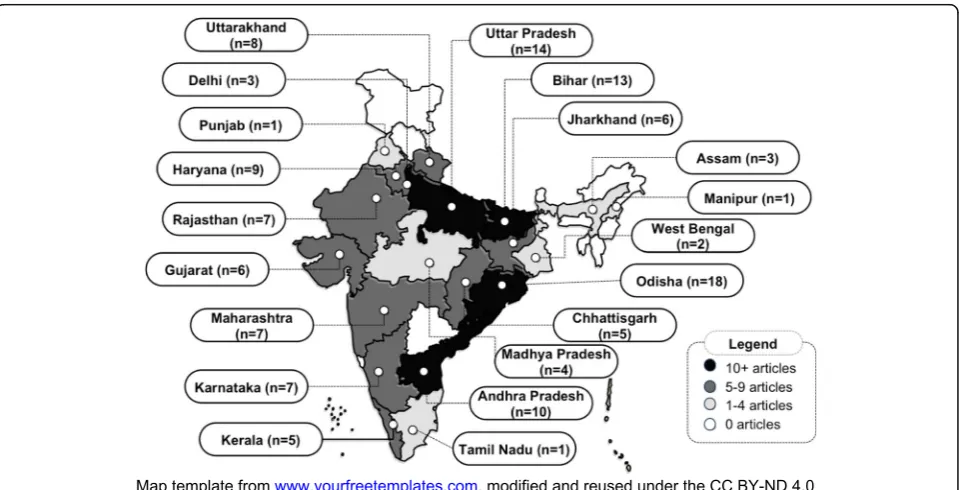
We assessed the location of the research conducted on the ASHA programme to describe its geographical spread (presented in Fig. 3). To do so, we counted the number of studies in each Indian state. Studies con-ducted in multiple states were counted once for each state. We did not count articles that took a national per-spective or that did not specify the state where their re-search was conducted.
Health condition focus
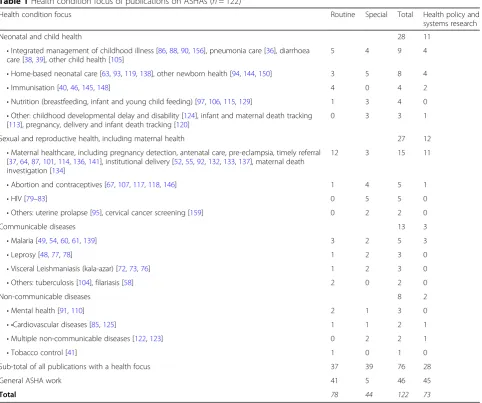
Articles that focused on a particular health condition were classified into the following categories: neonatal and child health, sexual and reproductive health, com-municable diseases, and non-comcom-municable diseases (Table1). Any article that did not have a specific health condition focus was classified as‘general ASHA work’.
Routine versus special intervention
We classified all articles according to whether they fo-cused on the routine work of ASHAs within the national programme (e.g. assessments of typical ASHA practice) or were small-scale special interventions that engaged with ASHAs above and beyond their routine govern-ment work (e.g. pilot mHealth interventions or special surveys that used ASHAs as enumerators) (also pre-sented in Table1).
Evaluation outcomes
Among studies that presented evaluative findings, we assessed whether these findings were broadly positive
(such as ASHAs having high knowledge or effectively performing a new skill), negative (such as ASHAs having poor knowledge or low motivation) or mixed (such as ASHAs facing significant challenges but also gaining self-esteem, effectively delivering some health services or benefitting from key support structures).
Health systems perspective
We considered an article to have taken a health systems perspective if it examined health systems elements, such as supervision, training, supply chain management, finan-cing, motivation, etc., or if the article discussed linkages or repercussions between health systems dimensions such as how communities supported ASHAs or whether facility providers were responsive to ASHAs.
CHW–health systems interface
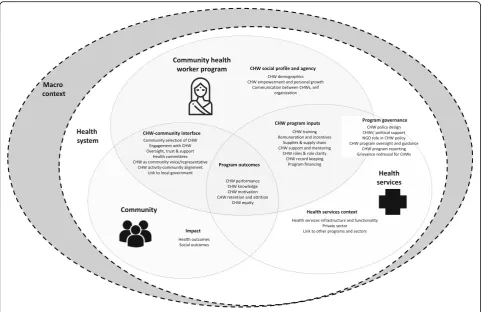
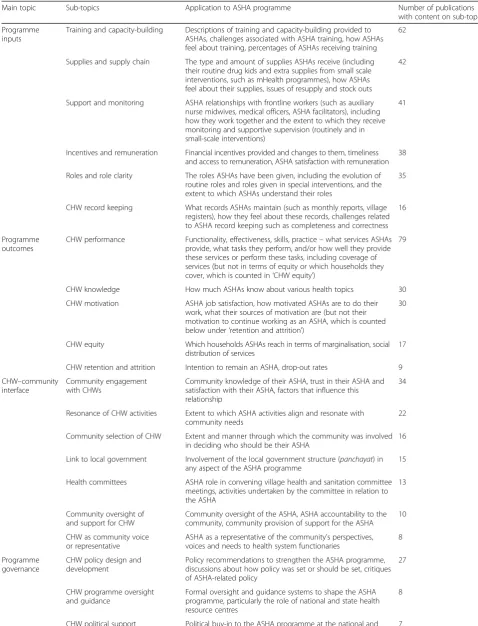
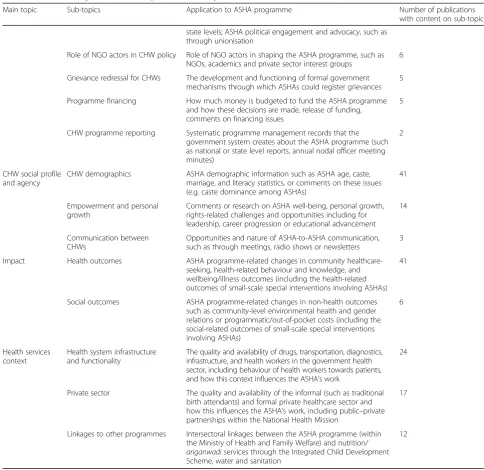
We developed a CHW–health system interface frame-work and assessed the number of publications providing information on the topics in the framework, specifically on CHW social profile and agency, CHW programme inputs, CHW–community interface, health services con-text, programme governance, programme outcomes, and programme impact (Fig. 1). The framework was devel-oped through discussion among team members, review of existing CHW frameworks [5,18,19,23,33, 34], and during a workshop among Indian and African re-searchers. While reading each article, we extracted any meaningful content falling under each of the topics in the framework and then counted the number of articles providing information for each topic. For an article to be counted as providing meaningful information it had to present some new data or novel comment, critique or interpretation related to the topic. Thus, for example, under the topic ‘CHW programme inputs’sub-topic‘ re-muneration and incentives’an article presenting a back-ground description of the remuneration system for ASHAs would not be counted, whereas an article pilot testing an add-on incentive or presenting findings on how ASHAs feel about their remuneration would be counted. Table 2 presents details on how each topic applies to the ASHA programme and the number of ar-ticles with substantive content on each topic.
Research typology and methodology
using and testing theory to explain causal mechanisms; ‘research to establish influence’ (adequacy, plausibility or probability) assesses the impact of one variable on an-other; ‘emancipatory research’ is used to jointly under-stand a problem, act on it, and learn from working collaboratively to address power; and ‘predictive research’ is used to anticipate the consequences of decisions.
Authorship
To analyse authorship, we assessed the institutional af-filiation of the first author as domestic (based in India), foreign (any country other than India) or global (inter-national bodies, including WHO, UNICEF and the World Bank). To understand collaboration and partner-ship between Indian and foreign institutions, we coded the affiliations of all authors as solely domestic (Indian), solely foreign, mixed domestic and foreign, or global.
Results
From 2786 unique references identified in our search, 122 articles met our inclusion criteria (Fig.2), of which 56 were quantitative, 29 mixed methods, 28 qualitative,
and 9 commentary or synthesis. Additional file 2
presents the complete references of included articles. Additional file 3 presents a sortable excel database of
included articles. Additional files 4 and 5 provide an overview of article findings.
Location: where in India is research on the ASHA programme being performed?
Seventeen articles were about the ASHA programme as a national programme and thus did not have a specific research location. Of those articles that specified geo-graphic location, while 13 involved comparative research conducted in multiple states [36–48], the great majority was conducted within a single state. Overall, research on the ASHA programme is concentrated in large northern states (Fig.3), with most articles reporting research from Odisha (formerly Orissa) [42–44, 47, 49–62], then Uttar Pradesh [36,38–40,46,63–71] and Bihar [36–39,44,46,
48,72–77]. Significant numbers of published articles came from Andhra Pradesh [41, 44, 78–85], Haryana [86–94], Uttarakhand [40,95–101], Maharashtra [37,45,102–106], Rajasthan [37,40,44,45,107–109], Karnataka [110–116], Jharkhand [42–44,47,117,118], and Gujarat [38,39,41,
119–121]. In contrast, fewer articles were published on the ASHA programme in Kerala [44,122–125], Chhattis-garh [126–130], Madhya Pradesh [131–134], Delhi [135– 137], Assam [44,138,139], West Bengal [44,48], Manipur [140], Punjab [141], and Tamil Nadu [37].
There is no research from the union territories,1which are administrative areas with no legislative assemblies and have very few ASHAs. There was also no research from several small north-eastern states (Sikkim, Aruna-chal Pradesh, Meghalaya, Mizoram, Nagaland and Trip-ura), Jammu and Kashmir or from Telangana, which was created in 2014 and thus has only existed as a separate entity for a few years.
Health condition focus of articles
Out of 122 published articles, 76 (62%) focused on a par-ticular health condition (Table 1). The most common health foci were neonatal and child health (n= 26) and sexual and reproductive health, including maternal health (n= 26), with fewer articles focusing on commu-nicable (n= 13) and non-communicable diseases (n= 9). The more affluent southern Indian states of Kerala, Andhra Pradesh and Karnataka were frequently the re-search sites for innovative efforts to address
non-communicable diseases [85, 110, 122, 123, 125]. In addition, all five of the publications on HIV are from one project in Andhra Pradesh on engaging with ASHAs to support women living with HIV [79–83].
Of the 46 articles (38%) without a specific health topic focus, many relate to cross-cutting functions that sup-port the ASHA’s core role as maternal and child health promoters. These articles include research on the associ-ation between educassoci-ational level and ASHA capacity (such as filling in the village health register tracking children and pregnant women) [65], the ASHA’s role in multiple reproductive, maternal and child health functions [50,
51,56], in village health and nutrition days [59, 99], and in village health, sanitation and nutrition committees [43] (Table1).
Routine versus special intervention focus
Of the 122 papers, 78 (64%) focused on the routine ASHA programme. Details of these publications are
Table 1Health condition focus of publications on ASHAs (n= 122)
Health condition focus Routine Special Total Health policy and
systems research
Neonatal and child health 28 11
•Integrated management of childhood illness [86,88,90,156], pneumonia care [36], diarrhoea care [38,39], other child health [105]
5 4 9 4
•Home-based neonatal care [63,93,119,138], other newborn health [94,144,150] 3 5 8 4
•Immunisation [40,46,145,148] 4 0 4 2
•Nutrition (breastfeeding, infant and young child feeding) [97,106,115,129] 1 3 4 0 •Other: childhood developmental delay and disability [124], infant and maternal death tracking
[113], pregnancy, delivery and infant death tracking [120]
0 3 3 1
Sexual and reproductive health, including maternal health 27 12
•Maternal healthcare, including pregnancy detection, antenatal care, pre-eclampsia, timely referral [37,64,87,101,114,136,141], institutional delivery [52,55,92,132,133,137], maternal death investigation [134]
12 3 15 11
•Abortion and contraceptives [67,107,117,118,146] 1 4 5 1
•HIV [79–83] 0 5 5 0
•Others: uterine prolapse [95], cervical cancer screening [159] 0 2 2 0
Communicable diseases 13 3
•Malaria [49,54,60,61,139] 3 2 5 3
•Leprosy [48,77,78] 1 2 3 0
•Visceral Leishmaniasis (kala-azar) [72,73,76] 1 2 3 0
•Others: tuberculosis [104], filariasis [58] 2 0 2 0
Non-communicable diseases 8 2
•Mental health [91,110] 2 1 3 0
• •Cardiovascular diseases [85,125] 1 1 2 1
•Multiple non-communicable diseases [122,123] 0 2 2 1
•Tobacco control [41] 1 0 1 0
Sub-total of all publications with a health focus 37 39 76 28
General ASHA work 41 5 46 45
Fig. 2Diagram of article screening process
presented in Additional file 4. The remaining 44 (36%) were about special interventions that engaged ASHAs beyond their official roles and responsibilities such as pilot interventions. Details of these programmes are pre-sented in Additional file5.
Evaluation outcomes
Findings in the publications on the routine ASHA
programme were mostly mixed (55%, n= 43/78) and
negative (23%, n= 18/78), with few indicating overall positive findings (13%, n= 10/78). In contrast, findings in the publications on special interventions were over-whelmingly positive (77%, n= 34/44), with few negative
(5%, n= 2/44) or mixed (9%, n= 4/44) results.
Article-wise assessments of evaluation outcomes can be found in Additional files4and5.
Health systems perspective
Over half the articles (60%, n= 73/122) took a health systems perspective when researching and discussing the
ASHA programme (right-hand column of Table 1).
While only one-third of the 76 studies with a health condition focus had a health systems perspective (37%, n= 28/76), almost all the 46 studies on general ASHA work did so (98%,n= 45/46). The only article on general ASHA work that did not take a health system perspective was an assessment of ASHA knowledge across a range of topics related to their expected areas of work [131].
CHW–health systems interface
When considering article content in relation to the CHW–health system interface framework (Fig.1), across the 122 articles, ASHA performance (65%, n= 79/122) and ASHA training and capacity-building (51%, n= 62/ 122) were discussed across the largest number of publica-tions (Table2). At the other end of the spectrum, five or fewer articles discussed programme financing, programme reporting, grievance redressal for ASHAs, and communi-cation between ASHAs (Table2).
In terms of CHW programme inputs, most of the arti-cles on ASHA training and capacity-building discussed these inputs alongside other health system concerns. Only two publications took training and capacity-building as their primary focus– one commentary on training [142] and one study reporting on an intervention to improve supportive supervision [71]. After training and capacity-building, programme inputs related to supply chains, in-centives and remuneration, support and monitoring, and CHW roles and role clarity were all mentioned in a large number of publications (n= 35–42/122). Less attention was given to CHW record keeping (n= 16/122).
With regards to incentives and remuneration, 12 (10%) articles focused specifically on this topic, including
research on the link between incentives and perform-ance, the influence of introducing payment vouchers for home-based newborn care [138], how adding incentives influenced the Mitanin programme [127] and many studies examining aspects of theJanani Suraksha Yojana programme, which provides ASHAs and pregnant women with cash incentives to promote institutional de-livery and postnatal care [52, 53, 55, 92, 132, 133, 137]. Those that had a specific focus on the support and monitoring relationship between ASHAs and frontline health workers included two that tried pairing ASHAs with male health workers [50, 51] and one on trust and teamwork [57].
Programme outcomes, and especially ASHA perform-ance, were discussed in more than half of the articles, and was the focus of 11 (9%) articles, including research linking ASHA education or selection with ASHA per-formance [65, 66, 98, 112], mHealth to improve per-formance [64, 74, 120, 121], the tasks ASHAs perform and the extent to which they reach marginalised house-holds [116], their motivation to perform [109], and is-sues of burn out [96]. Other aspects of programme outcomes, such as CHW knowledge and motivation, also received fair attention (25%, n= 30/122), in contrast to CHW equity (13%, n= 16/122) and CHW retention and attrition (7%,n= 9/122).
In terms of the CHW–community interface, the most frequently discussed sub-topics were community en-gagement with CHWs (28%, n= 34/122) and resonance of CHW activities with community members (18%,n= 22/122). However, few articles examined community se-lection of CHWs (13%, n= 16/122), links to local gov-ernment (the Panchayati Raj institutions) (12%, n= 15/ 122), the role of health committees (11%, n= 13/122), community oversight and support for CHWs (8%, n= 10/122), and CHW as a community representative (7%,n= 8/122). Ten articles (8%) focused specifically on the CHW–community interface, including ASHA rela-tionships with the community [36, 40, 69, 143], village health and nutrition days [59, 99], health committees [43, 144], a maternal health video dissemination inter-vention [70], and ASHA communication and leadership in their communities [68].
Most sub-topics within programme governance were
rarely discussed in the literature. Although the
programme policy’s design and development was com-mented on in 27 articles, few articles discussed CHW programme oversight and guidance (n= 8), CHW political support (n= 7), the role of NGO actors in CHW policy (n = 6), grievance redressal for CHWs (n= 5), programme fi-nancing (n= 5), or CHW programme reporting (n= 2).
Within CHW social profile and agency, many articles
(34%, n= 41/122) included content on ASHA
Table 2CHW–health system interface topics discussed in publications on ASHAs
Main topic Sub-topics Application to ASHA programme Number of publications
with content on sub-topic
Programme inputs
Training and capacity-building Descriptions of training and capacity-building provided to ASHAs, challenges associated with ASHA training, how ASHAs feel about training, percentages of ASHAs receiving training
62
Supplies and supply chain The type and amount of supplies ASHAs receive (including their routine drug kids and extra supplies from small scale interventions, such as mHealth programmes), how ASHAs feel about their supplies, issues of resupply and stock outs
42
Support and monitoring ASHA relationships with frontline workers (such as auxiliary nurse midwives, medical officers, ASHA facilitators), including how they work together and the extent to which they receive monitoring and supportive supervision (routinely and in small-scale interventions)
41
Incentives and remuneration Financial incentives provided and changes to them, timeliness and access to remuneration, ASHA satisfaction with remuneration
38
Roles and role clarity The roles ASHAs have been given, including the evolution of routine roles and roles given in special interventions, and the extent to which ASHAs understand their roles
35
CHW record keeping What records ASHAs maintain (such as monthly reports, village registers), how they feel about these records, challenges related to ASHA record keeping such as completeness and correctness
16
Programme outcomes
CHW performance Functionality, effectiveness, skills, practice–what services ASHAs provide, what tasks they perform, and/or how well they provide these services or perform these tasks, including coverage of services (but not in terms of equity or which households they cover, which is counted in‘CHW equity’)
79
CHW knowledge How much ASHAs know about various health topics 30
CHW motivation ASHA job satisfaction, how motivated ASHAs are to do their work, what their sources of motivation are (but not their motivation to continue working as an ASHA, which is counted below under‘retention and attrition’)
30
CHW equity Which households ASHAs reach in terms of marginalisation, social distribution of services
17
CHW retention and attrition Intention to remain an ASHA, drop-out rates 9
CHW–community interface
Community engagement with CHWs
Community knowledge of their ASHA, trust in their ASHA and satisfaction with their ASHA, factors that influence this relationship
34
Resonance of CHW activities Extent to which ASHA activities align and resonate with community needs
22
Community selection of CHW Extent and manner through which the community was involved in deciding who should be their ASHA
16
Link to local government Involvement of the local government structure (panchayat) in any aspect of the ASHA programme
15
Health committees ASHA role in convening village health and sanitation committee meetings, activities undertaken by the committee in relation to the ASHA
13
Community oversight of and support for CHW
Community oversight of the ASHA, ASHA accountability to the community, community provision of support for the ASHA
10
CHW as community voice or representative
ASHA as a representative of the community’s perspectives, voices and needs to health system functionaries
8
Programme governance
CHW policy design and development
Policy recommendations to strengthen the ASHA programme, discussions about how policy was set or should be set, critiques of ASHA-related policy
27
CHW programme oversight and guidance
Formal oversight and guidance systems to shape the ASHA programme, particularly the role of national and state health resource centres
8
empowerment (11%, n= 14/122) or communication be-tween ASHAs (2%,n= 3/122). Five articles focused specif-ically on ASHA rights and wellbeing, including taking gender- and rights-based perspectives on remuneration and employment conditions [9,45, 102,108] and other ASHA struggles related to supplies, training and payment [89].
Over one-third of the articles (34%, n= 41/122) pro-vided information on health outcomes linked to the programme, but few (5%, n= 6/122) discussed social outcomes, such as on women’s empowerment [9, 108,
126] or cost effectiveness [49,75,90].
In terms of health services context, the link between
the health system’s functionality and the ASHA
programme was discussed in 24 articles (20%), while the private sector was only discussed in 17 articles (14%). Linkages between the ASHA programme and other pro-grammes (such as for nutrition, water or sanitation) were only discussed in 12 (10%) articles.
Research design
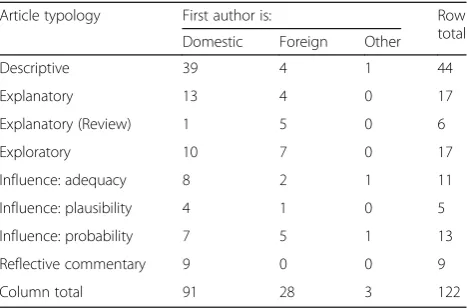
The bulk of the research undertaken on the ASHA programme was descriptive (36%,n= 44/122), although a fairly large proportion aimed to evaluate the influence of particular factors on ASHAs (32%,n= 39/122). Fewer arti-cles were exploratory (14%, n= 17/122) or explanatory (195, n= 23/122), and nine were reflective commentaries
Table 2CHW–health system interface topics discussed in publications on ASHAs(Continued)
Main topic Sub-topics Application to ASHA programme Number of publications
with content on sub-topic
state levels; ASHA political engagement and advocacy, such as through unionisation
Role of NGO actors in CHW policy Role of NGO actors in shaping the ASHA programme, such as NGOs, academics and private sector interest groups
6
Grievance redressal for CHWs The development and functioning of formal government mechanisms through which ASHAs could register grievances
5
Programme financing How much money is budgeted to fund the ASHA programme and how these decisions are made, release of funding, comments on financing issues
5
CHW programme reporting Systematic programme management records that the government system creates about the ASHA programme (such as national or state level reports, annual nodal officer meeting minutes)
2
CHW social profile and agency
CHW demographics ASHA demographic information such as ASHA age, caste, marriage, and literacy statistics, or comments on these issues (e.g. caste dominance among ASHAs)
41
Empowerment and personal growth
Comments or research on ASHA well-being, personal growth, rights-related challenges and opportunities including for leadership, career progression or educational advancement
14
Communication between CHWs
Opportunities and nature of ASHA-to-ASHA communication, such as through meetings, radio shows or newsletters
3
Impact Health outcomes ASHA programme-related changes in community healthcare-seeking, health-related behaviour and knowledge, and wellbeing/illness outcomes (including the health-related outcomes of small-scale special interventions involving ASHAs)
41
Social outcomes ASHA programme-related changes in non-health outcomes such as community-level environmental health and gender relations or programmatic/out-of-pocket costs (including the social-related outcomes of small-scale special interventions involving ASHAs)
6
Health services context
Health system infrastructure and functionality
The quality and availability of drugs, transportation, diagnostics, infrastructure, and health workers in the government health sector, including behaviour of health workers towards patients, and how this context influences the ASHA’s work
24
Private sector The quality and availability of the informal (such as traditional birth attendants) and formal private healthcare sector and how this influences the ASHA’s work, including public–private partnerships within the National Health Mission
17
Linkages to other programmes Intersectoral linkages between the ASHA programme (within the Ministry of Health and Family Welfare) and nutrition/
anganwadiservices through the Integrated Child Development Scheme, water and sanitation
(7%,n= 9/122). There were no articles that were emanci-patory or predictive. See Additional file 6 for a detailed classification of each article.
Among descriptive studies, the great majority, whether quantitative, qualitative or mixed, focused on the know-ledge or performance of ASHAs on specific health con-ditions. Substantial numbers of descriptive surveys were undertaken by ASHAs to screen for health conditions, with the accuracy of such screening verified by other data sources in several studies. Outlier descriptive stud-ies include a post-intervention survey to measure the ef-fect of ASHAs in reducing obstetric delays [37], a mixed methods study that combined system-generated data with key informant interviews to assess health system readiness, including that of ASHAs, for malaria [54], and a formative study for an mHealth intervention in-clusive of ASHAs [121].
Most influence research studies that assessed the ef-fectiveness of ASHAs involved programme research with little consideration of health systems dimensions. Fur-thermore, findings on ASHAs were often subsumed among a range of frontline workers who were assessed. Outlier studies with health systems elements included a mixed methods evaluation on the impact of the Janani Suraksha Yojana programme on ASHA motivation and performance, among other factors [52]. Other studies sought to evaluate the effect of home-based neonatal care incentives on knowledge and practices [138], in-creasing knowledge of safe medical abortion on average monthly client load at health centres [118], and influ-ence of ASHAs on immunisation coverage [145].
Among exploratory studies, two were quantitative in nature. One developed a scale to measure communica-tion and leadership of ASHAs [68] and another devel-oped a framework for mHealth adoption [74]. There was only one mixed methods exploratory study that sought to understand the underlying barriers to using emer-gency contraception among a range of providers, includ-ing ASHAs [146]. The majority of the qualitative exploratory studies sought to understand the underlying mechanisms of the ASHA programme [62,89,140], bar-riers to point-of-care testing, including by ASHAs [111], and the potential for new areas of work for ASHAs, whether cardiovascular health [125], non-communicable diseases [122], or treatment of child pneumonia [36]. Insightful health systems exploratory research in-cluded that exploring task-sharing of ASHAs with male workers [50, 51], coordination among frontline workers [109], and ethnographies by Mishra [56] and Nordfeldt and Roalkvam [40].
Explanatory mixed methods studies also discussed in more depth the underlying factors supporting overall programme performance of ASHAs [44], their role in health systems that fail women seeking obstetric care
[134], mHealth interventions used by ASHAs [70, 85] and diarrhoea management including that of ASHAs [38]. Two studies focused on motivation and emotional labour, one using a Likert scale [53] and the other struc-tural equation modelling [96]. Mixed methods explana-tory studies also sought to understand questions of remuneration and the feminisation of labour [45,102].
Amongst qualitative explanatory studies, case study re-search was used for an in-depth understanding of the ASHA programme [100, 126, 130]. In-depth ethnog-raphies included those on integration and teamwork [57], notions of citizenship [108], incentives [127] and community participation [103].
Various reviews provided insight on the ASHA programme. Some drew from previous CHW experiences in India to flag issues for the current ASHA programme [147], particularly with regards to rights of ASHAs [9]. Others drew from international experience to generate lessons for how best to use CHWs for immunisation in India [148], understand CHW scale-up [149], CHW re-muneration [6] or systems integration [23].
Several reviews reflected health policy and systems is-sues relevant to the ASHA programme, whether related to community processes [143], system readiness for newborn care [150], HIV [79], or CHW scale-up in general [151]. Some reviews were particularly critical of previous govern-ment training efforts and the implications for the ASHA programme [142] and were concerned about the overall nature of the ASHA programme [152–155].
Authorship analysis: who is publishing on the ASHA programme?
Over half (59%, n= 72/122) of the papers were written by authors solely affiliated with domestic (Indian) insti-tutions and over one-quarter (30%, n= 37/122) were produced by partnerships between domestic and foreign institutions. Only 11 (9%) were written by authors solely from foreign institutions. This pattern of strong domes-tic involvement in research either solo or in partnership with foreign organisations was further emphasised with first authorship. Almost three-quarters of the articles’ first authors are affiliated with Indian institutions (74%,n= 90/122), with the remaining first authors affili-ated with foreign (24%, n= 29/122) and global (3%, n= 3/122) organisations. Among articles produced by part-nership between domestic and foreign organisations, first authorship was 50% domestic and 50% foreign.
The location of authorship was associated with the art-icle type. Negative findings represented a minority of the overall studies, but were largely reported by domestic first authors (20%,n= 18/90), as opposed to foreign first authors (7%, n= 2/29). In terms of research design and typology (Table 3), domestic first authors wrote all the
descriptive and explanatory research articles (89%, n= 39/44), while foreign first authors dominated review arti-cles. With regards to influence studies, there was a shift from Indian first authors leading articles for simpler de-signs (adequacy and plausibility), with partnerships with foreign authors being more important for probability de-signs and exploratory studies.
We assessed funding sources for research on the ASHA programme and found that 49 of the 122 articles (40%) did not disclose any information on funding, while for 8 articles the authors stated that they received no funding for their work. Of those that did disclose fund-ing, foundations (such as the Bill and Melinda Gates Foundation) were the largest funders (15%, n= 18/122), bilateral organisations (such as USAID) funded 10 (8%), and the Government of India funded research that was published in 9 (7%) articles.
Discussion Location
As expected, research proliferated in many of the states with the highest burden of maternal and child mortality, including the larger states, such as Bihar, Jharkhand, Madhya Pradesh, Odisha, Rajasthan, Uttar Pradesh and Chhattisgarh, and the smaller north-eastern states of Arunachal Pradesh, Assam and Manipur. Two large high-burden states did not feature in the published
lit-erature – Himachal Pradesh, where the ASHA
programme started later, and Jammu and Kashmir, where security concerns likely hindered research. Many of the smaller states in north-eastern India (Meghalaya, Mizoram, Nagaland, Sikkim and Tripura) also did not feature, potentially due to lower interest from research donor organisations or access barriers. Several southern states with comparatively good maternal and child health indicators were also the sites of a number of stud-ies (particularly Andhra Pradesh, Karnataka and Kerala), often featuring research on frontier areas for ASHAs,
including mental health [110], cardiovascular disease
[85, 125] and other non-communicable disease
screening, prevention and management [122, 123]. While several studies that supported comparative re-search across several states were found, additional work of this nature would support generalisations for the na-tional programme.
Health condition focus
Research on the routine programme tended to focus on maternal and child health, while the special interven-tions showcased a plethora of innovation, often empha-sising special focus areas (HIV, childhood disability developmental delay, death tracking, abortion, contra-ceptives, uterine prolapse) that were beyond the initial purview of the ASHA programme. On the one hand, the proliferation of donor-funded pilot projects without a strong linkage to or consideration of the broader health system suggests a problematic allocation of resources to efforts unlikely to function at scale. In addition, publica-tions that described using ASHAs merely as data collec-tors for other teams raise questions about coherence, permission and respecting ASHA time. On the other hand, some smaller scale studies, such as those focused on home-based newborn care, started as special inter-ventions but were subsequently adopted into the routine programme.
Evaluation outcomes
While smaller scale special interventions were generally able to bring about positive outcomes, research on as-pects of the routine ASHA programme more often showed mixed or negative outcomes. This indicates that, with significant inputs and resources, ASHAs can deliver positive results, but that these focused short-term en-gagements do not reflect the everyday operating reality of the large-scale routine programme. The routine programme grapples with the challenges of operating at scale and of integration with the resource-constrained government health system.
Both positive and negative outcomes associated with ASHAs at scale occurred in the context of the National Health Mission. Research findings from specific states have shown that ASHAs have been selected across most villages [145] according to recruitment norms [112], and have received most or all of their training [44, 54]. The majority have a reasonable grasp of core health concepts [41,46,76,97,104,131,136], are reasonably well known and trusted as a source of health information and refer-ral in their communities [57, 62], and are providing a subset of households with health information and ser-vices [41,44,56,58,60,75,101,140], particularly by en-couraging antenatal care and institutional delivery [52,
55,132] and childhood immunisation [116]. The ASHA Table 3Domestic versus foreign authorship by research
typology
Article typology First author is: Row
total Domestic Foreign Other
Descriptive 39 4 1 44
Explanatory 13 4 0 17
Explanatory (Review) 1 5 0 6
Exploratory 10 7 0 17
Influence: adequacy 8 2 1 11
Influence: plausibility 4 1 0 5
Influence: probability 7 5 1 13
Reflective commentary 9 0 0 9
programme at scale has been associated with im-provements in neonatal health, some aspects of
care-seeking, and increased immunisation and
health-related awareness in certain areas [36, 86, 135,
141, 145, 156].
Negative research results from specific states identified ASHA knowledge gaps [36,104, 105,114, 119,131], in-adequacies in ASHA training or supervision [56, 57, 68,
93,105,109,139,146,156], low community engagement with and awareness of ASHAs [134], challenges related to referrals (limited transportation, coordination and health facility resources) [55,100,111, 136,140], dissat-isfaction among ASHAs with their remuneration or sup-port [9,52,53,89,102,140], lack of supplies [54,60,89,
156], and subpar performance or coverage [41, 60, 65,
66,75,103,112,116,145].
Chhattisgarh’s Mitanin programme emerged as a strong success story, wherein Mitanins performed as socio-political actors on the social determinants of health [126,128,130]. However, in other states, ASHAs have generally been more successful in performing a link-worker role, without significant action on commu-nity mobilisation or the social determinants of health [43,44,98,100,152].
Health systems perspective
The National Health Mission is a health system reform seeking to strengthen government service delivery through all the health system building blocks, including cross-cutting community engagement. However, health condition-focused research on the ASHA programme often took a narrow perspective, without accounting for the broader health system factors in which the programme operates. In comparison, studies on general ASHA work examined the programme in context and considered broader systemic or cross-cutting policy issues.
Health systems content
Many publications presented meaningful information on multiple topics in the CHW–health system framework (Fig. 1), reflecting that researchers frequently considered the ASHA programme within the broader health system context. However, a number of essential health system considerations, which are central to the programme’s vi-sion, were rarely discussed in the published litera-ture. In particular, there was little consideration of programme governance (programme oversight and guid-ance, CHW political support, the role of NGO actors in CHW policy, grievance redressal for CHWs, programme financing, and CHW programme reporting), community voice, community engagement in ASHA selection, and community collaboration with ASHAs through health committees. While many studies measured ASHA per-formance and knowledge, few discussed or used existing
programme or health facility records, leaving the routine systems needed to monitor the programme unexplored. Additionally, while health outcomes associated with the ASHA programme or small-scale interventions engaging ASHAs were frequently assessed, social outcomes were rarely discussed. While the existing research on gender, motivation, ASHA agency, and relationships and link-ages among different actors (auxiliary nurse midwives, Anganwadiworkers, block and district managers) is wel-come, far more research on these topics is required to truly understand the ASHA as an integrated member of the health system.
In the first decade of the programme, research asses-sing ASHA capacity and performance has played a
valu-able role in understanding early challenges and
successes. However, as the ASHA programme enters its next decade, research on other aspects of the CHW– health system framework will be increasingly important to the programme’s capacity to adapt, sustain and achieve its broader goals around empowerment, com-munity engagement and change across the social deter-minants of health. Future research should consider the upcoming challenges of running a mature CHW programme at scale, including recruitment and training for expanded roles in non-communicable diseases, ASHA social security, retention, aging, and ongoing knowledge retention and skills upgrade. Furthermore, echoing global gaps in research on CHW programmes [13], ongoing re-search is required on meeting the rights and needs of ASHAs, effective approaches to training and supervision, on realising the ASHA role as a community change agent, and on the influence of health system decentralisation, so-cial accountability and governance.
Research typology and methodology
The academic literature on the ASHA programme show-cases a rich range of research. It is noteworthy that re-search focusing directly on aspects of the ASHA programme itself tended to be descriptive and explana-tory, while the more complex influence studies, includ-ing the randomised controlled trials, focused on broader health interventions, such as integrated management of childhood illness, with limited findings pertaining to ASHAs, who were just one of many providers.
methods influence studies and realist evaluations, taking these areas of the ASHA programme as their focus, would enable increasingly evidence-informed policy-making, planning and advocacy. Furthermore, there is a need for emancipatory research that engages ASHAs as agents to identify and work towards addressing challenges, and pre-dictive research that helps guide next steps. Ultimately, a complex, evolving and dynamic intervention such as the ASHA programme, which is implemented at scale as part of a larger system reform agenda, cannot be studied through a single research design. Research agendas at state and national levels are likely to be different and the various facets of the programme require different designs.
Authorship and funding
Indian authors and institutions have shown strong re-search leadership and critical engagement with the programme, and have also developed international part-nerships to support complex research studies. The dom-inance of Indian authors, especially in critiques of the programme and research with negative and mixed find-ings, showcases a vibrant civil society space – and is a welcome contrast to other country contexts where crit-ical research may be severely curtailed [157]. While the dominance of Indian-led academic work generates op-portunities to disseminate and build upon the research findings in the same setting [158], there was repetition among descriptive studies and other areas of inquiry were largely neglected. Further engagement is needed between policy needs and research generation to en-sure effective use of research investments.
The high percentage of papers that did not disclose their source of funding is concerning, as it could obscure power dynamics guiding research priority topics, regions and in-stitutions. It is also noteworthy that research commis-sioned and funded by the government was largely absent from the published literature, although we note that this research may be conducted and disseminated internally or published in the grey literature. A mature CHW programme requires government leadership in funding re-search that addresses policy-maker needs, including large scale evaluations. Ensuring that this research is peer reviewed and published in journals will help to inform na-tional and internana-tional conversations on CHWs.
Limitations
This overview of published literature on the ASHA programme has several limitations. We only considered published studies listed in prominent journal databases (PubMed, Scopus and Embase). We did not include the extensive grey literature published on the programme, including important NGO and government reports. While we also gathered and analysed all government documents in the public domain, the findings from that
area of work are reported on elsewhere [11] and are be-yond the scope of this paper.
Authorship, while classified as domestic, foreign and other, hides those of Indian origin based in foreign institu-tions, or who may have subsequently moved back to India. Some included articles significantly involved ASHAs in their studies but had limited findings relevant to the ASHA programme (e.g. studies that used ASHAs as data collectors to assess the prevalence of a health issue, but were not ul-timately assessing or commenting on the ASHA role or capacity). Other studies did not disaggregate ASHAs from other frontline health workers.
We did not assess the methodological quality of the included articles because there was such a wide range of research typologies used. This limits our ability to comment on the strength of research being done and on how trustworthy, robust, and meaningful these academic contributions are. The wide range in complexity, insight, and rigor across the included manuscripts is not ana-lysed in this paper.
Conclusion
Academic work on the ASHA programme highlights a range of special interventions, but also showcases the challenges faced by a programme at massive scale, situ-ated in the broader health system. As the programme continues to evolve, ongoing research and continued do-mestic critical leadership is vital to address key know-ledge gaps and provide insight into ground realities, including on programme governance, intersectoral link-ages, ASHA solidarity, and community capacity to pro-vide support and oversight.
Endnotes 1
Chandigarh, Dadra and Nagar Haveli, Daman and Diu, Lakshadweep, Puducherry, Andaman and Nicobar Islands.
Additional files
Additional file 1: Search terms on the ASHA community health worker programme. (DOCX 18 kb)
Additional file 2:Reference list of all included articles. (DOCX 31 kb)
Additional file 3:Database of included articles and their characteristics. (XLSX 73 kb)
Additional file 4: Summary of research on the main ASHA programme. (DOCX 71 kb)
Additional file 5: Summary of smaller scale interventions that engaged ASHAs. (DOCX 44 kb)
Additional file 6: Research on ASHAs, by typology and methodology. (DOCX 133 kb)
Abbreviations
Acknowledgements Not applicable.
Funding
Asha George is supported by Health Systems Extra-Mural Unit funded by the South African Medical Research Council and the South African Research Chair's Initiative of the Department of Science and Technology and National Research Foundation of South Africa (Grant No 82769). Any opinion, finding and conclu-sion or recommendation expressed in this material is that of the author and the National Research Foundation does not accept any liability in this regard. This research was made possible in part by the generous support of the American people through the United States Agency for International Development (USAID), under the terms of the Cooperative Agreement AID-OAA-A-14-00028. The contents are the responsibility of the authors and do not necessarily reflect the views of USAID or the United States Govern-ment. The National Health Systems Resource Centre, New Delhi, India, pro-vided in kind funding support.
Availability of data and materials
The datasets generated during this study are included in this published article (Additional files2,3,4,5and6).
Authors’contributions
ASG, KS and RRV conceptualised the study. KS conducted the literature searches, article screening and data extraction. KS and ASG analysed the data and drafted the manuscript. RRV provided critical guidance and feedback throughout the process. All authors read and approved the final manuscript.
Ethics approval and consent to participate Not applicable.
Consent for publication Not applicable.
Competing interests
KS and ASG declare that they have no competing interests. RV is executive director of the National Health Systems Resource Centre, which provides technical assistance to the National Health Mission within the Indian Ministry of Health and Family Welfare, including on the ASHA programme.
Publisher’s Note
Springer Nature remains neutral with regard to jurisdictional claims in published maps and institutional affiliations.
Author details 1
Independent consultant, Bangalore, India.2School of Public Health, University of the Western Cape, Robert Sobukwe Road, Bellville, Cape Town 7535, South Africa.3National Health Systems Resource Centre, New Delhi, India.
Received: 10 November 2018 Accepted: 20 February 2019
References
1. World Health Organization. Global Strategy on Human Resources for Health Workforce 2030. Draft for the 69th World Health Assembly. Geneva: WHO; 2016.
2. Tulenko K, Møgedal S, Afzal MM, Frymus D, Oshin A, Pate M, et al. Community health workers for universal health-care coverage: from fragmentation to synergy. Bull World Health Organ. 2013;91(11):847–52. 3. Schneider H, Okello D, Lehmann U. The global pendulum swing towards
community health workers in low- and middle-income countries: a scoping review of trends, geographical distribution and programmatic orientations, 2005 to 2014. Hum Resour Health. 2016;14(1):65.
4. Naimoli JF, Perry HB, Townsend JW, Frymus DE, McCaffery JA. Strategic partnering to improve community health worker programming and performance: features of a community-health system integrated approach. Hum Resour Health. 2015;13(1):46.
5. Schneider H, Lehmann U. From community health workers to community health systems: time to widen the horizon? Health Syst Reform. 2016;2(2):112–8.
6. Singh D, Negin J, Otim M, Orach CG, Cumming R. The effect of payment and incentives on motivation and focus of community health workers: five case studies from low- and middle-income countries. Hum Resour Health. 2015;13:58.https://doi.org/10.1186/ s12960-015-0051-1.
7. Maes KC, Kohrt BA, Closser S. Culture, status and context in community health worker pay: Pitfalls and opportunities for policy research. A commentary on Glenton et al. (2010). Soc Sci Med. 2010;71(8):1375–8. https://doi.org/10.1016/j.socscimed.2010.06.020.
8. Glenton C, Scheel IB, Pradhan S, Lewin S, Hodgins S. The female community health volunteer programme in Nepal: decision makers’perceptions of volunteerism, payment and other incentives. Soc Sci Med. 2010;70(12):1920– 7.https://doi.org/10.1016/j.socscimed.2010.02.034.
9. Bhatia K. Community health worker programs in India: a rights-based review. Perspect Public Health. 2014;134(5):276–82.
10. Kane S, Kok M, Ormel H, Otiso L, Sidat M, Namakhoma I, et al. Limits and opportunities to community health worker empowerment: A multi-country comparative study. Soc Sci Med. 2016;164:27–34.https://doi.org/10.1016/j. socscimed.2016.07.019.
11. Ved R, Scott K, Gupta G, Ummer O, Singh S, Srivastava A, et al. How are gender inequalities facing India’s one million ASHAs being addressed? Policy origins and adaptations for the world’s largest all-female community health worker programme. Hum Resour Health. 2019;17(1):3.
12. Schaaf M, Fox J, Topp S, Warthin C, Freedman LPLP, Robinson RSRS, et al. Community health workers and accountability: reflections from an international“think-in”. Int J Equity Health. 2018;17(66):1–5.
13. Scott K, Beckham S, Gross M, Pariyo G, Rao K, Cometto G, et al. What do we know about community-based health programs? A systematic review of existing reviews on community health workers and their integration with health systems. Hum Resour Health. 2018;16(1):39.
14. World Health Organization, Global Health Workforce Alliance. Global Experience of Community Health Workers for Delivery of Health Related Millennium Development Goals. 2010.http://www.who.int/
workforcealliance/knowledge/publications/alliance/Global_CHW_web.pdf. Accessed 5 Mar 2019.
15. Bosch-Capblanch X, Liaqat S, Garner P. Managerial supervision to improve primary health care in low- and middle-income countries. Cochrane Database Syst Rev. 2011;9:CD006413.https://doi.org/10.1002/14651858. CD006413.pub2.
16. Hill Z, Dumbaugh M, Benton L, Ka K, Strachan DL, Asbroek A, et al. Supervising communtiy health workers n low-income countries- a review of impact and implementation issues. Glob Health Action. 2014;7:1–10. 17. Jaskiewicz W, Tulenko K. Increasing community health worker productivity
and effectiveness: a review of the influence of the work environment. Hum Resour Health. 2012;10(1):38.https://doi.org/10.1186/1478-4491-10-38. 18. Kok MC, Dieleman M, Taegtmeyer M, Broerse JEW, Kane S, Ormel H, et al.
Which intervention design factors influence performance of community health workers in low- and middle-income countries? A systematic review. Health Policy Plan. 2015;30(9):1207–27.
19. Kok MC, Kane S, Tulloch O, Ormel H, Theobald S, Dieleman M, et al. How does context influence performance of community health workers in low-and middle-income countries? Evidence from the literature. Health Res Policy Syst. 2015;13(1):13.
20. McCollum R, Gomez W, Theobald S, Taegtmeyer M. How equitable are community health worker programmes and which programme features influence equity of community health worker services? A systematic review. BMC Public Health. 2016;16:419.
21. Vaughan K, Kok MC, Witter S, Dieleman M. Costs and cost-effectiveness of community health workers: evidence from a literature review. Hum Resour Health. 2015;13(1):71.
22. Pallas SW, Minhas D, Pérez-Escamilla R, Taylor L, Curry L, Bradley EH, et al. Community health workers in low- and middle-income countries: what do we know about scaling up and sustainability? Am J Public Health. 2013; 103(7):74–82.
24. Giugliani C, Harzheim E, Duncan MS, Duncan BB. Effectiveness of community health workers in Brazil: a systematic review. J Ambul Care Manage. 2011;34(4):326–38.
25. Bornstein VJ, Stotz EN. Concepções que integram a formação e o processo de trabalho dos agentes comunitários de saúde: uma revisão da literatura. Cien Saude Colet. 2008;13(1):259–68.
26. Pereira IC, Oliveira MAC. O trabalho do agente comunitário na promoção da saúde : revisão integrativa da literatura. Rev Bras Enferm. 2013;66(3):412–9. 27. Baatiema L, Sumah AM, Tang PN, Ganle JK. Community health workers in
Ghana: the need for greater policy attention. BMJ Glob Heal. 2016;1(4): e000141.
28. Ministry of Health and Family Welfare India. National Rural Health Mission (2005–2012): Mission Document. New Delhi: Government of India; 2005. 29. Gough D, Thomas J, Oliver S. Clarifying differences between review designs
and methods. Syst Rev. 2012;1(1):28.
30. PubMed. PubMed Help. 2019.https://www.ncbi.nlm.nih.gov/books/ NBK3827/#pubmedhelp.FAQs. Accessed 20 Jan 2019.
31. Elsevier. Embase. 2019. https://www.elsevier.com/en-in/solutions/embase-biomedical-research. Accessed 20 Jan 2019.
32. Scopus. What is Scopus?. 2018.https://service.elsevier.com/app/answers/ detail/a_id/15534/supporthub/scopus/#tips. Accessed 20 Jan 2019. 33. Naimoli JF, Frymus DE, Wuliji T, Franco LM, Newsome MH. A community
health worker“logic model”: towards a theory of enhanced performance in low- and middle-income countries. Hum Resour Health. 2014;12(1):56. 34. Community Health Network. Hot Topics, Fresh Insights, and Ways Forward.
Meeting Report. Washington, DC; 2011. https://coregroup.org/wp-content/ uploads/media-backup/Meetings/Spring_Meeting_2011/CORE_Group_ Spring_Meeting_2011_report_6_16_11_2.pdf. Accessed 9 Mar 2019. 35. George AS, Campbell J, Ghaffar A, HPSR HRH Reader Collaborators.
Advancing the science behind human resources for health: highlights from the Health Policy and Systems Research Reader on Human Resources for Health. Health Res Policy Syst. 2018;16(1):80.
36. Awasthi S, Nichter M, Verma T, Srivastava NM, Agarwal M, Singh JV, et al. Revisiting community case management of childhood pneumonia: Perceptions of caregivers and grass root health providers in Uttar Pradesh and Bihar, Northern India. PLoS One. 2015;10(4):1–19.
37. Deshpande S, Bhanot A, Maknikar S. Assessing the influence of a 360-degree marketing communications campaign with 360-360-degree feedback. Soc Mar Q. 2015;21(3):142–51.
38. Kumar S, Roy R, Dutta S. Scaling-up public sector childhood diarrhea management program: Lessons from Indian states of Gujarat, Uttar Pradesh and Bihar. J Glob Health. 2015;5(2):020414.
39. Lamberti LM, Walker CLF, Taneja S, Mazumder S, Black RE. The association between provider practice and knowledge of ORS and zinc supplementation for the treatment of childhood diarrhea in Bihar, Gujarat and Uttar Pradesh, India: a multi-site cross-sectional study. PLoS One. 2015;10(6):1–17.
40. Nordfeldt C, Roalkvam S. Choosing vaccination: negotiating child protection and good citizenship in modern India. Forum Dev Stud. 2010;37(3):327–47. 41. Persai D, Panda R, Mathur MR. Self-reported practices and attitudes of
community health workers (accredited social health activist) in tobacco control - findings from two states in India. Int J Prev Med. 2015;6:48. 42. Rath SSSSS, Nair N, Tripathy PK, Barnett S, Rath SSSSS, Mahapatra R, et al.
Explaining the impact of a women’s group led community mobilisation intervention on maternal and newborn health outcomes: the Ekjut trial process evaluation. BMC Int Health Hum Rights. 2010;10(1):25.
43. Srivastava A, Gope R, Nair N, Rath S, Rath S, Sinha R, et al. Are village health sanitation and nutrition committees fulfilling their roles for decentralised health planning and action? A mixed methods study from rural eastern India. BMC Public Health. 2016;16(1):59.
44. Sundararaman T, Ved R, Gupta G, Samatha M. Determinants of functionality and effectiveness of community health workers: results from evaluation of ASHA program in eight Indian states. BMC Proc. 2012;6(Suppl 5):O30. 45. Swaminathan P. The formal creation of informality, and therefore, gender
injustice: Illustrations from India’s social sector. Indian J Labour Econ. 2015; 58(1):23–42.
46. Thacker N, Choudhury P, Gargano LM, Weiss PS, Pazol K, Vashishtha VM, et al. Attitudes and practices of auxiliary nurse midwives and accredited social health activists in uttar pradesh and bihar regarding polio immunization in india. J Trop Pediatr. 2013;59(4):266–73.
47. Tripathy P, Nair N, Sinha R, Rath S, Gope RK, Rath S, et al. Effect of participatory women’s groups facilitated by accredited social health activists
on birth outcomes in rural eastern India: a cluster-randomised controlled trial. Lancet Glob Heal. 2016;4(2):e119–28. https://doi.org/10.1016/S2214-109X(15)00287-9.
48. Verma C, Rao P. Determinants of rural women’s participation in india’s National Leprosy Eradication Programme. Indian J Lepr. 2014;86:105–10. 49. Das A, Friedman J, Kandpal E, Ramana GNV, Gupta RKD, Pradhan MM, et al.
Strengthening malaria service delivery through supportive supervision and community mobilization in an endemic Indian setting: an evaluation of nested delivery models. Malar J. 2014;13(1):482.
50. Elazan SJ, Higgins-Steele AE, Fotso JC, Rosenthal MH, Rout D. reproductive, maternal, newborn, and child health in the community: task-sharing between male and female health workers in an Indian rural context. Indian J Community Med. 2016;41(1):34–8.
51. Fotso JC, Higgins-Steele A, Mohanty S. Male engagement as a strategy to improve utilization and community-based delivery of maternal, newborn and child health services: evidence from an intervention in Odisha, India. BMC Health Serv Res. 2015;15 Suppl 1(Suppl 1):S5.
52. Gopalan SS, Durairaj V. Addressing maternal healthcare through demand side financial incentives: experience of Janani Suraksha Yojana program in India. BMC Health Serv Res. 2012;12(1):319.
53. Gopalan SS, Mohanty S, Das A. Assessing community health workers’ performance motivation: a mixed-methods approach on India’s accredited social health activists (ASHA) programme. BMJ Open. 2012;2(5):e001557. 54. Hussain MA, Dandona L, Schellenberg D. Public health system readiness to
treat malaria in Odisha State of India. Malar J. 2013;12(1):351.
55. Malini S, Tripathi RM, Khattar P, Nair KS, Tekhre YL, Dhar N, et al. A Rapid Appraisal on Functioning of Janani Suraksha Yojana in South Orrisa.http:// www.nihfw.org/pdf/RAHI-I%20Reports/Berhampur/Berhampur.pdf. Accessed 5 Mar 2019.
56. Mishra A. The role of the Accredited Social Health Activists in effective health care delivery: evidence from a study in South Orissa. BMC Proc. 2012; 6(Suppl 1):P1.
57. Mishra A.‘Trust and teamwork matter’: community health workers’ experiences in integrated service delivery in India. Glob Public Health. 2014; 9(8):960–74.https://doi.org/10.1080/17441692.2014.934877.
58. Mishra A, Kar K, Satapathy D. Mass drug administration against filariasis - a study on coverage and compliance, in a coastal district of Odisha. J Commun Dis. 2015;47(4):13–8.
59. Panigrahi S, Mohapatra B, Mishra K. Awareness, perception and practice of stakeholders in India regarding Village Health and Nutrition Day. J Fam Med Prim Care. 2015;4(2):244.
60. Sahu SS, Rao SP, Dash S. Performance of Accredited Social Health Activists (ASHAs) in diagnosis and treatment of Malaria in Eight Falciparum Endemic Tribal Districts of Southern Odisha, India. J Commun Dis. 2016;48(2):12–9. 61. Valadez JJ, Devkota B, Pradhan MM, Meherda P, Sonal GS, Dhariwal A, et al.
Improving malaria treatment and prevention in India by aiding district managers to manage their programmes with local information: a trial assessing the impact of Lot Quality Assurance Sampling on programme outcomes. Tropical Med Int Health. 2014;19(10):1226–36.
62. Swain S, Swain P, Nair KS, Dhar N, Gupta S, Nandan D. A rapid appraisal of functioning of ASHA under NRHM in Orissa. Health Popul Perspect Issues. 2008;31(2):73–9.
63. Das E, Panwar DS, Fischer EA, Bora G, Carlough MC. Performance of accredited social health activists to provide home-based newborn care: a situational analysis. Indian Pediatr. 2014;51(2):142–4.
64. DeRenzi B, Wacksman J, Dell N, Lee S, Lesh N, Borriello G, et al. Closing the feedback loop: a 12-month evaluation of ASTA, a self-tracking application for ASHAs. ICTD’16 Proceedings of the Eighth International Conference on Information and Communication Technologies and Development; 2016. Article 22. http://doi.acm.org/10.1145/2909609.2909652.
65. Kansal S, Kumar S, Kumar A. Is educational level of ASHA matters for their effective functioning? A cross- sectional study in eastern Uttar Pradesh. Indian J Community Heal. 2012;24(1):41–4.
66. Kumar S, Kaushik A, Kansal S. Factors influencing the work performance of ASHA under NRHM a cross sectional study from eastern Uttar Pradesh. Indian J Commun Health. 2012;24:325–31.
67. Sebastian MP, Khan ME, Kumari K, Idnani R. Increasing postpartum contraception in rural India: Evaluation of a community-based behavior change communication intervention. Int Perspect Sex Reprod Health. 2012;38(2):68–77.