R E S E A R C H
Open Access
Patchy
‘
coherence
’
: using normalization process
theory to evaluate a multi-faceted shared decision
making implementation program (MAGIC)
Amy Lloyd
1, Natalie Joseph-Williams
1, Adrian Edwards
1, Andrew Rix
3and Glyn Elwyn
1,2*Abstract
Background:Implementing shared decision making into routine practice is proving difficult, despite considerable interest from policy-makers, and is far more complex than merely making decision support interventions available to patients. Few have reported successful implementation beyond research studies. MAking Good Decisions In Collaboration (MAGIC) is a multi-faceted implementation program, commissioned by The Health Foundation (UK), to examine how best to put shared decision making into routine practice. In this paper, we investigate healthcare
professionals’perspectives on implementing shared decision making during the MAGIC program, to examine the
work required to implement shared decision making and to inform future efforts.
Methods:The MAGIC program approached implementation of shared decision making by initiating a range of interventions including: providing workshops; facilitating development of brief decision support tools (Option Grids); initiating a patient activation campaign (‘Ask 3 Questions’); gathering feedback using Decision Quality Measures; providing clinical leads meetings, learning events, and feedback sessions; and obtaining executive board level support. At 9 and 15 months (May and November 2011), two rounds of semi-structured interviews were conducted with healthcare professionals in three secondary care teams to explore views on the impact of these interventions. Interview data were coded by two reviewers using a framework derived from the Normalization Process Theory.
Results:A total of 54 interviews were completed with 31 healthcare professionals. Partial implementation of shared decision making could be explained using the four components of the Normalization Process Theory:‘coherence,’ ‘cognitive participation,’ ‘collective action,’and‘reflexive monitoring.’Shared decision making was integrated into routine practice when clinical teams shared coherent views of role and purpose (‘coherence’). Shared decision making was facilitated when teams engaged in developing and delivering interventions (‘cognitive participation’), and when those interventions fit with existing skill sets and organizational priorities (‘collective action’) resulting in demonstrable improvements to practice (‘reflexive monitoring’). The implementation process uncovered diverse and conflicting attitudes toward shared decision making;‘coherence’was often missing.
Conclusions:The study showed that implementation of shared decision making is more complex than the delivery of patient decision support interventions to patients, a portrayal that often goes unquestioned. Normalizing shared decision making requires intensive work to ensure teams have a shared understanding of the purpose of involving patients in decisions, and undergo the attitudinal shifts that many health professionals feel are required when comprehension goes beyond initial interpretations. Divergent views on the value of engaging patients in decisions remain a significant barrier to implementation.
Keywords:Shared decision making, Implementation, Patient-centered care, Normalization Process Theory
* Correspondence:[email protected]
1
Institute of Primary Care and Public Health, Cardiff University School of Medicine, Heath Park, Cardiff, CF, 14 4YS, UK
2
The Dartmouth Center for Health Care Delivery Science, HB 7256, 37 Dewey Field Road, 2nd Floor, Hanover, NH 03755, USA
Full list of author information is available at the end of the article
Background
Implementing shared decision making (SDM) in routine practice is difficult [1], despite considerable interest from policy-makers. In SDM, clinicians and patients are expected to make decisions together, using the best available evi-dence. Patients are encouraged to think about the avail-able screening, treatment, or management options, and the likely benefits and harms of each so that they can communicate their preferences and collaborate to select the best course of action [2]. Most attempts by researchers to implement SDM have been based on a narrow inter-pretation that SDM [3] is the delivery of decision support tools to patients in hopes of accomplishing greater levels of patient-provider collaboration. Over 80 randomized controlled trials, mostly conducted since the early 1990s onwards, have demonstrated that decision support tools lead to patients having greater knowledge, more accurate risk perceptions, and greater comfort with decisions, while also reducing the number of patients remaining undecided or choosing major surgery [4]. Yet, debate remains as to whether greater levels of collaboration are generated within clinical encounters. In addition, there are very few demonstrations of successful implementation of decision support tools outside of a research setting [5,6]. This‘tool delivery’ interpretation of SDM is being challenged [3], and is viewed as too myopic.
Several key authors have provided insight into the bar-riers of using decision support tools [7-9]. However, there have been no reports of broader approaches to implemen-tation. A systematic review of implementation attempts revealed conceptualizations that define SDM as the rou-tine use of decision support tools [6], work confirmed at a recent conference [1]. We were commissioned by The Health Foundation (UK) to undertake a broader approach, which included efforts to explain the tenets of SDM to clinical teams, engage them in the co-development of tools, and enhance their skills at involving patients in SDM. This paper describes a qualitative study of health professionals’ experiences as we worked with them to attempt to embed SDM into routine care. We chose the Normalization Pro-cess Theory (NPT) as our lens, having previously used this approach to explore implementation challenges [10]. NPT is an explanatory model that helps to review and evaluate implementation processes. Our aim in this article is to use NPT to examine the work that needs to be done by health professionals to inform future efforts to implement and embed SDM.
Methods
The MAGIC program
This study was part of Phase I of the MAking Good Deci-sions In Collaboration (MAGIC) implementation program, commissioned by The Health Foundation, which involved joint work between Cardiff University School of Medicine,
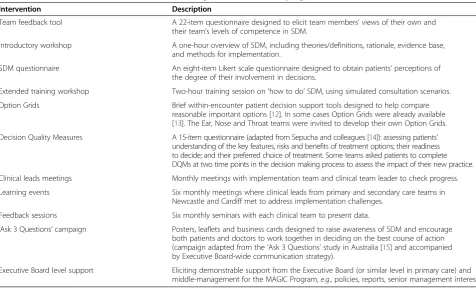
Cardiff and Vale University Health Board, Newcastle Uni-versity, and Newcastle-upon-Tyne Hospitals NHS Founda-tion Trust. We worked with a variety of clinical teams across sites and settings to develop and test interventions designed to promote SDM (see Table 1). The implementa-tion approach drew on a well-known‘model for improve-ment’[11]. In this model, core teams are asked to agree on clear aims and measures using iterative Plan-Do-Study-Act (PDSA) cycles. This study reports on healthcare profes-sionals’experiences of the interventions in three secondary care specialties: head and neck cancer, breast cancer, and pediatric tonsillectomy.
Participants and data collection
Semi-structured interviews were conducted with health-care professionals from the three secondary health-care teams. All participants had direct contact with patients. The MAGIC program was considered by the Cardiff and Vale University Health Board Research Governance Committee to be an implementation program, and the data collected to be part of the evaluation of service development. As such, the program was not considered to require formal ethical approval.
Two rounds of interviews were conducted after 9 and 15 months of the 18-month program. After consenting, participants were interviewed by an experienced qualita-tive researcher (AL). All interviews were audio-recorded and transcribed. During the first round of interviews, par-ticipants were asked to describe their involvement with the program, and to share their opinion about the most significant change that had occurred during the first nine months. They were asked why they felt the change was significant, and how, if at all, the program had contributed. During the second round of interviews, participants were asked about the most significant developments since the beginning of the program; they were asked to share their views about SDM and to describe the extent to which they were adopting the approach, and if not, why not. They were also asked whether any systems had been set up to support or sustain SDM, and which of the program inter-ventions had contributed the most to any change. The interview schedule drew on the most significant change (MSC) technique, an approach that has been used to monitor and evaluate complex participatory implementa-tion programs [16].
Data analysis: using a framework approach
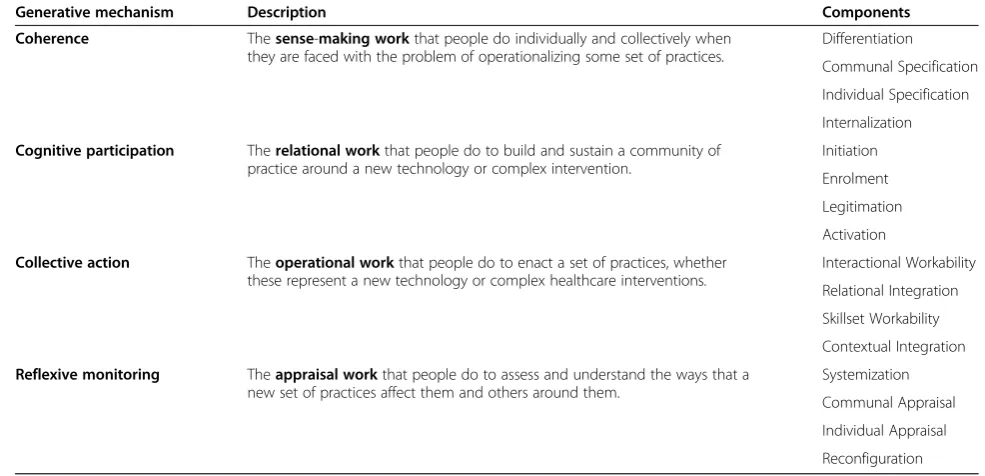
in many similar studies to date [19-21]. NPT proposes that‘complex interventions become routinely embedded (implemented and integrated) in their organizational and professional contexts as the result of people working, indi-vidually and collectively, to implement them’[22]. Accord-ing to the theory, the work of implementAccord-ing a complex intervention is operationalized by four generative mecha-nisms (see Table 2) and requires collective and continu-ous investment in sense-making, commitment, effort and appraisal. Once a complex intervention is routinely em-bedded in practice, it becomes ‘normalized.’ This theory provided a good match with our wish to examine the im-plementation efforts and to go beyond a barriers and facil-itators approach.
Descriptive codes were generated and organized through thematic analysis under a framework based on the compo-nents of the four NPT constructs. Themes were identified using this framework and compared across the data. For example, under the construct‘coherence,’we coded data in relation to the components‘differentiation’(Is SDM dif-ferent from what they already do?),‘communal specifica-tion’(Does the team agree on the purpose and value of SDM?),‘individual specification’(Does each team mem-ber understand how it affects their day-to-day roles and responsibilities?), and ‘internalization’ (Do those tasks and responsibilities make sense?).
We also examined the data for deviance to avoid over-looking issues that did not map onto the NPT framework.
Inter-coder agreement was sought for all coding and the generation of categories and themes. To mitigate potential bias, both researchers (AL, AR, NJW, GE), and the leads from each of the clinical teams reviewed the transcripts.
Results and discussion
A total of 35 front-line healthcare professionals were vited to participate in this study. Eligible participants in-cluded consultants (n = 15), nurses (n = 11), registrars (residents) (n = 3), allied health professionals (n = 3), and a consultant nurse (n = 1). In total, 54 interviews were conducted, over two rounds, with 31 front-line healthcare professionals (89% of healthcare professionals were inter-viewed at least once). Interviews were conducted with a range of team members, including 13 consultants (42%), 11 nurses (36%), 3 allied health professionals (10%), 3 reg-istrars (residents) (10%), and 1 consultant nurse (2%). A total of 23 healthcare professionals were interviewed twice. In total, 8 healthcare professionals were interviewed once: 1 was unavailable at 9 months, and by 15 months, 3 had left the teams and 4 were unavailable for interview. Inter-view duration was between 15 to 60 minutes. All inter-views were included for analysis.
The interview data highlighted the extent of cognitive and behavioral work that clinicians, managers, and policy-makers need to do, individually and collectively, to nor-malize SDM. No themes were identified that could not be coded using the NPT framework, and agreement was
Table 1 Interventions and influences utilized during Phase 1 of MAGIC program
Intervention Description
Team feedback tool A 22-item questionnaire designed to elicit team members’views of their own and their team’s levels of competence in SDM.
Introductory workshop A one-hour overview of SDM, including theories/definitions, rationale, evidence base, and methods for implementation.
SDM questionnaire An eight-item Likert scale questionnaire designed to obtain patients’perceptions of the degree of their involvement in decisions.
Extended training workshop Two-hour training session on‘how to do’SDM, using simulated consultation scenarios.
Option Grids Brief within-encounter patient decision support tools designed to help compare reasonable important options [12]. In some cases Option Grids were already available [13]. The Ear, Nose and Throat teams were invited to develop their own Option Grids.
Decision Quality Measures A 15-item questionnaire (adapted from Sepucha and colleagues [14]): assessing patients’ understanding of the key features, risks and benefits of treatment options; their readiness to decide; and their preferred choice of treatment. Some teams asked patients to complete DQMs at two time points in the decision making process to assess the impact of their new practice.
Clinical leads meetings Monthly meetings with implementation team and clinical team leader to check progress.
Learning events Six monthly meetings where clinical leads from primary and secondary care teams in Newcastle and Cardiff met to address implementation challenges.
Feedback sessions Six monthly seminars with each clinical team to present data.
‘Ask 3 Questions’campaign Posters, leaflets and business cards designed to raise awareness of SDM and encourage both patients and doctors to work together in deciding on the best course of action (campaign adapted from the‘Ask 3 Questions’study in Australia [15] and accompanied by Executive Board-wide communication strategy).
reached on all coding. Here, we identify and describe four key themes, shaped by the NPT framework (see Table 3).
Uncovering divergent views: the challenge of building coherence
The first construct of NPT is ‘coherence’; the sense-making work required for successful implementation. The key question to ask is,‘what is the work?’ ‘Coherence’was one of the key themes to emerge from the data, highlight-ing the importance of a clinical team sharhighlight-ing the same un-derstanding about the principles of SDM, how SDM differed from their existing approach, and whether they wanted to adopt SDM in their work routines. It was clear from the interviews at nine months that the teams were usually far from agreement on most of these issues.
Members of the same team often offered conflicting views on their approach to decision making with patients. Some proposed that the team had‘always involved patients in decision making’(Allied Health Professional, Head and Neck Cancer); others stated that this approach was neither beneficial nor appropriate. One consultant suggested that the role of the clinical team was to protect patients from the ‘agony’ of choice: ‘I think the function of the MDT
[multidisciplinary team] should definitely be to quite clearly help people to make what we think is the best decision’ (Consultant, Head and Neck Cancer).
Healthcare professionals became more aware of the lack of a coherent approach to SDM during the course of the program. During the first few months, variable under-standing of the aims, objectives and expected benefits of SDM among team members was mostly unnoticed, or at least, was not of any importance. Data collected during the second round of interviews showed that MAGIC had differentiated SDM from current practice, and as a result had increased awareness that different, often strong, views prevailed:‘What [involvement in the program] has caused lots of people to do is actually think about the process of imparting information from themselves to a patient when that patient has a choice to make…And it’s been a surprise for me how I’d always believed that we all roughly thought the same way because we’re all roughly taught the same way, but in fact we have polarized views about how that should happen’ (Consultant, Head and Neck Cancer). Some healthcare professionals rejected the principles of SDM. Others reported a change in their view of SDM as
‘something they already did,’to ‘something that they could
Table 2 Four generative mechanisms of Normalization Process Theory
Generative mechanism Description Components
Coherence Thesense-making workthat people do individually and collectively when they are faced with the problem of operationalizing some set of practices.
Differentiation
Communal Specification
Individual Specification
Internalization
Cognitive participation Therelational workthat people do to build and sustain a community of practice around a new technology or complex intervention.
Initiation
Enrolment
Legitimation
Activation
Collective action Theoperational workthat people do to enact a set of practices, whether these represent a new technology or complex healthcare interventions.
Interactional Workability
Relational Integration
Skillset Workability
Contextual Integration
Reflexive monitoring Theappraisal workthat people do to assess and understand the ways that a new set of practices affect them and others around them.
Systemization
Communal Appraisal
Individual Appraisal
Reconfiguration
Table 3 Themes: the work of implementation
Descriptive themes Normalization process theory generative mechanisms
Uncovering divergent views: the challenge of building coherence Coherence
Facilitating participation, transferring ownership of the work Cognitive participation
Assessing fit and adapting to change together Collective action
do better:’ ‘Initially when we started, like many of us, I thought ‘we do that anyway’. I think the biggest difference is, well actually, we didn’t do it well’(Nurse, Breast Cancer). Clinicians said that the most useful interventions were the short and extended training workshops; the experience of developing and implementing tangible tools, such as brief decision support tools (Option Grids); and feedback from short patient-reported questionnaires (Decision Qual-ity Measures).
In short, the workshops differentiated SDM from the seemingly obvious (and accepted) concept of ‘involving patients.’ The‘coherence’was sometimes enhanced when practical tools such as Option Grids and Decision Quality Measures (DQMs) were introduced: ‘What’s different is that we’re making it more concrete now, rather than an ideal…it’s a practical thing now…we can actually put it into practice rather than just say it’s a good idea. We can encourage and show people how they can do it better and we can measure that we are doing it’(Clinical Nurse Spe-cialist, Breast Cancer).
However, the new awareness had a price. Some team members did not agree that treatment options should be made explicit or that patients should be asked to consider relevant trade-offs. Identifying these differing views usually led to disagreements where previously colleagues had as-sumed shared values. While we identified and worked with healthcare professionals who advocated for SDM, we do not think that‘coherence’about SDM at the level of each team was accomplished during the course of the program. This lack of coherence was an obstacle to implementation, or as the theory would propose, normalization.
Facilitating participation, transferring ownership of the work The second construct of NPT is called‘cognitive partici-pation.’ This term describes the work done by individ-uals in teams as they develop roles and take on tasks in accomplishing new ways of doing things. The key ques-tion to ask is,‘Who does the work?’
The data we collected identified participation in the new set of practices as integral to successful implementation. Participants described the new SDM work as requiring leaders to define the work, and then enrolling others to contribute collectively to the process. Identifying leadership support for SDM was challenging: clinical teams are not simple hierarchical units, and substantial autonomy exists, especially for experienced clinicians. As we described above, many team members had conflicting views about the goal and value of SDM. Individuals who advocated for SDM, motivated by the prospect of improving practice, faced re-sistance. One clinical lead described her efforts as‘banging [her] head against a brick wall’ (Clinical Nurse Specialist, Head and Neck).
Mediating conflicting views among team members de-layed the development of interventions. Coupled with
decreased support from some team members, the loss of momentum had significant impact. A consultant, reflecting on a perceived lack of progress at the second round of in-terviews explained that a key reason was‘lack of time and leadership…there’s no one driving the project…it needs someone on the inside, it needs a clinician to drive it, and no one has taken that on’(Consultant, Head and Neck).
The interview data demonstrated that the most effec-tive way of enrolling team members was to engage them in the process of developing SDM interventions. The clinical leads, when engaged in the work, involved other team members in the development of Option Grids and DQMs. This involvement helped them reflect on their existing practice:‘…thinking through the questions…helped us think about what we discuss at our home visits and how we do that?’ (Nurse, Breast Cancer). Others felt that the MAGIC team’s approach of working collaboratively with the clinical teams helped to legitimize the interventions, which in turn increased likelihood of implementation. As one consultant noted, being‘open to ideas and wanting us to give our feedback’led to the development of tools‘that can be used on a practical level’ (Consultant, Breast Can-cer). In contrast, delivering interventions without involving the clinical teams in their development was counter-productive; these were more likely to be described as ‘a complete waste of time’(Nurse, Breast Cancer).
Working collaboratively with clinical teams helped the clinical leads to define and initiate new practices. DQMs and Option Grids were, in due course, routinely used by nurses in the breast cancer clinic and in the clinic where referrals for tonsillectomy were assessed. It was not pos-sible to introduce these tools into the multidisciplinary team for head and neck cancer. Team members had di-vergent views on the role and purpose of SDM. We ob-served that ‘cognitive participation’ in the development of tools and measures as well as the iterative process of trying them out, and resolving problems, were fundamen-tal to accomplishing ownership and engagement. These steps were possible but required regular external engage-ment, facilitation and encouragement over many months.
Assessing fit and adapting to change together
The NPT construct ‘collective action’ can be examined by focusing on how new interventions are implemented into practice, in short,‘how does the work get done?’The interview data revealed that the teams were most able to grasp SDM when given tangible interventions that could be integrated into routine practice. NPT uses the terms
relationship between the interventions and established policies and procedures.
Many healthcare professionals referred (effectively) to the ‘interactional workability’ of Option Grids. Option Grids were described as tools that facilitated interaction with patients, as providing ‘structure’ for clinical en-counters (Registrar, Head and Neck), as supporting and
‘standardizing’ the provision of information across team members (Nurse, Head and Neck Cancer), and as helping patients‘visualize’the difference between treatment op-tions: ‘Patients can now see for themselves the actual differences in the choices they have, on a piece of paper. Previously they had to imagine it. Now they can actually see it on a piece of paper, I think that visualization of a concept makes things easier for them to understand’ (Consultant, Breast Cancer). Nevertheless, the utility of Option Grids was not necessarily obvious; the added value had to be experienced:‘I thought [using the Op-tion Grid] is going to take a lot longer in the clinic. It doesn’t. You are actually doing it at the same time as you are talking, and I don’t think it takes any longer at all. The parents ask you a few more questions, but that’s what they should be doing anyhow. It’s not “them and us” anymore, we’re making a decision between us. It feels like that now.’(Nurse, Paediatric Tonsillectomy).
As leaders in the teams initiated, and then valued new practices, they became advocates, and then enrolled others, thus demonstrating‘relational integration.’In order to im-plement the interventions, each team member needed to understand their roles and responsibilities in relation to this work. The data revealed a process of trial and error among team members as they sought to ‘work out where to put [the Option Grid]’ (Nurse, Paediatric Tonsillectomy), and to allocate the right tasks, printing, data administration and so on, to the right people. Teams that successfully imple-mented Option Grids and DQMs were those which devel-oped processes, which were usually led by nurses, to ensure routine use:‘We’ve now got a pack. That makes a big differ-ence, because before we were scrabbling around…but now we’ve got packs with everything in it, the DQM question-naire, the Option Grid, it’s all there’(Nurse, Breast Cancer). One individual put the packs together, others ensured packs were available in consulting rooms. Participants described collective action to define roles in the process. In NPT terms, this is‘skillset workability.’
Team members wanted to know whether SDM was aligned with existing organizational policies. In NPT terms, they were asking for evidence of ‘contextual integration.’ As one consultant commented,‘If you haven’t got Board buy-in, if you haven’t got support from that level of man-agement, then everything is an uphill struggle’(Consultant, Head and Neck). Healthcare professionals reported that visits by senior managers of the Health Board demon-strated organizational support for the program.
Monitoring benefit, reflecting on value
The data showed that an important element of the pro-gram was the effort to measure change. In NPT terms, this equates to ‘reflexive monitoring,’where the teams wanted to know how new practices affected them and their pa-tients. Providers described the importance of agreeing on how to collect information as well as wanting to view the data to understand differences and trends. We noted how motivated the teams were to receive information about the effectiveness of their new practices, which they then used to reconfigure processes further.
During the program, PDSA cycles were used and pa-tients were asked to complete DQMs (see Table 1). In-formation from PDSA cycle reports and DQMs were appraised in small group meetings or during team feed-back events, held on a six-month basis, and contributed to the implementation process. As one consultant stated,
‘The feedback has really helped us as a team to see [where] we were doing well…and also see where a lot more input was needed’(Consultant, Breast Cancer). Providers felt the feedback sessions increased awareness of how ‘change [was] achieved in practice’ (Consultant, Breast Cancer). This monitoring brought teams together around a com-mon goal of improving practice, yet there were different motivations for the use of the data. Senior clinicians wanted the data for external use, such as to defend rela-tively high mastectomy rates: ‘When questions about the number of mastectomies versus the number of wide local excision are asked, we can show that our patients have made a quality decision as opposed to following some-body’s preferences or just being told what to do’ (Nurse, Breast Cancer). Nevertheless, there was initial skepticism about the data collection proposal; ‘I think at first we thought: is this going to be a paper exercise?’ (Nurse, Breast Cancer). However, after using DQMs, the breast care nurses came to value both the aggregate data as well as immediate data from individual patients:‘Ah right, she still hasn’t understood that point…I’ll just make sure they understand exactly what’s going to happen.’As the nurses realized the real time value of these data, they took on re-sponsibility for collecting DQMs regularly.
In NPT terms, the effort to measure and discuss the results is evidence of ‘reflexive monitoring.’Data collec-tion was far more likely when those responsible for data collection perceived the process to be relevant and benefi-cial. Teams that routinely monitored new SDM practices could demonstrate impact, which increased motivation for sustained implementation.
Conclusions
Principal findings
been conceptualized so far [1]. We found that healthcare providers had divergent attitudes toward the concept of sharing decisions with patients, and that this was accen-tuated by efforts made to implement SDM. Normalizing shared decision making requires intensive work to ensure that teams have a shared understanding of the purpose of involving patients in decisions, and undergo the attitudi-nal shifts that many health professioattitudi-nals feel are required when comprehension goes beyond initial interpretations. Divergent views on the value of engaging patients in deci-sions remain a significant barrier to implementation.
At the outset, many health professionals reported that they were‘already doing SDM’and demonstrated limited motivation to change practice. Providing SDM workshops and working collaboratively to develop decision support tools helped individuals to understand that SDM goes well beyond a general involvement of patients, and requires de-liberate efforts to inform patients about reasonable treat-ment options and ascertain preferences. However, increased understanding does not necessarily lead to wide agreement about the desirability of SDM. This core issue refers to‘ co-herence,’a term used by NPT to describe the sense-making work that people do individually and collectively when they are faced with the problem of operationalizing a set of practices. Achieving ‘coherence’ within each of all three specialties proved too difficult. We observed par-tial implementation, led mainly by nursing colleagues, who were sympathetic to the idea that patients should be offered information and the opportunity to partici-pate meaningfully in making key decisions. While other elements of the NPT were observed– ‘cognitive participa-tion,’ ‘collective action,’ and ‘reflexive monitoring’ ‘ coher-ence’ appeared to be the prerequisite toward successful normalization of SDM.
Strengths and weaknesses of the study
The strength of this study is the longitudinal nature of the design and the nature of the interview data captured at two critical time points. Interviews were conducted by the program facilitator (AL), who worked with the teams to support their engagement. The interviewer had an in-depth knowledge of the efforts she and others had made to introduce the interventions to the teams (see Table 1), and had good working relationships with all the teams’ members. The interviews were candid; the providers did not feel obligation to the program to report success, as is evident from the transcripts. Two individuals (AR and AL) independently coded the transcripts, and our inter-pretation of the transcripts was also discussed with members of the clinical teams for respondent validation.
We were able to talk to most team members but not all, and it is likely that providers not interviewed would have been even more critical, given their unwillingness to contribute. We acknowledge that this is a small sample,
and that our data may not be generalizable to other clin-ical teams. We are unsure whether specific attributes of the clinical specialties influenced the applicability of SDM, although we note that the issues identified in this study are consistent with those found in other similar studies (see below).
We are also unsure whether the specific attributes of the patients influenced their capacity to engage in SDM, as previous studies have suggested [23]. The Research Governance Committee decision that the study did not constitute primary research enabled us to try a number of different interventions. However, we were unable to collect data from patients and therefore lack their per-spective in this study.
Comparison to existing literature
The findings from this study deepen our understanding of implementation challenges already published. Frequently cited issues about health professionals’lack of understand-ing about how to operationalize SDM [6,9,24-26] com-bined with evidence that some health professionals view patient involvement in decision making as inappropriate [8,27] and that poor teamwork hinders implementation [26,28], emphasize the need for‘coherence.’Health profes-sionals’ lack of trust in the content of decision support tools [6,8,25,29,30] may be related to low participation in the development and use of such tools. Health profes-sionals frequently report competing demands and time pressures as reasons for failing to incorporate SDM inter-ventions into routine practice [6,9,25-27,29-33], yet this study reveals a deeper issue; even if there were time, at least some providers have and maintain significant am-bivalence about the proposal that decisions should be
‘shared.’Conceptualizing SDM as the provision of ‘ infor-mation’ to patients puts the central idea of empowering patients at risk. Health professionals willingly accept that patients should be informed: it is much more challenging for them to accept that patient preferences should play a part in how decisions are made [34].
Implications
Provider ambivalence about SDM, among some team members, impairs ‘coherence’ – an agreed view about
Competing interests
The authors declare that they have no competing interests.
Authors’contributions
AL participated in the conception and design of the study, collected and analyzed the data, and drafted the manuscript. NJW participated in the conception and design of the study, managed the coordination and delivery of the MAGIC program in Cardiff, and helped to critically revise the manuscript. AR participated in the conception and design of the study and helped with analysis and interpretation of the data. AE participated in the conception and design of the study and helped to critically revise the manuscript. GE conceived the study, participated in its design and coordination, and helped to draft and revise the manuscript. All authors read and approved the final manuscript.
Acknowledgements
We wish to acknowledge the assistance and collaboration of Cardiff and Vale Breast Care and ENT teams. This work was undertaken as part of The Health Foundation’s MAking Good Decisions In Collaboration (MAGIC) program: Cardiff Group: Glyn Elwyn (PI), Natalie Joseph-Williams, Andrew Rix, Amy Lloyd, Emma Cording, Mike Spencer, Helen McGarrigle, Annette Beasley, Val Willmott, Adrian Edwards, Jan Davies, Alun Tomkinson, Keith Cass and Laura Roach. Newcastle Group: Richard Thomson (PI), Carole Dodd, Lynne Stobbart, Dave Tomson, Diane Palmer, Sheila Macphail, Steve Robson, Claire Leader, Chris Watson, Rob Pickard, Jill Ferguson, Chris Hall, Matt Shaw, Stewart Nicholson, Sandra Scott, Hume Hargreave, Julie Marshall and Jo Lally. Funding was provided by The Health Foundation, an independent charity working to continuously improve the quality of healthcare in the UK.
Author details
1Institute of Primary Care and Public Health, Cardiff University School of
Medicine, Heath Park, Cardiff, CF, 14 4YS, UK.2The Dartmouth Center for Health Care Delivery Science, HB 7256, 37 Dewey Field Road, 2nd Floor, Hanover, NH 03755, USA.3Independent advisor to the MAGIC program Institute of Primary Care and Public Health, Cardiff University School of Medicine, Health Park, Cardiff, CF, 14 4YS, UK.
Received: 16 April 2013 Accepted: 27 August 2013 Published: 5 September 2013
References
1. Elwyn G, Grande S, Godfrey M, Hoffer Gittell J, Collins V (Eds):Are We There Yet? Case Studies of Implementing Patient Decision Support.Hanover, New Hampshire: The Dartmouth Center for Health Care Delivery Science and The Dartmouth Institute for Healthcare Policy and Clinical Practice; 2013. 2. Elwyn G, Coulter A, Laitner S, Walker E, Watson P, Thomson R:Implementing
shared decision making in the NHS.Brit Med J2010,341:c5146. 3. Entwistle VA, Cribb A, Watt IS:Shared decision-making: enhancing the
clinical relevance.J Roy Soc Med2012,105:416–421.
4. Stacey D, Bennett C, Barry M, Col N, Eden K, Holmes-Rovner M, Llewellyn-Thomas H, Lyddiatt A, Légaré F, Thomson R:Decision aids for people facing health treatment or screening decisions.Cochrane Db Syst Rev 2011:CD001431.
5. Légaré F, Witteman HO:Shared decision making: examining key elements and barriers to adoption into routine clinical practice.Health Affair2013, 32:276–284.
6. Elwyn G, Scholl I, Tietbohl C, Mann M, Edwards A, Clay K, Légaré F, van der Weijden T, Lewis C, Wexler R, Frosch D:“Many miles to go…”A systematic review of the implementation of patient decision support interventions into routine clinical practice.BMC Med Inform Decis2013. In Press. 7. Légaré F, Ratté S, Gravel K, Graham ID:Barriers and facilitators to
implementing shared decision-making in clinical practice: update of a systematic review of health professionals’perceptions.Patient Educ Couns 2008,73:526–535.
8. Caldon L, Collins K, Reed M, Sivell S, Austoker J, Clements A, Patnick J, Elwyn G, BresDex Group:Clinicians’concerns about decision support interventions for patients facing breast cancer surgery options: understanding the challenge of implementing shared decision-making.Health Expect2010, 14:133–146.
9. Lin GA, Halley M, Rendle KAS, Tietbohl C, May SG, Trujillo L, Frosch DL:An effort to spread decision aids in five california primary care practices yielded low distribution, highlighting hurdles.Health Affair2013,32:311–320. 10. Elwyn G, Légaré F, van der Weijden T, Edwards A, May C:Arduous
implementation: does the Normalisation Process Model explain why it’s so difficult to embed decision support technologies for patients in routine clinical practice.Implement Sci2008,3:57.
11. Langley GJ, Moen RD, Nolan KM, Nolan TW, Norman CL, Provost LP:The Improvement Guide: A Practical Approach to Enhancing Organization Performance.2nd edition. San Francisco, California: Josey-Bass; 2009. 12. Elwyn G, Lloyd A, Joseph-Williams N, Cording E, Thomson R, Durand M-A,
Edwards A:Option Grids: shared decision making made easier.Patient Educ Couns2013,90:207–212.
13. BresDex: breast cancer decision explorer.[http://www.bresdex.com/] 14. Sepucha K, Ozanne E, Silvia K, Partridge A, Mulley AG Jr:An approach to
measuring the quality of breast cancer decisions.Patient Educ Couns 2007,65:261–269.
15. Shepherd H, Barratt A, Trevena L, McGeechan K, Care K, Epstein R, Butow P, Del Mar C, Entiwstle V, Tattersall M:Three simple questions to increase information about treatment options and patient involvement in healthcare consultations.Patient Educ Couns2011,84:379–385. 16. Davies R, Dart J:The“Most Significant Change”(MSC) Technique.Cambridge:
Care International; 2005. http://www.mande.co.uk/docs/MSCGuide.pdf. 17. Ritchie J, Spencer L:Qualitative data analysis for applied policy research.
InAnalyzing Qualitative Data.Edited by Bryman A, Burgess R. New York, New York: Routledge; 1994:173–194.
18. May C, Finch T:Implementing, embedding, and integrating practices: an outline of Normalization Process Theory.Sociology2009,43:535–554. 19. Gallacher K, May CR, Montori VM, Mair FS:Understanding patients’
experiences of treatment burden in chronic heart failure using Normalization Process Theory.Ann Fam Med2011,9:235–243. 20. Macfarlane A, O’Reilly-de Brún M:Using a theory-driven conceptual
framework in qualitative health research.Qual Health Res2012,22:607–618. 21. Blakeman T, Bower P, Reeves D, Chew-Graham C:Bringing
self-management into clinical view: a qualitative study of long-term condition management in primary care consultations.Chronic Illn2010, 6:136–150.
22. Normalization Process Theory on-line user’s manual and toolkit.[http://www. normalizationprocess.org/]
23. Protheroe J, Brooks H, Chew-Graham C, Gardner C, Rogers A:Permission to participate? A qualitative study of participation in patients from differing socio-economic backgrounds.J Health Psychol2013,18:1046–1055. 24. Stacey D, Chambers SK, Jacobsen MJ, Dunn J:Professionals providing
decision support for callers: an implementation study.Oncol Nurs Forum 2008,35:961–969.
25. Feibelmann S, Yang TS, Uzogara EE, Sepucha K:What does it take to have sustained use of decision aids? A programme evaluation for the Breast Cancer Initiative.Health Expect2011,14(Suppl 1):85–95.
26. Frosch DL, Singer KJ, Timmermans S:Conducting implementation research in community-based primary care: a qualitative study on integrating patient decision support interventions for cancer screening into routine practice.Health Expect2011,14(Suppl 1):73–84.
27. Silvia K, Ozanne E, Sepucha K:Implementing breast cancer decision aids in community sites: barriers and resources.Health Expect2008,11:46–53. 28. Uy V, May SG, Tietbohl C, Frosch DL:Barriers and facilitators to routine
distribution of patient decision support interventions: a preliminary study in community-based primary care settings.Health Expect012: . Epub ahead of print.
29. Holmes-Rovner MV, Valade D, Orlowski C, Draus C, Nabozny-Valerio B, Keiser S:Implementing shared decision-making in routine practice: barriers and opportunities.Health Expect2000,3:182–191.
30. Stapleton H, Kirkham M, Thomas G:Qualitative study of evidence based leaflets in maternity care.Brit Med J2002,324:639–642.
31. Silvia K, Sepucha K:Decision aids in routine practice: lessons from the breast cancer initiative.Health Expect2006,9:255–264.
32. Stacey D, Pomey M, O’Connor A, Graham I:Adoption and sustainability of decision support for patients facing health decisions: an implementation case study in nursing.Implement Sci2006,1:17.
34. Elwyn G, Rix A, Holt T, Jones D:Why do clinicians not refer patients to online decision support tools? Interviews with front line clinics in the NHS.Brit Med J2012,2:e001530.
35. Frosch DL, May SG, Rendle K, Tietbohl C, Elwyn G:Authoritarian physicians and patients’fear of being labeled“difficult”among key obstacles to shared decision making.Health Affair2012,31:1030–1038.
doi:10.1186/1748-5908-8-102
Cite this article as:Lloydet al.:Patchy‘coherence’: using normalization process theory to evaluate a multi-faceted shared decision making implementation program (MAGIC).Implementation Science20138:102.
Submit your next manuscript to BioMed Central and take full advantage of:
• Convenient online submission
• Thorough peer review
• No space constraints or color figure charges
• Immediate publication on acceptance
• Inclusion in PubMed, CAS, Scopus and Google Scholar
• Research which is freely available for redistribution