ABEPRO
DOI: 10.14488/BJOPM.2018.v15.n4.a14
BUSINESS MODEL INNOVATION INFLUENCING FACTORS:
AN INTEGRATIVE LITERATURE REVIEW
ABSTRACT
Highlights: Proposal to integrate the Business Model Innovation (BMI) influencing factors in a single framework. Twelve BMI influencing factors found through an integrative litera -ture review. Factors grouped through an affinity diagram to design the framework archi -tecture, containing four categories. The study highlights the importance for companies to consider the interrelationship between the influence factors to be successful in their BMI initiatives.
Goal: This paper aims to provide an integrated framework that comprises influence fac -tors for business model innovation, and describe them by exploring the linkages between different factors.
Design / Methodology / Approach: an integrative literature review was conducted using PRISMA work flow to manage this kind of methodology.
Results: This work finds 12 main potential influence factors for business model innova -tion. All factors have been grouped into four different categories, using the affinity dia -gram approach.
Limitations of the investigation: Business model innovation is a recent research topic, and not all its influence factors are agreed upon. Despite the importance of grouping, those already described in a single framework, there may be other relevant factors not mapped. Originality / Value: Despite the existence of bibliographic material on specific influencing factors, there is, to the best of the authors’ knowledge, no study that integrates all the explored factors. This work contributes to literature by integrating the diverse factors into a single framework.
Practical implications: It contributes to practice, enticing managers to reflect on their own environment, and on the possible paths to follow for succeeding with its business model innovations efforts.
Keywords: Business model innovation; influencing factors; strategic management; inte -grative literature review.
Vinicius Luiz Ferraz Minatogawa
[email protected] Faculty of Americana – FAM, Americana, São Paulo, Brazil
Matheus Munhoz Vieira Franco
[email protected] University of Campinas – UNICAMP, Campinas, São Paulo, Brazil
Jefferson de Souza Pinto [email protected] University of Campinas – UNICAMP, Campinas, São Paulo, Brazil
Antonio Batocchio
1. INTRODUCTION
Despite the growing importance of business model in -novation, its execution is not a simple task. According to Christensen’s et al. (2016) study, business model innovation initiatives success rate is low, which reflects in a high fail -ure index. Therefore, Hock et al. (2016) argue that business model innovation capabilities need to take part in an organi -zation’s dynamic activity system. In this sense, it is important to better understand what the influencing factors around the BMI process are.
This is important to several industries, since the increase in market changes and disruptions frequency results in shortening business model life cycles. In turn, it implies that there is a constant threat to the sustainability of the exist -ing business model (Lindgardt et al., 2012). Additionally, the business model innovations brought to market pose a signif -icant challenge even for companies that successfully deliver products and process innovations (Doz and Kosonen, 2010), because the processes and routines designed to promote product innovation are not necessarily the proper ones to develop novel business models (Eichen et al., 2015). There -fore, it is safe to say that the interest to better understand the phenomenon is relevant not only for practitioners, but also to academics. Thus, understand the influencing factors aims to reduce the failure index and promote the competi -tiveness of the organization.
Despite this growing interest on influencing factors, stud -ies focus is on specific factors, such as cognitive barriers, separately. In this line of thinking, there is, for instance, a discussion that managerial cognitive barriers play an import -ant role influencing the business model innovation process (Chesbrough and Rosenbloom, 2002; Martins et al., 2015). Moreover, to the best of the authors’ knowledge, the con -sulted literature does not provide an integrative view of these factors. Thus, there is a need to better understand the whole, by integrating all the different influence factors, to contribute to the business model innovation initiatives success rate (Keller et al., 2017; Wrigley et al., 2016). The purpose of this work is, therefore, to answer the following research question: what are the main influencing factors concerning the organization’s business model innovation initiatives?
To answer this question, an integrative literature review was conducted, aiming at combining the different factors into a single framework. This work contributes to both lit -erature and practice. First, it contributes to lit-erature by in -tegrating the diverse factors into a single framework. This is important to engage researchers to further investigate the influences of the whole instead of treating them separately. Second, it contributes to practice, enticing managers to re -flect on their own environment, and on the possible paths to
follow if it is to succeed with its business model innovations efforts.
2. METHOD
Through identifying a gap pretraining the business mod -el innovation influencing factors, an integrative literature review was conducted as a mean to begin filling this gap. This specific review method considers both experimental and non-experimental studies in its analysis. Since business model innovation is still a recent research line, using this ap -proach makes sense to broaden the coverage and to allow more studies in the analysis. As a result, by using this ap -proach it is possible to evaluate different publications and, thus, provide a general analysis of this body of knowledge (Botelho et al., 2011).
2.1 INSTRUMENTATION
For the integrative review approach, Souza et al.’s (2010) and Whittemore and Knafl’s (2005) frameworks were used:
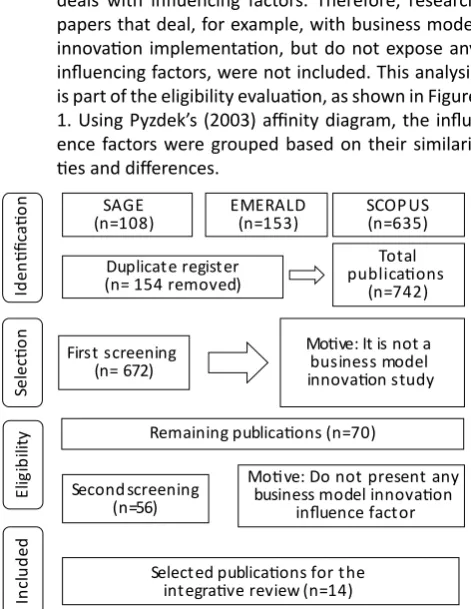
b) Stages 3 and 4 – information gathering and includ-ed studies analysis: the remaining papers resultant from stages 1 and 2 continue to complete reading and analysis. The guiding goal is to find studies that deals with influencing factors. Therefore, research papers that deal, for example, with business model innovation implementation, but do not expose any influencing factors, were not included. This analysis is part of the eligibility evaluation, as shown in Figure 1. Using Pyzdek’s (2003) affinity diagram, the influ -ence factors were grouped based on their similari -ties and differences.
SAGE
(n=108) EMERALD(n=153) SCOPUS(n=635)
Duplicate register (n= 154 removed)
Total
publica�ons
(n=742)
Id
en
�fi
ca
�
on
Se
le
c
�
on First screening
(n= 672)
Mo�ve: It is not a
business model
innova�on study
El
ig
ib
ili
ty Remaining publica�ons (n=70)
Second screening (n=56)
Mo�ve: Do not present any
business model innova�on
influence factor
In
clu
de
d
Selected publica�ons for the
integra�ve review (n=14)
Figure 1. PRISMA workflow, adapted for integrative literature review application
Source: Adapted from Oliveira et al. (2017)
c) Stages 5 and 6 – data analysis and results presen-tation: these analyses were based on the business model innovation influencing factors, especially tak -ing the result-ing groups into account. By do-ing this, it is possible to draw conclusions from the litera -ture analysis, especially about challenges and gaps existent that could base a future research agenda. Figure 2 presents the resultant affinity diagram, and represents the structure from which the conclusions and the framework of this work were drawn. The di -agram makes it easier to understand the discussed influence factors, and how they relate to one anoth -er with business model innovation. In total, it was identified 14 research papers addressing 12 different business model innovation influence factors.
-Adap�ng to ecosystem changes;
-Adap�ng to other ecosystem’s actors. Business Model Innova�on Influence Factors
Managerial Enviromental Cogni�ve
Rela�onship -Overcoming current business model dominant logic;
-Focus on innova�ng the business model rather than the product;
-Organiza�onal iner�a; Long-term perspec�ve,
-Alignment with business model partners;
-Using the open innova�on paradigm.
-Building complementarity between business model components;
-Cross-func�onal engagement; -Entrepreneurial orienta�on;
-Strategic flexibility and modularity.
Figure 2. Affinity diagram comprising the business model innovation influencing factors grouping
Source: Authors
3. BUSINESS MODEL INNOVATION INFLUENCE FACTORS
3.1 COGNITIVE FACTORS
proper tools to “[…] provoke and facilitate divergent thinking regarding business model design” (p. 30). Addressing this issue, Täuscher and Abdelkafi (2017) suggest several visual tools for business model cre -ation as possible paths to help overcoming the domi -nant logic. Their systematic literature review on visu -al tools for business model innovation maps out the possibilities, which contexts favor each use, which are their advantages and weaknesses, and how to better use them. Herbes et al.’s (2017) study comple -ments these views by citing diverse cognitive barri -ers, characterized by the authors as risk and change aversion. Finally, Laudien and Daxböck (2017) assert that the dominant logic barrier “[…] acts as a blinder toward market-based opportunities and threats”.
b) Focus on innovating the business model rather than the product: this barrier is almost a reflection of the first, because product and service innovations take part in the mainstream business logic whereas busi -ness model innovation does not. Changing the focus from the first to the second, thus, poses a significant challenge. Through several interviews, Frankenberg -er et al. (2013) show that the studied companies exhibit a notorious orientation toward a product and service innovation culture. The authors infer from interviewees’ comments that: there is a lack of a business model innovation culture and proper tools to systematically develop novel business model ideas, while there are plenty to support product and service innovations; and the financial investment is already committed to product and service’s inno -vation portfolio. Despite this reality, Lindgardt et al. (2012) highlight that business model innovations of -ten produce higher profits than product and service innovations. In addition, Eichen et al. (2015) support the notion that, often, even successful technological innovations need a complementary business model innovation to create value. The business model in -novation literature, in general, also provides support to this notion. See, for example, Chesbrough and Rosenbloom (2002).
c) Organizational inertia: Huang et al. (2013) define this barrier as an organization’s inability to respond effi -ciently to changes. The authors separate the inertia in three dimensions: thought inertia, action inertia, and psychological inertia. The former is the inability of an organization’s members to realize that there are external changes that require internal changes to respond to them. Action inertia, in turn, is when an organization notices the existence of external fac -tors that require internal changes; however, there is slow or no movement to do so. Finally, the latter is a psychological resistance to accept the change.
Thus, it happens when the organization recognizes the need to change and has the capacity to change; however, for a plethora of reasons, it chooses to keep the status quo. Huang’s et al. (2013) findings show that the negative effects of the organization -al inertia on business model innovation have two main reasons. First, they may threaten to break the current structure of power and interests of the com -pany, resulting in resistance against its occurrence. Second, it is a challenge for employees to adapt to new operation procedures, norms, and manage -ment behavior. Gärtner and Schön (2016) argue that “inertia” and “path dependency” are synonyms. This is because the positive rewards overtime, the orga -nization’s history, and its past success create rigidity toward changes.
d) Long-term perspective: according to Karlsson et al. (2017), long-term perspective is the main factor re -garding the implementation success of a new busi -ness model. Its study, however, is specific to the bio -gas industry and, thus, it is hard to generalize that long-term perspective is an overriding factor. Also, it is the only study that highlights this factor. Neverthe -less, even though there may be business model in -novations that occur in the short-term, it seems log -ical to understand the phenomenon as a long-term perspective. That because it often involves several experimentations and trial-and-error learning loops, knowledge management, and changes in the funda -mental way of doing business. Altogether, this points towards business model innovation as a long-term goal, rather than a short-term one.
3.2 MANAGERIAL FACTORS
into consistent business models to overcome it. To sum up, managers need to direct its focus in recognizing in -consistencies in the business model and represent this knowledge clearly and concisely.
b) Cross-functional engagement: despite the business model innovation literature pointing to the leader -ship as responsible for it, Winterhalter’s et al. (2017) single case study with BASF highlights that it is rather a cross-functional process. In this particular case, the company aims at delivering business model innova -tions to its customers through a central unit that in -tegrates diverse functions, such as marketing, R&D, and operations. This unit is responsible for putting together this knowledge diversity and has direct contact with the board of directors to assure lead -ership’s attention and support. Although only one publication using a single case study approach rep -resents this factor, it makes sense to understand the cross-functional need to business model innovation. This makes sense especially considering the previous factor, in which there is a need to integrate the dif -ferent business model components.
c) Entrepreneurial orientation: Bouncken and Fred -rich (2016) propose that this is a key factor for suc -cessful business model innovation and, in fact, the authors consider it the most important one. Specif -ically concerning the inertia barrier addressing the risk aversion behavior, entrepreneurial orientation offers means to overcome it and create novel busi -ness ideas. Other authors provide complements to this line of thinking and corroborates Bouncken and Fredrich’s (2016) view. Guo et al. (2013), for in -stance, suggest that entrepreneurial abilities help managers sensing and seizing opportunities, guiding their attention towards business model innovation. Likewise, Karlsson et al.’s (2017) study on biogas in -dustry’s business model innovations shows that all success cases involved entrepreneurial characteris -tics, such as problem solving and risk-taking behav -ior. It is important to note that these characteristics exist in both cases that involved entrepreneurial ini -tiatives and the ones that did not.
d) Strategic flexibility and modularity: even though strategic flexibility and modularity are not synonyms, they do present relevant similarities with each oth -er. According to Gärtner and Schön (2016), strategic modularity favors the flexibility which, in turn, is a positive business model innovation antecedent. Modularity’s main idea is to build complex systems from smaller, simpler, subsystems named modules. These are different sets of specialized operations that interact among one another and that enable re
-combination and new configurations without losing the whole system functionality (Campagnolo and Ca -muffo, 2010). Similarly, Bouncken et al. (2016) assert that the capacity to reconfigure resources and capa -bilities through modularization positively influence business model innovation. To illustrate this factor, Gärtner and Schön (2016) use Amazon’s case, since the company successfully turned different business model elements into independent modules. The AWS (Amazon Web System), for instance, is an in -formation technology infrastructure system that at -tends both the Amazon’s electronic-commerce ser -vices and the market. To achieve these two different goals, Amazon had to develop this infrastructure as a separate module, since its full integration would make one them less efficient. Strategic flexibility, in turn, is the capacity to quickly adjust, add, remove or reconfigure the resources to respond to a chang -ing environment (Schön, 2012). It is relevant to high -light, however, that modularization may also lead to path dependency since changing modularly is easier and convenient, detracting attention from aimed to systemic changes (Gärtner and Schön, 2016).
3.3 ENVIRONMENTAL FACTORS
a) Adapting to ecosystem changes: Frankenberger et al. (2013) note that this factor is a significant chal -lenge in stages before the search for business mod -el innovation ideas. When facing, for instance, reg -ulatory changes imposed by the government or by the society, it is important to adapt early to these changes. Similarly, different technological chang -es often call for an adaptive movement to provide changes in the mainstream business model. The In -ternet illustrates this fact, since it enabled a pletho -ra of new business model configu-rations (Timmers, 1998). According to Winterhalter et al. (2017), technological changes comprises an important trig -ger for business model innovation efforts. Schnei -der et al.’s (2013) study on maintenance, repair and aviation revision companies mapped different fac -tors influencing business model innovations, such as technological development, economic changes and deregulation. Finally, Herbes et al. (2017) call attention to ethical concerns, a barrier that is not well explored by the business model innovation lit -erature. Their study focuses on German energy co -operative and shows that climate change concerns guide the need to innovate the business models to accordingly deal with it.
changes, since another actor’s movements is an external environmental change. Actors such as cus -tomers, suppliers, competitors, universities, and government exert influences the focal firm opera -tions. Understanding these actor’s needs and move -ments is important especially to business model innovations’ initial stages. In support of this argu -ment, Schneider et al. (2013) show that changes in maintenance, repair and aviation revision industries’ demand influences the business model components of these companies. According to Zhu et al. (2017), a business model innovation is successful when it is capable of strategically responding to demand op -portunities by offering products or services that at -tend customer preferences in appropriate time. The authors illustrate this argument through an analysis of China’s cell phone manufacturers. Their analysis shows that having the most efficient or the most innovative business model in this industry does not mean having competitive advantage. This latter is rather associated with those companies offering the best solution to attend specific customers’ prefer -ences to seize a demand change opportunity. In line with the notion of adapting to customer demands, Winterhalter et al. (2017) emphasize market pres -sures as an important business model innovation catalyst.
3.4 RELATIONAL FACTORS
a) Alignment with business model partners: all stake -holders need to support the innovating business model If it is to be successful, otherwise it will be dif -ficult to manage and to operationalize (Frankenberg -er et al., 2013). Business model’s central role is to create and deliver value to all involved stakeholders (Chesbrough and Rosenbloom, 2002; Teece, 2010). Accordingly, Guo et al. (2013) use the managerial bonds concept, which represents, for instance, the capability to create relationship with business part -ners. The link between managerial bond and busi -ness model innovation occurs by allowing access to better business opportunities and market informa -tion (Guo et al., 2013). The authors’ results show positive influence when entrepreneurial orientation complements these managerial bonds. That be -cause, when only connected to managerial abilities, it leads to exploitation and optimization of current resources, and not to a business model innovation.
b) Use the open innovation paradigm: Huang et al. (2013) explore open innovation’s efficiency in over -coming organizational inertia and backing business model innovation, and its resulting impact on the
organization’s performance. The study shows that open innovation reduces organizational inertia and positively influences business model innovation. Chesbrough and Rosenbloom (2002) also defend open innovation usage, and encourage organiza -tions to promote innovative ideas flow from both outside-in and inside-out, by opening this process to external agents (Chiaroni et al., 2011; Dodgson et al., 2006). To summarize, it means that, by understand -ing the world as a globalized entity, organizations should seek knowledge outside its internal depart -ments’ boundaries and, as a result, search for new ways to achieve competitive advantage through in -novation.
4. CONCLUSION
This study proposed to answer the research question re -garding the main factors that influence the business model innovation process. To this end, the integrative literature re -view method was used to map and explain all the explored factors so far in a single framework. As a result, the factors were grouped in four different macro groups, and each group was described in detail. It is relevant to note that, despite separating the factors in four different groups, they display interactions among each other. To illustrate, an or -ganization with an entrepreneurial orientation may present higher tendency to successfully adapt to external ecosystem changes and to overcome the inertia.
The influence factors framework proposed in this paper can evolve alongside the business model innovation con -cept, since it is a recent research topic. In this sense, there may be new factors, not so far identified, that can comple -ment the framework in the future. Moreover, the catego -ries proposed in this article may not represent the totality of factors, as new factors do not necessarily need to fit inside those. Updating the framework is relevant to help under -standing why some business model cases are successful and others are not.
REFERENCES
Botelho, L. L. R.; Cunha, C. C. A.; Macedo, M. (2011), “O método da revisão integrativa nos estudos organizacionais”, Gestão e Sociedade, Vol. 5, pp. 121–136.
Bouncken, R. B.; Fredrich, V. (2016), “Business model in -novation in alliances: Successful configurations”, Journal of Business Research, Vol. 69, pp. 3584–3590, available from: https://doi.org/10.1016/j.jbusres.2016.01.004
Bouncken, R. B.; Lehmann, C.; Fellnhofer, K. (2016), “The role of entrepreneurial orientation and modularity for busi -ness model innovation in service companies”, International Journal of Entrepreneurial Venturing, Vol. 8, pp. 237–260, available from: https://doi.org/10.1504/IJEV.2016.078973
Campagnolo, D.; Camuffo, A. (2010), “The concept of modularity in management studies: A literature review”, In -ternational Journal of Management Reviews, Vol. 12, pp. 259-283, available from: https://doi.org/10.1111/j.1468-2370.2009.00260.x
Chesbrough, H.; Rosenbloom, R. S. (2002), “The role of the business model in capturing value from innovation : evidence from Xerox Corporation’s technology spin-off companies”, In -dustrial and Corporate Change, Vol. 11, pp. 529–555.
Chiaroni, D.; Chiesa, V.; Frattini, F. (2011), “The Open Inno -vation Journey: How firms dynamically implement the emer -ging innovation management paradigm”, Technovation, Vol. 31, pp. 34-43, available from: https://doi.org/10.1016/j.tech -novation.2009.08.007
Christensen, C. M.; Bartman, T.; van Bever, D. (2016), “The Hard Truth about Business Model Innovation”, MIT Sloan Ma -nagement Review, Vol. 58, pp. 31-40.
Dodgson, M.; Gann, D.; Salter, A. (2006), “The role of tech -nology in the shift towards open innovation: the case of Proc -ter & Gamble”, R&D Management, Vol. 36, pp. 333-346.
Doz, Y. L.; Kosonen, M. (2010), “Embedding Strategic Agi -lity A Leadership Agenda for Accelerating Business Model Re -newal”, Long Range Planning, Vol. 43, pp. 370–382,-available from: https://doi.org/10.1016/j.lrp.2009.07.006
Eichen, S. F. V. D.; Freiling, J.; Matzler, K. (2015), “Why bu -siness model innovations fail”, Journal of Bu-siness Strategy, Vol. 36, pp. 29–38, available from: https://doi.org/10.1108/ JBS-09-2014-0107
Foss, N. J.; Saebi, T. (2018), “Business models and busi -ness model innovation: Between wicked and paradigmatic problems”, Long Range Planning, Vol. 51, pp. 1–13, available from: https://doi.org/10.1016/j.lrp.2017.07.006
Frankenberger, K.; Weiblen, T.; Csik, M.; Gassmann, O. (2013), “The 4I-framework of business model innovation: a structured view on process phases and challenges”, In -ternational Journal of Product Development, Vol. 18, No.
3/4, pp. 249-273, available from: https://doi.org/10.1504/ IJPD.2013.055012
Gärtner, C.; Schön, O. (2016), “Modularizing business mo -dels: between strategic flexibility and path dependence”, Journal of Strategy and Management, Vol. 9, pp. 39–57, avai -lable from: https://doi.org/10.1108/JSMA-12-2014-0096
Guo, H.; Zhao, J.; Tang, J. (2013), “The role of top mana -gers’ human and social capital in business model innovation”, Chinese Management Studies, Vol. 7, pp. 447–469, available from: https://doi.org/10.1108/CMS-03-2013-0050
Herbes, C.; Brummer, V.; Rognli, J.; Blazejewski, S.; Gericke, N. (2017), “Responding to policy change: New business mo -dels for renewable energy cooperatives – Barriers perceived by cooperatives’ members”, Energy Policy, Vol. 109, pp. 82–95, available from: https://doi.org/10.1016/j.enpol.2017.06.051
Hock, M.; Clauss, T.; Schulz, E. (2016), “The impact of orga -nizational culture on a firm’s capability to innovate the busi -ness model”, R&D Management, Vol. 46, pp. 433–450, availa -ble from: https://doi.org/10.1111/radm.12153
Huang, H. C.; Lai, M. C.; Lin, L. H.; Chen, C. T. (2013), “Over -coming organizational inertia to strengthen business model innovation: An open innovation perspective”, Journal of Orga -nization Change Management, Vol. 26, pp. 977–1002, availa -ble from: https://doi.org/10.1108/JOCM-04-2012-0047
Karlsson, N. P. E.; Halila, F.; Mattsson, M.; Hoveskog, M. (2017), “Success factors for agricultural biogas production in Sweden: A case study of business model innovation”, Journal of Cleaner Production, Vol. 142, pp. 2925–2934, available from: https://doi.org/10.1016/j.jclepro.2016.10.178
Keller, F. H.; Daronco, E. L.; Cortimiglia, M. (2017), “Stra -tegic tools and business modeling in an information tech -nology firm”, Brazilian Journal of Operations & Production Management, Vol. 14, pp. 304, available from: https://doi. org/10.14488/BJOPM.2017.v14.n3.a4
Laudien, S. M.; Daxböck, B. (2017), “Business model in -novation processes of average market players: a qualitative --empirical analysis”, R&D Management, Vol. 47, pp. 420–430, available from: https://doi.org/10.1111/radm.12208
Lindgardt, Z.; Reeves, M.; Stalk, G.; Deimler, M. S. (2012), Business Model Innovation: when the game gets tough, chan -ge the game, in: Deimler, M.; Lesser, R.; Rhodes, D.; Sinha, J. Own the future: 50 ways to in from the Boston Consulting Group, John Wiley and Sons, Massachusetts, pp. 291–298.
Martins, L. L.; Rindova, V. P.; Greenbaum, B. E. (2015), “Un -locking the Hidden Value of Concepts: A Cognitive Approach to Business Model Innovation”, Strategic Entrepreneur -ship Journal, Vol. 9, pp. 99–117, available from: https://doi. org/10.1002/sej.1191
-Approved: 22 Oct 2018
DOI: 10.14488/BJOPM.2018.v15.n4.a14
How to cite: Minatogawa, V. L. F.; Franco, M. M. V.; Pinto, J. S. et al. (2018), “Business model innovation influencing factors: an integrative literature review”, Brazilian Journal of Operations & Production Management, Vol. 15, No. 4, pp. 610-617, available from: https://bjopm.emnuvens.com.br/bjopm/article/view/599 (access year month day). views and meta-analyses: The PRISMA statement”, Interna
-tional Journal of Surgery, Vol. 8, No. 5, pp. 336–341, available from: https://doi.org/10.1016/j.ijsu.2010.02.007
Oliveira, W. A.; Silva, J. L.; Sampaio, J. M. C.; Silva, M. A. I. (2017), “Saúde do escolar: uma revisão integrativa sobre família e bullying”, Ciência & Saúde Coletiva, Vol. 22, pp. 1553–1564, available from: https://doi.org/10.1590/1413-81232017225.09802015
Pyzdek, T. (2003), The Six Sigma Handbook: the complete guide for greenbelts, blackbelts, and managers at all levels, Revised an. ed. McGraw-Hill, New york.
Schneider, S.; Spieth, P.; Clauss, T. (2013), “Business model innovation in the aviation industry”, International Journal of Product Deveplopment, Vol. 18, pp. 286–310, available from: https://doi.org/10.1504/IJPD.2013.055010
Schön, O. (2012), “Business Model Modularity – A Way to Gain Strategic Flexibility?”, Controllig & Management Review, Vol. 56, pp. 73–78.
Souza, M. T.; Dias, M.; Carvalho, R. (2010), “Revisão integra -tiva: o que é e como fazer”, Einstein, Vol. 8, pp. 102–106, availa -ble from: https://doi.org/10.1590/S1679-45082010RW1134
Täuscher, K.; Abdelkafi, N. (2017), “Visual tools for busi -ness model innovation: Recommendations from a cognitive perspective”, Creativity and Innovation Management, Vol. 26, pp. 160–174, available from: https://doi.org/10.1111/ caim.12208
Teece, D. J. (2010), “Business models, business strategy and innovation”, Long Range Planning, Vol. 43, pp. 172–194.
Timmers, P. (1998), “Business Models for Electronic Mar -kets”, Electronic Markets, Vol. 8, pp. 3–8, available from: htt -ps://doi.org/10.1080/10196789800000016
Whittemore, R.; Knafl, K. (2005), “The integrative review: updated methodology”, Journal of Advanced Nursing, Vol. 52, pp. 546–553, available from: https://doi.org/10.1111/j.1365-2648.2005.03621.x
Winterhalter, S.; Weiblen, T.; Wecht, C. H. et al. (2017), “Business model innovation processes in large corporations: insights from BASF”, Journal of Business Strategy, Vol. 38, pp. 62–75, available from: https://doi.org/10.1108/JBS-10-2016-0116
Wrigley, C.; Bucolo, S.; Straker, K. (2016), “Designing new business models : blue sky thinking and testing”, Journal of Business Strategy, Vol. 37, pp. 22–31, available from: https:// doi.org/10.1108/JBS-04-2015-0041