The International Journal of Digital Curation
Volume 8, Issue 1 | 2013A Digital Archives Framework for the Preservation of Artistic
Works with Technological Components
Guillaume Boutard,
Centre for Interdisciplinary Research in Music Media andTechnology, McGill University
Catherine Guastavino, School of Information Studies,
McGill University
James Turner,
École de Bibliothéconomie et des Sciences de l’Information, Université de Montréal
Abstract
The preservation of artistic works with technological components, such as musical works, is recognised as an issue by both the artistic community and the archival community. Preserving such works involves tackling the difficulties associated with digital information in general, but also raises its own specific problems, such as constantly evolving digital instruments embodied within software and idiosyncratic human-computer interactions. Because of these issues, standards in place for archiving digital information are not always suitable for the preservation of these works. The impact on the organisation and the descriptions of such archives need to be conceptualised in order to provide these technological components with readability, authenticity and intelligibility. While previous projects emphasized readability and authenticity, less effort has been dedicated to addressing intelligibility issues.
The research into the specification of significant properties and its extension, namely significant knowledge, offers some grounds for reflecting on this question. Furthermore, the relevance of taking into account the creative process involved in the production of technological components offers an opportunity to redefine the status of technological agents in the performative aspect of digital records. Altogether, the research on significant knowledge and creative processes provide us with a conceptual framework that we propose to bring together with digital archives models to form a coherent framework.
Introduction
From both a theoretical and a practical viewpoint, the preservation of artistic works, such as artistic works with technological components, raises questions that keepers of digital archives need to address. Technological components are an integral part of the work, together with the musical score; as such they require preservation attention. These technological components of the work, especially digital media processing software created specifically for each work, seem to epitomize archival issues in terms of readability, authenticity and intelligibility (Lee, 2000). The music research
literature emphasizes the question of sustainability of this repertoire when confronted with technological obsolescence:
“Most, if not all, live electro–acoustic works are endangered today because their sustainability in time is extremely low.” (Bernardini & Vidolin, 2005).
In the context of such works, preservation relates to the ability to re-perform the work, rather than preserving the recording of the performance. Media processing software can be used to transform the sound of acoustic instruments or to synthesise new electronic sounds during the performance.1 Therefore, it is critical to preserve this software, kept as is or migrated, together with the ability to use it. Similarly, this kind of software is used in new media arts. The DOCAM (Documentation and
Conservation of the Media Arts Heritage) project investigated conservation of works of art featuring technological components such as these.2 The increased popularity of these technological components in other artistic domains, such as dance and theatre,3 shows the potential impact of this research and the extent of the issues the artistic domain is facing.
These issues have already partially formed the basis for several digital archives projects concerned with the preservation of artistic works, such as CASPAR (Cultural, Artistic and Scientific knowledge for Preservation, Access and Retrieval) and
InterPARES II (International Research on Permanent Authentic Records in Electronic Systems). Theory and practice must come together in a consistent framework that can address the preservation needs for artistic works involving technological components (Boutard, Guastavino & Turner, 2012).
In 2006, Gladney stated that:
1 Examples of software environments used to develop this kind of technological components include
Max/MSP and Pure Data. This kind of software is used to transform the sound of acoustical instruments or to synthesise new electronic sounds during the performance. Examples of software components implemented in these environments include sound spatialisation and multiple dynamic audio effects. For a typology of audio effects, see Verfaille, Guastavino and Traube (2006). Examples of composers using these technologies include Karlheinz Stockhausen and Pierre Boulez.
2 During the DOCAM project, case studies included artist David Rokeby’s work comprising of video
processing components developed with the Max/MSP software environment.
3 For example, works by choreographer Myriam Gourfink, or collaborations between stage director
“Many articles about digital preservation come from the cultural heritage community, which is somewhat unfortunate as the IT community is not involved.” (Gladney, 2006).
This situation seems to have improved, since projects such as CASPAR are committed to the preservation of cultural and artistic digital components from an engineering point of view. Nevertheless, in this context, these technological
components represent testbed documents, which are not essentially different from any other digital document. The project, based on the Open Archival Information System (CCSDS, 2002), is primarily addressing readability issues – that is to say, the ability to retrieve and process a digital file in the future (Lee, 2000).We argue that the specific preservation issues these technological components raise enlighten digital curation as a whole, that is to say “the active involvement of information professionals in the management, including the preservation, of digital data for future use” (Yakel,
2007).
InterPARES II addressed the question of authenticity, focussing on the interactivity of the records. As regards electronic music, the project categorized interaction as ‘experiential’, that is to say, an environment that provides “user interaction driven not by pre-programmed options, but by the user’s interests” (Duranti & Thibodeau, 2006). This relates to Rowe’s (1993) three-dimensional classification system for interactive music systems4 in terms of stored representation, and specifically to its first
dimension, which ranges from score-driven systems to performance-driven systems. In this context, Duranti and Thibodeau (2006) argue that preservation is ensured by a thorough description by the composer of each component’s interaction with the other performance components.
Lee’s third focus of attention is intelligibility: the ability to understand the meaning of the preserved file (Lee, 2000). We argue that intelligibility is closely related to meaningful usability, a term coined by Rothenberg:
“The relationship between digital preservation and authenticity stems from the fact that meaningful preservation implies the usability of that which is preserved. That is, the goal of
preservation is to allow future users to retrieve, access, decipher, view, interpret, understand and experience documents, data, and records in meaningful and valid (that is, authentic) ways.” (Rothenberg, 2000).
In the context of the preservation of artistic works involving technological components, where generally we have to deal with the “consequences of limited media life expectancy and hardware and software obsolescence” (Gladney, 2009), and where specifically migration is a fundamental mode of survival (Yong, 2006), we need to provide digital records with meaningful usability (Rothenberg, 2000) for reuse, migration and analysis. Building on Duranti and Thibodeau’s recommendation for thorough documentation, we argue that preservation issues for technological components, such as digital media processing, need to be addressed in the context of
4 The three dimensions are: score driven to performance driven; transformative, generative, or
the process of their creation – a process that involves many agents, both human and non-human – as well as that of archival practice (Boutard, Guastavino & Turner,
2012). Thus we need to establish the potential link between creative processes, meaningful usability and models of digital archives.
Archiving the Creative Process
The Relevance of the Creative Process
Digital sound processing software produced during the creative process of musical works involving technological components epitomize the complex conditions of creation and use, as well as the idiosyncratic and obsolescent technological frameworks involved. It also epitomizes the variability of hierarchies and the
organization of labor, and specifically the creative side of sustaining tasks, described by Benghozi (1995). It is no wonder that digital sound processing software represent a challenge to digital archives theories and models: they are the result of complex knowledge interactions in a creative process involving multiple agents, both human and non-human, that cannot be reduced to the added value paradigm conveyed by concepts such as context information and/or, in OAIS terms, Representation Information. In 2008, Cunningham stated that:
“[Records] derive their meaning and value from a myriad of contextual relationships surrounding their creation and use – relationships that have to be documented and understood.” (Cunningham, 2008).
While this statement relates to the archival lifecycle and to the concept of the records continuum, it is relevant to the creative process as well. It emphasizes the fact that a digital object is not merely an isolated object. Indeed, “technology does not develop according to an inner technical logic but is instead a social product, patterned by the conditions of its creation and use” (Williams & Edge, 1996). Consequently, the status we grant to digital object has an impact on the way we manage them within theories and models.
The InterPARES I project proposed a specification of the necessary constituent parts of a record (Duranti & Thibodeau, 2006). It consists of the documentary form, which includes intrinsic elements (such as the place of origin and the chronological date) as well as extrinsic elements (such as the overall presentation features), the annotations, the context (i.e. the juridical-administrative context, the provenancial context, the procedural context, the documentary context and the technological context), and finally the medium, whose status is undefined and might be part of the technological context, according to Duranti and Thibodeau. If “the medium is not a relevant factor in assessing a record’s authenticity” (Duranti & Thibodeau, 2006), we argue that it is relevant to its intelligibility, since the medium allows us to account for the active participation of non-human agents in the interaction process.5 The creative
5 In this sense, the medium relates to the third dimension of Rowe’s (1993) classification, which ranges
process leading to the creation of digital signal processing software involves, notably, processes that Latour (1994) refers to as delegation and ‘blackboxing’. The recursive process of blackboxing6 emphasizes the complex relation between human agents and technological agents. Delegation is the technological inscription of a program of action whose goals are defined by agents, both human and non-human; it emphasizes the active role of technological agents. These processes are critical to the intelligibility of these musical technological components, and consequently to the musical works of which they are part. These processes have impact on the software’s potential reuse and migration. Still, they are difficult to document after the finalization of the technology intended for preservation, so the documentation accounts for “the state of crisis in which machines, devices and implements were born” (Latour, 2005). If we do want to account for this ‘state of crisis’, the curation lifecycle should be informed by creative processes.
Documenting the Creative Process
Boutard and Guastavino (2012b) have described the creative process of a musical work involving technological components. They conducted a formal analysis, based on grounded theory (Glaser & Strauss, 1967), of secondary ethnographic data previously collected at IRCAM (Institut de Recherche et Coordination
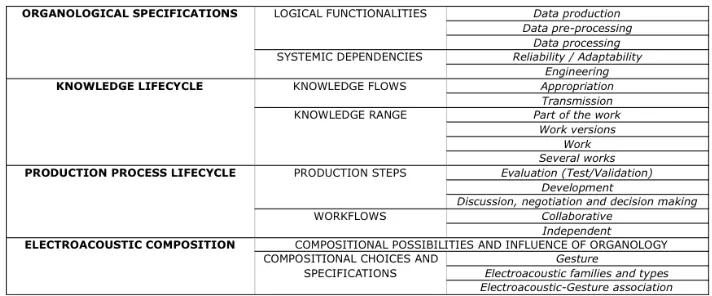
Acoustique/Musique) from 2006 to 2008. These data consisted of two years of research and artistic production surrounding the composition of a string quartet with live electronics and a specific focus on interaction. The IRCAM team, APM (Analyse des Pratiques Musicales), collected video recordings of studio sessions during the entire process, as well as interviews with the main participants: the composer, the scientific team leader and the computer music designer. The team also collected emails, notes, scores and sound processing software at various stages of technological development. The inductive analysis grounded in the data gave rise to a categorization scheme (see Figure 1) highly relevant to documentation (Boutard & Guastavino,
2012b).
Figure 1. The first three levels of Boutard and Guastavino’s (2012b) categorization of the creative process of a musical work involving technological components - the broadest category is displayed on the left.
6 Latour (1994) states: “each of the parts inside the black box is a black box full of parts. If any part
The categorization scheme is composed of four broad categories:
Organological specifications,
Knowledge lifecycle,
Production process lifecycle,
Electroacoustic composition.
The latter category was considered most idiosyncratic.
Boutard and Guastavino (2012b) consider that each broad category is relevant to documentation. Organological specifications document logical functionalities, as well as a network of systemic dependencies, which range from engineering dependencies and issues of adaptability and reliability to various contextual factors. The knowledge lifecycle involves knowledge flows, in terms of appropriation (a category relevant to all human agents of the creative process, both on the part of the performer, and on the part of the composer, the engineers and the researchers) and in terms of transmission. Subsequently it involves the specification of the knowledge range – that is to say, the extent to which this knowledge is relevant to a small or large part of the work, and also to other works. Appropriation procedures and certain types of transmission highlight the tacit dimension of the knowledge involved in the creative process. The importance of tacit knowledge for preservation has already been emphasized in the musicological literature; Zattra states that:
“Obsolescence and preservation are crucial problems in the study of electroacoustic music. Therefore, mental texts (of composers, technicians, etc.) are important to the preservation and analysis of musical works.” (Zattra, 2007).
In addition, Boutard and Guastavino (2012b) posit that the broad category of the
production process lifecycle is the backbone of the documentation of every other broad category that emerged from their analysis. The production process lifecycle describes the lifecycle in terms of production steps (such as development, evaluation, and decision making) and workflows that account for collaborative and independent work processes. Production steps support organological specifications, since:
“Central to SST [Social Shaping of Technology] is the concept that there are ‘choices’ (though not necessarily conscious choices) inherent in both the design of individual artefacts and systems...” (Williams & Edge, 1996).
The production process lifecycle also supports the plasticity of knowledge range, since it may account for the generalization process of a local solution to a broader extent, a process emphasized by Callon (1981) in the context of the sociology of science. Similarly the production process lifecycle’s workflows support the broad range of knowledge flows, either in terms of appropriation or transmission.
Impact on Models of Digital Curation and Digital Archiving
Models and lifecycles
In 2008, Higgins proposed a lifecycle in seven phases, namely the Digital Curation Centre (DCC) curation lifecycle model (2008), based on Pennock’s (2007) lifecycle approach to digital curation. This lifecycle is composed of the following phases: create or receive; appraise and select; ingest; preservation action; store; access, use and re-use; and finally, transform, which links back to the first phase. According to Higgins:
“[This] lifecycle approach ensures that all the required stages are identified and planned, and necessary actions implemented, in the correct sequence. This can ensure the maintenance of authenticity, reliability, integrity and usability of digital material.” (Higgins, 2008).
Subsequently, Constantopoulos et al. (2009) combined the DCC lifecycle with a second model influenced by semantic web technology in order to account for domain-specific contextual information and user experience.
Higgins posits that the DCC model is a complement to the OAIS model. Indeed, we may consider the lifecycle approach as an activity scheme on top of the OAIS logical model, defined with component and class schemes. However, a notable difference is the recognition of appraisal – a concept that doesn’t appear much in the OAIS reference model. The DCC model may complement the OAIS model, but we are still not provided with formal relationships, especially in terms of the SIP (Submission Information Package), AIP (Archival Information Package), RI (Representation Information) and PDI (Preservation Description Information).
In order to relate Boutard and Guastavino’s (2012b) categorization to archival models and lifecycles, we will discuss three broad categories: organological
specifications, knowledge lifecycle and production process lifecycle. The relevance of the most idiosyncratic category, electroacoustic composition, is closely related to the other three categories (Boutard & Guastavino, 2012b). Consequently, there is a general need to identify these three broad categories within digital archives concepts and to identify potential limitations.
Organological specifications
Organology, in Boutard and Guastavino’s (2012b) categorization, refers to taxonomies of musical instruments as well as systems that include computers, software, sensors, etc. (Stiegler, 2003). This category may be the most familiar to digital preservation systems since it deals with specifications. Therefore, as a premise, this category can be related to OAIS Representation Information, namely “the
information that maps a Data Object into more meaningful concepts” (CCSDS, 2002). Representation Information still is a broad category that involves both Semantic Representation Information and Structure Representation Information.
The first subcategory of organological specifications, namely logical
level concepts” (CCSDS, 2002). As regards the last point, we might revise the categorization of logical functionalities into Structure Information. Interestingly, papers addressing Representation Information in terms of operationalization (Matthews et al., 2010) or in terms of mappings to other conceptual frameworks (Sacchi et al., 2011) do not refer to this distinction between Semantic and Structure Representation Information. The OAIS model (CCSDS, 2002) acknowledges that: “Representation Information contains both Structure Information and Semantic Information, although in some implementations the distinction is subjective.” The semantic link between both types of Representation Information is specified in the OAIS logical model of the information object as “adds meaning to” - a very broad phrasing resulting in a description activity that may be difficult to manage.
Furthermore, logical components and algorithms do not have to reflect physical components. This affects their relationship to potential Archival Information
Collections (AICs) composed of various Archival Information Units (AIUs). Indeed, they relate to a more abstract level of description.
The second subcategory, systemic dependencies, offers other challenges. The OAIS reference model defines two key concepts in its specification of Preservation
Description Information (PDI), namely provenance and context. Context Information “documents the relationships of the Content Information to its environment. This includes why the Content Information was created and how it relates to other Content Information objects existing elsewhere” (CCSDS, 2002). Accordingly, we may want to relate the part of systemic dependencies that refers to the network of contextual factors influencing reliability and adaptability, such as inter/intra performer reliability issues or organological adaptability. These factors may still be difficult to formalize, which emphasizes the need for a framework able to support such a network of
contextual factors. Furthermore, OAIS Context Information is underspecified and may require a more extensive framework. Considering the InterPARES specification of the ambiguous relationship between the medium and the technological context (Duranti & Thibodeau, 2006), we may want to propose a framework which distinguishes
technological context from other types of context.
Similarly, systemic dependencies also involve engineering dependencies, i.e. the software architecture, including external libraries and versioning information. The management of these dependencies, according to Matthews et al. (2010), fits
Representation Information together with Preservation Description Information. We argue that it relates rather to the formal link between different AIPs. This is critical in a process where different agents have different agendas, and where solutions
discarded for a project may be useful for other projects, as observed in Boutard and Guastavino (2012b).
Knowledge lifecycle
The second category, knowledge lifecycle, is critical since it accounts for relationships between multiple agents, human and non-human. It relates to the
blackboxed instrument (Magnusson, 2009), since the category involves appropriation processes as well as transmission processes.7
Appropriation procedures and context of appropriation are especially relevant to musical works with technological components, since processes of embodiment are more complex with digital instruments than with acoustic instruments. With acoustic instruments:
“The music is performed and perceived through gestures whose deployment can be directly felt and understood through the body, without the need for verbal descriptions.” (Leman, 2010).
However, in the digital world mappings between gesture and electroacoustic outputs are arbitrary (Drummond, 2009). Consequently, the transmission of
interaction expertise with digital instruments is problematic. Matthews et al. (2010) conveniently specify that user interactions are outside of the scope of the OAIS model. This point is crucial, since appropriation is not limited to performers’ embodiment abilities. Indeed, Boutard and Guastavino (2012b) found that appropriation procedures apply to all human agents (including the composer, the computer music designer and the scientific team), as well as to the technological environment, and take place throughout the entire creative process. Appropriation procedures are critical as they directly relate to the processes of blackboxing and delegation involved in
technological mediation.
Subsequently, Matthews et al. (2010) consider that user interaction “may be categorized as the Significant Properties of software.” Indeed, there is a longstanding debate on the conceptual difference between Significant Properties and Representation information. Adrian Brown, cited by Hockx-Yu and Knight (2008), summarized it this way:
“While the former are about the intellectual intent and apply to the abstract information object and properties of the intellectual intent, the latter are specific technical manifestations of the information object and apply to the data object, e.g. format, encoding schemes, algorithms.”
Specifically, this concern regarding abstraction from the object is relevant to musical works with technological components, since digital sound processing
software “must be documented in an abstract form or, in other terms in an independent manner by the system used, since the machines have an extremely brief life” (Canazza & Vidolin, 2001). Considering the definition of Significant Properties, that is to say, “the characteristics of an information object that must be maintained to ensure that object’s continued access, use, and meaning over time as it is moved to new
technologies” (Knight & Pennock, 2009), Canazza and Vidolin’s statement is in direct relationship with the issues addressed by the digital archives community. With regards
7 Specifically, Magnusson (2009) states that “the blackboxed instrument contains the knowledge of its
to the OAIS model, Giaretta et al. (2009) acknowledged the relevance of Significant Properties for migration purposes and proposed to integrate a similar concept into the OAIS model, namely Transformational Information Properties, defined as: “an Information Property whose preservation is regarded as being necessary but not sufficient to verify that the Non-Reversible Transformation has adequately preserved information content.” However, Transformational Information Properties still do not account for the potential pertinence of abstraction levels, the fundamental concept of Significant Properties. Indeed, Hedstrom and Lee advocate for the expression of Significant Properties at several levels of abstraction (Hedstrom & Lee, 2002). Knight and Pennock (2009) implemented this proposal with the FRBR model:
“A framework that identifies and clearly defines the entities of interest to users of bibliographic records, the attributes of each entity, and the types of relationships that operate between entities.” (IFLA, 1998).
These entities describe four levels of abstraction for bibliographic records:
The work – A distinct intellectual or artistic creation;
The expression – A specific form for this intellectual or artistic creation;
The manifestation – A physical embodiment of the expression;
The item – A single exemplar of the manifestation.
In 2012, Boutard and Guastavino introduced the concept of Significant Knowledge, an extension of Significant Properties that accounts for tacit knowledge. Indeed, this proposal converges with Knight and Pennock’s (2009) implementation regarding the dimension of abstraction. Specifically, Boutard and Guastavino (2012a)
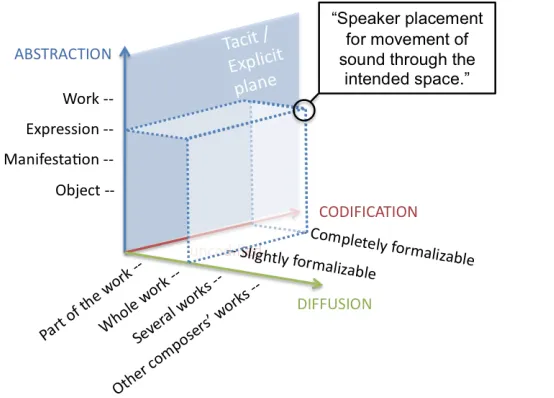
operationalized a three-dimensional knowledge management model introduced by Boisot (1995) and tested and validated this operationalization with composers using a survey on the use of sound spatialization. This model, primarily concerned with tacit knowledge, provides a conceptual framework that describes knowledge. The three dimensions of the model are abstraction, codification, and diffusion. Abstraction represents the synthesis process, which reduces the quantity of categories needed to account for data, while codification “involves the assignment of data to categories, thus giving them form” (Boisot & Child, 1999). Thus the more abstract and the less codified, the more tacit the knowledge. Furthermore, the dimension of diffusion measures the relevance to a given population (Boisot & Cox, 1999) and, according to Boisot and Child (1999), accounts for relational complexity. Boutard and
Guastavino’s (2012a) operationalization of the model for musical works involving technological components relies on FRBR levels for the abstraction dimension. In this sense, the abstraction dimension of their proposal relates to the state of the art of Significant Properties research and therefore represents the potential link to digital archives models. Subsequently, they related codification to the potential level of formalization of the knowledge described, on the basis of Boisot’s specifications (1995) and Zander and Kogut’s (1995) operationalization of codifiability.8 The
8 Zander and Kogut (1995) state that: “‘Codifiability’ captures the degree to which knowledge can be
addition of codification to abstraction provides a fair rendition of the potential tacit dimension of the knowledge involved in the creative process, a dimension
acknowledged by several authors in music research.9 Finally, they related the diffusion dimension to the music research work of Donin and Theureau (2007) on the different cognitive timescales of the creative process in music composition. This dimension is closely related to the subcategory knowledge range, which emerged from Boutard and Guastavino’s (2012b) study. An example of a contextual knowledge categorization, taken from their survey on the use of sound spatialization, is provided in Figure 2.
Figure 2. Categorization example of a knowledge description in the Significant Knowledge framework (adapted from Boutard & Guastavino, 2012a).
This model addresses Lee’s (2000) intelligibility, and therefore, Rothenberg’s (2000) meaningful usability, in the sense that it allows the categorization of the knowledge involved in the creative process and therefore provides a framework to capture it in a way that reflects its potential tacit dimension, and to relate it to a digital archives model. In doing so, it may account for appropriations and transmissions that occur during the creative process. These are relevant in the context of digital records that have been described as performances (Cunningham, 2008), and especially in considering performance as a process that involves human and non-human agents. Indeed, the focus on interaction by the InterPARES II project converges on this question of performance. However, the project’s conclusion that a “work of digital music can only be reproduced if the author describes each digital, intellectual and performing component of it and the interactions among them, by producing a set of instructions for re-creating each part of the piece and the piece as a whole” (Duranti & Thibodeau, 2006), accounts neither for abstraction nor codification, i.e. the tacit knowledge, nor for the multiple agents involved. Similarly, Matthews et al.’s (2010) framework for performance adequacy is built on a set of pre-defined Significant Properties evaluated on the basis of an input-output specification.
In 2011, Lee observed that:
“By directly attending to the creation, capture, management and sharing of contextual information, curators of digital collections can best ensure that the distributed network of digital collections will provide not only access to digital objects but also the means to make meaningful use and sense of the digital objects long into the future.” (Lee, 2011).
Boutard and Guastavino’s (2012a) framework provides us with an opportunity to document not only contextual information but also, in a broader way, the knowledge involved in the creative process. This position allows us to account for the fact that, according to Latour:
“When objects have receded into the background for good, it is always possible – but more difficult – to bring them back to light by using archives, documents, memoirs, museum collections, etc.” (Latour, 2005).
While the specification of knowledge flows and knowledge range fit adequately the three dimensions of the Significant Knowledge framework, the mapping of the
Significant Knowledge framework to the OAIS model still needs to be addressed. Matthews et al. (2010) consider that their narrowed notion of significant properties, as they put it, is outside of the scope of the OAIS model. Consequently, Boutard and Guastavino’s (2012a) potentially extended view of Significant Properties is a challenge to the model. Significant Knowledge requires the inclusion of abstraction levels in the OAIS model, as well as a mapping for both remaining dimensions, namely, codification and diffusion.
The production process lifecycle
We previously stated that the production process lifecycle is the backbone of every other broad category. Thus it is the backbone of a potential ingestion framework. Together with the knowledge lifecycle, it accounts for knowledgeflows during the creative process and therefore may be used to document blackboxing and delegation processes. Several authors in various domains, such as engineering knowledge preservation (Brunsmann & Wilkes, 2009) or video game preservation (Winget,
2011), acknowledged the production lifecycle’s impact on sustainability. The production process lifecycle category consists of production steps and workflows. Production steps especially account for the choices discussed previously that Williams and Edge (1996) refer to, both in terms of evaluation procedures and their
counterparts: development and decision making processes. These production steps relate directly to the organological specifications, since they track down the creative process on a longitudinal scale. They support modifications of logical functionalities, as well as the evolution of systemic dependencies. On the other hand, workflows, either collaborative or independent, account for a complex division of labor
(Benghozi, 1995). Workflows are also critical, since they emphasize the stakeholders of the creative process. These stakeholders are essential because they mutually construct what is significant,10 either explicitly or tacitly, during the creative process
10 See, for example, Angela Dappert and Adam Farquhar (2009), who state: “In the digital preservation
in a way that can only be poorly acknowledged by the OAIS concept of a Designated Community, which is oriented toward consumption rather than production. The combination of production steps and workflows offers helpful grounding for an ingestion framework that accounts for the technology as a social product.
This grounding for an ingestion framework in OAIS terms has to deal with the semantic relationships among Information Packages. The OAIS model is not a software versioning system, but it may have to provide some of the features of such a system. Similarly to the management of the engineering sub-category, a potential solution lies in the semantic link between AIPs and the Context Information.
However, the creative process does not end with the project. Works are migrated for re-performance purposes, providing new meaning to the work. As MacNeil and Mak (2007) put it, the authenticity is “also necessarily in a continuous state of becoming.” In this context, FRBR may again provide a suitable conceptual framework for relating AIPs to AICs. Furthermore, FRBRoo (Bekiari, Doerr & Le Boeuf, 2010) may be more relevant since it allows the specification of transversal links between libraries, which are on the same abstraction level but are a semantically linked unit within the
technological framework elaborated during the creative process.
On the other hand, workflows also have to relate to Preservation Description
Information. This implies further specification on the Provenance Information side. As with the ambiguity between Semantic and Structure Representation Information, the distinction between OAIS Provenance and Context Information may be challenging. The InterPARES specification for the necessary parts of the record11 exemplifies this ambiguity. While features of the documentary form, such as the name of the creators of the record or the place of origin, typically relate to Provenance Information, features of context involve provenancial context. This ambiguity may lead us to consider Provenance Information as a subset of Context Information. Workflows also have to be a fundamental part of the ingestion framework, since “to understand records as evidence of human activity it is necessary to understand how their systems of creation and use operated” (Cunningham, 2008).
The implications of these various requirements on the modelling are numerous.
Modelling
Representation Information is only one part of the information required for meaningful use of the Data Object. In addition, according to the OAIS model, the Transformational Information Property is an Information Property, that is to say, “that part of the Content Information as described by the Information Property Description. The detailed expression, or value, of that part of the information content is conveyed by the appropriate parts of the Content Data Object and its Representation
Information” (CCSDS, 2009). Thus these properties correspond to a pointer to a specific part of the Content Information. We argue that a different model is required: one that accounts for Significant Knowledge at different levels of abstraction,
codification, and diffusion.
First, we posit that a data object is not (re)presented but is performed12 to provide Content Information. This semantic shift emphasizes the technological process
involved in the use of digital records and offers further clarification on the difference from Preservation Description Information. Therefore, we propose the term
Performance Information rather than Representation Information for the sake of conceptual clarity. Consequently, the term Performance Information will be used in both Figures 3 and 4. The Performance Information can be used to (re)create the work.
The link between one Data Object and the associated Performance Information is in fact multiple, whether this Performance Information relates to Significant
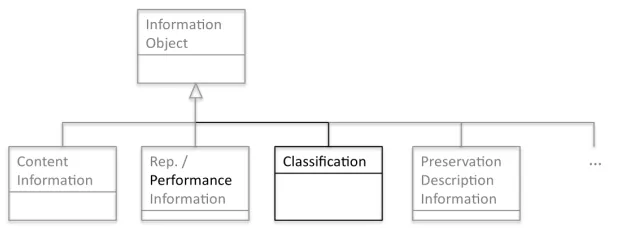
Knowledge, Significant Properties, or the OAIS’ combination of structure and semantics (see Figure 3). Typically, this last case requires the following information: Structure Representation Information and Semantic Representation Information. Whether this is a logical or a physical separation is a question of implementation. In the specific case of an implementation of Significant Properties on the basis of FRBR levels, using Knight and Pennock’s (2009) proposal, the four levels of the FRBR model may require four different Performance Information submissions. Since the Performance Information is an Information Object (see Figure 4), its own
Performance Information has to be provided according to the OAIS’ recursive provision.
Figure 3. The relationship between the Performance Information and the
Classification (UML diagram – extensions and modifications to the OAIS model are displayed in black).
Figure 4. The list of Information Objects.
12 The description of the digital record as a performance is discussed by Heslop, Davis and Wilson
Each Performance Information instantiation of the Classification Scheme is
independent on the data type. However, in the specific case of Significant Knowledge (the one for which we advocate), the focus on tacit knowledge is especially related to data collection methodologies. In this context, the relationship between Classification and data types may be part of the appraisal process.
Like Preservation Description Information and Performance Information,
Classification is an Information Object (see Figure 4). Consequently, it relates to its own specific Performance Information. Interestingly, if the Classification relies on Structure and Semantic Information, then the Performance Information of the Classification may provide the specification with the difference between these two entities. Generally speaking, a fundamental part of this Performance Information is the Classification Scheme. Another part of this Performance Information may be the categorization of the creative process provided by Boutard and Guastavino (2012b).13 The Classification Scheme specifies the model proposed, for instance Significant Knowledge. In this sense the Classification may be referred to as an instantiation of the Classification Scheme and the Classification Scheme as an implementation of the model. As an example of this, Boutard and Guastavino’s (2012a) survey provided an implementation of Significant Knowledge, that is to say a Classification Scheme, in the specific context of musical works with spatialization technology (see Figure 2). In the specific case of Performance Information that addresses the most explicit part of the Significant Knowledge’s Classification Scheme, this Performance Information could adequately relate to Costantopoulos and Dallas’ (2008) proposal of domain specific modelling. The Performance Information of this Performance Information (since Performance Information is an Information Object and therefore is recursive) is, in this context, the domain specific model for which they advocate.
Institutions have different needs. TRAC (Trustworthy Repositories Audit & Certification) observes that:
“Repositories are likely to differ the most in this area of ingest processes, depending on the type of material they collect and their relationships with its producers.” (CRL & OCLC, 2007).
The OAIS model considers that standards for ingest methodology used by an archive and for submission of digital data sources to an archive are outside its scope, but still acknowledges that they are required. We posit that the Classification Scheme is the first essential part of a potential ingestion framework. Accordingly, it needs to be specified with the Submission Agreement (see Figure 5) which the OAIS model refers to but does not model. In any event, the OAIS model needs to make explicit the relationship between the Submission Agreement and other entities. Furthermore, a Submission Agreement may relate to several Classification Schemes – for instance, Significant Knowledge in addition to the OAIS’ Semantic and Structure Information. Finally, a Preservation Description Information instance has to be provided with the Submission Agreement (see Figure 5) to account for “professional assumptions, concepts, and processes–the profession’s own metanarrative” (Cook, 2001).
13 In this sense, the Performance Information may account for various types of Information, such as
Figure 5. The Submission Agreement.
The specification of a Submission Agreement thus implies the provision of the Performance Information for every Classification that may be submitted in the context of this specific agreement, at least in this fundamental part of the Submission
Agreement that we call the Classification Scheme.
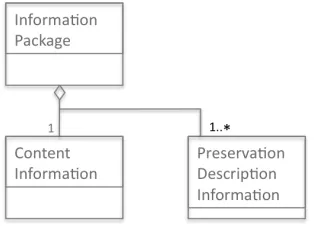
Figure 6. The Information Package content.
Since Performance Information is potentially instantiated several times, each instance has to be provided with corresponding Preservation Description Information. This implies a one-to-many aggregation relationship between the Information Package and the Preservation Description Information (see Figure 6). Thus each instance of Performance Information, which may be provided in various Submission Information Packages, relates to the relevant Provenance, Reference, Fixity and Context
Information.
A practical case that relates to our domain is the ingestion of the outcomes of a work session. The data is provided according to the Submission Agreement, which includes the classification scheme. It involves the current status of implementation of the sound processing software to be preserved14 as well as, potentially, video
recordings of the performers during appropriation phases, technological setup specifications such as the one provided in Figure 2, and so on. Several Submission Information Packages need to be provided, potentially, at different times. The
Administration entity of the OAIS model will confront each one of these Submission Information Packages with the Submission Agreement, in conformity with the OAIS model. Finally, an Archival Information Package will be constituted to reflect this work session. Each additional piece of information is a Performance Information instance, which relates to the Data Object – that is to say, the sound processing
software created during the work session. Each Performance Information instance relates to a Classification instance (see Figure 3) compliant with the Significant Knowledge’s Classification Scheme. This point is critical since all Performance Information instances require different data collection methodologies and therefore need to be appraised accordingly. The consideration of this additional piece of information as Performance Information, rather than another piece of Content Information, fundamentally emphasizes the semantic link between the Data Object and its Performance Information. This semantic link we have transformed with the term change from Representation Information to Performance Information.
This practical example reflects the lack of a longitudinal dimension of the model thus far. The model provides us with a relevant link between various submitted Information Objects, either Content Information or Significant Knowledge (i.e. a Performance Information instance together with the relevant Classification), in order to account for a specific work session. As Thibodeau puts it:
“Domain knowledge is also needed to understand records. [...] This common knowledge includes both specific empirical information about prior steps in a multi-step process, generic knowledge about the process, and expectations about both subsequent steps and the norms for recording and
communicating information about the process.” (Thibodeau,
2002).
Consequently, we still need to address the longitudinal dimension of the creative process, which we have shown here to be highly relevant. We need a higher level semantic relationship between Information Packages than the inclusion link that relates the Archival Information Collection’s Content Information to other Archival Information Packages.
Figure 7. The Archival Information Collection.
Creation of a work is a continuous process, and re-performances often imply technological migration. Each migration requires a new creative process, and thus a new production process lifecycle and knowledge lifecycle. Consistently with our previous statements, this leads to the development of a new Archival Information Collection. Therefore, the semantic link between collections has to be made explicit, which means providing adequate Context Information for each Archival Information Package. The Context Information needs to be specified according to a scheme; for example, the extensive framework provided by Lee (2011) or the InterPARES framework (Duranti & Thibodeau, 2006). Furthermore, the Context Scheme we advocate for should address stakeholders of the creative process in order to account for workflows. This has to be specified in relation to the Provenance Information and thus to a potential Provenance Scheme. As a consequence, a Preservation Description Scheme needs to be provided together with the Classification Scheme in the
Submission Agreement (see Figure 5), which in turn relates to an Archival Information Collection (see Figure 7). This Preservation Description Information Scheme is the second fundamental part of a potential ingestion framework. Similarly to the relationship between the Classification and the Classification Scheme, the Preservation Description Information Scheme provides the fundamental part of the Performance Information of the Preservation Description Information, since the Preservation Description Information is an Information object (see Figure 4).
Because of the potential ambiguity between Context Information and Provenance Information, we propose not to formalize in the model the occurrence of a separate Scheme for each Preservation Description Information constituent. In this sense, the InterPARES description of necessary constituent parts of every record, previously discussed, may be a relevant candidate for the Preservation Description Information Scheme insofar as the semantic of technological context is further specified. Indeed, this framework needs to emphasize the difference between Performance Information and both Provenance Information and Context Information. In order to do so, the technological context needs to be circumscribed to the engineering part – that is to say, it needs to provide similar functionalities to software versioning tools (the extent of which needs to be specified).
The relationship among AIPs, which reflects the longitudinal dimension of the creation process and its relevance to other creation processes may be adequately specified in the scope of the InterPARES documentary context, which is “manifested in, for example, classification schemes, records inventories, indexes, registers” (Duranti & Thibodeau, 2006). As suggested above, a relevant candidate for the implementation of this part of the context is FRBRoo.
Another potentially interesting part of the InterPARES framework, which may relate to Boutard and Guastavino’s categorization of the creative process, is the procedural context, which is “manifested in, for example, workflow rules, codes of administrative procedure” (Duranti & Thibodeau, 2006). Indeed, in the context of the creative process, it may support both production steps and workflows, which reflect the organizational management of institutions (whenever there is such a management). In this sense the production process lifecycle and the archival lifecycle are integrated.
“If a given preservation environment lacks a particular capability that a policy implies, the mapping from management policies to preservation capabilities will fail and the policy will devolve to an assertion that cannot be verified. This defines one essential component of a trustworthy preservation environment, that it support all capabilities required to implement assessment criteria.” (Smith & Moore, 2007).
In this sense the use of the Classification Scheme for the Significant Knowledge in conjunction with a detailed Preservation Description Information Scheme, based on the InterPARES framework, within the Submission Agreement, will improve the ingestion policies of institutions and support meaningful use of digital records.
Conclusion
The preservation of artistic works with technological components involves issues of readability, authenticity and intelligibility. Several projects address readability and authenticity issues while ignoring or minimizing the issue of intelligibility. Latour (1999) states that the more successful technologies become, accordingly, more obscure. As a consequence, we argue that intelligibility – and thus meaningful usability – is a critical concept for the preservation of digital technology. Indeed, intelligibility is especially relevant to records whose preservation relies on migration procedures and those that deal with performer-technology interactions, especially since issues of appropriation are more complex in the digital world. Thus a useful model needs to incorporate archival lifecycles, together with creative process
lifecycles, within a digital archives framework. In doing so, such a model may account for a relevant part of the knowledge interactions among multiple agents, both human and non-human, and provide the means to (re)create the work. We argue that
Performance Information, adequately associated with its relevant Significant Knowledge classification, provides a framework to capture these knowledge interactions and support the specification of data collection methodologies and ingestion policies.
With regards to the curation lifecycle, we emphasize the appraisal, ingest and transform phases, and provide an implementation of the concepts we present as relevant to address these issues. The model we propose relies on the specification of the OAIS Submission Agreement thanks to a Classification Scheme and Preservation Description Information Scheme. We propose to further specify these schemes respectively with the Significant Knowledge framework and the outcomes of the InterPARES project in terms of the necessary constituent parts of the digital record. The specification of the Classification Schemes, as well as the Preservation
Description Information Scheme, is a requirement for a policy-aware OAIS model, which supports ingest and appraisal throughout the archival lifecycle.
Acknowledgements
References
Bekiari, C., Doerr, M., & Le Boeuf, P. (Eds.). (2010). FRBRoo Model v1.0.1. International Working Group on FRBR and CIDOC CRM Harmonisation. Retrieved from
http://www.cidoc-crm.org/docs/frbr_oo/frbr_docs/FRBRoo_V1.0.1.pdf
Benghozi, P.J. (1995). Les sentiers de la gloire: savoir gérer pour savoir créer. In F. Charue-Duboc (Ed.), Des savoirs en action. Paris, France: L’Harmattan.
Bernardini, N. & Vidolin, A. (2005). Sustainable live electro-acoustic music.
Proceedings of Sound and Music Computing 2005. Salerno, Italy: Sound and Music Computing research community.
Boisot, M.H. (1995). Information space: A framework for learning in organizations, institutions and culture. London: Routledge.
Boisot, M.H. & Child, J. (1999). Organizations as adaptive systems in complex environments: The case of China. Organization Science, 10(3), 237-252.
doi:10.1287/orsc.10.3.237
Boisot, M.H. & Cox, B. (1999). The i-Space: A framework for analyzing the evolution of social computing. Technovation, 19(9), 525-536.
doi:10.1016/S0166-4972(99)00049-8
Boutard, G. & Guastavino, C. (2012a). Archiving electroacoustic and mixed music: significant knowledge involved in the creative process of works with
spatialisation. Journal of Documentation, 68(6), 749-771.
doi:10.1108/00220411211277028
Boutard, G. & Guastavino, C. (2012b). Following gesture following: Grounding the documentation of a multi-agent creation process. Computer Music Journal, 36(4), 59-80. doi:10.1162/COMJ_a_00147
Boutard, G., Guastavino, C. & Turner, J.M. (2012). Digital sound processing preservation: impact on digital archives. Proceedings of the 2012 iConference. Toronto, Canada. doi:10.1145/2132176.2132199
Brunsmann, J. & Wilkes, W. (2009). Enabling product design reuse by long-term preservation of engineering knowledge. International Journal of Digital Curation, 4(3), 17-28. doi:10.2218/ijdc.v4i3.114
Callon, M. (1981). Pour une sociologie des controverses technologiques. Fundamenta Scientiae, 12(4), 381-399.
Canazza, S. & Vidolin, A. (2001). Introduction: Preserving electroacoustic music.
Center for Research Libraries (CRL) & Online Computer Library Center (OCLC). (2007). Trustworthy Repositories Audit and Certification (TRAC). Criteria and Checklist (Technical Report No. 1.0). Chicago, IL: OCLC & CRL. Retrieved from http://www.crl.edu/PDF/trac.pdf
Consultative Committee for Space Data Systems. (2002). Reference model for an Open Archival Information System (OAIS). Recommendation for Space Data System Standards. CCSDS Blue Book.
Consultative Committee for Space Data Systems. (2009). Reference model for an Open Archival Information System (OAIS). Recommendation for Space Data System Standards. CCSDS Pink Book.
Constantopoulos, P. & Dallas, C. (2008). Aspects of a digital curation agenda for cultural heritage. Proceedings of the 2008 IEEE International Conference on Distributed Human-Machine Systems. Athens, Greece: IEEE.
Constantopoulos, P., Dallas, C., Androutsopoulos, I., Angelis, S., Deligiannakis, A., Gavrilis, D., Kotidis, Y., et al. (2009). DCC&U: An extended digital curation lifecycle model. International Journal of Digital Curation, 4(1), 34-45.
doi:10.2218/ijdc.v4i1.76
Cook, T. (2001). Fashionable nonsense or professional rebirth: Postmodernism and the practice of archives. Archivaria, 51, 14-35.
Cunningham, A. (2008). Digital curation/digital archiving: A view from the National Archives of Australia. The American Archivist, 71(2), 530-543.
Dappert, A. & Farquhar, A. (2009). Significance is in the eye of the stakeholder.
Proceedings of ECDL 2009. Corfu, Greece.
Donin, N. & Theureau, J. (2007). Theoretical and methodological issues related to long term creative cognition: the case of musical composition. Cognition, Technology & Work, 9(4), 233-251. doi:10.1007/s10111-007-0082-z
Drummond, J. (2009). Understanding interactive systems. Organised Sound, 14(2), 124-133. doi:10.1017/S1355771809000235
Duranti, L. & Thibodeau, K. (2006). The concept of record in interactive, experiential and dynamic environments: The view of InterPARES. Archival Science, 6(1), 13-68. doi:10.1007/s10502-006-9021-7
Giaretta, D., Matthews, B., Bicarregui, J., Lambert, S., Guercio, M., Michetti, G. & Sawyer, D. (2009). Significant properties, authenticity, provenance,
representation information and OAIS. Proceedings of the international
Gladney, H.M. (2006). Principles for digital preservation. Communications of the ACM, 49(2), 111-116. doi:10.1145/1113034.1113038
Gladney, H.M. (2009). Long-term preservation of digital records: Trustworthy digital objects. The American Archivist, 72(2), 401-435.
Glaser, B.G. & Strauss, A.L. (1967). The discovery of grounded theory: Strategies for qualitative research. Chicago, IL: Aldine Publishing.
Hedstrom, M. & Lee, C. (2002). Significant properties of digital objects: definitions, applications, implications. Proceedings of the DLM-Forum 2002. Luxembourg: Office for Official Publications of the European Communities.
Heslop, H., Davis, S. & Wilson, A. (2002). An approach to the preservation of digital records. Canberra: National Archives of Australia. Retrieved from
http://www.naa.gov.au/Images/An-approach-Green-Paper_tcm16-47161.pdf
Higgins, S. (2008). The DCC curation lifecycle model. International Journal of Digital Curation, 3(1), 134-140. doi:10.2218/ijdc.v3i1.48
Hockx-Yu, H. & Knight, G. (2008). What to preserve? Significant properties of digital objects. International Journal of Digital Curation, 3(1), 141-153.
doi:10.2218/ijdc.v3i1.49
International Federation of Library Associations (IFLA). (1998). Functional
requirements for bibliographic records (Final report). München: IFLA. Retrieved from http://www.ifla.org/files/cataloguing/frbr/frbr.pdf
Knight, G. & Pennock, M. (2009). Data without meaning: Establishing the significant properties of digital research. International Journal of Digital Curation, 4(1), 159-174. doi:10.2218/ijdc.v4i1.86
Latour, B. (1994). On technical mediation: Philosophy, sociology, genealogy.
Common Knowledge, 3, 29-64.
Latour, B. (1999). Pandora’s hope: Essays on the reality of science studies. Cambridge, MA: Harvard University Press.
Latour, B. (2005). Reassembling the social: An introduction to actor-network-theory.
New York, NY: Oxford University Press Inc.
Lee, C.A. (2011). A framework for contextual information in digital collections.
Journal of Documentation, 67(1), 95-143. doi:10.1108/00220411111105470
Lee, B. (2000). Issues surrounding the preservation of digital music documents.
Leman, M. (2010). Music, gesture, and the formation of embodied meaning. In R.I. Godøy & M. Leman (Eds.) Musical Gestures: Sound, Movement, and Meaning.
New York, NY: Routledge.
MacNeil, H.M., & Mak, B. (2007). Constructions of authenticity. Library Trends, 56(1), 26-52. doi:10.1353/lib.2007.0054
Magnusson, T. (2009). Of epistemic tools: Musical instruments as cognitive
extensions. Organised Sound, 14(2), 168-176. doi:10.1017/S1355771809000272
Matthews, B., Shaon, A., Bicarregui, J. & Jones, C. (2010). A framework for software preservation. International Journal of Digital Curation, 5(1), 91-105.
doi:10.2218/ijdc.v5i1.145
Muñoz-Viñas, S. (2005). Contemporary theory of conservation. Oxford, Burlington, MA: Elsevier Butterworth-Heinemann.
Pennock, M. (2007). Digital curation: A lifecycle approach to managing and preserving usable digital information. Library & Archives, 1.
Rothenberg, J. (2000). Preserving authentic digital information. In C.T. Cullen, P.B. Hirtle, D. Levy, C.A. Lynch & J. Rothenberg (Eds.) Authenticity in a Digital Environment. Washington, DC: Council on Library and Information Resources.
Rowe, R. (1993). Interactive music systems: Machine listening and composing. Cambridge, MA: MIT Press.
Sacchi, S., Wickett, K., Renear, A. & Dubin, D. (2011). A framework for applying the concept of significant properties to datasets. Proceedings of ASIS&T 2011 Annual Meeting. New Orleans, LA.
Smith, M. & Moore, R.W. (2007). Digital archive policies and trusted digital repositories. International Journal of Digital Curation, 2(1), 92-101.
doi:10.2218/ijdc.v2i1.16
Stiegler, B. (2003). Bouillonnements organologiques et enseignement musical. Des outils pour la musique, Les dossiers de l’ingénierie éducative. Chasseneuil du Poitou: CNDP.
Thibodeau, K. (2002). Knowledge and action for digital preservation: Progress in the U.S. Government. Proceedings of DLM-Forum 2002. Barcelona, Spain.
Verfaille, V., Guastavino, C. & Traube, C. (2006). An interdisciplinary approach to audio effect classification. Proceedings of the 9th DAFx (Digital Audio Effects) Conference. Montreal, Canada.
Winget, M.A. (2011). Videogame preservation and massively multiplayer online role‐playing games: A review of the literature. Journal of the American Society for Information Science and Technology, 62(10), 1869-1883.
doi:10.1002/asi.21530
Yakel, E. (2007). Digital curation. OCLC Systems & Services, 23(4), 335-340.
doi:10.1108/10650750710831466
Yong, K. (2006). Electroacoustic adaptation as a mode of survival: Arranging Giacinto Scelsi’s Aitsi Pour Piano Amplifée (1974) for piano and computer.
Organised Sound, 11(03), 243-254. doi:10.1017/S1355771806001567
Zander, U. & Kogut, B. (1995). Knowledge and the speed of the transfer and imitation of organizational capabilities: An empirical test. Organization Science, 6(1), 76-92. doi:10.1287/orsc.6.1.76
Zattra, L. (2007). The assembling of Stria by John Chowning: A philological investigation. Computer Music Journal, 31(3), 38-64.