Progresos en el nivel de inglés de estudiantes universitarios
a través de un curso basado en contenido
Erica Gómez Flórez
[email protected]Jhon Jaime Jiménez Díaz
[email protected]Sergio Alonso Lopera
[email protected] Universidad de Antioquia, Medellín – ColombiaContent-Based Instruction (CBI) may result in improved proficiency in language skills due to the meaningful combination of subject matter and foreign language as a means of communication. This paper shows how university students improved their level of English by means of a content methodology as they attended a course called Topics in Molecular Microbiology. The course was a collaborative enterprise between the School of Microbiology and the School of Languages at a public university. The methodology used was a case study. Five instruments and theMELICETtest were used and analyzed in order to check students’ language gains. The findings support that seven undergraduate students improved their speaking and listening skills. Finally, this study offers two implications: Universities should offer more CBIcourses; language teachers and content teachers should work collaboratively.
Key words:CBI, English language improvement, listening and speaking skills
La enseñanza basada en contenidos es beneficiosa en el aprendizaje de un idioma. El presente ar-tículo muestra cómo los estudiantes universitarios mejoraron su nivel de inglés por medio de la metodo-logía de contenido cuando ellos asistían a un curso de Microbiometodo-logía Molecular. El curso fue un trabajo colaborativo entre la Escuela de Microbiología y la Escuela de Idiomas de una universidad pública. La metodología utilizada fue un estudio de caso y se utilizaron cinco instrumentos y la pruebaMELICET
implicaciones: las universidades deberían ofrecer más cursos basados en contenidos, los profesores de idiomas y los profesores de contenido deberían trabajar colegiadamente.
Palabras clave:habilidades de escucha y habla, instrucción basada en contenido, mejora en el idioma inglés
Introduction
In this paper, researchers support how undergraduate students improved through a Content Based Instruction (CBI) course taught in English as a Foreign Language (EFL). Researchers focused on an elective course in microbiology called “Topics in Molecular Microbiology” for undergraduate students in a public university. Language faculty, English teachers from the School of Languages, and non language faculty, professors from the School of Microbiology, worked collaboratively in this content approach. Non language faculty taught the content component and language faculty taught the English component as suggested in the simulated adjunct model (Brinton & Jensen, 2002). This model entails the connection of a regular mainstream content course with an English as a Second Language (ESL) course. The language part supports and complements students’ learning of content.
This article is organized in five parts: one, the literature review; two, the context; three, the methodology and data collection and analysis; four, the findings. Finally, the conclusions, implications, and suggestions for further research are given.
Literature Review
In the adjunct model, Brinton and Jensen (2002) support the way students are enrolled in a course which is coordinated by two agents: content teachers and language teachers. The shared content base links the participants, and, teachers complement each other with mutually coordinated assignments. In this model, students work with content material which is given in a meaningful or contextualized form with the objective of acquiring information using a foreign or second language as a medium of communication. Then, the goal of this model is to integrate content and language parts leading to the use of cognitive skills.CBIis recognized as one of the ways to apply this model.
have to discuss issues with the vocabulary and discourse of content. Moreover, teachers must be aligned with curriculum standards.
There are also different reasons that these academic settings adopt this approach. The first reason is thatCBIin second and foreign language teaching helps students not only to acquire the subject matter of a specific area but also the language because they learn a language within the context of a specific academic subject leading to be beneficial (Wachs, 1996). In fact, Kasper (1994) carried out an empirical study in which the researcher involved mainstream psychology classes at a community college andESLstudents in pairedESLreading classes. In paired classes students are enrolled not only in anESLcourse but also in a mainstream content course (in this case psychology). Both content teachers and ESLteachers coordinate and work together to develop parallel materials and assignments. The results showed that the students in the paired classes scored significantly higher on the final reading assessment test than those who were only in the ESL reading class. In a follow-up study, Kasper (1997) took track of the same students and concentrated on their performance in reading and writing. The researcher showed that the students from paired classes scored higher on both reading and writing assessment tests. Another example that shows the effectiveness of CBI was carried out in a high school in Colombia. Chala and Pedraza (2003) found that students were interested in participating, their motivation increased, and they preferred working as a team when foreign language (FL) students followed this approach. Finally, another study that supports the benefits ofCBIis one at the university level in Colombia. Monsalve, Montoya, Posada and Serna (2005) carried out a study at Universidad Pontificia Bolivariana and found that CBIoffered scenarios in which content and language learning can be articulated positively inEFLclassrooms.
Another reason is the integration of skills. When L2 students attend a content course they have to communicate their ideas in oral or written forms. Additionally, they have to read material and listen to their teacher and peers. The integration of language skills takes place when working with this approach (Oxford, 2001; Nunan, 2004).
The last reason is about motivation. Interest in the content of the course leads to intrinsic motivation (Crookes & Schmidt, 1991). Students who are highly motivated make greater mental elaborations with the topic which is presented in the materials, and they not only improve their connections but also recall information better.
Context of the Study
only in America but also on other continents and has been projected to being one the best universities in Latin America. To achieve this distinction, students have to show some proficiency in a foreign language in order to graduate. The university offers undergraduate students two ways to learn English: reading comprehension courses (2 levels of 80 hours each), which are mandatory, and the possibility of taking courses of integrated skills (5 levels, 80 hours each) at “Programa Multilingua”. Also, many undergraduate and graduate courses include mandatory papers in English. This is a regular practice in the programs from the hard sciences and health. On the other hand, students mainly develop their communicative competence required to speak, listen and write at Programa Multilingua. This is not mandatory and students who score high grades in their undergraduate programs can enroll in this program.
The directors of the School of Languages and the School of Microbiology agreed on offering an English course for undergraduate students in their academic fields after the reading courses or the Multilingua program. The objective was to give students the option to continue studying English. Then, both language faculty and non-language faculty decided to work collaboratively and designed the elective course called “Topics in Molecular Microbiology” which both faculties teach in English. The language faculty researchers designed a strategy for content professors that included a 20-hour framework for mentoring
CBIteaching and language teaching strategies to be applied in the course. The following teaching methodologies were included in the class sessions: use of body language, group work, class management, strategies for confirmation, visual aids, realia, involvement of students, and background knowledge.
The course of four assigned class hours weekly lasted a total of 16 weeks. The course was programmed for two days, and each faculty worked a two-hour session. Based on the syllabus, the topics the content language faculty worked wereDNAStructure and Isolation,
PCR: Basic Principles, Nucleic Acid Labeling, Restriction Enzymes-DNACloning Strategies, and Recombinant Microorganisms.
On the other hand, the School of Languages was in charge of teaching the language part and prepared different activities for students. For instance, they had to write a paragraph developing a prompt or an abstract, they had to make and present a poster, and they had to give their points of views when they were asked to critique a situation. They also played games, listened to lectures and other listening material, and reported sequential events. Students received support from language teachers to accomplish those activities successfully.
Students’
Selection
oral and a written test. In the oral part, the researchers used a storytelling book in order to assess students’ ability to express ideas, use vocabulary, evidence coherence and the understanding of questions. In the written part, researchers used a picture to assess students’ sentence structure, coherence and vocabulary. The students who scored at least 60 over 100 points in both instruments were accepted. Six students out of eleven obtained the scores. One of the students who did not succeed talked to the researchers asking for the opportunity to take the course. He was so motivated and committed that the researchers decided to give him a chance to be in the class. There were 3 women and 4 men whose ages ranged from 20 to 25 years, and they were in the last year of their undergraduate program. They were all members of research groups in their areas.
Professors and
Researchers
Three professors from the non language faculty were in charge of designing and teaching the content part of the course (1 Post PhD, 2 MSs)- 2 women and 1 man. It is important to highlight the motivation, availability, willingness, and effort of these professors to design, program, and teach the topics of the content course in English. They were willing to participate because it was their first time teaching this course in English. On the other hand, two teachers from the language faculty were in charge of teaching the language part (1 graduate teacher, 1 pre-service teacher). The research group was composed of 11 members (1 PhD, 2 MAs, 5 graduate professors, and 3 pre-service teachers).
Methodology
The research question that guided our analysis for this particular course was:“What language improvement do students evidence after taking a CBI course?”
this research strategy because it helped them to analyze and support the issues about language improvement of this course.
Data Collection
Data were collected using the following techniques:
Focus group.A focus group is a qualitative research technique in which a group of people are asked about their perceptions, opinions, beliefs and attitudes about an issue, in this case, about the course. In this focus group students talked about the strengths and weaknesses of the process of learning and about improving their level of English as well as about the advantages and disadvantages of the course. They also talked about their personal feelings and gave recommendations for future content courses. This technique (Debus, 1990; Palmer 1994; Stewart & Shamdasani, 1990) helped researchers to learn of students’ experience in the content course they took in English at the end of the course. This meeting was audio recorded.
Class observations. Classroom observation is a technique that allows the researchers to assess classroom issues such as teaching, behaviors, and interactions (Brown, 1994). Researchers observed almost all the content and language sessions to assess the development of the CBI and to have a more general view of the students’ language improvement. Researchers designed an instrument to observe the sessions (see Appendix 1) and they took turns observing. They focused their observation on questions and answers, production of language, interaction between the teacher and students (among students, too), and group activities. Researchers tracked participation for each student and the observations were categorized and compared.
Storytelling.Researchers asked the students to tell the story presented in the pictures of an illustrated book. There was no time limit for narrating the story. The researchers recorded and transcribed the students’ narrative for further assessment. The aim of this instrument was to assess students’ oral language performance at the beginning and at the end of the course. Researchers followed theACTFLguidelines (American Council of the Teaching of Foreign Languages). The scale in theACTFL describes different levels of language proficiency for assessing speaking, writing, listening, and reading (Omaggio, 1993, p. 502). Researchers only used the scale for speaking for this technique. This scale offers a variety of levels in speaking: novice low, mid and high; intermediate low, mid and high; and advanced low, mid and high. This description is helpful in order to set language learning goals, communication functions, and assess language ability.
was a black and white image and there were no words on it. Students had 20 minutes to write the description.
Standardized MELICET test. The Michigan English Language Institute College Entrance Test (MELICET) is a test in which non-native speakers of English are tested under the same conditions. The test has three main parts: Listening, in which students are to answer 50 questions in 25 minutes. The second part is a combination of grammar, vocabulary, cloze, and reading; this section has 130 questions and test takers have 90 minutes to answer. The third part is an oral interview that takes from 10 to 15 minutes. The objective of this technique was to apply the pre-experimental design.
Self-assessment.Students ranked their English language skills based on a can-do scale adapted from Gardner (1985), which goes from 0 to 5. The equivalent in language performance is 0=bad, 1=poor, 2=fair, 3=good, 4=very good, 5=excellent. The students had to assess their performance in oral, listening and reading skills at the beginning and at the end of the course. The objective of this technique was to ask the students to self-verify the process of learning.
Data Analysis
Following the interpretive approach, researchers created categories based on their epistemological assumptions (Merriam, 1998). These categories were consequently modified to better reflect on the data collected. The data collected were analyzed quantitatively and qualitatively. The researchers scored the picture description and the story telling individually and based their analysis on the scales proposed by theACTFL. Then, to guarantee reliability, they compared and tallied all the analyses in order to determine the final assessment of each student.
Findings
The analysis of each language skill supports students’ evidencing improvement after taking the CBI course in English.
Speaking
Data obtained from the storytelling, the self-assessment, the class observations, and the students’ perceptions given in the focus group session showed that students’ ability to speak English improved greatly. The MELICET interview did not show a general significant improvement among the students but it showed individual improvement in two students.
researchers did not take this student into account in the analysis. The results showed that one of the students went down a scale. Another student’s language performance remained the same. Four of the students gained between one to four scales (see Table 1).
Table 1.Scales in storytelling
Students 1st description (July 2005 )
2nd description
(Nov. 2005) Gains
Student 1 Novice mid Novice high gained 1 scale
Student 2 Novice mid Novice low went down 1 scale
Student 3 Intermediate high Intermediate high remains the same
Student 4 Novice mid Novice high gained 1 scale
Student 5 Novice mid Intermediate high gained 4 scales
Student 6 Novice mid Intermediate mid gained 3 scales
Student 7 Novice mid did not take the second description XXX
The general analysis revealed improvement in two areas: Students used more complete sentences in their descriptions and their precision of the language increased. Most of the students were able to express their ideas in a precise way. This is the result of the fact that students had to participate in conversations, had to present material to their colleagues, and had to give their points of view during the course. The oral exercises allowed them to have a great amount of output that they had not previously had in their classes.
As mentioned in the students’ selection part, researchers gave a student a chance to enroll in the course although he did not succeed in the placement test (student 5). Nevertheless, he gained four scales due to his motivation.
Self-assessment analysis.The average result of the first self-assessment speaking test in Figure 1 was 2.94, the standard deviation was 0, 68.
by the self-assessment instrument. Researchers also confirmed this when they transcribed the focus group. One of the students assessed himself in speaking and said:
…I had improved in speaking because it was a small group and I had more
opportunities to speak. All of these gave us the chance to practice the oral
language leading me to improvement
(Student 3, focus group, December 12, 2005).Also, the analysis of the class observation formats showed improvement in class participation, which was reflected in more elaborate questions and more complete sentences during the course. At the beginning of the course, students did not participate very often in oral activities but after a while they did participate in activities in which they had to give their points of view. Also, they had to solve a problem or react to an issue. They had to take turns telling ideas, too.
At the beginning researchers tracked in their observation formats that one of the students asked for clarification: “Teacher, repeat please”, and at the end of the course the same student asked for clarification in a more elaborate way: “Hey, teacher, it is quite complex and I do not understand that, can you repeat that again?” (Researcher 2, class observation, June 8 and November 13, 2005).
In short, theCBIapproach helped students to improve their speaking of the language. As a result, the simulated adjunct model led the students to improve in the speaking skill.
MELICETtest - speaking.The average result of the first interview in Figure 2 was 51.86, the standard deviation was 7.37.
The average result of the second “interview” test was 54.43, the standard deviation was 7.46, the average percentage gain was 2.57% and the individual one was 3.66%. The
difference between the results in both tests was not significant since the value of the T-Student was 0.14 (>0.05). Although the results in both tests were not significant, it is important to highlight that students 1 and 5 showed great improvement in speaking. Again, student 5 showed great improvement in the interview due to his motivation as he expressed himself in the focus group:
… eh, I felt I had improved in some skills, my main difficulty was speaking I
think that I improved so much in that, right? (Student 5, focus group, December
12, 2005).
Listening
Data obtained from the self-assessment, theMELICETtest, the class observations, and the students’ perceptions presented in the focus groups sessions showed that their ability to listen to English had improved.
MELICET test - listening. The average result of the first listening comprehension
MELICETtest in Figure 3 was 50.29, the standard deviation was 6.11; the average result of the second test was 52, the standard deviation was 7.46; the average percentage gain was 1.71% and the individual one was 2.36. The difference between the results in both tests was significant since the value of the T-Student was 0.032 (<0.05).
The average result of the first “self-assessment listening test” in Figure 4 was 2.40, the standard deviation was 0.95. The average result of the second “self-assessment listening test”
was 3.14, the standard deviation was 0.95. The average percentage gain was 0.74% and the individual one was 48.21%. The difference between the results in both tests was significant since the value of the T-Student was 0.004 (<0, 05).
In the qualitative part, the analysis of theclass observationformats showed improvement in listening, reflected also in more comprehension of listening material. At the beginning, some of them had some problems understanding the teacher’s talk but after interacting with the teacher, their listening improved. In the observation formats researchers tracked this issue: “Students constantly interrupted the teacher to clarify his speech”. As the course advanced,
Figure 3. Listening comprehension
researchers noticed that students lessened their interruptions of the teacher: “It is observed that students now pay more attention and do not interrupt quite often the teacher in order to clarify his speech, but to complement the topic.” (Researcher 4, class observation, September 7, 2005).
In thefocus group, students also expressed that they had improved in listening; one of the students said:
…I think that the methodologies were good and at the end we noticed that we
had improved listening and speaking… personally, I improved in the
communicative skills in English. (Student 1, focus group, December 12, 2005).
All students attended the sessions and their listening to content lectures in English improved. Also, the development of the listening exercises in the language component allowed them to have a great amount of audio input that they had not had before in their classes. Finally, the results presented in the previous information validate that students improved considerably in listening.
Writing
Data obtained from picture description, the class observations, and the focus groups sessions showed that students had experienced some improvement writing in English.
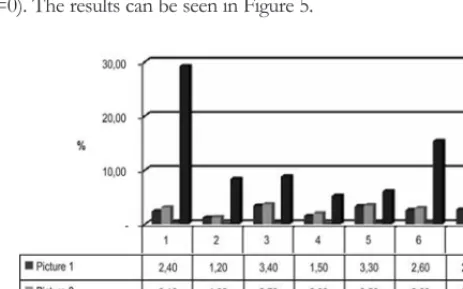
Picture description.Researchers scored this instrument following the composition scoring scheme and sample grades proposed by Gaudiani (1981, cited by Omaggio, 1993). The scale goes from 0 to 4 and letters are also given as equivalent conversion proposed by the author (A=4, B=3, C=2, D=1, F=0). The results can be seen in Figure 5.
The average result of the first “picture description” test in Figure 5 was 2.5, the standard deviation was 0.77. The average result of the second test “picture description” was 2.8, the standard deviation was 0.85. The average percentage gain was 0.30% and the individual one was 12.02%. The difference between the results in both tests was significant since the value of the T-Student is 0.008 (<0.05).
In the qualitative analysis, researchers examined in a detailed way the students’ composition and found that students wrote clear ideas about the picture and gave details and reasons in support of the image. They also gave some points of view and created more stories and a new character especially, in the second description (see Appendix 2 for comparison)
Also, researchers took some samples of prompts and analyzed them. Gains in vocabulary use and variety, longer and more accurate sentences were evident in the analysis of the prompts (see Appendix 3)
In thefocus group, students also expressed their having improved in writing; one of them said:
…I liked the activities with prompts because it helps you develop your writing. (Student 6, focus group, December 12, 2005).
The improvement was the result of the practice in writing introduced in the language component. Students were asked to write short essays using some prompts. Before theCBI
experience, they had barely written a composition in English. Additionally, in the language component, they were trained to write abstracts in their field. As a result, CBIinstruction helped students to improve in writing.
Reading
Data obtained from theMELICETtest, and the self-assessment showed that students did not experience significant improvement in reading in English; the results can be seen in Figure 6.
The average result of the first “grammar, cloze vocabulary & reading test” in Figure 6 was 46.29, the standard deviation was 10.64; the average result of the secondMELICETtest was of 49.71, the standard deviation was 10.06; the average of percentage gain was 3.43%, and the individual one was 5.81%. The difference between the results in both testswas not significant
since the value of the T-Student was 0.15 (>0, 05).
frequent, but mandatory. As students usually read materials in their fields, there was not much evidence of improvement in this skill.
The average result of the first “self-assessment reading test” in Figure 7 was 3.31, the standard deviation was 0. 61. The average result of the second “self-assessment reading test” was 3.89, the standard deviation was 0.56. The average percentage gain was 0.57% and the individual one was 19.8%. The difference between the results in both tests was not significant since the value of the T-Student is 0.054 (>0.05).
Figure 6. Grammar, cloze, vocabulary and reading
General Results in
MELICET
Test
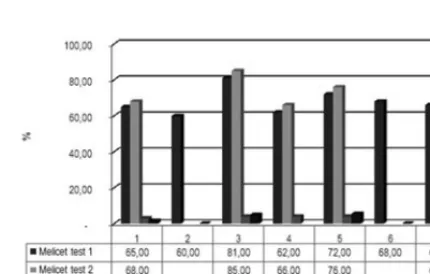
Figure 8 shows that for students who took the test, the average general score of the firstMELICETtest was 67/100 points (sd 7.04). The average general score of the second
MELICETtest was 72.4 (sd 8.08). The average percentage gain for all students was 3.2% and the individual one was 4.62%. The difference between the results in both tests was significant since the value of the T-Student is 0.00537 (<0.05). It means that the CBI
approach had a positive influence in the scores obtained by the students in theMELICET
test for the measured skills as the analysis of the significance is below the accepted error (95% or 0.05%).
As a conclusion, the integration of language and content had a positive effect on students because they improved in language skills, especially in speaking and listening which is validated by the six data collection techniques.
Conclusions and Pedagogical Implications
CBIwas useful because it helped undergraduate students improve their language (L2). The courseTopics in Molecular MicrobiologybenefitedEFLuniversity students in that their level of language in speaking and listening improved significantly and this is validated not only by the qualitative analysis but also the quantitative one.
The focus group, the class observations and the self-assessment instruments support qualitatively that students improved in language. Vocabulary use and variety, longer and more accurate sentences, and participation in class discussions are the most important aspects regarding speaking. In the listening part, students improved because it was evident they had
some problems understanding the teacher’s talk at the beginning of the course, but after interacting with the teacher, their listening part improved. The general structure of the instruments analyzed (Focus group, class observations, storytelling, picture description, self-assessment, and standardizedMELICETtest) validated average percentage gain as well as individual gains.
Finally, there are two implications in this study that need to be addressed: Based on the improvement in listening and speaking obtained by the undergraduate students who participated in the project, we feel universities in Colombia should promote more courses based on CBI because they represent a great gain for the development of their EFL
students’ linguistic skills. Also, this methodology helps the learner to use the language to fulfill a real purpose in his/her area of study.
The second implication requires bothEFLlanguage teachers and content teachers to integrate themselves through collaborative work in order to give students the option to learn content through the English language. When usingCBI, teachers should take into account the following issues (Met, 1999):
•
Make sure that students learn the content of the course as well as the language part•
Give students the elements for the discourse styles and language tools for their fields•
Enhance language learning by selecting motivating topics•
Also, enhance language learning by providing meaningful language practice opportunities by using different topicsSuggestions for Further Research
Researchers supported students’ improvement mainly in listening and speaking and suggest that language teachers should develop different reading and writing activities in order to analyze the improvement in each skill. Also, faculties should program moreCBI
courses during each academic semester and monitor the impact at the end of the program. Finally, researchers suggest that CBIcourses should be applied to different academic areas such as human sciences in order to see its impact.
References
Brinton, D. M. & Jensen, L. (2002). Appropriating the adjunct model: English for academic purposes at the university level. In J. Crandall & D. Kaufman (Eds.),Content-based instruction in higher education settings(pp. 125-138). Alexandria,VA: TESOL.
Chala, P. & Pedraza, D. (2003). Establishing cross-curricular links between Science and English in ninth grade.PROFILE Issues in Teachers’ Professional Development,4(1), 66-81.
Cresswell, J. W. (2007). Qualitative inquiry and research design:Choosing among five approaches. Thousand Oaks: Sage Publications Inc.
Crookes, G. & Schmidt, R. (1991). Motivation: Reopening the research agenda.Language Learning,
41(4), 469-512.
Debus, M. (1990). Handbook for excellence in focus group research. Washington, DC: Academy for Educational Development.
Dooley, L. (2002).Case study research and theory building. Advances in Developing Human Resources,
4(3), 335-354.
Gardner, R. (1985).Social psychology and second language learning: The role of attitudes and motivation. London: Edward Arnold.
Grabe, W. & Stoller, F. L. (1997). Content-based instruction: Research foundations. In Snow, M. A. & Brinton, D. M. (Eds.),The content-based classroom: Perspectives on integrating language and content
(pp. 5-21). New York: Longman.
Hernández, R., Fernández, C. & Baptista, P. (2003). Metodología de la investigación. México: McGraw-Hill Interamericana.
Kasper, L. F. (1994). Improved reading performance for ESL students through academic course pairing.Journal of Reading,37(5), 376-384.
Kasper, L. F. (1997). The impact of content-based instructional programs on the academic progress of ESL students.English for Specific Purposes,16(4), 309-320.
Merriam, S. (1998). Qualitative research and case study applications in education. San Francisco, CA: Jossey-Bass Publishers.
Met, M. (1999). Content-based instruction: Defining terms, making decisions. Retrieved from: http://www.carla.umn.edu/cobaltt/modules/principles/decisions.html
Monsalve, M., Montoya, P., Posada, C., & Serna, H. (2005). Articulating English to specific content areas at Pontificia Bolivariana University.Colombian Applied Linguistic Journal, 7, 130-148. Nunan, D. (2004).Task based language teaching.Cambridge: Cambridge University Press. Omaggio, A. (1993).Teaching language in context. Boston: Heinle and Heinle.
Oxford, R. (2001). Integrated skills in the ESL/EFL classroom. Retrieved from: http://www.cal.org/resources/digest/digest_pdfs/0105-oxford.pdf#search
Palmer, J. (1994). Focus group applications in higher education: Selected ERIC references.Journal of Applied Research in the Community College,2(1), 75-89.
Stewart, D. W. & Shamdasani, P. N. (1990). Focus groups: Theory and practice. Newbury Park, CA: Sage Publications.
Tellis, W. (1997). Introduction to case study. Retrieved from: http://www.nova.edu/ssss/ QR/QR3-2/tellis1.html
Wachs, S. (1996). Leaving the room: An introduction to theme-based oral English. Retrieved from: http://iteslj.org/Techniques/Wachs-ThemeBased.html
The Authors
Erica Gómez Flórez, MA in French literature, Rouen-France University; specialist in teaching French as a foreign language, Bourgogne-French University. She is a full time professor at Universidad de Antioquia. Her research interest is teaching reading comprehension.
John Jiménez Díaz, PhD candidate in education, Universidad de Antioquia; MA in didactics of teaching English, Universidad de Caldas; specialist in teaching foreign languages, Universidad de Antioquia. He is a professor at Universidad de Antioquia. His research interest is teaching reading strategies.
Sergio Lopera Medina, PhD student in linguistics; MA in linguistics; specialist in teaching foreign languages, Universidad de Antioquia. He is a full time professor at Universidad de Antioquia. His research interests are teaching EFL reading comprehension, compliments in pragmatics.
Appendix 1
Proyecto: Enseñanza de inglés basada en contenidos
(Content-based teaching) en los pregrados de la Universidad
Observación Nº____
Profesor: N° de estudiantes:
Curso: _____________________
Fecha: aula: hora:
Observador:
Aula Agenda Recursos
Tiempo
Actividades, Actitudes, Interacciones Comentarios y preguntas