Nery Yolanda Ruíz de Guerrero
Gladis Leonor Arias Rodríguez
[email protected] Universidad Santo Tomás – Tunja
The purpose of this study was to observe and describe the effects of applying extensive reading to a group of fifth level English students at Universidad Santo Tomás de Aquino and be accepted into the English Program. This project provided a confidential atmosphere for students to develop extensive reading practice based on different texts; it was characterized by students’ free and controlled reading in which they had the opportunity to make their own choices under the supervision of the teacher. Data were gathered through teachers’ journals, students’ oral reports and interviews given to them; in this way the categories which emerged wereextensive reading contributions in the process of second language acquisition, extensive reading as motivation in the reading practice, and the importance of including extensive reading in the English program.
Key words:extensive, reading, oral, written, reports, free, controlled, motivation
El propósito de este trabajo fue observar y describir los efectos de aplicar lectura extensiva a un grupo de estudiantes de quinto nivel de Inglés de la Universidad Santo Tomás de Aquino dirigido a hacer parte del programa de inglés. Este proyecto proporcionó a los estudiantes un ambiente adecuado para el desarrollo de lectura extensiva por medio de diferentes textos; el cual se caracterizó por la práctica de lectura libre y controlada, donde los estudiantes tenían la oportunidad de tomar sus propias decisiones bajo la supervisión del docente. La información fue recolectada a través del diario del docente, reportes orales y escritos de los estudiantes y las entrevistas aplicadas a los mismos.
Introduction
As teachers at Universidad Santo Tomás de Aquino, we have the experience to teach English to students in different programs and we observed their interest in developing reading with more intensity. It enhanced us to think that reading is a relevant tool, which is necessary for development in the classroom; then we focused our attention on observing the effects of extensive reading to be used as a part of the English program. This was done under the parameters of a descriptive case study.
The idea came from the need of a fifth level group of English students who wanted to improve their abilities in reading high level texts in English, acquiring reading strategies useful for their lives as professionals and, at the same time, learning new ways of acquiring knowledge.
Literature Review
Three main topics were essential to analyze the effects of extensive reading in the context of this research: extensive reading definitions and characteristics, learning styles in extensive reading and the integration of extensive reading into the English programs.
Extensive Reading Definitions and Characteristics
Reading has been the most emphasized skill in traditionalFL(Foreign Language) teaching. Universities usually emphasize intensive reading procedures which include short passages, syntactic, semantic and lexical analysis and also translation; nowadays,
extensive readingopens our minds to work beyond the classroom where students have the opportunity to choose their own materials and are not limited by grammar contents. This kind of reading is not only developed in class but also at students’ homes, in the cafeteria, in the park or wherever students prefer according to their own time.
Extensive reading generates some contributions in the process of second language acquisition such as the learning of new concepts that contributes to reinforcing the students’ schema-building; Robb and Susser (1989a, p. 25) remark: “Extensive reading provides an excellent means of building schema; with this procedure, teachers can expect that their students will come to read English not only skillfully, but with pleasure as well”. Therefore, knowledge depends on the authentic materials students are exposed to and also the motivation students have to perform this skill (reading).
Day and Bamford (1998) propose the following characteristics of Extensive readingthat help us to understand the wide range of applying it in our classrooms:
Students read as much as possible. Students have the appropriate environment for reading as much as possible according to their abilities, reading habits, interest and motivation; it can be done in or outside the classroom.
A variety of materials on a wide range of topics is available. Material (magazines, newspapers, stories, novels, etc.) is relevant in this study, taking into account that it is an important aspect for motivating students to read. Moreover, Thomson (1983, p. 58) says: “reading can be studied more effectively and enjoyably when students use easy material that they can understand and enjoy”.
Students select what they want to read. Students have the freedom to stop reading material that fails concerning their interest or level and look for another.
The purposes of reading are usually related to pleasure, information and general understanding. These purposes are determined by the nature of the material and the interests of the student.
Reading materials are well within the linguistic competence of the students.The material students choose to read must be appropriate to their range proficiency or level of comprehension; the teacher can guide students in this respect.
Reading is individual and silent. Students’ own pace is important during reading; the place can be in or outside the classroom. However, there are moments to share the readings with the other students.
choosing the materials for extensive reading is that they are at least 98% comprehensible to the students. There should be very little new vocabulary and very little new grammar. If the students can already understand that much of the text, new words can often be learned entirely through context”.
Teachers orient students to the goals of the program and explain the methodology.Teachers keep track of what each student reads, and guide students in getting the most out of the program.
Teachers not only provide the environment for carrying out the extensive reading processes but also guide students; they are responsible for following the principles of this discipline; in this way, Robb and Susser (1989a) manifest:
The teacher’s role in the extensive reading procedure is to encourage and help students with their reading, by conferences during or after class time, and by checking and commenting on written summaries that students do of their reading. Oral or written summaries give students an opportunity to show that they are, in fact, doing their reading (p. 7).
Learning Styles in Extensive Reading
What is a learning style? Ellis (1987) describes a learning style as the way in which a person perceives, conceptualizes and recalls information. Where do learning styles come from? Students’ learning styles are influenced by their genetic make-up, their previous learning experience, their culture and the society they live in.
What types of learning styles are there? There are many ways of looking at learning styles. This is the classification that Bandler and Grindler (1979) have created in the field of neuro-linguistics:
Auditory Learnerslearn best when information is presented in an auditory language format such as in teachers’ lectures, class discussions, listening to audio tapes, reading aloud or talking.
Visual Learnerslearn best when information is presented in a written language format or in another visual format such as pictures and diagrams.
In all academic classrooms, there will be students with multiple learning styles and students with a variety of major, minor and negative learning styles. Teachers can take advantage of these styles and strategies and provide a variety of activities useful for students to develop their capacities.
Then, all the students will have at least some activities that appeal to them based on their learning styles, and they are more likely to be successful in these activities.
In the development of this research there were a lot of techniques or strategies used by students through the different reading exercises and students chose their own according to their styles of learning.
While reading, students took notes, completed graphic organizers, and engaged in other activities that helped them to remember the content that they were reading. Also, they filled in a matrix of key ideas contained in the text. The teachers provided some advice about some details as a means to differentiate instruction and meet individual student’s needs.
Some other students used worksheets and teacher discussions but the graphic organizers allowed them to translate concepts into visual drafts that could more easily be understood and retained. Graphic organizers also tended to focus students’ attention on the most important parts of reading passages.
Other students wrote paragraphs that had a beginning, middle and end. Often, the first sentence gave an overview that helped them to provide a framework for adding details. Most of the students emphasized more looking up difficult words in English-Spanish dictionaries, and asked the teachers to translate every sentence into Spanish. However, excessive use of dictionaries puts too much stress on students and hinders their learning English.
The Integration of Extensive Reading into the English Programs
continent, different from Asiatic countries which have it as a main item in their programs. Brumfit (as cited by Robb & Susser, 1989b) says that the role of extensive reading in the English programs has been studied very little. The decision to incorporate extensive reading in the English program is proposed through this study due to the wide variety of benefits that students might receive from this practice.
Moreover, Tsang’s (1996, p. 4) study contributes to enhance the use of extensive reading as part of the programs: “Extensive reading programs can provide very effective platforms for promoting reading improvement from elementary levels upwards”. Although students and teachers require meaningful investment in time, energy and resources, it contributes in benefits in terms of language and skills development for learners. Davis (1995) also agrees in the integration of extensive reading in the English programs, particularly in countries and institutions where materials and financial resources are adequate.
Furthermore, some authors such as Hill and Lewis (1997), Bell (2007), Davis (1995), Elley and Mangubhai (1983), and Dubravcic (1996), among others, think that extensive reading is not only an optional activity in the classroom but an indispensable part of any language program due to its contributions in language learning and in the acquisition of knowledge. At the same time, Green (2005, p. 120) proposes, “Extensive reading should be incorporated fully into the language programs as a vital component of a task-based approach to second language learning”. Through this study it is patent to observe the students’ improvement in terms of knowledge because most of the students decided to read about topics about their own career or about general culture.
Extensive reading also contributes to improving the use of other skills such as speaking, listening, and writing because they make up part of communication, as Dubravcic (1996, p. 25) states: “It combines speaking and reading practices while adding the tone of entertainment to class”.
Research Methodology
According to the characteristics of this study, the researchers considered that the appropriate research was the qualitative descriptive case study, under Merrian and Nunan’s concepts. Merrian (1988) asserts that case study is an intensive, holistic description and analysis on a single entity, phenomenon or social unit. On the other hand, Nunan (1992) argues that case study involves a detailed description and analysis of an individual subject from whom observations, interviews, and stories provide the database.
Instruments for Data Collection
Due to the characteristics of this type of research, it uses semi–structured interviews, students’ samples and researchers’ journals for gathering data.
Semi–structured interviews. These are useful instruments for gathering information due to their flexibility to prove details or to discuss issues. Cohen and Crabtree (2006) affirm that semi-structured interviews are often preceded by observation, informal and unstructured interviewing in order to allow the researchers to develop a keen understanding of the topic of interest necessary for developing relevant and meaningful semi-structured questions.
These kinds of interviews are questionnaires with detailed questions. Not all questions are designed before the interview; some of them arose during it. This instrument permits discussion between the interviewer and the interviewee (See Annex 3).
Students’ samples. Students produce oral and written samples as products of their work; these samples contribute to the analysis of the effects from practicing extensive reading (See Annex 1).
Researchers’ journals. They have the function of pointing out principal aspects that emerge from the process of teaching and learning. Furthermore, through journals we can explore many topics, for example personal reactions, classroom and school phenomena, problem situations that occur in teaching, ideas for further analysis or reminders of things to take action on, etc.
worked in class and also evidence the students’ capabilities for solving problems and taking decisions. The researchers take notes about meaningful events of each class and this information serves as evidence to be gathered and analyzed (See Annex 4).
Based on the last assumptions, this research has stated the following research question:
Main Question
What are the effects of applying extensive reading to a group of fifth-level English students to be included as part of the English program at Universidad Santo Tomás de Aquino?
Sub-questions.How does extensive reading contribute to the students’ use of the English language?
What are the reading comprehension strategies and communicative strategies most used by students in developing extensive reading texts?
In which way does extensive reading contribute to the English program?
Setting and Population
Santo Tomas de Aquino University is a private institution of higher education in Colombia and one of its branches is located in the city of Tunja. It offers different programs and there are five levels of English as part of the curriculum; the program requires students to develop reading comprehension in their subject matter. Through this study, students developed extensive reading.
This study was done with five levels of English, 104 law, architecture and engineering students; 51 females and 53 males between the ages of 20 and 24. They come from different towns of Boyacá and from Tunja, the capital of the department and also from different socioeconomic levels. From this group, 20 students have been chosen at random to participate in this research in order to be impartial in the selection of students; however, the activities were developed for all of them.
Pedagogical Intervention
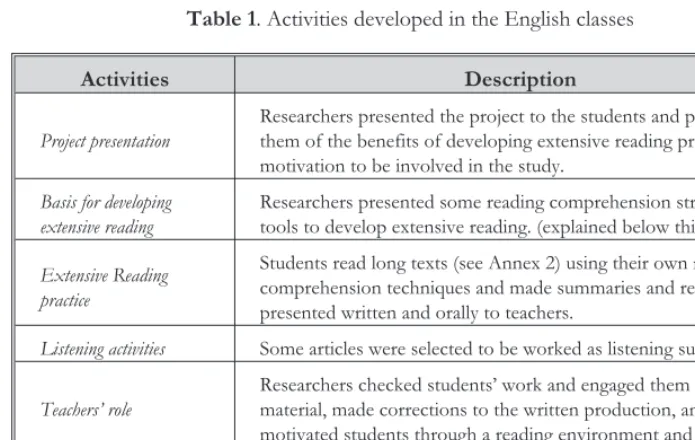
This study was organized following a logical order under the parameters of extensive reading with spaces for motivating students to read for pleasure, and teachers monitoring the students’ work. Table 1 shows the description of the principal activities developed in the English classes.
Table 1. Activities developed in the English classes
Activities Description
Project presentation
Researchers presented the project to the students and persuaded them of the benefits of developing extensive reading practices as motivation to be involved in the study.
Basis for developing extensive reading
Researchers presented some reading comprehension strategies as tools to develop extensive reading. (explained below this chart)
Extensive Reading practice
Students read long texts (see Annex 2) using their own reading comprehension techniques and made summaries and reports to be presented written and orally to teachers.
Listening activities Some articles were selected to be worked as listening support.
Teachers’ role
Researchers checked students’ work and engaged them to read the material, made corrections to the written production, and motivated students through a reading environment and the texts.
Students’ role
During reading, students chose their own techniques and read as much as possible according to their abilities, habits of reading, interest and motivation; it can be done in or outside the classroom.
For developing this practice, some reading comprehension techniques were given to students in order to start the process and they chose the best way for them according to their learning styles:
1. Preparation stage. This first stage helps them develop skills in anticipation and prediction for reading visual material.
Brainstorming to generate ideas that have a high probability of occurrence in the text.
Predicting or hypothesizing on the basis of the title or first line of a text. 2. Identify the purpose of the reading. Efficient reading consists of clearly
identifying the purpose of reading something. In this way you know what you are looking for.
3. Use efficient silent reading techniques for relatively rapid comprehension. Identify as many cognates as possible (cognates are words that are similar in form and meaning in both English and Spanish). You do not need to pronounce each word to yourself. Try to visually perceive more than one word at a time, or preferably phrases. Unless a word is absolutely crucial to global understanding, skip over it and try to infer its meaning through its context. 4. Guessing or inference. This is an extremely wide category learners can use
to their advantage to guess the meaning of a word, guess a grammatical relationship, infer implied meaning, and guess the content message. 5. Skimming. It consists of quickly running one’s eyes across a whole text to
get the gist. This strategy gives readers the advantage of being able to predict the purpose of the passage, the main topic or message, and possibly some of the developing or supporting ideas.
6. Scanning. This is the most valuable category; the purpose of scanning is to extract certain specific information, definitions, key concepts, supporting details, names or dates without reading through the whole text.
7. Semantic mapping, clustering or outlining. These strategies help the reader to provide some order to the chaos. Semantic maps are used to make graphics with the relevant information from the text and outline is an organized list of related items or ideas.
8. Vocabulary analysis. One way for learners to make guesses is to analyze words according to the function of the words in the sentences; for example, looking for prefixes, suffixes, nouns, adjectives, verbs, adverbs, prepositions, determiners or connectors.
Findings
From the analysis of data emerged the following categories:
• Extensive reading contributions in the process of second language acquisition.
• Extensive reading as motivation in the reading practice.
First Category: Extensive Reading Contributions in the Process of Second Language Acquisition
Through data analysis, the effects of extensive reading practice to be included in the English program were evident, having in mind that reading is a permanent task in students’ life; so, the characteristics of extensive reading and the constant contact with a foreign language facilitate the acquisition of this one: Krashen (as cited by Bell, 2007, p. 1) states: “Extensive reading will lead to language acquisition; it includes adequate exposure to the language, interesting material, and a relaxed, tension-free rearming environment”.
The students involved in this research were aware that reading is away to acquire new vocabularywhich is useful in their process of learning a foreign language; hence, in the interview the students manifested their perceptions about the contributions of practicing extensive reading:
“The enrichment of vocabulary has been very important; I have learnt more vocabulary through this kind of reading”.(Student 1, students’ interview, May 21, 2007)
“Students have acquired new vocabulary through reading different texts which are used in their oral reports”.(Researcher 1, journal, April 24, 2007)
The acquisition of new vocabulary is a tool that helps students to feel secure in the moment they write or speak. Nagy and Herman (1987) argue: “Traditional approaches to the teaching of vocabulary, in which the number of new words taught in each class was carefully controlled, is much less effective in improving vocabulary growth than simply getting students to spend time in silent reading of interesting books or magazines such as in extensive reading practices”.
Researchers agree about the use of extensive reading to improve students’ background or schema, and Robb and Susser (1989a, p. 12) remark, “We now teach learners reading skills/strategies for understanding the content, textual features, theoretical elements, andcultural background”, and (p. 12) “Extensive reading provides an excellent means of buildingschema”.
In fact, this research showed how students were aware of their knowledge acquisition through extensive reading:
Also the researchers’ evidence showed the students’ acquisition of knowledge with this practice:
Teachers’ journals about acquisition of knowledge.
“In fact this kind of reading makes students learn new concepts and information, in general, according to the topics they are interested in”.(Researcher 1, journal, March 20, 2007)
Students’ evidence showed that reading is the principal means to acquire informationwhich will be so useful in their personal and professional life.
At the same time another contribution of applying extensive reading is the acquisition and implementation of useful techniques for reading, writing and speaking. In this way, before starting to read, students acquire extensive reading techniques such as skimming, scanning, analysis of vocabulary, outlining, and summarizing, among others, and for speaking they make graphic organizers, semantic maps, pictures or friezes.
These techniques were implemented to make reading an easy task, avoiding the use of a dictionary and persuading the students to read real texts in English, taking into account that they can be used not only in English but also in Spanish. Bell (2007, p. 54) points out: “A large number ofEFL/ESLlearners require reading for academic purposes, and therefore need training in study skills and strategies for reading longer texts and books”.
Thus, students spoke about their use of different techniques during extensive reading practices:
“One day I used a scheme similar to a semantic map with pictures, it helped me so much; other times I used important words, key words”.(Student 9, students’ interview, May 21, 2007)
Differenttechniques were given to the students but they chose the best for them, according to their learning styles capacities and preferences.
Researchers in the journals manifested that during this study student used different learning styles, as follows:
used pictures, maps, or just learnt the principal ideas from the written summary” (Researcher 1, journal, May 25, 2007).
This study was based on the four skills (listening, reading, writing and speaking). The product of students’ reading was demonstrated with the written summaries (See Annex 1) and the oral reports which demonstrate if students really did the task. Robb and Susser (1989, p. 15) remark: “Oral or written summaries give students an opportunity to demonstrate that they are, in fact, doing their reading. They also allow the teacher to determine whether students understand their books at an acceptable level”.
Second Category: ExtensiveReading as Motivation in the English Classes
Teachers often look for ways that motivate their students in their classes, but when they find it is possible to do this through reading itself, they must think that it is meaningful. Regarding the characteristics of extensive reading, students read for pleasure, choosing the texts they prefer to read; in this way, reading is the motivation for students. Day and Bamford (1998, p. 5) state: “Reading materials selected for extensive reading programs should address students’ needs, tastes and interests so as to energize and motivate them to read the books”.
The interviewed students recognized extensive reading as motivation to read:
“Extensive reading has helped us to develop a pleasure for reading because we choose the texts we want to read and it has become a habit, it makes active English classes”(Student 16, students’ interview, May 18, 2007).
In this study the researchers created the adequate atmosphere for developing extensive reading where the material was the principal motivating factor to develop it, so they documented this in the journals:
“Students feel enthusiasm doing extensive reading, and one of the principal factors was that they chose their own materials and they read for pleasure”(Researcher 2, journal, May 25, 2007).
Third Category: The importance of including Extensive Reading in the English program
Reading has worked well in specific academic purposes in our schools and universities. Now, analyzing the advantages of this, it is necessary to suggest strongly the implementation of extensive reading practice into the curriculum. Day and Bamford (1998) emphasize: “Extensive reading has gradually been gaining popularity as one of the most effective strategies for motivating second language learning at various proficiency levels. Many researchers have emphasized the importance of including extensive reading in foreign language acquisition”.
According to students’ experiences in this study, most of them claimed the importance of including extensive reading as part of the English program, not only in the last level but also from the beginning of the foreign language learning program.
“Without doubt, I think that the last semester has been very important, the last four levels were meaningful, you taught us different things, and this one has collected each one and taught us more, I think that we have to start with reading from the first level, so, in the class you have to implement extensive readings”(Student 4, students’ interview, May 21, 2007).
The aspects mentioned before show that extensive reading might favorably affect students’ reading, understanding and production, helping them develop the ability to read large quantities of materials in a short time; likewise, researchers approve the implementation of extensive reading into the curriculum as a way to improve the four abilities of learning a foreign language.
“Students claim the need to include the extensive reading practice since the first level as an attempt to improve oral fluency as a way to motivate those students who show little or no interest in studying English programs mainly through grammar contents”(Researcher 2, journal, May 26, 2007).
The previous considerations demonstrate that the implementation of extensive reading into the curriculum will enhance our students’ acquisition of a foreign language and also an serve as an approach to be used in the different fields of study.
Conclusions
The effects of extensive reading practice to be included in the English program is revealed in the following characteristics:
It is easy to conclude that a successful way to decrease students’ negative feelings towards studying English and improving their reading proficiency is the implementation of real extensive reading into the English program at Universidad Santo Tomás de Aquino.
It is evidenced that students’ motivation is greatly enhanced by the readers’ engagement in reading and it is also relevant to mention that students’ habits and the social environment are other important factors in the development of reading practice.
Keeping in mind that we learn to read by reading, the amount of reading learners did during this experience was crucial, so learners were encouraged to read as much as possible, at their own pace; written summaries and oral reports were required after their reading. They were also taught to be responsible for their own reading and to administer and organize their time in order to increase their confidence and motivation to read.
Data analysis showed that this group of students, through reading, gained in the acquisition of knowledge and vocabulary and also practiced useful techniques to be applied in reading, writing and oral reports.
References
Bandler, R. & Grindler, J. (1979).Frogs into princes: Neuro-linguistic programming. Boulder, CO: Real People Press.
Bell, T. (2007).Intensive versus extensive reading: A study of the use of graded readers as supplementary input material to traditional “Intensive” reading techniques. Unpublished MA TEFL Dissertations. University of Reading.
Cohen, D. & Crabtree, B. (2006). Qualitative Research Guidelines Project. Retrieved from: http://www.qualres.org/HomeSemi-3629.html
Davis, C. (1995). Extensive Reading: An expensive extravagance?English Language Teaching Journal, 49(4), pp. 329-336.
Day, R.R. & Bamford, J. (1998). Extensive reading in the second language classroom. New York: Cambridge University Press.
Dubravcic, J. (1996). Telling the truth about extensive reading.The Language Teacher, 20(12), p. 52. Ellis, R. (1987).Second language acquisition in context.New York: Prentice Hall.
Elley, W. B., & Mangubhai, F. (1983). The effect of reading on second language learning. Reading Research Quarterly, 19(1), pp. 53-67.
Green, C. (2005). Integrating extensive reading in the task-based curriculum. ELT Journal, 59(4), pp. 306-311.
Hill, J. & Lewis, M. (Eds.) (1997).Dictionary of selected collocations.England: Language Teaching Publications.
Merriam, S. (1988). Case study research in education: A qualitative approach. San Francisco, CA: Jossey–Bass.
Nagy, W.E. & Herman, P. (1987). Breadth and depth of vocabulary knowledge: Implications for acquisition and instruction. In Mckeown, M. & Curtis, M. (Eds), The nature of vocabulary acquisition. (pp. 19-35) Hillsdale, NJ: Lawrence Erlbaum Associates.
Nunan, D. (1992).Research methods in language learning. Cambridge: Cambridge University Press. Robb, T. N. & Susser, B. (1989a). Extensive reading vs. skills building in an EFL context. Reading in
a Foreign Language, 5(2), pp. 239-251.
Robb, T.N. & Susser, B. (1989b). Developing extensive reading.JALT Newsletter, 6(1), pp. 1-5. Thompson, C. (1983) Intensive and extensive reading - A summary, for practicing teachers, of
material presented by Damien Tunnacliffe at JALT ‘83.The Language Teacher, 8(4), 21-22. Tsang, Wai-King. (1996). Comparing the effects of reading and writing on writing performance.
Applied Linguistics,17(2), pp. 210-223.
The authors
time teacher and researcher at the language department atUSTA(Universidad Santo Tomás, Tunja). Her research interests include language learning through reading.
Gladis Leonor Arias Rodríguez holds a MA in language teaching fromUPTC
Annex 1
Student’s written sample
(Summary)
The contamination of rivers and streams for chemical pollutants has become one of the most serious environmental problems in the XX century; the scientists have established many of the local effects of the contamination of the air. We know for example adversely affects human health, every year about 10 million people die in the world to drink polluted water.
The natural resources of a country the basic capital, the effects of the polluted air about the human health have wakened up the conscience that it is necessary a great effort in the search of solutions there are multiple forms to maintain it or to reestablish the environment.
In many cities is very serious air pollution and virtually no one river or lake is not polluted by domestic sewage, for this reason pollution is one of the most critical problems in the world.
From my point of view, the conservation also includes the maintenance of the natural reservations, if people stopped using aerosols, it would help the environment and the solution begins at home.
Annex 2
Sample text used during reading practice
Annex 3
Interview
Santo Tomas University, Tunja Languages Department
Extensive Reading Project
Objective: To identify the effects of applying extensive reading to a group of fifth-level English students to be included as part of the English program at Universidad Santo Tomás de Aquino.
1. How do you feel developing extensive reading? (comfortable, bored, happy tired, etc.)
2. What is your favorite reading in and outside the university? (scientific, academic, entertainment, informative, etc.)
3. Have you received benefits with the practice of extensive reading? What kind? Explain. (Enrichment of vocabulary, use of new reading comprehension techniques, acquisition of knowledge, more comprehension for reading in English. What else? )
4. What reading comprehension techniques do you use during the process of practicing extensive reading in this course? (brainstorming, looking at visual aids, predicting, silent reading, cognates, skimming, scanning, mapping, vocabulary analysis, and summarizing )
5. What personal techniques do you use for the presentation of oral reports? 6. When you practice extensive reading, do you prefer to read alone or with
your friends?
7. What do you think about including the practice of extensive reading in the English program atUSTA?
Annex 4
Teachers’ journals sample
Date: April 9, 07Theme. Identifying the topic and supporting sentences.
Procedure: The students were divided into groups of 5 people. They carried out the activity for identifying the topic and supporting sentences. Some of them had difficulties in understanding the content of the texts; however, at the end, with the effort of the group, the teacher explained again and clarified the doubts they had.
Date: April 19, 07
Theme: Extensive reading practice.