Deewan et al. World Journal of Engineering Research and Technology
IMPROVED GENETIC ALGORITHM USING HYBRID INITIAL
POPULATION TO SOLVE TRAVELLING SALESMAN PROBLEM
Pratha Deewan*1, Punit Kumar2 and Vinod Todwal3
1
Research Scholar, Department of Information Technology, RCEW, Jaipur, Rajasthan, India.
2
Assistant Professor, Department of Computer Science, RCEW, Jaipur, Rajasthan, India.
3
Head, Department of Information Technology, RCEW, Jaipur, Rajasthan, India.
Article Received on 29/06/2019 Article Revised on 19/07/2019 Article Accepted on 09/08/2019
ABSTRACT
Genetic Algorithm is very useful to solve optimization problems. It
performs genetic operators to solve optimization problems. Travelling
Salesman Problem is a well-known optimization problem. TSP is
useful to solve many problems of science and engineering. In this
paper genetic algorithm is applied to solve TSP. A hybrid initial
population is generated in genetic algorithm. The hybridization of initial population improves
the performance of the genetic algorithm. Proposed genetic algorithm is applied on three
standard instances of TSP and results are compared with other heuristic algorithms. From the
experimental results it is observed that the proposed hybrid GA performs better than other
techniques.
KEYWORDS: Genetic Algorithm, Travelling Salesman Problem, Hybrid Initial Population.
INTRODUCTION
Travelling Salesman Problem (TSP) is an optimization problem in operation research. The
important task of TSP is to find Hamiltonian Cycle for given graph in minimum cost. TSP
utilize in different applications like network routing, vehicle routing. electronic circuits board
drilling etc. the various methods for solving TSP are given by many researcher in last recent
years. Some of these researchers apply branch & bound, neural network (NN), PSO, Cutting
planes, ACO (ant colony optimization) etc. for solving TSP.
World Journal of Engineering Research and Technology
WJERT
www.wjert.org
SJIF Impact Factor: 5.218*Corresponding Author Pratha Deewan
Research Scholar,
These approaches provide solution near to the optimal rather than optimal within a specified
time, for TSP. the TSP problem is like to Hamiltonian problem which given by a
mathematician. In this problem, a salesman has to visit cities which are represented by node
in a completed graph and select the path in such way each vertex of that graph must be at
least once. A salesman starts to visit from one city and cover all cities. Path length should be
minimum. Whenever increasing the number of cities (group of cities represented by n) then
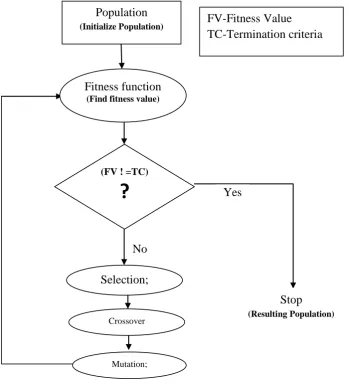
the possibilities of path may increase. To solve TSP problem, GA uses venous operators such
as selection, reproduction and mutation. The flowchart of the slandered GA is shown in
figure-1.
Figure 1: Flowchart of standard GA.
MATERIAL AND METHODS
Various researchers have attempts to solve TSP by using Genetic Algorithm. And discussed
their pros & cons, So in this section discuss work of some researches in this area. Fitness function
(Find fitness value)
Population
(Initialize Population)
(FV ! =TC)
?
Selection;
Crossover
Mutation;
Yes
No
FV-Fitness Value
TC-Termination criteria
Stop
In 2004, Long Jin et. al.,[1] Authors initially find the advantages & limitations over genetic
operators beside with local search methods for TSP. Proposed an algorithm to solving large
TSP, known as Heterogeneous Selection Evolutionary Algorithm (HeSEA) which integrates
EA (Edge Assembly) Crossover, LK (Lin–Kernighan) local search. In 2008, Sumanta Basu
and Diptesh Ghosh,[2] authors survey and find to solving TSP, Tabu search is one of the most
frequently used and point out the research gap in literature after reviewing various research
paper. In 2009, K Rajanand et. al.,[3] gives a novel algorithm on the basis of evolutionary
optimize technique to solve TSP. this technique gives the better results to solve large
dimension TSP. In 2010, Yang Yi et. al.,[4] provide a solution for TSP (Travelling Salesman
Problem). It is NP hard problem and most frequently used. Heuristic global optimization
search algorithm like used to simulate the BES (Biology Evolutionary System).In 2010,
Masafumi K et al.,[5] gives a solution to solve large scale TSP using GA. This algorithm is
compared with maximum preservative, greedy cross over etc. In 2012, N Kumar et. al.,[6]
Survey that GA gives best performance to solve various NP hard problem like TSP. GA
always utilize natural evaluation process to solve the problem. In this author present a critical
survey on TSP solutions which are proposed by many researchers in last recent year. After
survey state that need to improve GA to solve TSP. In 2012, A Singh et. al.,[7] gives
overviews about Bee Colony Optimization to solving TSP with its basic method of bee
foraging behaviour. It is also used after each bee cycle to improve the quality of the solutions.
In 2012, S Basu,[8] survey that Tabu Search is very frequently used to solving TSP. and
author also survey on various those paper which consider Tabu search on TSP and bring out
some important research gab for future work. In 2012, K H. Hingrajiya et. al.[9] state that
ACO (Ant Colony Optimization) is a heuristic algorithm which applied on CO
(Combinatorial Optimization) Problems. Reason behind to utilize is that the working process
of ACO is easily understandable. Author gives an approach to solve the TSP using improved
ACO Algorithm. In 2013, Saloni Gupta et. al.[10] is develop a GA which used to determine
the better solution of TSP, however it work on the basis of the nature of the problem. Author
analyze different solution technique of TSP which proposed by researcher in last recent years.
In 2014, S. Khattar et. al.,[11] Gives the details (step by step) process of solving TSP using
GA. Genetic algorithm provides the better solution for TSP. Author also surveyed on various
research paper which are proposed to solving TSP and find the research gap for new research.
In 2015, K. S. Suresh et.al.[12] proposed a solution for Robot Path Planning RPP using
various algorithms based on evolutionary, developed by many researchers in last recent years
based on natural biological world behaviours. In 2015, A Fouad, et.al.[4] Proposed an AP
(Affinity Propagation) Clustering Technique which optimize the performance of the GA to
solve TSP, The main purpose is to create cluster of cities and apply GS on each cluster
individually, thus the require less computational time to solve.
In 2015, S Ahmed et.al.,[15] Author compare various meta heuristic to solve the TSP and
apply ACO & GA on different three instances with different size & complexity. Author state
that GA is very fast, cost effective computation resources and implementation is very esay.
While The ACO a greedy approach but returns better results for large problem. A. I.
Hammouri et al. apply Dragonfly algorithm to solve TAP. The Dragonfly algorithm was
applied on many instances of TSP and results were compared with other algorithms such as
ACO, PSO, GA. After doing a analysis of this literature survey it is concluded that the
performance of GA can be further improved using hybridization of its operators. Next section
discussed the proposed work.
In this paper an optimized genetic algorithm using hybrid initial population generation is
proposed. The proposed algorithm makes the initial population hybrid. The initial population
is generated using hybridization of random technique and nearest neighbour technique. The
two techniques used for generation of chromosomes are (a) Random generation of
chromosomes (b) Nearest Neighbour First approach of chromosome generation.
(a) Random generation of chromosomes
Randomness is the power behind the genetic algorithm. In this work random approach is used
to generate chromosomes of initial population. In random approach the sequence of cities
visited in a tour by the salesman are selected randomly. These chromosomes will generate
chromosomes with high fitness value later on in the process of cross over and mutation.
(b) Nearest Neighbour First approach of chromosome generation.
TSP is basically a fully connected graph. Nearest neighbour first is a useful technique to
traverse the graph with minimum path length. After selecting a starting city, the next city is
selected which is having the minimum path length among all then cities which are to be
visited. The nearest city is then added in the path and that city become the current city. Then
from this current city, a city at nearest distance is selected from all the remaining cities. This
In this work, the a hybrid initial population of chromosomes using random approach and
nearest neighbour first approach is generated. Because the fitness value (1/path-length) of the
chromosomes generated using nearest neighbour first approach is very high, so the average
fitness value of the initial population is very high as compared to standard GA. This
improvement in the standard GA will improve the performance of the GA. The next section
discussed the results of the hybrid GA.
RESULTS AND DISCUSSION
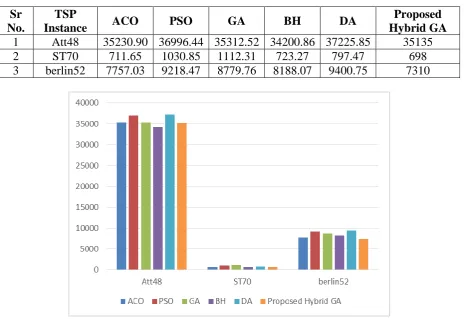
The hybrid genetic algorithm is implemented and the performance of hybrid GA is tested on
three instances of TSP from TSPIB online data set. Table 1 is showing the results. From the
results shown in Table 1 it is clear that the proposed hybrid GA perfrom better as compared
to other heuristic techniques such as ACO, PSO, BH and DA. It also performed better than
the standard GA. The performance of BH for Att48 instance is better than the proposed
algorithm otherwise proposed hybrid GA outperform the other techniques. Figure 2 is
showing a graph to compare the performance of proposed hybrid GA and other techniques.
Sr No.
TSP
Instance ACO PSO GA BH DA
Proposed Hybrid GA 1 Att48 35230.90 36996.44 35312.52 34200.86 37225.85 35135
2 ST70 711.65 1030.85 1112.31 723.27 797.47 698
3 berlin52 7757.03 9218.47 8779.76 8188.07 9400.75 7310
CONCLUSION AND FUTURE SCOPE
In this paper, genetic algorithm is applied to solve Travelling Salesman Problem. A hybrid
initial population using random approach and nearest neighbour approach is generated. The
hybridization of initial population improves the average fitness value of the initial population.
This improved initial population help in cross over and mutation operations and generate
good quality solutions of TSP. The proposed hybrid genetic algorithm was applied on three
standard TSP instances. From the results it is concluded that proposed hybrid GA performs
better than other techniques.
REFERENCES
1. Jin L, Tsai S, Yang J, Tsai J, Kao C. An evolutionary algorithm for large traveling
salesman problems. IEEE Transactions on systems, Man and Cybernetics-Part B:
Cybernetics, 2004; 34(4): 1718–29.
2. Basu S, Ghosh D. A Review of the Tabu Search Literature on Traveling Salesman
Problems. Indian Institute of Management, 2008; 10(1):1–16.
3. Rajan K, Anilkumar. Genetically motivated search algorithm for solving Traveling
salesman problem. SB Academic Review, 2009; XVI(1&2): 19–31.
4. Yang Yi et.al, The Improved Hybrid Genetic Algorithm for Solving TSP Based on
Handel-C, 2010 3rd International Conference on Advanced Computer Theory and
Engineering (ICACTE), 978-1-4244-6542-2/$26.00 © 2010 IEEE
5. Masafumi KURODA et.al, A Proposal for Zoning Crossover of Hybrid Genetic
Algorithms for Large-scale Traveling Salesman Problems, 978-1-4244-8126-2/10/ ©2010
IEEE.
6. kumar N, Karambir, Kumar R. A Genetic algorithm approach to study Traveling
salesman problem. Journal of Global Research in Computer Science, 2012; 3(3): 33–8.
7. Singh A, Narayan D. A Survey Paper on Solving Traveling Salesman problem Using Bee
colony optimization. International Journal of Emerging Technology and Advanced
Engineering, 2012; 2(5): 309–14.
8. Basu S. Tabu Search Implementation on Traveling Salesman Problem and Its Variations:
A Literature Survey. American Journal of Operations Research, 2012; 2: 163–73.
9. Hingrajiya KH, Gupta RK, Chandel GS. An Ant Colony Optimization Algorithm for
Solving Traveling Salesman Problem. International Journal of Scientific and Research
10.Gupta S, Panwar P. Solving Traveling salesman problem using genetic algorithm.
International Journal of Advanced Research in Computer Science and Software
Engineering (IJARCSSE), 2013; 3(6): 376–80.
11.Khattar S, Gosawmi P. A Solution of Genetic Algorithm for Solving Traveling Salesman
Problem. International Journal for Scientific Research and Development (IJSRD), 2014;
2(4): 341–3.
12.K. S. Suresh et.al, Solving Travelling Salesman Problem and Mapping to Solve Robot
Motion Planning through Genetic Algorithm Principle, Indian Journal of Science and
Technology, December 2015; 8(35): DOI: 10.17485/ijst/2015/v8i35/86809.
13.K. Bharathi et.al, A Framework for the Design and Analysis of an Evolutionary
Algorithm for Multi Travelling Salesman Problem, Indian Journal of Science and
Technology, December 2016; 9(48): DOI: 10.17485/ijst/2016/v9i48/104352.
14.Ahmad Fouad El-Samak and Wesam Ashour, "Optimization Of Traveling Salesman
Problem Using Affinity Propagation Clustering And Genetic Algorithm", JAISCR, 2015;
5(4): 239-245. 10.1515/jaiscr-2015-0032.
15.Sabry Ahmed Haroun, Benhra Jamal and El Hassani Hicham, A Performance
Comparison of GA and ACO Applied to TSP, International Journal of Computer
Applications (0975 – 8887), May 2015; 117: 19.
16.I. Hammouri, E. T. A. Samra, M. A. Al-Betar, R. M. Khalil, Z. Alasmer and M. Kanan,
"A Dragonfly Algorithm for Solving Traveling Salesman Problem," 2018 8th IEEE
International Conference on Control System, Computing and Engineering (ICCSCE),