Background:
Hospital Acquired Infections are major challenge for low and middle income countries which have
limited healthcare resources. Literature has explored the prevalence is high and practice is limited. This study aims to
assess prevalence and preventive practices of Hospital Acquired Infection among health workers.
Methods:
A cross -sectional research design was carried out between Feb 2017 to May 2017 in National Trauma
Center , Kathmandu. Census method was used to recruit 121 respondents and to find out prevalence. A structured
questionnaire and observation checklist was used for data collection. Data was objectively analyzed in SPSS full
version 21.
Results:
Prevalence of bacteria causing Hospital Acquired Infections was 11.83% in critical units. Among 95
specimen analysis, 53 specimen were isolated in critical units.
The most common site of infection was the urinary tract
19 (35.8%) and bacteria causing nosocomial infection was Escherichia coli 28.30%. Culture plate was used to obtain
environment samples, Out of 9 specimen analysis, Staphylococcus aureus was the most common isolated organism.
Level of practice were significantly associated with education, training on HAI, work experience 0.019, 0.026, 0.027
respectively.
Conclusions: The study found that prevalence of hospital acquired infection do exist in less percentage but preventive
practices of HAI in majority of respondent were fair. Hence,
there is a need to raise awareness as well as training on
Hospital acquired Infection among health care workers.
Keywords:
Critical units; hospital acquired Infection; nosocomial Infection; practice; prevention.
Prevalence of Hospital Acquired Infection and its
Preventive Practices among Health Workers in a
Tertiary Care Hospital
Purna Devi Shrestha,1 Sirjana Rai,1 Shobha Gaihre1
1National Trauma Center, Mahaboudha, Kathmandu, Nepal.
Correspondence:
Purna Devi Shrestha, National Trauma Center,
Mahaboudha,
Kathmandu, Nepal. Email: [email protected] , Phone: +9779841457945.
ABSTRACT
J Nepal Health Res Counc 2018 Oct-Dec;16(41): 452-6
INTRODUCTION
Hospital Acquired Infection affect patients in a hospital or other health-care facility, and are not present or incubating at the time of admission. Of every 100 hospitalized patients at any given time, 7 in developed countries and 10 in developing countries will acquire at least one health care associated infection.1 Most hospital acquired infections are transmitted through contact with the hands of nurses and physicians.2 Nosocomial infections increase the costs of healthcare due to added antimicrobial treatment and prolonged hospitalization.3
A study done on Teaching hospital shows the prevalence of bacteria causing nosocomial infection was 34.4%.4 Survey of 324 staff from acute care hospitals in Kathmandu, shows that 16%, 14%, and 0.3% of the respondents achieved maximum scores for knowledge, attitude, and practice items, respectively.5 Hence, this study aimed to assess prevalence and its preventive practices among health workers in Critical Units in National Trauma Center, Kathmandu.
METHODS
A descriptive study was conducted from Feb –May 2017 (3month) in critical unit in National Trauma Center. Census was used to find out the prevalence of Hospital Acquired Infection. Specimens which included culture of urine, sputum, pus, catheter tip, tracheal secretions, blood and CSF were sent to lab and isolated organism were analysed according to the standard protocol by the American Society of Microbiology.6 Similarly, environment samples were obtained by using culture plate once on monthly basis for 3month in Operation theatre, ICU and Post-operative unit.
Cross-sectional research design was used to assess the preventive practices of HAI among health workers. Census method was adopted where all health workers working in critical units in National Trauma Center i.e 121 were included in the study. Structured questionnaire was used to collect information about HAI. Respondent practices score were measured by using set of 19
Original
Article
statements and was observed by using checklist in natural environment. The scores for practice items were given 1 for each possible option. The score was calculated by giving one for each possible option. The practice scores were categorized into good (≥80%), fair (59-79%), and poor (≤59%).This data collection tool was developed by using references of WHO guidelines and Guidelines for prevention of hospital acquired infections.7-9 During this three month, each day, any two of the divided homogeneous group that was doctor and nurse were given questionnaire and practices was observed of same subject by using checklist excluding Saturday and public holiday.
To ensure validity and reliability questionnaire was pretested in Bir hospital, ICU in 10% (i.e. around 12) of the subjects with similar characteristics. Ethical clearance was taken from Institutional Review Board (IRB) of NAMS. Verbal as well as written informed consent was taken from each participant before data collection. Privacy was maintained and participants were assured of confidentiality. SPSS version 16 software was used to manage and analyze the data.
RESULTS
Regarding the socio-demographic characteristics of the respondents, majority 56.2% of the respondents were between 20-29 years. Majority 51.2% respondents were female. The number of doctors and nurses were almost equal with 46.92% doctors and 46.15% nurses. Least 17.4% respondent had received training whereas 82.6% were without training. Similarly, 59.5% respondent had working experience less than 5 years and 40.5% had working experience more than 5 years (Table 1).
Table 1. Socio-demographic characteristics. (n=121)
Variables Number Percent
Age (in completed years) 20-29
30-39
68 56.2
53 43.8 Sex
Male Female
59 48.8
62 51.2
Education MS/consultant Resident/MS student MBBS
Bachelor PCL CMA
14 11.6
41 33.9
6 5.0
29 24.0
29 24.0
2 1.7
Occupation
Doctor Nurse
61 46.92 60 46.15 Training received of hospital acquired infection control in last year
No Yes
100 82.6
21 17.4
Working Experience Less than 5 years More than 5years
72 59.5
49 40.5
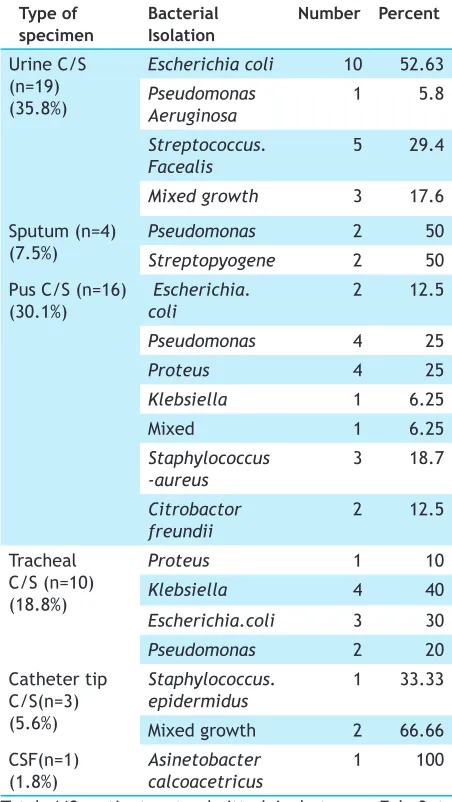
Table 2. Distribution of bacteria associated with hospital acquired Infection. N=53
Type of specimen
Bacterial Isolation
Number Percent
Urine C/S (n=19) (35.8%)
Escherichia coli 10 52.63
Pseudomonas Aeruginosa
1 5.8
Streptococcus.
Facealis 5 29.4
Mixed growth 3 17.6 Sputum (n=4)
(7.5%)
Pseudomonas 2 50
Streptopyogene 2 50 Pus C/S (n=16)
(30.1%)
Escherichia. coli
2 12.5
Pseudomonas 4 25
Proteus 4 25
Klebsiella 1 6.25
Mixed 1 6.25
Staphylococcus
-aureus 3 18.7
Citrobactor
freundii 2 12.5
Tracheal C/S (n=10) (18.8%)
Proteus 1 10
Klebsiella 4 40
Escherichia.coli 3 30
Pseudomonas 2 20
Catheter tip C/S(n=3) (5.6%)
Staphylococcus. epidermidus
1 33.33
Mixed growth 2 66.66
CSF(n=1)
(1.8%) Asinetobacter calcoacetricus 1 100
Total 448 patient get admitted in between Feb 3 to May 3 2017 at National Trauma Center. Out of 448 the prevalence of hospital acquired infection was 11.83% (n= 53) in this study.
the most predominant 52.63 % followed by Streptococcus facealis 29.4% , Mixed growth 17.6% and Pseudomonas aeruginosa 5.8%. In case of sputum specimens, 4 (7.5%) Pseudomonas 50% Streptopyogene 50% was found to be in same number. Whereas 16 (30.1%) bacteria were isolated from pus specimens, Pseudomonas 25%,
Proteus 25% was common pathogen which is followed by
Staphylococcus aureus 18.7%, E.coli 12.5%, Citrobactor freundii 12.5%, Klebsiella 6.25% and mixed 6.25%. Among 10 (18.8%) endotracheal bacterial isolates,
Klebsiella was found to be more predominant 40% which was followed by Escherichia coli 30%, Pseudomonas
20% and Proteus 10%. Likewise, Catheter tip C/S 3 (5.6%) in which mixed growth 66.6% and Staphylococcus epidermidus 33.3%. Similarly, CSF 1(3.7%) bacteria isolated, which was Acinetobactor calcoacetricus (Table 2.).
Table 3. Types of microorganism isolates in critical units by culture plate.
Unit Isolated microorganism
OT 1st month 2nd month 3rd month No growth No growth Staphylococcus
aureus
POST
-OP No growth Escherichia- coli Staphylococcus aureus
ICU Staphylococcus
aureus Staphylococcus aureus Staphylococcus aureus
Regarding growth of microorganism by culture plate, there was no growth during 1st and 2nd month but
Staphylococcus aureus isolated in 3rd month in operation theatre. likewise, no growth of microorganism in 1st month but E-coli seen during 2nd month, E-coli and
Staphylococcus aureus isolated during 3rd month in Post-operative. Similarly, Staphylococcus aureus was isolated in ICU during 1st ,2nd and 3rd month respectively (Table3.).
Table 4. Association between level of practice and selected demographic variables of health workers. n=121
Variables Level of Practice P-value
Good Fair
Age
20-29 12(17.64%) 56(82.35%) 0.666 30-39 11(20.75%) 42(79.24%)
Sex
Male 8(13.55%) 51(86.44%) 0.136
Female 15(24.19) 47(75.80%) Education
Upto certificate level
11(32.35%) 23(67.64%) 0.019
Above certificate level
12(13.79%) 75(86.20%)
Training
No 12(13.95%) 74(86.04%) 0.026
Yes 11(31.42%) 24(68.57%)
Work experience
Less than 5 years 8(11.94%) 59(88.05%) 0.027 More than 5
years
15(27.77%) 39(72.22%)
Occupation
Doctor 8(13.11%) 53(86.88%) 0.096
Nurse 15(25%) 45(75%)
Table 4 shows that that level of practice were significantly associated with education, training on HAI, work experience (p=0.05) p=0.019, 0.026, 0.027 respectively. In each variable we can observe number of health worker having fair level of practice is higher than good level of practice.
DISCUSSION
Recently, hospital acquired infections have become a global concern recognized as a major patient safety issue.We selected three critical units (Operation Theater, Intensive Care Unit and Post operative Care). Total 121 health workers were included to find out their preventive practices. For prevalence we included the admitted patient during 3 months of study period and total no of patients was 448. Our study concluded with the result of 53(11.83%) having hospital acquired infection , which is accordance to the result reported by Ling et al.(9%),10 Malhotra and Sharma (8.78%),11 Afroz et al (9.4%)12 However, higher prevalence were reported by Maksimovic et al.(28.2%),13 Bagheri and Sepand (30.43%).14 But comparatively low prevalence was reported by study of Ige et al (2.6%).15 These comparisons indicate that the prevalence of hospital acquired infection in National Trauma Centre is in moderate level. Infection prevention in National Trauma Centre needs to be strengthen because still our findings are lower than the other research and the probable reason could be the hospital’s infection control team has started to take pick not very long.
study on Teaching Hospital in Zahedan, Southeast Iran shows that most common site of infection was the respiratory tract (67.9%) followed by the urinary tract (13.6%).17 In this study, out of 95 specimen analysis 53 bacteria were isolated in critical units, urine 19(35.8%), sputum 4(7.5%), pus 16(30.1%), endotracheal specimen 10(18.8%), catheter tip 3(5.6%) and CSF 1(1.8%) were found.
A study conducted in Janaki Medical College had data that out of total of 216 environmental samples collected, 18.98% (41) samples showed the presence of S. aureus. It was also isolated from the blood samples of patients admitted to ICU (7.5%) and NICU (6.8%) of these organisms in sensitive units like ICU, NICU, POW and the isolation of S. aureus from clinical samples indicates a possibility of HAI.18 Our study used culture plate to obtain environment samples and the result was similar to this study which means Staphylococcus aureus was the most common one for causing nosocomial infection, Out of 9 specimen analysis, 5 Staphylococcus aureus was isolated. This shows that critical units are not safe for the critically ill patients. This is not just for patient but also health hazardous to health personnel working in such infected environment.
Our study shows that level of practice were significantly associated between education, training on HAI, work experience and level of practice. In each variable we can observe number of health worker having fair level of practice is higher than good level of practice. Among 121 health worker 87(71.90%) are health worker with education above certificate level with 75 having fair level of practice, 86(71.07%) has not got training, n=98 has fair level of practice and 67(55.37%) have worked for less than 5 years and scoring fair level of practice are n=59 with p=0.019, 0.026, 0.027 respectively in education, training and work experience proving significant association with level of practice. A cross sectional study was conducted in governmental hospitals of Palestine where no significant statistical differences were found between mean practice scores towards age, years of experience, training course, and qualification (f=1.482, 2.625, 0.129, 0.727 ) respectively at p < 0.05(0.220, 0.051, 0.720, 0.484) respectively. Significant statistical differences were found in mean practice scores only in relation to gender, (F = 8.569) at p < 0.05 (0.004).9 This study showed the association between them. So timely training, educational status and work experience plays vital role in changing the attitude of health worker toward prevention of hospital acquired infection.
Hence, the study findings showed that the health workers are still not being able to provide quality services to
patients. So, immediate action is needed for improving quality of service.
Also, the result of the study can be used to find out the cause of hospital acquired infection and necessary interventions can be taken.
CONCLUSIONS
It is quite appalling that preventive practices of infection in majority of respondent was fair. Prevalence of bacteria causing hospital acquired infection is 11.83%. This study showed that urinary tract were the predominant area where organisms are isolated. There was Staphylococcus
isolated in culture plate in critical unit. So, there was a risk of environmental contamination, which could increase risk of transmission. Thus, efforts are needed to strengthen infection control program like continuous monitoring, training to health professional to enhance overall quality service of hospital.