~ 309 ~ WWJMRD 2018; 4(1): 309-313
www.wwjmrd.com International Journal Peer Reviewed Journal Refereed Journal Indexed Journal UGC Approved Journal Impact Factor MJIF: 4.25 e-ISSN: 2454-6615
Dr. Mohammad Miyan Department of Mathematics, Shia P. G. College, Lucknow, India
Correspondence: Dr. Mohammad Miyan Department of Mathematics, Shia P. G. College, Lucknow, India
Analysis on the MDH Power Generation Technology
Dr. Mohammad Miyan
Abstract
The demand of electricity goes to be augmented day by day. The recent survey, demand and force the globe to get various supply for power generation. Magnetic Hydro Dynamic is one amongst them. The MHD power generation technology provides engaging generation potential to the electrical power utilities. In this paper, there are discussions on the MHD technology and also the principle of operation, types, recent developments going down in MHD power generation and power extraction techniques. In future, with Coal chemical change Technology, fusion Technology, gas Technology etc., MHD route could gain acceptance as a topping unit for steam power plants and turbine power plants. MHD Steam plants are preferred to traditional steam power plants.
Keywords: MHDGenerators, MHD, Power Generation
1. Introduction
The MHD means magneto-hydrodynamics i.e., the magneto-fluid dynamics or hydro-magnetics, is that the analysis of the magnetic behavior of the electrically conducting fluids. The samples of those magneto fluids are embraced plasmas, salt water, liquid metals and electrolytes. The word “magneto hydrodynamics” springs from magneto electric machine, which implies the field, hydro, which means water and dynamics which means movement. The construct of MHD was initiated by Hannes Alfvén that he has received a reward within the field of Physics in 1970. (Wikipedia, 2017)
The fundamental conception behind MHD is that magnetic fields will induce currents in an exceedingly moving semi-conductive fluid, which successively polarizes the fluid and reciprocally changes the force field itself. The set of equations that describe MHD are a combination of the Navier–Stokes equations of fluid dynamics and Maxwell’s equations of electromagnetism. These differential equations should be resolved at the same time, either analytically or numerically. (Wikipedia, 2017)
The MHD generation is referred to as the generator i.e., hydraulics power generation may be a direct energy conversion system that converts the warmth energy directly into power, with none intermediate energy conversion, as opposition the case altogether different power generating plants. Therefore, during this method, substantial fuel economy may be achieved by the elimination of the link method of manufacturing energy so once more changing it to power.
2. History of MHD Generation
The idea of MHD power generation was introduced for the terribly initial time by physicist Michael Faraday in the year 1832 in his Bakerian lecture to the honorary society. He really administrated a high class experiment at the Waterloo Bridge in nice Britain for measuring this, from the flow of the River Thames in earth's field.
Fig.2.1: Magneto hydrodynamic Electric Generation
This experiment during a method printed the essential idea behind MHD generation over the years then, many analysis work had been conducted on this subject, and later in 1940 this idea of generator hydro dynamic power generation, was imbibed because the most generally accepted method for the conversion of heat energy directly into current while not a mechanical sub-link.
3. Principle of MHD Generation
The principal of MHD power generation is extremely straight forward and relies on Faraday’s law of magnetism induction, that states that once a conductor and a field of force moves relative to every different, then voltage is iatrogenic within the conductor, which ends up in flow of current across the terminals.
Fig.3.1: Magneto hydrodynamic Electric Generator
The Magnetohydrodynamic Electric Generator given in the figure (figure 3.1) shows the flow of a conducting fluid under the influence of magnetic and electrical fields. In normal generator or generator, the conductor consists of copper windings or strips whereas within the MHD generator the new ionized gas or conducting fluid replaces the solid conductor. In standard generator or generator, the conductor consists of copper windings or strips whereas in the MHD generator the new ionized gas or conducting fluid replaces the solid conductor. A controlled, electrically conducting fluid flows through a thwart wise field of force during a channel or duct. Combine of electrodes are placed on the channel walls at right to the field of force and connected through an external circuit to deliver power to a load connected to that. Electrodes within the MHD generator perform constant perform as brushes during a standard DC generator. The MHD generator develops DC power and also the conversion to AC is completed victimization of the electrical converter.
The power generated by the MHD generator per unit length is approximately given by,
𝑃 =𝜎𝑢 𝐵
2
𝜌
Where,
B = magnetic flux density;
u = fluid velocity;
σ = electrical conductivity of conducting fluid;
𝜌 = density of fluid.
We can see and analyze from the equation that for the higher power density of the MHD generator; there must be a strong magnetic field of around 4-5 tesla and a quite high flow velocity of conducting fluid in the place of appropriate conductivity.
4. MHD Cycles and Working Fluids
The MHD cycles can be classified as two types i.e., Open Cycle MHD and Closed Cycle MHD. The detailed descriptions of the types of MHD cycles and also the used working fluids are given as follows:
4.1 Open Cycle MHD System
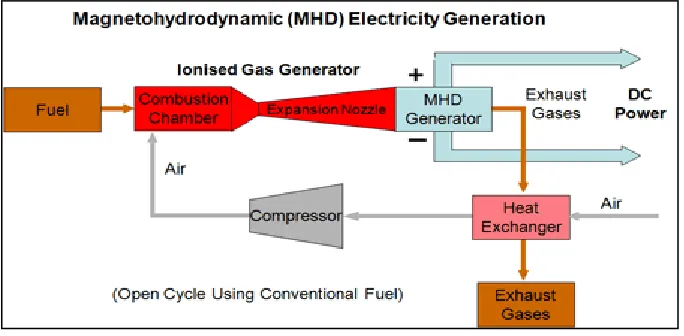
In open cycle MHD system, region air at terribly hot temperature and pressure is more responsible the robust flux. Coal is initial processed and burnet within the combustor at a hot temperature of regarding 2700oC and
~ 311 ~
on have a high speed then more responsible the flux of MHD generator. Throughout the enlargement of the gas at hot temperature, the positive and negative ions move to the electrodes and therefore represent an electrical current. The
gas is then created to exhaust through the generator. Since constant air cannot be reused once more thus it forms associate open cycle and therefore is called as open cycle MHD.
Fig.4.1: Open Cycle MHD System
4.2 Closed Cycle MHD System
As the name suggests the operating fluid in a much closed cycle MHD is circulated in a very control system. Hence, during this case noble gas or liquid metal is employed because the operating fluid to transfer the heat. The liquid metal has sometimes the advantage of high electrical
conduction; therefore the heat provided by the combustion material needn't be too high. Contrary to the open loop system there's no water and outlet for the region air. Hence, the method is simplified to an excellent extent, because the same fluid is circulated time and once more for effective heat transfer.
Fig.4.2: Closed Cycle MHD System
5. Advantages of MHD Generation
The advantages of the MHD generation over the alternative customary methods of generation are mentioned here. Here solely the operative fluid is circulated, and there are not any different moving mechanical components. That reduces the mechanical losses to cypher and additionally makes the operation plenty of dependable. Customary coal-fired generators come back through a most efficiency of around 35%. The upper potency is attributable to utilization the energy from the recent plasma gas to plain steam turbines. The temperature of operating fluid is maintained by the walls of MHD. It’s the power to achieve full power level virtually directly. The value of MHD generators is far less than standard generators. The MHD has terribly high potency, which is on top of most of the opposite standard or
non-conventional technique of generation. (Ajith et al. 2013)
6. Related Researches
in non-conventional energy because the typical sources are already depleting at an awfully speedy pace. The MHD power generator is in advanced stage these days and nearer to business utilization. It'll not be long before the technological drawback of MHD systems are going to be overcome and MHD system would rework itself from non-conventional to traditional energy sources. (Petkar, 2016) Dwivedi et al. have analyzed that the facility generation capability should increase rapidly to scale back pollution, and to enhance overall potency the coal should be volatilized at pitheads and therefore the gas, SNG, transported by pipe-grid to any or all thermal stations. This facilitates conversion of all stations into combined cycles initially. Later MHD generators or thermal cells will be added to the facility stations. This is often the sole method useful to one and every one. The house applications victimization MHD generators have a lot of advantage in comparison to the opposite space crafts. (Dwivedi et al. 2014)
Mgbachi analyzed that an influence generator from magnetoelectric machine dynamics is won’t to illuminate our home. With the assistance of huge electrical converter, a D.C. output is regenerate to A.C. output and sent to grid. It’s not arduous to create. Magneto electric machine dynamics will produce employment to energy engineers. But magneto electric machine dynamics offers D.C. output. Electrical converter which will convert D.C. output to A.C. and send to grid is extremely costly. It’s not reliable to power larger network. Since its D.C., protection is least. Magneto electric machine dynamics must be improved in line to supply of energy generation on like hydro and scheme. (Mgbachi, 2015)
According to Pandit, Energy Technology is an engineering science handling varied energy routes comprising the exploration and extraction of primary raw energy, conversions to intermediate or secondary varieties of energy and by-products, transportation alternatives, storage, distribution and provide of secondary varieties of energy. (Pandit, 2015)
Goel et al. aforementioned that the standard conversion systems have vital losses (thermodynamics conversion) and these traditional systems are did not fulfill the wants of energy of the trendy world. So, the performance from the purpose of potency and dependability is restricted which might be improved by the operation with MHD generators. (Goel et al. 2015)
Khan et al. analyzed that in magneto electric machine fluid mechanics (MHD) generator, salt water is undergone duct underneath the presence of robust field. As a result, voltage is iatrogenic and output is extracted by putting the electrodes in appropriate positions. (Khan et al. 2016) Majid et al show that each one the parameter provides an important impact on the present manufacture, attributable to that the extremely thought has to occur to style the MHD generator as an electrical power generator so as to support the demand for energy. (Majid et al. 2016)
Vishal et al. analyze that the development in corrosion science & superconducting magnets will create speedy commercialization doable. The saving is billions of greenbacks towards fuel prospects of far better fuel utilization. It will thus be claimed that the event of MHD for electrical utility power generation is an objective of national significance. The sensible potency of this sort of power generation won't be but hour. Therefore it'll be most
vital in forthcoming decade. (Vishal et al. 2013)
7. Conclusion
A power generator from generator dynamics may be wont to illuminate our home. With the assistance of huge electrical converter, a D.C. output may be regenerate to A.C. output and sent to grid. It’s not arduous to make. Generator dynamics will produce employment to energy engineers. But generator dynamics offers D.C. output. Electrical converter that may convert D.C. output to A.C. and send to grid is very costly. It’s not reliable to power larger network. Since its D.C., protection is minimal. Generator dynamics must be improved in line to supply of energy generation on like hydro and system. In future, with Coal chemical change Technology, fusion Technology, gas Technology etc., MHD route might gain acceptance as a topping unit for steam power plants and turbine power plants. MHD Steam plants are preferred to traditional steam power plants. But technological issues connected with style, materials, high temperatures, reliability, long service life etc are underneath investigation in many countries on pilot plants. MHD prospects area unit favorable. In approaching decade, these techniques are most vital because the sensible potency of such power generation won't be but hour.
In India, and lots of different developing Nations, the gap between the demand and provide of secondary energy is increasing leading to perpetual energy crises besides several strategies of power generation like thermal, nuclear, diesel etc. One in every of the high economical and distinctive strategies with pollution free surroundings is magneto electric machine Hydro Dynamic (MHD) kind power generation. It’s the simplest way of generating electricity by conversion of heat into current, while not the requirement of any moving mechanical parts- no turbines and no rotary generators. Thus as a result of the elimination of link method of manufacturing energy then changing it to current, the fuel economy will be achieved. Essentially the potency of non-conventional station like star, wind, periodic event are around of 35-40%, whereas of MHD station is regarding 50-60% which may be raised up to 75-80% by mistreatment super conducting magnets. Therefore mistreatment MHD power generation technique the crises of energy will be reduced up to bound limits.
References
1. Ajith, K. R. & Jinshah, B. S. (2013). Magneto hydrodynamic Power Generation. International Journal of Scientific and Research Publications, Volume 3, Issue 6, ISSN 2250-3153, pp. 1-11.
2. Barbu, V. et al. (2003). Exact controllability magneto-hydrodynamic equations. Communications on Pure
and Applied Mathematics, 56 (6): 732–
783. doi:10.1002/cpa.10072.
3. Calvert, J. B. (2002). Magneto hydrodynamics: The dynamics of conducting fluids in an electromagnetic
field, self-published by an Associate Professor
Emeritus of Engineering, University of Denver, U.S.A. 4. Dwivedi, Y. D., Rao, C. H. K. & Jagadish, D. (2014). Environment Friendly Magneto Hydro Dynamic
Generator-A Sequel. International Journal of
~ 313 ~
5. Goel, P. & Shukla, A. (2015). MAGNETO
HYDRODYNAMICS POWER GENERATION.
International Advanced Research Journal in Science, Engineering and Technology (IARJSET) National Conference on Renewable Energy and Environment (NCREE-2015) IMS Engineering College, Ghaziabad, Vol. 2, Special Issue 1, pp. 105-107. DOI 10.17148/IARJSET.
6. Haverkort, J. W. (2009). Magneto
hydrodynamics, short introduction for fluid
dynamicists, Magneto hydrodynamics.
7. Khan, M. M. & Shafi, M. A. & Riaz, Z. (2016). Magneto Hydro Dynamic Generation, International Journal of Scientific & Engineering Research, Volume 7, Issue 12, ISSN 2229-5518, pp. 281-289.
8. Lorrain, P., Lorrain, F. & Houle, S. (2006). Magneto-fluid dynamics: fundamentals and case studies of natural phenomena, Springer, New York, ISBN 0-387-33542-0.
9. Magneto hydrodynamics (2017). From Wikipedia, the
free encyclopedia. Retrieved from:
https://en.wikipedia.org/wiki/Magnetohydrodynamics
10. MHD Generation (2017). Retrieved from:
https://www.electrical4u.com/mhd-generation-or-magneto-hydro-dynamic-power-generation/
11. Magneto hydrodynamic generator (2017). From
Wikipedia, the free encyclopedia. Retrieved from: https://en.wikipedia.org/wiki/Magnetohydrodynamic_g enerator
12. Mgbachi C. A. (2015. DESIGN ANALYSIS OF
MAGNETOHYDRODYNAMIC (MHD)
ELECTRICAL POWER GENERATION
TECHNOLOGY. International Journal of
Advancements in Research & Technology, Volume 4, Issue 10, ISSN 2278-7763, pp. 103-108.
13. Majid, M. F. M. A., Apandi, M. A. H. M., Sabri, M. & Shahril, K. (2016). FUNDAMENTAL STUDIES ON
DEVELOPMENT OF MHD
(MAGNETOHYDRODYNAMIC) GENERATOR
IMPLEMENT ON WAVE ENERGY HARVESTING, IOP Conf. Series: Materials Science and Engineering 114 012145. doi:10.1088/1757-899X/114/1/012145, pp. 01-09.
14. Pandit, A. R. (2015).
MAGNETO-HYDRO-DYNAMICS (MHD) GENERATION. National
Conference on Recent Research in Engineering and Technology (NCRRET -2015), International Journal of Advance Engineering and Research Development (IJAERD), ISSN: 2348 - 4470.
15. Petkar, J. (2016). Magneto hydrodynamic Open Cycle
Power Generator and Selection of Carrier Gas and Seed. International Journal of Advanced Research in
Electrical, Electronics and Instrumentation
Engineering, Vol. 5, Issue 8,
DOI:10.15662/IJAREEIE.2016.0508063 6998
16. Sharma, S. & Gambhir, S. (2015). MAGNETIC
HYDRO DYNAMICS POWER GENERATION TECHNIQUES. International Journal of Computing and Corporate Research, Volume 5 Issue 5 International Manuscript ID: 2249054XV5I5092015-11.
17. Vishal, D. D. & Anand, S. (2013), The Future Power Generation with MHD Generators Magneto Hydro
Dynamic generation. International Journal of