Influence of Ortho Group
Introduction on the
Alkylation of Phenolic
Hydroxyl of Apocynin
Copyright © 2016 INTRODUCTION
Apocynin (4-hydroxy-3-methoxyacetophenone, Figure 1), as an efficient inhibitor of nicotinamide adenine dinucleotide phosphate (NADPH) oxidase, has an antioxidant effect by reducing the production of reactive oxygen species (ROS)1–3. Apocynin was also reported to possess
biologi-cal activity against inflammation4,5. Consequently, it has been investigated
as a therapeutic candidate for oxidative stress and inflammation-mediated diseases, including asthma, arthritis, acute lung injury and cardiovascular diseases1,5–7. These works indicated that apocynin might be a valuable lead
compound.
However, the structure-activity relationship (SAR) of anti-inflammation and antioxidation of apocynin has been rarely discussed so far. A series of apocynin analogues were synthesized in our lab for further biologi-cal evaluation and SAR study8,9. The phenolic hydroxyl was found to be
an important position for modification of apocynin. The reactivity of the phenolic hydroxyl was related to the feature of the micro environment around. In this work, the ortho group introduction of phenolic hydroxyl of apocynin was investigated to disclose the way to improve the reaction activity of apocynin.
MATERIALS AND METHODS
All chemicals (reagent grade) used were commercially available. Analytical TLC was performed on Merck silica gel 254F plates. 1H-NMR spectra were
recorded at ambient temperature on a 300 MHz spectrometer (AV-300, Bruker) in CDCl3 or d6-DMSO. All the chemical shifts were reported in δ (ppm) using tetramethylsilane (TMS) as an internal standard. Electrospray ionization (ESI) mass spectra were obtained in the positive ion detection mode on a Finnigan LCQ Advantage MAX mass spectrometer (Applied Biosystems, 4000 Q TRAP).
ORIGINAL ARTICLE
Gao Ruitao1, Ou Yang1, Liu Wu1,
Wang Gaofang1, Li Sha2,
Jiang Jie1,3*
1 Institute of New Drug Research, College
of Pharmacy, Jinan University, Guangzhou 510632, China
2 Department of Pharmaceutics, College of
Pharmacy, Jinan University, Guangzhou 510632, China
3 Dongguan Institute of Jinan University,
Dongguan 523808, China
n Address reprint requests to:
*Jiang Jie, Institute of New Drug Research, College of Pharmacy, Jinan University, Guangzhou 510632, Dongguan Institute of Jinan University, Dongguan 523808, China E-mail: [email protected]
n Article citation: Ruitao G, Yang O, Wu L, Gaofang W, Sha L, Jie J. Influence of ortho
group introduction on the alkylation of phenolic hydroxyl of apocynin. J Pharm Biomed Sci 2016;06(07):414–418.
Available at www.jpbms.info
Statement of originality of work: The manuscript has been read and approved by all the authors, the requirements for authorship have been met, and that each author believes that the manuscript represents honest and original work.
Source of funding: This research was supported by the National Natural Science Funds of China (81441128) and the National Science and Technology Support Project of the Ministry of Science and Technology of China (2013BAH08F04) to Jiang Jie.
Competing interest / Conflict of interest: The authors have no competing interests for financial support, publication of this research, patents and royalties through this collaborative research. All authors were equally involved in discussed research work. There is no financial conflict with the subject matter discussed in the manuscript.
Disclaimer: Any views expressed in this paper are those of the authors and do not reflect the official policy or position of the Department of Defense.
NLM Title J Pharm Biomed Sci CODEN JPBSCT
2230-7885 ISSN No
ABSTRACT
Apocynin was widely studied in inflammation and oxidative stress related diseases and showed effectiveness. Structure-activity relationship study was carried out and intended to figure out new lead compounds of better efficacy. In the structure-activity relationship study of apocynin, different ortho group introduction was found to obviously affect the alkylation of phenolic hydroxyl. In this work, different ortho substituents of apocynin phe-nolic hydroxyl were designed and synthesized to further discuss their influence on the reaction activity of the phenolic hydroxyl group. When compared with the introduction of electron withdrawing group, aldehyde group (–CHO), introduction of electron donat-ing group, amine group (–NH2), at the ortho position improved the reactivity of phenolic hydroxyl. It enabled the alkylation of phenolic hydroxyl easily occurring under a mild con-dition with a yield increase at least 26%, thus facilitated the modification of apocynin in further steps.
KEYWORDS apocynin, alkylation, phenolic hydroxyl, ortho substituent
J Pharm Biomed Sci JPBSCT
2230-7885
http://dx.doi.org/10.20936/jpbms/160264
Experimental
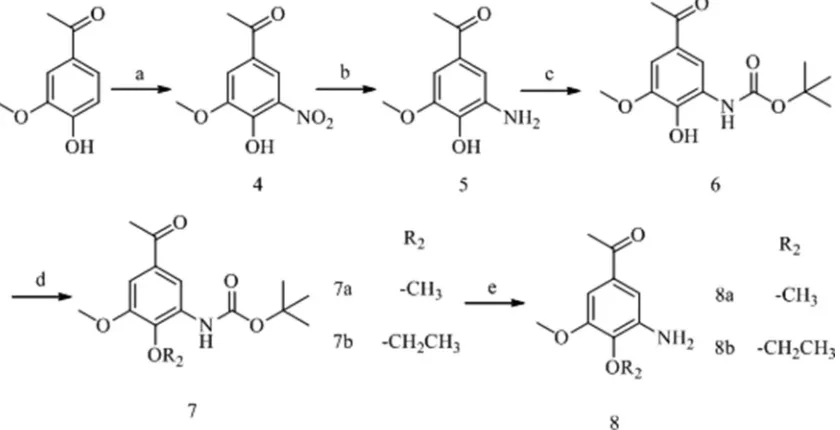
In this work, two different kinds of groups, electron with-drawing (Compound 2) and donating (Compound 5) groups were introduced at the ortho position of phenol hydroxyl of apocynin. As shown in Scheme 1, starting with apocynin, the aromatic aldehyde 2 was prepared through the Reimer-Tiemann reaction. Compound 2 was then treated with iodomethane (CH3I) and bromoethane (CH3CH2Br) in dimethyl formamide (DMF), respectively, yielding phenol ether 3a and 3b. In Scheme 2, compound 1 was nitrated to give a nitro 4. Catalytic hydrogenation of compound 4
Fig. 1 Chemical structure of apocynin.
Scheme. 1 Reagents and conditions: (a) NaOH/CHCl3/CH3OH, 80°C, 2 h; (b) K2CO3/CH3I or K2CO3/CH3CH2Br, DMF 0~40°C, 2 h.
Scheme. 2 Reagents and conditions: (a) 67% HNO3/HAC, 0°C, 2 h; (b) Pd/C/H2/CH3OH, 25°C, 12 h; (c) (BOC)2O/Et3N, DCM, 12 h,
25°C; (d) Et3N/CH3I or Et3N/CH3CH2Br, Acetone, 2 h, 25°C; (e) TFA/DCM, 2 h, 25°C.
over 10% Pd/C in absolute methanol afforded amine 5. In order to selectively modify the phenolic hydroxyl of 5, its amine group was protected by (BOC)2O in dichloro-methane (DCM) to give 6. Compound 6 was then treated with CH3I or CH3CH2Br in acetone, respectively, affording intermediates 7a and 7b. Then BOC was removed by treat-ing 7a and 7b with trifluoroacetic acid (TFA) in dichloro-methane to produce 8a and 8b.
filtration. The filtrate was concentrated in vacuum to remove solvent and give a crude product. The crude product was purified by column chromatography, eluting with ethyl acetate:petroleum ether (1:8, v/v), to afford 3.5 g (30% yield) of compound 2 as a yellow powder. MS (ESI): m/z [M+H]+ 195, [M−H]+ 193. 1H-NMR (300
MHz, d6-DMSO): δ 11.47 (s, 1H, OH), 10.00 (s, 1H, CHO), 7.83 (d, J = 1.6 Hz, 1H, ArH), 7.74-7.73 (d, J
= 1.6 Hz, 1H, ArH), 3.98 (s, 3H, OCH3), 2.62 (s, 3H, CH3CO).
5-acetyl-2,3-dimethoxybenzaldehyde (
3a
)
The mixture of 2 (1.96 g, 10 mmol) and K2CO3 (2.76 g, 20 mmol) in 50 ml DMF was added CH3I (2.84 g, 20 mmol) by dropping slowly at 0°C. The mixture was heated to 40°C and stirred for 2 h. Then the reaction mixture was poured into the saturated Na2SO3 aqueous solution (20 ml) slowly. The mixture was extracted with ethyl ace-tate (30 ml × 3) and the organic layer was dried by using anhydrous sodium sulfate. After filtration, the filtrate was concentrated in vacuum to remove ethyl acetate and give a crude product. The crude product was purified by column chromatography, eluting with ethyl acetate: petroleum ether (1:8, v/v), to afford 1.12 g (53.8% yield) of 3a as a white solid. MS (ESI): m/z [M+H]+ 209,[M−H]+ 207. 1H-NMR (300 MHz, d
6-DMSO): δ 10.33
(s, 1H, CHO), 7.88 (d, J = 1.9 Hz, 1H, ArH), 7.79 (d,
J = 1.8 Hz, 1H, ArH), 4.00 (s, 3H, OCH3), 3.96 (s, 3H, OCH3), 2.62 (s, 3H, CH3CO).
5-acetyl-2-ethoxy-3-methoxybenzaldehyde (
3b
)
The mixture of 2 (1.96 g, 10 mmol) and K2CO3 (2.76 g, 20 mmol) in 50 ml DMF was added CH3CH2Br (2.18 g, 20 mmol) by dropping slowly at 0°C. The resulting solu-tion was stirred at 40°C for 2 h. Then the reacsolu-tion was quenched by pouring into saturated NH4Cl aqueous solu-tion (20 ml). The reacsolu-tion mixture was extracted with ethyl acetate (30 ml × 3) and the organic layers were com-bined and dried by using anhydrous sodium sulfate. Then filtered and the filtrate was concentrated in vacuum to remove ethyl acetate and give a crude product. The crude product was purified by column chromatography, eluting with ethyl acetate: petroleum ether (1:8, v/v), to afford 0.97 g (43.6% yield) of 3b as a white solid. MS(ESI):m/z [M+H]+ 223, [M−H]+ 221. 1H-NMR (300 MHz,
d6-DMSO): δ 10.49 (s, 1H, CHO), 8.02 (d, J = 2.0 Hz, 1H, ArH), 7.80 (d, J = 2.0 Hz, 1H, ArH), 4.36 (q, J = 7.1 Hz, 2H, CH2), 3.97 (s, 3H, OCH3), 2.64 (s, 3H, COCH3), 1.44 (t, J = 7.1 Hz, 3H, CH3).
1-(4-hydroxy-3-methoxy-5-nitrophenyl)
ethanone (
4
)
Compound 1 (20 g, 120 mmol) was dissolved in glacial acetic acid (300 ml) and cooled to 0°C in an ice bath. To the solution, nitric acid (65%, 14 ml, 240 mmol) was
added slowly through a dropping funnel. After all nitric acid had been added, the reaction was stirred at 25°C for 2 h and then poured into ice water (50 ml) with stir-ring for 10 min. After 30 min of standing, the reaction mixture was filtered through a Buchner funnel and the residue was washed with ice-water, which was recrys-tallized in 95% ethanol to afford 12.9 g (51% yield) of 4 as a yellow needle crystal. MS (ESI): m/z [M+H]+
212, [M−H]+ 210. 1H-NMR (300 MHz, CDCl
3): δ 11.13
(s, 1H, OH), 8.31 (d, J = 1.6 Hz, 1H, ArH), 7.77−7.76 (d, J = 1.6 Hz, 1H, ArH), 4.01 (s, 3H, OCH3), 2.63 (s, 3H, CH3CO).
1-(3-amino-4-hydroxy-5-methoxyphenyl)
ethanone (
5
)
To a solution of 4 (10.55 g, 50 mmol) in methanol (300 ml) was added 10% Pd/C (500 mg) and the sus-pension was degassed in vacuum and purged with H2 for several times. Then the reaction mixture was hydrogenated by hydrogen overnight. The mixture was filtered, and the filtrate was concentrated in vacuum to remove metha-nol and give a residue. Then the residue was added into a mixture of ethyl acetate and H2O. After extraction, the organic layer was separated and dried by using anhydrous sodium sulfate. The solvent was removed in vacuum to afford a crude product. The crude prod-uct was purified by column chromatography, eluting with ethyl acetate:petroleum ether (1:2, v/v), to give a white solid 5 (7.4 g) with a yield of 82%. MS (ESI):
m/z [M+H]+ 182, [M−H]+ 180. 1H-NMR (300 MHz,
CDCl3): δ 7.06 (d, J = 1.6 Hz, 1H, ArH), 7.03 (d, J = 1.6 Hz, 1H, ArH), 5.90 (s, 1H, OH), 3.92 (s, 3H, OCH3), 2.52 (s, 3H, CH3CO).
Tert-butyl
(5-acetyl-2-hydroxy-3-methoxyphenyl)-carbamate (
6
)
Compound 5 (1.81 g, 10 mmol) was dissolved in 50 ml dichloromethane in a 100 ml bottom flask. The solution of BOC2O (3.27 g, 15 mmol) and Et3N (1.01 g, 10 mmol) was added rapidly and the resulting solution was stirred at 25°C for 12 h. Then the mixture was concen-trated in vacuum to remove the solvent and give a crude product. The crude product was purified by column chromatography, eluting with ethyl acetate: petroleum ether (1:6, v/v), to afford 6 (2.47 g, 88% yield) as a white solid. MS (ESI): m/z [M+H]+ 282, [M−H]+ 280. 1H-NMR (300 MHz, d
6-DMSO): δ 10.02 (s, 1H, OH), 8.06
(d, J = 1.1 Hz, 1H, NH), 7.89 (s, 1H, ArH), 7.26 (d, J
= 1.9 Hz, 1H, ArH), 3.87 (s, 3H, OCH3), 2.50 (s, 1H, CH3), 1.47 (s, 9H, 3 × CH3).
Tert-butyl (5-acetyl-2,3-dimethoxyphenyl)
carbamate (
7a
)
5 mmol) by dropping slowly. The mixture was stirred at 25°C for 2 h. Then the reaction was quenched by pouring into saturated Na2SO3 aqueous solution (20 ml) slowly. The reaction mixture was extracted with ethyl acetate (30 ml × 3) and the organic layer was dried by using anhydrous sodium sulfate. After filtration, the filtrate was concentrated in vacuum to remove ethyl ace-tate and give a crude product. The crude product was purified by column chromatography, eluting with ethyl acetate: petroleum ether (1:6, v/v), to afford 7a (1.19 g, 81% yield) as a white solid. MS (ESI): m/z [M+H]+
296, [M−H]+ 294. 1H-NMR (300 MHz, CDCl
3): δ 8.36
(s, 1H, NH), 7.21 (d, J = 1.9 Hz, 1H, ArH), 7.18 (s, 1H, ArH), 3.88 (s, 3H, OCH3), 3.85 (s, 3H, OCH3), 2.55 (s, 3H, CH3), 1.49 (s, 9H, 3 × CH3).
1-(3-amino-4,5-dimethoxyphenyl)ethanone (
8a
)
To the solution of 7a (1.475 g, 5 mmol) in 50 ml dichloromethane, was added TFA (3.7 ml, 50 mmol) by dropping slowly. The mixture was stirred at 25°C for 2 h. The reaction was quenched by pouring the mixture into the water. To the mixture, NaHCO3 was added to make pH 6-7 under stirring. The mixture was extracted with dichloromethane (30 ml × 3) and the organic layer was dried using anhydrous sodium sulfate. Then filtered and the filtrate was concentrated in vacuum to remove solvent and give a residue. The residue was puri-fied by column chromatography, eluting with ethyl ace-tate: petroleum ether (1:8, v/v), to afford 8a (0.82 g, 85% yield) as a white solid. MS (ESI): m/z [M+H]+ 196,[M−H]+ 194. 1H-NMR (300 MHz, d
6-DMSO): δ 6.99
(d, J = 2.0 Hz, 1H, ArH), 6.80 (d, J = 2.0 Hz, 1H, ArH), 5.13 (s, 2H, NH2), 3.80 (s, 3H, OCH3), 3.69 (s, 3H, OCH3), 2.47 (s, 3H, CH3).
Tert-butyl (5-acetyl-2-ethoxy-3-methoxyphenyl)
carbamate (
7b
)
The mixture of 6 (1.405 g, 5 mmol) and Et3N (0.51 g, 5 mmol) in 50 ml of acetone was added CH3CH2Br (0.54 g, 5 mmol) by dropping slowly. The mixture was stirred at 25°C for 2 h. Then the reaction was quenched by pouring into saturated NH4Cl aqueous solution (20 ml). The reaction mixture was extracted with ethyl acetate (30 ml × 3) and the organic layers were com-bined and dried by using anhydrous sodium sulfate. Then filtered and the filtrate was concentrated under reduced pressure to remove solvent and give a crude product. The crude product was purified by column chromatography, eluting with ethyl acetate:petroleum ether (1:6, v/v), to afford 7b (1.23 g, 80% yield) as a white solid. MS (ESI): m/z [M+H]+ 310, [M−H]+
308. 1H-NMR (300 MHz, CDCl
3): δ 8.15 (s, 1H, ArH),
8.01 (d, J = 1.9 Hz, 1H, ArH), 7.29 (d, J = 2.0 Hz, 1H, NH), 4.10 (d, J = 7.0 Hz, 2H, CH2), 3.87 (s, 3H, OCH3), 2.54 (s, 3H, COCH3), 1.48 (s, 9H, 3 × CH3), 1.27 (s, 3H, CH3).
1-(3-amino-4-ethoxy-5-methoxyphenyl)
ethanone (
8b
)
To the solution of 7b (1.545 g, 5 mmol) in 50 ml of dichl oromethane, was added TFA (3.7 ml, 50 mmol) by dropping slowly. The mixture was stirred at 25°C for 2 h. The following post-treatment of the reaction mixture and the purification of crude product was same as that of compound 8a. Compound 8b (0.88 g, 85% yield) was obtained as a white solid. MS (ESI): m/z [M+H]+
210, [M−H]+ 208. 1H-NMR (300 MHz, d
6-DMSO): δ 7.03 (d, J = 2.0 Hz, 1H, ArH), 6.86 (d, J = 2.0 Hz, 1H, ArH), 3.96 (d, J = 7.0 Hz, 2H, CH2), 3.80 (s, 3H, OCH3), 2.48 (s, 3H, COCH3), 1.28 (t, J = 7.0 Hz, 3H, CH3).
RESULTS AND DISCUSSION
A series of apocynin derivatives were prepared accord-ing to Scheme 1 and 2. In Scheme 1, the aromatic alde-hyde 2 was prepared through the Reimer-Tiemann reaction. The reaction was taken place between phenol compounds and chloroform in the alkali solution. It’s a process that introduces aldehyde group (CHO) at phe-nolic hydroxyl’s ortho position. The reaction is a typical electrophilic aromatic substitution and the electrophilic reagent is dichloride carving (CCl2). Due to the low yield of Reimer-Tiemann reaction, some researches discussed the way of increasing yield10–12. In this work, the yield
of aldehyde derivative of apocynin (Compound 2) was somewhat low around 30%. The electron-withdrawing substituent groups on the benzene ring of apocynin, which reduces the electron density of benzene ring, may account for the low yield.
In Scheme 2, the hydrogenation reduction of the nitro derivative 4 required a high purity of hydrogen. Zinc and iron powder together with hydrochloric acid was tried to reduce the nitro group into amino group. Under this condition, the reaction was slow and its post-treatment was difficult. It is speculated that the reaction is susceptible to stay at the intermediate stage of hydroxylamine13–15. Therefore, compound 4 was treated
with hydrogen gas in the presence of palladium carbon as a catalyst and the yield reached 82%.
CONCLUSION
In this work, different groups were introduced to the
ortho position of phenolic hydroxyl of apocynin. It fol-lowed that introduction of electron-donating group at the ortho position enhanced the reactivity of apocynin in alkylation of its phenolic hydroxyl group by Williamson reaction. It enabled the alkylation occurring under mild condition and afforded high yield of alkylated apocynin derivatives, which is a key intermediate for further mod-ification of apocynin.
REFERENCES
1. Yu J, Weiwer M, Linhardt RJ, Dordick JS. The role of the methoxy-phenol apocynin, a vascular NADPH oxidase inhibitor, as a chemopreventative agent in the potential treatment of cardio-vascular diseases. Curr Vasc Pharmacol. 2008;6(3):204–217. 2. Stolk J, Hiltermann TJ, Dijkman JH, Verhoeven AJ. Characteristics
of the inhibition of NADPH oxidase activation in neutrophils by apocynin, a methoxy-substituted catechol. Am J Respir Cell Mol Biol. 1994;11(1):95–102.
3. Pearse DB, Dodd JM. Ischemia-reperfusion lung injury is prevented by apocynin, a novel inhibitor of leukocyte NADPH oxidase. Chest. 1999;116(1 Suppl):55S–56S.
4. Ximenes VF, Brunetti IL, Fonseca LM. Apocynin and related methoxy-catechols as inhibitors of neutrophil-NADPH oxidase in LPS-activated whole blood. Res. J Biol Sci. 2007;2(3):360–364. 5. Abdelmageed ME, El-Awady MS, Suddek GM. Apocynin
ame-liorates endotoxin-induced acute lung injury in rats. Int Immuno-pharmacol. 2016;30:163–170.
6. Pandey A, Kour K, Bani S, Suri KA, Satti NK, Sharma P, et al. Amelioration of adjuvant induced arthritis by apocynin. Phytother Res. 2009;23(10):1462–1468.
7. Peters EA, Hiltermann JT, Stolk J. Effect of apocynin on ozone- induced airway hyper responsiveness to methacholine in asth-matics. Free Radic Biol Med. 2001;31(11):1442–1447.
8. Lu X, Wan S, Jiang J, Jiang X, Yang W, Yu P, et al. Synthesis and biological evaluations of novel apocynin analogues. Eur J Med Chem. 2011;46(7):2691–2698.
9. Xu L, Li Y, Wan S, Wang Y, Yu P. Protective effects of apocynin nitrone on acute lung injury induced by lipopolysaccharide in rats. Int Immunopharmcol. 2014;20:377–382.
10. Kulinkovich OG. Carbine methods for the introduction of acyl and acylmethyl groups into organic molecules. Russ Chem Rev. 1989;58(8):711–719.
11. Neumann R, Sasson Y. Increased para selectivity in the Reimer-Tiemann reaction by use of polyethylene glycol as complexing agent. Synthesis. 1986;(7):569–570.
12. Thoer A, Denis G, Delmas M, Gaset A. The Reimer-Tiemann reac-tion in slightly hydrated solid-liquid medium: a new method for the synthesis of formyl and diformyl phenols. Synthetic Communications. 1988;18(16–17):2095–2101.
13. Fu S, Zhan H, Yu H. Synthesis and characterization of N-hydroxy-benzenamine and its N-acylation. J South China Univ Technolog (Nat Sci). 2000;28(5):59–63.
14. Sheng M, Yang B, Jian K, Ding Y, Zhang Z, Geng L. The research progress in the reduction of aromatic nitro compounds to the arylhydroxylamines. Agrochemicals. 2011;50(4):235– 238, 252.