(UDC: 624.073.2:620.191.35)
Performance of magnetic fluid based squeeze film between a curved porous
circular plate and a flat circular plate and effect of surface roughness
M.Shimpi1*, G.Deheri 2
1
Birla Vishvakarma Mahavidyalaya Engineering College, Vallabh Vidyanagar (India) Email: [email protected]
2
Department of Mathematics, Sardar Patel University, Vallabh Vidyanagar (India) Email: [email protected]
*Corresponding author
Abstract
Efforts have been directed to study and analyze the squeeze film behavior between a curved rough porous circular plate and a flat rough porous circular plate under the presence of a magnetic fluid lubricant. The curved film thickness is described by a secant function. It is taken in to consideration that the external magnetic field is oblique to the lower plate. The bearing surfaces are assumed to be transversely rough. The random roughness of the bearing surfaces is characterized by a stochastic random variable with non-zero mean, variance and skewness. The concerned Reynolds equation governing the film pressure is averaged with respect to the random roughness parameter. The associated non-dimensional partial differential equation is solved with appropriate boundary conditions in dimensionless form to obtain the pressure distribution, in turn, which leads to the calculation of load carrying capacity. The computed results show that the performance of bearing system enhances considerably as compared to that of a bearing system working with a conventional lubricant as the magnetization increases the effective viscosity of the lubricant. The results tend to indicate that the bearing suffers due to transverse surface roughness, in general. Probably this may be due to the fact that the transverse surface roughness offers resistance to the motion of the lubricant. The effect of variance (negative) is considerably positive at least in the case of negatively skewed roughness as the load carrying capacity arises sharply. The combined effect of porosity and standard deviation is relatively adverse, in the sense that the already decreased load carrying capacity due to porosity gets further decreased owing to standard deviation. However, this investigation suggests some ways to mitigate this adverse effect.
Keywords: Squeeze film, Magnetic fluid, Rough surface, Reynolds equation, Load carrying capacity, Circular plates.
1. Introduction
46
squeeze film porous metal bearing [Ting 1972; 1975a, Wu 1970; 1971]. [Prakash et al.1973] dealt with several geometrical structures regarding the performance of squeeze film. [Elsharkawy et al. 1996] analyzed the hydrodynamic lubrication of squeeze film in porous bearing associated with circular plates.
The squeeze film behavior between a curved upper plate and a flat lower plate was studied by [Murti 1975] and it was shown that the load carrying capacity rose sharply with curvature in the case of concave pads. [Gupta et al. 1980] discussed the corresponding problem in the case of annular plates. In the above analysis, the lower plate was considered to be flat one. [Ajwaliya 1984] extended these analyses by assuming the lower plate also to be curved. According to his investigations such situation could be found useful in the design of machine elements like clutch plates and collar bearings.
In all the above investigations conventional lubricants were used. Use of magnetic fluid as a lubricant modifying the performance of the bearing system, has been very well recognized. [Verma1986] discussed the squeeze film performance under the presence of a magnetic fluid lubricant. [Bhat and Deheri 1991] analyzed the behavior of the squeeze film between porous annular disks. Here it was concluded that the application of magnetic fluid lubricant enhanced the performance of the squeeze film. However, they assumed that the plates were flat. But in actual practice the flatness of the plate does not endure owing to elastic, thermal and uneven wear effects. With this end in view, [Bhat et al. 1993] studied the effect of magnetic fluid lubricant on the configuration of [Ajwaliya 1984] considering the surface of the plate approximated by an exponential function. [Patel et al. 2002] deliberated on the squeeze film behavior between curved circular plates using a magnetic fluid lubricant. They found that the magnetic fluid lubricant improved the performance of bearing system. [Deheri and Patel 2006] studied the effect of magnetic fluid lubricant on the behaviour of a squeeze film between porous circular disks with sealed boundary. Here it was proved that the performance of the bearing system enhance considerably by sealing the boundary and choosing suitable magnetic strength. [Hsu et al. 2008] investigated magnetic hydrodynamic squeeze film characteristic between circular disks incorporating the effects of rotational inertia. From the results obtain it was clear that the rotational inertia was resulted in a reduced load carrying capacity while the applied magnetic fields provided an increase in load carrying capacity and response time. This study established that the squeeze film characteristics were found to be improved by the use of an electrically conducted fluid in the presence of a transverse magnetic field. [Hsu et al. 2009] presented a study dealing with the combined effects of surface roughness and rotating inertia up on squeeze film characteristic between circular disks while the surface structure with circumferential roughness increase the load carrying capacity and lengthened the response time, the radial structure reverse these trends. [Shimpi and Deheri 2010] analyzed the surface roughness and elastic deformation effects on the performance of a magnetic fluid based squeeze film between rotating porous circular plates with concentric circular pockets. Here it was concluded that the negative effect of porosity roughness and deformation could be minimized by the positive effect of magnetization parameters at least in the case of negatively skewed roughness by choosing suitably the pocket radius. [Davim 2011] investigated the performance of a hydrodynamics rough film. Here the Tribology aspects was examined with special emphases on surface topography, wear of materials and lubrications. [Huang et al.2011] discussed the effect of Ferrofluid lubricant with an external magnetic field. It was concluded that the Ferrofluid registered a relatively good friction reduction performance in the presence of an external magnetic fluid compared with carrier liquid. Also, the life period was found to be improved.
1967. Christensen et al. 1969a; 1969b; 1970]. [Christensen et al. 1969a; 1969b; 1970] proposed a comprehensive general analysis both for transverse as well as longitudinal surface roughness. Christensen and Tonder‘s approach formed the basis of the analysis to study the effect of surface roughness in a number of investigations [Ting 1975a, Prakash et al. 1982; 1983, Prajapati 1991; 1992, Guha1973, Gupta et al. 1996, Andharia et al. 1997]. [Patel et al. 2008] investigated the squeeze film behavior between two infinitely long porous rough parallel plates with porous matrix of variable film thickness.
Here it has been sought to investigate the effect of surface roughness on the behavior of magnetic fluid based squeeze film between a curved porous circular plate and a flat porous circular plate where in, the curved film thickness is described by a secant function.
2. Analysis
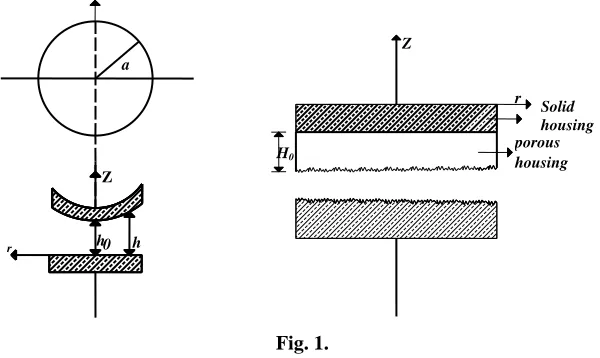
The configuration of the bearing system is displayed in Fig. 1.
Fig. 1.
It is assumed that the surface of the upper plate determined by
2 0sec , 0 hh Br r a(1)
approaches the lower plate with the normal velocity h0
, where h0 is the central distance between the plates and Bis the curvature parameter.
The bearing surfaces are assumed to be transversely rough. Following [Tzeng and Seibel 1967] the film thickness h x
of the lubricant film is
Sh x h x h
(2)
where h x
is the mean film thickness and hSis the deviation from the mean film thicknesscharacterizing the random roughness of the bearing surfaces.hS is considered to be stochastic in
nature and governed by the probability density function
Z
h0 h a
r
r Solid housing porous housing H0
48
2 2 2 2 35 1 , 32 0, . S S S hc h c
f h c c
Otherwise (3)
where c is the maximum deviation from the mean film thickness. The mean , the standard deviation and the parameter , which is the measure of symmetry of random variable hS are defined by the relationships
SE h
(4)
2 2S
E h
(5)
and
3S
E h
(6)
where Edenotes the expected value defined by
c
Sc
E R R f h dS
(7)
Assuming axially symmetric flow of the magnetic fluid between the plates under an oblique magnetic field
cos , , 0, sin ,
H H r r z H r r z
(8)
whose magnitude H vanishes at ra, the modified Reynolds equation governing the film pressure p becomes [Bhat , Patel et al., Gupta et al.]
0 20 1 12 2 H d d
rg h p h
r dr dr
(9)
where
3 2 2 2 30
3 3 3 12
g h h h h h H
(10)
Also, 0 is permeability of free space, is the magnetic susceptibility of particles and is the viscosity of the lubricant, is the permeability of porous facing, H0is the thickness of porous medium. Taking, for instance,
2
, 0 H ka a r r a
(11)
3 2
cot
2 r a r z r a r
(12)
whose solutions are
2 2 1.5
cos r a
C ec a r (13) and 2 1.5 a r Z C r a (14)
where C is a constant of integration. Introducing the non-dimensional quantities 3 2 0 0 3 2 0 0 , , ,
h p r H
P R a
a h a h , 3
* 0 0
3
2 0 0 0
0
, , , .
h k
h h h
a h (15)
with the usual assumptions of hydromagnetic lubrication. The modified Reynolds equation governing the film pressure pturns out to be [Bhat 2003, Deheri et al. 2005]
03 03 0
2 2
0 0
1 12
h p h k
d d
RG h R R
dR dR
a h a h
(16)
where
3 2 2 2
2 2 2 2 3
sec 3 sec
3 sec 3 12
G h R R
R (17)
In view of the non-dimensional quantities introduced above, the associated non-dimensional Reynolds equation governing the dimensionless pressure P is obtained from
4
*
1 12
2
d d
g h A R P R R
dR dR
(18)
where
2 2 2 31 3 3 3 3 12
g h
(19)
and
2 2
0.5 3 6 3 3 A
(20)
50
1 0P
;
* 2 dP dR when
R0(21)
One obtains the non-dimensional pressure distribution:
2 * 2 2 3 1 1 2 R P Rg h A R
(22)
Lastly, the load carrying capacity Wis determined in dimensionless form as 1 3 0 0 0 2 h w
W RP dR
h
(23) and hence
2 2 *2 2 2
3 1.5
ln 12
2
A g h A g h
W g h A A (24)
3. Results and discussion
It is clearly seen from Equation (22) and Equation (24) that the non-dimensional pressure distribution is determined from Equation (22) while Equation (24) presents the distribution of dimensionless load carrying capacity. These two expressions depend on various parameters such as *, , , , and. These parameters describe respectively, the effect of magnetization, roughness, curvature of the plate and porosity. Furthermore, a close glance at the Equation (22) and Equation (24) reveals that the increase in pressure is
* 1 2 R (25)while the load carrying capacity enhances by
* 12
(26)
due to the magnetic fluid lubricant. Furthermore, it is seen that taking roughness parameters to be zero, this study reduces to the performance of a squeeze film in curved porous circular plates under the presence of a magnetic fluid lubricant. In the absence of magnetization, this investigation gives the squeeze film performance in curved porous circular plates. Further, taking the curvature parameter to be zero, one obtains the performance of a squeeze film in porous circular plates [Prakash et al.1973]. This reduces to the performance of a squeeze film in circular plates in the absence of porosity.
In order to analyze the quantitative effect of the computed results the following fixed values of different parameters are considered *0.5 , 0.05, 0.05, 0.05,
0.001,
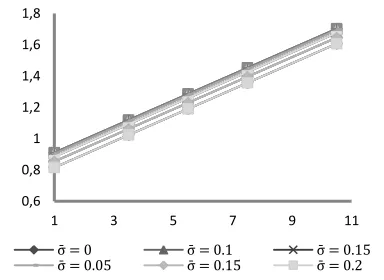
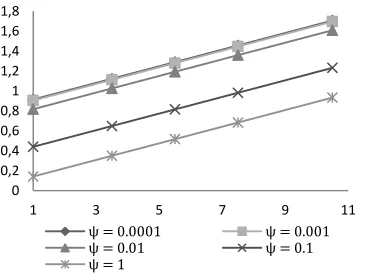
The variation of load carrying capacity with respect to the magnetization parameter for different values of , , , and presented in Figures 1–5, suggest that the load carrying capacity rises sharply due to magnetic fluid lubricant. The effect of curvature parameter is to decrease the load carrying capacity.
Fig. 1. Variation of Load carrying capacity with respect to * and
Fig. 2. Variation of Load carrying capacity with respect to * and
0,6 0,8 1 1,2 1,4 1,6 1,8
1 3 5 7 9 11
σ̄ = 0 σ̄ = 0.1 σ̄ = 0.15
σ̄ = 0.05 σ̄ = 0.15 σ̄ = 0.2
0,4 0,6 0,8 1 1,2 1,4 1,6 1,8 2
1 3 5 7 9 11
52
Fig. 3 Variation of Load carrying capacity with respect to * and
Fig. 4. Variation of Load carrying capacity with respect to * and
Fig. 5. Variation of Load carrying capacity with respect to * and
0,8 1 1,2 1,4 1,6 1,8 2
1 3 5 7 9
ε̄ = -0.1 ε̄ = -0.05
ε̄ = 0 ε̄ = 0.05
ε̄ = 0.1
0,6 0,8 1 1,2 1,4 1,6 1,8 2
1 3 5 7 9 11
β̄ = 0.25 β̄ = 0.35 β̄ = 0.45
β̄ = 0.55 β̄ = 0.65
0 0,2 0,4 0,6 0,8 1 1,2 1,4 1,6 1,8
1 3 5 7 9 11
ψ 0.0001 ψ 0.001
ψ 0.01 ψ 0.1
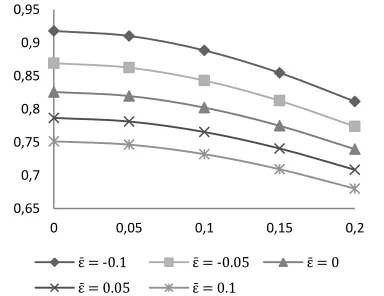
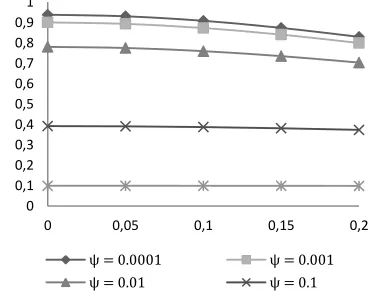
Figures 6-9, describe the variation of load carrying capacity with respect to standard deviation for various values of variance , skewness , and respectively. It is clearly observed that has a significantly negative effect, which means that the already decreased load carrying capacity due to further decreases owing to. Therefore, the combined effect of and is considerably negative in the sense that the load carrying capacity decreases sharply. But the effect of porosity with respect to standard deviation is almost negligible for the values of less than 0.001.
Fig. 6. Variation of Load carrying capacity with respect to and
Fig. 7. Variation of Load carrying capacity with respect to and
0,4 0,5 0,6 0,7 0,8 0,9 1 1,1
0 0,05 0,1 0,15 0,2
ᾱ = -0.1 ᾱ = -0.05
ᾱ = 0 ᾱ = 0.05
ᾱ = 0.1
0,65 0,7 0,75 0,8 0,85 0,9 0,95
0 0,05 0,1 0,15 0,2
ε̄ = -0.1 ε̄ = -0.05 ε̄ = 0
54
Fig. 8. Variation of Load carrying capacity with respect to and
Fig. 9.Variation of Load carrying capacity with respect to and
Fig. 10.Variation of Load carrying capacity with respect to and
0,7 0,75 0,8 0,85 0,9 0,95
0 0,05 0,1 0,15 0,2
β̄ = 0.25 β̄ = 0.35 β̄ = 0.45
β̄ = 0.55 β̄ = 0.65
0 0,1 0,2 0,3 0,4 0,5 0,6 0,7 0,8 0,9 1
0 0,05 0,1 0,15 0,2
ψ 0.0001 ψ 0.001
ψ 0.01 ψ 0.1
0,9 1 1,1 1,2 1,3 1,4 1,5 1,6
-0,1 -0,05 0 0,05 0,1
ε̄ = -0.1 ε̄ = -0.05
ε̄ = 0 ε̄ = 0.05
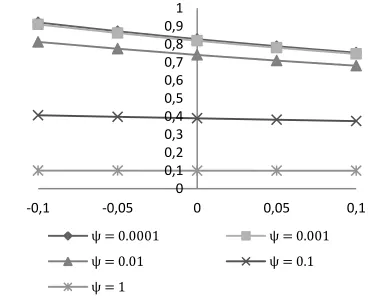
In Figures 10-12, one can see the profile for the load distribution with respect to the variance for different values of , and respectively. From these three Figurers, it is easily seen that variance (+ve) decreases the load carrying capacity while variance (-ve) increases the load carrying capacity. However, the effect of the curvature parameter with respect to the variance
is significant in the sense that the combined effect of the curvature parameter and the variance (+ve) is considerably adverse as indicated in Figure. 11.
Fig. 11.Variation of Load carrying capacity with respect to and
Fig. 12. Variation of Load carrying capacity with respect to and
The effect of skewness is depicted in Figures 13–14, so far as load carrying capacity is concerned. It is observed that skewness follows the path of the variance with regards to the trends. But the effect of curvature parameter on the distribution of the load carrying capacity
0,9 1 1,1 1,2 1,3 1,4 1,5 1,6
-0,1 -0,05 0 0,05 0,1
β̄ = 0.25 β̄ = 0.35 β̄ = 0.45
β̄ = 0.55 β̄ = 0.65
0,3 0,5 0,7 0,9 1,1 1,3 1,5
-0,1 -0,05 0 0,05 0,1
ψ 0.0001 ψ 0.001 ψ 0.01
56
with respect to is significant. Further, the effect of skewness is sharper as compared to that of the variance.
Fig. 13. Variation of Load carrying capacity with respect to and
Fig. 14. Variation of Load carrying capacity with respect to and
Lastly, the effect of with respect to the curvature parameter on the distribution of the load carrying capacity is negligible for the values of porosity less than 0.001. This can be observed in Figure. 15.
0,65 0,7 0,75 0,8 0,85 0,9 0,95 1
-0,1 -0,05 0 0,05 0,1
β̄ = 0.25 β̄ = 0.35 β̄ = 0.45
β̄ = 0.55 β̄ = 0.65
0 0,1 0,2 0,3 0,4 0,5 0,6 0,7 0,8 0,9 1
-0,1 -0,05 0 0,05 0,1
ψ 0.0001 ψ 0.001
ψ 0.01 ψ 0.1
Fig. 15. Variation of Load carrying capacity with respect to and
Some of these figures establish that the negative effect of porosity and the standard deviation can be compensated up to some extent by the positive effect of magnetic fluid lubricant in the case of negatively skewed roughness, particularly, when the negative variance is involved; by choosing a suitable value of the curvature parameter. It is clearly noticed that the combined effect of negatively skewed roughness and negative variance is significantly positive.
4. Conclusion
This article offers ample scopes for reducing the adverse effect of the standard deviation and porosity by the positive effect of magnetization parameter in the case of negatively skewed roughness by suitably choosing the curvature parameter. The reduction becomes sharper particularly, when negative variance occurs. Thus, this analysis makes it mandatory that the roughness must be accorded due consideration while designing the bearing system especially, from bearing‘s life period point of view. Further, this investigation establishes that the bearing can support a load even when there is no flow, which does not happen in the case of conventional lubricant.
0 0,1 0,2 0,3 0,4 0,5 0,6 0,7 0,8 0,9 1
0,25 0,45 0,65
ψ 0.0001 ψ 0.001
ψ 0.01 ψ 0.1
58
Извод
Перформансе притиснутог филма магнетног флуида између
закривљене порозне кружне плоче и равне кружне плоче и ефекат
површинске храпавости
M.Shimpi1*, G.Deheri 2
1
Birla Vishvakarma Mahavidyalaya Engineering College, Vallabh Vidyanagar (India) Email: [email protected]
2
Department of Mathematics, Sardar Patel University, Vallabh Vidyanagar (India) Email: [email protected]
*Corresponding author
Резиме
Рад је усмерен ка анализи понашања притиснутог филма између закривљене грубе порозне кружне плоче и равне грубе порозне кружне плоче у присуству магнетног подмазивача. Дебљина закривљеног филма је описана функцијом сечице. Узето је у обзир да је спољашње магнетно поље усмерено према доњој плочи. Претпостављају се да су попречне грубе површине лежајева. Насумична храпавост површина лежаја окарактерисана је стохастичком случајном променљивом са ненултном средњом вредношћу, варијансом и нагибом.Одговарајућа Рејнолдсова једначина која одређује притисак филма је узета као просечна у односу на случајан параметар храпавости. Одговарајућа бездимензионална парцијална диференцијална једначина је решена са граничним условима у бездимензионалном облику да би се добила дистрибуција притиска, што заузврат води до рачунања носивости. Добијени резултати показују да се перформансе лежајног система значајно побољшавају у поређењу са лежајним системом који ради са уобичајеним подмазивачем пошто магнетизација повећава ефекте вискозности подмазивача. Резултати генерано показују да лежај трпи због попречне храпавости површине. Ово, вероватно, може бити због чињенице да попречна храпавост површине пружа отпор кретању подмазивача. Ефекат варијанце (негативне) је значајан поготово у случају негативног нагиба како се носивост оптерећења нагло повећава.Комбинација ефекта порозности и стандардне девијације је релативно неповољна у смислу да се већ смањена носивост услед порозности даље још смањује због стандардне девијације. Међутим, ово истраживање предлаже неке начине за ублажавање ових лоших ефеката.
Кључне речи: Танак филм, магнетни флуид, храпава површина, Рејнолдсова једначина, носивост, кружне плоче
References
Andharia P.I., Gupta J.L., Deheri G.M.(1997). Effects of Longitudinal Surface Roughness on Hydrodynamic Lubrication of Slider Bearings, Proceedings of Tenth International Conference on Surface Modification Technologies, the Institute of Materials, 872-880. Bhat M.V. and Deheri G.M.(1991). Squeeze Film Behavior in Porous Annular Disks Lubricated
with Magnetic Fluid, Wear, 51, 123-128.
Bhat M.V. and Deheri G.M.(1993). Magnetic Fluid-Based Squeeze Film in Curved porous Circular disks, Journal of Magnetism and Magnetic Materials, 127, 159-162.
Bhat M.V.(2003). Lubrication with a Magnetic Fluid, Team Spirit (India) Pvt. Ltd.
Burton R.A.(1963). Effect of two dimensional Sinusoidal Rough nesses on the Load Support characteristics of a Lubricant Film, Journal of Basic Engg. Trans. ASME, 85, 258–264. Christensen H. and Tonder K.C.(1969a). Tribology of Rough Surfaces: Stochastic Models of
Hydrodynamic Lubrication, SINTEF Report No.10/69-18.
Christensen H. and Tonder K.C.(1969b). Tribology of Rough Surfaces: Parametric Study and Comparison of Lubrication Model, SINTEF Report No.22/69-18.
Christensen H. and Tonder K.C.(1970). The Hydrodynamic Lubrication of Rough Bearing Surfaces of Finite Width, ASME-ASLE Lubrication Conference, Paper No.70-Lub-7. Davies M.G.(1963). The Generation of Pressure between Rough Fluid Lubricated, moving,
deformable surfaces, Lub. Engg., 19, 246-253.
Davim P.J. (2011). Tribology for Engineering – A practical guide, WP, Oxford-Cambridge-Philadelphia-New Delhi.
Deheri G.M. and Patel R.M.(2006). Squeeze Film based Magnetic Fluid in between Porous Circular Disk with Sealed Boundary, Int. Journal of Applied Mechanics and Eng.,11(4), 803-812.
Deheri G.M., Andharia P.I., Patel R.M.(2005). Transversely Rough Slider Bearings with Squeeze Film formed by a Magnetic Fluid, Int. Journal of Applied Mechanics and Engineering, 10, 53-76.
Elsharkawy A.A. and Nassar M.M. (1996). Hydrodynamic Lubrication of Squeeze Film between Porous Circular Plates, Acta Mecanica, 118(1- 4), 121-134.
Guha S.K.(1973). Analysis of Dynamic characteristics of Hydrodynamic Journal Bearings with Isotropic Roughness Effects, Wear, 167, 173-179.
Gupta J. L. and Deheri G.M. (1996). Effect of Roughness on the behavior of Squeeze Film in a Spherical Bearing, Tribology Transactions, 39, 99-102.
Gupta J.L. and Vora K.H. (1980). Analysis of Squeeze Film between Curved Annular Plates, Journal of Lub. Tech. Trans. ASME, 102, 48-59.
Hsu C.H., Lai C., Hung C.R., Lin J.R.(2008). Magneto-hydrodynamic Squeeze Film characteristics between Circular Discs including Rotational Inertial Effects, Proceedings of the Institution of Mechanical Engineers, Part J: Journal of Engineering Tribology, 222(2), 157-164.
Hsu C.H., Lu R.F., Lin J.R. (2009). Combined Effects of Surface Roughness and Rotating Inertia on the Squeeze Film characteristics of Parallel Circular Disks, Journal of Marine Science and Techno., 7(1), 60-66.
Huang, W., Cong, S., Liao, S. (2011), ―Study of the Ferrofluid lubrication with an external magnetic field‖. Tribology Letters, 41, 145-151.
Michell A.G.M.(1950). Lubrication, its principle and practice, Blackie. London.
Murti P.R.K. (1975). Squeeze Films in Curved Circular plates, Transaction ASME, F97, 650-652.
60
Patel R.M. and Deheri G.M.(2002). Magnetic Fluid-Based Squeeze Film between two Curved Plates lying along the Surfaces Determined by Secant Functions, Indian Journal of Engineering and Material Sciences, 9, 45-48.
Prajapati B.L.(1991). Behaviour of Squeeze Film between Rotating Porous Circular Plates: Surface Roughness and Elastic Deformation Effects, Pure Appl. Math. Sci., 33(1-2), 27-36. Prajapati B.L.(1992). Squeeze Film behaviour between Rotating Porous Circular Plates with Concentric Circular Pocket: Surface Roughness and Elastic Deformation Effects, Wear, 152, 301-307.
Prakash J and Vij S.K. (1973). Load Capacity and Time Height Relation between Porous Plates, Wear, 24, 309-322.
Prakash J. and Tiwari K.(1982). Lubrication of a Porous Bearing with Surface Corrugations, Journal of Lub. Tech. Trans. ASME, 104, 90-95.
Prakash, J. and Tiwari K.(1983). Roughness Effects in Porous Circular Squeeze-Plates with arbitrary Wall Thickness, Journal of Lub. Tech.105, 90-95.
Shimpi M.E. and Deheri G.M.(2010). Surface Roughness and Elastic Deformation Effects on the behaviour of the Magnetic Fluid based Squeeze Film between Rotating Porous Circular Plates with Concentric Circular Pockets, Tribology in Industry, 32(2), 21-30.
Ting L.L. (1975a). Engagement behavior of Lubricated Porous Annular Disks, Wear, 34, 159-182.
Ting L.L.(1972). A Mathematical Analog for Determination of Porous Annular Discs, Squeeze Film behavior including the Fluid Inertia Effect, Journal of Basic Eng., 94 (3), 417-423. Tonder K.C.(1972). Surface distributed Waviness and Roughness, First world conference in
Industrial Tribology, New Delhi, A3, 1-8.
Tzeng S.T and Saibel E.(1967). Surface Roughness Effect on Slider Bearing Lubrication, Transaction ASLE, 10, 334-340.
Verma P.D.S.(1986). Magnetic Fluid-Based Squeeze Film, International Journal of Engineering Sci., 24(3), 305-401.
Wu H. (1970). Squeeze Film Behaviour for Porous Annular Disks, Journal of Lub. Tech, 92, 206-209.