MISLEM – PILOT
STUDY, INTERMIN
REPORT
Dr Jane Andrews*
Dr Helen Higson
Research Centre for Higher Education,
Learning and Management, Aston
Business School, Aston University
July 2006
All enquiries to Jane Andrews, HELM, MB621, Aston University.
Contents
Page Subject
3 Introduction
4 Literature
5 Methodology
5 Students’ Perceptions of Aston University and the ‘Work- Place Experience’
6 Preparation for the Placement
7 Discipline Specific Knowledge and Skills 9 Understanding Business Knowledge & Skills 11 Generic Competencies and Skills
Placement Perspectives
Introduction
The MISLEM project is funded by the European Union under the auspices of the ‘Leonardo Programme’. Its primary aim is to evaluate and analyse business graduate employability in relation to the quality of undergraduate level business and
management education within the wider European area. It is anticipated that one of the major outcomes of the project will be the formulation of a set of ‘generic’ key
meta business skills and competencies that will be applicable throughout EU business schools.
Part of the project involves analysing the value of work-based learning programmes including formal work-placements in the UK. Such work-placements, which refer to formally organised programmes in which students undertake a period of educational work-based learning, form an important part of the curriculum at Aston University and are highly valued for the contribution they make in enhancing graduate
employability. This report describes and discusses the analysis of Aston Business School’s placement programme. It describes the students’ perspectives in relation to their work-placement experiences and discusses the usefulness of the skills and knowledge acquired in the first two years of undergraduate education to the work-placement situation. It also draws attention to a set of ‘generic’ skills and
competencies developed by students whilst on placement.
Literature
The value of work-placements in providing students with the opportunity to enhance and develop skills and knowledge acquired at university is reflected in the literature (Ellis, 2000; Robinson, 2000; Quinn, 2004). Whilst there is little doubt that good
work-placements can constitute an important learning experience for students, some authors argue that employers also benefit as placement students make a significant contribution both to the organisations in which they are placed and to industry as a whole (Stokes, 1993; Ellis, 2000). Others point to the usefulness of work-placements as a positive indicator of employability (Robinson, 2000; Siebert et al, 2002), arguing that vocational placements enable students to build upon core subject discipline-focused knowledge and skills whilst providing the ideal setting in which students are able to acquire softer transferable interpersonal, communication and self-management skills desired by employers (Fry, 2001; Harvey & Knight, 2005; Gribben, 2006).
Simply put, work-placements ultimately enhance graduate employability by preparing students for the world of work (Hartog & Frame, 2004; Rayfield, 2005; Tysome, 2006). However, one of the most important factors determining the success of such programmes is the level of academic support available for students whilst on
placement (Robinson 2000; Neill & Mulholland, 2003). The role played by academics in supporting undergraduates to develop and enhance their own employability is discussed by Harvey & Knight (2005) who suggest that within the higher educational environment academics and academic institutions have a responsibility to promote student employability by encouraging students to develop ‘softer’ transferable skills such as flexibility, risk-taking, self-management and interpersonal skills (p.8).
Whilst the benefits of work-placements for both students and employers appear to be wide-reaching, there is little empirical evidence to support this contention. It is anticipated that by drawing attention student perspectives and experiences of their work-placement this report will contribute to debates in this area.
Methodology
Out of a sample of 250 third-year undergraduate business and management placement students, 25 were selected using random sampling techniques and surveyed by e-mail about their experiences of undertaking a work-placement as part of their
undergraduate courses. The main advantage of using random survey techniques was that they provided the ideal research tool with which to capture the views of students from all of the business and management undergraduate programmes offered at Aston University. Moreover, by using random sampling techniques each of the placement students had an equal chance of being selected to take part in the survey thereby increasing the representativeness of the sample (May, 1993; Robson, 2003).
The surveys, which followed mixed methodological approaches, included questions about various aspects of the students’ placement experiences. This report provides a brief overview of the students’ perspectives and experiences.
Perceptions of Aston University and the ‘Work-placement’ Experience
The study participants represented the whole range of undergraduate programmes offered by Aston Business School including Combined Honours (Bachelors Degrees in which students study two separate, unrelated subject areas). Of the twenty-five completing the questionnaire, 23 (92%) were either satisfied or very satisfied with the education they had received thus far at Aston; the other two were neither satisfied or dissatisfied.
Of the remaining 2 individuals, one individual was dissatisfied and one very dissatisfied with their placement.
The students’ placement work activities varied greatly; the most frequently reported activity, regularly undertaken by 19 (76%) of the participants was report writing. Low level administrative duties represented the second most frequently undertaken activity with 16 (64%) of the participants indicating that a significant amount of their time was taken up with general office work including filing and answering e-mail, postal and telephone enquiries. Other everyday work related activities regularly undertaken whilst on work-placement included arranging and attending meeting (11, 44% of the participants); low-level electronic working , using the internet, inputting data into data-bases etc (11, 44%) ; interacting with customers (10, 40%); technical ICT related maintenance and programming work (9, 36%). Around a third, (8, 32%), of the students indicated that they regularly undertook managerial level tasks such as office leadership, teaching and training or project management. More infrequent activities included travelling overseas (1, 4% of the participants); attending corporate events (1, 4%); arranging corporate hospitality, (1, 4%); financial accounting, (1, 4%); and creative thinking (1, 4%).
For the majority of the students, the fact that they were studying at Aston University was a significant factor taken into account by their placement employers at the time of recruitment (21, 84%). Having been appointed, 9 (36%), of the students believed that they were given the opportunity to fully utilise the business related knowledge, skills and competencies acquired in the first two years of their university education during their placement experiences. However, 23 (92%), indicated that the softer skills acquired at university (interpersonal and communication) proved most useful during the course of their placement.
Preparation for the Placement
The students were asked to identify what skills & competencies they felt should have been delivered as part of their formative undergraduate education prior to
commencement of the work-placement. The majority (20, 80%) felt that their
them the opportunity to improve further their general written and verbal
communication skills. This included presentation skills, report writing skills and electronic writing skills – which were noted as being particularly problematic by several of the students (e-mail etiquette). Other areas identified as being somewhat lacking by the majority of the students included strategic management and
organisational skills – the ability to think, plan and act strategically within a work setting (13, 54% of the students felt this was an area in which they lacked the
appropriate level of skill). Leadership skills were also identified by the students as an area where they could have been better prepared during the first two years of their degree (8, 36%). Notably, only 1 student felt that their degree should have equipped them with greater business knowledge whilst another single student identified
business acumen as an area in which they lacked the necessary level of skill.
Having identified the areas in which the students felt they could have been better prepared for their placement, they were then asked to describe what key changes to undergraduate education they believed would improve their placement experiences. Most of the students declined to answer this question; however, 6 (24%) felt their courses should have included more lectures from actual business managers and entrepreneurs whilst 12 (48%) commented about student numbers and the lack of opportunity for discussion in lectures.
The ‘business game’, which is a second year module in which students are required to work in teams to manage a virtual business, was identified by the majority of the students as being particularly valuable in preparing the students for their work-placement (20, 80%). In addition to this other ‘real-life’ teaching and learning techniques such as the use of case-studies and tutorials based upon contemporary events were also identified as being particularly useful in preparing the students’ for their placements (16, 64%).
Discipline specific knowledge and skills
The students were asked about their perceptions and experiences of fourteen different business and management related disciplines; accounting; human resources;
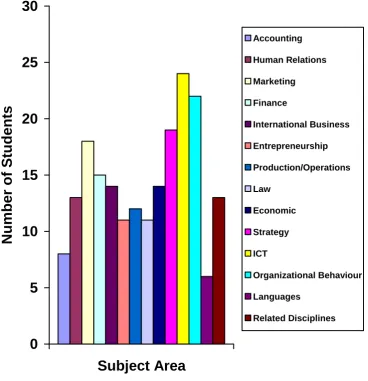
law; economics; strategy; information and communication technology; organizational behaviour; languages; related disciplines including sociology and psychology of business. Figure 1, below, depicts the students’ perceptions of the usefulness of discipline specific business knowledge in respect of their placement experiences.
Figure 1: Usefulness of Subject Disciplines to Placement
0
5
10
15
20
25
30
Subject Area
Number of Students
Accounting Human Relations Marketing Finance
International Business Entrepreneurship Production/Operations Law
Economic Strategy ICT
Organizational Behaviour Languages
Related Disciplines
entrepreneurship, productions/operations management and law were useful whilst on placement.
- Understanding, business knowledge & skills
On the whole the students believed that they had high levels of understanding in all the business areas taught at Aston University. The exceptions to this were
entrepreneurship, productions/operations management and marketing which were identified by around 25% of the students as being areas in which they had limited understanding.
In addition to questions focusing on the usefulness of discipline focused subject knowledge, the students were also asked about how relevant they believe an
Figure 2: The Importance of Understanding Business Concepts in Relation to Future Career Plans
0
5
10
15
20
25
Number of Students
Subject Area
Accounting Human Relations Marketing Finance
International Business Entrepreneurship Productions/Ops Mgmt Law
Economics Strategy ICT
Organizational Behaviour Languages
Associated Disciplines
Generic competencies and skills
Eight generic competencies and skills were identified during an earlier exploratory
study as being relevant to graduate employability (Andrews & Higson, 2006). These were; the ability to influence and persuade subordinates, colleagues and superiors in a work situation; the ability to work effectively in a team – including teambuilding skills; the ability to think critically and analytically; good self and time management skills; leadership abilities; the ability to see the bigger picture;good presentation skills; and high levels of written and oral communication skills.
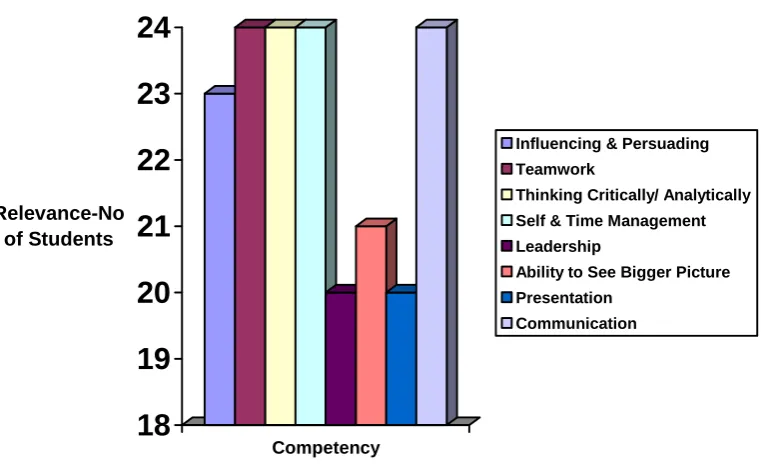
Figure 3 shows the students’ perceptions of the relevance of the competencies in respect of their experiences whilst on work-placement.
Figure 3: The Students’ Perceptions of the Relevance of the Competencies
18
19
20
21
22
23
24
Relevance-No of Students
Competency
Influencing & Persuading Teamwork
Thinking Critically/ Analytically Self & Time Management Leadership
Ability to See Bigger Picture Presentation
Of the eight generic competencies and skills, four were identified by twenty-four of the participants as being particularly relevant to their daily work routines (teamwork; thinking critically/analytically; self and time management’ and communication).
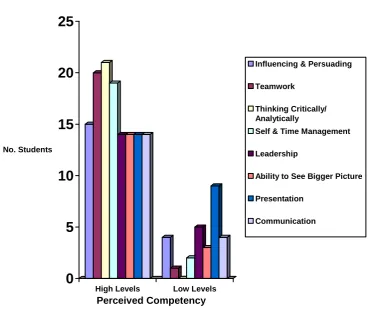
Whilst the majority of the students acknowledged the importance of the generic competencies and skills in their daily work routines, their perceptions of their own ability to use such competencies varied greatly. Figure 4 below shows the students’ perceived level of competency in each area and also indicates the areas where the students feel less capable.
Figure 4: Perceptions of Abilities of Using Generic Competencies
0
5
10
15
20
25
No. Students
High Levels Low Levels
Perceived Competency
Influencing & Persuading
Teamwork
Thinking Critically/ Analytically
Self & Time Management
Leadership
Ability to See Bigger Picture
Presentation
Figure 4 shows that the area in which the students felt the least capable related to presentation skills whilst the area where they felt most confident was in their ability to think critically and analytically. Whilst, on the whole, the students felt relatively confident in using the competencies they all acknowledged that, during the course of their placement experiences, they experienced times when they felt less than capable in utilising the competencies. Presentation skills were the most problematic with 8 (36%) of the students identifying problems in this area.
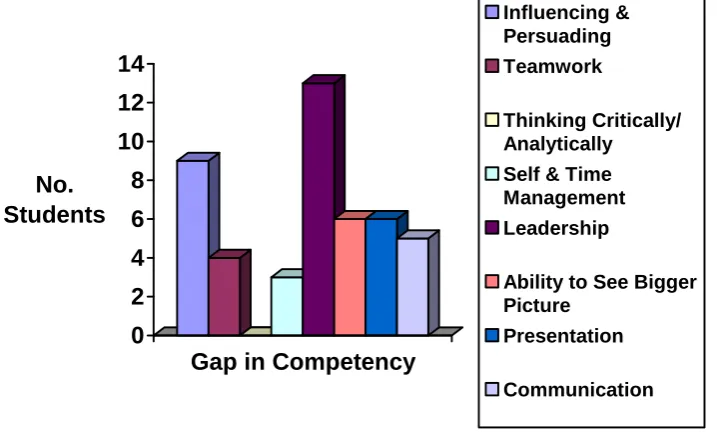
In addition to presentation skills, the students also perceived there to be a notable gap in their leadership abilities with 13 (52%) of the students indicating that, during their placement, they had experienced times when their leadership skills were less than adequate. Figure 5 shows the number of students reporting a ‘gap’ in their ability to use the generic skills whilst on placement.
Figure 5: Perceptions of a ‘Gap’ in Competencies.
0 2 4 6 8 10 12 14 No. Students
Gap in Competency
Influencing & Persuading Teamwork
Thinking Critically/ Analytically
Self & Time Management Leadership
Ability to See Bigger Picture
Presentation
Communication
Discussion
This study suggests that Aston Business School students are more than adequately prepared for their work-placement experience and that once on placement they have a positive and educational experience. That 92% of the students were either ‘satisfied’ or ‘very satisfied’ with their placement would indicate that, on the whole, the
placements are at an appropriate level matching the students’ abilities and
expectations. The wide spectrum of placement positions occupied by the students is reflective of the Business School Placement Scheme, indicating that the first two years of business focused degrees appropriately prepare undergraduates for a diverse range of placement jobs in which they are expected to be able to complete a wide range of tasks.
Despite the diversity of occupational tasks undertaken, which varied from basic administration to more complicated managerial and technological tasks, the students indicated that they had limited opportunity to fully utilise the business skills,
competencies and knowledge acquired in the first two years of their education. This finding supports research into graduate employability which suggests that many graduates are under-employed in positions in which their skills and knowledge are under-used and not fully recognised by employers (Nabi, 2003).
Many of the students identified a clear gap in their general communication and presentation skills. This is despite the fact that much of the curriculum focuses on such skills, with tutorials offering students the opportunity to enhance and build upon their verbal and interpersonal skills. It is evident that students do bear some
responsibility in this matter, low levels of attendance at, and participation in, tutorials does nothing to promote student learning. However, from an andragogical
perspective, undergraduates are adults, responsible for their own learning (Forest & Peterson, 2006). Tutorials offer the opportunity to hone the softer skills desired by employers - it is up to individual students to decide whether or not to take up that opportunity.
One of the most significant findings related to real-life teaching and learning
it prepares them for some of the real-life challenges associated with the work environment – including the problems of teamwork. It culminates with the students presenting their work to actual business managers – an experience many find daunting. Yet, it was this experience that many identified as being of the greatest relevance to their placement experiences. The other teaching and learning techniques identified in the study as being useful in preparing the students for their
work-placements reflected case-study and other real- life learning techniques such as tutorials in which students are encouraged to analyse and discuss contemporary events. This suggests that student engagement and participation in the classroom provides valuable learning opportunities which enhances subsequent work-based learning.
The skills and competencies most utilised by the students were ICT based; this is not surprising given the fact that most contemporary office work is in electronic format and much office communication undertaken electronically. The fact that the most frequently used business skills and competencies reflected learning acquired whilst studying organizational behaviour and business strategy may reflect the students occupational position within the organizations in which they were deployed. Most conceptualised themselves as ‘trainees’ and viewed their position as being one in which they were acquiring valuable work-based skills within a learning environment. The least utilised areas of business knowledge used by the placement students were entrepreneurship, operations management and law. This may reflect the structure of the curricula – many of the students do not study these disciplines until the final year of their degree.
When asked to assess which business disciplines may prove useful in their future careers’ the students gave particular credence to international business, organizational strategy, organizational behaviour and ICT. However, with the exception of languages and accounting, all of the business disciplines included within the questionnaire were deemed to be relevant. This supports current thinking about the role played by graduates within a knowledge based economy (Harvey et al, 2002) and the value of a higher education qualifications grounded in precise, yet expansive, business
Although the students generally perceived themselves to have an adequate understanding of, and ability to use, many of the business skills and knowledge associated with specific subject areas, they were less confident in their opinions of their abilities to use the generic competencies identified in the study. Whilst all eight of the competencies were deemed relevant to the students’ work-placements, the study suggests that many of them lacked confidence in their abilities to utilise such generic skills. This was particularly the case for presentation skills, leadership skills and communication skills. Whilst this finding may reflect the students’ age a lack of experience within a formal work setting, it also leads to the suggestion that
undergraduate education might further enhance employability by including such intangible ‘softer’ skills within the curriculum. Undergraduates could be encouraged to develop their own presentation and communication skills by the inclusion of assessed presentations where permitted within each module. Leadership skills may be more difficult to teach; however, UK universities generally provide students with the opportunity to become involved in a wide-range of extra-curricula sporting or
voluntary activities. Such activities in themselves may promote leadership and self-confidence whilst providing the ideal medium in which students can ‘grow’ as individuals (Fenton et al: 1993, Liao-Troth & Dunn: 1999, Wardell et al: 2000).
Conclusion
This exploratory study has drawn attention to the benefits of undertaking a formal work-placement as part of a Bachelors Degree Programme from the perspectives of the students’ themselves. It has shown how placements enhance employability by providing the opportunity for students to build upon the skills and knowledge acquired during the first two years of their degree whilst developing and acquiring ‘softer’ generic competencies such as communication skills. The growing
alternative study, examining how universities might assist undergraduate students develop ‘softer’ intangible leadership and communication skills could provide the empirical grounding for curricula development in this area.
References
Andrews J. & Higson H. (2006). MISLEM Project: Phase II: Report of Study Findings. Unpublished Report. HELM. Aston University Business School. Ellis N. (2000). ‘Developing Graduate Sales Professionals Through Co-operative Education and Work-placements: A Relationship Marketing Approach’. Journal of European Industrial Training. 24. 1. pp 34-45
Fenton N., Golding P., Radley A. (1993). Thinking about Charity – Report of a Pilot Study into Public Attitudes to Charities and Volunteering. In Saxon-Harrold & Kendal J. (eds). Researching the Voluntary Sector. pp 75-85. Tonbridge. Charities Aid
Foundation.
Forest S.P. & Peterson T.O. (2006). ‘It’s Called Andragogy’. Academy of Management, Learning & Education. 5. 1. pp 113-122.
Fry O. (2001). ‘Undergraduate Takes the First STEP to Success’. Training & Management Development Methods. 15. 1. pp 401-407.
Gibben R. (2006). ‘Shell Offers Students a Meeting of Minds’. Times Higher. 4/5/06. pg. 1
Hartog, M. & Frame, P. (2004). ‘Business Ethics in the Curriculum: Integrating Ethics Through Work Experience’. Journal of Business Ethics. 54. pp. 399-409.
Harvey L., Locke W. & Morey A. (2002). Enhancing Employability, Recognising Diversity: Making Links Between Higher Education and the World of Work. London. Universities UK
Harvey, L. & Knight, P. (2005). Briefings on Employability 5: Helping Departments to Develop Employability. London. ESECT. (Enhancing Student Employability Co-Ordination Team). Learning & Teaching Support Network.
Liao-Troth M.A. & Dunn C.P. (1999). Social Constructs and Human Service: Managerial Sensemaking and Volunteer Motivation. Voluntas. 10. 4. pp 345-361. May T. (1993). ‘Social Research: Issues, Methods & Practice’. Buckingham. Open University Press. 2nd Edition.
Nabi, G.R. (2003). ‘Graduate Employment and Underemployment: Opportunity for Skill Use and Career Experiences Amongst Recent Business Graduates’. Education & Training. 45. 7. pp 371-383
Neill, N.T., & Mulholland, G.E. (2003). ‘Student Placement – Structure, Skills and E-support’. Education & Training. 45. 2. pp 89-99.
Rayfield T. (2005). ‘Tucking Into a Sandwich Course’. ISCO Career Scope.
http://www.careerscope.info/features/CSsummer05/sandwich.pdf
Robinson, H. (2000). Development Through Placements. EQUIPE. (Educational Quality in Placements in Engineering). Loughborough University.
Robson C. (1993). ‘Real World Research’. Oxford. Blackwell.
Siebert, J.W., Davis, G.C., Litzenberg K.R. & Broder J.M. (2002). ‘Time Allocation Decisions Associated with Job Market Preparation: Undergraduate Perceptions Versus Market Realities’. American Journal of Agricultural Economics. 84. 1. pp 222-234.
Stokes P.J. (1993). ‘The European Industrial Placement Environment: A UK Perspective’. Journal of European Business Education. 3. 1. pp 85-101.
Tysome T. (2006). ‘Students Think Degrees Are Still Good Value’. London. The Times Higher. 7/7/06. No. 1750. pg. 11.
Quinn C. (2004). ‘Want to Run The Show?’. London. The Guardian. 21/2/04. Guardian Rise. Pg. 2
UCAS (2006). ‘Sandwich Courses’. http://search.ucas.co.uk/cgi-
bin/hsrun/search/search/StateId/RBZSuwHsn3Q0LpjAtdldUxzsVbi6I-4r_8/HAHTpage/search.HsSearch.submitForm?txtSubject=sandwich+courses&cmbQ ual=&cmbAttend=&cmbInst=
Date accessed 14/8.06