The value of Tablets as reading aids for individuals with
central visual field loss: an evaluation of eccentric reading
with static and scrolling text
Robin Walker1, Lauren Bryan1, Hannah Harvey1, Afsane Riazi1and Stephen J. Anderson2
1Department of Psychology, Royal Holloway, University of London, Egham, and2Neurosciences, School of Life and Health Sciences, Aston University,
Birmingham, UK
Citation information: Walker R , Bryan L, Harvey H, Riazi A & Anderson SJ. The value of Tablets as reading aids for individuals with central visual field loss: an evaluation of eccentric reading with static and scrolling text.Ophthalmic Physiol Opt2016. doi: 10.1111/opo.12296
Keywords: eccentric viewing, low vision, macular degeneration, reading, scrolling text
Correspondence:Robin Walker E-mail address: [email protected]
Received: 20 November 2015; Accepted: 2 March 2016
Abstract
Purpose: Technological devices such as smartphones and tablets are widely avail-able and increasingly used as visual aids. This study evaluated the use of a novel app for tablets (MD_evReader) developed as a reading aid for individuals with a central field loss resulting from macular degeneration. The MD_evReader app scrolls text as single lines (similar to a news ticker) and is intended to enhance reading performance using the eccentric viewing technique by both reducing the demands on the eye movement system and minimising the deleterious effects of perceptual crowding. Reading performance with scrolling text was compared with reading static sentences, also presented on a tablet computer.
Methods: Twenty-six people with low vision (diagnosis of macular degeneration) read static or dynamic text (scrolled from right to left), presented as a single line at high contrast on a tablet device. Reading error rates and comprehension were recorded for both text formats, and the participant’s subjective experience of reading with the app was assessed using a simple questionnaire.
Results: The average reading speed for static and dynamic text was not signifi-cantly different and equal to or greater than 85 words per minute. The compre-hension scores for both text formats were also similar, equal to approximately 95% correct. However, reading error rates were significantly (p=0.02) less for dynamic text than for static text. The participants’ questionnaire ratings of their reading experience with the MD_evReader were highly positive and indicated a preference for reading with this app compared with their usual method.
Conclusions: Our data show that reading performance with scrolling text is at least equal to that achieved with static text and in some respects (reading error rate) is better than static text. Bespoke apps informed by an understanding of the underlying sensorimotor processes involved in a cognitive task such as reading have excellent potential as aids for people with visual impairments.
Introduction
Smartphones, tablets and electronic readers often incor-porate basic features such as image enlargement and high-contrast screens that can be used as effective low vision aids.1 The capabilities of these devices can be fur-ther extended by the development of bespoke apps that are tailored towards specific visual impairments.2 For
example, tablets and smartphones can present text in a range of formats including dynamically as horizontally scrolling lines (similar to a news ‘ticker’) or as a serial stream of words at a single location (rapid-serial visual-presentation – RSVP). The use of dynamic text presentation methods could aid reading in individuals with a central field loss (CFL)3–6 as exhibited in macular degeneration (MD).
Individuals with macular degeneration often make use of their relatively preserved peripheral vision and self-select a preferred area of their eccentric retina (preferred retinal loci, or PRL).7–9The use of the eccentric viewing technique can develop spontaneously within 6 months of disease onset,10 and has been associated with improvements in reading speed.11 Reading with dynamic formats such as RSVP and scrolling lines involves a different pattern of eye movements12, 13to the stereotypical pattern used for read-ing normally,14 and could enhance eccentric reading in people with a central field loss.4, 15, 16
The effective use of eccentric viewing for reading requires the reader to be able to hold an eccentric gaze position (at their PRL) and this ability can be compromised in people with MD,17 as can their oculomotor control.9, 18 A tech-nique called the ‘steady-eye’ strategy, where the reader holding a steady eccentric viewing position while moving the page of text from right-to-left in front of their eyes,19 may reduce the demands on the oculomotor system. The eccentric viewing and steady-eye techniques can be com-bined and there is some evidence that these strategies reduce reading difficulties.20, 21 The use of dynamic text formats, such as horizontally scrolling sentences6 and RSVP,16 can potentially mitigate the difficulties encoun-tered in eccentric reading by reducing the demands to make eye movements. Faster reading rates have been observed with horizontal drifting text compared with static text6and RSVP4in cases of CFL. A study employing a simulated cen-tral scotoma to mimic CFL reported a reduction in reading errors and improved adherence to eccentric viewing with scrolling text compared with static text.5
An advantage of electronic devices is that they can enable text to be presented with dynamic formats and this may have wide-ranging benefits for people with low vision. Fur-thermore, other potential textual characteristics (e.g. font size, word spacing, line spacing, colour) can also be manip-ulated. The present study examined reading performance and subjective reading experience with static and scrolling text in individuals with macular disease. Participants read single sentences of either static or scrolling text presented on a tablet (iPad2) and were instructed to adopt an eccen-tric viewing strategy.
Methods
Participants
The participants were all recruited from the membership of the Macular Society (UK), which actively promotes the eccentric viewing technique. As such it was expected that participants would, in general, be aware of this technique. As they were not recruited from a clinical setting they were not ‘patients’ as such and we did not have access to their clinical details (e.g. whether they were receiving treatment
or not). The inclusion criteria were: a diagnosis of binocu-lar macubinocu-lar degeneration (wet or dry); over 18 years of age, binocular distance acuity between 0.30 and 0.80 (Mean 0.55, S.D. 0.24) logMAR (Snellen equivalents 6/12 or 20/40 to 6/40 or 20/135) and English as primary language. The exclusion criteria were: inability to read 24-point font; ocu-lar co-morbidity; dyslexia and any cognitive impairment. Informed consent was collected from all participants prior to the study, as approved by Royal Holloway Psychology departmental and NHS ethical review (reference, 14LO0047).
Materials
The sentences used in the assessment of reading perfor-mance consisted of 40 sentences from the MNRead compi-lation,6which are all of a standard length of 46 characters (excluding spaces) or approximately 10–12 words long (e.g. ‘Every Tuesday the jazz band took requests to play songs’). A double space was included between each word to reduce visual crowding.22 Twenty sentences were presented dynamically (horizontally-scrolling) on a tablet device (iPad2) in Arial 24 point black font on a yellow background using the MD_evReader app2. On the basis of an earlier pilot study,2 the scrolling speed was set at a comfortable rate of approximately 180 characters/minute for all partici-pants. Twenty single sentences were presented in static for-mat (same font size, colour as for scrolling) using the SlideSharkR(Brainshark Inc.; https://www.slideshark.com/) presentation app that allows text to be manipulated and presented on an iPad (similar to Microsoft PowerpointR; www.microsoft.com/en-gb). At the end of each sentence the participant was asked a simple comprehension question (e.g. ‘Was it a rock band that took requests?’). A digital mp3 recorder recorded the participants reading aloud for later off-line scoring. Binocular reading acuity was mea-sured using the MNRead Acuity Chart.15
User experience questionnaire
Following the assessment of reading performance, partici-pants completed a short user evaluation questionnaire (Appendix 1). Items probed their explicit awareness and active use of the eccentric viewing and steady eye tech-niques as well as their subjective experience of reading with the MD_evReader app, along with factors that would deter them from using such devices.
Procedure
explained to participants and they were asked to adhere to these strategies as much as possible when reading. The pre-ferred retinal locus for each participant was assessed using an Amsler chart: ten participants had received training in eccentric viewing (provided by the Macular Society) and were aware of their ideal PRL. For scrolling text a movable fixation marker (controlled by the MD_evReader app (Fig-ure 1) was then positioned on the tablet screen as a land-mark for gaze position to be held such that the text was located at the participant’s PRL (e.g. if the PRL was in the lower right visual field the eccentric fixation stimulus was positioned above and to the left of the text). For static text, participants were instructed to read whilst holding an eccentric viewing position at their PRL.
Participants first performed a short practice session in which they read three scrolling and three static sentences presented on an iPad2 tablet held upright using a stand at a viewing distance of approximately 40 cm. If required, each participant could make adjustments to the position of the movable fixation stimulus following this practice. The eccentric fixation stimulus was presented in the scrolling text condition only; participants were instructed to read static text whilst moving their gaze along the line at their preferred eccentric viewing position. For the assessment, participants were asked to read 10 scrolling sentences and then 10 static sentences. This sequence was repeated with a further two sets of 10 sentences to counterbalance the text presentation methods. A short break was given between each block of sentences. Participants were encouraged to read whilst holding an eccentric viewing position and to adopt the steady-eye strategy with scrolling text. Recording of the participants reading started when they first vocalised, not when the sentence appeared on the screen. At the end
of the testing session participants completed the user evaluation questionnaire (with assistance from the researcher for reading the questions if required). Reading performance measures for scrolling and static text formats were examined using non-parametric statistics (Wilcoxon signed-ranks test), and the median was used to describe the Likert-scale questionnaire scores.
The audio recording enabled reading speed and errors to be quantified after the session. A sentence was deemed to contain errors if the participant omitted words, added additional words, or read a word incorrectly (even if they subsequently corrected the error). After each sentence, par-ticipants were asked a comprehension question and were required to respond with either “Yes” or “No”. An incor-rect answer was scored as zero, while a corincor-rect answer was scored as one. Reading speed was recorded for each sen-tence with a stopwatch. It should be noted that for scrolling text participants typically waited for some seconds for words to appear on the screen before they started to read aloud.
Results
Twenty-six (23 female) adults aged from 42 to 93 years (mean age =75.8 years) volunteered to take part in the study. Of these, 14 had attended a higher education insti-tute, including 11 at University/Polytechnic level. All reported a prior diagnosis of macular disease as follows: left eye diagnoses included: 14 wet AMD, 10 dry AMD and two Stargardt disease; right eye diagnoses included: 10 wet AMD 14 dry AMD and two juvenile forms (Stargardt’s dis-ease). Average length of diagnosis was 110 months (range 8–516 months). Ten participants (38.5%) had prior knowl-edge of the eccentric viewing technique and stated that they used the strategy for tasks, including reading (average time using EV was 35.5 months).
Following the initial assessment of the PRL, twenty-two participants positioned the fixation stimulus (a cross) above the line of text, while four positioned the stimulus below the sentence. The first trial of static and scrolling text
Figure 1. Main screen of MD_evReader showing fixation stimulus posi-tioned above a single line of (scrolling) text. The trackpad (bottom of screen) is used to control the speed of scrolling.
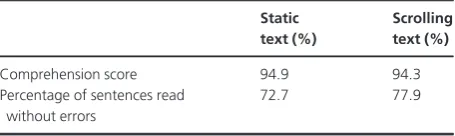
Table 1. Average comprehension scores (%), and the % of sentences read without errors for static and scrolling lines of text
Static text (%)
Scrolling text (%)
Comprehension score 94.9 94.3
Percentage of sentences read without errors
72.7 77.9
were excluded, with each participant’s reading assessed on the remaining 19 sentences for each condition (Table 1).
Comprehension and Error rates
Comprehension performance was high for both the scrolling and static text formats (94.3% and 94.9% respec-tively), and a comparison between conditions was not sig-nificant (Wilcoxon-signed-ranks testZ = 0.48,p=0.63, r=0.03). The overall number of reading errors was low (Medianscrolling=0.21, static =0.24) and the difference between the two conditions was not significant (Wilcoxon-signed-ranks test Z= 1.35, p=0.18, r=0.84). The proportion of sentences read without errors was, however, significantly greater for scrolling text (77.9%) than static text (72.7%), Wilcoxon-signed-ranks test Z= 2.26, p=0.02,r=0.82).
Reading Speed
The average time taken to read was 7.2 s for static sentences (S.D. 4.5, range 2.8–17.0 s) and 7.8 s for scrolling sentences (S.D. 4.1, range 3.2s–18.0 s), which equates to reading speeds of approximately 91.6 and 84.6 words per minute respectively. A t-test confirmed that reading speed was comparable in the two text formats [t(25) = 1.94, p=0.064].
User experience questionnaire
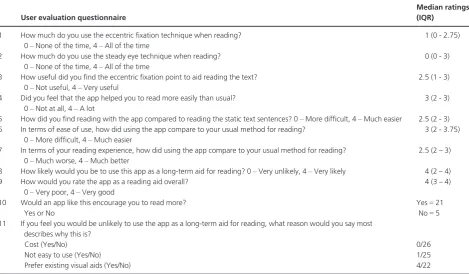
Following the reading assessment participants completed a short questionnaire designed to probe their prior knowl-edge and stated use of the eccentric viewing technique and also their subjective experience of reading scrolling text presented using the MD_evReader app. The questionnaire items and the median responses on a five-point Likert scale are reported inAppendix 1.
Discussion
Reading performance in 26 adults with binocular macular degeneration and a central field defect was assessed using a tablet with an app developed to enhance eccentric reading.2 Participants were instructed to read using the eccentric viewing technique, and performance was assessed for single sentences of either static or horizontally-scrolling text. Reading performance was good overall with a high average reading speed observed in both conditions (overall mean= 84–92 w.p.m), along with excellent comprehension rates (95% correct). Average reading error rates and com-prehension scores were comparable across presentation for-mats, and a small reduction in the number of sentences read without errors was observed for dynamic scrolling
text. Our data shows that reading performance with scrol-ling text is at least equal to that achieved with static text and in some respects (reduced error rates) is better than with static text. Given reading scrolling text is an unusual situation and many of the participants reported not being familiar with the eccentric viewing technique, the high comprehension and low reading error rates observed for dynamic text demonstrates the potential benefits of bespoke apps for tablet devices as low vision aids for indi-viduals with a CFL.
The questionnaire ratings of user experience of reading scrolling text with the MD_evReader app were positive (Appendix 1). The majority of participants rated the MD_evReader highly as a reading aid and three-quarters said that it would encourage them to read more than they do at present. A similar percentage reported that their reading experience with the MD_evReader app was equally good or better than their current method. Although it is plausible that the positive ratings may be subject to a degree of acquiescence bias, the overall posi-tive responses to questions focused on reading scrolling text presented on tablet are encouraging. Reading hori-zontally-scrolling text is an unusual situation and com-bining this with eccentric viewing and steady-eye strategies in a single assessment session is not ideal for evaluating its potential as a low-vision aid. Despite these limitations reading speed and comprehension were com-parable across formats and reading errors were reduced with scrolling text. Reading performance with dynamic text formats presented on eReaders and Tablets may ben-efit from interventions, such as perceptual learning, which has been shown to produce tangible improvements after a small number of practice sessions.23
The limitations of the present study include the lack of prior experience of eccentric viewing for some participants and the potential unreliability in the assessment of the par-ticipants’ PRL with an Amsler grid. Future studies could investigate the effects of perceptual learning,23 combining eccentric viewing with static and a wider range of dynamic formats (scrolling and RSVP) over a longer period of time, with added performance measures (e.g. minimum font size, duration of comfortable reading). User feedback could be collected using features incorporated into the app rather than relying on a separate questionnaire.
Disclosure
The authors report no conflicts of interest.
Acknowledgments
grateful to the staff and volunteers from the Macular Soci-ety who contributed their time to act as participants. We would also like to thank Gordon Legge for providing addi-tional MNRead sentences.
References
1. Crossland MD, Silva RS & Macedo AF. Smartphone, tablet computer and e-reader use by people with vision impair-ment.Ophthalmic Physiol Opt2014; 34: 552–557. 2. Crossland MD, Culham LE, Kabanarou SA & Rubin GS.
Preferred retinal locus development in patients with macu-lar disease.Ophthalmology2005; 112(9): 1579–
1585doi:10.1016/j.ophtha.2005.03.027.
3. Walker R. An iPad app as a low-visual aid for people with macular disease.Brit J Ophthalmol2013; 97: 110–112. 4. Bowers AR, Woods RL & Peli E. Preferred retinal locus and
reading rate with four dynamic text presentation formats. Optom Vis Sci2004; 81: 205–213.
5. Fine EM & Peli E. Scrolled and rapid serial visual pre-sentation texts are read at similar rates by the visually impaired. J Opt Soc Am A Opt Image Sci Vis 1995; 12: 2286–2292.
6. Harvey H & Walker R. Reading with peripheral vision: a comparison of reading dynamic scrolling and static text with a simulated central scotoma.Vis Res2014; 98: 56–60.
7. Legge GE, Ross JA, Luebker Aet al.Psychophysics of read-ing 8. The Minnesota low-vision readread-ing test.Optom Vis Sci 1989; 66: 843–853.
8. Fletcher DC & Schuchard RA. Preferred retinal loci relation-ship to macular scotomas in a low-vision population. Oph-thalmol1997; 104: 632–638.
9. Von Noorden GK & Mackensen G. Phenomenology of eccentric fixation.Am J Ophthalmol1962; 53: 642–661. 10. Whittaker SG, Budd J & Cummings RW. Eccentric fixation
with macular scotoma.Investigative Ophthalmol Vis Sci. 1988; 29: 268–278.
11. Crossland MD, Culham LE, Kabanarou SAet al.Preferred retinal locus development in patients with macular disease. Ophthalmology2005; 112: 1579–1585.
12. Nilsson UL, Frennesson C & Nilsson SEG. Patients with AMD and a large absolute central scotoma can be trained successfully to use eccentric viewing, as demonstrated in a scanning laser ophthalmoscope.Vis Res2003; 43: 1777– 1787.
13. Buettner M, Krischer C & Meissen R. Characterization of gliding text as a reading stimulus.B Psychonomic Soc1985; 23: 479–482.
14. Potter MC. Rapid serial visual presentation (RSVP): a method for studying language processing. New methods in reading comprehension research. In:New Methods in Read-ing Comprehension Research(Kieras D. & Just M editors), Erlbaum: Hillsdale, 1984; 118: pp. 91–118.
15. Rayner K. Eye movements in reading and information pro-cessing: 20 years of research.Psychol Bull1998; 124: 372–422. 16. Legge GE, Ross JA, Luebker Aet al.Psychophysics of
Read-ing. VIII. The Minnesota Low-Vision Reading Test.Optom Vis Sci1989; 66: 843–853.
17. Rubin GS & Turano K. Low-vision reading with sequential word presentation.Vis Res1994; 34: 1723–1733.
18. Crossland MD, Culham LE & Rubin GS. Fixation stability and reading speed in patients with newly developed macular disease.Ophthalmic Physiol Opt2004; 24: 327–333. 19. Timberlake GT, Mainster MA, Peli Eet al.Reading with a
macular scotoma I. Retinal location of scotoma and fixation area.Invest Ophth Vis Sci1986; 27 : 1137–1147.
20. Watson G & Berg R.Near training techniques. In: Under-standing Low Vision, (Jose R, editor), American Foundation for the Blind: New York, 1983; pp. 317–362.
21. Nilsson UL & Nilsson SEG. Rehabilitation of the visually handicapped with advanced macular degeneration.Doc Ophthalmol1986; 62: 345–367.
22. Palmer S, Logan D, Nabili Set al.Effective rehabilitation of reading by training in the technique of eccentric viewing: evaluation of a 4-year programme of service delivery.Brit J Ophthalmol2010; 94: 494–497.
23. Blackmore-Wright S, Georgeson MA & Anderson SJ. Enhanced text spacing improves reading performance in individuals with macular disease.PLoS One2013; 8: e80325. 24. Chung ST. Improving reading speed for people with central vision loss through perceptual learning.Investigative Oph-thalmol Vis Sci2011; 52: 1164–1170.
Appendix 1: User experience questionnaire
Participants completed a questionnaire (Table A1) devised to evaluate user experience of reading using the MD_ev-Reader iPad app. The questionnaire was completed follow-ing the assessment of readfollow-ing performance. The researcher read out each question and explained the nature of the response required (either on a 5-point Likert scale, or with a yes/no response) and recorded the responses.
Findings and summary
Less than half (10/26) of the participants included in the study were explicitly aware of eccentric viewing (either informed by Macular Society eccentric viewing trainers, or literature). It is quite likely, however, that participants may have spontaneously developed the use of an eccentric pre-ferred retinal location (Crossland 2005) despite their lack of acknowledged awareness of the strategy. For those partici-pants who stated they had experience of the eccentric viewing strategy, the average length of time since they first adopted the use of the technique was 13.6 months (range 2–132 months). The median questionnaire ratings for ques-tions 1 and 2 relating to use of eccentric viewing and steady-eye techniques for reading were low (1 and 0 respectively) and show a large degree of variability, which illustrates the variability in prior knowledge of eccentric viewing.
Items 4–7 examined the participant’s experience of read-ing scrollread-ing text presented on the iPad usread-ing the MD_ev-Reader app. Median scores indicated users found it easier to read dynamic text presented with the app than when reading normally, and when compared to reading static sentences and with their usual preferred reading method. Scores for ease of use and experience of reading with the app were also high compared with participants’ usual read-ing method. The participants’ evaluations of the iPad app
for reading were positive: a median of 4.0 was given for the question that asked how likely they would be to use the app as a long-term reading aid. When asked how they would rate the app overall, the median score for participants was 4.0, with 90% of participants rating the app positively (rating of 3 or 4). Participant age was negatively correlated with their average approval rating of the app, with older age being associated with a lower rating (q=-48,p= 0.02). Of all participants, 84% agreed that the app would encour-age them to read more. One reason given why it was unli-kely they would use the app was that they preferred their existing reading aid (4/26 cases).
Although the positive evaluations of reading experience when using the iPad app are encouraging, they should be interpreted with a degree of caution as they may be subject to the influence of acquiescence bias. Participants verbally reported their ratings directly to the research assistant and it is quite likely that they would be more likely to make their responses more positive than was actually the case. Bespoke apps like the MD_evReader have the potential to enhance further the basic features of tablet devices and enable methods of text presentation, including dynamic and RSVP which are not available on standard eReaders. The cost of developing and purchasing apps is relatively inexpensive and they offer excellent potential as innovative low vision aids.
Table A1.Results from the user evaluation questionnaire showing the questions and the median ratings (0–4 Likert scale) and interquartile range (IQR), and yes/no responses to questions 10 and 11
User evaluation questionnaire
Median ratings (IQR)
1 How much do you use the eccentric fixation technique when reading? 0–None of the time, 4–All of the time
1 (0 - 2.75)
2 How much do you use the steady eye technique when reading? 0–None of the time, 4–All of the time
0 (0 - 3)
3 How useful did you find the eccentric fixation point to aid reading the text? 0–Not useful, 4–Very useful
2.5 (1 - 3)
4 Did you feel that the app helped you to read more easily than usual? 0–Not at all, 4–A lot
3 (2 - 3)
5 How did you find reading with the app compared to reading the static text sentences? 0–More difficult, 4–Much easier 2.5 (2 - 3) 6 In terms of ease of use, how did using the app compare to your usual method for reading?
0–More difficult, 4–Much easier
3 (2 - 3.75)
7 In terms of your reading experience, how did using the app compare to your usual method for reading? 0–Much worse, 4–Much better
2.5 (2 – 3)
8 How likely would you be to use this app as a long-term aid for reading? 0–Very unlikely, 4–Very likely 4 (2 – 4) 9 How would you rate the app as a reading aid overall?
0–Very poor, 4–Very good
4 (3 – 4)
10 Would an app like this encourage you to read more? Yes or No
Yes=21 No=5 11 If you feel you would be unlikely to use the app as a long-term aid for reading, what reason would you say most
describes why this is? Cost (Yes/No)
Not easy to use (Yes/No) Prefer existing visual aids (Yes/No)