YOUTH LEARNING FROM THE WORLD, LEADING IN THEIR
COMMUNITY: A SUMMARY REPORT
Tamara Thorpe
TNT Intercultural and Leadership Development Victoria, British Columbia
Abstract
This research was conducted to explore the impact of participation in an international education program on youth leadership development and how youth can more effectively engage in civic and community issues. The findings and recommendations offer international education programs, educators and youth workers strategies and best practices to support youth in their leadership development through service learning, an educational approach that combines civic engagement with learning activities. Service learning offers the opportunity to support and enhance the learning from international exchanges and educations programs. It can be applied towards youth in both academic and non-academic youth programs.
Introduction
After participating in my first international education program twenty years ago, I immediately noticed a change in my values and worldview. Following this experience, I saw my community with new eyes, and understood the challenges associated with learning a new language and being immersed in a culture where the rules of engagement are foreign to me. Any stereotypes and prejudices I held about others were replaced with awareness and understanding. This increased sensitivity to difference and increased social awareness inspired me to become active in my community and volunteer with organizations committed to social responsibility and peace education. In my professional work in international education exchanges I heard endless anecdotes of similar transformative experiences and witnessed it in youth I worked with after they returned from an international experience. This sparked a curiosity about the connection between cross-cultural learning and leadership development.
This action research project was an opportunity to more closely examine how international education programs influences young people to be agents of change in their community. The research question was, “What are the skills and values youth gain from participating in an international exchange program that enables them to lead change in their community?” The project identified the transformative characteristics of international exchanges, and their relationship to youth leadership development and civic engagement.
The Opportunity
Literature Review
This action research was grounded in the experiences of those who had participated in an international exchange and how it influences one’s worldview and leadership to create change in their own community. Therefore, the review of literature began with an examination of the impact of international exchanges. Secondly, the review explores how youth develop and demonstrate leadership skills in schools, at home and in their community. Lastly, the literature reviewed examined youth participation in civic engagement and strategies for community service.
International education
Leaders, scholars, and politicians have been participating in international exchanges for thousands of years. These exchanges go back as far as the 8th century B.C. with the Greeks and Romans, then Marco Polo’s explorations to China in the 1200’s that brought pasta to Italy, and the education of author and social activist W.E.B. Dubois in Germany in the 1890s (Hynes, 2005, p. 10-11; Foundation, 2000, p. 9; Wikipedia, 2005, p. 2-3). Cross-cultural exchanges are playing an even larger role in the education of youth today in both the academic and private sector. Fred Donnelly (2003) from the Canadian Bureau of International Education writes, “In the 21st century educators are looking to expand student participation in various types of international experiences” (p. 4). Whether the exchange is sponsored by the government or the private sector there is a consensus among educators and scholars that international exchanges will increase global peace through the development of cross cultural understanding and the development of international relationships.
Specific learning outcomes consistently mentioned in the literature reviewed included increased self-confidence, a greater self-awareness, communication and leadership skills, an awareness and appreciation of different cultures, an interest in learning about another culture, a foreign language, adaptability to new environments, empathy, an understanding of the world as one community, and a greater interest in one’s own home culture and community involvement (AFS, 1993; Hammer, 2005; Stephenson, 1999; Watson, 2003). The literature provides overwhelming support for the premise that participation in an international exchange is transformational because we learn from experience. Lutterman-Aguilar and Gingerich (2002) believe that “study abroad and experiential education are natural partners because they share the common goal of empowering students and preparing them to become responsible global citizens” (p. 15).
Youth leadership development
The literature reviewed reveals that all youth have the potential to lead and acknowledges the value of providing youth with a concrete definition (Fertman & Van Linden, 1999) and list of specific skills to work towards. The literature also suggests that leadership opportunities made available at a young age can influence opportunities for youth in the future, reinforcing the importance of youth leadership development programs.
There are different approaches to how youth develop and learn leadership skills. The research indicates two approaches to successfully developing leadership skills that are most common in schools and youth organizations. The first is through participation in service to the community, civic engagement or social activism (Garst & Johnson, 2003; Hall, 1993; Mohammed, 2001). Research carried out by those who work with youth suggests that given the opportunity to actively participate in leading change on issues that have meaning to them, youth will inevitably find their voice and develop the skills necessary to lead change.
Service learning
student learning into the community and helps foster a sense of caring” (as cited in Champion, 1999, p. 6).
The research done by Weah, Simmons, & Hall, (2000) found that youth participate in service learning because they “feel personal satisfaction” and want “to improve their community, and to improve society as a whole” (p. 673). These findings are consistent with the research done by Howard (1993) and Woehrle (1993), who emphasize the personal growth youth experience as they gain a deeper understanding of the diverse needs within their own community and experience the positive feelings of serving others (pp. 42-43). Woehrle (1993) writes “Students come to realize that they, the servers, benefit as much as or more than those they are serving” (p. 42).
Champion (1999) has narrowed the benefits of service learning for youth into four key areas: an increase of self-esteem; a sense of empowerment by participating in community service where they are needed, valued, and respected; improved citizenship as a result of active engagement in community life; and a heightening the student’s desire to learn through their experience (p. 17-18). Additionally, service learning promoted: a heightened sense of personal and social responsibility; more positive attitudes towards adults; more active exploration of careers; enhanced self-esteem; growth in moral ego development; more complex pattern of thoughts; and greater mastery of skills and content (Champion, 1993, p. 17). Therefore, the benefits to youth participation in service learning open the door for advanced learning, leadership development, and an increased awareness of self and others.
The literature found a consensus among professionals in the field of service learning whose work was reviewed that all successful projects must begin by developing a reciprocal relationship with the community (Champion, 1999; Spangler & Teter, 2002; Weah, Simmons, & Hall, 2000). While the intentions of the service learning project may be honorable, the exclusion of the stakeholders in the development of the service implies that those providing the service know what is best for others and makes an assumption about their needs. Successful and sustainable service learning projects must begin by working with all stakeholders to assess the needs of the community being served (Champion, 1999; Spangler & Teter, 2002; Weah et al., 2000). This extensive preparation will help facilitate the action phase of a project. It should include ongoing assessment by the stakeholders to ensure that the plans originally set continue to be suitable, goals and outcomes are being met effectively, and any needed changes can occur.
Several researchers have reported that upon completion a successful service learning project provides opportunities for reflection, evaluation, and recognition. Reflection plays a key role in the learning and development of the youth and adult participants in a service learning project (Champion, 1999; Weah et al., 2000). Depending upon the program, reflection can be done in a formal written report, through journaling, or a debrief discussion. Whichever the format, reflection allows the participants to more deeply contemplate the social issue and their role in changing it. Recognition is the opportunity to acknowledge and validate the work of all key stakeholders. This could be done as an internal event or by inviting the media to write about the project.
Another essential component to the success of service learning or community projects is the relationship between the adults and youth. Spengler and Teter (2002) believe that “Youth and adults must enter into the discovery as equal participants in the learning agendas for the services effort” (p. 17). Other literature suggested that adults that may need to learn to collaborate with youth and treat them as equals (p. 17). Larson, Walker and Pearce (2005), on the other hand, found that both adults and youth must develop the skills to work together (p. 59).
Character education
The second approach for youth to develop leadership skills is through a formal educational program in the school system. The literature regarding youth leadership commonly uses the term “character education”, denoting curriculum designed to develop values and virtues in young people (Calabrese & Roberts, 2002; Fertman & Van Linden, 1999; McKay, 2002). Critics agree that the weakness of character education programs is the assumption that adults already have character. Therefore, there is as much literature indicating the need for character education training for educators, as there is for youth.
The link between youth leadership and character was made in the works of Raymond Calabrese and Brian Roberts (2002) and those of Carl Fertman and Josephine van Linden (1999). Calabrese and Roberts (2002) “propose that character is at the heart of leadership” (p.230). The theory of Character Education is that youth today need to learn good values. Fertman and van Linden define Character Education as “formal instruction in honesty, trust, cooperation, respect, responsibility, hope, determination, and loyalty” stating that, “it lays the foundation for positive leadership development” (p. 9).
Conclusion - The research offered some clear definitions of leadership for youth, and while the approaches to youth leadership development are different, both community service and character education approaches provide good examples of how youth can be supported to develop as leaders. The emphasis of this project led to a more thorough examination of youth leadership development through service to the community. The research not only outlines key strategies for implementing a sustainable community project, but also includes specific techniques for youth and adults to collaborate which are in the recommendations at the conclusion of this report.
Method Participants
Research participants were active members of CISV Victoria and included youth ranging in age from 14-18 and adults over the age of 25. Each research participant had been involved in at least one of CISV’s local, national and/or international education programs. Participants were CISV members who served on the Youth Executive and the Mosaic Committee. The Youth Executive consists of youth, ranging in age from 14 to 19, who are responsible for developing and coordinating activities for other youth members to increase awareness of issues of peace and the global environment. Mosaic is a project-based CISV program that emphasizes building partnerships with the local community to empower individuals to be agents of change, reach out and involve as many as possible. The Mosaic Committee was made up primarily of adults, with just a couple of youth members. The committee was responsible for organizing community-based programs in collaboration with the Youth Executive.
This action research project assisted the Youth Executive in identifying common themes for a vision and values that they wanted to contribute to the development of community-based projects. Mosaic had specifically expressed a need to develop a vision, plan and more collaborative relationship with the Youth Executive to increase youth participation in community-based projects.
There were six adults and 12 youth invited to participate, all either members of Mosaic or Youth Executive at the time invitations were sent out. Fourteen invitations were returned with a signed informed consent form. On the first day of the large group intervention, there were twelve participants, 8 youth and four adults, and on the second day there were ten, six youth and four adults. There were varying numbers throughout the observation phase based on meeting attendance because not all who attended the meetings were participants.
Data Collection
intervention, using Appreciative Inquiry (AI). AI has been defined as a process and philosophy that explores the best of what we are to create a better future (Martinetz, 2002, p. 34). AI, as an approach to research, proposes that the research participants can facilitate change by focusing on their existing strengths. This process was selected to allow research participants to collaborate on developing their shared values and vision for their impact at the community level from a position of strength. According to Dr. Charles F. Martinetz (2002), “AI emphasizes collaboration and participation of all voices in the organization and approaches change as a journey rather than an event” (p.34).
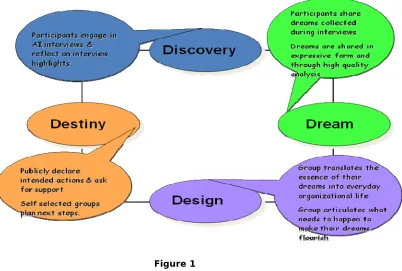
Appreciative Inquiry is a four-step process that includes a phase of Discovery, Dream, Design, Destiny. In the Discovery phase participants share their best experiences in one-to-one interviews, then share those experiences with the entire group. Together participants find common themes in their experiences that are used to discover shared values. In the next phase, Dream, those shared values are used to create a shared vision for the future. In small groups participants develop a variety of future vision statements. In the third phase, Design, the vision statements are used to develop propositions for actions to realize the future visions. In the final phase of Destiny, participants make commitments to actions and plans to realize their proposals.
Figure 1
Observation was done of subsequent stakeholder planning meetings to capture the progress of intended actions made during the strategic planning retreat. In these observations, discussions of plans as they related to the commitments made in the AI strategic planning retreat were recorded. These included partnering with like-minded organizations, increasing participation in community projects and collaboration within and among committees. An Observation Data Collection form that listed the aforementioned categories of specific actions and behaviors was used to record observations (see Appendix A).
shared values, future visions, and plans for action. The data were transcribed by the researcher, and the process of analysis began with “the identification of key factors in the study and the relationship among them” (Glesne, 1999, p. 150). The data were examined for common themes and coded. The coding system identified participants’ comments into the following themes: cross-cultural, new programs, organizational development, values, financial, skills, community, family, education, youth-adult partnerships, and work with developing countries, government partnerships and like-minded organizations. Once the data were sorted and listed for the primary research and sub questions, patterns emerged. The emergent codes were summarized in a written, bullet point format. In each phase of the data analysis, data were sent to the participants, the project sponsor and another individual external to the organization to verify accuracy and any inconsistency or bias.
Findings
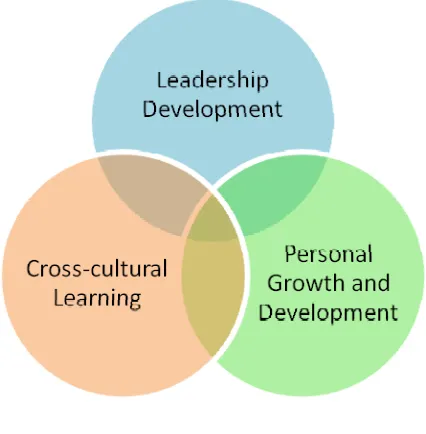
The research findings support that the experiential nature of CISV international education programs were transformative experiences for the participants. Emergent themes in the research were transformative learning in leadership, personal growth and development, and cross-cultural learning.
A closer examination of the findings reflected similar transformative learning outcomes for both youth and adults, and for those who had participated in the international education programs in their own community as well as those who had traveled nationally or internationally. This substantiated that local programs have equal potential for the same learning outcomes, and the development and expansion of CISV Victoria’s local programs creates opportunity to reach more people since local programming is more accessible than the travel programs.
Leadership
Reflecting on their best experiences participating in CISV programs, participant responses emphasized the opportunity to develop their leadership skills. Based upon the leadership skills identified in the literature reviewed, the leadership development of the participants were categorized by their abilities to facilitate games and activities, communicate effectively, understand group dynamics and value civic engagement. Data included the following comments:
“I learned a lot about planning and running activities and how to change things based on the mentality of the camp participants” (Bill, youth).
“I learned to acknowledge the everyday differences between people and how we take things for granted. I was really seeing a different world and I gained the ability to negotiate and see both sides of a conflict” (Bill, youth).
“In these programs you change and learn with others. The group connection is so important” (Ed, youth).
“It was like being part of a world community” (SusiQ, adult).
“I have been very active in the organization, I have had fun and I can take my experiences and the things I have learned into the community” (Madeline, adult).
Personal growth and development
Participants agreed that personal growth was another aspect of learning and development that shaped their best experiences. Themes that arose in the interviews and discussions were self-evaluation, self-awareness, critical reflection, and developing a socially conscious attitude and global perspective.
“It was a real life experience. I was confronted with real life and it opened my eyes to things I have never seen” (Corne, youth).
“Looking back from our families experiences, I was able to see a change in myself” (SusiQ, adult).
“I am so much more in tune with myself” (Tegan, youth).
“I am now motivated to do something about things I care about and I want to make things better” (Tod, youth).
“I bring reflection of experiences and self-evaluation of my role in these experiences. I also can bring ideas that support our values I believe in working for social change and justice” (SusiQ, adult).
Cross-cultural learning
Participants’ best experiences also included cross-cultural learning. Webster’s Dictionary defines cross-cultural as “dealing with or offering comparison between two or more different cultures or cultural areas” (Merriam-Webster, 1977, p. 272). Participants described experiences learning to work and communicate with people from different cultures as another contributing factor to their best experiences. Participants stated that they have become more aware and sensitive to cultural differences and have gained a deeper appreciation for others.
“living with them [international youth] was the most learning” (Bill, youth).
“I started to appreciate attributes that came up in the other culture that reflected a rigidity in my own culture. I appreciated their bond and their attitude towards us” (SusiQ, adult).
“I got to understand people from different cultures” (Bill, youth).
Shared values
differences and more accepting of others.
Future vision and commitments to action
Participants were asked to imagine CISV programs in the future when it is making the change in the community that they wanted to see. They were then asked to explain what the organization is doing, describe its reputation in the community and what is making the future vision possible. Similar to the participants’ best experiences, emergent themes in their visions of the future included leadership, personal growth and development, and cross-cultural learning. Each group envisioned an organization taking a leadership role in community change and social justice, sharing and teaching their cross-cultural values and making a difference in the lives of others.
“CISV youth providing learning opportunities for other youth, and youth from different cultural backgrounds provide learning opportunities to CISV youth.”
“Endorsing and promoting recycling, local produce, community cars and fair trade.”
“Encouraging teens to make good choices in life.”
Participants created provocative propositions and commitments to action that reflected their learning in leadership development, personal growth and development, and cross-cultural learning. Some of those propositions were:
“CISV is a family organization that fosters a caring and open environment where our voices are respected and validated. These voices bring our values of self-awareness, cultural sensitivity, social consciousness, and leadership from the internal community of CISV to the local and global community, in order to change the world one kid at a time.”
“CISV is the guiding force that breaks down cultural distinctions, stereotypes and barriers while embracing and learning from all cultures in pursuit of developing clear ideas about how to achieve social, economic, and environmental justice.”
“CISV Victoria has very clear ideas about how to achieve social, economic and environmental justice.”
The committed actions decided upon by this group were to complete a fundraising project for a school in Nepal, organize a multicultural fair to gather different youth groups and like-minded organizations in Victoria to exchange information and share cultures, and to give presentations about their learning experience in schools.
Observation data
Observation of subsequent planning meetings for these actions found the adult research participants had successfully implemented the actions to realize two of the propositions. They were establishing a connection with the school in Nepal and organizing the youth fair; however, they have not yet realized the desired level of youth collaboration and involvement.
Observations of the youth research participants found a consistent demonstration of leadership, cross-cultural learning, and values of inclusion in their regular programming. They made efforts to be more inclusive and plan activities that better integrated CISV’s educational principles. Individually, the participants took steps towards the proposed projects; however, as a committee they did not take any direct action to realize the committed actions.
Summary of Study Findings
cross-cultural learning and adopted new cross-cross-cultural, community and personal values. The participants’ best experiences, visions for the future and proposed projects reflected these skills and values. At the conclusion of the data collection phase, the adult participants had followed through on two proposed projects; however, they had difficulty including and collaborating with the youth. Likewise, the youth were unable to demonstrate an ability to effectively collaborate with the adults; however, the data illustrated individual youth’s contributions to the proposed projects and positive changes to their existing programs.
Study Conclusions
This action research project sought to find the skills and values youth gain from participating in an international education program that enables them to lead change in their community. The findings of this study indicate that participants adopt a range of skills and values that are consistent with those in the literature on international exchanges, youth leadership development and service learning.
Conclusion #1 - Participants applied what they learned from their CISV experiences to their future vision for the organization and its role in leading change in the community. They hope to create similar learning experiences for the community so more people have the opportunity to develop greater self-awareness, communication and leadership skills, interest in other cultures, appreciation for local diversity and a more global perspective.
Conclusion #2 - Participants incorporate values of inclusion, learning, sharing, diversity and awareness, and equality into the program and projects development.
Conclusion #3 - The strengths that participants contribute to an effective and sustainable community project is their leadership and shared values and visions. The challenges appear to be in the ability of the youth and adults to collaborate and for the youth to follow through on their vision and plans collectively, as a team or committee. CISV Victoria needs a better plan for creating supportive youth-adult partnerships to develop sustainable community projects.
Conclusion #4 - A more visible and active role in service to the community will position CISV Victoria to have greater influence in the community, create more opportunities for youth leadership development and strengthen the organization.
Recommendations
Once the research determined the impact of participation in an international education program on youth leadership development, the next step was to determine how youth might more effectively and actively engage in leading change in their community. For CISV Victoria youth to have a more active role in service to the community, the youth and adults needed to be more inclusive and collaborative in the planning and organization of community service projects. Three recommendations were offered to CISV Victoria in order to develop sustainable community service projects.
#1 Adopt a youth-driven approach
Planning committees should adopt a youth-driven approach to develop more supportive partnerships in the planning of community service projects. In a youth-driven approach, adults play a supporting role by monitoring the progress of the project, while youth take the lead.
which approach is most appropriate for a project, it is important to consider the goals for youth development, stakeholder interests, the experience and temperament of the adults, and the skills and experience of the youth (Larson et al., 2005, pp. 70-71). Larson, Walker and Pearce (2005) state that the youth-driven approach is more ideal for community change because youth are active participants in their learning and get more practical experience (p. 59).
The youth-driven approach requires the adults to trust the youth leadership and that the adult participation does not dominate or threaten youth participation (Larson, et al., 2005, p. 63). The adult-driven approach has equal value and potential for positive results as a youth-driven approach. However, the difference between the two approaches is related to the objective of the partnership and desired outcomes. The objective of an adult-driven approach is for adults to pass on specific skills to the youth to build confidence and personal and social growth in youth (Larson, et al., p. 68). By contrast, a youth-driven approach is best when the objective is community change and it results in youth gaining leadership development, essential administrative skills, advanced critical thinking, a greater connection to the issue the project is addressing and a sense or feeling for the outcome of the project (Larson, et al., p. 83).
Figure 3
#2 Incorporate best practices in service learning
It is recommended to incorporate the following best practices in service learning to develop sustainable community service projects. Service learning is an opportunity for youth to actively lead change and develop the skills necessary to do so. A four step model of best practices is provided.
Step 1: Building the Relationship
• Identify the partnering organization
• Meet with the appropriate stakeholders to determine their needs
• Build and develop a reciprocal relationship
To establish a sustainable partnership with a community organization it is important for youth to develop a relationship with its stakeholders in the early developmental phases of a project.
is involved in assessing their needs to determine the goals of the project.
The needs assessment creates a base and target for action. All Stakeholders should be involved in the assessment process which could include techniques such as asset mapping, focus group, survey or interviews.
Note: A project that excludes the stakeholders in the early phases of development is not sustainable.
Step 2: Goals, Roles and Outcomes Establish
• Project outcomes: What do all stakeholders want to achieve through this project?
• Roles and responsibilities: Who will do what and when?
• Skills the youth expect to gain through the project: What do the youth want to learn?
This pre-planning is an opportunity for the youth to develop a vision and plan that includes the voices of all key stakeholders to ensure a project that everyone can buy into. This extensive preparation will also help facilitate the next phase of the project, taking action.
Step 3: Taking Action
Now that the goals, roles and outcomes have been determined, it is time to put the plans into action. Project management and youth-adult collaboration become critical elements in the taking action phase. This will be an opportunity for everyone to learn new skills and hone existing ones. Youth will require support and flexibility from adults as they may struggle with group dynamics, meeting deadlines, and maintaining regular communications with stakeholders.
It is important to provide ongoing assessment of the plans and project once it has gotten started. This:
• Ensures the quality and effectiveness of a project and
• Allows the youth to address any necessary changes
The youth can ensure that their plans originally set continue to be suitable, the goals and outcomes are being met effectively, and any needed changes can occur.
Step 4: Ending Thoughtfully
Upon completion of project, there must be:
• Reflection by participants
• Evaluation of project outcome and learning
• Individual recognition
Reflection - Reflection plays a key role in the learning and development of the youth. It offers youth the opportunity to more deeply examine their role in the community, the needs of it, and the role they play in addressing those needs. Youth should be encouraged to express these reflections through all phases of the project, but particularly in the end. Youth can record their reflections by journaling, in written or photo format; offering an oral presentation; writing an article for a community newspaper or the organizations newsletter; other artistic expressions such as a painting, collage, poem, song, etc; or a more traditional written summary or report.
Evaluation - The sustainability of the project and relationship with the partnering organization require an evaluation of the project outcomes and vision. It will also be important for youth leaders to evaluate the learning outcomes and skill development of the youth. The leadership and management skills that youth exercise in this activity should not be overlooked but recognized and acknowledged.
Recognition - Recognition validates everyone's contributions and increases awareness in the community. This could be a celebration, media coverage, or an award or certificate ceremony. Be imaginative and create an event and activity that acknowledges the work everyone has done.
#3 Develop a shared vision
Key stakeholders should develop a shared vision for the impact of community based programs. A vision is a statement that inspires stakeholders and encapsulates a collective purpose and intention and has the power to create a common direction towards a shared future, possibilities for the future, and collective values. With a shared vision CISV Victoria can create local programs that ensure a positive impact on the organization and community.
A visioning process should involve key stakeholders, identify strategic objectives with wide appeal, identify relevant elements in the old ideology, link the vision to core competencies, evaluate the credibility of their vision, and continually assess and refine the vision (Yukl, 2002, p. 164).
Conclusion
The strengths that members of the CISV Victoria bring to community service projects are their leadership, shared values and vision gained from their cross-cultural learning experiences. The challenges they face are the ability of the youth and adults to collaborate and for the youth to execute their vision and plans for a community project. The data revealed that CISV participants are able to apply values of inclusion, learning, sharing, diversity and awareness, and equality that they learned from CISV cross-cultural programs to their vision for community service projects; however, they struggle to practice those values in the planning and organization of those projects. Therefore, the success of building a more visible and active role in service to the community will be dependent upon the participants' ability to be more inclusive and collaborative.
Update
grant to bring in an external consultant to facilitate a visioning process over a 5 month period of time. Over 30 members of the organization participated, including youth as young as 12 years old. As a result, a lot of excitement was generated, along with a stronger identity and a more collaborative vision towards programs. Various program changes have been made to ensure that the organization is more inclusive, the membership is better informed, and CISV Victoria is more visible in the community.
References
AFS, A. F. (1993, May). An overview of AFS research1980-1993. AFS Center for the Study of Intercultural Learning .
Calabrese, R., & Roberts, B. (2002). Character, school leadership and the brain: learning how to integrate knowledge with behavioral change. International Journal of Educational Management , 229-238.
Champion, F. (1999, July). Educational psychology interactive: service learning links. Retrieved October 17, 2005, from Readings from educational psychology:
http://chiron.valdosta.edu/whuitt/files/Service_Learning.html
Donnelly, F. (2003, Fall). Gauging the study abroad experience. CBIE Newsletter , pp. 4-5.
Fertman, C., & Van Linden, J. (1999). Character education: an essential ingredient for youth leadership development. NASSP Bulletin , 9-15.
Foundation, S. R. (2000). Marco polo and his travels. Retrieved January 1, 2006, from
www.silk-road.com/artl/marcopolo.shtml
Garst, B., & Johnson, J. (2003). Education: camp research symposiums. Retrieved November 11, 2005, from ACAcamps: http://acacamps.org/research/connect/03symposium.pdf
Glesne, C. (1999). Becoming qualitative researchers. New York: Longman.
Hall, M. (1993). In our ownlanguage:youth as servant leaders. Journal of Emotional and Behavioural Problems , 27-29.
Hammer, M. (2005, January). AFS Research and Education: reports and publications. Retrieved September 2005, from AFS Intercultural Programs:
http://74.52.0.194/downloads/files/Educational-Results-Report-Final.pdf
Howard, M., & Woehrle, T. (1993). Service learning: character education applied. Educational Leadership , 42-43.
Hynes, G. (2005). A biographical sketch of web dubois. Retrieved January 1, 2006, from
www.dubois.org/html/DuBoisBio.htm
Larson, R., Walker, K., & Pearce, N. (2005). A comparison of youth-driven and adult-driven youth programs: balancing inputs from youth and adults. Journal of Community Psychology , 57-74.
Lutterman-Aguilar, A., & Gingerich, O. (2002, Winter). Back Issues: volume 8. Retrieved August 12, 2005, from Frontiers: the interdisciplinary journal of study abroad:
http://www.frontiersjournal.com/issues/vol8/vol8-07_luttermanaguilargingerich.pdf
Manning, M., & Binzagr, G. F. (1996). Methods, values and assumptions underlying large group interventions intended to change the whole system. The International Journal of Organizational Analysis , 268-284.
Martinetz, C. (2002). Appreciative inquiry as an organizational development tool. Performance Improvement , 34-39.
McKay, L. (2002). Character education with a plus. Education Digest , 45-51.
Merriam-Webster. (1977). Webster's new collegiate dictionary. Springfield, Massachusetts: G. & C. Merriam Company.
Mohammed, I. (2001). Broadening the bounds of youth development: youth as engaged citizens. New York, NY: Chevy Chase, MD: Ford Foundation: Innovation Center for Community and Youth Development.
Spangler, K., & Teter, W. (2002). Community youth development. CYD Journal , 15-19.
Stephenson, S. (1999, Fall). Back Issues. Retrieved August 12, 2005, from Frontiers Journal:
the interdisciplinary journal of study abroad:
http://www.frontiersjournal.com/issues/vol5/vol5-01_Stephenson.pdf
Watson, J. (2003). Educators and NGO's: impact of CISV. Retrieved August 2005, from CISV International: http://resources.cisv.org/docs/main?action=document.view&id=154
Weah, W., Simmons, V., & Hall, M. (2000). Service learning and multicultura/multiethnic perspectives. Phi Delta Kappan , 673-676.
Wikipedia. (2005, June). Greco-roman relations. Retrieved January 1, 2006, from
http://en.wikipedia.org/wiki/Greco-Roman_relations
Yukl, G. (2002). Leadership in organizations (custom edition for LT 516 ed.). Upper Saddle Rive, NJ: A Pearson Education Company.
Appendix A
Major Project: Youth learning from the world leading in their community
Observations Data Collection Sheet
Researcher: Date: Location:
Evidence of symmetry of values and goals:
Evidence of collaboration among members of Steering:
Evidence of collaboration with Local Work Committee:
Evidence of community inclusion and/or partnering with like-minded organizations:
Biographical Note: