Article
Effect of a Comprehensive Health Care Program on
Blood Pressure, Blood Glucose, Body Composition,
and Depression in Older Adults Living Alone: A
Quasi-experimental Pre-posttest Study
Eun Jeong Hwang 1 and In Ok Sim2,*
1 Sehan University, 1113 Samho-eup, Yeongam-gun, Jeollanam-do, 58447, Republic of Korea; [email protected]
2 Red Cross College of Nursing, Chung-Ang University, 84 Heukseok-ro, Dongjak-Gu, Seoul, 156-756, Republic of Korea; [email protected]
* Correspondence: Tel: +82-10-3372-5920, Fax: +82-2-824-7961, E-mail: [email protected] (I. O. Sim)
Abstract: This study explored the effects of a comprehensive health care program (CHCP) on blood pressure, blood glucose, body composition, and depression in older adults living alone. We used a quasi-experimental, two-group, pre-posttest design. The CHCP consisted of open lectures, health counseling, exercise classes, nutrition counseling, and self-help group meetings at a local senior welfare center. Fifty-eight subjects participated in this study, with thirty subjects in the experimental group and twenty-eight subjects in the control group. Data were analyzed using the descriptive statistics, χ²-test, and t-test. Comparisons of the pretest and posttest systolic blood pressure (t = - 2.530, p < .016) and blood glucose (t = 3.089, p < .004) between the experimental and control groups showed significant differences. In both the experimental (t = 3.949, p < .001) and control groups (t = 3.816, p < .002), depression symptoms showed a significant decrease post-test, compared with pre-test. Our findings infer that older adults require physical and psychosocial healthcare and that more efforts must be made to improve the general health and wellbeing of this population group.
Keywords: older adults, blood pressure, blood glucose, depression, senior center, comprehensive healthcare
1. Introduction
In 2015, older adults—members of the population 65 years and older—accounted for 12.8% of the total population. This number increased to more than 14% in 2018 [1]. The number of older adults living alone has also been continuously increasing due to changes in the social environment. This number increased from 13.6% in 1994 to 21.2% in 2017, and it is expected to increase to 23.3% by 2035 [1].
Older adults living alone may experience social isolation, deterioration of social relationships, and hampered development [2,3]. The main difficulties faced by older adults are economic and health related and may include feelings of loneliness and alienation, and older adults living alone may experience these problems more intensely [4]. In a survey of older adults living alone conducted by the Ministry of Health and Welfare [2], 73.3% of the respondents replied that they had contact with their family less than once every month, while 57.3% of respondents said that they had almost no contact with others within their neighborhoods, and 50.0% reported not participating in any social activities. Yoon et al. [5] report that older adults living alone had significantly lower levels of psychological well-being, self-esteem, and life satisfaction than older adults living with others. Cederbom et al. [6] state that living alone is related to poor health status, difficulties with activities of daily living, low levels of physical activity, and a greater prevalence of chronic pain. Furthermore, older adults living alone are more likely to have poorer physical and mental health statuses, as they tend not to adopt health-promoting behaviors such as exercise, health care, nutrition, and stress management [3]. Poor physical and mental health in all older adults may lead to serious social
problems; however, these problems are likely to be even more serious in older adults living alone. Another notable factor is that, as age increases, the risk of being left alone due to the death of a spouse increases; therefore, the likelihood of becoming lonely and alienated also increases. In South Korea, the suicide rate among older adults is currently 104.5 per 100,000, more than double the total suicide rate in 2012 [7].
Among older adults living alone, the severity of their physical and mental problems often depend on their level of social support. Zebhauser et al. [8] report that older adults with a stable social network are less likely to feel depressed or lonely. The absence of depression and a functioning social network are considered to be the factors most likely to protect older adults living alone from loneliness. When older adults living alone have these social relationships, they are able to maintain communication with the outside world and overcome the feelings of redundancy that accompanies old age as well as the depression caused by the loss of family members [9]. However, those that do not receive adequate help or support from family or others are at risk of depression, which exacerbates mental and physical health issues and negatively affects their quality of life. It has been reported that a significant negative relationship exists between loneliness and overall social support [9].
Several related studies have shown that older adults living alone require more social support, stronger relationships, and better physical health than older adults living with others. Current programs addressing the health and wellbeing of older adults living alone are limited to fragmentary interventions that focus on disease management and an integrated approach. These programs are often inadequate for meeting the requirements of this population. Chronic disease requires continuous care throughout life to improve and maintain self-function and to provide effective education and exercise, which enable individuals to control their illnesses. Senior welfare centers are well used by older adults, and therefore, it seems reasonable that integrated programs that focus on chronic illness management and social relationship formation should be administered at these centers[10]. Senior welfare centers currently provide various programs for older adults that involve hobbies, leisure, employment and health support, and general education; however, it has been reported that existing emotional and social support programs are insufficient [10]. The fragmented nature of these programs, however, makes it difficult to address the physical and mental health and emotional problems of older adults. It has previously been advocated that social contexts and health-related factors should be considered in an integrated manner to resolve difficulties such as depression, loneliness, and the many other problems faced by older adults living alone [11]. This suggests that a comprehensive program involving health education, counseling, and self-help groups may be appropriate.
This study investigated the effects of a comprehensive health care program (CHCP) administered at a senior welfare center for older adults living along in M city. This program addresses blood pressure, blood glucose, body composition, and depression. Ultimately, this study aims at providing basic data that will enable the improvement and implementation of CHCPs at senior welfare centers.
2. Materials and Methods
Design
The study was conducted using a quasi-experimental, two-group, pre-posttest design.
Participants
significance level (α) at 0.05, and the power (1-β) at 80%. The minimum sample size required was calculated to be 52 individuals, 26 in each study group [12]. Sixty-two subjects agreed to participate in the study and stated that they understood the purpose of the study. Of these, thirty-two subjects who agreed to participate in the CHCP were assigned to the experimental group. The remaining thirty subjects chose not to participate in the program but agreed to data collection and constituted the control group. Members of the control group participated in a play program run at the Welfare Center. During this intervention, two subjects in each group withdrew from the experiment. A final sample of fifty-eight subjects participated in the study: thirty subjects in the experimental group and twenty-eight subjects in the control group.
Data collection Blood pressure
The same qualified and experienced nurse measured all the subjects’ blood pressure using an upper-arm cuff blood pressure monitor (BRAUN ExactFitTM 5 upper arm blood pressure monitor, Kaz Europe Sàrl, Lausanne, Switzerland). Normal adult systolic and diastolic blood pressure readings were set to be 120 and 80 mmHg respectively [13].
Blood glucose
Blood glucose levels were measured by the same nurse at the same time using a finger prick blood glucose monitor (SD CodeFreeTM 5 blood glucose monitoring system, SD Biosensor Co., Ltd., Chungbuk, Korea). The normal range for blood glucose was set as 80–130 mg/dL in a fasting state and less than 180 mg/dL two hours after a meal [14].
Body composition
Body composition consists of muscle mass (MM) and body fat mass (BFM), and were measured using a body component meter (InBody 4.0 unit, Biospace Co., Seoul, Korea) in the standing position with bare feet positioned as indicated on the unit. The arms grasp the electrode knobs to complete the machine’s measurements.
Geriatric depression scale: short form
We used the Korean version of the geriatric depression scale: short form—originally developed by Yesavage and Sheikh [15] and modified by Kee [16]—to assess depression. This scale consists of 15 items with “yes” or “no” answers. Scores range from 0 to 15 points and a score of 4 points or below indicates a normal result, a score of 5 to 9 points indicates mild depression, and 10 points and higher indicates severe depression. The Cronbach’s ⍺ of this instrument in the present study was .88, indicating acceptable internal consistency.
Data processing
The CHCP applied in this study was drafted based on a comprehensive literature review, after which the first draft was revised and confirmed by consulting with community experts, doctors, nursing professors, and local experts. Finally, a six-month CHCP was finalized and used in this study. A nurse at the welfare center coordinated the practice team—consisting of nurses, physiotherapists, and nutritionists—and held monthly meetings to verify progress. The internist who provided the open lectures were commissioned from the community. Details concerning the CHCP are provided in Figure 1.
their blood pressure and blood glucose levels were checked by the same nurse, at the same time. Sixty one-hour self disease-control education and one on one health counseling sessions were provided by the same nurse at the center every Monday and Wednesday. Sixty one-hour exercise classes were provided by a physical therapist every Tuesday and Thursday. These consisted of exercises focused on strength, balance, agility, and flexibility. The same exercise program was provided every time to all participants by the same instructor. Sixty one-hour nutrition counseling sessions were provided by a nutritionist every Monday and Friday. The topics included diet menus, nutrition education, and counseling. Two self-help group meetings were held at which subjects shared experiences and coping strategies. Lectures and counseling sessions were held in a seminar room and a consultation room respectively. The exercise programs were conducted in an auditorium. A free lunch was provided daily for any of the older adults that visited the center. This contributed to the subjects rarely being absent, despite the six-month study period. To ensure the validity of the study results, the researchers and the program’s service providers were not in communication. The researcher that analyzed the results did not participate in the program and a different experienced nurse than the nurse who was involved in the program collected data from subjects before and after the program. This nurse was unaware of the participants’ group assignment. To prevent the effects of the program affecting members of the control group, intervention times differed and classrooms were some distance from each other.
Data Analysis
Data were analyzed using IBM SPSS version 21 software. The homogeneity comparison of the general characteristics between the experimental and control groups was used as the chi-squared test and independent sample t-test. Comparisons between the experimental and control groups of blood pressure, blood glucose levels, body compositions, and depression levels before and after the CHCP were performed using a paired t-test and independent sample t-test.
Ethical considerations
Before conducting this study, approval was obtained from the institutional review board of the clinical examination committee of Sehan University (SH-IRB 2018-25). Participants were provided with an explanation of the study purpose and informed that they were free to withdraw from the study at any time without prejudice. Written informed consent was obtained from each individual. Identification data of study subjects were kept separately at the welfare center and were not made available to those conducting the study. The CHCP for the experimental group and a play program for the control group were provided free of charge.
3. Results
Participant characteristics
Table 1. Comparison of the General Characteristics of the Experimental Group and the Control Group
Variables
Experimental group (n = 30)
Control group (n = 28)
t or χ² p-value
n % n %
Gender
Male 11 36.7 17 60.7 3.35 .058
Female 19 63.3 11 39.3
Age
65–69 1 3.3 3 10.7 1.30 .521
70–79 15 50.0 12 42.9
≤ 80 14 46.7 13 46.4
M ±SD 78.17 ±4.92 77.64 ±6.45 0.35 .728
Disease
HT 18 60.0 14 50.0 0.68 .712
DM 2 6.7 3 10.7
Both 10 33.3 11 39.3
HT = hypertension; DM = diabetes mellitus; BP = blood pressure
Comparison of blood pressure, blood glucose, body composition, and depression before and after participating in the CHCP
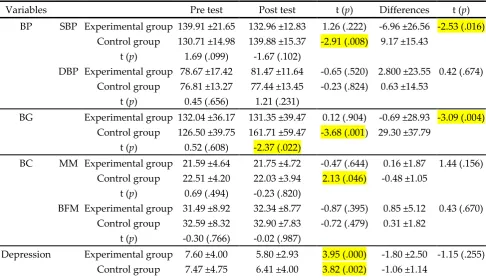
The results of the blood pressure readings, blood glucose levels, body composition readings, and levels of depression of the experimental and control groups pre-test and post-test are shown in Table 2.
Table 2. Comparison of pretest and posttest Blood Pressure (BP), Blood Glucose (BG), Body Composition (BC), and Depression
Variables Pre test Post test t (p) Differences t (p)
BP SBP Experimental group 139.91 ±21.65 132.96 ±12.83 1.26 (.222) -6.96 ±26.56 -2.53 (.016) Control group 130.71 ±14.98 139.88 ±15.37 -2.91 (.008) 9.17 ±15.43
t (p) 1.69 (.099) -1.67 (.102)
DBP Experimental group 78.67 ±17.42 81.47 ±11.64 -0.65 (.520) 2.800 ±23.55 0.42 (.674) Control group 76.81 ±13.27 77.44 ±13.45 -0.23 (.824) 0.63 ±14.53
t (p) 0.45 (.656) 1.21 (.231)
BG Experimental group 132.04 ±36.17 131.35 ±39.47 0.12 (.904) -0.69 ±28.93 -3.09 (.004) Control group 126.50 ±39.75 161.71 ±59.47 -3.68 (.001) 29.30 ±37.79
t (p) 0.52 (.608) -2.37 (.022)
BC MM Experimental group 21.59 ±4.64 21.75 ±4.72 -0.47 (.644) 0.16 ±1.87 1.44 (.156) Control group 22.51 ±4.20 22.03 ±3.94 2.13 (.046) -0.48 ±1.05
t (p) 0.69 (.494) -0.23 (.820)
BFM Experimental group 31.49 ±8.92 32.34 ±8.77 -0.87 (.395) 0.85 ±5.12 0.43 (.670) Control group 32.59 ±8.32 32.90 ±7.83 -0.72 (.479) 0.31 ±1.82
t (p) -0.30 (.766) -0.02 (.987)
t (p) 0.10 (.921) -0.60 (.550)
SBP = systolic blood pressure; DBP = diastolic blood pressure; MM = muscle mass; BFM = body fat mass.
The pre-test results show no significant differences in blood pressure, blood sugar, body composition, and depression between the experimental and control groups. The systolic blood pressure and blood glucose levels of the experimental group showed significant changes in the post-test readings, compared with the pre-post-test readings; however, the systolic blood pressure (t = -2.91, p < .008), blood glucose (t = -3.68, p < .001), and muscle mass (t = 2.13, p = .046) of the control group was significantly changed post-test, compared with the pre-test. The systolic blood pressure (t = -2.53, p < .016) and blood glucose (t = -3.09, p < .004) differences between post-test and pre-test between the experimental and control groups were significant. In both the experimental (t = 3.95, p < .001) and control groups (t = 3.82, p < .002), depression was significantly decreased post-test, compared with the pre-test results. Although not statistically significant, the muscle mass of the control group had generally decreased after the intervention, while the muscle mass of the experimental group had increased after the intervention.
4. Discussion
This study explored the effects of a CHCP on blood pressure, blood glucose, body composition, and depression in Korean older adults living alone. The results showed that after the intervention, the overall systolic blood pressure in the experimental group decreased, compared with that of the control group. Moreover, the blood glucose levels in the control group were significantly higher than those in the experimental group after the intervention. In related studies [8,10,17-20], older adults that participated in a physical activity program showed physical function improvement, compared with older adults that did not participate.
In this study, a slight increase in muscle mass was noted in the experimental group, whereas a significant decrease was observed in the control group (t = 2.13, p = .046). Existing studies show that limited physical activity in older adults cause muscle atrophy, which, in turn, reduces overall physical function [21,22]. These studies also suggest that physical function in older adults cannot be improved by temporary short-term physical programs, but that it can be improved by consistent long-term physical activity.
In this study, both the experimental group (t = 3.95, p < .001) and the control group (t = 3.82, p = .002) showed a significant decrease in post-intervention depression; however, the mean decrease in depression was greater in the experimental group (differences were -1.80 and -1.06 respectively). Furthermore, members of both the experimental and control groups—both of which took part in regular activities—showed improvements in depression, which is consistent with the results of previous studies [4,23]. The results of these previous studies support the notion that taking part in different activities improved depression in older adults. In their work, Cho and Lee [24] emphasize the importance of forming various social connections by performing community activities and establishing links with welfare services, based on their finding that greater social support improves life satisfaction. The deterioration of family function and the weakening of social support systems are thought to contribute toward exacerbating loneliness and depression and decreasing the quality of life in older adults. Kim and Kim [10] conclude that programs provided by senior welfare centers play an important role in the formation of social support systems.
therapy activities, which positively affects their self-esteem, resulting in positive physical and psychological effects. According to Kim [23], nutrition and dietary habits (β = 0.42, p < .001) and regular activities (β = 0.37, p < .001) have a significant effect on the life satisfaction of older women living alone in rural areas.
According to Lee and Kim [26] many older adults living alone are enthusiastic about their lives, have no confidence in their health statuses, and do not feel like proud members of society. Dorji et al. [17] state that many older adults complained of depression. They also report that the physical and psychological conditions and social relationships of older adults were significantly correlated with their quality of care, and state that a variety of participation programs and health programs for older adults living alone should be provided to address this problem.
Along with the rapidly increasing number of older adults, the proportion of older adults living alone continues to increase. Older adults living alone have been reported to have substantially poorer physical and psychological health. These factors and the pressure generated by changing demographics mean that there is an urgent need to determine the social alienation risks of older adults living alone and to reach a consensus on both the social support required and on means of promoting relationship formation.
5. Conclusions
Several limitations to this study warrant consideration. First, the results of this study may differ from the general situation, because only older adults wanted to participate in the program. Second, individual characteristics—such as disease severity or degree of family support—were not considered; therefore, caution should be used with the generalization and interpretation of our results.
This study aimed to determine the effects of a CHCP conducted at a senior welfare center for older adults living alone, considering their blood pressure, blood glucose, body composition, and depression. Due to population aging, the physical and psychosocial health of the older adults are becoming ever more important; furthermore, the increase in the proportion of older adults living alone compounds the problem. Those living alone are more vulnerable to a lack of social support than those living with others. Therefore, organizations for the support of older adults, such as senior welfare centers, should focus more on older adults living alone. The results of this study emphasize the need for a CHCP for older adults living alone; however, the provision of comprehensive community health care programs is currently very limited. Based on our findings, we recommend that participatory programs be supported and revitalized by targeting welfare centers.
We also suggest that further research be conducted on the development of CHCPs considering individual characteristics and circumstances such as family support and future management plans.
Author Contributions: Study design, E.J.W.; data collection and analysis, E.J.W. and I.O.S.; manuscript writing, E.J.W. and I.O.S.
Funding: This research received no external funding.
Acknowledgments: In this section you can acknowledge any support given which is not covered by the author contribution or funding sections. This may include administrative and technical support, or donations in kind (e.g., materials used for experiments).
Conflicts of Interest: The authors declare no conflict of interest. References
1. National Statistical Office. Prospective estimating population and household. Daejeon: The Office; 2019. Available from:
http://kosis.kr/statisticsList/statisticsListIndex.do?menuId=M_01_01&vwcd=MT_ZTITLE&parmTabId=M _01_01#SelectStatsBoxDiv (accessed on 8 August, 2019).
http://www.1661-2129.or.kr/upload/2015년독거노인현황조사결과분석보고서.pdf [Korean] (accessed on 5 December, 2018)
3. Song, M.S.; Boo, S.J. Factors affecting the intention to participate in healthcare programs among elders living alone. J Korean Acad Community Health Nurs 2016, 27(4), 319–326.
https://doi.org/10.12799/jkachn.2016.27.4.319
4. Kim, Y.S. The study of the impact of the family type on the health promoting behavior and physical and mental health of elderly people. Health and Social Welfare Review 2014, 34(3), 400–429. https://doi.org/10.15709/hswr.2014.34.3.400
5. Yoon, J.A.; Kang, J.S.; Bae, M.J.; Lee, N.Y.; Lee, C.M.; Jeon, W.J. Comparison of psychological well-being, self-esteem and satisfaction on life between the older adults living alone and older adults living with other. The Journal of Korea Aging Friendly Industry Association 2016, 8(2), 63–69. http://www.ot-kapa.co.kr/board/board_file/HM41877573.pdf
6. Cederbom, S.; Sӧderlund, A.; Denison, E.; Wågert, P.V.H. Chronic pain among older women living alone: a study focusing on disability and morale. Eur J Physio 2014, 16, 139–150. https://www.tandfonline.com/doi/abs/10.3109/21679169.2014.893448
7. Korea Institute for Health and Social Affairs. Analysis of determinants and regional differences of suicide risk and regional differences. Seoul: The Institute, 2014. Available from:
https://www.kihasa.re.kr/web/publication/research/view.do?pageIndex=22&keyField=&key=&menuId=4 4&tid=71&bid=12&division=001&ano=1826 (accessed 8 December, 2018).
8. Zebhauser, A.; Baumert, J.; Emeny, R.T.; Ronel, J.; Peters, A.; Ladwig, K.H. What prevents old people living alone from feeling lonely? Findings from the KORA-Age-study. Aging & Mental Health 2015, 19(9), 773–780. https://doi.org/10.1080/13607863.2014.977769
9. Chen, Y.; Hicks, A.; While, A.E. Loneliness and social support of older people living alone in a county of Shanghai China. Health Soc Care Community 2014, 22(4), 429–438. https://doi.org/10.1111/hsc.12099
10. Kim, G.W.; Kim, Y.M. The Effects of Program Factors on the Quality of Life in the Senior Welfare Center: Focusing on social support parameters. Journal of Korean Policy Studies 2016, 16(4), 37–52.
11. Park, N.S.; Jang, Y.; Lee, B.S.; Chiriboga, D.A. The relation between living alone and depressive symptoms in older Korean Americans: do feelings of loneliness mediate? Age & Ment Health 2017, 21(3), 304-312. https://doi.org/10.1080/13607863.2015.1099035
12. Faul, F.; Erdfelder, E.; Lang, A-G.; Buchner, A. G*Power 3: A flexible statistical power analysis program for the social, behavioral, and biomedical sciences. Behav Res Methods 2007, 39, 175–191.
13. American Heart Association. Healthy and unhealthy blood pressure ranges. Texas (USA): The Association; 2019. Available from:
http://www.heart.org/HEARTORG/Conditions/HighBloodPressure/AboutHighBloodPressure/Understan ding-Blood-Pressure-Readings_UCM_301764_Article.jsp (accessed 10 January, 2019).
14. Korean Diabetes Association. Diabetes treatment and control. Seoul (Korea): The Association; 2019. Available from: http://www.diabetes.or.kr/general/class/medical.php?mode=view&number=322&idx=6 (accessed 8 November, 2018).
15. Yesavage, J.A.; Sheikh, J.I. Geriatric depression scale (GDS): recent evidence and development of a shorter version. Clin Geront 1986 5(1-2), 165-173. https://doi.org/10.1300/J018v05n0109
16. Kee, B.S. A preliminary study for the standardization of geriatric depression scale short form-Korea Version. J Korean Neuropsychiatr Assoc 1996, 131(2), 298–307.
17. Dorji, N.; Dunne, M.P.; Seib, C.; Deb, S. Quality of life among senior citizens in Bhutan: Associations with adverse life experiences, chronic diseases, spirituality, and social connectedness. Asia Pac J Pub Health 2017, 29(1), 35–46. http://dx.doi.org/10.1177/1010539516685609
18. Yu, J.O.; Kim, J.S. Effects of a physical activity program using exergame with elderly women. J Korean Acad Nurs 2015, 45(1), 84–96. http://dx.doi.org/10.4040/jkan.2015.45.1.84
19. Jang, S.J.; Park, H.J.; Kim, H.J.; Chang, S.J. Factors influencing physical activity among community-dwelling older adults with type 2 diabetes: a path analysis. J Korean Acad Nurs 2015, 45(3), 329–336. http://dx.doi.org/10.4040/jkan.2015.45.3.329
20. Parry, S.; Chow, M.; Batchelor, F.; Fary, R.E. Physical activity and sedentary behavior in a residential aged care facility. Australas J Age 2019, 38(1), E12–E18. http://dx.doi.org/10.1111/ajag.12589
22. Jeon, M.Y.; Gu, M.O.; Yim, J.E. Comparison of walking, muscle strength, balance, and fear of falling between repeated fall group, one-time fall group, and nonfall group of the older adults receiving home care service. Asian Nurs Res 2017, 11(4), 290–296. https://doi.org/10.1016/j.anr.2017.11.003
23. Kim, H.J. Health promotion behaviors of rural elderly women living alone and their life satisfaction. J Korean Acad Community Health Nurs 2016, 27(3), 254–261. https://doi.org/10.12799/jkachn.2016.27.3.254 24. Cho, S.H.; Lee, H.Y. A study on life satisfaction of low-income elderly people who living alone. Journal of
the Korea Academia-Industrial Cooperation Society 2015, 16(12), 8957–8965. https://doi.org/10.5762/KAIS.2015.16.12.8957
25. Lee, H.S.; Kim, C. Structural equation modeling to assess discrimination, stress, social support, and depression among the elderly women in South Korea. Asian Nurs Res 2016, 10(3), 182–188.
https://doi.org/10.1016/j.anr.2016.06.003
26. Lee, S.S.; Kim, S.H. A study on the living conditions and social welfare needs of the older adults who lives alone in the farming and fishing communities-focused on the province of Jeollanamdo. The Korean Association of Regional Development 2011, 11(1), 23–60.