P a r k , L a u r a L., B a k er, C a t h e r i n e E ., S u m , Alvin a n d H a y e s ,
L a w r e n c e ( 2 0 1 6 ) T h e infl u e n c e of a c e t a m i n o p h e n o n s p r i n t
in t e r v al t r e a d m ill r u n n i n g : a r a n d o miz e d c r o s s ov e r t r i al.
Kin e si olo gy, 4 8 ( 1). p p . 5 8-6 2 .
Do w n l o a d e d fr o m : h t t p ://i n si g h t . c u m b r i a . a c . u k /i d/ e p ri n t/ 2 3 5 9 /
U s a g e o f a n y i t e m s f r o m t h e U n i v e r s i t y o f C u m b r i a’ s i n s t i t u t i o n a l r e p o s i t o r y ‘I n s i g h t ’ m u s t c o n f o r m t o t h e f o l l o w i n g f a i r u s a g e g u i d e l i n e s .
Any it e m a n d it s a s s o ci a t e d m e t a d a t a h el d i n t h e U niv e r si ty of C u m b r i a ’s in s ti t u ti o n al r e p o si t o r y I n si g h t ( u nl e s s s t a t e d o t h e r wi s e o n t h e m e t a d a t a r e c o r d ) m a y b e c o pi e d , di s pl ay e d o r p e rf o r m e d , a n d s t o r e d i n li n e wi t h t h e JIS C f ai r d e a li n g g ui d eli n e s ( av ail a bl e
h e r e) fo r e d u c a t i o n al a n d n o t-fo r-p r ofi t a c tiviti e s p r o v i d e d t h a t
• t h e a u t h o r s , ti tl e a n d full bi blio g r a p h i c d e t ail s of t h e it e m a r e ci t e d cl e a rly w h e n a n y p a r t
of t h e w o r k is r ef e r r e d t o v e r b a lly o r i n t h e w ri t t e n fo r m
• a h y p e rli n k/ U RL t o t h e o ri gi n al I n si g h t r e c o r d of t h a t it e m is i n cl u d e d i n a n y ci t a ti o n s of t h e w o r k
• t h e c o n t e n t is n o t c h a n g e d i n a n y w a y
• all fil e s r e q ui r e d fo r u s a g e of t h e it e m a r e k e p t t o g e t h e r wi t h t h e m a i n it e m fil e. Yo u m a y n o t
• s ell a n y p a r t of a n it e m
• r e f e r t o a n y p a r t of a n it e m wi t h o u t ci t a ti o n
• a m e n d a n y it e m o r c o n t e x t u ali s e it i n a w a y t h a t will i m p u g n t h e c r e a t o r ’s r e p u t a t i o n
• r e m ov e o r a l t e r t h e c o py ri g h t s t a t e m e n t o n a n it e m . T h e full p oli cy c a n b e fo u n d h e r e.
Alt e r n a t iv ely c o n t a c t t h e U niv e r si t y of C u m b ri a R e p o si t o ry E di t o r b y e m a ili n g
THE INFLUENCE OF ACETAMINOPHEN ON SPRINT INTERVAL
TREADMILL RUNNING: A RANDOMIZED CROSSOVER TRIAL
Laura L. Park
1, Catherine E. Baker
2, Alvin Sum
1, and Lawrence D. Hayes
31
School of Human Sciences, London Metropolitan University, London, UK
2
English Institute of Sport, Bisham Abbey National Sports Centre, Buckinghamshire, UK
3Department of Medical and Sport Sciences, University of Cumbria, Lancaster, UK
Original scientific paper UDC: 615:796.422
Abstract:
Although considerable research concerning the efficacy of analgesics in sport exists, there is a paucity of data concerning effects of acute acetaminophen (ACT) ingestion on sprint interval running exercise. This investigation concerned the effect of acute ACT ingestion on eight 30 s maximal treadmill sprints on a non-motorized treadmill, interspersed with two-minute rests in males (N=8, age 26±3 years, body height 174±7 cm, body mass 71±8 kg) in a placebo-controlled, randomized crossover design. A time x condition repeated measures analysis of variance (ANOVA) determined ACT ingestion did not influence mean power output, peak power output, peak vertical ground reaction force, peak oxygen uptake, or total distance completed (p>.05). Perceived pain was reduced by 8-15% during the final three sprints following ACT ingestion (p<.05). Data presented here suggest ACT may reduce exercise-induced pain during the latter stages of sprint interval treadmill running, without influencing performance.
Key words: fatigue, pain, perception, power output, sprint intervals
Introduction
Acetaminophen (ACT) is a commonly used over-the-counter analgesic to reduce musculoskel-etal pain in sub-elite athletes (Garcin, et al., 2005; Lily, 2010; McDonald & Molloy, 2012). Although the primary mechanism of action for ACT is poorly understood, it exhibits both analgesic and anti-pyretic properties (Blough & Wu, 2011). ACT is thought to act similarly to ibuprofen as a
cyclooxy-genase inhibitor without influencing inflammation
or oedema, whilst modulating afferent and efferent pain pathways (Bonnefont, Alloui, Chapuy, Clottes, & Eschalie, 2003; Boutaud, Aronoff, Richardson, Marnett, & Oates, 2002; Pickering, et al., 2006).
Although limited research exists regarding the role of ACT in exercise performance, acute ACT ingestion has been reported to improve time to exhaustion during running and cycling performed in the heat (Burtscher, et al., 2013; Mauger, et al., 2014). These studies provided initial evidence that ACT ingestion may be used as an ergogenic aid due to its antipyretic properties. Foster and colleagues
(2014) explored the analgesic influence of ACT
during sprint interval cycling (Foster, Taylor, Chrismas, Watkins, & Mauger, 2014). Participants completed eight 30 s Wingate Anaerobic Tests, 30
minutes after ingesting 1.5 g of ACT or a placebo
(PLA). The authors indicated a significant improve -ment in mean power output in the ACT condition compared to PLA. This was attributed to increased
mean power output during the final three sprints, accompanied by significantly slower power dimi
-nution. No significant differences were observed
for pain perception, peak power output, or heart rate between ACT and PLA conditions. The authors suggested ACT permitted participants to tolerate increased muscular pain associated with this type of exercise. Therefore, these authors suggested untrained cyclists may rely on afferent feedback to calculate an appropriate pacing strategy.
Stocchero et al. (2014) explored metabolic differences between intense running and cycling exercise and observed serum creatine kinase (CK) was greater after intense running than after intense cycling. Moreover, Nieman et al. (2014) observed
that after three days of intensified training, runners
experienced a greater relative increase in
Park, L.L. et al.: THE INFLUENCE OF ACETAMINOPHEN ON SPRINT INTERVAL... Kinesiology 48(2016)1:58-62
following running compared to cycling, and there-fore the possibility that ACT may improve running performance to a greater extent than cycling perfor-mance requires exploration.
Although considerable research exists
concern-ing the efficacy of analgesics in sport, there is a
paucity of data concerning the effect of acute ACT ingestion on sprint interval running perfor-mance. Consequently, the purpose of this study was to investigate whether an acute dose of ACT would improve performance during sprint interval running exercise.
Materials and methods
Participants
Following an a priori power calculation, eight recreationally active male participants (N=8, age 26±3 years, body height 174±7 cm, body mass 71±8 kg), who participated in regular exercise (4±2 sessions·wk-1), were recruited for the present study.
Prior to study commencement, participants were required to provide written informed consent and complete a Physical Activity Readiness Question-naire (PAR-Q). Prior to experimental trials, partici-pants were given a verbal and written explanation of the protocol and the opportunity to familiarize themselves with the laboratory and experimental conditions on a calibrated WOODWAY®Force 3.0 treadmill. Ethical approval was granted by the London Metropolitan University research ethics review panel.
Experimental procedures
Following three initial familiarization sessions, participants reported to the laboratory on two sepa-rate occasions (sepasepa-rated by a minimum of 48 h) and completed testing at the same time of day to
amelio-rate the influence of diurnal variation (Hayes, Bick -erstaff, & Baker, 2010). Upon arrival at the labora-tory, participants orally ingested either 1.5 g ACT or placebo (PLA) taste-matched solution adminis-tered in a randomized, double-blinded, crossover design. Thirty minutes post-ingestion, participants completed a standardized 5 min warm-up involving walking at a moderate pace interspersed with two 10 to 15 second all-out sprints. A recovery period of 5 minutes was allowed between the warm-up and the test. Participants performed eight 30-second maximal sprints, separated by two-minute active rests to allow time for substantial recovery, and to prevent substantial lactate clearance, in order to facilitate an increase in pain and fatigue
(Mendez-Villanueva, Hamer, & Bishop, 2007). For each
stage, participants were provided with a 5 s count-down and verbal encouragement throughout. Partic-ipants did not receive any feedback (visual or verbal) concerning sprint performance (distance covered, time remaining, power output). All sprints were
performed on a non-motorized treadmill as previ-ously described (Delextrat, Baliqi, & Clarke, 2013). Subjects were equipped with a harness around their waist, connected by a non-elastic tether to a hori-zontal load cell attached to the vertical strut of the treadmill which was locked during sprinting. For each participant, the gauge was adjusted to ensure the tether was horizontal during sprinting. This device was used to measure horizontal force (N). Treadmill speed was monitored by two optical speed photomicrosensors mounted on the rear shaft of the treadmill belt, while vertical force (N) was recorded by four individual vertical load cells mounted onto the underside of the belt. Power (W) was computed from instantaneous force and speed data. Data were
collected at a sampling rate of 75 Hz by the XPV7
PCB interface. Peak power output (W), mean power output (W), peak vertical ground reaction (GRFV
[kg]) and distance completed (m) were collected
and calculated at 200 Hz sample rate throughout
the test using the WOODWAY®Force 3.0 software
package. Intra-class correlations have been previ -ously reported as r=.89, .94, and .97 for peak power output, mean power output, and distance covered, respectively, during 30 s sprints on a non-motorized treadmill (Gonzalez, et al., 2013).
Oxygen uptake
Oxygen uptake (ml·kg·min-1) was determined
by open circuit spirometry using Quark PFT
(COSMED, Italy). Expiratory airflow was achieved
using a volume transducer connected to an oxygen analyser. Prior each test, the Quark PFT was cali-brated according to the manufacturers’ guidelines. After a 60 minute warm-up period, the carbon dioxide and oxygen sensors were calibrated against room air in addition to a reference gas of a known composition (5% carbon dioxide, 15% oxygen, and 80% nitrogen) with volume calibrated using a 3 L pump. Oxygen uptake (VO2) carbon dioxide uptake
(VCO2) respiratory exchange ratio, and minute
ventilation were displayed continuously. Breath-by-breath data were sampled and transferred to a PC for real-time display. The recorded data were saved to the internal database until analysis. The
coefficient of variation for VO2 determination using
online systems has previously been determined as
<3% (Foss & Hallen, 2005; Hayes, et al., 2015).
Pain scale
verbal instruction of the correct use of the scale was provided prior to each experimental procedure. Statistical analysis
Data were analyzed using IBM SPSS statistics version 21.0 (IBM Corp, NY, USA). Parametric
assumptions were checked using numerical methods: checking studentized residual, Shapiro-Wilk test
and Mauchly’s Test of sphericity. Following confi
r-mation of parametricity, mean differences in mean power output, peak power output, GRFv, peak VO2,
distance completed, and perceived pain between the two experimental conditions (ACT and PLA) were assessed using a two-way (condition x sprint) anal-ysis of variance (ANOVA) with repeated measures
and posteriori Sidak. The difference in distance
completed over the eight bouts was analysed using a paired samples t-test. Alpha was set a priori at
p<.05 and 95% confi dence intervals (CI) and effect
sizes (ES) are displayed where appropriate. Data are presented as mean±standard deviation (SD).
Results
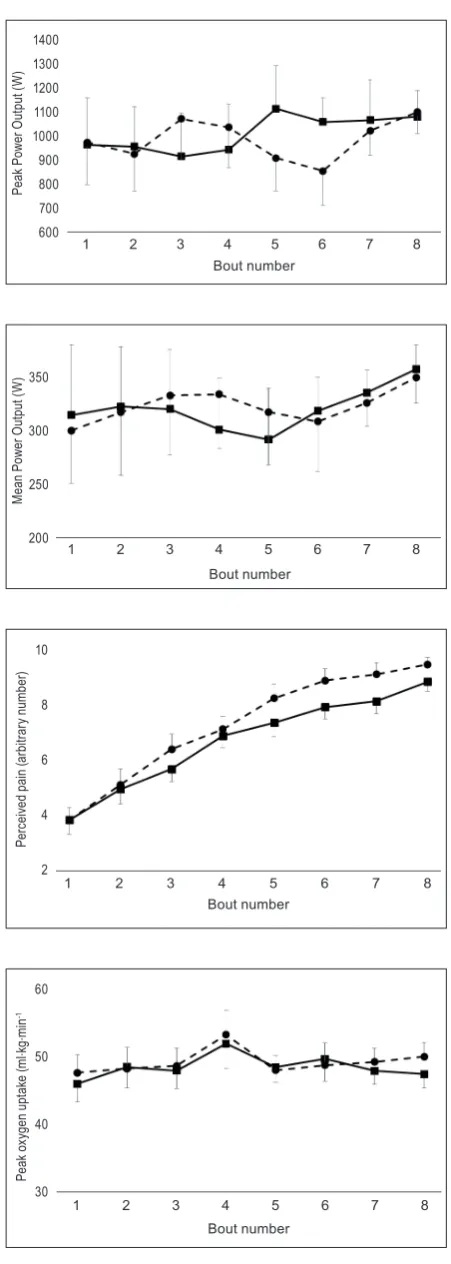
No main effect of condition (p=.83; ES=.01), or interaction between condition and bout (p=.22; ES=.17) was observed for peak power output
between ACT (1008±418 W, 95% CI=909-1108 W) and PLA (983±374 W, 95% CI=894-1072 W) conditions (Figure 1:A). No signifi cant main effect
(p=.64; ES=.03), or interaction effect (p=.21; ES=.17) was observed for mean power output
between ACT (320±119 W, 95% CI=292-3486 W) and PLA (323±119 W, 95% CI=295-351 W) conditions (Figure 1:B). No signifi cant main effect
(p=.31; ES=.15) was found for pain perception
between ACT (5.97±2.35, 95% CI=5.41-6.53) and PLA (6.24±2.78, 95% CI=5.58-6.91) conditions. A signifi cant interaction effect existed between
condi-tion and sprint number (p<.001; ES=.61). Posteriori Sidak adjustment revealed that pain perception was
signifi cantly reduced during sprint six (8.6±1.4
compared to 7.4±1.4), seven (8.9±1.4 compared to 7.7±1.5), and eight (9.3±0.9 compared to 8.6±1.1) during the ACT condition compared to the PLA condition (Figure 1:C).
No signifi cant main effect (p=.42; ES=.10) was
observed for peak GRFv between ACT (178±27
kg, 95% CI=172-185 kg) and PLA (185±60 kg, 95% CI=171-200 kg) conditions. No effect of
condi-tion (p=.47; ES=.08) was observed for peak VO2
between ACT (48±7 ml·kg·min-1, 95% CI=46-50
ml·kg·min-1) and PLA (49±8 ml·kg·min-1, 95%
CI=47-51 ml·kg·min-1) conditions (Figure 1:D).
Paired-samples t-test revealed no signifi cant
differ-ence in distance completed between ACT (664±109
m, 95% CI=580-748 m) and PLA (657±111 m, 95% CI=572-742 m) conditions (p=.31).
14 1400 1300 1200 1100 1000 900 800 700 600 Pe ak P ow er O ut pu t ( W ) Bout number
1 2 3 4 5 6 7 8
14
(2014). Serum S100B level increases after running but not cycling exercise. Applied Physiology, Nutrition and Metabolism, 39, 340-344.
M ea n P ow er O ut pu t ( W ) 350 300 250 200 Bout number
1 2 3 4 5 6 7 8
15
Figure. 1 A:Peak power output during 8 x 30 s treadmill sprints. B:Mean power output during 8 x 30 s treadmill sprints. C:Peak oxygen uptake observed during each 30 s treadmill sprint. D:Perceived pain after 8 x 30 s treadmill sprints. Data are presented as mean±standard error for clarity. Acetaminophen: solid line. Placebo: dashed line. *denotes a significant difference between groups (p<.05).
Per ceiv ed p ain (a rb itr ar y n um ber ) 10 8 6 4 2 Bout number
1 2 3 4 5 6 7 8
15
Figure. 1 A:Peak power output during 8 x 30 s treadmill sprints. B:Mean power output during 8 x 30 s treadmill sprints. C:Peak oxygen uptake observed during each 30 s treadmill sprint. D:Perceived pain after 8 x 30 s treadmill sprints. Data are presented as mean±standard error for clarity. Acetaminophen: solid line. Placebo: dashed line. *denotes a significant difference between groups (p<.05).
Pe ak ox yg en u pt ake ( m l∙ kg∙ m in -1 60 50 40 30 Bout number
1 2 3 4 5 6 7 8
Figure 1. A: Peak power output during 8 x 30 s treadmill
sprints. B: Mean power output during 8 x 30 s treadmill
sprints. C: Peak oxygen uptake observed during each 30 s
treadmill sprint. D: Perceived pain after 8 x 30 s treadmill
Park, L.L. et al.: THE INFLUENCE OF ACETAMINOPHEN ON SPRINT INTERVAL... Kinesiology 48(2016)1:58-62
Discussion
The main finding of the present study was
that ACT ingestion did not improve sprint internal
treadmill running performance. However, pain
perception was reduced during sprint six, seven, and eight using the ACT condition compared to the PLA condition. This suggests ACT may be used to reduce exercise-induced pain in the latter stages of sprint interval training.
Results of the present study differ from those
concerning cycling performance, where a signifi -cant change was observed for peak power output and mean power output accompanied by unaltered pain perception (Foster, et al., 2014). These findings
in combination with the present investigation indi-cate ACT ingestion may be used to either improve performance, or minimise pain perception during repeated sprint exercise at a given exercise intensity. Findings from the present investigation indicate that
exercise-induced pain did not significantly influ -ence sprint interval performance, as pain perception
decreased without significant alteration in perfor -mance parameters. A possible explanation for this is that muscle fatigue does not only occur in the working muscle, but is a conscious awareness of physical activity in which exercise-induced neuro-muscular pain is one factor amongst a multitude
of factors that influence central drive (Bundle &
Weyand, 2012; Noakes, 2012; St Clair Gibson, et al., 2003).
Amann, Proctor, Sebranek, Pegelow, and Dempsey (2009) previously demonstrated that complete removal of pain with an opioid analgesic enabled participants to experience higher toler-ance to peripheral neuromuscular fatigue during initial stages of exercise, but at a cost of increased
diminution in mean power output during the final
stages, resulting in no net increase in performance. This occurred as a result of participants adopting a more aggressive approach to their pacing strategy, resulting in greater levels of end-exercise
periph-eral neuromuscular fatigue. Therefore, it appears a degree of afferent neuromuscular feedback is required to maintain an appropriate pacing strategy and not induce premature fatigue (Amann, et al., 2009).
That we report no significant differences
between the ACT and PLA conditions for peak GRFv is likely due to participants exceeding
veloci-ties of 6 m∙s-1 for both ACT and PLA conditions.
During velocities greater than 6 m∙s-1, peak GRFv
remains relatively constant on a non-motorized treadmill despite any increase in running velocity (Brughelli, Cronin, & Chouachi, 2010) and
there-fore our findings are in line with previous studies
(Brughelli, et al., 2010).
That improved power profiles were observed
following ACT ingestion by previous investiga-tions (Foster, et al., 2014) but not in the present
study is puzzling. However, a possible explana -tion may be that sprint interval cycling results in greater peripheral neuromuscular fatigue than does repeated sprint exercise running (Rampinini, et al., 2014). Moreover, Rampinini and colleagues (2014) reported rating of perceived exertion (RPE) to be higher during repeated sprint cycling compared to repeated sprint running. We therefore propose that ACT may have a greater ergogenic potential during activities where peripheral neuromuscular fatigue (and therefore RPE) is higher such as cycling and
resistance exercise. However, further research is
required to test this hypothesis.
In conclusion, the present study was the first
to investigate the effects of 1.5 g ACT ingestion on sprint interval treadmill running. Results presented here suggest that sprint interval treadmill running
performance was not influenced by ACT ingestion;
however, pain perception was decreased during the
final stages of exercise. Future research may wish to
investigate events where peripheral neuromuscular fatigue is high as ACT may have more potential as an ergogenic aid.
References
Amann, M., Proctor, L., Sebranek, J., Pegelow, D., & Dempsey, J. (2009). Opioid-mediated muscle afferents inhibit central motor drive and limit peripheral muscle fatigue development in humans. Journal of Physiology, 587, 271-283.
Blough, E., & Wu, M. (2011). Acetaminophen: Beyond pain and fever relieving. Frontiers in Pharmacology,2, 72. Bonnefont, J., Alloui, A., Chapuy, E., Clottes, E., & Eschalie, A. (2003). Orally administered paracetamol does not act
locally in the rat formalin test. Anaesthesiology, 99, 976-981.
Boutaud, O., Aronoff, D., Richardson, J., Marnett, L., & Oates, J. (2002). Determinants of the cellular specificity
of acetaminophen as an inhibitor of prostaglandin H(2) synthase. Proceedings of the National Academy of
Sciences, 99, 7130-7135.
Brughelli, M., Cronin, J., & Chouachi, A. (2010). Effects of running velocity on running kinetics and kinematics.
Bundle, M.W., & Weyand, P.G. (2012). Sprint exercise performance: Does metabolic power matter? Exercise and Sport
Sciences Reviews, 40, 174-182.
Burtscher, M., Gatterer, H., Philippe, M., Krüsmann, P., Kernbeiss, S., Frontul, V., et al. (2013). Effects of a single
low-dose acetaminophen on body temperature and running performance in the heat: A pilot project. International
Journal of Physiology, Pathophysiology and Pharmacology, 5, 190-193.
Cook, D., O’Connor, P., Eubanks, S., Smith, J., & Lee, M. (1997). Naturally occurring muscle pain during exercise: Assessment and experimental evidence. Medicine and Science in Sports and Exercise, 8, 999-1012.
Delextrat, A., Baliqi, F., & Clarke, N. (2013). Repeated sprint ability and stride kinematics are altered following an official match in national-level basketball players. Journal of Sports Medicine and Physical Fitness, 53, 112-118.
Foss, O., & Hallen, J. (2005). Validity and stability of a computerized metabolic system with mixing chamber.
International Journal of Sports Medicine, 26, 569-575.
Foster, J., Taylor, L., Chrismas, B.C., Watkins, S.L., & Mauger, A.R. (2014). The influence of acetaminophen on repeated sprint cycling performance. European Journal of Applied Physiology, 114, 41-48.
Garcin, M., Mille-Hamard, L., Billat, V., Imbenotte, M., Humbert, L., & Lhermitte, M. (2005). Use of acetaminophen
in young subelite athletes. Journal of Sports Medicine and Physical Fitness, 45, 604-607.
Gonzalez, A.M., Wells, A.J., Hoffman, J.R., Stout, J.R., Fragala, M.S., Mangine, G.T., et al. (2013). Reliability of the
Woodway Curve™ non-motorized treadmill for assessing anaerobic performance. Journal of Sports Science
and Medicine, 12, 104-108.
Hayes, L.D., Bickerstaff, G.F., & Baker, J.S. (2010). Interactions of cortisol, testosterone and resistance training:
Influence of circadian rhythms. Chronobiology International, 27, 675-705.
Hayes, L.D., Sculthorpe, N., Herbert, P., Baker, J.S., Spagna, R., & Grace, F.M. (2015). Six weeks of conditioning
exercise increases total, but not free testosterone in lifelong sedentary aging men. Aging Male, 18, 195-200. Kolkhorst F.W., Londeree, B.R., & Thomas, T.R. (1994). Effects of consecutive exercise days of jogging or cycling on
the resting metabolic rate and nitrogen balance. Journal of Sports Medicine and Physical Fitness, 34, 343-350.
Lily, K.F. (2010). Athletes, NSAID, coxibs, and the gastrointestinal tract. Current Sports Medicine Reports,9, 103-105.
Mauger, A., Taylor, L., Harding, C., Wright, B., Foster, J., & Castle, C. (2014). Acute acetaminophen (paracetamol)
ingestion improves time to exhaustion during exercise in the heat. Experimental Physiology, 99, 164-171. McDonald, D.D., & Molloy, B. (2012). Factors predicting older adults’ use of exercise and acetaminophen for osteoarthritis
pain. Journal of the American Academy of Nurse Practitioners, 24, 669-674.
Mendez-Villanueva, A., Hamer, P., & Bishop, D. (2007). Physical fitness and performance: Fatigue responses during
repeated sprints matched for initial mechanical output. Medicine and Science in Sports and Exercise, 39, 2219-2225.
Nieman D.C., Luo, B., Dreau, D., Henson, D.A., Shanely, R.A., Dew, D., & Meaney, M.P. (2014). Immuno and
imflammation responses to a 3-day period of intensified running versus cycling. Brain, Behavior, and Immunity, 39, 180-185.
Noakes, T. (2012). Fatigue is a brain-derived emotion that regulates the exercise behaviour to ensure the protection of whole body homeostasis. Frontiers in Physiology, 3, 82.
Pickering, G., Loriot, M., Libert, F., Eschalier, A., Beaune, P., & Dubray, C. (2006). Analgesic effect of acetaminophen in humans: First evidence of a central serotonergic mechanism. Clinical Pharmacology & Therapeutics, 79, 371-378.
Rampinini, E., Connolly, D.R., Ferioli, D., La Torre, A., Alberti, G., & Bosio, A. (2014). Peripheral neuromuscular fatigue induced by repeated-sprint exercise: Cycling vs running. Journal of Sports Medicine and Physical
Fitness, Epub ahead of print.
St Clair Gibson, A., Baden, D., Lambert, M., Lambert, E., Harley, Y., Hampson, D., et al. (2003). The conscious
perception of the sensation of fatigue. Sports Medicine, 33, 167-176.
Stocchero, C.M., Oses, J.P., Cunha, G.S., Martins, J.B., Brum, L.M., Zimmer, E.R., et al. (2014). Serum S100B level increases after running but not cycling exercise. Applied Physiology, Nutrition and Metabolism, 39, 340-344.
Submitted: May 14, 2015 Accepted: October 15, 2015
Correspondence to:
Lawrence D. Hayes, B.Sc (Hons), M.Sc., Ph.D.
Department of Medical and Sport Sciences University of Cumbria
Bowerham Road, Lancaster
LA1 3DH, UK