Concept Paper
How Thumbelina Knows
Giorgio De MichelisDISCo, University of Milano – Bicocca, Viale Sarca 336, Milano, 20126, Italy; [email protected]
Abstract: In this paper I take the book by Michel Serres “Thumbelina” as the occasion for a reflection on the conceptual basis of knowledge management, as it was built by Ikujiro Noanka and co-workers. The direct access to knowledge that Thumbelina practices together with her peers is, in fact, for me, a god observation point to bring the reflection of Nonaka further, towards the discovery of a new understanding of knowledge and knowing processes. If the digital revolution is third step after writing and printing, in the soft changes in the relations between human beings and knowledge, then it poses in an urgent manner the problem to deepen our understanding of what knowledge and intelligence are and to change our practice at the education level and to design new digital tools to support our knowledge management processes.
Keywords: knowledge management; tacit knowledge; explicit knowledge
1. Introduction
But this is what the paper is about, and we cannot anticipate how our discourse develops, without making it generic and vague.
The paper will bring its readers in a trip that, after a short survey of the most relevant points, for us, of Knowledge Management theories, presents to them Thumbelina, through a summary of Serres’ book (2014). Thereafter, starting from the relationship between Thumbelina and knowledge, we will discuss how well established concepts in knowledge creation and learning are remixed in the digital age, so that we can better see how Thumbelina, and any other person, know. The concluding remarks, will discuss some implications of the findings and suggestions we got in our trip.
2. Knowledge Management
Knowledge Management has emerged in the last thirty years as a multidisciplinary field of research where scholars and practitioners discuss the theoretical and practical issues raised by the human practice aiming to keep and update the knowledge of an organization and/or of a community. Knowledge management has been studied, experimented and practiced paying attention to its human (psychological, social and organizational) and technological aspects. With respect to technology, there has been also the development of several systems supporting it and their evaluation in action. But the core of the research on knowledge management has been highly theoretical focusing on questions like: what is the knowledge we aim to manage? What does it mean to share it? Which role does technology play in knowledge management? Etc.
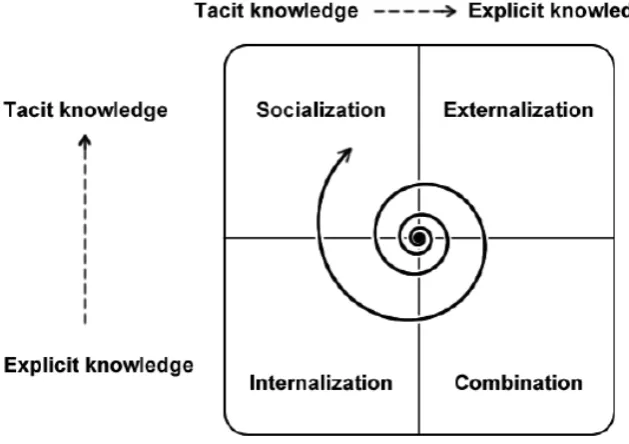
Figure 1. The Knowledge Spiral (Nonaka & Takeuchi, 1995)
The spiral is the never-ending process letting knowledge flow within the organization: through socialization newly created capability to perform is shared; through internalization, external knowledge is appropriated; through externalization, know how is made available to the external world, as explicit knowledge, that can be updated through combination. It is interesting that the knowledge spiral generates two horizontal movements as well: while internalization concentrates knowledge from large communities sharing the access to explicit knowledge to small groups of strictly interacting people, externalization does the contrary, making the knowledge created within small groups of interacting people accessible by larger communities having access to the repository where related documents are stored.
Nonaka’s contribution has been widely appreciated because it has given a solid theoretical basis to the shared persuasion that knowledge management cannot be reduced to making the knowledge possessed by its members available in the data and document repositories of the organization, putting, I hope, a final word on the false expectation that organizations can store the knowledge created by their members into documents and data bases. Tacit and explicit knowledge are mutually related but they are not the same; rather, they are intrinsically diverse.
The coexistence of two different forms of knowledge, ascribable, respectively, to information and know how, even if not explicitly recognized, is well known from centuries and from centuries has become a question discussed in philosophy and other sciences. While newcomers mainly acquire manual skills (from simple handicraft to art) through socialization, going to work in the ateliers and/or workshops of expert people, scientific and knowledge and philosophy is, generally, transmitted making reference to what is written in books1.
With the development of science and technology in the eighteenth and nineteenth centuries, several diverse new professions have emerged needing a solid know-how embodying relevant pieces of mathematics and scientific knowledge. For their common features, all these professions were collected under the name of engineer. Engineering schools invented, for all their courses, a
1We do not have space, here, to recall the philosophical question, opened by Plato, of how
model that characterizes them all over the world: five years of University are divided in two periods: the first one, common to all courses and lasting two years, is dedicated to all the scientific disciplines needed for becoming, later, a professional, while the second, different for each course and lasting three years, is dedicated to get the know how for exerting a specific profession. Learning mathematics and sciences is propaedeutic to acquiring the know how for acting as a professional, hypostatizing, in some sense, a segment of Nonaka’s knowledge spiral, where internalization precedes socialization. The same model has been adopted in the engineering schools for architecture courses, with the difference that propaedeutic courses, in this case, are dedicated to acquire a solid universal culture, more than to access specialized disciplines. We know that educational programs are under discussion in these years almost at every latitude and longitude. Europe adopted a 3+2 model (Bologna process; Neave, 2003) that was no more not based on propaedeutics but on the bachelor/master distinction: the applications of this model are sharply discussed in many countries. But in any case, it remains interesting that tacit and explicit knowledge distinction permeates our discourse on knowledge creation and sharing at different levels.
Concluding this resumé it is useful to recall that the issue of how people know has been raised again by the scholars who brought to the attention of the public what they call ‘collective intelligence’ (Levy, 1997): their starting point is the reformulation of a typical systemic argument, that systems are more than their parts. In this case, what is stressed is that groups and/or communities know more and, therefore, are more intelligent than their individual members. I like to underline that the idea of multi-disciplinarity is strictly related with collective intelligence, since it assumes that the participation of people with different backgrounds and competencies grants, in facing difficulties and breakdowns, a capability that no single participant can have.
All what I have written here refers to the contemporary society and to its members, who got their education before the year 2000. But, as many observers have remarked, digital natives, or millennials (these are the two most used names for indicating young people who grew up with digital technologies in their life space) practice in general, and practice knowledge in particular, in a new and diverse mode. Is this changing the picture of knowledge management I have recalled in these few notes? Or, and it may be more interesting, is this showing to us something new and diverse about the practice of knowledge, that we did not see before?
This is the reason why I think a good idea, at this moment, to survey what Michel Serres tells us about Thumbelina.
2. Michel Serres’ Thumbelina
As anticipated in the Introduction, Michel Serres is a French philosopher born in 1930, who has frequently taught in the United States, in particular at Stanford University, in the heart of Silicon Valley in California.
He had, therefore, a privileged viewpoint for observing the digital revolution in its making, and he did it with his eyes rich of the wisdom and culture of old Europe. On the one hand, he has not been too much influenced by the emotions provoked by the rapid diffusion of ICT (Information and Communication Technology), avoiding any optimistic or pessimistic attitude; on the other, he did not take refuge in scepticism.
He has been able, in this way, to avoid to judge a still ongoing phenomenon, that is difficult to read and interpret, and to approach it with great caution and openness, with the intention of understanding its character.
The outcome of these reflections has been published in 2012 in a small, brilliant book entitled “Petite Poucette”, translated in English in 2015 with the title “Thumbelina” (Serres, 2015).
Petit Poucette (Thumbelina) is the feminine version for Petit Poucet (Thumbelino). Petit Poucet is the title of a famous fable of Charles Perrault (it appeared in the collection “The Tales of Mother Goose” in 1696; Perrault, 2014). Thumbelino is also the title of a fable of Grimm brothers, while Thumbelina is the title of a fable of Hans Christian Andersen. In the stories narrated in all these fables, Thumbelino/Thumbelina is a shrewd, autonomous boy/girl who is able to skive off in difficult situations.
Choosing Thumbelina as the lead of his essay, Serres tells us that he looks at the digital revolution from the teenager’s viewpoint, that he thinks that, with this respect, girls are more interesting than boys, and finally, he wants to recall us, in a playful way, that teenagers (both males and females) are notable because they digit on their cellular phones with their thumbs.
Thumbelina is, therefore, a teenager, a digital native. What does it mean that she a digital native, but for fact that she is born when personal computers, emails, chats etc. have been already invented and are widely diffused? In what does she differ from teenagers of previous times, from those who have been teenagers twenty, thirty years, or more? In what differs from us, the adults of today?
Serres answers to these questions on the basis of what he has discovered, observing her in a tender, curious and share way.
The questions he poses are interesting, because they aim to catch what is changing in people’s behaviour, in their way of thinking, of relating each-other, of approaching the world where they live, the things populating it. They do not demand to discuss, now, how much digital revolution is really a revolution, nor where it will bring human society, if their outcomes will be positive or negative, which transformations it will provoke, which perils are opening and for whom. I don’t want to claim that these questions are not interesting, but it seems to me that Serres is telling us that it is impossible to give to them non trivial answers, if, before, we do not understand, at an anthropological level, what is happening to the people directly using the digital devices.
Let us survey, in short, the small book of Serres.
He begins it, enumerating the differences Thumbelina and her friends exhibit with respect to us, when we were young, and, in some sense, with respect, also, to our adult experience: “Without us even realizing it, a new kind of human being was born in the brief period of time that separates us from the 1970s. He or she no longer has the same body or the same life expectancy. They no longer communicate in the same way; they no longer perceive the same world; they no longer live in the same Nature or inhabit the same space.” (Serres, 2015, 7)
And later: “… he or she comprehends differently. […] He or she writes differently. […] They no longer speak the same language.” (ibidem, 7).
Recalling these transformations, that Serres illustrates with short, incisive, examples, and that would merit a discussion by themselves, we are brought to the first revelation of the book: millennials have become the first ‘individuals’: “Until recently, we lived in what we might call our ‘belongings’: French, Catholics, Jews, Protestants, Muslims, atheists. Southerners or Northerners, females or males, poor or rich… We belonged to regions and religions, cultures (rural or urban), teams, towns, a sex, a dialect, a party, and a motherland. Through travel, images, the web, and abominable wars, almost all these collectives have been broken apart. Those that remain are unravelling.” (ibidem, 9).
The birth of the individual represents a deep break in the history of the humanity, to which we did not pay adequate attention, that we did not understand in its depth (may be because we were thinking that it had already happened), but the novelty of juvenile behaviours and of their way of staying in the world, has there its roots. Thumbelina and her peers are naked and without any defense in face of the world. Families and institutions are no more able neither to protect them nor to guide their growth, since all, previously developed, mediators have become ineffective. And the world, today, is always more complex and bewildering.
How did digital technology contribute to this outcome? The digital can be considered the third element, after writing and printing, in a sequence of soft but shattering inventions, changing human condition (ibidem, 26). Serres is quite resolute in claiming that soft revolutions, impacting intelligences, change the world in a deeper way than hard ones, changing production modes, like bronze and iron ages, industrial revolution, etc. Digital technology is revolutionary, for its being soft, for its being used by every one in a growing number of everyday situations, impacting the way human beings think, speak and know, rather than for automation and robots, and their capability to change production systems, work and decisional processes: “Though we hardly realize it, we are living together, today, as the children of the book, and the grandchildren of writing.” (ibidem, 21).
In conclusion, digital technology has changed and changes our relationships with knowledge, as, previously did writing and printing: identities emerge from aggregations mediated by human knowledge.
Knowledge, up to writing and printing, and also after them, required to human beings an uncritical submission (“A democracy of knowledge has never existed”; ibidem, 32) that was well represented by the architecture of the lecture room, by the format of the page. In order to access them you had to lie down: even masters were knowledge servants. Digital technology turns upside down this hierarchy: knowledge is there, in the net; whoever can access it, selecting what is interesting. No one can impose his/her advantage. “The innovation: the ease of access that has been given to Thumbelina, and to the entire world, their pockets with all the knowledge in their smart phones” (ibidem, 34).
Our world seems unaware of this changes: lecture rooms are still like in the old days, books, even e-books, are made as before, but the authority they exhibit is neutralized; they are no more the privileged places for knowledge transmission. “Thumbelina seeks and finds knowledge in a machine” (ibidem, 37) subverting its specialization, articulation and organization. The net is a confuse and magic space where things are juxtaposed without any criterion: the net is the supreme place for serendipity, for surprise.
Chaos “occupies the totality of space” (ibidem, 55): we discover, in this way, that the order of knowledge was, truly, the order of its scholars, of the mediators through which we accessed it. Once that the mediators disappear, every access to knowledge, every search, creates its order The chaos that we see is the outcome of the co-existence of several, diverse orders, generated by several diverse accesses, searches, even when they are performed by the same person. This plurality of orders can not be reconciled in a single order and knowledge gets a casual form where dense places are adjacent to patchy places, where information has not a unique sense, where two nearby news items can appear contradictories. “If she consults a good website, Thumbelina […] can know as much, or more, on a given subject – a decision to be made, public information, the care of oneself – as any teacher, manager journalist senior official, CEO, or president, all of whom have reached the pinnacle and are obsessed with glory” (ibidem, 61), but this does not gran to her that what she needs allows her to take the right decision.
contents she finds there as well as to get them critically. Direct access to knowledge is the novelty in Thumbelina’s life, but it should not be considered a good thing ‘per se’.
We are now ready to approach the problem of how Thumbelina knows.
3. How Thumbelina knows
Michel Serres has indicated to us that Thumbelina, today has a direct access to knowledge, without any mediation, and that this has relevance for all human beings, even for people like me, who are quite older that Thumbelina and who lived in a period of time where the relation with knowledge was strictly mediated by expert people, by professors). This is something radically new, changing forever the way human beings get/create new knowledge.
The very same idea of ‘knowledge transmission’, on which mankind built its educational organization and its self-awareness, is zeroed in the world of Thumbelina: no one transmits any thing, there is not anything to transmit. The partial and incomplete democratization of knowledge, started by the invention of writing and extended by that of printing, liberated knowledge from monopolistic control of clergy, without, in any case, eliminating the filter of masters and scholars. A further step is happening today, with Internet: knowledge mediators are running out. They played a crucial role in the age of script and printing, moving from explaining phenomena (that is something anyone has to do by him/herself) to presenting the scientific theories allowing to explain phenomena. A theory, in fact, is such that any person, when she has learned it, can explain a phenomenon in the same way. Scientific knowledge, even if it depends on masters and scholars, is sharable, reproducible and falsifiable. For this reasons, we claim that it is half-way democratic.
Schools, universities and research centers: human societies have institutions for creating and reproducing knowledge and for disseminating it. The system of sciences has been created in these processes: scientific disciplines have become always more specialized and structured, so that two different channels have emerged for transmitting them. On the one hand, an elitist and demanding one, for those people who want to become part of the scientific milieu, contributing to the development of scientific knowledge; on the other hand, a universal and widely accessible one, divulgating scientific discoveries and concepts to the large public. This model has never been able to cover in an adequate and complete way the transmission of knowledge between generations: science was too specialized, its vulgate for the large public too simplified, but it worked for two centuries.
Formal education going on in Institutions like schools and universities was not able in any case to cover all forms of knowledge, in particular, it was unable to transmit practical know how. Therefore, it has been coupled with apprenticeship, the form of knowledge transfer happening between experts and novices when they work together. This is typical in handicraft (but also in art) where novices learn how to do (get their know how) socializing the tacit knowledge of experts through more or less structured forms of learning by doing.
Apprenticeship allowed novices to gain practical knowledge and this has been recalled when, in the Universities, engineering and architectural schools have developed two original variants of a teaching approach coupling scientific and practical knowledge.
In these cases, knowledge is not only transmitted but also re-created by participants practicing and growing their experience. What we have observed in Thumbelina is not, therefore, radically new, it can be considered as a recombination of the different components of previous educational practice. The crisis of the transmission of scientific knowledge provoked by the direct access to knowledge allowed by the digital revolution opens new spaces to other forms of recombining the main ways education is practiced in modern times.
The story we have narrated above, can be rephrased in more abstract terms adopting the terminology Nonaka and co-workers introduced in their studies about the ‘knowledge creating’ organizations. Let us start from the two forms of knowing, they have brought again to our attention: on the one hand, there is information, stored in digital repositories and represented in texts, diagrams, images or formalized in data bases (information is called by Nonaka explicit knowledge, since it can be considered as the extreme form of publication of knowledge and scientific knowledge has this form); on the other, there is know how, contained in the heads of human beings and habilitating them to perform effectively (it is called by Nonaka, following Polanyi, tacit knowledge, to underline its private nature). Both, information and know how, are knowledge and, even if they are not the same knowledge, it is always possible to convert know-how in information and, vice-versa, information in know know-how: I can transfer in a book, that anyone can read, my tacit knowledge, what I know, modeling it through mathematics and scientific theories; I can learn the content of a book reading it, and then become able to use its content in my performances. There is a strict connection between tacit and explicit knowledge, even if they are, irremediably, distinct: Ikujiro Nonaka and Hirotaka Takeuchi, in ‘The Knowledge Creating Company’ (1997), have grounded their knowledge management theory on them.
The kernel of their approach is that knowledge is continuously (re-)created by human beings since knowledge creation is always a transformation of previous knowledge: so when se read a book we are receiving the knowledge it contains, rather, we are transforming it in new tacit knowledge; in the same way, things go when we work together with other people, when we write with them or alone. Knowledge creation, claim Nonaka and Konno (1998) in order to be effective, needs to be located in a ‘ba’, a space for human relationships and interactions. Ba can be physical or digital, or a combination of them: what it important is that its inhabitants recognize it as the place for sharing.
Let us go back, now, to Michel Serres. His Thumbelina has free, immediate and direct, without mediators, access to the knowledge in the web. This is the main effect of the third soft revolution, the digital revolution. How does she move in this new context? If we go close to her, while she browses the web, reads a blog, intervenes in a forum, buys something, participates in a wiki, we will see that she is, as Serres claims, naked in face of the net.
In any case, these are relatively simple cases, turning out in the moment when she finds the information she is looking for: considering them situations involving knowledge and knowing seems to me excessive, since no real knowledge is transformed or generated.
But, when Thumbelina’s search is less episodic, when it is serving within an activity, a performance, engaging her with other people, when it is embedded in a story of actions and interactions, in a compulsory context of references, then that search becomes part of a knowledge creation process. In these cases, access to knowledge reiterates and elongates in time (widening accessed explicit knowledge) and, progressively, the (tacit) knowledge, Thumbelina and her friends create and share, grows: what they share makes them a team, united by the experience they live together, even when, at the beginning, they had diverse cultural and disciplinary backgrounds. They learn how to perform, become capable to face breakdowns and always better in justifying and explaining what they do and how they do it: their knowledge, while habilitates them to do, becomes the basis of their responsibility (etymologically: of their ‘ability to respond’). In this case, Thumbelina’s accesses to the net intertwine with her interactions with her friends: Thumbelina is not alone!
She is still naked, without mediators guiding her navigation, bur she is not alone, because she is with her friends, with whom she takes decisions, performs. She discusses the information (explicit knowledge) she finds in the web with her team, creating together with its members new knowledge, growing their awareness and determinacy. Without looking closer also to this process of sharing and remixing giving raise to a shared evolving knowledge, it is not possible to understand the relationship between Thumbelina and knowledge. Makers and digital handicraftsmen who use 3D printers, connect, through Arduino, their outcomes with sensors and engines, building in short time the prototype of new things; young people who launch start-ups, presenting to the public and/or putting in the market their innovation, despite their inexperience: what unites all of them, is that they are not alone, that together they become strong and effective.
I don’t want, with the above claims, to sing an uncritical paean to the millennials who create the future in the net: I know that, often, what they do does not merit attention, does not find users, does not find customers. I find interesting that their way of accessing the information in the web as a collective allows them to transform that information into knowledge. Their social network pulsates (intertwining enlargements and contractions), without declining: the team/community giving to each one of them the capacity to get/create new knowledge becomes always more effective.
It is in fact, this collective, with the variable geometry of its interactions (where different groups of participants, from the full collective to any of its subsets, interact; De Michelis, 2014), who plays the role of mediator between Thumbelina’s team and explicit knowledge.
Thumbelina is, therefore, naked, because she has not trusted mediators, but not alone (because she lives her experiences together with larger or smaller groups of friends, peers, partners) in front of knowledge. The collective, she is member of, constitutes the filter through which the information of the web becomes knowledge: the conceptual categories introduced by Nonaka and Takeuchi (see previous section) can help us to understand how this happens.
As anticipated in the previous section, in fact, in “The Knowledge Creating Company”, Nonaka e Takeuchi affirm that knowledge can not be transmitted between people, rather, it can only be re-created by the person who listens what another person says or reads what is written in a text in accordance with a <stimulus-response> mechanism. internalization (from explicit to tacit) , externalization (from tacit to explicit), socialization (from tacit to tacit) and combination (from explicit to explicit). are the four types of knowledge transformation and they can be useful to understand better the access to digital information: the members of a collective transform the information they find in the net into (tacit) knowledge, without the help of any expert mediator validating the process, through their internalizations, externalizations, socializations and combinations.
professors, telling them what they understood, getting further explanations of what they did not understand. It can not be disputed that interacting with other people has limits as a mediator: it works well in aiding Thumbelina in socialization but it may be un-effective, for example, when she needs to internalize highly specialized and abstract (explicit) knowledge (Sebastiano Bagnara and colleagues discuss this issue; Bagnara et al., 2015; Bagnara & Pozzi, 2015). Another example: if she needs to use a new material, it is necessary that within the collective there is someone who knows how to do with it: handicraft knowledge, that probably is the most relevant expression of ‘know how’, grows within human experience, it is not created ex novo, from scratch. The reference for handicraft is always apprenticeship, where youngsters socialize with expert people. Continuing with the examples: if she needs to access scientific knowledge, that is based on, and derives from, formal theories, expressed in mathematical terms, it is necessary that someone has studied those theories and possesses them (applying scientific knowledge is uncertain and risky, if you do not master reference theories). As a conclusion, if the collective, whose Thumbelina is part of, does not include experts of the specialized knowledge needed to do what was planned, then she will find serious difficulties in getting and creating new knowledge, risking to remain entangled in the narrow space of the badly possessed and inaccurate knowledge. I underline this fact, because, as Serres recalls us, Thumbelina and her peers, as digital natives, live in a world, where traditional forms of knowledge transmission (lecture, text-book) are becoming always less effective (and less frequented) and new forms that are capable to substitute them, have not yet been invented.
As a matter of fact, the acquisition of high, scientific knowledge is problematic without the presence of an expert teacher and this situation threatens Thumbelina, also because, as Serres has observed, even in the net, scientific knowledge has its traditional forms (on the one side, specialized text-books, on the other, popular over-simplifications). In the attempt to conform to moving forward novelties without questioning their identities, cultural and scientific institutions and the people who guide and populate them did some reforms that no more than a plaster cast on wooden legs, a patching up (Serres, 2015, 13). Yet “we all sense that we urgently need a decisive change in teaching” (ibidem, 13); “The page-format so dominates us –though we are hardly aware of it- that even our new technologies have not been able to break away from it” (ibidem, 23). The same happens in the buildings where knowledge is made accessible, in the University departments: “the same layout of the floors, the same classrooms, the same hallways” (ibidem, 23) and Serres concludes: “as if the recent revolution, at least as powerful as those of the printing press and writing, had changed nothing in our knowledge, in our pedagogy, or in the space of the university itself, which was invented long ago by and for the book” (ibidem, 23). We can still analyze how Thumbelina knows using the four knowledge transformation modes by Nonaka, but we cannot imagine that putting them in a sequence like the knowledge spiral does can capture the behaviour of Thumbelina. For her, definitively, the four transformation modes are simultaneous; they are activated and ordered by the practice engaging her in a way that does not follow any rule or principle. Therefore, books and lectures loose always more their effectiveness, and other ways of making knowledge explicit must be invented and experimented capable to better intertwine with the other forms of knowledge creation.
If we want to avoid a dramatic impoverishment of the capability of learning by young people, then, we need to rethink the way networked knowledge is organized, beginning with the practice of its acquisition and renovation. It is a broad research and experimentation terrain and beginning to work on it is urgent.
believing that there is a uniform and consistent knowledge basis let us suppose. Efforts for developing a semantic web (Berners Lee), 2001 in its radical formulation, for example, suffer for this misleading idea. On the contrary, Latour (2012) suggests us that knowledge aggregates around discussions, controversies. Organizing information around the questions whose it is argument, allows the creation of an effective support to the knowledge each of us continuously re-creates, in a dialogic process uniting and differentiating all the people sharing it. Finally, it is important to take into account that the interactions (conversations) through which people create and share knowledge are part of a story involving varying groups of people, who, in their ba (Nonaka & Konno, 1998), share in different moments and at different levels that knowledge. I have designed, with a group of young collaborators, itsme, the prototype of a new front-end for the operating system of personal computers (De Michelis, 2015), for supporting these stories. Itsme, abandons the well known desktop metaphor (Kay, 1977) that shapes all personal computers after the Macintosh, for grounding its interface on a new metaphor, we have called ‘stories and venues’: in accordance with it, itsme creates a virtual place (venue) for each story lived by its user. In each venue, the user can find the traces of all the actions and interaction she did during the related story as well as all the people with whom she interacts and the means for any new interaction with them.
At a different level, what we have learned from Thumbelina opens, I think, a reflection n the role of teaching. Even who is inclined to see in her behaviour only positive aspects, can not neglect, in fact, that there are forms of knowledge that are quite difficult to learn, without the help of experts who practice them at the research level and who have a good experience on how they can be taught, learned and applied. As we have recalled in the previous sections, we do not need to invent anything: engineering and, mainly, architecture indicate us the direction along which we can move. Passing from transmission to the co-creation model requires that professors and scholars rethink their position in the learning process, stepping down from their chair to merge with Thumbelina and her peers while they are sharing their knowledge experience. Teachers must interact with their students so that they understand what they can and can not do, limiting their lectures to the exposition of the most difficult and complex parts of their discipline. In my course of ‘Interaction Design Laboratory’ at the University of Milano – Bicocca, I am experimenting, from several years, forms of participative teaching with promising results.
4. Conclusion
In the previous pages of this text, I have tried to show that the chaos, the noise (“the noise occupies the totality of space”; Serres, 2015, 55), is really constituted by the coexistence of several, diverse, continuously changing, orders (voices). These orders are continuously defined and re-arranged within the experiences of the users in the net, remaining always incomplete and contradictory, but any new breakdown opening new ambiguities and contradictions is compensated by partial and local re-alignments. Mis-alignments and re-alignments characterize, altogether, any new access to explicit knowledge, any new sharing of it within a collective.
It is a mistake to consider the incompleteness and inconsistency, that we see in the knowledge shared within a collective, as due to the limited level of sharing reached by its members to their partial rationality: rather it is intrinsic to the dynamics of knowledge sharing within the collective, where uninterruptedly aligns previous knowledge of its members and innovates it, breaking its integrity. Using a mathematical metaphor, we can say that the chaos evoked by Serres is a system of manifold semi-orders, each one asymptotically tending to completeness and consistency, without ever reaching them. But each semi-order, even if it tends to become a full order, remains isolated by the other semi-orders, and from this derives the chaos! All these orders, as a matter of fact, are independent from each other and it is not possible putting them into hierarchy so that they are brought again into a unique structured order.
Does this mean that chaos filling all our space is fated to create a fog becoming always more thick and unpierceable? That the dream of a shared knowledge is a chimera? No, because we can se that, at a different level and in indirect forms, the conversations of the members of the collective, marrying aligning and mis-aligning, innovation and sharing, can be considered the ordering mechanisms of shared knowledge: in fact, they are both increasing the degree of knowledge sharing within the collective and indicating to its members that new knowledge has been created. At a higher level, the shortcuts among the diverse experiences of human beings, their common participation in institutional processes like schools and universities, their use of social computing platforms, their access to the same, immense, unique repository of documents and data that is the web, create the conditions for an asymptotic alignment of their knowledge.
The new order that is emerging, after the third soft revolution (the digital revolution) recalled by Serres, is an order of stories and changes, rather than an order of facts and data: it is a dynamic order of knowledge creation, not of knowledge items. We will learn to live with it, to manage it, observing carefully how people behave in these times, beginning, for anagraphic and anthropological reasons, with Thumbelina and her peers and inventing systems, aiming, not to neutralize the chaos around us, but to make visible and understandable the orders constituting it.
The discourse, now, stops here. Thumbelina has helped us to explore the changing world we are experiencing without understanding it and to appreciate how she and her friends and peers try to give sense to their actions and interactions. It is up to us to help her, giving her the tools and means for doing it without encountering too many obstacles.
5. Acknowledgments
respect those existing now. This text contains this attempt, for which I pay, again, a tribute to Michel Serres, even if I am the only responsible of what it contains.
My friends and colleagues with whom in Milano and around the world, we try to develop the perspective of ‘socially embedded technologies’ have discussed with me many of the issues recalled in this paper. I am grateful for this to them.
Finally Alessandra Agostini, Alessio Bellino, Sebastiano Bagnara, Federico Butera, Alessandro Ghisalberti, Remo Pareschi, Piero Rivizzigno and Carla Simone read and commented a preliminary version of it, discussing it with me and indicating me the stylistic, argumentative and contentual changes they considered useful.. Their advice has been very useful, and therefore I thank them.
6. References
S. Bagnara e S. Pozzi, Apprendere il saper fare. In: F. Tosi, G. Lotti, S. Follesa, A. Rinaldi, cura di, Artigianato Design Innovazione, DIDA, Firenze, 2016, 28-37.
S. Bagnara, P. Marti, S. Pozzi. Le dimensioni sociali del design. Sistemi Intelligenti, 27(1), 2015, !27-140. T. Berners Lee. The Semantic Web. Scientific American. 284(5), 2001, 34-43.
F. Cabitza, C. Simone. e M. P. Locatelli. Supporting artifact-mediated discourses through a recursive annotation tool. In: Proceedings of the 17th ACM International conference on Supporting Group Work. ACM Press, New York, 2012, 253-262.
T. H. Davenport. Saving IT's Soul: Human Centered Information Management. Harvard Business Review 72(2), 1994, 119–131.
G. De Michelis. La geometria variabile dell’Intelligenza Collettiva. (in Italian), Sistemi Intelligenti, 26(3), 2014, 521-532.
G. De Michelis. Situated Computing. In: V. Wulf, K. Schmidt, D. Randall, eds., Designing Socially Embedded Technologies in the Real World, Springer Verlag, Berlin, 2015, 63-76.
G. De Michelis. Interaction design at itsme. Sistemi Intelligenti. In: V. Wulf, K. Schmidt, D. Randall, eds., Designing Socially Embedded Technologies in the Real World, Springer Verlag, Berlin, 2015, 158-173.
A. Kay. Microelectronics and the personal computer. Scientific American 237(3), 1977, 230–244. B. Latour. Enquéte sur les modes d’existence, La Decouverte, Paris, 2012.
P. Lévy. Collective Intelligence: Mankind's Emerging World in Cyberspace, 1994, Cambrigde, Mass.: Perseus Books, 1997.
G. Neave. The Bologna Declaration: Some of the Historic Dilemmas Posed by the Reconstruction of the Community in Europe’s Systems of Higher Education. Educational Policy 17(1), 2003, 141-164.
I. Nonaka, N. Konno. The Concept of “Ba”: building a foundation for knowledge creation, California Management Review 40(3), 1998, 40-54.
I. Nonaka, G. von Krogh and S. Voelpel. Organizational Knowledge Creation Theory: Evolutionary Paths and Future Advances. Organization Studies27(8), 2006, 1179-1208.
I. Nonaka, H. Takeuchi. The Knowledge Creating Company, Oxford University Press, Oxford,1995. M. Polanyi, The tacit dimension. The University of Chicago Press, Chicago IL, 2009.
C. Perrault, The Tales of Mother Goose. (bilingual) Sleeping Cat Books, Kent OH, 2014.
M. Serres. Thumbelina. The Culture and Technology of Millennials (Engl. Transl.). Rowman & Littlefield, Lanham MA, 2015.
T. Venturini. Building on faults. Public Understanding of Science, SAGE Publications, 21(7), 2012, 796-812.