Article
Optimization of finite-differencing kernels for
numerical relativity applications
Roberto Alfieri1,2 ID0000-0002-6201-9335, Sebastiano Bernuzzi1,2 ID0000-0002-2334-0935, Albino
Perego1,2,3 ID0000-0002-0936-8237, David Radice4,5ID 0000-0001-6982-1008
1 Dipartimento di Scienze Matematiche Fisiche ed Informatiche, Universitá di Parma, I-43124 Parma, Italy 2 Istituto Nazionale di Fisica Nucleare, Sezione Milano Bicocca, gruppo collegato di Parma, I-43124 Parma,
Italy
3 Istituto Nazionale di Fisica Nucleare, Sezione Milano Bicocca, I-20126 Milano, Italy 4 Institute for Advanced Study, 1 Einstein Drive, Princeton, NJ 08540, USA
5 Department of Astrophysical Sciences, Princeton University, 4 Ivy Lane, Princeton, NJ 08544, USA * Correspondence: [email protected]
Abstract: A simple optimization strategy for the computation of 3D finite-differencing kernels
1
on many-cores architectures is proposed. The 3D finite-differencing computation is split
2
direction-by-direction and exploits two level of parallelism: in-core vectorization and multi-threads
3
shared-memory parallelization. The main application of this method is to accelerate the high-order
4
stencil computations in numerical relativity codes.
5
Keywords:Numerical Relativity; Many-core architectures; Knight Landing; Vectorization
6
1. Introduction
7
Numerical relativity (NR) is the art of solving Einstein’s equations of general relativity using
8
computational physics techniques. The typical NR application is the simulation of strong-gravity
9
astrophysical phenomena like the collision of two black holes or two neutron stars, and the
10
collapse/explosion of massive stars. Those simulations are of primary importance for fundamental
11
physics and high-energy astrophysics, including the emerging field of gravitational-wave and
12
multi-messenger astronomy [1–3]. Some of the open problems in the simulation of strongly gravitating
13
astrophysical sources demand the modeling of the dynamical interaction between supranuclear-density,
14
high-temperature matter [4], and neutrino radiation in complex geometries [5]; the resolution
15
of magnetohydrodynamical instabilities in global simulations [6,7]; the production of accurate
16
gravitational waveforms for many different physical settings [8,9].
17
Addressing these challenges will require significant computational resources and codes able to
18
efficiently use them. For example, in the case of neutron star mergers, typical production simulations
19
use few hundreds cores and require∼100 000 CPU-hrs to cover the dynamical timescale of the last
20
orbits (O(100)milliseconds of evolution). However, to fully capture hydromagnetic instabilities in the
21
merger remnant, necessary to predict the electromagnetic signature of mergers, it would be necessary
22
to increase the resolution in these simulations by more than a factor ten. With current technologies, a
23
simulation at this scale would require one billion CPU-hrs. Clearly, exascale resources are needed to
24
perform these simulations.
25
Exascale high-performance computing, based on energy-efficient and heterogeneous architectures,
26
offers the possibility to tackle some of scientific challenges of relativistic astrophysics in strong-gravity
27
regime. On the technological side, the Intel Knight Landing (KNL) processor brings up most of
28
the features required for the upcoming exascale computing, such as power efficiency, with a large
29
FLOPs/watt ratios, and high peak performance, provided by the many-core architecture and by large
30
vector instructions [10]. The KNL many-core architecture allows users to approach exascale systems
31
with the standard MPI/OpenMP programming model that is standard for NR codes. More recently,
32
Intel released the Skylake (SKL) processor microarchitecture that succeds the Broadwell (BDW) and
33
supports the same AVX-512 instruction set extensions as the KNL. Vectorization has a key role since it
34
introduces an increasing speed-up in peak performance, but existing NR codes do require refactoring
35
or even the introduction of new programming paradigms and new algorithmic strategies for the
36
solution of Einstein equations.
37
This work discusses the first steps towards the implementation of a highly scalable code that will
38
be dedicated to NR simulations for GW astronomy and relativistic astrophysics. The primary focus
39
is on the vectorization of the basic kernels employed for the discretization of the spacetime’s metric
40
fields. We consider the optimization of the computation of finite-differencing derivatives on a spatially
41
uniform, logically Cartesian patch using high-order-accurate stencils in 3D. The problem has been
42
discussed rarely since high-order finite-differencing operators are peculiar to NR applications, e.g.
43
[11–14], but not often employed in other branches of relativistic astrophysics (but see [15,16] for an
44
optimization discussion). Here, we propose an optimization strategy based on the use of OpenMP 4.0
45
PRAGMA and on two level of parallelism: in-core vectorization and multi-threads shared memory
46
parallelization.
47
2. Method
48
The general relativistic description of the spacetime (metric fields) plus matter and radiation fields
49
reduces to solving an initial-boundary value problem with nonlinear hyperbolic partial differential
50
equations (PDE) in 3 spatial dimensions plus time (3+1 D). A toy model equation for the metric fields
51
is the tensor wave equation,
52
∂thij = −2Kij (1a)
∂tKij = Rij, (1b)
obtained by linearzing Einstein equation around a reference background,g=η+h. Above,i,j=1, 2, 3 are spatial indexes,hijis the perturbed metric,Kijthe extrinsic curvature, and the Ricci tensor takes the form
Rij =− 1 2η
kl
∂k∂lhij, (1c)
whereηij is the inverse background metric and a sum onkis understood (Einstein’s summation 53
convention). An even simpler toy model retaining all the key features is the 3D scalar wave equation,
54
∂tφ = Φ, (2a)
∂tΦ = ∆φ = ηij∂i∂jφ. (2b)
The PDE system in Eq. (1) is in a first-order-in-time and second-order-in-space form and mimics
55
the conformal BSSNOK and Z4 free evolution schemes for general relativity [17–20]. Note the basic
56
operations of the RHS of Eq. (1) are derivatives, metric inversion and contractions (multiplication,
57
divisions and sums).
58
Table 1. Coefficients of 1D finite differencing stencils for first (top) and second (bottom) derivative. Stencils are symmetric.
S 0 1 2 3 4
2 0 2/3 -1/12
3 0 3/4 -3/20 1/60
4 0 4/5 -1/5 4/105 -1/280
2 -5/2 4/3 -1/12 3 -49/18 3/2 -3/20 1/90
4 -205/72 8/5 -1/5 8/315 -1/560
each component of the fields on a given grid-node isui,j,k=u(xi,yj,zk). The derivatives in the RHS, e.g., in they-direction, are approximated by
∂yui,j,k ≈h−1
S
∑
s=−Scsui,j+s,k, (3)
whereSis the size of the stencil and the error term scales asO(h2S)(See Tab.1). Similar expressions
59
hold for the other directions. Mixed derivatives are approximated by the successive application of 1D
60
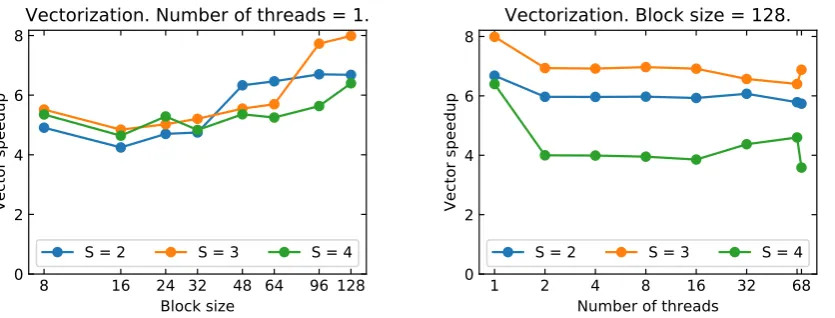
finite differencing operators. The method of lines and standard explicit integration algorithms are then
61
used to time-update the state vectorui,j,k = {ui,j,k}composed of all the field components with the
62
equations in the form ˙ui,j,k(t) =Fi,j,k(u,∂u,∂∂u). Our work focuses on the optimization of the finite 63
differencing kernel and tensor contractions for the computation of the RHS.
64
Our global strategy for the RHS computation is composed of two levels: (i) in-core vectorization,
65
that takes advantage of single instruction multiple data (SIMD) parallelism on aligned memory; and
66
(ii) multi-thread and shared-memory parallelism of the outer loops. (ii) splits RHS evaluations in block
67
of operations (derivatives, contractions, etc) in order to fit instructions and data cache. We expect the
68
latter optimization to be particularly important for the Einstein equations, where the RHS evaluation
69
involve accessing tens of grid functions.
70
The dataui,j,kis stored in contiguous arrays of floats or double. Thex-direction is the only one
71
where elements are contiguous in memory; thus SIMD parallelization is only possible along its fastest
72
running index. The other two directions are accessed asu[ijk + s*dj]oru[ijk + s*dk], where
73
dj=nxanddk=nxny. So for the approximation of the derivatives in theyandzdirections strided
74
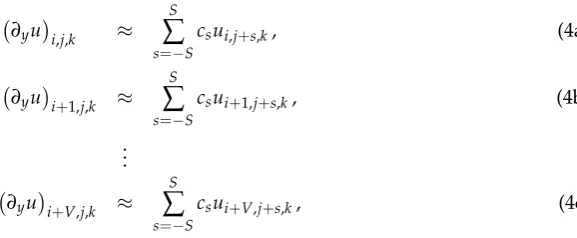
memory access is unavoidable. Instead of using vector instructions to evaluate (3), we vectorize the
75
code by grouping together points in thex-direction, i.e., the derivative in they-direction is computed
76
as
77
∂yui,j,k ≈
S
∑
s=−Scsui,j+s,k, (4a)
∂yui+1,j,k ≈
S
∑
s=−Scsui+1,j+s,k, (4b) ..
.
∂yui+V,j,k ≈
S
∑
s=−Scsui+V,j+s,k, (4c)
whereVis the size of the vector register, e.g., 8 on KNL when computing in double precision. This
78
simple in-core parallelization strategy is then combined with threading for out-of-core, but in-node
79
parallelism using the OpenMP library. Note that our implementation requires the additional storage of
80
1D arrays with temporary data. However, for typical block sizes (323or larger) the additional memory
81
requirements are negligible, even when storing hundreds of grid functions.
Table 2.BDW, KNL, and SKL characteristics and performance of the nodes used for the tests.
Node type Intel Xeon Frequency Cores HT Core/Node perf cache
BDW E5-2684 v4 2.3 GHz 2x18 off 36/1300 GFlops 256 KB L2, 40 MB Smart Cache KNL Phi 7250 1.4 GHz 1x68 on 44/3000 GFlops 1 MB L2, 16 GB MCDRAM SKL 8160 2.1 GHz 2x24 off 67/3200 GFlops 1 MB L2, 33 MB L3
A pseudo code of our RHS implementation is the following:
83
To ensure optimal performance of our code, we perform aligned memory allocation at 64bit
84
boundaries and we ensure that the block size is a multiple of the vector size. This avoids the need for
85
and the use of remainder loops. Note that avoiding reminder loops is also necessary to ensure the
86
exact reproducibility of the calculations. The block size is fixed and set at compilation stage.
87
3. Experimental setup
88
The above method is tested on BDW, KNL and SKL nodes of the Marconi cluster at CINECA, and
89
on BDW and KNL nodes of the HPC data center at the University of Parma. The characteristics of the
90
nodes are listed in Tab.2. 1
91
We consider independent implementations of the scalar wave and linearized Einstein equations
92
and exploit the auto-vectorization capabilities of the Intel C/C++ compiler combined with the
93
introduction of the PRAGMA SIMD statement. This approach strikes a balance between performance
94
and code portability. The specific options for auto-vectorization that we employed are:
95
icc -O3 -xCORE-AVX2 -qopt-report=4 # do Vectorization (V) on BDW
96
icc -O3 -xMIC-AVX512 -qopt-report=4 # do Vectorization (V) on KNL
97
icc -O3 -xCORE-AVX512 -qopt-report=4 # do Vectorization (V) on SKL
98
icc -O3 -no-vec -no-simd # do Not Vectorize (NV)
99
Note that, in order to completely disable vectorization, we use the options-no-vecfor compiler
100
auto-vectorization and-no-simdto disable the PRAGMA SIMD statements. Double precision data
101
type and align arrays with 64 bytes-wise vector are employed in all our tests.
102
4. Results
103
4.1. Wave equation
104
We explore the performances of our method on BDW, KNL and SKL using the wave equation
105
implementation. Comparative tests on those architectures on a single core/thread are first considered
106
for variable block size up to 128 points, and with focus on vectorization performances. Multi-thread
107
performances and strong OpenMP scaling are then analyzed with a fixed block size of 128 points. The
108
speed of our implementation is measured in terms of Million cells updates per second; figures refer to
109
the speed of the whole program that is dominated by the RHS evaluation.
110
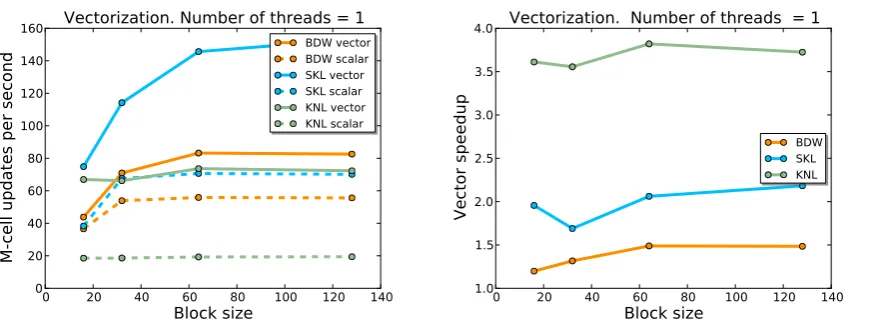
The results relative to the single core optimization are shown in Fig.1. Without vectorization the
111
speed on the KNL core is about a factor 3 smaller than BDW; SKL is about 20% faster then BDW. When
112
vectorization is enabled, we find a speedup of of 1.5 on BDW, of 4 on KNL, and of 2 on SKL. This
113
in-core optimization results are about half the theoretical maximal speedup of a single core due to the
114
vectorization: 8x for KNL/SKL and 4x for BDW.
115
1 The peak performance reported in the Table are calculated assuming 2 instructions per cycle (superscalar processors),
0 20 40 60 80 100 120 140
Block size
0 20 40 60 80 100 120 140 160
M-cell updates per second
Vectorization. Number of threads = 1
BDW vector BDW scalar SKL vector SKL scalar KNL vector KNL scalar0 20 40 60 80 100 120 140
Block size
1.0 1.5 2.0 2.5 3.0 3.5 4.0
Vector speedup
Vectorization. Number of threads = 1
BDW SKL KNL
Figure 1.Single-core performances (left panel) and speedup (right panel) for variable block size in the case of the wave equations with stencil sizeS=2. The tests have been executed with vectorization enabled (solid lines) and disabled (dashed lines). The best performance is obtained for vectorized kernel on SKL.
Table 3.Vectorization speedup on single core for the wave equation with stencil sizeS=2. The block size is 1283. The table shows the Intel compiler report information (obtained with the-qopt-report
options) and the measured speedup (ratio between non-vectorized and vectorized execution time). The measured speed-up differs of about a factor 2 or more from the potential speedup.
BDW KNL SKL
Operation Compiler Measure Compiler Measure Compiler Measure
Derivative 5.03 1.7 6.58 3.7 5.73 2.22
Contraction 5.61 1.8 7.77 4 5.61 2.27
Table3reports speedup measurements on the two main operations of the RHS (contraction and
116
derivatives). Such numbers differs of about a factor 2 or more from the potential speedup reported
117
by the compiler at compilation time (also reported on the table). Performances are stable for variable
118
block size as soon as the number of floating point operations dominate the computation (n&32).
119
All data fits the cache memory on the considered systems (see also below), so the sub-optimal
120
performance of our implementation can not be ascribed to the memory speed. Our results are in-line
121
with those reported by Intel in a similar test [16].
122
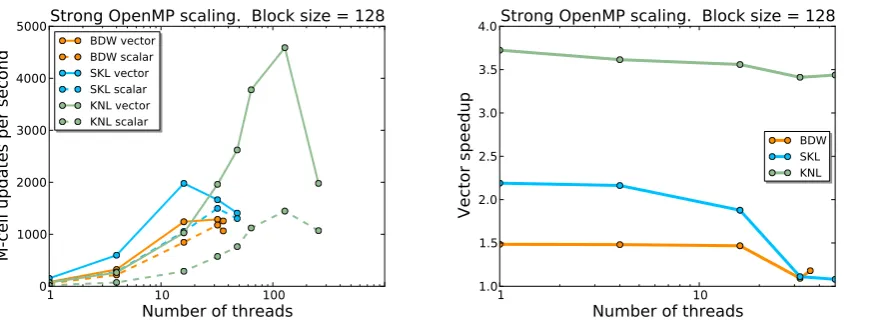
The results relative to the multi-thread optimization are shown in Fig.2. The grid size employed
123
for these test is n = 128. The latter block size correspond to a grid with a maximum memory
124
occupation of 33 MBytes. BDW smart cache, L3 SKL cache and KNL MCDRAM are large enough for
125
the considered block sizes, so the memory speed does not represent a bottleneck even for the single
126
thread computation. In KNL systems the MCDRAM High Bandwidth Memory is 4 times faster than
127
DDR4. The MCDRAM can be used as a cache memory if the node is configured in Cache Mode. If the
128
node is in Flat Mode it is possible to allocate data on MCDRAM through the High-Bandwidth Memory
129
(HBM) library or through the memory affinity control provided by thenumactltool. We tested both
130
methods obtaining the same results.
131
Scaling on BDW and SKL is close to ideal until 16 threads, then we observe a drop of the
132
performance even running on 32 physical cores. On the other hand the KNL shows a sustained
133
speed-up (about 4x) up to 64 physical cores, and remains good with hyper-threading. The use of the
134
KNL node can, in principle, speed-up computations of more than a factor of 2 with respect to BWD
135
and SKL when the kernel works on sufficiently large block sizes. Note, however, the use ofn=128 is
136
unrealistic for numerical relativity application since one would be memory limited in that case.
1 10 100
Number of threads
0 1000 2000 3000 4000 5000
M-cell updates per second
Strong OpenMP scaling. Block size = 128
BDW vectorBDW scalar SKL vector SKL scalar KNL vector KNL scalar
1 10
Number of threads
1.0 1.5 2.0 2.5 3.0 3.5 4.0
Vector speedup
Strong OpenMP scaling. Block size = 128
BDW SKL KNL
Figure 2.Multi-thread performances (left panel) and speedup (right panel) for block sizen=128 as a function of the number of threads, in the case of the wave equations with stencil sizeS=2. KNL demonstrates good speedup, overall performance and scalability, especially in case of large block sizes.
4.2. Linearized Einstein equations
138
Let us know discuss the results on linearized Einstein equations.
139
Besides stencil operations the numerical solution of Einstein’s equations also requires the
140
evaluation of many tensor operations, such as the contraction of tensor indices and the inversion of
141
small 3x3 or 4x4 matrices. Since these operations are local to each grid point and involve the multiple
142
re-use of data already in cache, they can be more efficiently vectorized. The linearized Einstein
143
equations are not as algebraically complex than their fully non-linear counterpart, but can give an
144
indication of the speedup that could be achieved with vectorization in a production simulation.
145
We perform a study of the performance of our vectorization and threading strategies for the
146
linearized Einstein equations using the same compiler options as in Sec.4.1. The tests are performed
147
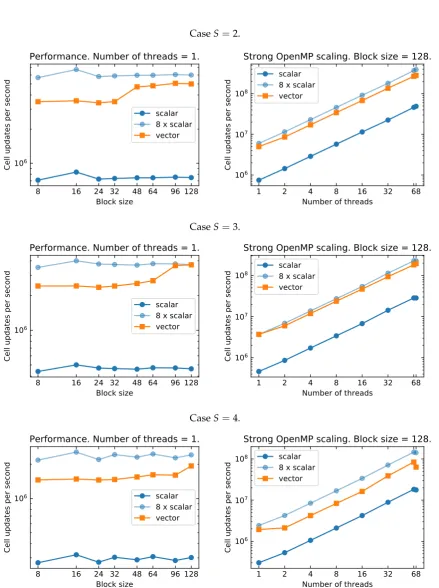
using a single KNL node on CINECA Marconi. Our results are summarized in Figs.3and4.
148
The single core performances are very encouraging, especially for large block sizes. Indeed,
149
on a single core, the vectorized code can achieve close to a factor∼8 speedup over the non-vector
150
version of our code. This is the theoretical maximum speedup for double precision calculations if
151
fused math-addition operations are not used. Even for smaller block sizes, down toN=8, we achieve
152
a speedup factors of∼5−6. This shows that vectorization would be very beneficial also for production
153
simulations, where the block sizes are typicallyn=32 or smaller.
154
When multithreading, the speedup due to vectorization is somewhat worse. On the one hand,
155
this is expected because each thread operates on a smaller sub-block of the data. On the other hand,
156
when comparing vector speedups with threading to those obtained in an equivalently smaller single
157
core case, we typically find worse speedups in the former case (see Fig.4). This might indicate that
158
the default tiling employed by OpenMP is not efficient. Improvements could be obtained either by
159
tuning the tiling, or by switching to a coarse grained parallelization strategy also for OpenMP. The
160
latter could be, for example, to map threads to individual (small) blocks.
161
We extended our OpenMP scaling tests all the way up to 68 cores, thus using all of the physical
162
cores on a KNL node. However, we find the results with 68 threads to be somewhat inconsistent
163
between runs: sometimes running on 68 threads yields a speedup and sometimes a slowdown. We
164
find that leaving 4 physical cores dedicated to OS and IO tasks result in more predictable performances.
165
Consequently, we do not plan to perform simulations using more than 64 OpenMP threads on the
166
KNL architecture. Nevertheless, in Figs.3and4we show the results obtained with 68 threads for
167
completeness.
CaseS=2.
8
16 24 32 48 64 96 128
Block size
10
6Cell updates per second
Performance. Number of threads = 1.
scalar
8 x scalar
vector
1
2
4
8
16
32
68
Number of threads
10
610
710
8Cell updates per second
Strong OpenMP scaling. Block size = 128.
scalar
8 x scalar
vector
CaseS=3.
8
16 24 32 48 64 96 128
Block size
10
6Cell updates per second
Performance. Number of threads = 1.
scalar
8 x scalar
vector
1
2
4
8
16
32
68
Number of threads
10
610
710
8Cell updates per second
Strong OpenMP scaling. Block size = 128.
scalar
8 x scalar
vector
CaseS=4.
8
16 24 32 48 64 96 128
Block size
10
6Cell updates per second
Performance. Number of threads = 1.
scalar
8 x scalar
vector
1
2
4
8
16
32
68
Number of threads
10
610
710
8Cell updates per second
Strong OpenMP scaling. Block size = 128.
scalar
8 x scalar
vector
8
16 24 32 48 64 96 128
Block size
0
2
4
6
8
Vector speedup
Vectorization. Number of threads = 1.
S = 2
S = 3
S = 4
1
2
4
8
16
32
68
Number of threads
0
2
4
6
8
Vector speedup
Vectorization. Block size = 128.
S = 2
S = 3
S = 4
Figure 4.Vectorization speedup forS=2,S=3, andS=4. Left panel: single core vector speedup. Right panel: vector speedup for increasing thread count. Good vector efficiency is achieved for large block sizes, even though the speedup due to vectorization shows an unclear trend withS. The results when using 68 threads might be affected by system interrupts.
5. Conclusion
169
Motivated by the future need of developing a highly scalable code for NR application on
170
exascale computing resources, we have introduced and tested an optimization strategy to calculate 3D
171
finite-differencing kernels on different many-core architectures, including BDW, KNL and SKL. The
172
proposed method can be implemented with a minimal programming effort on existing NR codes. It
173
gives substantial speed-up of both contraction and 3D stencil computations on BDW, KNL and SKL
174
architectures.
175
A deeper code re-factory would be needed in order to further improve performances. For example
176
the introduction of the loop tiling technique would guarantee a better exploitation of the L1 and L2
177
caches. Using intrinsic instructions can further improve the performance. This approach would limit
178
our possibility to keep the code simple and portable but we plan to test it in a compute intensive loop
179
of our kernel in order to assess the further speed-up.
180
We think compilers can heavily improve their auto-vectorization capabilities and we expect
181
the Intel compiler to continue to improve in upcoming releases, as partially confirmed by similar
182
conclusion reported in [16]. In our early work we also tested the GNU compiler (v. 5.4.0), but we had
183
to move to the Intel compiler since the vectorization support did not demonstrate to be ready for the
184
production stage. Work on GNU compilers will continue using the next compiler releases for code
185
portability reasons.
186
Future work will be focused on improving the multi-thread performances of our approach and
187
on embedding it into a distributed memory and adaptive grid framework.
188
Acknowledgments: S.B. acknowledges support by the European Union’s H2020 under ERC Starting Grant,
189
grant agreement no. BinGraSp-714626. DR acknowledges support from a Frank and Peggy Taplin Membership
190
at the Institute for Advanced Study and the Max-Planck/Princeton Center (MPPC) for Plasma Physics (NSF
191
PHY-1523261). Computations were performed on Marconi/CINECA (PRACE proposal 2016153522 and ISCRA-B
192
project number HP10B2PL6K), and on the HPC facility of the University of Parma, Italy.
193
Author Contributions:S.B. and D.R. conceived and designed the project; A.R. performed the analysis of the wave
194
equation code at CINECA and Parma; S.B. implemented the wave equation code; D.R. implemented the linearized
195
Einstein code and performed the the analysis of the linearized Einstein code at CINECA; A.P. performed the
196
analysis of the wave equation code at CINECA; All authors contributed to discussion and paper writing.
197
Conflicts of Interest:The authors declare no conflict of interest.
198
Abbreviations
The following abbreviations are used in this manuscript:
200 201
BDW Intel Broadwell architecture FMA Fused multiply-add
KNL Intel Knight Landing architecture HNM High-Bandwidth Memory library
MCDRAM Multi-Channel Dynamic Random-Access Memory MPI Message Passing Interface
NR Numerical Relativity OpenMP Open Multiprocessing RHS Righ-hand-side
SIMD Single Instruction Multiple Data SKL Intel Skylake architecture
202
References
203
1. Abbott, B.P.; others. Observation of Gravitational Waves from a Binary Black Hole Merger. Phys. Rev.
204
Lett.2016, 116, 061102,[arXiv:gr-qc/1602.03837].
205
2. Abbott, B.P.; others. GW170817: Observation of Gravitational Waves from a Binary Neutron Star Inspiral.
206
Phys. Rev. Lett.2017, 119, 161101,[arXiv:gr-qc/1710.05832].
207
3. Multi-messenger Observations of a Binary Neutron Star Merger. Astrophys. J. 2017, 848, L12,
208
[arXiv:astro-ph.HE/1710.05833].
209
4. Radice, D.; Bernuzzi, S.; Del Pozzo, W.; Roberts, L.F.; Ott, C.D. Probing Extreme-Density Matter with
210
Gravitational Wave Observations of Binary Neutron Star Merger Remnants. Astrophys. J.2017, 842, L10,
211
[arXiv:astro-ph.HE/1612.06429].
212
5. Perego, A.; Rosswog, S.; Cabezon, R.; Korobkin, O.; Kaeppeli, R.; others. Neutrino-driven winds from
213
neutron star merger remnants. Mon.Not.Roy.Astron.Soc.2014, 443, 3134,[arXiv:astro-ph.HE/1405.6730].
214
6. Radice, D. General-Relativistic Large-Eddy Simulations of Binary Neutron Star Mergers. Astrophys. J.
215
2017, 838, L2,[arXiv:astro-ph.HE/1703.02046].
216
7. Kiuchi, K.; Kyutoku, K.; Sekiguchi, Y.; Shibata, M. Global simulations of strongly magnetized remnant
217
massive neutron stars formed in binary neutron star mergers2017. [arXiv:astro-ph.HE/1710.01311].
218
8. Bernuzzi, S.; Nagar, A.; Thierfelder, M.; Brügmann, B. Tidal effects in binary neutron star coalescence.
219
Phys.Rev.2012, D86, 044030,[arXiv:gr-qc/1205.3403].
220
9. Bernuzzi, S.; Nagar, A.; Dietrich, T.; Damour, T. Modeling the Dynamics of Tidally Interacting Binary
221
Neutron Stars up to the Merger. Phys.Rev.Lett.2015, 114, 161103,[arXiv:gr-qc/1412.4553].
222
10. Sodani, A.; Gramunt, R.; Corbal, J.; Kim, H.S.; Vinod, K.; Chinthamani, S.; Hutsell, S.; Agarwal, R.; Liu, Y.C.
223
Knights Landing: Second-Generation Intel Xeon Phi Product. IEEE Micro2016, 36, 34–46.
224
11. Brügmann, B.; Gonzalez, J.A.; Hannam, M.; Husa, S.; Sperhake, U.; others. Calibration of Moving Puncture
225
Simulations. Phys.Rev.2008, D77, 024027,[arXiv:gr-qc/gr-qc/0610128].
226
12. Husa, S.; González, J.A.; Hannam, M.; Brügmann, B.; Sperhake, U. Reducing phase error in long numerical
227
binary black hole evolutions with sixth order finite differencing. Class. Quant. Grav.2008, 25, 105006,
228
[arXiv:gr-qc/0706.0740].
229
13. Radice, D.; Rezzolla, L.; Galeazzi, F. Beyond second-order convergence in simulations of binary neutron
230
stars in full general-relativity. Mon.Not.Roy.Astron.Soc.2014, 437, L46–L50,[arXiv:gr-qc/1306.6052].
231
14. Bernuzzi, S.; Dietrich, T. Gravitational waveforms from binary neutron star mergers with high-order
232
weighted-essentially-nonoscillatory schemes in numerical relativity. Phys. Rev. 2016, D94, 064062,
233
[arXiv:gr-qc/1604.07999].
234
15. Borges, L.; (Intel), P.T. 3D Finite Differences on Multi-core Processors.
235
16. Andreolli, C. Eight Optimizations for 3-Dimensional Finite Difference (3DFD) Code with an Isotropic
236
(ISO). Intel Software On-line documentation2014.
237
17. Baumgarte, T.W.; Shapiro, S.L. On the numerical integration of Einstein’s field equations. Phys. Rev.1999,
238
D59, 024007,[gr-qc/9810065].
239
18. Nakamura, T.; Oohara, K.; Kojima, Y. General Relativistic Collapse to Black Holes and Gravitational Waves
240
from Black Holes. Prog. Theor. Phys. Suppl.1987, 90, 1–218.
19. Shibata, M.; Nakamura, T. Evolution of three-dimensional gravitational waves: Harmonic slicing case.
242
Phys. Rev.1995, D52, 5428–5444.
243
20. Bernuzzi, S.; Hilditch, D. Constraint violation in free evolution schemes: comparing BSSNOK with a
244
conformal decomposition of Z4. Phys. Rev.2010, D81, 084003,[arXiv:gr-qc/0912.2920].
245
21. Dolbeau, R. Theoretical peak FLOPS per instruction set: a tutorial. The Journal of Supercomputing2018,
246
74, 1341–1377.