* To whom all correspondence should be addressed.
Effect of Video Modeling Demonstration from Different View
on Coordination Changes of an Unfamiliar Task: An Important
Point to Teach
Abdolzadeh Hamideh1. Taheri Torbati, Hamidreza2* and Saberi kakhki Alireza2
1Department of Sport Science – PhD student in Ferdowsi University of Mashhad- Iran. 2Department of Sport Science –Ferdowsi University of Mashhad- Iran.
http://dx.doi.org/10.13005/bbra/2309
(Received: 12 July 2016; accepted: 18 August 2016)
This research attempts to investigate effect of observing motion models from angles of 0, 60, 120, 180, 240 and 300 degrees on coordination changes of a discrete unfamiliar task. A total of 48 girl students were divided into 6 groups according to their performance scores in the pre-test and practiced after seeing film intended by their group. Then delayed retention test was conducted. Results showed that all groups learnt the motion model and elbow-shoulder and elbow – wrist coordination in the acquisition phase show that all groups learnt the motion model, but in wrist-elbow coordination angle of 240 degrees showed weaker motion models acquisition compared with other angles. Retention test results in the retention phase of elbow-shoulder coordination revealed that angle of 180 ° and 240 degrees showed the lowest and highest mean, respectively. But in wrist-elbow coordination, no significant difference was observed between other groups except 180 ° and 240 ° angles, which showed the lowest and highest mean, respectively. This research suggests that observational learning practicing improves motion model coordination and to learn more, observing motion from the angle of 180 degrees can be considered a way to improve learning due to learner involvement in more memory and cognitive processes.
Keywords: Observational learning, viewing angle, video model, teaching, discrete task.
Learning through observation or modeling is a technique which is commonly used in teaching motor skills. The coach shows the skills because he or she believes that student will receive more information in a shorter time rather than verbal description and undoubtedly, one of the most important factors affecting learning is presentation skills(Magill and Anderson, 2007). Observing individuals’ motion skills of others when combined with physical exercise of those skills is a common form of learning, which is called
others (Hodges et al., 2007). Sports scientists are interested in the acquisition of motion skills, evaluation of effectiveness of different types of visual displays during coaching, training and physical exercise exercises. Scully and Newell (1985) provided an integrated concept of research evidence on biological motion perception in line with the learning process framework defined by Newell (1985) (i.e. coordination control and skill) and proposed visual perception perspective in the field of observational learning as an alternative to traditional theories. This perspective is based on the fact that visual displays should initially be used for transmission of information motion essential for learning and task execution. From this point of view, it is argued that the main role of visual displays during skill acquisition phase is manipulation of motion information source so that learners optimally collect effective coordination models to find appropriate solutions for the intended task (Scully and Carnegie, 1998). According to the logic of this theory on the effects of observational learning, Scully (1988) proposed some practical implications on the use of visual displays in training motion skills (Al-Abood et al., 2001, Scully and Newell, 1985).In an effort to investigate empirical supports for these proposals, we evaluated the issue that use of different observation angles of the motion model can differently facilitate the acquisition of motion coordination. In the observational learning, conditions and different factors are effective such as model features, observer’s characteristics, task characteristics and model presentation conditions (Williams et al., 1999). After initial learning, model observation leads to optimal learning and provision of elements needed to motion (Olson, 2015). One of modeling methods is video model (Hayes et al., 2007) and observation of actual motion models, i.e. execution of model by coach or any other person in contrast to video methods, are among conventional methods used in physical education classes and rehabilitation centers (Snyder et al., 2011). However, results of recent studies, for example, Dayan, Eran, et al.’s study (2014), which discusses difference between two models in observing the actual execution and execution of focused-motion video, it was found that the video method compared with real observation of the motion is associated with far better results (Dayan
et al., 2014). One of the characteristics that can affect model use type in the observational learning is learner’s ability level. Observational learning is often used to enhance level of acquired skills of beginners or athletes with a moderate level (Ste-Marie et al., 2012). Moreover, modeling effect on motion skills, depending on the nature and characteristics of task is different and all indicators of motion skills and motion are not learned through modeling in the same way. Observers learn more from consecutive and continuous motions modeling compared with discrete motions (Ashford
et al., 2007).
Observation of the entire body in motion is obligatory in continuous skills, but in discrete skills, observation of the executive organ is sufficient (Hodges et al., 2007). In general, if the skill is simpler and has fewer components, the observation will be more effective (Laguna, 2008). And the reason for these differences is that researchers in recent studies found that discrete and continuous motions use separate motion control mechanisms in the motor system (Howard
However McCullough et al., (2001) stated that providing visual information about skills may affect acquisition of temporal aspects and spacing of learner’s motions (McCullagh and Weiss, 2001). Fleishman & Gagne (1954) stated that the model viewing angle is an important factor in education, which can affect modeling effects (Ste-Marie et al., 2012). Several studies have been done on the viewing angle. For example, Ishikura& Inomata, (1995), in a study on learning dance movement sequence skills, concluded that the mental model (subjective) that depicts skills from rear view of the model learned the motion sequence lot faster and the objective model group or non-aligned model from front view of the model learned the motion sequences pretty late. All groups showed similar performance in retention test (Ishikura and Inomata, 1995, Ste-Marie et al., 2012). Again, Ishikura& Inomata (1998),in an effort to distinguish between two reversed modeling strategies to modeled learning of motion skills, concluded that the objective model may lead to more learning but the learner needs more time to pass through the acquisition phase, while in the subjective model, the learner shows efficiency in acquiring skills (Ishikura and Inomata, 1998).Also, Roshal supported better results of the acquisition phase after using the subjective model i.e. knotting task in 1961 (Roshal, 1961, Ste-Marie et al., 2012). However, while repeating Rosholt’s test, Sam Brook (1998)did not find any difference in the acquisition results between subjective and objective groups (Sambrook, 1998, Ste-Marie et al., 2012). Jordan (1979) investigated and implemented effects of viewing position while learning dance steps using spatial and temporal sequence analysis and came to the conclusion that learner’s position is a very important factor in learning and performance and viewing the model from the rear view (mental) produced the best results (Williams et al., 1999). Similarly, Ramsey (1995), investigated effects of learner’s position while viewing video modeling of receiving skills’ in novice hockey players and came to the conclusion that there was a significant effect, but there was no difference between peripheral, mental and mixed viewing in ball–bat contact timing (Williams et al., 1999). Press et al. (2009) investigated body motions sequence imitation in six angles of 0-60-120-180-240 and 300 degrees. Results showed that when the model is seen with
a 0 degree or from behind, subjects’ performance was more accurate (Press et al., 2009). Ishikura (2012), in a study investigated effects of sequential modeling of body motions in three types of observation; from behind, opposite and combination and came to the conclusion that all groups learnt the motion model and two observation types i.e., backside and combination compared with the front-side observation had greater accuracy. Also, the modeling effect was equal in two observation types i.e., backside and combination(Ishikura, 2012). Considering similarity of retention results in Ishikura& Inomata’s research and superiority of the objective model (1995)(front-side observation) in Ishikura& Inomata task learning (1998), lack of difference in acquisition results of Sam Brook’s observation groups (1998), lack of difference between side, rear, and a combination view in Ramsey’s research (1995),different results on observation accuracy of front and back sides observation in Press et al.’s research (2009) and superiority of back side and combination observations compared with the front-side observation and equal effect of modeling from behind angle view and the combination observation in Ishikura’s research (2012), the overall conclusion that observation from the back of the model is more effective than viewing from the front angle may be somewhat aberrant due to the mentioned inconsistency, particularly few tests investigated effect of viewing angle on acquisition and learning (Ste-Marie et al., 2012). In this study, according to the previous research results, this question arises whether different video motion viewing angles can affect perception and ultimately performance and learning? It is possible that a change in the viewing angle leads to different effects on coordination model changes.
of displaying the video model on coordination changes of an unfamiliar task was investigated.
METHODOLOGY
Participants
A total 48 girl students who voluntarily participated in this study were investigated. Participants’ average age and height were 22± 4 and 160 ± 10, respectively. They did not have any previous experience in throwing skills on the horizontal plane and all were beginners and had normal levels of visual indicators. Subjects’ right-handedness was determined using Edinburgh’s handedness Questionnaire and according to their performance scores in the pre-test were divided into 6 homogenous groups.
Research and task tools
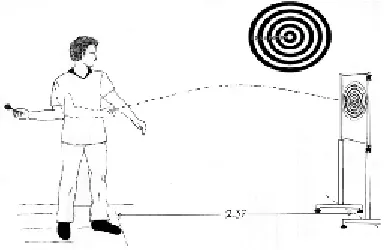
Tools used in this study was dart boards in standard sizes, 10 standard dart arrows, 7 full-HD shooting Cameras Fujifilm (Simi reality motion systems) for shooting viewing model from different angles and a dart board and screen to show participants their performance. For the purpose of novelty, the intended task was a modified form of dart throwing. In throwing darts, hand is placed in such a way that the forearm is placed in the sagittal plane and motion is done around the frontal axis. However, in this study and throwing modified form, forearm is placed along the body and on the horizontal plane and the vertical axis and the participant throw darts towards boards at a distance of 2.37-meter. The purpose of this task was to get more points by targeting a modified dart board using the dominant hand towards a specific standard dart (Unicorn). Moreover, results
of this test were modified for the scoring system. This target consists of 10 concentric circles. The target’s center had a diameter of 2.25 cm and radius of other circles was increased 2.25 cm compared with the previous circle. The target’s center has 10 scores and scores are decreased from the inside to outside. So that the inner circle had 10 scores and outer circle just 1, respectively. Moreover, height of the dart board was changeable according to participants’ height.
The task was unfamiliar for all the participants. In order to provide a skilled model, an adult person (25 years old) was asked to practice the intended motion for 5 days and 200 attempts each day (10 blocks of 20 attempts- every 2 minutes). On the fifth day after the 10-minute break, model implementation in the desired angles was filmed and one of her throws that had exactly hit the center of the target was used as the model film. A total of 6 films on changed throwing darts were shot from 6 desired angles, which were used for 6 groups.
Procedure
In this study, subjects to get familiar with throwing skills attended a briefing session, in which following tips relating to dart throwing skills were discussed: how to stand, how to get missiles, how to open elbow and throw missiles and continue to move. Later in the pre-test, subjects performed 10 modified dart throwing and scores related to the motion result was recorded by the experimenter in order to homogenize targeted groups. Then, after pre-test, individuals were randomly homogeneously placed in six angle groups with regard to the performance scores (60, 120, 180, 240 and 300 degrees) so that 8 subjects attended in
Fig. 1. The modified-dart aiming task in a horizontal plane
each group. The variance analysis test showed no significant difference between different groups at this stage (F = 0.1, P = 0.992). All people in all groups observed a film of the same person and a similar throwing with the angle intended by their group. Moreover, in all groups, before viewing, viewers’ attention was directed to verbal instructions and the model motion in the film. They had 6 training blocks during the acquisition phase and watched the intended movie 5 times before the start of each block and then conducted 10 throwing attempts. In this stage, individuals performed a total of 30 observations and 60 throwing attempts (in six attempt blocks with 2 minutes rest between blocks).It should be noted that viewing angles determined for groups are pro-clockwise so that the back-side viewing angle is 0 degree and continuing angles are clockwise (Press
et al., 2009).Delayed retention test was conducted 48 h after the acquisition session so that participants carried out a block of 10 trials. In this study, the model of motion coordination was recorded in all efforts and the first three attempts pretest and the first three attempts in 2, 4 and 3 blocks and 6 of acquisition plus 3 first retention attempts were investigated in order to analyze motion. Also, individuals were not given any feedback during these efforts (Breslin et al., 2009).
Data collection
Motion Analysis Simi analyzer system was used to collect and analyze kinematics of motion. A total of 3 markers were placed on three joint of the dominant hand (i.e. right upper organ) of the model and all participants: shoulder acromion and external condyle of the elbow and wrist, the fourth marker was attached on the external condyle of femur. 3D coordinate data were recorded in an off-line mode and with sampling frequency of 100 Hz. Next, handling raw data were filtered using recursive second-order Butterworth filter with frequency of 5 Hz, which was used two times to neutralize the phase shift (Wood, 1982). Then, motion data filtered for speed data extraction were used as off-line. Finally, displacement and speed values obtained from data were calculated. When the model was filmed, her kinematic motion was recorded using Simi system and through the methods mentioned above. Model kinematic data were collected for comparative analyses. Especially for all efforts displayed by the model, linear
displacement and speed of the dominant hand was calculated since the beginning of motion until the release of darts.
Dependent measures
Kinematic data and motion results for all acquisition and retention efforts were collected in accordance with the above-described methods of data collection. However, only for the kinematic motion, 3 first pre-test efforts and blocks 2, 4 and 6 of acquisition blocks plus 3 first retention attempts were analyzed. The kinematic motion measurements were chosen as the appropriate variables to investigate the research predictions on effects of visual viewing on the coordination.
Coordination between joints of shoulder, elbow and wrist were put in a formula offered by Kelso (1995) , which is known as a discrete relative phase, in which variability of coordination between organs were calculated (Gordon et al., 2004). The formula is as follows:
t= time
The maximum rotation of segment 1
The maximum rotation of segment 2
= The phase differences during the cycle j
Data analysis
Scores of accuracy were analyzed in 6 (viewing angle) × 7 (blocks) analysis of variance (ANOVA) with repeated measure on the last factor for the practice phase. The retention was also analyzed by a one-way ANOVA. Also DRP (Discrete relative phase), scores were analyzed in 6 (viewing angle) × 4 (blocks) analysis of variance (ANOVA) with repeated measure on the last factor for the practice phase. For the retention test the DRP scores was analyzed using a one-way ANOVA.
RESULTS
Scores of accuracy Acquisition
Table 1. Results of scores of accuracy
Factor d. f. F P Effect Size
Acquisition Angle 5,42 1.43 0.234 0.23
Block 6, 252 29.32 <.001 0.41
Angle*Block 30, 252 2.6 <.001 0.24
Retention Angle 5, 42 4.98 0.001 0.37
Table 2. Results of DRP of shoulder- elbow analysis
Factor d. f. F P Effect Size
Acquisition 5, 42 1.87 0.119 0.18
Angle 3, 126 14.07 <.001 0.3
Angle*Block 15, 126 2.76 0.001 0.25
Retention Angle 5, 47 4.71 0.002 0.36
Table 3. Results of DRP of elbow-wrist analysis
Factor d. f. F P Effect Size
Acquisition Angle 5, 42 1.76 0.03 0.25
Block 3, 126 19.18 <.001 0.31
Angle*Block 15, 126 2.94 0.003 0.23
Retention Angle 5, 47 4.71 0.001 0.39
improvement of participants. The interaction effect of viewing angle and blocks (F30, 252= 2.60, p<.001, = .24) was significant as well. However the main effect of viewing angle was not significant (F5, 42= 1.43, p<.243, = .23) (Table 1).
Retention
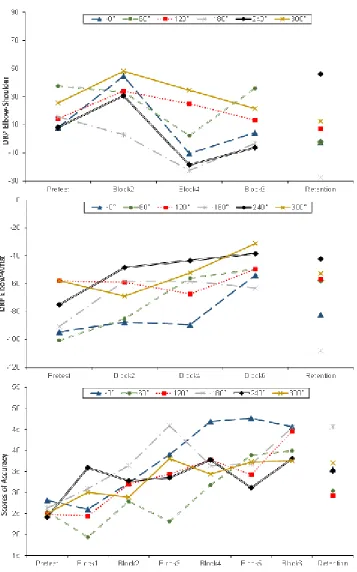
The effect of viewing angle was significant (F5, 47= 4.98, p=.001, = .37) (Table 1). Post hoc analysis revealed that there were significant differences between group of 180 with 60 and 120 degrees (P<.05). (Figure 3, low panel).
Movement coordination
DRP of Shoulder - Elbow
Acquisition
The data for all training groups are shown in top panel of Figure 1. A significant main effect for block (F3, 126= 18.07, p<.001, = .31) showed practice has positive effect on improvement of participants. The interaction of viewing angle and blocks (F15, 126= 2.76, p=.001, = .25) was significant as well. While the main effect of viewing angle (F5,
42= 1.87, p=.119, = .18) was not significant
(Table 2).
Retention
The effect of viewing angle was significant (F5, 47= 4.71, p=.002, = .36). Further analysis revealed that there was a significant difference between group of 180 and 240 degrees (p<.05) which group of 180 degrees had least scores (Figure 3, top panel).
DRP of Elbow-Wrist Acquisition
Retention
The effect of viewing angle was significant (F5, 47= 5.34, p=.001, = .39).post hoc analysis revealed that there were significant differences between group of 180 and 60, 120, 240 and 300 degrees (P<.05). (Figure 3, middle panel).
DISCUSSION
The purpose of the present study is to investigate effect of different angles of showing the video model on acquisition and retention of coordination changes of an unfamiliar task. For this purpose a total of 48 girl and non-athlete students were voluntarily tested. The volunteers practiced in six training groups observed dart throwing task in the horizontal plane at observational angles of 0, 60, 120, 180, 240 and 300.The results showed that during elbow-shoulder acquisition coordination, all groups learnt the motion model. Subjects at zero angle group or subjective model who observes the skill from the back-side angle and subjects at angle of 180 degrees or objective models or models non-aligned with the intended model, learned the motion model with a mean difference of less than the model. The results of this study are inconsistent with Ishikura& Inomata (1995), Roshal (1961), Jordan (1979), Press et al. (2009), Ishikura’s results (2012), who found group with back-side observation, compared with the view group with front-side observation had greater coordination (Ishikura, 2012, Ishikura and Inomata, 1995, Press et al., 2009, Roshal, 1961, Williams et al., 1999)but are consistent with Sam Brook’ (1998), Ramsey’s results (1995) who found no difference in acquisition results among subjective and objective groups(Sambrook, 1998, Williams et al., 1999). Also it is likely that results obtained in this study, which indicates the dominance 0 and 180 angles in the acquisition, is due to better observation and imitation of the motion model by the subjects. Furthermore, during the wrist-elbow acquisition coordination phase, the largest and smallest average obtained for of 240 and 180 angles, respectively. In other words, less average shows less difference and better coordination with the motion model. Also, investigations on the post hoc test showed that there is a significant difference between 240 angle and 0, 60 and 180
direction with model, the learner is required to make two inversions in the information / data (front, rear, right & left). Based on the Ishikura& Inomata’s hypothesis (1995), as the data inversion increased, deeper understanding processes are required and makes the learner to process understanding skills at a deeper level, because the reverse process needs visual motion information, thus, it furthers skills learning due to stronger memory representation.
Thus, this hypothesis is proven that in the retention phase, observers learn more when they observes the motion from 180 degrees, frond-side or objective model. Also, differences between the two models may be associated with differences in the processing of visual information related to difference between the model and the learner in association with left and right sides of the body (Ishikura and Inomata, 1995). Accordingly, it can be assumed that if the left-right reverse complexity of visual information changes the type of code used for remembering information, depth of processing related to the acquisition and retention of skills may be affected (Ishikura and Inomata, 1995). It can be also said that learners in the objective model needed to manipulate what they observe in two axis’s. There are two different ways, in which processing strategy could be reversed. One way is that visual information is reversed in the working memory before being transferred to long-term storage (reverse in working memory).Another way is that visual information is transferred from working memory into long-term storage without being reversed and then reversing occurs in the motion reproduction phase (reproduction reversing).Therefore, it is possible to identify these two processing strategies can be with different effects on visual search models during observations and distinguish them in the next execution of the observed skill (Ishikura and Inomata, 1998). According to current research on effects of viewing angles, which has focused on a discrete motion skill in contrast to previous studies, which mainly have focused on chain and continuous skills (dance sequences, sequential knotting and skills to get moving baseball ball), despite different motion control mechanisms in motor system (Howard et al., 2011), use similar mechanisms in order to learn the motion, while using the video modeling; So, it is possible that other studies, which have different task demands
are associated with different results by using discrete tasks. Therefore, due to the rarity of research on discrete tasks, there is still need for further research in this area.
CONCLUSIONS
In explaining the obtained results, it can be said that observational learning practice, especially observing the video model from 0 and 180 angles, due to better observation and imitation of the motion model by the participants, improves performance coordination, while to learning more, observing the motion from 180 angle can be considered as a way to improve learning due to engagement of the learner in more memory and cognitive processes, (Ishikura and Inomata, 1995, Ishikura and Inomata, 1998).
ACKNOWLEDGEMENT
The author wishes to appreciate authorities of Ferdowsi University of Mashhad of faculty of physical education, especially respected management of public department and respected authority of laboratories as well as subjects who sincerely accompanied him during the study.
REFERENCES
1. Al-Abood, S. A., Davids, K., Bennett, S. J.,
Ashford, D. & Marin, M. M. Effects of manipulating relative and absolute motion information during observational learning of an aiming task. Journal of Sports Sciences, 2001;
19, 507-520.
2. Ashford, D., Davids, K. & Bennett, S. J.
Developmental effects influencing observational
modelling: A meta-analysis. Journal of sports
sciences, 2007; 25, 547-558.
3. Bandura, A. Social foundations of thought and
action: A social cognitive theory, Prentice-Hall, Inc 1986.
4. Breslin, G., Hodges, N. J. & Williams, M. A.
Effect of information load and time on observational learning. Research quarterly for exercise and sport, 2009; 80, 480-490.
5. Dayan, E., Sella, I., Mukovskiy, A., Douek, Y.,
Giese, M. A., Malach, R. & Flash, T. The default mode network differentiates biological from
non-biological motion. Cerebral Cortex, 2014;
6. Gordon, D., Robertson, E., Caldwell, G. E., Hamill, J., Kamen, G. & Whittlesey, S. N.
Research methods in biomechanics. Human
Kinetics 2004.
7. Hayes, S. J., Hodges, N. J., Scott, M. A., Horn,
R. R. & Williams, A. M. The efficacy of demonstrations in teaching children an unfamiliar movement skill: The effects of object-orientated actions and point-light demonstrations. Journal of sports sciences, 2007; 25, 559-575.
8. Hodges, N. J., Williams, A. M., Hayes, S. J. &
Breslin, G. What is modelled during
observational learning? Journal of Sports
Sciences, 2007; 25, 531-545.
9. Howard, I. S., Ingram, J. N. & Wolpert, D. M.
Separate representations of dynamics in rhythmic and discrete movements: evidence from
motor learning. Journal of Neurophysiology,
2011; 105, 1722-1731.
10. Ishikura, T. Effects on modeling sequential body
movements when viewed from the front or rear.
Perceptual and motor skills, 2012; 114, 290-300.
11. Ishikura, T. & Inomata, K. Effects of angle of model-demonstration on learning of motor skill.
Perceptual and motor skills, 1995; 80, 651-658.
12. Ishikura, T. & Inomata, K. An attempt to
distinguish between two reversal processing strategies for learning modeled motor skill.
Perceptual and motor skills, 1998; 86, 1007-1015.
13. Laguna, P. L. Task complexity and sources of
task-related information during the observational learning process. Journal of sports sciences, 2008;
26, 1097-1113.
14. Magill, R. A. & Anderson, D. Motor learning
and control: Concepts and applications, McGraw-Hill New York 2007.
15. Mccullagh, P. & Weiss, M. Modeling:
Considerations for motor skill performance and
psychological responses. Handbook of sport
psychology, 2001; 2: 205-238.
16. Olson, M. H. An introduction to theories of
learning, Psychology Press 2015.
17. Press, C., Ray, E. & Heyes, C. Imitation of
lateralised body movements: doing it the hard way. Laterality, 2009; 14, 515-527.
18. Roshal, S. M. Film-mediated learning with
varying representation of the task: Viewing angle, portrayal of demonstration, motion, and
student participation. Student response in
programmed instruction, 1961; 155-175.
19. Sambrook, T. D. Does visual perspective matter
in imitation? Perception, 1998; 27, 1461-1473. 20. Scully, D. & Carnegie, E. Observational learning in motor skill acquisition: A look at
demonstrations. The Irish Journal of
Psychology, 1998; 19, 472-485.
21. Scully, D. & Newell, K. Observational-Learning and the Acquisition of Motor-Skills-toward a Visual-Perception Perspective. Journal of Human Movement Studies, 1985; 11, 169-186.
22. Snyder, C. W., Vandromme, M. J., Tyra, S. L.,
Porterfield Jr, J. R., Clements, R. H. & Hawn, M. T. Effects of virtual reality simulator training method and observational learning on surgical
performance. World journal of surgery, 2011;
35, 245-252.
23. Ste-marie, D. M., Law, B., Rymal, A. M., Jenny,
O., Hall, C. & Mccullagh, P. Observation interventions for motor skill learning and performance: an applied model for the use of observation. International Review of Sport and Exercise Psychology, 2012; 5, 145-176. 24. Williams, A. M., Davids, K. & Williams, J. G. P.
Visual perception and action in sport, Taylor & Francis 1999.
25. Wood, G. A. Data smoothing and differentiation
procedures in biomechanics. Exercise and sport sciences reviews, 1982; 10, 308-362.
26. Wulf, G., Shea, C. & Lewthwaite, R. Motor
skill learning and performance: a review of influential factors. Medical education, 2010; 44,