Original Research Article
Knowledge and attitudes about reproductive health and pregnancy
preparedness: preliminary study of brides and grooms in Brebes
district, Central Java, Indonesia
Sri Achadi Nugraheni
1*, Martini
1, Martha Irene Kartasurya
1,
Ike Johan Prihatini
2, Etik Sulistyowati
1INTRODUCTION
Reproductive health in Indonesia still lack. This is shown by a high of maternal mortality rate (MMR) in Indonesia 229 per 100 thousand live births (133-379) in 2008.1-3 Maternal mortality in Brebes highest in Central Java. One of causes of high maternal mortality rate is a lack of sensitivity of brides and grooms reproductive health
including maternal awareness about the risks of pregnancy signs and taking action. To reduce maternal mortality required tremendous innovation that is supported by many parties, including cross-sector.
Data marriage in Brebes 2015 showing that 40% of weddings between 13 to 18 years, and 70% of them because of teenage pregnancy. Teenage pregnancy caused
ABSTRACT
Background: Knowledge of brides and grooms about reproductive health and pregnancy preparedness in Indonesia still lack. Efforts to give lessons reproductive health and pregnancy preparedness to brides and grooms today still taboo and limited. Education about reproductive health and pregnancy preparedness is one of strategic ways to increase brides’ and grooms’ knowledge and attitudes about reproductive health and pregnancy preparedness. This study conducted to evaluate an effect of reproductive health and pregnancy preparedness education by provision of media on brides and grooms in Brebes district.
Methods: This study utilized quasi experimental pre and post-test one group design. Population of this study includes 54 brides and grooms (31 females and 23 males) in Brebes.
Results: Based on the results of a different test with Wilcoxon Match paired Test obtained were significant differences between the respondents' knowledge and attitudes before and after reproductive health education and provision of media (p=0.008).
Conclusions: That means there were significant interventions in the form of brief counseling and provision of media to increase knowledge and attitudes of respondents about reproductive health. The results demonstrate that interventions can significantly improve knowledge and attitudes of respondents (p<0.005; Delta; 0.20). Recommendation to improve risk of maternal mortality rate is a reproductive health education with early intervention in brides and grooms as one of strategic actions to improving knowledge, minimize incidence of complication in pregnancy and maternal mortality.
Keywords: Brief counseling, Reproductive health, Pregnancy preparedness, Brides and grooms
1
Faculty of Public Health, Diponegoro University, Semarang, Indonesia
2
Faculty of Health Sciences, Universitas Pesantren Tinggi Darul Ulum, Jombang
Received: 04 April 2018
Revised: 21 April 2018
Accepted: 23 April 2018
*Correspondence:
Dr. Sri Achadi Nugraheni,
E-mail: [email protected]
Copyright: © the author(s), publisher and licensee Medip Academy. This is an open-access article distributed under the terms of the Creative Commons Attribution Non-Commercial License, which permits unrestricted non-commercial use, distribution, and reproduction in any medium, provided the original work is properly cited.
lack of information about reproductive health in young generation including elementary school age children, many marriages occurred after they finish, even unfinished. Given the pyramid population mostly in the age 10-19 years, provision of brides and grooms courses is a port d'entry (entry), which is most appropriate to prevent escalation of MMR in the future.4 Premarital is a transition period between adolescence and adult to be parent, quality of pregnancy preparedness affects life for the next generation so that puts as a critical period. In developing countries of this transition took place very quickly. Because most of brides and grooms did not have accurate knowledge of reproductive health, sexuality, and pregnancy preparedness and did not have access to information and reproductive health services. Needs and types of reproductive health and complication in pregnancy risks faced by a young couple. Types of reproductive health risk, complication in pregnancy, sexually transmitted diseases (STDs), and contraceptive, needs to know by brides and grooms.5
Based on that background and literature, a problem of Indonesia which quite a lot contributed to high maternal mortality rate, lack of reproductive health education during children, adolescence or before marriage (brides and grooms), lack of knowledge about early detection of pregnancy risk, as well as delays in referral to mothers with high risk.6,7 Premarital care (PMC) involves the promotion of health and well-being of a woman and her partner before pregnancy and is considered a primary preventive approach for couples planning for conception and an important step towards protecting society and allowing people to enjoy life.8 The process should educate couples and provide them with accurate and unbiased information. Premarital education and counseling seem to be effective in strengthening marriages and have clearly been shown to be beneficial.9 Premarital screening can potentially reduce the burden of inherited hemoglobin diseases by reducing the number of high-risk marriages.10 In addition, the implementation of premarital infectious disease screening is an ambitious and massive project with regard to cost and impact.11 Premarital programs are most successful when they address social, religious, ethnic, and cultural factors.12 Al-Sulaiman et al conducted a study in Riyadh among three groups of participants: one representing the general population, one of couples applying for PMSGC and one of couples who had received the results of their testing.13 They found a fair degree of knowledge among the three groups of Saudi participants regarding the nature of the tests and the targeted disorders. Other studies found a significant lack of knowledge, even among educated persons, about premarital care.14 Some studies have been conducted to assess the knowledge of university students in Jeddah regarding the PMSGC program.14 However, to date, few studies have been performed in Jeddah to assess the knowledge and attitude of the general population about the PMSGC program and to determine the level of satisfaction of program participants regarding the
PMSGC program. Such a study regarding PMSGC is urgently needed.
The objectives of the present study were to assess the knowledge and attitudes about reproductive health and pregnancy preparedness. Premarital course is one of the strategic actions that have significant leverage to solving the problem of improving knowledge of mothers to minimize the causes of death during pregnancy, childbirth and immediately after delivery.
METHODS
This study utilized the quasi experimental pre and post test one group design, as a preliminary study to analyze an effect of brief counseling to reproductive health and pregnancy preparedness by provision of media on brides and grooms in Brebes during January until December 2017.
Population and sample
The population of this study brides and grooms. Study was conducted in Central Java Province with high absolute MMR in Indonesia, especially in the district of Brebes. Sample number 54 brides and grooms (31 females and 23 males) studied. Inclusion criteria were that age group 15 until 45 years, have never been received reproductive health or prenatal education before marriage, and not health workers (e.g. doctors, midwives and nurses). Exclusion criteria were that the brides and grooms after marriage does not live in Brebes district.
Data collection
Data collection began after the approval of the study proposal from the Research Committee at Faculty of Public Health, Diponegoro University, Indonesia. A cover letter was attached to each questionnaire to assure that the participant’s information is confidential. Respondents were given a briefing background before the questionnaires distribution. Permission was taken directly from the brides and grooms by filled the consent form then collected data were obtained by answering a self-administered questionnaire.The questionnaire comprises of close-ended questions. The session has been ended within 20 minutes and the study data stored in the researcher’s personal computer.
Data analysis
The collected data were reviewed, coded, verified, and statistically analyzed. Data was analysed using Wilcoxon Match paired Test. Before carrying out this study the research protocol was approved by Ethics committee of the Faculty of Public Health, Diponegoro University, Indonesia.
RESULTS
Overview of respondents
A total of 54 respondents were included in this study. The majority of participants were female (57.5%), and the rest were male (42.6%).
Table 1. Socio-demographic characteristics of respondents (N=54).
Characteristics Respondent distribution
N %
Age group (years)
<21 12 22.8
21-35 41 77.3
>35 1 1.9
Higher education level
Elementary 12 22.2
Junior high school 9 16.7
Senior high school 18 33.3
Diploma/Bachelor 13 24.1
Others 2 3.8
Employment
Unemployment 14 25.9
Farmer 3 5.6
Private employment 15 27.8
Entrepeneur 22 40.7
Gender
Male 23 42.6
Female 31 57.4
Total 54 100
Age distribution of brides and grooms in this study, most of respondents between 21-35 years (77.3%) and maximum 21-29 years (11 respondents), with the youngest respondent was 16 years (2 respondents), while the oldest was 43 years (1 respondents). Education of brides and grooms, most of respondents have senior high school graduates (33.3%).
Knowledge of respondents about reproductive health and pregnancy preparedness
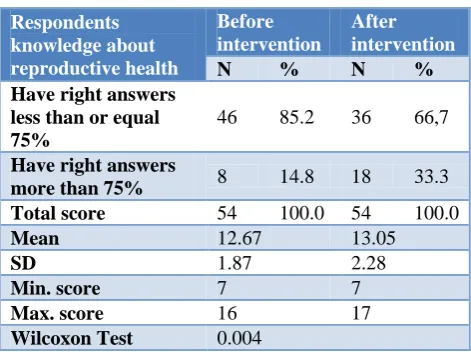
The data groups were paired data groups. Normality test results were known that both variables abnormal distributed (total pre-test p=0.001) and abnormal distribution (total post test p=0.009), so that non parametric difference test can be used. From different test result with Wilcoxon Match paired Test, there was a significant difference between respondent knowledge before and after intervention (p=0.008). Results of the analysis means there was significant improvement in form of intervention to increase knowledge of respondents about reproductive health and pregnancy preparedness. The results of statistical tests indicate that interventions can significantly improve the knowledge of respondents (p<0.005).
Table 2: Differences score knowledge of brides and grooms in Brebes district.
Respondents knowledge about reproductive health
Before intervention
After intervention
N % N %
Have right answers less than or equal 75%
46 85.2 36 66,7
Have right answers
more than 75% 8 14.8 18 33.3
Total score 54 100.0 54 100.0
Mean 12.67 13.05
SD 1.87 2.28
Min. score 7 7
Max. score 16 17
Wilcoxon Test 0.004
Attitudes of respondents about reproductive health and pregnancy preparedness
significantly improve the attitudes of respondents (p<0.005).
Table 3: Differences score attitudes of brides and grooms in Brebes district.
Respondents attitudes about reproductive health
Before intervention
After intervention
N % N %
Have right answers less than or equal 75%
18 33.3 21 38.9
Have right answers
more than 75% 36 66.7 33 61.1 Total score 54 100.0 54 100.0
Mean 7.29 7.72
SD 2.01 2.19
Min. score 0 3
Max. score 10 10
Wilcoxon Test 0.001
Knowledge and attitudes of respondents
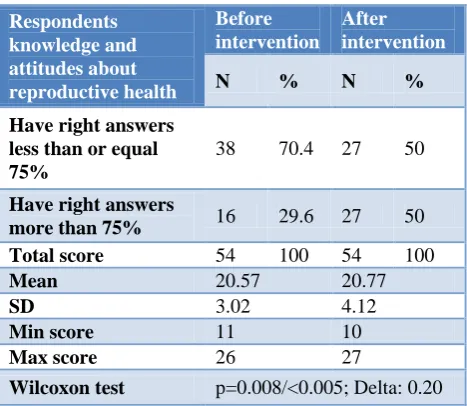
The data groups were paired data groups. Normality test results were known that both variables abnormal distributed (total pre-test p=0.033) and abnormal distribution (total post test p=0.001), so that non parametric difference test can be used. From different test result with Wilcoxon Match paired Test, there was a significant difference between respondent knowledge and attitudes before and after intervention (p=0.008). Results of the analysis means there was significant improvement in form of intervention to increase knowledge and attitudes of respondents about reproductive health and pregnancy preparedness. The results of statistical tests indicate that interventions can significantly improve the knowledge and attitudes of respondents (p<0.005; Delta: 0.20).
Table 4: Differences score knowledge and attitudes of respondents.
Respondents knowledge and attitudes about reproductive health
Before intervention
After intervention
N % N %
Have right answers less than or equal 75%
38 70.4 27 50
Have right answers
more than 75% 16 29.6 27 50
Total score 54 100 54 100
Mean 20.57 20.77
SD 3.02 4.12
Min score 11 10
Max score 26 27
Wilcoxon test p=0.008/<0.005; Delta: 0.20
DISCUSSION
In this study, it has been found that the knowledge and attitudes towards before intervention was lower than after intervention. The results of statistical tests indicate that interventions can significantly improve the knowledge of respondents (p<0.005).
Basically, when entering a marriage period, brides and grooms face health risks, one of them is reproductive health and pregnancy. Brides and grooms’ reproductive health status is supported also by nutrition needs, health, psychological. According to the Danish National Board of Health, many studies including national surveys suggest that expectant parents require more information on psychosocial aspects related to couple and parenthood.6
ICPD recommends essential services that should be highlighted include reproductive health information and counseling; clinical services for brides and grooms; advisory services relating to pregnancy preparedness, sexual behavior and sexually transmitted diseases; as well as the prevention and treatment of maternal mortality rate.7,15
Before counseling and provision of reproductive health media, brides and grooms mostly have good knowledge, but poor knowledge about: male reproductive organs function, ideal pregnancy, stages of pregnancy preparedness, complications in pregnancy, vomiting of pregnancy, and excessive vomiting at young gestational age.
After brief counseling about reproductive health and pregnancy preparedness, brides and grooms in Brebes mostly have a good knowledge, but poor knowledge about: male reproductive organs function, ideal gestational age, stage of pregnancy preparedness, complications in pregnancy, and excessive vomiting at young gestational age.
Prior attitude of brides and grooms in Brebes, mostly good attitude, but poor attitude about: who is responsible reproductive health partner, male contraception, reproductive problems openness to the couple. After intervention, brides and grooms in Brebes mostly have a good attitude.
Results of statistical analysis, indicate an influence of intervention in the form of counseling and the provision of media to increase knowledge and attitudes of respondents named brides and grooms about reproductive health.
In 2011, the World Health Organization (WHO) issued guidelines on preventing early pregnancy and poor reproductive outcomes in adolescents from LMICs focusing on four major pregnancy prevention outcomes: (1) increasing access to and use of contraception; (2) preventing marriage before 18 years; (3) increasing knowledge and understanding of the importance of early pregnancy prevention; and (4) preventing coerced sex.17
Also, a study by United Nations Fund for Population Activities, confirmed that knowledge of reproductive health, physically changes of female, physically changes of male, physically protection could remain unmet, mainly due to lack of knowledge, social stigma, laws and policies preventing provision of contraception and abortion to unmarried (or any) adolescents, and judgmental attitudes among service providers.17
In Brixval et al, premarital education in small classes may increase childbirth self efficacy, counseling and provision of media could improving knowledge and attitude of newlyweds, could minimize causes of death during pregnancy, childbirth and immediately after delivery.18 Besides, The lack of emergency preparedness planning remains problematic for new parents especially newlyweds, but there is a special concern for premarital education needs.19
The inclusion of this information is also important given that sexuality, family planning services, antenatal services and reduce complications associated with pregnancy, e.g. preterm birth, low birth weight, stillbirth and neonatal death.17
These findings are consistent with the findings of other premarital education studies from The International Federation of Gynecology and Obstetrics (FIGO) recommendations on adolescent, preconception, and maternal to prepare their pregnancy, especially in nutrition needs. Adolescent, preconception, and maternal nutrition represent a major public health issue that affects not only the health of adolescents and women, but also that of future generations. Good health and nutrition before conception are key to a mother’s ability to meet the nutrient demands of pregnancy and breastfeeding, and are vital to the healthy development of her embryo, fetus, infant, and child.20
Also, a study by Greenaway confirmed that premarital education in Sub-Saharan Africa, could increase knowledge of women with first marriage and prepare for their pregnancy. Educated mother more secure in pregnancy than uneducated mother about reproductive health and pregnancy preparedness.21
This finding agreed with a study by Ibrahim, which showed an increase in brides and grooms’ knowledge and attitudes about reproductive health improvement. Premarital care involves the promotion of health and well-being of a woman and her partner before pregnancy and is considered a primary preventive approach for
couples planning for conception and an important step towards protecting society and allowing people to enjoy life.22 The process should educate couples and provide them with accurate and unbiased information. Premarital education and counseling seem to be effective in strengthening marriages and have clearly been shown to be beneficial.22,23
The goal of premarital education movement is to give contemporary individuals and couples the knowledge, skills, and virtues needed to build and sustain healthy marriages.24 It is important to educate the population about the potential benefits of counseling, as well as the ethical dilemmas involved, so that members of the general public can make the right decisions for themselves and their families.25
Caroll and Doherty conducted a meta-analytic review of 23 well-designed premarital programs and found that premarital prevention programs are generally effective in producing immediate and short-term gains in interpersonal skills and the overall quality of relationships.26
Addressing young couples’ needs regarding information on reproductive health remains a critical area for expanded health education interventions.27-29 Premarital counseling provides an opportunity to intervene according to the identified risks.30 In the present study, the majority of participants recommended adding counseling about building a healthy family as well as reproduction and fertility issues. A high percentage of respondents also recommended adding more genetic counseling, which agrees with results of Al Sulaiman et al.31
One successful approach is ‘solution focused’ premarital counseling. Murray and Murray discussed how this approach focuses on a couple’s resources and helps them to develop a shared vision for the marriage.32
Socialization and follow-up of Local Government Instruction Regent Regional Brebes, if possible will be forwarded to Governor Instruction and Instruction of the Ministry of Religion and The National Population and Family Planning (BKKBN) of Central Java an obligation of reproductive health education for brides and grooms. Instructions will be forwarded to regional leaders in order to allocate a portion of budget funds, for a provision of premarital educator. Publication in the Journal of National Scientific and International accredited, Textbook and Workshop on reproductive health. The effectiveness of reproductive health education depended on teachers, strategy, and method of teaching used by teachers.
CONCLUSION
(p=0.008). The result of statistical test showed that giving treatment or giving intervention can significantly improve knowledge and attitude of the respondent (p<0.005; Delta: 0.20). Shared responsibility for reproductive health matters by males and females would also be made a greater possibility.
Recommendations
Brief counseling about reproductive health and pregnancy preparedness by provision of media on brides and grooms in Brebes as knowledge intervention needs to be done continuously either through brides and grooms itself or through various parties related to brides and grooms such as Naib or called Penghulu, Public healthcare providers who give injections TT (Tetanus Toxoid) or midwives and Parents of brides and grooms. It is necessary to conduct an initiation for regulation-making in premarital counseling involving Naib or Penghulu and Public healthcare providers. This research activity will involve cross-sector, especially the Ministry of Religion and The National Population and Family Planning (BKKBN) of Central Java.
ACKNOWLEDGEMENTS
The authors would like to thank all of brides and grooms participants for completing study especially Institution of
Research and Community Services Diponegoro
University.
Funding: No funding sources Conflict of interest: None declared
Ethical approval: The study was approved by the Institutional Ethics Committee
REFERENCES
1. World Health Organization. World health statistics. 2014;38-40.
2. Raj A, Saggurti N, Balaiah D, Silverman JG. Prevalence of child marriage and its effect on fertility and fertility-control outcomes of young women in India: a cross-sectional, observational study. Lancet J. 2009;373:1883-9.
3. Kementerian Kesehatan RI Direktorat Jenderal Bina Kesehatan Masyarakat Direktorat Bina Kesehatan Ibu. Pedoman Pemantauan Wilayah Setempat Kesehatan Ibu dan Anak (PWS-KIA). Jakarta: Kementerian Kesehatan RI; 2010.
4. Ferguson S, Davis D, Browne J. Does antenatal education affect labour and birth? A structured review of the literature. Women Birth. 2012;26:5-8. 5. Slater C, Robinson AJ, FRCP. Sexual health in
adolescents. Clin Dermatol (Elsevier). 2014;32:189-95.
6. Brot C, Poulsen A. Recommendations in relation to antenatal care 2009 (In Danish: Anbefalinger for svangreomsorgen 2009). Copenhagen: The National Board of Health; 2009.
7. Michelle J. Hindin and Adesegun O. Fatusi. Adolescent Sexual and Reproductive Health in Developing Countries: An Overview of Trends and Interventions. J Int Perspect Sexual Reprod Health. 2015;35(2).
8. Abd Al Azeem ST, Elsayed ET, El Sherbiny NA, Ahmed LA. Promotion of knowledge and attitude towards premarital care: an interventional study among medical student in Fayoum University. J Public Health Epidemiol. 2011;3(3):121-8.
9. Kigin ML. At-risk individuals’ awareness, motivation, roadblocks to participation in premarital interventions, and behaviors following completion of the relationship evaluation (relate). Master of Science thesis submitted to the faculty of Brigham Young University. Marriage and Family Therapy Program: Brigham Young University; 2005.
10. Alswaidi FM, O’Brien SJ. Premarital screening programmes for haemoglobinopathies. HIV and hepatitis viruses: review and factors affecting their success. PubMed J Med Screening. 2009;16:22-8. 11. Editorial. Premarital HIV screening in Saudi Arabia,
is antenatal next? J Infection Public Health. 2009;2:4-6.
12. Memish ZA, Saeedi MY. Six-year outcome of the national premarital screening and genetic counseling program for sickle cell disease and thalassemia in Saudi Arabia. Annals Saudi Med J. 2011;31(3):229-35.
13. Al Sulaiman A, Suliman A, Al Mishari M, Al Sawadi A, Owaidah TM. Knowledge and attitude toward the hemoglobinopathies premarital screening program in Saudi Arabia: population-based survey. Hemoglobin J. 2008;32(6):531-8.
14. Ibrahim NK, Al Bar H, Fakeeh A, Al Ahmadi J, Qadi M, Al-Bar A, et al. An educational program about premarital screening for unmarried female students in King Abdul- Aziz University, Jeddah. J Infection Public Health. 2011;4(1):30-40.
15. Madeni, Shigeko Horiuchi and Mariko Iida. Evaluation of a reproductive health awareness program for adolescence in urban Tanzania-A quasi-experimental pre-test post-test research. Biomed Central J Reprod Health. 2011;8:21.
16. Axelsen SF, Brixval CS, Due P, Koushede V. Integrating couple relationship education in antenatal education – A study of perceived relevance among expectant Danish parents. J Sci Direct Sexual Reprod Healthcare. 2014;5:174-5. 17. Commission on Information and Accountability for
Women’s and Children’s Health. Keeping promises, measuring results. Geneva: World Health Organization. 2011.
19. Giarratano G, Sterling YM, Orlando S, Mathews P, Deeves G, Bernard ML, Danna D. Targeting prenatal emergency preparedness through childbirth education. JOGNN. 2010;39:480-8.
20. Hanson MA, Bardsley A, De-Regil LM, Moore SE, Oken E, Poston L, et al. The International Federation of Gynecology and Obstetrics (FIGO) recommendations on adolescent, preconception, and maternal nutrition. Int J Gynecol Obstet. 2015;131S4:S213–S253.
21. Greenaway, Smith E. Premarital childbearing in Sub Saharan Africa: Can investing in women’s education offset disadvantages for children? SSM Population Health; 2016: 164-174.
22. Ibrahim NK, Bashawria J, Al Bara H, Al Ahmadia J, Al Bara A, Qadia M, et al. Premarital Screening and Genetic Counseling program: Knowledge, attitude, and satisfaction of attendees of governmental outpatient clinics in Jeddah. J Infection Public Health. 2013;6:41-54.
23. Risch GA, Riley LA, Lawler MG. Problematic issues in the early years of marriage: Content for premarital education. J Psychol Theol. 2003;31:253-69.
24. Hawkins AJ, Carroll JS, Doherty WJ, Willoughby B. A comprehensive framework for marriage education. Family Relations J. 2004;53(5):547-58. 25. Gilani AI, Jadoon AS, Qaiser R, Nasim S, Meraj R,
Nasir N, et al. Attitude towards genetic diagnosis in Pakistan: a survey of medical and legal communities and parents of thalassemic children. Community Genetics J. 2007;10(3):140-6.
26. Carroll JS, Doherty WJ. Evaluation the effectiveness of premarital programs: a
meta-analytic review of outcome research.
Interdisciplinary J Applied Family Sci. 2003;52(2):105-29.
27. Abd Al Azeem ST, Elsayed ET, El Sherbiny NA, Ahmed LA. Promotion of knowledge and attitude towards premarital care: an interventional study among medical student in Fayoum University. J Public Health Epidemiol. 2011;3(3):121-8.
28. Beamish J, Abderrazik LT. Adolescent and youth reproductive health in Morocco: status, issues, policies, and program in the Near East: Programs, Policies. Washington, DC: Focus on Young Adults; 2003.
29. Beamish J. Adolescent and youth reproductive health in Egypt: status, issues, policies, and Programs. Washington, DC: Focus on Young Adults; 2003.
30. Al-Arrayed SS, Hafadh N, Al-Serafi S. Premarital counseling: an experience from Bahrain. Eastern Mediterranean Health J. 1997;3(3):415-9.
31. Al Sulaiman A, Saeedi M, Al Suliman A, Owaidah T. Postmarital follow-up survey on high risk patients subjected to premarital screening program in Saudi Arabia. Prenatal Diagnosis J. 2010;30(5):478-81.
32. Murray CE, Murray Jr TL. Solution-focused premarital counseling: helping couples build a vision for their marriage. J Marital Family Therap. 2004;30:349-58.
Cite this article as: Nugraheni SA, Martini, Kartasurya MI, Prihatini IJ, Sulistyowati E.Knowledge and attitudes about reproductive health and pregnancy preparedness: preliminary study of brides and grooms in Brebes district, Central Java, Indonesia. Int J