Original Research Article
A comparative study on HIV/AIDS awareness among medical and
non-medical students of Gujarat
Manish M. Kathad
1, Jay R. Patwa
1*, Riddhi Patel
2, Siddharth K. Patel
2,
Yatri Patel
2, Jaydeep Pathak
2, Chintan S. Prajapati
2INTRODUCTION
The acquired immune deficiency syndrome (AIDS) caused by human immunodeficiency virus (HIV) is a modern pandemic affecting industrialized and developing countries.1,2 AIDS was one among the infectious diseases, which was responsible for 1.1 million deaths on the planet in the year of 2016.3
If we take a gander at worldwide HIV insights, 36.7 million individuals were living with HIV in 2016 globally and 1.8 million individuals turned out to be recently
infected with HIV in 2016. Asian AIDS epidemic has risen enormously and about 7.2 million people are presently living with HIV/AIDS in this region.4 Although prevalence of HIV is declining in India, due to huge population of India, India holds the second largest absolute number of HIV cases in the world.
As per the recently released, India HIV estimation 2015 report, National adult (15–49 years) HIV prevalence in India is estimated at 0.26% (0.22%–0.32%) in 2015. In 2015, adult HIV prevalence is estimated at 0.30% among males and at 0.22% among females. Among the all ABSTRACT
Background: The acquired immune deficiency syndrome (AIDS) caused by human immunodeficiency virus (HIV) is
a modern pandemic affecting industrialized and developing countries. Around half of the new cases of HIV occur in individuals beneath 25 years of age. Present study was carried out to assess the knowledge and sensitization levels of 1st year college- students about basics of HIV/AIDS, prevention, support, treatment, their perceptions of programmatic services and stigma/discrimination pertaining to HIV/ AIDS.
Methods: One hundred medical students of SBKS MIRC, Sumandeep Vidhyapeeth and one hundred non-medical
students of Sanskar education trust were interviewed with the help of pre-designed questionnaire to know and compare the awareness of HIV/AIDS among students.
Results: Correct knowledge of treatment, curability and vaccine of HIV was only with 85%, 40% and 55% among
medical students and 66%, 24% and 48% among non-medical students respectively. Correct knowledge about route of transmission of HIV was higher in medical students compare to non-medical students and this Knowledge difference was statistically significant (p<0.05).
Conclusions: The outcomes underline that there is a need of education programs in the school and adolescent period
in the nation so that risk groups will be appropriately educated about this deadly disease.
Keywords: HIV/AIDS, Modes of transmission, Awareness, Prevention
1
Department of Community Medicine, Sumandeep Vidyapeeth, Vadodara, Gujarat, India
2
Final MBBS, Sumandeep Vidyapeeth, Vadodara, Gujarat, India
Received: 26 August 2018
Revised: 13 September 2018
Accepted: 14 September 2018
*Correspondence:
Dr. Jay R. Patwa,
E-mail: [email protected]
Copyright: © the author(s), publisher and licensee Medip Academy. This is an open-access article distributed under
the terms of the Creative Commons Attribution Non-Commercial License, which permits unrestricted non-commercial use, distribution, and reproduction in any medium, provided the original work is properly cited.
States/UTs, in 2015, Gujarat has shown the 7th highest estimated adult HIV prevalence of 0.42%.5
Route of transmission of HIV infection are: unprotected
heterosexual intercourse, unprotected homosexual
intercourse, infected blood transfusion, sharing of
infected needles, syringes, instruments, vertical
transmission from mother to child.6 According to India’s National AIDS Control Organization (NACO), the bulk of HIV infections in India occur during unprotected heterosexual intercourse.
Around half of the new cases of HIV occur in individuals beneath 25 years of age. HIV/AIDS pandemic is most exceedingly terrible among the youths as they tend to explore different avenues with practice of risky behavior often with little consciousness of peril. This group is more vulnerable due to fragmented social, emotional and
psychological development bringing about risky
behavior.7 Huge numbers of them are not set up to settle on safe choices at this age, and without satisfactory parental observing they might be particularly susceptible to unsafe behaviour. To control this epidemic an overall awareness need to be created in general population and especially high risk groups.
Initially, the approach was to target the core/HRB populations but gradually with shifting dynamics of epidemic into general population through the bride population, approach also included focus on next
generation of the adults i.e. adolescents, the
school/college-going population since they constitute a very important segment of the population that need to be sensitized towards issues of HIV/AIDS considering them future citizens and productive population of the country. Behaviour change communication starting at an early age can be instrumental in bringing about long-term change in community perceptions towards HIV/AIDS be it
stigma/discrimination or service utilization by
government.
Naturally it is believed that Medical students have higher knowledge towards HIV AIDS compared to their non-medical counterparts. A lot of research has already been done pan India to assess knowledge level of medical and para-medical students on HIV but only few studies have compare the knowledge level of medical students and their counterpart non-medical students. Present study was carried out in one such strata of students and compare it with other strata, in order to assess the knowledge and
sensitization levels of 1st year college- students about basics of HIV/AIDS, prevention, support, treatment, their
perceptions of programmatic services and
stigma/discrimination pertaining to HIV/ AIDS.
METHODS
Present study is cross sectional study among 1st year M.B.B.S. students of S.B.K.S. M.I and R.C., Sumandeep Vidyapeeth, Waghodia and 1st year B.A. students of SANSKAR Education Trust, Waghodia. Minimum sample size, keeping the expected parameter (proportion of children with satisfactory knowledge) at 0.5 and with an acceptable deviation of 0.1 on each side at an alpha error of 0.05 (two-tailed) (i.e. acceptable 95% confidence limit 0.4 to 0.6), the minimum sample size worked out to 200. So, we have randomly selected 100 1st year medical students and 100 1st year BA students randomly using simple random table. After obtaining the permission from ethical committee we started data collection. Study was done between March 2017 to April 2017. Data was collected by pre tested, pre formed questionnaire after taking informed verbal consent from individual student. Collected data compiled in Microsoft office Excel 2007 format. Data was processed using Epi info statistical software. Descriptive and analytical statistical methods are used for the preparation of results. Chi square test was used to compare the level of significance between two groups. P value of less than 0.05 was considered as statistically significant.
Exclusion criteria
Exclusion criteria were those who are not willing to participate; student who are not present on all our visit (maximum 3 visits).
RESULTS
In the current study total 200 students participated, out of which 100 were medical students and rest 100 were non-medical students. Table 1 shows that all the students heard about HIV/AIDS but correct knowledge of its diagnosis, treatment, curability and vaccine was only with 96%, 85%, 40% and 55% among medical students and 88%, 66%, 24% and 48% among non-medical students respectively. The difference between knowledge of medical and non-medical students was statistically not significant (p>0.05) (Table 1).
Table 1: Percentage of students having correct knowledge of HIV/AIDS.
S.
No. Question
Percentage of students having correct knowledge about HIV/AIDS
Medical students (n=100) Non-medical students (n=100)
1. Have you ever heard about HIV/AIDS 100 100
2. Is the diagnosis of HIV/AIDS available 96 88
3. Is the treatment available for HIV/AIDS 85 66
4. Is HIV/AIDS is curable disease 40 24
5. Is there any vaccine available for HIV 55 48
Table 2: Knowledge about route of transmission of HIV/AIDS among students.
S.
No. Route of transmission
Percentage of students having correct knowledge about route of transmission of HIV/AIDS
Medical students (n=100) Non-medical students (n=100)
1. Sexual contact 96 81
2. Blood transfusion 80 63
3. Sharing of needle and syringe 91 44
4. Mother to child 80 39
X2 value=9.091, p<0.05 (0.02).
Table: 3 Common myths about route of transmission of HIV/AIDS among students.
S. No.
Myths about route of transmission
Percentage of students having myths about route of transmission of HIV/AIDS
Medical students (n=100) Non-medical students (n=100)
1. Coughing and spitting 8 10
2. Kissing 19 24
3. Sharing utensils 1 8
4. Mosquito bite 2 15
5. Hand shake & Hug 1 5
X2 value=9.588, p<0.05 (0.04).
Table 4: knowledge of prevention of HIV/AIDS among students.
S.
No. Prevention methods
Percentage of students having correct knowledge about prevention of HIV/AIDS
Medical students (n=100) Non-medical students (n=100)
1. Use of barrier contraceptives like
condom 91 65
2. Avoid using contaminated needle /
syringe 69 39
3. Screening of donor’s blood before
transfusion 71 29
4. Avoid unprotected sex with
multiple partners 84 62
X2 value=5.702, p>0.05 (0.12).
Correct knowledge about different routes of transmission of HIV/AIDS like Sexual contact, blood transfusion, sharing of needle and mother to child among medical students was 96%, 80%, 91% and 80% and among non-medical students was 81%, 63%, 44% and 39% respectively (Table 2). This Knowledge difference between medical students and non-medical students was statistically significant (p<0.05).
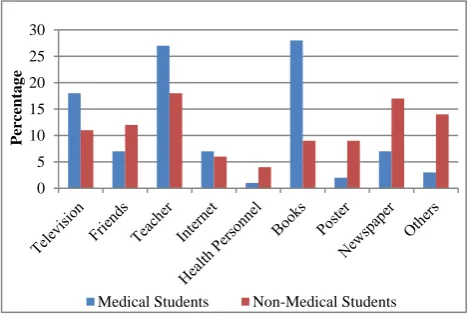
Books (28%), teacher (27%), television (18%) were the most common source of information among medical students while teacher (18%), newspaper (17%), other (14%) and friends (12%) were the most common source of information among non-medical students (Figure 1).
Common myths about different routes of transmission of HIV/AIDS like coughing and spitting, kissing, sharing utensils, mosquito bite, hand shake and hug among medical students was 8%, 19%, 1%, 2% and 1% and among non-medical students was 10%, 24%, 8%, 15%
and 5% respectively (Table 3). This Knowledge difference between medical students and non-medical students was statistically significant (p<0.05).
Figure 1: Source of HIV/AIDS information among students.
0 5 10 15 20 25 30
Perc
entag
e
Correct knowledge about different methods of prevention of HIV/AIDS like use of barrier contraceptives, avoid using contaminated needle / syringe, screening of donor’s blood before transfusion and avoid unprotected sex with multiple partners among medical students was 91%, 69%, 71%, 84% and among non-medical students was 65%, 39%, 29% and 62% respectively (Table 4). This Knowledge difference between medical students and non-medical students was not statistically significant (p>0.05).
DISCUSSION
HIV infection is most imperative social issues and quickly spreading infection of the twenty first century yet at the same time, consciousness of malady among individuals is still low. The current study assessed the awareness level of HIV, its mode of transmission, prevention of HIV and common myths among 1st year MBBS (medical) Students and 1st year BA (Non-medical) students. Awareness regarding HIV is essential to students as there are passing through adolescent age group where there are higher chances of contracting HIV/AIDS furthermore secure themselves concerning balanced choices about their sexual life what's more, can secure against HIV disease.
In the present study, almost all the students heard about HIV/AIDS (100%), 96% medical students aware about availability of diagnostic modalities for HIV/AIDS, while only 88% non-medical students aware about the same. The finding was comparable to finding of study conducted by Shridevi et al and Kiran et al that all the students aware of HIV and its causative agent.8,9
In the present study 85%, 40% and 55% of the medical students knew that treatment for HIV is available, HIV is non-curable disease and No vaccine available for HIV while only 66%, 24% and 48% of the non-medical students knew the same respectively. The finding was contrary to finding of study conducted by Chauhan et al.10 In our study we found that there was lower knowledge about HIV in non-medical students compares to medical students however this difference was not statistically significant.
In the present study, 96%, 80%, 91% and 80% of the medical students were aware that route of transmission of HIV are Sexual contact, blood transfusion, sharing of needle and mother to child while only 81%, 63%, 44% and 39% of non-medical students were aware about the same respectively. Our results were similar to the Kiran et al study in whom, 94.12% were aware regarding contaminated needles and syringes, 95.09% on blood transfusion, 100% were aware regarding unprotected sex,
84.31% were aware about vertical transmission.9
However in our study we found that there was substantially lower knowledge about HIV transmission in
non-medical students compares to medical students and this difference was statistically significant (p<0.05).
Common myths about different routes of transmission of HIV/AIDS like Coughing and spitting, kissing, sharing utensils, mosquito bite, hand shake and hug among medical students was 8%, 19%, 1%, 2% and 1% and among non-medical students was 10%, 24%, 8%, 15% and 5% respectively. The finding was comparable to finding of study conducted by Shridevi et al.8
However in the present study it was found that, there were substantially higher misconceptions about HIV in non-medical students compares to medical students and this difference was statistically significant (p<0.05).
Books (28%), teacher (27%), television (18%) were the most common source of information among medical students while teacher (18%), newspaper (17%), other (14%) and friends (12%) were the most common source of information among non-medical students. Similar findings were noted by Kiran et al.9
Correct knowledge about different methods of prevention of HIV/AIDS like use of barrier contraceptives, Avoid using contaminated needle / syringe, screening of donor’s blood before transfusion and avoid unprotected sex with multiple partners among medical students was 91%, 69%, 71% and 84% and among non-medical students was 65%, 39%, 29% and 62% respectively. These findings were comparable with study done by Satheesh et al and Mohan et al.11,12
CONCLUSION
Our study found that HIV related awareness among medical students is comparatively higher than the non-medical students. The outcomes underline that there is a need of education programs in the school and adolescent period in the nation so that risk groups will be appropriately educated about this deadly disease. The study likewise proposes need of sex-education or juvenile instructions in schools to encourage the teenagers with rectify logical information on sexuality and pubescence related concerns. Inclusion of specific chapters on HIV/AIDS will also help in preventing the spread of this pandemic to a large extent.
ACKNOWLEDGEMENTS
The authors thank to students who participated in this study. The author also thank to Sumandeep Vidyapeeth
for conducting EviGenCHIP–Evidence Generating
Community Health Project.
Funding: No funding sources Conflict of interest: None declared
REFERENCES
1. Weiss RA. HIV and AIDS in relation to other
pandemics. EMBO Rep. 2003;4(1):10–4.
2. Gayle HD, Hill GL. Global Impact of Human
Immunodeficiency Virus and AIDS. Clin Microbiol Rev. 2001;14(2):327–35.
3. Sastry J, Pisal H, Sutar S, Kapadia-Kundu N, Joshi
A, Suryavanshi N, et al. Optimizing the HIV/AIDS informed consent process in India. BMC Med. 2004;2(1):28.
4. Fact sheet - Latest statistics on the status of the
AIDS epidemic UNAIDS. Available from:
http://www.unaids.org/en/resources/fact-sheet
5. HIV DATA As per the recently released, India HIV
Estimation 2015 report, National adult (15–49 years) HIV prevalence in India. Available from: http://www.naco.gov.in/sites/default/files/HIV%20 DATA.pdf. Accessed on 4 August 2108.
6. WHO | HIV/AIDS. WHO. Available from:
http://www.who.int/features/qa/71/en/ Accessed on 4 August 2108.
7. Marfatia Y, Naswa S. Adolescent HIV/AIDS: Issues
and challenges. Indian J Sex Transm Dis AIDS. 2010;31(1):1.
8. Shridevi K, Srigouri T. HIV awareness among first year MBBS students in a private medical college, Telangana, India. Int J Community Med Public Health. 2017;4(6):1906.
9. Nikam K, Arun J, Bhagyashri J, Rajashekhar K, Shashikant N, Anjana B. A cross-sectional study of hiv/aids awareness among paramedical students of BIMS, Belgaum. J Adv Res Med Sci Former J Adv Res Biol Sci. 2013;5(4):336–40.
10. Chauhan G, Chhaya J, Karve S, Kankrecha R,
Khurana D. Knowledge and awareness of AIDS among first year students of MBBS, BDS and BPT of Sumandeep Vidyapeeth University, Piparia- Vadodara. Int J Community Med Public Health. 2018;5(8):3435.
11. Satheesh BC, Thilak SA, Sarada AK,
Madusoodanan KV, Venugopalan PP. A study on awareness of HIV among first year MBBS students in a private Medical College, Kerala, India. Int J Community Med Public Health 2016;3:2305-8.
12. Shinde M, Trivedi A, Shinde A, Mishra SK. A study
of awareness regarding HIV/AIDS among
secondary school students. Int J Community Med Public Health. 2017;3(6):1461–5.
Cite this article as: Kathad MM, Patwa JR, Patel R,