http://www.ijcmph.com pISSN 2394-6032 | eISSN 2394-6040
Original Research Article
Prevalence of hypertension and co-morbidities among elderly women in
rural area: a cross sectional study
Soumyashree M. N., R. G. Viveki*
INTRODUCTION
Aging is a universal process. In the words of Seneca "old age is an incurable disease" but more recently Sir James Sterling Ross commented “you do not heal old age, you protect it, you promote it and you extend it”. These are in fact the principles of preventive medicine.1 Hypertension, a key NCD risk factor, appears to be increasing in prevalence, possibly associated with development, urbanization and lifestyle changes.2 NCDs have been the leading causes of death among women globally for the past three decades and are now responsible for two in
every three deaths among women each year.3 The World Health Organization (WHO) has estimated that globally hypertension is directly responsible for about 62% of cerebrovascular disease and 49% of ischemic heart disease.4 In India, NCDs were responsible for 53% of deaths and 44% of disability adjusted life years lostand 57% of all stroke deaths and 24% of coronary heart disease deaths.5, 6 India endorsed the Sustainable Development Goal for health to set a target to decrease premature deaths from non-communicable diseases (NCDs) by one-third by 2030.7 Rural areas in India are in transitional phase, this increases the risk of conditions like hypertension in rural areas. Even today there is
ABSTRACT
Background: NCDs have been the leading causes of death among women globally for the past three decades and are now responsible for two in every three deaths among women each year. India endorsed the Sustainable Development Goal for health to set a target to decrease premature deaths from non-communicable diseases (NCDs) by one-third by 2030. Aims of the study were to estimate the prevalence of hypertension among the elderly women from rural area and to know the associated co-morbidities among the elderly women from rural area.
Methods: A community based cross sectional study was conducted among elderly women >60 yrs. Data was collected by using pre tested structured questionnaire, which contained basic information like name, age, education & socioeconomic status, occupation, marital status, known case of hypertension, family history, any other co- morbidities.
Results: 65.2% of the participants had normal blood pressure, 34.7% were hypertensive. 38% of study subjects living in joint family were hypertensive, majority (53.8% and 85.6%) of them who were obese and had a history of tobacco intake were hypertensive. The association between hypertension and these variables was found to be statistically significant.
Conclusions: 15.4% of the study participants were newly detected hypertensives. This indicates a need for awareness to be created among the elderly women regarding hypertension risk factors, to sensitize them for regular medical check-ups to ensure prevention and early detection of hypertension.
Keywords: Hypertension, Co-morbidities, Rural area, Elderly women
Department ofCommunity Medicine, Belagavi Institute of Medical Sciences, Belagavi, Karnataka, India
Received: 25 June 2018
Accepted: 28 July 2018
*Correspondence:
Dr. R. G. Viveki,
E-mail: [email protected]
Copyright: © the author(s), publisher and licensee Medip Academy. This is an open-access article distributed under the terms of the Creative Commons Attribution Non-Commercial License, which permits unrestricted non-commercial use, distribution, and reproduction in any medium, provided the original work is properly cited.
scarcity of the studies in rural areas of India.8 Hypertension poses a considerable public health burden on cardiovascular health status and healthcare systems in India.9 Co-morbidities in hypertensive patients have been related with obesity, diabetes, atherosclerosis, ischemic heart disease, myocardial infarction, heart failure and stroke.10 There is hardly any study conducted to know the prevalence of hypertension among elderly women in rural area. Present study has been undertaken to estimate the prevalence of hypertension among the elderly women and to know the associated co morbidities among the elderly women.
METHODS
A community based cross sectional study was conducted among elderly women >60 yrs who were residing for at least six months in rural field practice area of the Department of Community Medicine of Belagavi Institute of Medical Sciences during August 2016 to February 2017. The study was conducted after obtaining the Ethical clearance from Institutional Ethical Committee (IEC). A formal permission to conduct the study was obtained from the authorities of the rural health training centre (RHTC) and consent was taken from study participants. Out of 6 sub-centres under RHTC, one village was randomly selected from each subcentre. If the sample size was not met, other village of same subcentre was considered by multistage sampling method. Data was collected from 70 study subjects from each subcentre. Household selection was done by systematic random method (Figure 1). A total of 420 study participants were included after calculating the sample size as 415, by using the hypothesis testing method at 95% confidence interval, with an allowable error of 5% and considering a 10% non-response rate. The estimated prevalence of Hypertension among women as per study conducted by Chinnakali et al was found to be 40.8%.11 Elderly women, who were non-cooperative and totally deaf or dumb, with renal diseases and tumors of the adrenal glands (secondary hypertension) were excluded from the study. Those already having hypertension based on history or clinical reports were included.
By using pre tested structured questionnaire, basic information like name, age, education, socioeconomic status, occupation, marital status, past history of hypertension, family history, any other co- morbidities like DM, Visual problems, Insomnia etc., were collected. Blood pressure measurement was done by using sphygmomanometer and stethoscope in sitting position in right brachial artery after 5 minutes rest. A total of 2 measurements were taken during the interview at an interval of 5 minutes each, lowest of two readings were considered for analysis. Korotkoff sound appearance of 1 and disappearance of 5 was considered as systolic and diastolic blood pressure respectively. Measurement of blood pressure of all participants was done by single investigator. Recorded blood pressure was categorized
classifications for the hypertension.14 Pulse pressure was calculated as difference between systolic and diastolic blood pressure. Mean arterial blood pressure was calculated by using following formula: DBP+1/3 pulse pressure. The collected data was compiled, tabulated and analyzed by MS Excel and SPSS version 22. It was analyzed by using descriptive statistics, viz. percentages and the inferential statistics using chi square to test the difference between proportions. The difference in proportion is considered statistically significant whenever p≤0.05.
RESULTS
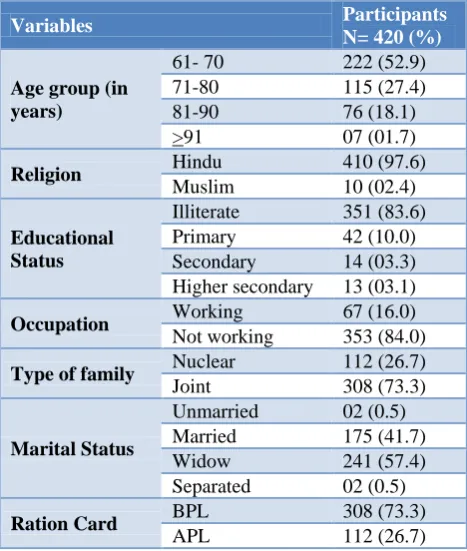
The present study included 420 elderly women. Table 1 shows distribution of the study participants according to socio-demographic variables. More than half of the study subjects were in the age group of 61 – 70 yrs, majority (97.6%) was Hindu by religion and 83.6% were illiterate. Nearly three- fourth of them stayed in a joint family and 57.1% were widow. In present study 65.2% blood pressure recorded were found to be normal, 34.7% of the
study subjects were hypertensive. Among the
hypertensive study subjects 15.7% were newly detected hypertensives and 19.2% were known hypertensives (Figure 2).
Table 1: Distribution of the study participants according to socio-demographic variables.
Variables Participants
N= 420 (%)
Age group (in years)
61- 70 222 (52.9)
71-80 115 (27.4)
81-90 76 (18.1)
>91 07 (01.7)
Religion Hindu 410 (97.6)
Muslim 10 (02.4)
Educational Status
Illiterate 351 (83.6)
Primary 42 (10.0)
Secondary 14 (03.3)
Higher secondary 13 (03.1)
Occupation Working 67 (16.0)
Not working 353 (84.0)
Type of family Nuclear 112 (26.7)
Joint 308 (73.3)
Marital Status
Unmarried 02 (0.5)
Married 175 (41.7)
Widow 241 (57.4)
Separated 02 (0.5)
Ration Card BPL 308 (73.3)
APL 112 (26.7)
in a joint family were hypertensive, majority (53.8% and 85.6%) of them who were obese and had a history of tobacco intake were hypertensive, this association between them was found to be statistically significant. High prevalence of hypertension was found in the age
group of 61 to 80 yrs (36.5%), among those who were not working (36.5%) and who had high amount of salt intake, however this association was not found to be statistically significant (Table 2).
Figure 1: Multistage sampling. Note: SC=Subcentre, V=Village.
Table 2: Association between hypertension and socio demographic factors.
Socio demographic factors
Hypertension
P value
Present n=146 (%)
Absent n=274 (%)
Age (years)
61- 70 81 (36.5) 141 (63.5) >0.5
71-80 42 (36.5) 73 (63.5)
81-90 22 (28.9) 54 (71.1)
≥91 01 (14.3) 6 (85.7)
Occupation
Working 18 (26.9) 49 (73.1) >0.05
Not working 128 (36.3) 225 (63.7)
Type of family
Nuclear 29 (25.9) 83 (74.1) < 0.05
Joint 117 (38.0) 191 (62.0)
Marital status
Unmarried 02 (100) 00 <0.05
Married 51 (29.1) 124 (70.9)
Widow 93 (38.6) 148 (61.4)
Separated 00 02 (100)
Salt intake
<5 g/day 12 (26.1) 34 (73.9) >0.05
>5 g/ day 134 (35.8) 240 (65.2)
Physical activity
Present 26 (23.8) 83 (76.2) <0.05
Absent 120 (38.5) 191 (61.5)
BMI
Underweight 20 (35.7) 36 (64.3) <0.05
Normal 63 (30.7) 142 (69.3)
Overweight 42 (35.0) 78 (65.0)
Obese 21 (53.8) 18 (46.2)
Tobacco intake
Present 125 (85.6) 94 (34.4) <0.05
Absent 21 (14.4) 180 (65.6)
Figure 2: Prevalence of hypertension among elderly women in rural area.
Figure 3: Classification of blood pressure among the study subjects.
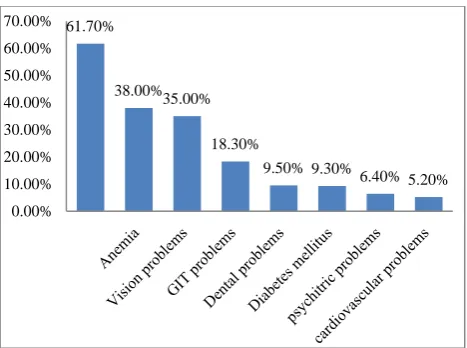
In Figure 4, most common co – morbidities found among elderly women was musculoskeletal problems (61.7%), followed by anemia (38%), Vision problems (35%) and gastrointestinal problems (18.3%).
19.30% 15.40% 65.20%
Diagnosed hypertensives Newly detected hypertensives Normotensive
13.50%
51.60% 23.30%
11.40% Normal
Prehypertension Stage I hypertension Stage II
Figure 4: Distribution of co- morbidities among the study subjects.
DISCUSSION
In the present study we found the prevalence of hypertension among the elderly women was 34.7%. A similar study done by Chinnakali et al reported 40.8% of prevalence.11 Other studies conducted by Rao et al and Singh et al found 38.9% and 58.2% of hypertensives among the women.12,13 Newly detected hypertensives were found to be 15.4%. However in other study by Rao et alit was found to be 20.3%.12 We found 51.6% of pre-hyprehypertensives in our study similar findings of high prevalence were found in studies done by Vimala et al and Prabhakaran et al.14,15 This may suggest that if subjects in the pre-hypertensive groups were identified and the lifestyles modified, the onset of hypertension could be delayed or prevented. 23.3% and 11.4% of the study subjects showed blood pressure reading of Stage I hypertension and stage II hypertension respectively. Similar findings were found in other studies by Rao et al and Vimala et al.12,14
Significant association was found between hypertension and BMI, lack of physical activity and tobacco intake. Similar findings were found in studies done by Sheth et al and Rao et al.12,17 As age increased prevalence of hypertension was found to be high, however this association was not statistically significant. In other studies done at eastern India it was found to be significantly associated.16 Most common co morbidities
among the study subject were found to be
musculoskeletal problems. However other studies reported hypertension and vision problems as most common co morbidities.13,18
CONCLUSION
34.7% of the study subjects were hypertensive. Among the hypertensive 15.7% were newly detected during the study period and 19.2% were known hypertensives. This indicates a need for awareness to be created among the
be sensitized for regular medical check-ups to ensure prevention and early detection of the chronic diseases. Health education and promotion of healthy lifestyle for the elderly women should be implemented. Health problems of elderly should be tackled with psycho-social intervention. Proper implementation of the national programme on elderly is needed.
ACKNOWLEDGEMENTS
Authors extend sincere thanks to all the participants and staff of the Department of Community Medicine, Belagavi Institute of Medical Sciences, Belagavi for co- operating during the study period. Authors are grateful to the beloved Director, Dr. S T Kalsad, Belagavi Institute of Medical Sciences, Belagavi for permitting to conduct the present study.
Funding: No funding sources Conflict of interest: None declared
Ethical approval: The study was approved by the Institutional Ethics Committee
REFERENCES
1. Sheth AM, Jadav PA. Prevalence and factors
affecting hypertension among old age population in rural area. Int J Comm Med Pub Health. 2016;3:1866-71.
2. Lloyd-Sherlock P, Beard J, Minicuci N, Ebrahim S, Chatterji S. Hypertension among older adults in low
and middle-income countries: prevalence,
awareness and control. Int J Epidemiol.
2014;43:116-28.
3. Bonita R, Beaglehole R. Women and NCDs:
Overcoming the neglect. Glob Health Action. 2014;7:237-42.
4. Midha T, Lalchandani A, Nath B, Kumari R,
Pandey U. Prevalence of isolated diastolic hypertension and associated risk factors among adults in Kanpur, India. Indian heart J. 2012;64:374-9.
5. Srinath Reddy K, Shah B, Varghese C, Ramadoss A. Responding to the threat of chronic diseases in India. Lancet. 2005;366:1744–9.
6. Ghosh S, Mukhopadhyay S, Barik A. Sex
differences in the risk profile of hypertension: a cross-sectional study. BMJ Open. 2016;6:1008-15.
7. Open Working Group Proposal for Sustainable
Development Goals. http://sustainabledevelopment. un.org/focussdgs.html. Accessed 18 February 2018.
8. Kokiwar PR, Gupta SS. Prevalence of hypertension
in a rural community of central India. Int J Biol Med Res. 2011;2(4):950-3.
9. Kumar C, Sagar V, Kumar M, Kiran KA.
Awareness about hypertension and its modifiable risk factors among adult population in a rural area of Ranchi district of Jharkhand, India. Int J Comm Med Pub Health. 2016;3:1069-73.
61.70%
38.00% 35.00% 18.30%
9.50% 9.30%
6.40% 5.20% 0.00%
10. Zygmuntowicz M, Owczarek A, Elibol A, Chudek J. Comorbidities and the quality of life in hypertensive patients. Pol Arch Med Wewnętrznej. 2012;122:7-8.
11. Chinnakali P, Mohan B, Upadhyay R P, Singh A K,
Srivastava R, and Yadav K. Hypertension in the Elderly: Prevalence and Health Seeking Behavior. North Am J Med Sci. 2012;4(11):558–62.
12. Rao CR, Kamath VG, Shetty A, Kamath A. High
blood pressure prevalence and Significant
Correlates: A Quantitative Analysis from Coastal
Karnataka, India. Hindawi Publish Corp.
2013;2013:1-6.
13. Singh JP, Gupta SB, Singh AK. Lifestyle habits and diseases amongst rural geriatrics population. Int J Community Med Public Health. 2016;3:957-61. 14. Vimala A, Ranji SA, Jyosna MT, Chandran V,
Mathews SR, Pappachan JM. The Prevalence, Risk Factors and Awareness of Hypertension in an Urban Population of Kerala. Saudi J Kidney Dis Transpl. 2009;20(4):685-9.
15. Prabhakaran D, Shah P, Chaturvedi V,
Ramakrishnan L, Manhapra A, Reddy KS.
Cardiovascular risk factor prevalence among men in a large industry of northern India. Natl Med J India. 2005;18:59-65.
16. Pratim DP, Bhaswati S, Nilanjan G, Ashique FK, Chanda Subhasis C, Arpita D, et al. Hypertension and Related Morbidity among Geriatric Population of Eastern India. Mat Soc Med. 2012;24(1):29-33.
17. Sheth AM, Jadav PA. Prevalence and factors
affecting hypertension among old age population in rural area. Int J Community Med Public Health 2016;3:1866-71.
18. Shraddha K, Prashantha B, Prakash B. Study on morbidity pattern among elderly in urban population of Mysore, Karnataka, India. Int J Med Biomed Res. 2012;1(3):215-23.