Infogain Publication (Infogainpublication.com) ISSN : 2454-1311
Development and Validation of Responsible
Environmental Behavior Scale towards Solid
Waste Management (REBS-SWM)
in School Setting
Joy D. Talens
Science Area, College of Education, Arts and Sciences, De La Salle Lipa, Philippines
Abstract— This study aimed to develop a valid and
reliable instrument to measure undergraduate students’ responsible environmental behavior towards solid waste management. Data gathered from 418 undergraduate students provided evidence for validity and reliability of the new instrument consists of 34 behavior items on a six point Likert type scale. Results of the factor analysis with varimax rotation showed that items constituting Responsible Environmental Behavior Scale towards Solid Waste Management (REBS – SWM) were grouped under three subscales: (1) Personality factors; (2) Knowledge on action strategy; and (3) Knowledge on issues. Each item had a factor loading of 0.40 or above with its own scale and the alpha reliability coefficient for all of the three subscales was 0.81. Thus, REBS – SWM is a valid and reliable instrument that can be used in the field of environmental and science education and can be used as basis for management of wastes in school setting.
Keywords— responsible environmental behavior, solid waste management.
I. INTRODUCTION
As the world becomes more dependent on usage of products of technology, waste materials abound leading to environmental degradation. One of the main causes of environmental degradation is improper management in the disposal of solid waste (Licy, 2013). In response to this condition, countries all over the world have different ways to manage wastes. In the Philippines, Republic Act 9003 known as Ecological Waste Management Act 2000 was implemented. Part of this act is on sharing practices on management of solid wastes so people can learn from these and contribute towards addressing the country’s garbage problem because it is estimated that 36,000 tons of garbage generated nationwide daily.
The Department of Environment and Natural Resources spearheaded search for eco – friendly Philippine schools which helps to increase public awareness of and action on environmental protection. Thus, in the years 2009, 2011
and 2013 the said department conducted search for eco – friendly Philippine schools through partnership with Department of Education, Commission on Higher Education and Smart Communications believing that this project will help increase public awareness of and action on environmental problem.
It can be said that students play important role in increasing public awareness and taking actions to care for the environment. Environmental attitude of young people appears to be crucial as they ultimately play a direct role in providing knowledge – based solutions to incoming environmental problems (Arora & Sunita, 2011; Bradley, et al, 1999; Eagles, et al, 1999). Likewise, student attitudes affect individual’s behavior, particularly their choice of action and persistence to give a decision (Ugulu, et al, 2013).
Infogain Publication (Infogainpublication.com) ISSN : 2454-1311 Graefe (1997) tested the following independent variables:
socio-demographic variables, general environmental variables, specific – issue variables and situational factors. Sivek and Hungerfold (1990) concluded that perceived skill in using environmental action strategies, level of environmental sensitivity and locus of control appear to be important factors in the development of responsible environmental behavior. In addition, Vaske and Kobrin (2001) found that local natural resource can influence environmentally responsible behavior in an individual’s everyday life. Mobley, et al (2013) found that reading environmental literature was a stronger predictor of environmental behavior. For Hayward (1990) the following were predictors of environmental behavior: personal responsibility, knowledge of action strategies, worry and age.
It can be gleaned that all these instruments are very useful to assess individuals’ responsible environmental behavior. Likewise, ratings of students in any of these scales can help in solving problems related to solid waste management. However, there is no specific instrument that will determine students’ responsible environmental behavior towards solid waste management in school setting particularly in the Philippines among undergraduate students with the following factors: personality factors which include attitudes, perception and personal responsibility; knowledge of issue; knowledge of action strategies; and action skills. It is also worthy to note that Hsu (2004) assessed the effects of an environmental education course on college students’ responsible environmental behavior and associated environmental literacy variables. The results of this study showed that the course significantly promoted the student’s responsible environmental behavior, locus of control, environmental responsibility, intention to act, perceived knowledge of environmental issues and perceived knowledge of and skills in using environmental strategies. However, a scale to assess these variables among Filipinos towards solid waste management is still wanting. Thus, there is a need to develop an instrument that will cater to all these things discussed. It is also worthy to consider that De La Salle Lipa, Philippines as an institution of learning responds to Ecological Waste Management Act 2000 through its various projects geared towards protection of the environment particularly project Clay Go. With the development and use, students’ responsible environmental behavior towards solid waste management can be measured and appropriate actions or remediation can be implemented in the light of the results. Likewise, Hines, et al (1987) emphasized that if the predictors mentioned are present, action will likely follow resulting to proper solid waste management in school setting.
II. THEORETICAL FRAMEWORK
This study is anchored on the Model of Responsible Environmental Behavior proposed by Hines, et al (2010). Based on the said model, prediction of responsible environmental behavior is not a simple process as it involves number of variables such as personality factors (which involve attitudes, locus of control and personal responsibility); knowledge of issues, knowledge of action strategies and action skills. Hines, et al (2010) added that these predictors likely develop a desire to take action. If the requisite abilities are present, action will likely follow. This study is also anchored on Hungerford and Volk (1990) theory of responsible environmental behavior. According to this theory, there are three corresponding categories of variables that contribute to behavior such as entry level, ownership and empowerment variables. Hungerford and Volk (1990) explained that entry level variables that is defined as an “empathetic perspective toward the environment while ownership variables are environmental issues that are important at a personal level such as in – depth knowledge of the issues and personal investment. Empowerment variables strengthen the sense that one can change and are able to solve environmental problems to make a better world.
The figure below shows the framework to be used in this study.
Fig.1:Theoretical Paradigm
III. METHODOLOGY 1. Participants of the Study
The participants of the study were 418 students enrolled in Science classes such as Physical Science, Environmental Science, Biological Science, General Chemistry, Physics offered during the First Semester of School Year 2015-2016.
2. Development of the Scale
The Responsible Environmental Behavior Scale Towards Solid Waste Management (REBS-SWM) in School Setting has been developed following a six – stage model as used by Ugula, et al (2013).
responsible environmental
behavior personality
factors
knowledge of issues
knowledge of action strategies
Infogain Publication (Infogainpublication.com) ISSN : 2454-1311 Stage 1. Development of the Item Pool
Literature review had been conducted in the development of the instrument specifically; this is anchored on the proposed model of responsible environmental behavior by Hines, et al (2010) in which four main clauses have been defined namely – personality factors which include attitudes, perception and personal responsibility; knowledge of issue; knowledge of action strategies; and action skills which will be the latent constructs in the study. According to Hines, et al (2010), they are the proposed predictors of responsible environmental behaviour. However, in this study, these predictors were tested to confirm that the aforementioned predictors can be considered as latent factors. The statements for each factor were positively-stated and negatively-stated questions to test the consistency of the respondent’s answers. Likewise, the proposed instrument followed the Likert-scale format with the following verbal descriptions: 1 strongly disagree, 2 disagree, 3 moderately disagree, 4 moderately agree, 5 agree, and 6 strongly agree. A 45 – item questionnaire had been come up. Stage 2. Validation of the Item Pool
Draft items were sent to three specialists for formal review. Each item was placed into a matrix and then asked to be evaluated in terms of their appropriateness for each of the four latent constructs or which Hines, et al (2010) considered as predictors of responsible environmental behavior. Other studies had been looked into by the researcher such as the scale developed by Ugulu, et al (2013) entitled “High school students’ environmental attitude: scale development and validation” and the study conducted by Lee, et al (2013) on
conceptualizing and measuring environmentally
responsible behaviors from the perspective of community – based tourists. Finally 45 items were kept to form the scale.
Stage 3. Taking Experts Opinion
The experts (seven faculty members) were then asked to examine the items with regard to their relevance to the
purpose of the instrument, content coverage,
understandability and consistency. Revisions were done in accordance with the opinions, comments and suggestions of the experts which were added to the instrument. Content validity of the scale has been provided by the opinions of the experts. Consequently, a 48 – item scale was created and used in the pilot test. Stage 4: Pilot Testing
The pilot testing of the Responsible Environmental Behavior Scale towards Solid Waste Management (REBS-SWM) in School Setting has been carried out with a group of 32 students enrolled in Science class who were not included in the administration of the instrument. They were asked on the level of difficulty and
understanding each of the indicators of the four latent constructs. Items identified as difficult and vague were revised as suggested. Likewise, the amount of time for the administration of the instrument had been determined to provide idea on how long will the students accomplish the instrument.
Stage 5: Administration of the Instrument
Final form of the 48 – item Responsible Environmental Behavior Scale towards Solid Waste Management (REBS-SWM) in School Setting was administered to 600 students enrolled in Science classes such as Physical Science, Environmental Science, Biological Science, General Chemistry, Physics offered during the First Semester of School Year 2015-2016.
Stage 6: Calculating Validity and Reliability
The data collected from 600 students were first examined. However, not all of them were considered valid as 182 of these instruments were answered incompletely. After removing those invalid instruments, data were analyzed by means of factor analysis. To determine the reliability of the instrument, Cronbach Alpha internal consistency coefficient was used.
3. Content Domain.
The instrument is anchored on the proposed model of responsible environmental behavior by Hines, et al (2010). The four main clauses in the definition namely – personality factors which include attitudes, perception and personal responsibility; knowledge of issue; knowledge of action strategies; and action skills were the latent constructs or factors in this study. They were the proposed predictors of responsible environmental behavior towards solid waste management in the school setting. The statements for each factor were positively-stated and negatively-positively-stated questions to test the consistency of the respondent’s answers. The scale was presented before a panel of researchers for comments and suggestions. After comments and suggestions have been considered, some statements will be possibly deleted and some will be rephrased.
The proposed instrument will be constructed using a Likert-scale format with the following anchors: 1 strongly disagree, 2 disagree, 3 moderately disagree, 4 moderately agree, 5 agree, and 6 strongly agree.
4. Pretesting among the Participants
Infogain Publication (Infogainpublication.com) ISSN : 2454-1311 5. Data Analysis
To test whether the four predictors are indeed factors to determine responsible environmental behavior towards solid waste management in a school setting, a confirmatory factor analysis (CFA) was used. This was done to examine the fit of the factors suggested in the description of responsible environmental behavior towards solid waste management based on the Model of Responsible Environmental Behavior proposed by Hines, et al (2010) such that it involves number of variables such as personality factors (which involve attitudes, locus of control and personal responsibility); knowledge of issues, knowledge of action strategies and action skills.
IV. RESULTS AND DISCUSSION
The KMO measure of sampling adequacy and Barlett’s test of sphericity were also used to evaluate the strength of the linear association among the 48 items in the correlation matrix. As shown in Table 1, the KMO statistics which is 0.800 was above the recommended value of 0.60. It also shows that the Barlett’s test of sphericity was significant (x2=923.877, p =0.000). Thus, the above indicators demonstrate that factor analysis was deemed to be appropriate for the measurement of the construct.
Table 1 Results of KMO and Bartlett’s Test
KMO and Bartlett's Test
Kaiser-Meyer-Olkin Measure of Sampling
Adequacy. .912
Bartlett's Test of Sphericity
Approx. Chi-Square 7116.317
Df 1128
Sig. .000
.800
Approx. Chi-Square 923.877
Df 190
Sig. .000
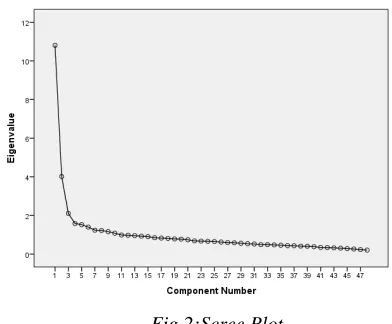
The principal component analysis with varimax rotation was applied to determine the number of factors to extract. One of the tools to help determine the appropriate number of factors to retain is the scree test. This is the most common approach to decide the number of factors in an instrument (Friendy, 2012; Newson, 2005). The scree test examines the scree plot. As can be seen in the figure 3, scree plot produced by SPSS is a two dimensional graph with factors on the x – axis and eigenvalues on the y – axis. According to Newson (2005), eigen values represent the variance for each of the underlying factor. In this study, there were four factors. Likewise, Newson (2005) explained that these values do not represent percentages but scores that total to the number of items. In this case, a 48 – item scale have 48 possible underlying factors, each factor will have an
eigenvalue that indicates the amount of variation in the items accounted for by each factor.
It can be noticed in the scree plot that the rate of decline tends to be very fast for the first factor but tend to level off. The “elbow” or the point at which the curve bends is considered to indicate the maximum number of factors to extract. In this case, there are only three factors to determine the responsible environmental behavior towards solid waste management in a school setting such as: personality factors which include attitude, skills, perception and personal responsibility; knowledge of action strategy and knowledge of issues.
Fig.2:Scree Plot
Factor analysis was used to eliminate items whose item values item – scale correlation value was below 0.20 and whose factor loading was below 0.40. Table 1 shows the results of factor analysis and loadings of the REBS – SWM. The items indicated in the Table are the items retained based on the results of factor analysis.
Table 2 Results of Factor Analysis and Loadings of the REBS – SWM
Lo ad in gs
Co mm una litie
s M SD
4. I understand the value of integrating solid waste management in school policies.
.6 06
.37 6
5. 05 50
1.0 080 4 5. I believe it is good to bring my
own utensils and cloth napkin that can be washed and used again.
.5 93
.36 0
4. 84 93
1.1 686 4 6. I believe that students understand
solid waste management concepts but are not willing to practice proper management
.4 12
.22 8
4. 70 33
1.1 455 4 7. I am willing to facilitate school –
based environmental projects on waste management.
.5 42
.45 6
4. 47 85
1.0 843 4 9. I like to reuse the backside of
printed papers as memo pads for .5 93
.38 3
5. 14
Infogain Publication (Infogainpublication.com) ISSN : 2454-1311
writing drafts and making
calculations.
83 9
12. I understand the importance of having complete facilities to manage wastes in school.
.7 10 .54 6 5. 21 53 .97 526 13. I know the importance of buying
and using recycled content paper products like copier paper, paper towels and toilet papers.
.6 80 .48 8 5. 08 85 1.0 590 8 14. I know that solid waste
management involves four Rs to address waste issues
.7 05 .53 9 5. 18 42 1.0 328 1 15. I cannot understand the value of
integrating solid waste management as an integral part of classroom management. .3 74 .27 8 4. 22 01 2.0 566 0 16. I am not ready to be trained as
one of the facilitators or member to monitor solid waste management in school. .4 71 .40 7 3. 79 90 1.3 773 8 17. I understand why solid waste
management is integrated in the curriculum. .6 70 .45 4 4. 85 17 1.1 024 3 18. I am willing to encourage other
students to use recycled materials for their projects in school.
.6 89 .51 7 4. 79 90 1.0 719 0 20. I know the importance of one’s
involvement in co – curricular and extracurricular activities related to solid waste management.
.7 01 .53 0 4. 76 32 1.0 078 3 22. I am eager to initiate or join in
school – based campaign on solid waste management. .4 76 .33 2 4. 44 50 1.2 303 5 24. I know that we can make
recycling easy by positioning
recycling bins next to the
photocopier/printer. .4 36 .56 3 4. 61 96 1.1 573 1 27. I am willing to motivate others
on active utilization of online educational technologies such as
social media to disseminate
information to reduce waste.
.6 63 .52 1 4. 66 75 1.1 303 3 29. I know that it is necessary for all
schools to implement a program on recycling all plastic, glass and metal food and beverage containers.
.7 40 .58 9 5. 09 33 1.0 264 6 30. I know that schools should have
recycling containers for cans and papers whenever one has trash with good signage. .7 40 .58 1 5. 14 35 1.0 632 1 36. I feel that it is my duty to do the
4 Rs (reduce, re-use, refuse and .6 63 .44 5 5. 06 1.1 296
recycle). 70 4
37. I believe that it is useful to buy items which I frequently use in bulk,
and to purchase refills and
concentrates. .5 82 .35 9 4. 84 45 1.0 329 0 40. I believe that it is necessary to
run a “spell check” on my work on the computer screen before having it printed back to back.
.6 46 .43 4 4. 89 00 1.1 198 4 46. I do not like to volunteer on co –
curricular and extracurricular
activities on solid waste
management. .46 8 3. 92 82 1.4 706 1
8. I am confused why incentives should be given to those who practice solid waste management.
.4 47 .25 7 3. 30 62 1.3 037 5
23. I am not sure if leftover foods are considered wastes. .4 24 .26 4 3. 74 40 1.3 778 0 26. I am wondering why canteens
should switch to reusable utensils and dishes instead of throwaways
whenever possible. .5 79 .34 9 3. 39 71 1.5 362 0
32. I cannot comprehend the value of organizing contest/s or competition/s on solid waste management in school. .6 10 .48 6 3. 57 89 1.4 090 3
34. I am confused on the importance of integrating solid waste
management in general assemblies and orientations. .3 92 .21 5 3. 63 88 2.8 269 2
38. I avoid buying materials that are durable and recyclable.
.4 80 .13 0 3. 97 37 1.5 288 7 42. I notice that there are times when
I leave plastic water bottle/s in the classroom. -.3 06 .12 2 4. 05 50 2.0 740 1 43. I do not understand why we have
to use a routing slip when circulating information or post notices on the bulletin boards, better yet, I am in favor of an electronic bulletin board.
.3 96 .16 8 3. 19 86 1.4 398 6
44. I cannot understand the
possibility of switching to refillable containers for milk and juice whenever one buys in the canteen.
.5 69 .42 7 3. 62 20 1.3 991 1
10. I am hesitant to take part in activities intended to reduce individual wastes. -.6 74 .67 7 3. 57 42 1.9 989 2
Infogain Publication (Infogainpublication.com) ISSN : 2454-1311 materials recycling facility should be
established in every institution
74 6 42
58 989
2 31. I know that everyone should
follow waste management hierarchy (that gives emphasis on reducing, reusing, and recycling the majority of wastes)
.3 60
.57 5
5. 17 22
1.0 429 6
10. I am hesitant to take part in activities intended to reduce individual wastes.
-.6 74
.67 7
3. 57 42
1.9 989 2
Using varimax rotation, the results of the first factor analysis consists of 12 indicators for the first latent construct or factor. These are items numbers 4, 5, 6, 7, 9, 12, 13, 14, 15, 16, 17, 18, 20, 22, 24, 27, 29, 30, 36, 37, 40 and 46. Nine items for the second latent construct or factor were obtained such as item number 8, 23, 26, 32, 34, 38, 42, 43, 44. For the third factor analysis, only three items were obtained such as item numbers 10, 11 and 31.
As a result, the following items were removed from the original 48 – item REBS – SWM: 1, 2, 3, 19, 21, 25, 28, 33, 35, 39, 41, 45, 47, 48 had been removed because these items did not meet the criterion set. Thus, the 35 – item Responsible Environmental Behavior Scale towards Solid Waste Management (REBS-SWM) in School Setting was developed.
In terms of validity of the instrument developed, REBS – SWM was examined using factor analysis with varimax rotation. This was done to determine whether the instrument measures what it is intended to measure. Likewise, expert opinions were considered to establish the content and face validity of the instrument. Students’ evaluations also provided data on construct validity. To establish the reliability of the instrument, Cronbach Alpha internal consistency coefficient was used. This was done to determine how consistent the items with each other. According to Tavakol and Dennick (2011), Cronbach Alpha Internal Consistency Coefficient verifies correlation of test with itself. As a result, the Cronbach Alpha Internal Consistency Coefficient was found as 0.81. Thus, it can be said that REBS – SWM is a reliable and valid 35 – item instrument to measure students’ responsible environmental behavior towards solid wastes management in the school setting.
V. CONCLUSION
The main purpose of conducting this study is to construct an instrument to determine the undergraduate students’ responsible environmental behavior. All steps of constructing a Likert – type attitude scale were followed. A 48 – items were drafted. Thirteen items were excluded from the scale based on the results of factor analysis.
Kaiser – Meyer – Olkin and Barlett tests were also obtained which indicate that the 34 – item scale had construct validity. Internal consistency reliability was estimated among the following construct such as personality factors, knowledge on action strategy and knowledge on issues. Thus, REBS – SBW is considered valid and reliable.
ACKNOWLEDGEMENTS
The author is very grateful to the Office of Research and Publications of De La Salle Lipa, Philippines particularly to its director, Ms. Gina Dimaano; Publication Officer, Mr. Jose Macatangay; and Management Officer, Ms. Shiela Maloles. Sincerest gratitude is extended to Mr. Darwin Magpili and all validators, participants of this study and those who in one way or another extended help to complete this study.
REFERENCES
[1] L. Aurora and S. Agarwal, “Knowledge, attitude and practices regarding waste management in selected hostel students University of Rajasthan, Jaipur,” International Journal of Chemical, Environmental and Pharmaceutical Research vol. 2, no.1, pp. 40 – 43, 2011.
[2] C. J. Bradley, T. M. Waliczek and J. M. Zajicek, G. Eason, B. Noble, and I. N. Sneddon, “Relationship
between environmental knowledge and
environmental attitude of high school students”, Journal of Environmental Education, vol. Phil. Trans. Roy. Soc. London, vol. 30, no. 3, p. 17, 1999. [3] S. P. Cotrell, “Influence of socio-demographics and
environmental attitudes on general responsible environmental behavior among recreational boaters,” Journal of Environmental Education, Retrieved:
August 18, 2013 Retrieved from:
eab.sagepub.com/content/42/4/420.
[4] S. P. Cotrell, “Testing a conceptual framework of responsible environmental behavior,” The Journal of Environmental Education, vol. 29, no. 1, pp. 17-27, 1997.
[5] P. F. J. Eagles and R. Demare, S. P. Cotrell, “factors influencing children’s environmental attitudes,” The Journal of Environmental Education, vol. 30, no. 4, p. 33 1999.
[6] K. Hayward, “Responsible environmental behavior: a test of the Hines model,” Retrieved: August 18, 2013 from: http://scholars. wlu.ca/etd/588.
[7] K. Hayward, “Responsible environmental behavior: a test of the Hines model,” Retrieved: August 18, 2013 from: http://scholars. wlu.ca/etd/588.
Infogain Publication (Infogainpublication.com) ISSN : 2454-1311 environmental behavior: a meta-analysis,” The
Journal of Environmental Behavior, vol. 18, no. 2, pp.1-8, 1987.
[9] S. J. Hsu, “The effects of an environmental education program on responsible environmental behavior and associated environmental literacy variables in Taiwanese College students,” The Journal of Environmental Education, vol. 35, no. 2, pp. 37 – 48,2004.
[10]S. J. Hsu and R. E. Roth, “Predicting Taiwanese secondary teachers’ responsible environmental behavior through environmental literacy variables,” The Journal of Environmental Education, vol. 30, no. 4, pp. 11 – 18, 1999.
[11]H. R. Hungerford and K. D. Thomas, “The theory of responsible environmental behavior,” Journal of Environmental Education, vol. 21, no. 3, pp. 8 – 21, 1999.
[12]Y. H. Hwang, S. Kim and J. Jeng, “Examining the causal relationships among selected antecedents of responsible environmental behavior,” The Journal of Environmental Behavior, vol. 31, no.4, pp. 19 – 25, 2000.
[13]A. Kollmus and J. Agyeman, “Mind the gap: why do people act environmentally and what are the barriers to pro – environmental behavior?”, Environmental Education Research, vol. 8, no.3, pp. 239 – 260, 2002.
[14]T. H. Lee, F. H. Jan, and C. Yang, “Conceptualizing
and measuring environmentally responsible
behaviors from the perspective of community – based tourists,”Tourism Management, vol.36, pp. 454 – 468, 2013.
[15]C. D. Licy, R. Vivek, K. Saritha, T. K. Anies and C.T. Josphina, “Awareness, attitude and practice of
school students towards household waste
management,” Journal of Environment, vol. 2, no.6, pp.147 – 150, 2013.
[16]D. McKenzie – Mohr, L.S. Nemiroff, L. Beers and S. Desmarais, “promoting social behavior,” Journal of Social Issues, vol. 51, no. 4, pp: 139 – 156, 1995. [17]C. Mobley, W.M. Vagias and S. L. DeWard,
“Exploring additional determinants of
environmentally responsible behavior: the influence of environmental literature and environmental attitudes.” Retrieved: August 18, 2014 Retrieved from: eab.sagepub.com/content/42/4/420.abstract. [18] N. Newson (2012). A quick primer on exploratory
factor analysis. [Online] Available:
http://www.upa.pdx.edu/10A/newson/semclass/ho_ef
a.doc (October 3, 2012).
[19]A. P. Sia, H. R. Hungerford and A. N. Tomera, “Selected predictors of responsible environmental
behavior: an analysis,” The Journal of Environmental Education, vol. 17, no. 2, pp. 31 – 40, 1986.
[20]D. J. Sivek and H. Hungerford, ‘Predictors of responsible behavior in members of three Wisconsin conservation organizations”, The Journal of Environmental Behavior, vol. 21, no. 2, pp. 35 – 40, 1990.
[21]I. Ugula, M. Sahin and S. Baslar, “High school students’ environmental attitude: scale development and validation,” International Journal of Education Science, vol. 5, no. 4, pp. 415 – 424, 2013.
[22]J. J. Vaske and K. C. Kobrin, “Place attachment and
article dates explained,” The Journal of
Environmental Education, vol. 32, no. 4, pp.: 16 – 21, 2001.
[23]J. Clerk Maxwell, A Treatise on Electricity and Magnetism, 3rd ed., vol. 2. Oxford: Clarendon, 1892, pp.68–73.