Original Research Article
Prevalence of disability in activities of daily living among elderly
in a rural community of Puducherry
Anandaraj R.*, Prakash M., Kavita Vasudevan
INTRODUCTION
Ageing, being a natural process, the decline in the organ function is unstoppable. This process results in increased chronic illness and disability. Disability has been defined as a restriction or lack of ability to perform an activity in the manner or within the range considered normal for a human being.1 It reflects how well an individual is able to function in general areas of life. Many elderly patients with chronic illness are limited in their physical activities.2
Evaluation of the health status of elderly is incomplete without including the concept of functional assessment. Functional assessment is a part of the integral and
multidisciplinary evaluation of the elderly patient.3 Functional capacity is classified as “basic activities of daily living” such as personal hygiene, getting dressed, eating and general mobility; and “instrumental activities of daily living” which require more complex abilities, such as housework, financial transactions, use of the telephone or the ability to go out alone.4
Scales are available to assess activities of daily living (ADL), but not many can be employed in our context.5-8 Everyday abilities scale for India (EASI) is an 11-item scale which can be utilized to overcome this barrier.9 It includes items concerned with eating, personal hygiene, dressing, social interaction and cognitive functioning. This scale has been validated (Cronbach’s α=0.82) for use even in illiterate elderly in rural India.9
ABSTRACT
Background: Normal ageing changes, acute illness and worsening chronic illness can lead to a decline in the ability to perform day to day tasks necessary to live independently. This research aims to study about the disability in activities of daily living among rural elderly in an union territory of south India.
Methods: A cross sectional study was conducted for three months among 245 randomly selected rural elderly aged ≥60 years. Everyday abilities scale for India was used to assess disability in activities of daily living. Results were expressed in frequencies and percentages. Appropriate univariate and multivariate analyses were done.
Results: The prevalence of disability in activities of daily living was found to be 13.9%. Univariate analysis found out that illiteracy, economic dependency, marital status, living arrangement and presence of sleep problems were significantly associated with disability in activities of daily living. Multivariate analysis observed that predictors of disability were economic dependency (aOR, 95% CI=9.15, 2.94–28.47) and living arrangement (aOR, 95% CI =8.00, 2.46–26.01).
Conclusions: Disability in activities of daily living is a neglected serious issue and needs a community-based primary health care approach.
Keywords: Activities of daily living, Disability, EASI, Rural elderly
Department ofCommunity Medicine, Indira Gandhi Medical College and Research Institute, Puducherry, India
Received: 07 July 2018
Revised: 10 August 2018
Accepted: 11 August 2018
*Correspondence:
Dr. Anandaraj R.,
E-mail: [email protected]
Copyright: © the author(s), publisher and licensee Medip Academy. This is an open-access article distributed under the terms of the Creative Commons Attribution Non-Commercial License, which permits unrestricted non-commercial use, distribution, and reproduction in any medium, provided the original work is properly cited.
Baseline functional assessment provides data that may indicate future decline or improvement in health status, allowing to plan and intervene appropriately for this set of individuals. Fewer community based studies have been conducted in this part of the nation so far to address this issue. With this background, the present study has been conducted with the objective of estimating the prevalence of disability in activities of daily living among rural elderly and to study the associated epidemiological factors.
METHODS
A community based cross sectional study was conducted among the elderly individuals (aged ≥60 years) residing in villages covered under Embalam centre, which is one of the field practice areas attached to a medical college in Puducherry. Terminally ill subjects or those who are not comprehensive enough to respond to the questions were excluded. The study was conducted for a period of three months from August-2017 to October-2017.
Considering the prevalence of disability in activities of daily living as 17.6%, with an absolute precision of 5, the estimated sample size by using the formula n=1.962 pq/d2 was 223.10 Adding a 10% non response rate to this, the final sample size arrived to 245 study subjects.
Enlisting of all elderly persons under the service areas of Embalam centre was done using survey records of Anganwadi workers. The required sample size was then obtained by simple random sampling using random number table. Informed consent was obtained from the study subjects after explaining them the purpose of the study. Ethical approval was obtained from the Institutional Ethical Review Board. The study questionnaire consisted of two parts.
Part one collects socio demographic variables and information about addictions, sleep problems and any physician diagnosed chronic morbidity. Part two collects information about disability in activities of daily living of the study subjects using a validated tool namely “Everyday Abilities Scale for India” [EASI]. Study
subjects with EASI score above three will be classified as “disabled in activities of daily living”.9
Economic dependency was classified as follows: Independent: if he/she is leading economically productive life/if he/she is getting any pension, and not dependent on any other for their livelihood. Partially dependent: if he/she is having a small income like an old age pension and is also depending on their family members. Totally dependent: if he/she is not getting any income and is totally dependent on their family members for their livelihood.10
Chronic morbidity in the study subjects was assumed if there was any illness requiring medications for more than six months. The subjects were considered to be suffering from sleep problems in case they either had excess or lack of sleep on most days of a week.
Data entry was done using Microsoft EXCEL 2010 and analysed using SPSS (version 17.0). Categorical variables were summarized using percentages. Chi-square test was used for analyzing categorical data. Fisher’s exact test was used when the expected value of more than 20% of the cells was less than five. Multivariate logistic regression analysis (backward stepwise regression) was done. All the variables in univariate analysis with a p value below 0.05 were included into the model to identify predictors of disability in activities of daily living. A p value of less than 0.05 was considered to be statistically significant.
RESULTS
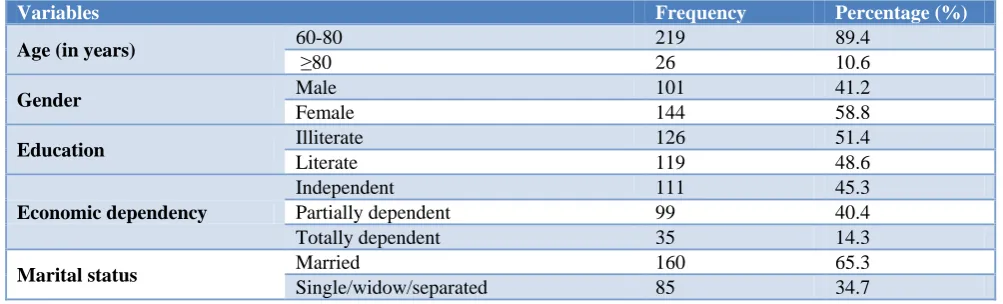
The descriptive profile of the study subjects has been provided in Table 1. The mean (±SD) age of the study subjects was 69.4 (±7.8) years. About 58.8% of the study subjects were females. Most of them were economically independent or partially dependent. Only 12.7% of the study subjects were living alone. Almost 49% had at least one physician diagnosed chronic morbidity, while 58.4% had sleep problems. Out of 245 elderly study subjects, 34 (13.9%) were found to suffering from disability in activities of daily living, as they had an EASI score above three.
Table 1: Descriptive profile of study subjects & prevalence of disability in activities of daily living (n=245).
Variables Frequency Percentage (%)
Age (in years) 60-80 219 89.4
≥80 26 10.6
Gender Male 101 41.2
Female 144 58.8
Education Illiterate 126 51.4
Literate 119 48.6
Economic dependency
Independent 111 45.3
Partially dependent 99 40.4
Totally dependent 35 14.3
Marital status Married 160 65.3
Single/widow/separated 85 34.7
Variables Frequency Percentage (%)
Living arrangement Alone 31 12.7
With any others 214 87.3
Chronic morbidity No 125 51.0
Yes 120 49.0
Addictions No 147 60.2
Yes 97 39.8
Sleep problems No 102 41.6
Yes 143 58.4
Disability in activities of daily living
No 211 86.1
Yes 34 13.9
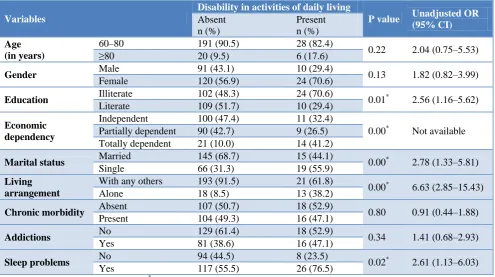
Table 2: Factors influencing disability in activities of daily living by univariate analysis (n=245).
Variables
Disability in activities of daily living
P value Unadjusted OR (95% CI) Absent
n (%)
Present n (%)
Age (in years)
60–80 191 (90.5) 28 (82.4)
0.22 2.04 (0.75–5.53)
≥80 20 (9.5) 6 (17.6)
Gender Male 91 (43.1) 10 (29.4) 0.13 1.82 (0.82–3.99)
Female 120 (56.9) 24 (70.6)
Education Illiterate 102 (48.3) 24 (70.6) 0.01* 2.56 (1.16–5.62)
Literate 109 (51.7) 10 (29.4)
Economic dependency
Independent 100 (47.4) 11 (32.4)
0.00* Not available Partially dependent 90 (42.7) 9 (26.5)
Totally dependent 21 (10.0) 14 (41.2)
Marital status Married 145 (68.7) 15 (44.1) 0.00* 2.78 (1.33–5.81)
Single 66 (31.3) 19 (55.9)
Living arrangement
With any others 193 (91.5) 21 (61.8)
0.00* 6.63 (2.85–15.43)
Alone 18 (8.5) 13 (38.2)
Chronic morbidity Absent 107 (50.7) 18 (52.9) 0.80 0.91 (0.44–1.88)
Present 104 (49.3) 16 (47.1)
Addictions No 129 (61.4) 18 (52.9) 0.34 1.41 (0.68–2.93)
Yes 81 (38.6) 16 (47.1)
Sleep problems No 94 (44.5) 8 (23.5) 0.02* 2.61 (1.13–6.03)
Yes 117 (55.5) 26 (76.5)
OR: Odds ratio, CI: Confidence interval; *significant.
Table 3: Predictors of disability in activates of daily living by multivariate analysis (n=245).
Variables P value adjusted OR 95% CI
Education 0.13 2.07 0.79–5.37
Economic dependency 0.00* 9.15 2.94–28.47
Marital status 0.66 0.80 0.30–2.12
Living arrangement 0.001* 8.00 2.46–26.01
Sleep problems 0.12 2.05 0.81–5.19
OR: Odds ratio, CI: Confidence interval; *significant.
About 24 (70.6%) females were found to be disabled as compared to 10 (29.4%) males as observed in Table 2. But gender was not found to be significantly associated with disability in activities of daily living. Illiterates (70.6%), as compared to literates (29.4%), were more vulnerable for disability. A state of economic dependency was statistically associated with ADL disability. About 19 (55.9%) of those who were not currently married were
Logistic regression analysis of all the variables revealed that economic dependency (aOR, 95% CI=9.15, 2.94– 28.47) and living arrangement (aOR, 95% CI=8.00, 2.46– 26.01) emerged as predictors of disability in activities of daily living (Table 3).
DISCUSSION
This community based study was conducted in villages covered as field practice areas under a medical college in Puducherry. The prevalence of disability in ADL among elderly aged above 60 years was found to be 13.9% in this study. International studies have observed this prevalence ranging from 15% to 39.5%.11-14
In a community based study from rural Ballabhgarh among elderly individuals aged 60 years or above, the prevalence of functional disability was estimated to be 47.8%.15 Gupta et al, in their community based study in Jhansiobserved that the prevalence of disability in ADL was 23.4%.16 Higher age group & female gender were found to be significantly associated with disability in ADL. A study in Tamil Nadu observed that 22% of their study population has at least one disability in activities of daily living.17
The present study observed a lesser prevalence when compared to previous published literature. This may be attributed to the difference in the scales used to measure the disability in activities of daily living.
In a study by Chakrabarty et al, prevalence of disability in activities of daily living was 16.16% as per ADL scale.18 Age, gender and chronic morbidities such as anaemia, ischemic heart disease, chronic obstructive pulmonary disorder, prostatic hypertrophy, osteoporosis, osteoarthritis and acid peptic disorders were significantly associated with disability.
Srinivasan et al, in their study among urban elderly in Bengaluru observed that 6.2% reported restriction of daily activities in the past month.19 The present study done in rural areas observed prevalence twice that of this reported value. Urban residence usually give a scope for better access to health care, access to transportation, less dependence on physical effort to complete certain tasks, and better financial support in the form of retirement benefits.16 These may be the possible reasons for this difference.
Hearing and visual impairment not being evaluated in present study due to logistic issues amounts for its limitation. An earlier study observed hearing impairment being significantly associated with functional disability.19 Possibility of limitation in ADL due to these impairments cannot be ruled out. Further studies considering these domains as well are advisable.
Government of India has a dedicated national health program for health care of elderly. The primary objective
of this program is to provide access to promotional, preventive, curative and rehabilitative services to the elderly.20 Capacity building of the medical and paramedical professionals as well as the care-takers within the family for providing health care to the elderly is essential. Training them to screen for functional disability in ADL should be integrated in this area so as to facilitate early detection of disability and to differentiate this from ongoing ageing process. Linkage to appropriate old age homes can be considered. A community based primary health care approach inclusive of home visits will pave a long way to address this neglected serious issue.
CONCLUSION
To conclude, disability in activities of daily living has been observed from the present study to be a neglected issue. A community-based primary health care approach is the need of the hour to tackle this public health problem.
ACKNOWLEDGEMENTS
The authors would like to acknowledge the interns and community volunteers who assisted in data collection. The authors thank Dr. Madhan for his technical guidance in drafting the proposal. The authors are also grateful to the study participants without whom this work is not possible..
Funding: No funding sources Conflict of interest: None declared
Ethical approval: The study was approved by the Institutional Ethics Committee
REFERENCES
1. International Classification of Impairment, Disabilities, Handicaps. Geneva: World Health Organization; 1980.
2. Williams K, Frei A, Vetsch A, Dobbels F, Puhan MA, Rüdell K. Patient-reported physical activity questionnaires: a systematic review of content and format. Health Qual Life Outcomes. 2012;13(10):28.
3. Castilla-Rilo J, López-Arrieta J, Bermejo-Pareja F, Ruiz M, Sánchez-Sánchez F, Trincado R. Instrumental activities of daily living in the screening of dementia in population studies:a systematic review and meta-analysis. Int J Geriatr Psychiatry. 2007;22(9):829-36.
4. Lawton MP, Brody EM. Assessment of older people: self-maintaining and instrumental activities of daily living. Gerontologist. 1969;9(3):179-86. 5. Katz S. Assessing self‐maintenance: activities of
6. Pfeffer RI, Kurosaki TT, Harrah CH Jr, Chance JM, Filos S. Measurement of functional activities in older adults in the community. J Gerontol. 1982;37(3):323-9.
7. Dewing J. A critique of the Barthel Index. Br J Nurs. 1992;1:325‑9.
8. Jitapunkul S, Kamolratanakul P, Ebrahim S. The meaning of activity of daily living in a Thai elderly population:development of a new index. Age Ageing. 1994;23:97–101.
9. Fillenbaum GG, Chandra V, Ganguli M, Pandav R, Gilby JE, Seaberg EC, et al. Development of an activities of daily living scale to screen for dementia in an illiterate rural older population in India. Age Ageing. 1999;28:161-8.
10. Gupta P, Mani K, Rai SK, Nongkynrih B, Gupta SK. Functional disability among elderly persons in a rural area of Haryana. Indian J Public Health. 2014;58(1):11-6.
11. Chaudhry SI, McAvay G, Ning Y, Allore HG, Newman AB, Gill TM. Geriatric impairments and disability:The cardiovascular health study. J Am Geriatr Soc 2010;58:1686‑92.
12. Yoshida D, Ninomiya T, Doi Y, Hata J, Fukuhara M, Ikeda F, et al. Prevalence and causes of functional disability in an elderly general population of Japanese:the Hisayama study. J Epidemiol. 2012;22(3):222-9.
13. Abdulraheem IS, Oladipo AR, Amodu MO. Prevalence and correlates of physical disability and functional limitation among elderly rural population in Nigeria. J Aging Res. 2011;2011:369894. 14. Fillenbaum GG, Blay SL, Andreoli SB, Gastal FL.
Prevalence and correlates of functional status in an older community–representative sample in Brazil. J Aging Health. 2010;22:362‑83.
15. Goswami A. Health Status of the Aged in a Rural Community. PhD Thesis. New Delhi: Centre for Community Medicine, All India Institute of Medical Sciences; 2002.
16. Gupta S, Yadav R, Malhotra AK. Assessment of physical disability using Barthel index among elderly of rural areas of district Jhansi (U.P), India. J Family Med Prim Care. 2016;5:853-7.
17. Venkatorao T, Ezhil R, Jabbar S, Ramakrishnan R. Prevalence of disability and handicaps in geriatric population in rural south India. Indian J Public Health. 2005;49:11‑7.
18. Chakrabarty D, Mandal PK, Manna N, Mallik S, Ghosh P, Chatterjee C, et al. Functional disability and associated chronic conditions among geriatric populations in a rural community of India. Ghana Med J. 2010;44(4).
19. Srinivasan K, Vaz M, Thomas T. Prevalence of health related disability among community dwelling urban elderly from middle socioeconomic strata in Bangaluru, India. Indian J Med Res. 2010;131:515-21.
20. National Programme for the Health Care of the Elderly. Operational guidelines, 2011. Ministry of Health and Family Welfare, Government of India. Available at: https://mohfw.gov.in/sites/default/ files/8324324521Operational_Guidelines_NPHCE final.pdf. Accessed on 05 March 2017.