RESEARCH ARTICLE
GENERATION AND DIFFUSION OF EXCITONS IN SILICON SOLAR CELLS
*Saliou Ndiaye, Mamadou Niane, Waly Diallo, Modou Faye, Moulaye Diagne and Bassirou BA
Laboratoire des Semi-conducteurs et d’Energie Solaire de la Faculté des Sciences et Techniques de l’Université
Cheikh Anta Diop de DAKAR, BP 5005, Dakar-fann, Sénégal
ARTICLE INFO
ABSTRACT
We studied the phenomena of exciton generation and diffusion in a monocrystalline silicon solar cell. This study revealed two types of exciton generation: an exciton generation associated with the generation rate Gex of the excitons and a generation rate Cex/eh related to the coupling between the electron and the hole and representing the number of holes and electrons which are bonded per unit volume and per unit time to form an exciton. We have studied the exciton fraction generated as a function of the wavelength, which shows that the exciton generation is more important in the infrared. The rate of coupled exciton generation increases as a function of the coupling coefficient. Indeed, the strong coupling between the electron and the hole, synonymous with a strong bond between these two particles, favors the formation of coupled excitons. We also noted a decrease in the effective diffusion lengths as a function of the coupling coefficient. The strong bond between the electron and the hole reduces the mobility of the latter.
Copyright © 2018,Saliou Ndiaye et al. This is an open access article distributed under the Creative Commons Attribution License, which permits unrestricted use, distribution, and reproduction in any medium, provided the original work is properly cited.
INTRODUCTION
The production of the electric current passes through the generation of excitons which diffuse into the material before dissociating into free electron-hole pairs. Two types of exciton generation are defined: The generation of excitons associated
with the generation rate Gex of the excitons (Barrau et al.,
1973; Burgelman and Minnaert, 2006; Corkish et al., 1998;
Kane and Swanson,1993; Kane and Swanson , 1993; Zhang et
al., 1998) and the generation of excitons linked to the coupling
between the electron and the hole (Lin et al., 2001).This
second generation, defined by the magnitude Cex/eh (cm-3s-1),
represents the number of electrons and holes that bind per unit volume and per unit time to form excitons. According to Burgelman, the opposite of this size corresponds to a volumic
dissociation of excitons in free electron-hole pairs (Lin et al.,
2001). We call these excitons, coupled excitons because their
formation is related to electron - hole coupling. Moreover, the mutual influence between the electrons and the excitons results in an effective diffusion of these charge carriers, which is
characterized by the two diffusion lengths L1 and L2. The aim
of this article is to study the variations of the two types of generation as a function of the wavelength and the exciton binding coefficient. This article studies also the diffusion lengths of electrons and excitons as a function of the coupling coefficient.
*Corresponding author: Saliou Ndiaye
Laboratoire des Semi-conducteurs et d’Energie Solaire de la Faculté des Sciences et Techniques de l’Université Cheikh Anta Diop de Dakar, BP 5005, Dakar-fann, Sénégal.
We consider a model of solar cell silicon n+p simplified. The contribution of the emitter is neglected and the excitation is low.
Theoretical model
We will denote electrons, holes and excitons with the subscript e, h and ex, respectively. We will limit ourselves to a one-dimensional analysis.
Excitons generation
Our study model reveals two types of excitons generation Gex
and Cex/eh involved in the distribution of charge carriers,
translated by the following equations system (Corkish et al.,
1998; Niasse et al., 2009; Zhang et al., 1998):
α x
exp 0 G ) n ex Δn A N (Δ b τ Δn
2 dx Δn 2 d
D ne e
e e e e
(1)
α x
exp 0 ex G ) n ex Δn A N (Δ b ex τ
ex Δn
2 dx
ex Δn 2 d ex
D ne
(2)
α x
exp 0 G
Gex ex
(cm-3s-1) (3)
) n ex Δn A N (Δ b
/
ne C
eh
ex (cm-3s-1) (4)
ISSN: 0976-3376
Vol. 09, Issue, 02, pp.7630-7634, February,Asian Journal of Science and Technology 2018ASIAN JOURNAL OF
SCIENCE AND TECHNOLOGY
Article History:
Received 19th November, 2017
Received in revised form 24th December, 2017
Accepted 14th January, 2018
Published online 28th February, 2018
Key words:
Excitons generation associated to Gex
The total generation of the carriers depends on the fraction of
the generated free electron-hole pairs feh and the exciton
fraction fex generated. Thus, the generation rates of free
electron-hole pairs Ge and excitons Gex are defined by the
following relations (Corkish et al., 1998).
G eh f e G
and Gex fexG
(5)1
feh ex f
(6)
The expression of G (λ) is given by:
1
exp
x
G F R
(7)
G (λ): Total generation rate of free electron-hole pairs and
excitons.
feh: Fraction of electron-hole pairs generated.
fex: Generated exciton fraction.
F (λ): Incident flow
α (λ): absorption coefficient of the material R (λ): reflection coefficient of the material
Depending on the values of feh and fex, which depend on the
exciting wavelength and the type of semiconductor (organic or inorganic), we can have two distinct situations:
- feh ≈ 1 and fex ≈ 0
The total generation of carriers corresponds to the generation of free electron-hole pairs. In this case, the excitons arise only from the relaxation of the free electron-hole pairs.
- feh ≈0 and fex ≈ 1
This situation is obtained in organic semiconductors.
The fraction of excitons is almost equal to the total generation of carriers.
Exciton generation associated to Cex /eh
By observing the continuity equations (1) and (2), Cex /eh
corresponds to an exciton generation rate and a recombination rate of electrons. Indeed, a continuity equation governs the phenomena of generation, diffusion and generation of charge
carriers. Cex /eh is related to the coupling between the electron
and the hole. This generation of excitons represents the number of electrons and holes that bind per unit volume and
per unit time to form excitons (Corkish et al., 1998; Zhang et
al., 1998). We call these excitons coupled excitons because their formation is related to electron - hole coupling. This generation is zero when the electron exciton system is in equilibrium.
This equilibrium is translated by the following equality:
Δnexn A N
Δne . With n*, the equilibrium constant. One thus
notes the disappearance of the mutual influence between the electrons and the excitons in the material. This leads to the equations of continuity peculiar to electrons and excitons.
α x
exp 0 G τ Δn
2 dx Δn 2 d
D e
e e e e
(8)
α x
exp 0 ex G ex τ
ex Δn
2 dx
ex Δn 2 d ex
D
(9)
Excitons diffusion
The phenomena of generation are followed by an effective diffusion of the charge carriers. This diffusion is characterized
by two effective diffusion lengths L1 and L2 which depend on
the mutual influence between the electrons and the excitons. When this influence disappears, the effective diffusion lengths
tend to the own diffusion lengths Le and Lex. The excitons have
a very low diffusion length (Lex < Le). The expressions of the
diffusion lengths are given in the papers of Zhang and Corkish (Corkish et al., 1998; Zhang et al., 1998).
RESULTS AND DISCUSSION
Variation of the exciton generation fraction as a function of wavelength
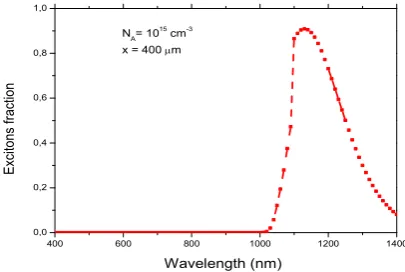
We consider a monocrystalline silicon solar cell which has a depth H= 1000μm and a doping level NA = 1015 cm-3. We have
plotted in Figure1, the variation of the fraction of excitons generated as a function of the excitation wavelength. We find that low wavelengths do not generate excitons. However, there is a strong generation of excitons for wavelengths between 1110 and 1200 nm, the largest at a wavelength equal to 1130 nm. The strong generation of excitons is thus obtained in the infrared. Indeed, for the wavelengths that are higher but close to the wavelength gap of the silicon (λg ≈ 1108 nm) the generated electron does not reach the conduction band, it is in an intermediate state and thus forms with the hole of the valence band an exciton. The silicon atoms are then in an excited state. For wavelengths less than λg, the electron has enough energy to cross the gap and become free in the material. This electron is weakly bound to the valence band hole.
400 600 800 1000 1200 1400
0,0 0,2 0,4 0,6 0,8 1,0
Wavelength (nm)
NA= 10 15
cm-3
x = 400 m
Exci
tons f
raction
Figure 1. Fraction of excitons generated as a function of the excitation wavelength at a depth in the base x = 400 μm
Variation of the coupled excitons generation rate as a function of the wavelength
chosen an average coupling coefficient b = 10-11 cm3.s-1and a
doping rate NA = 1017cm-3. We study the influences of NA and
b on the resulting profile. Figure2 represents this generation
rate as a function of the wavelength for the three positions in the photovoltaic cell.
400 600 800 1000 1200
0,0 5,0x10¹¹
1,0x10¹²
1,5x10¹²
2,0x10¹² NA=10 17
cm-3
b=10-11
cm3
.s-1
Cou
pled
e
xci
to
ns
gener
at
ion
r
at
e
(
cm
-3.s -1)
Wavelength (nm)
x = 0 x = 400 m x= 1000 m
Figure 2 : Variation of the coupled excitons generation rate as a function of the wavelength for various positions in the solar cell.
NA = 1017 cm-3 et b = 10-11 cm3.s-1
This figure shows that the generation of coupled excitons is more visible in the range of lengths in the vicinity of λg. The low wavelengths generate an insignificant number of coupled excitons. It is also noted that the amount of coupled excitons is zero at the junction and very low on the back side because of the electric field that prevails in the space charge zone and phenomena of recombination and excitonic conversion to the surface back
Effect of the doping rate in acceptor atoms
Figure 3 shows the variations in the coupled excitons generation rate for given values of the doping rate.
400 600 800 1000
0
1x10¹²
2x10¹²
3x10¹²
4x10¹²
5x10¹²
Wavelength (nm)
Coupl
ed
excit
ons
generati
on r
ate
(cm
-3.s
-1) NA= 10
-15
cm-3
NA= 10-16
cm-3
NA= 10
-17
cm-3
b=10-15
cm3
.s-1
x = 400m
Figure 3 : Variation of the coupled excitons generation rate as a
function of the wavelength for three values of the doping level :
NA = 1015 cm-3, NA = 1016 cm-3et NA = 1017 cm-3
We note that coupled excitons generation rate decreases as a
function of the doping rate in acceptor atoms. Indeed, the increase of the doping rate favors the recombination phenomena of excitons through the formation of stable
exciton-acceptor complexes (A0X) which are stable for any
value of the capture cross-section σ (Karazhanov. S. Zh et al.,
2000 ; Lin. C.F et al., 2001).
Effect of the coupling coefficient
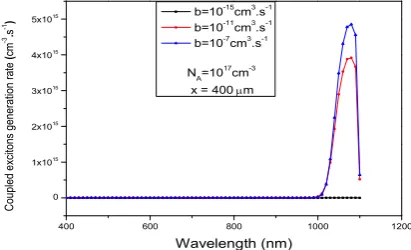
We consider three values of the coupling coefficient:
b = 10-13 cm3.s-1, b = 10-11 cm3.s-1 and b = 10-8 cm3.s-1. In figure 4, we have the coupling effect on the coupled excitons generation rate.
Figure 4 : Variation of the coupled excitons generation rate as a function of the wavelength for three values of the coupling
coefficient : b = 10-13 cm3.s-1, b = 10-11 cm3.s-1and b = 10-7 cm3.s-1
This rate increases as a function of the coupling coefficient. The strong coupling between the electron and the hole, synonymous with a strong bond between these two particles, favors the formation of coupled excitons.
Variation of the coupled excitons generation rate as a function of the depth in the base
When the solar cell is illuminated with suitable light, the excitons are generated in the base. It follows the phenomena of diffusion and recombination in depth. We first approach the mechanisms of exciton generation in volume before going on to the influence of the doping rate and the coupling coefficient b. For this, we considered a wavelength λ = 1080 nm, capable of generating excitons. The results obtained are represented by figure 5. We note that the generation rate, zero at the junction, is maximum at a given depth in the base and decreases considerably in depth. Indeed, the generation of the carriers in volume depends on the phenomena of recombination of the electrons and the catches of excitons.
0 200 400 600 800 1000
0,0 2,0x10¹²
4,0x10¹²
6,0x10¹²
8,0x10¹²
1,0x10¹³ N
A= 10 15
cm-3
b=10-11 cm3.s-1
nm
C
oupled
exc
itons ge
neration rat
e
(cm
-3 .s -1 )
Depth (m)
Figure 5. Variation of the coupled excitons generation rate as a
function of the depth in the base. b = 10-11 cm3.s-1 and NA = 1015
cm-3
400 600 800 1000 1200
0 1x10¹⁵
2x10¹⁵
3x10¹⁵
4x10¹⁵
5x10¹⁵ b=10
-15
cm3
.s-1
b=10-11
cm3
.s-1
b=10-7
cm3
.s-1
NA=10 17
cm-3
x = 400m
Cou
pled
e
xcitons generat
ion ra
te
(
cm
-3.
s
-1)
Effect of the doping level
In order to better study the influence of the doping rate, we
considered three values of NA : NA = 1015 cm-3, NA = 1016 cm-3
et NA = 1017 cm-3. Thus, we obtain the results given by figure
6. The doping of the solar cell reduces the formation of excitons coupled in any part of the solar cell. The increase of the doping rate reinforces the sites of capture of excitons by the impurities thus leading to the formation of exciton-impurity complex.
0 200 400 600 800 1000
0,0 2,0x10¹²
4,0x10¹²
6,0x10¹²
8,0x10¹²
1,0x10¹³
C
oupl
ed excitons g
en
eration
rate
(
cm
-3.
s
-1)
Depth (m)
NA= 1015
cm-3
NA= 1016
cm-3
NA= 1017
cm-3
b=10-11
cm3
.s-1
nm
Figure 6. Variation of the coupled excitons generation rate as a function of the depth in the base for three values of the doping
level : NA = 1015 cm-3, NA = 1016 cm-3 and NA = 1017 cm-3
Effect of the coupling coefficient
We have plotted in Figure 7 the variations of coupled exciton formation under the influence of the exciton binding coefficient.
0 50 100 150 200 250 300 350 400
0,0 2,0x10¹²
4,0x10¹²
6,0x10¹²
8,0x10¹²
1,0x10¹³
Co
upled exci
tons gen
e
ration
rate
(
cm
-3.
s
-1)
Depth (m)
b = 10-13
cm3
.s-1
b = 10-11 cm3.s-1 b = 10-7
cm3
.s-1
NA = 10 15
cm-3
= 1080 nm
Figure 7. Variation of the coupled excitons generation rate as a
function of the depth in the base for three values of the coupling
coefficient : b = 10-13 cm3.s-1, b = 10-11 cm3.s-1and b = 10-7 cm3.s-1
We find that there is a strong generation of coupled excitons if the coupling is strong. It is also important to note that the maximum of these profiles approximates the space charge area as a function of the increasing values of b.
Effective diffusion lengths as a function of the exciton binding coefficient
We have plotted in Figure 8 the profiles of the effective
diffusion lengths L1 and L2 as a function of the exciton
bonding coefficient. By way of comparison, we have
represented the own diffusion lengths Le and Lex. The doping
rate is NA = 1017 cm-3.
-15 -14 -13 -12 -11 -10 -9 -8 -7
0 10 20 30 40 50 60 70 80 90
nm NA = 10
17
cm-3
Di
ffu
si
on
length(
m
)
Logb (cm3.s-1)
Le
Lex
L1
L2
Figure 8. Variation of the effectives diffusion lengths L1
and L2 compared to own diffusion lengths Le et Lex for a
doping level NA = 1017 cm-3
This figure, which shows three types of coupling according to the values of b, shows a decrease in the effective diffusion lengths as a function of the coupling coefficient.
10-15 cm3.s-1≤ b ≤10-13cm3.s-1, coupling is low. The
effective diffusion lengths remain equal to the own
diffusion lengths: L1≈ Le and L2 ≈ Lex. The electron and
the exciton diffuse independently with their own diffusion length.
10-9cm3.s-1≤ b ≤ 10-7cm3.s-1, we have a strong coupling.
The electron and the hole are strongly bonded. This strong bond reduces the mobility of the electron and the hole of the exciton, which results in a reduction in the effective scattering lengths.
Between these two types of coupling, there is an
intermediate coupling: the average coupling moyen
(10-13cm3.s-1<b ≤ 10-10cm3.s-1). The electron and the
exciton do not diffuse independently, but each of water
has its own effective diffusion length L1 and L2,
respectively.
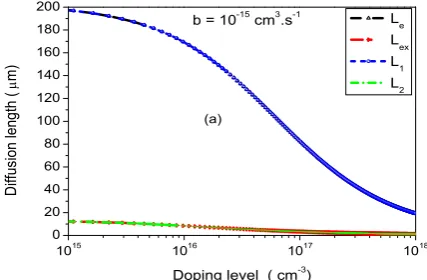
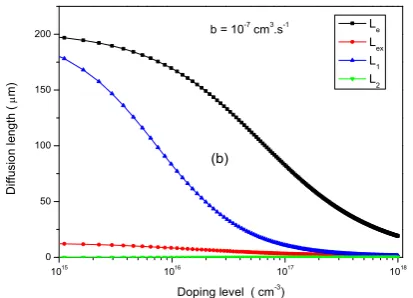
Diffusion lengths as a function of the doping level
Figure 9 shows the variations of the effective and own diffusion lengths as a function of the doping rate in acceptor atoms for each type of coupling.
1015
1016
1017
1018
0 20 40 60 80 100 120 140 160 180 200
D
iffus
ion
leng
th (
m)
Doping level ( cm-3
)
Le
Lex
L1
L2
b = 10-15 cm3.s-1
1015
1016
1017
1018
0 50 100 150
200 b = 10
-7
cm3.s-1 Le
Lex L1 L2
Di
ffusio
n length
(
m)
Doping level ( cm-3
)
(b)
Figure 9. Variation of the diffusion lengths as a function of
the doping rate in acceptor atoms for weak coupling (a) and for strong coupling (b)
Increasing the doping rate reduces the diffusion of electrons and excitons regardless of the type of coupling. Indeed impurities favor the formation of particle-impurity complex of lower mobility. It is also observed that when the electron and the hole of the exciton are weakly bonded, the effective diffusion lengths are equal to the own diffusion lengths whatever the value of the doping rate.
Conclusion
In this article we studied the phenomena of exciton generation and diffusion in a monocrystalline silicon solar cell. This study revealed that the notion of electron - exciton coupling developed in the articles of Zhang and Corkish is in fact related to the mutual influence between the electron and the hole which in some cases binds to form an exciton. This phenomenon disappears at equilibrium terminating the coupling. Our article has thus revealed a new exciton generation mechanism associated with Cex / eh. We also find
that the strong bond between the holes and the electrons decreases the mobility of these carriers in the material thus causing a lower diffusion length of the excitons than that of the electrons.
REFERENCES
Barrau, J, et al., 1973. Experimental determination of exciton formation coefficient in silicon, Journal of
AppliedPhysics. Chem. Solids, vol.34n.11, pp.1757-2028.
Burgelman, M. and Minnaert, M. 2006 Including Corkish. R
et al., 1998. Exciton in silicon diodes and solarcells: A
three-particle theory, Journal of Applied Physics, vol. 79n.1, pp. 195-203. excitons in semiconductor solar cell modeling, Thin Solid Films, vol.511 n.512, pp.214-218.
Fisher. R. et al., 1991. Hot-Exciton Relaxation Cdx Zn1-xTe/
ZnTe Multiple Quantum Wells, Physical Review Letters,
vol.67 n.1, pp.128-131..
Kane. D.E and Swanson.R.M. 1993. Effect of exciton on visible stripshrinking and transport of semiconductor,
Journal of Applied Physics, vol.73 n.3, pp.1193 – 1197.
Karazhanov. S. Zh. et al., 2000. The effect of excitons on CdTesolarcells, Journal of AppliedPhysics, vol.87n.17, pp.8786-8792.Lin. C.F et al., 2001. Miin-JangChen,Eih-Zhe
Liang, W. T. Liu, C. W. and Liu, Reduced temperatur edependence of luminescence fromsilicon due to field-induced carrier confinement, Applied Physics Letters, vol.78 n.3, pp. 261-263.
Niasse, O. A et al., 2009. Effects of excitons in the quantum efficiency of the solarcellCdS / CdTe by the model of the dielectricfunction, Review of Renewable Energy vol. 12 n. 3, pp. 501 – 512.
Schaller, R. D and V. I. Klimov.V.I. 2004. Multiexciton generation in quantum dots, Physical ReviewLetters, vol.92 n.18, May 2004
Zhang, Y. et al, 1998. Effects of excitons on solarcells,
Journal of Applied Physics, vol. 84n.7,octobre 1998, pp.
3966-3971.