Original Research Article
Personal protective equipment compliance among laundry workers in
secondary and tertiary health facilities in Nigeria
Emmanuel N. Omoijiade
1*, Lucky Evbuomwan
2INTRODUCTION
The health and safety of healthcare workers are threatened daily due to their exposure to various occupational hazards, however, exposure to hazardous agents depends upon the job category and the work environment of the healthcare worker (HCW).1,2
Occupational safety and health (OSH) hazards in healthcare facilities can be grouped according to location or service offered. Contaminated laundry, noise, heat, lifting, sharps, slips, trips, falls and fire hazards are among those located in the laundry department.3 In
industrial laundries, the most common accidents involve chemical exposure, sharp objects left in soiled linen, slips from wet floors, exposure to pathogens in contaminated linen, among others.4
Studies have shown that a number of factors contribute to occupational illnesses and injuries in healthcare facilities (HCFs) among which are negligence and carelessness of health care workers, lack of adequate protective aids and equipment, inadequate number of staff, excessive workload, failure to observe basic safety and hygiene guidelines, and inadequate operational knowledge of modern healthcare equipment.5,6
ABSTRACT
Background: Generally, personal protective equipment (PPE) should be used by healthcare workers, as they provide a physical barrier between hazards and the wearer. Exposure to occupational hazards in the laundry can be limited by the use of PPE such as barrier gowns, gloves, eyewear, foot coverings and face masks. This study provides information on the PPE compliance of the workers at the laundry, as this would prove useful in order to establish appropriate interventions to minimize occupational risks of workers in the healthcare laundries.
Methods: This study was a comparative cross-sectional study. It was conducted in six hospitals with a laundry department in Benin-city, composed of one available tertiary healthcare facility and five secondary healthcare facilities. Questionnaire was administered to the workers concerning the availability and use of PPE.
Results: The common PPE used were nose masks (7.9%), hand gloves (39.5%), safety boots (3.6%) and coveralls (84.5%). Respondents revealed that eye goggles or face shields and ear plugs or muffs were never provided for them.
Conclusions: Compliance of respondents to PPE was not at an optimally recommended level. It is recommended that efforts be made to ensure that workers comply with PPE use, while providing all necessary protective equipment, which should first be assessed before selection and use.
Keywords: Personal protective equipment, Hospital laundry, Health facilities, PPE availability, PPE use, Healthcare laundry
1
Department ofEnvironmental Health Sciences, University of Ibadan, Ibadan, Oyo, Nigeria
2
Department of Microbiology, University of Benin, Benin, Edo, Nigeria
Received: 15 December 2018
Revised: 17 January 2019
Accepted: 18 January 2019
*Correspondence:
Emmanuel N. Omoijiade,
E-mail: [email protected]
Copyright: © the author(s), publisher and licensee Medip Academy. This is an open-access article distributed under the terms of the Creative Commons Attribution Non-Commercial License, which permits unrestricted non-commercial use, distribution, and reproduction in any medium, provided the original work is properly cited.
The importance of hygiene cannot be over-emphasized, as the World Health Organization stated that appropriate hand hygiene can minimize micro-organisms acquired on the hands from carrying out daily duties and when there is contact with body fluids and various contaminated equipment or surfaces.7 Little wonder that workers are required to wash their hands after handling any linen, whether soiled or clean, as recommended by Pyrek.4 Generally, personal protective equipment (PPE) should be used by HCW, as they provide a physical barrier between hazards and the wearer.7 Exposure to occupational hazards in the laundry can be limited by the use of PPE such as barrier gowns, gloves, eyewear, foot coverings and face masks.4 Unfortunately, a report by the Kenya ministry of health noted that in most cases, PPE is not provided and in some cases where provisions are made, the staff either ignore their use or use them wrongly.8 Moreover, some workers in Nigerian health facilities believed that observing safety precautions against occupational hazards can be relatively burdensome and time-consuming, though wearing of aprons and gloves are considered to be very important before clinical procedures, as reported by Aluko et al.9 According to a report by Kenya ministry of health, the main OSH issues in the laundry section are provision of training on personal safety, provision of PPE and guidance through administrative controls especially the generation and use of relevant and updated standard operating procedures (SOP). The report noted that most of the staff were neither trained nor aware both of the provisions of the law on their personal safety at work and of the necessary actions to be taken to ensure their safety at work.8
It is imperative that protective gloves as well as any personal protective equipment–be assessed before its selection and use. The European agency for safety and health at work (EU-OSHA) noted that regular training and the raising of awareness of workers at risk have been positively evaluated as protection measure against workplace risks.10
Pyrek noted that exposure to potentially infectious pathogens in the laundry can be limited by the use of PPE, however, Kumar et al noted that hospital laundry workers did not use PPE consistently and that the factors affecting the noncompliance of the PPE usage depended on the type of PPE and activities they were involved in.4,11 Hence, this study provides information on the PPE compliance of the workers at the laundry, as this would prove useful in order to establish appropriate interventions to minimize occupational risks of workers in the healthcare laundries.
The main objectives of the study were to assess availability and use of protective equipment in the hospital laundry, as well as to compare PPE compliance among the different hospital categories in the study area.
METHODS
This study was a comparative cross-sectional study carried out from April to September 2016. It was conducted among the 50 hospital laundry workers in the Benin metropolis of Edo state, Nigeria, who gave their consent to participate in the study. Only hospital laundry workers who worked in secondary and tertiary health facilities were included in the study. 42 respondents per group was the minimum sample size required as calculated based on the formula for sample size estimation of two proportions illustrated below:
n=
Where; n=sample size per group,
P=proportion of the attribute,
q=complement of ‘p’,
Za=1.96 (95% confidence level),
Zb=0.84 (80% power),
P1=0.646.12
P2=0.342.13
Hence, a minimum of 84 respondents was required for the study. Due to limited population size however, there was no need to take a sample, as the total population was used.
Data were collected via survey. A semi-structured questionnaire was issued to the hospital laundry workers which provided data on the availability and use of PPE. For respondents who were not literate, data was collected via interviews. The content of the questionnaire included;
socio-demographic information, occupational
information, and PPE availability and use.
Statistical package for social science version 20 (SPSS 20) was used for data entry, management and analysis. From the data gathered with the questionnaire, descriptive statistics was used to summarize data on the socio-demographic characteristics as well as on PPE compliance, using frequency tables, bar graphs and pie charts.
RESULTS
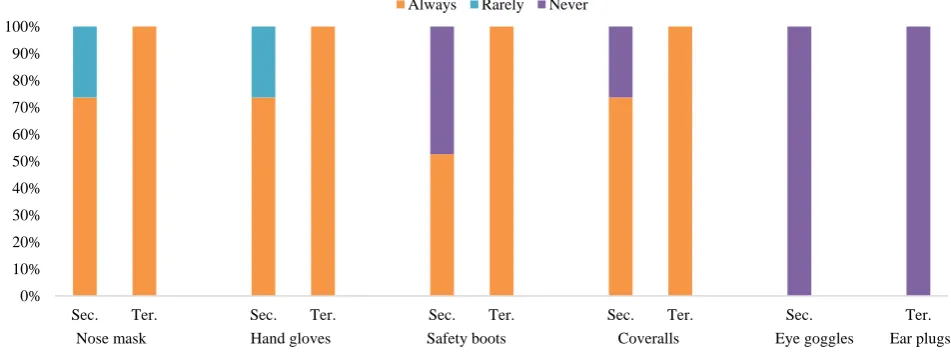
All the respondents of the private secondary and government tertiary hospitals who required nose mask for their job tasks reported that it was always provided for them, whereas, all the respondents in the government
secondary hospitals reported that it was rarely provided for them (Figure 1). An association between provision of nose mask and health facility type (p=0.016) and hospital category (p=0.000) was observed, as presented in Table 1.
Table 1: Socio-demographic characteristics of respondents.
Description of variables PS GS GT Total
n % n % n % n %
Age range of respondents (years)
≤30 2 14.3 0 0 2 6.5 4 8
31-40 2 14.3 1 20 9 29 12 24
41-50 3 21.4 1 20 9 29 13 26
51-60 4 28.6 2 40 7 22.6 13 26
>60 3 21.4 1 20 4 12.9 8 16
Mean age±S.D. 48.21±12.50 54.4±10.16 46.32±10.65 47.6±11.19
Sex of respondents
Male 2 14.3 1 20 17 54.8 20 40
Female 12 85.7 4 80 14 45.2 30 60
Educational qualification
None 5 35.7 2 40 2 6.5 9 18
Primary 5 35.7 2 40 11 35.5 18 36
Secondary 4 28.6 1 20 15 48.4 20 40
Tertiary 0 0 0 0 3 9.7 3 6
Years of working experience in hospital laundry
≤5 11 78.6 4 80 10 32.3 25 50
5-10 3 21.4 0 0 11 35.5 14 28
11-15 0 0 0 0 2 6.5 2 4
15-20 0 0 0 0 5 16.1 5 10
>20 0 0 1 20 3 9.7 4 8
Mean±S.D. 3.71±2.525 10.0±14 10.39±7.32 8.48±7.72
Mode of employment
Permanent 14 100 1 20 26 83.9 41 82
Contract 0 0 4 80 5 16.1 9 18
Key: PS=Private secondary, GS=Government secondary, GT=Government tertiary.
Table 2: Measure of association among health facility indices and PPE provision.
Table 3: Measure of association among health facility indices and PPE use.
Description of variables Type of health facility Hospital category
X2 P value X2 P value
Use of nose mask 24.783 0.000 24.958 0.000
Use of hand gloves 7.067 0.029 8.347 0.080
Use of safety boots 4.016 0.134 4.016 0.134
Use of coveralls 3.744 0.154 3.744 0.154
Description of variables Type of health facility Hospital category
X2 P value X2 P value
Provision of nose mask 5.758 0.016 38 0
Provision of hand gloves 5.758 0.016 38 0
Provision of safety boots 11.267 0.001 21.478 0
All the respondents of the private secondary and government tertiary hospitals who required hand gloves for their job tasks reported that it was always provided for them, whereas, all the respondents in the government secondary hospitals reported that it was rarely provided for them (Figure 1). An association between provision of hand gloves and health facility type (p=0.016) and hospital category (p=0.000) was observed as presented in Table 1.
As presented in Figure 1, respondents in private secondary (71.4%), as well as all of those in government tertiary hospitals who required safety boots for their job tasks reported that it was always provided for them, whereas, all the respondents in the government secondary hospitals reported that it was never provided for them. An association between provision of safety boots and health
facility type (p=0.001) and hospital category (p=0.000) was observed (Table 1).
All the respondents of the private secondary and government tertiary hospitals reported that coveralls were always provided for them, whereas, all the respondents in the government secondary hospitals reported that it was never provided for them (Figure 1). As presented in Table 1, an association between provision of coveralls and health facility type (p=0.003) and hospital category (p=0.000) was observed.
All of the respondents in the private secondary and government secondary hospitals who required eye goggles or face shields for their job tasks were never provided with them, as well as respondents in the government tertiary hospital who required ear plugs or muffs for their job tasks. This is presented in Figure 1.
Figure 1: Availability of personal protective equipment.
Figure 2: Use of personal protective equipment.
0% 10% 20% 30% 40% 50% 60% 70% 80% 90% 100%
Sec. Ter. Sec. Ter. Sec. Ter. Sec. Ter. Sec. Ter.
Respo
ndents
Always Rarely Never
0% 10% 20% 30% 40% 50% 60% 70% 80% 90% 100%
Secondary Tertiary Secondary Tertiary Secondary Tertiary Secondary Tertiary
Respo
ndents
Always Sometimes Never
Nose mask Hand gloves Safety boots Coveralls Eye goggles Ear plugs
Furthermore, whenever nose masks were provided for them, only 14.3% of respondents in private secondary hospitals, 20% of those in government secondary hospitals and none of them in the government tertiary hospital reported that they always made use of them (Figure 2). An association between use of nose mask and health facility indices (p=0.000) was observed, as presented in Table 2.
As presented in Figure 2, whenever hand gloves were provided for them, only 28.6% of respondents in private secondary hospitals, none of those in government secondary hospitals and 57.9% of those in the government tertiary hospital reported that they always made use of them. An association between use of hand gloves and health facility type (p=0.029) was observed, however there was no observed association between the use of hand gloves among the various hospital categories (p=0.080) (Table 2).
Also, among those provided with safety boots, only 10% of those in private secondary and none of them in the government tertiary hospitals reported that they always made use of them as presented in Figure 2. No association between use of safety boots and health facility indices (p=0.134) was observed, as presented in Table 2.
As presented in Figure 2, among those provided with coveralls, all of those in private secondary and 77.4% of them in the government tertiary hospitals reported that they always made use of them. No association between use of coveralls and health facility indices (p=0.154) was observed (Table 2).
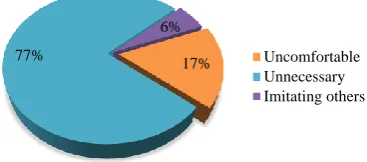
Majority of the respondents (77.1%) who failed to use nose masks always, reported necessity as the reason for the non-compliance, a further 17.1% reported discomfort as the reason, while the remaining 5.7% reported that they were simply imitating the vast majority who were non-compliant with the use of nose masks. This is presented in Figure 3.
Figure 3: Reasons for non-compliance in nose mask use.
As presented in Figure 4, majority of the respondents (95.7%) who failed to use hand gloves always, reported necessity as the reason for non-compliance, while the other 4.3% reported latex allergy as the reason for non-compliance in the use of hand gloves.
Also, majority of the respondents (74.1%) who failed to use safety boots always, reported discomfort as the reason for non-compliance, a further 14.8% reported necessity as the reason, while the remaining 11.1% reported that the boots did not fit them as they were not the right size for them (Figure 5).
Figure 4: Reasons for non-compliance in hand gloves use.
Figure 5: Reasons for non-compliance in safety boots use.
Respondents (85.7%) who failed to use coveralls always, reported necessity as the reason for non-compliance in the use of coveralls, while the other 14.3% reported discomfort as the reason. This is presented in Figure 6.
Figure 6: Reasons for non-compliance in coveralls use.
DISCUSSION
All the respondents in tertiary health facility who required nose mask and hand gloves for their job tasks reported that it was always provided for them, whereas, 17%
77%
6%
Uncomfortable Unnecessary Imitating others
4%
96% Allergy
Unnecessary
74% 15%
11%
Uncomfortable Unnecessary Improper size
14% 86%
Uncomfortable
some of those in the secondary health facility reported that these were rarely provided for them.
Furthermore, just over half of the respondents in the secondary health facility who required safety boots and coveralls for their job tasks reported that it was always provided for them, while respondents in tertiary health facility all reported safety boots and coveralls were always provided.
All of the respondents in the secondary health facility who required eye goggles or face shields for their job tasks were never provided with them, as well as respondents in the tertiary health facility that required ear plugs or muffs for their job tasks.
This is similar to findings by Kumar et al, who noted that the workers did not use ear plugs as it was not available to them, and was confirmed in a report by the Kenya ministry of health.8,11
These findings show that not all of the required Personal Protective Equipment were provided at all times for the laundry workers as recommended by the World Health Organization (WHO), stating that Personal Protective Equipment provides a physical barrier between hazards and the wearer, and should be used by healthcare workers, and supported by Pyrek who noted that exposure to potentially infectious pathogens in the laundry can be limited by the use of PPE.4,7
Whenever nose masks were provided for them, a number of respondents in the secondary health facility reported that they always made use of them, as opposed to respondents in the tertiary health facility who all reported otherwise. Majority of them reported necessity as the reason for non-compliance in the use of nose mask, as they believed wearing of nose mask was sometimes unnecessary.
Also, whenever hand gloves were provided for them, about half of the respondents in tertiary health facility reported that they always made use of them, as opposed to respondents in the secondary health facility, where only few of them reported so. Majority of those who did not always make use of hand gloves reported necessity as the reason, with latex allergy being the other reported reason. This is why EU-OSHA stated that it is imperative that protective gloves as well as any PPE be assessed before its selection and use.10
Furthermore, among those provided with safety boots, almost all of the respondents in both secondary and tertiary health facilities alike reported that they did not always make use of them, with majority of them reporting discomfort as the reason for non-compliance, stating that they did not feel comfortable in them while carrying out their job tasks. According to a study by Kumar et al, boots were ill-fitting especially for the
female laundry workers, uncomfortable and slowed movements during the activity.11
Among those provided with coveralls, almost all of the respondents in both secondary and tertiary health facilities alike reported that they always made use of them. Majority of the few who did not comply reported necessity as the reason for non-compliance, stating that wearing coveralls was not always necessary.
This is similar to findings by Kumar et al, who noted that the laundry workers did not use PPE consistently and that the factors affecting the noncompliance of the PPE usage depended on the type of PPE and activities they were involved in.11 This is consistent with the report by the Kenya ministry of health, where it was noted that in some cases where PPE provisions are made, the laundry staff either ignored their use or used them wrongly.8
Limitations of the study
Most of the respondents in the secondary health facility were not as literate as those in the tertiary health facility, and therefore, needed some help in providing responses to the questionnaire. This may have resulted in some form of bias when explaining the questions to the respondents and noting their responses.
Only one tertiary healthcare facility was compared with five secondary health facilities, and this does not provide a suitable ground for proper comparative analysis. Although total sampling was used in the study, the study population was not large enough to carry out more valid comparative analysis.
CONCLUSION
PPE were not always provided to the laundry workers, however, laundry workers in the tertiary health facility had PPE readily provided for them than those in the secondary health facility. Furthermore, the recommended use of the available PPE was dismal in both the tertiary and secondary health facilities alike.
Funding: No funding sources Conflict of interest: None declared
Ethical approval: The study was approved by the Institutional Ethics Committee
REFERENCES
1. Harrington JM, Gill FS, Aw TC, Applebey G, Atwell CP. Occupational health, 4th ed. Oxford (UK): Blackwell Pup; 2000: 3-347.
2. Russi MB, Howarth MV. Occupational medicine in health care industry: Text Book of Clinical Occupational and Environmental Medicine. 2nd ed. USA: Elsevier Inc; 2005: 245.
3. World Health Organization (WHO). Health worker occupational health. In: WHO, editors. Occupational Health - Health workers; 2012. WHO, Geneva; 2010.
4. Pyrek KM. Infection Control Today: Preventing Sharps Injuries and Blood-borne Pathogen Exposures in the Healthcare Laundry. Informa Exhibitions LLC; 2015: 12.
5. Amosun AM, Degun AM, Atulomah NOS,
Olanrewaju MF, Aderibigbe KA. Level of knowledge regarding occupational hazards among nurses in Abeokuta, Ogun state, Nigeria. Curr Res J Biol Sci. 2011;3(6):586–90.
6. Sukumar S, Karthiga VA. Study on Laundry Workers Attitude towards Health Care Industry in Trichy City. Int J Sci Res Pub. 2014;4(1):1-8. 7. World Health Organization (WHO). Practical
Guidelines for Infection Control in Health Care Facilities. WHO, Geneva; 2003.
8. Kenya Ministries of Health and IntraHealth International (KMHII). Report of the Occupational
Safety and Health Risk Assessment. Nairobi, Kenya: MsOH; 2013: 125.
9. Aluko OO, Adebayo AE, Adebisi TF, Ewegbemi MK, Abidoye AT, Popoola, BF. Knowledge, attitudes and perceptions of occupational hazards and safety practices in Nigerian healthcare workers. BMC Res Notes. 2016;9:71-84.
10. European Agency for Safety and Health at Work (EU-OSHA). Expert forecast on emerging chemical risks related to occupational safety and health; 2009. Available at: http://osha.europa.eu/en/publications/ reports/TE3008390ENC_chemical_risks. Accessed on 10 November 2018.
11. Kumar MS, Goud BR, Joseph B. A study of occupational health and safety measures in the Laundry Department of a private tertiary care teaching hospital, Bengaluru. Indian J Occup Environ Med. 2014;18(1):13-20.
12. Enwere OO, Diwe KC. Knowledge, perception and practice of injection safety and healthcare waste management among teaching hospital staff in South East Nigeria: an intervention study. Pan Afr Med J. 2014;17:218.
13. Ofili A, Asuzu M, Okojie O. Knowledge and practice of universal precaution amongst nurses in Central Hospital, Benin City, Edo State, Nigeria. Niger Postgrad Med J. 2003;10:26-31.