Sailing through Changing Oceans:
Ocean and Polar Life and Environmental
Sciences on a Warming Planet
Science Position Paper
Sailing through Changing Oceans:
Ocean and Polar Life and Environmental
Sciences on a Warming Planet
European Science Foundation (ESF)
The European Science Foundation was established in 1974 to provide a common platform for its Member Organisations – the main research funding and research performing organisations in Europe – to advance European research collaboration and explore new directions for research. ESF provides valuable services to the scientific and academic communities – such as peer review, evaluation, career tracking, conferences, implementation of new research support mechanisms and the hosting of high-level expert boards and committees – with the aim of supporting and driving the future of a globally competitive European Research Area. ESF currently has 66 member organisations in 29 countries.
www.esf.org
Editors
• Jean-Pierre Henriet, Renard Centre of Marine Geology, Department of Geology and Soil Sciences, Ghent University, Belgium
• Laura De Santis, Istituto Nazionale di Oceanografia e di Geofisica Sperimentale (OGS), Trieste, Italy
• Eva Ramirez-Llodra, Section for Marine Biology, Research Centre for Coast and Ocean, Norwegian Institute for Water Research (NIVA), Oslo, Norway
• Paola Campus, Scientific Review Group for Life, Earth and Environmental Sciences, European Science Foundation (ESF), Strasbourg, France
• Roberto Azzolini, Department of Earth System Science and Environmental Technologies, National Research Council of Italy (CNR), Rome, Italy
Authors
Chapters 1 and 2
• Jean-Pierre Henriet, Renard Centre of Marine Geology, Department of Geology and Soil Sciences, Ghent University, Belgium
• Laura De Santis, Istituto Nazionale di Oceanografia e di Geofisica Sperimentale (OGS), Trieste, Italy
Chapter 2
• Fabio Florindo, Istituto Nazionale di Geofisica e Vulcanologia, Roma, Italy
• Stephen Pekar, School of Earth and Environmental Sciences, Queens College, New York, USA; Earth and Environmental Sciences Ph.D. Program, The Graduate Center of the City University of New York, USA
• Dick Kroon, School of GeoSciences, Faculty of Science and Engineering, The University of Edinburgh, Scotland, UK
• Dierk Hebbeln, MARUM – Centre for Marine Environmental Sciences, University of Bremen, Germany
• Gert J. De Lange, Department of Geochemistry, Institute of Earth Sciences, Utrecht University, The Netherlands
Chapter 3
• Eva Ramirez-Llodra, Section for Marine Biology, Research Centre for Coast and Ocean, Norwegian Institute for Water Research (NIVA), Oslo, Norway
• Nadine Le Bris, Laboratoire d’Ecogéochimie des Environnements Benthiques; Université Pierre et Marie Curie, CNRS, Banyuls Marine Station, France
• Marina R. Cunha, Departamento de Biologia & CESAM, Universdade de Aveiro, Portugal
• Maria C. Baker, Ocean and Earth Science, National Oceanography Centre, University of Southampton, UK
• J. Murray Roberts, Centre for Marine Biodiversity & Biotechnology; Lyell Centre for Earth and Marine Science & Technology, School of Life Sciences, Heriot-Watt University, Edinburgh, Scotland, UK
• Cinzia Verde, Institute of Bioscience and
BioResources, National Research Council, Naples, Italy; Department of Biology, University Roma 3, Rome, Italy
• Guido di Prisco, Institute of Bioscience and BioResources, National Research Council, Naples, Italy
• Melody S. Clark, British Antarctic Survey, Natural Environment Research Council, Cambridge, UK
• Lloyd S. Peck, British Antarctic Survey, Natural Environment Research Council, Cambridge, UK
• Federico M. Lauro, Singapore Centre on
Environmental Life Sciences Engineering (SCELSE), Nanyang Technological University, Singapore; School of Biotechnology and Biomolecular Sciences, The University of New South Wales, Sydney, Australia
Chapter 4
• Paola Campus, Scientific Review Group for Life, Earth and Environmental Sciences, European Science Foundation (ESF), Strasbourg, France
• Roberto Azzolini, Department of Earth System Science and Environmental Technologies, National Research Council of Italy (CNR), Rome, Italy
Contents
Forewords 3
Executive Summary 6
Chapter 1 9
The Road to Climate Change Research: Life and Environment in Ocean and Polar Sciences
Of climate variability and climate change, of oceans and poles, and Grand Challenges 9 Prelude to the ECOPS Grand Challenges in Ocean and Polar Sciences 10 Peering into the climates of deep time: ocean and ice shelf drilling 12 Peering into recent climate variability: seabed and ice coring 14
Margin process studies in the MAST era and FP5 14
The rise of collaborative global studies in ecosystems, biodiversity and biogeochemistry 14 Peering into the near future: IPCC as the star of the fin de siècle 16 Human Resources and Infrastructure for European Ocean and Polar Sciences 17
The Cascais Initiative 18
Chapter 2 23
Dynamics of the Ocean and Polar Environment on a Warming Planet
Temporal Variability at Different Scales 25
Long-term climatic changes 25
Super warm interglacials in the Pleistocene record 28
Abrupt climate changes 31
Spatially Differentiated Responses 34
Sea level rise and the stability of ice sheets, from a geological perspective 34 Past and potential future effects on the oxygenation level for vulnerable European basins:
Baltic, Black and Mediterranean Sea 40
Chapter 3 45
Dynamics of Ecosystems under Global Change
Deep-sea biodiversity dynamics and ecosystem stability 48
Ecosystem connectivity in a changing ocean 51
Deep-sea biodiversity, ecosystem function and ecosystem services on our changing planet 55 The response of reef framework-forming cold-water corals to ocean acidification 61 Stresses on polar marine ecosystems: impact on key ecosystem functions and services 67
Chapter 4 73 Ocean and Polar Life and Environmental Sciences in Horizon 2020: opportunities and needs
Horizon 2020: Background in Marine and Polar Science Priorities 73 Climate Change & European Marine Ecosystem Research (CLAMER) 74 The EC Marine Strategy Framework Directive (MSFD, 2008/56/EC) 74 Joint Programming Initiative Healthy and Productive Seas and Oceans (JPI Oceans) 75
European Marine Board: Navigating the Future IV 76
The United Nations Conference on Sustainable Development (UNCSD) Rio+20 and
the theme of Oceans 76
The contribution of the International Atomic Energy Agency (IAEA) to the monitoring and
protection of marine environments 79
European Polar Science 80
Arctic Region 80
Antarctica 81
European Polar Board 82
The 4th European Marine Board Forum ‘Arctic 2050’ 83 The Transatlantic Alliance and the Galway statement 83 International Conference on Arctic Research Planning – ICARP III 83 Comparative Table of International Organisations’ Scientific Priorities
vs ESF Sailing through Changing Oceans 83
The First Horizon 2020 Work Programme 2014-2015 and Links to Relevant Ocean
and Polar Life Topics 88
Excellent Science: European Research Infrastructure 88 Societal Science: Food Security, Sustainable Agriculture and Forestry, Marine, Maritime 89 and Inland Water Research and the Bioeconomy
Societal Science: Climate Action, Environment, Resource Efficiency and Raw Materials 91 Dynamics of the Ocean and Polar Environment in a Warming Planet 94
Scientific Priorities 94
Areas of Opportunities in the first Calls and Actions of Horizon 2020 95 Relevant Scientific Topics in need of new Horizon 2020 Calls 96
Dynamics of the Ecosystems under Global Change 96
Scientific Priorities 96
Areas of Opportunities in the first Calls and Actions of Horizon 2020 97 Relevant Scientific Topics in need of new Horizon 2020 Calls 97
Marine Polar Research 98
Scientific Priorities 98
Sailing through Changing Oceans 3
The European Science Foundation (ESF) Science Position Paper Sailing through Changing Oceans
has experienced a long journey, originating from a meeting held in 2011 in Cascais, Portugal. At this venue, organised under the auspices of the ESF’s Standing Committee for Life, Earth and Environmental Sciences (LESC), now Scientific Review Group for Life, Earth and Environmental Sciences (SRG-LEE), a panel of scientists involved in the ESF European Collaborative Research Programmes EuroDIVERSITY, EuroMARC and EuroDEEP joined other scientific experts involved in the international programmes Antarctic geological drilling (ANDRILL), Life in Extreme Environments
(CAREX), The Commission for the Conservation of Antarctic Marine Living Resources (CCAMLR),
Evolution and Biodiversity in the Antarctic (EBA) and Integrated Marine Biogeochemistry and Ecosystem Research (IMBER). The Executive Secretary of the European Polar Board (EPB) also attended the meeting.
Coordinated by the European Science Foundation, the experts initiated a discussion on the theme of ocean and polar life and environ-mental sciences on a warming planet, exploring long-term and widely multidisciplinary collabo-rative opportunities in view of common and/or complementary top-priority future research needs in marine and polar areas: the valuable and syner-getic work of the group led to the decision, a few months later, to integrate all the outputs of the dis-cussion, including a number of scientific essays, into a dedicated European Science Foundation Science Position Paper.
The rapidly evolving European scenario for research in oceanic and polar regions within a warming planet scenario has prompted the authors not only to analyse the evolution of this scientific domain in the last 50 years and to identify the key and most pressing priorities for future research, but also to carefully analyse the recommendations made by international organisations and scientific clusters during the development of the European Commission Horizon 2020 Work Programme. The final part of the Science Position Paper provides the reader with an analysis of the past and potential future opportunities to develop research in
cutting-edge priorities in ocean and polar life linked to the warming of the planet under the Horizon 2020 umbrella, thus generating opportunities for new synergies among experts on climatic change, polar regions, ocean processes, marine ecosystems and biodiversity on a European and a global scale.
Sailing through Changing Oceans looks at key topics of the future of research on ocean and polar sciences in a warming planet, in the framework of the new European research perspective and of its link to the increasing societal needs for a sus-tainable economy. Recognising the fundamental importance of the indications provided by the UN Conference on Sustainable Development Rio+20 and of the related sustainable development goals,
Sailing through Changing Oceans advocates for a key concept, which brings together societal and research needs: ‘In the current context of global change, sus-tainable and responsible exploitation of the oceans can be realised only through a deep understanding of the ocean processes and of the associated ecosystems spanning every latitude of Planet Earth.’
Professor Dr Reinhart Ceulemans
Chair of the ESF Scientific Review Group for Life, Earth and Environmental Sciences, SRG-LEE
Dr Paola Campus
ESF Senior Science Officer in charge of the Scientific Review Group for Life, Earth and Environmental Sciences
Dr Roberto Azzolini
National Research Council of Italy (CNR), Department of Earth System Science and Environmental Technologies
Sailing through Changing Oceans 4
Indeed, concerning the two major environmental challenges we are facing today, that is the impact of climate changes and the preservation of biodiversity, the polar regions are of very particular scientific interest. The jeopardised future of the polar bear with the reduction in the extent of Arctic sea ice is already well known. Yet, with a region in Siberia, the region around the US Palmer Antarctic sta-tion in the western Antarctic Peninsula is the other part of our planet where the increase in mean tem-peratures is the most important. As a result, about 70% of some populations of Adélie penguins there have already disappeared. Even on the main part of the Antarctic continent, the modelling of the populations of the iconic emperor penguin suggest that according to the last IPCC scenarios they will become extinct in one or two centuries. Climate warming also results in invasive species establish-ing and competestablish-ing with endemic species such as common flies in the sub-Antarctic Kerguelen Archipelago.
However, considering biodiversity, the alarm-ing decline obviously does not only result from climate change as overfishing may superimpose on the effect of warming. It is particularly so in Arctic seas and the future of cod populations remains a major issue. With some exceptions, the Southern Ocean has been essentially preserved since the peri-ods of the massive destruction of seals and whales. Yet, an analysis of the impact of climate variability and long-term change is essential to determine the conditions for potential fisheries to be sustainable and allow for the preservation of biodiversity.
But there is also great scientific interest in investigating the biodiversity of the Arctic and Antarctic regions for basic research. Deciphering, for example, the phylogeny of fish of high latitudes with molecular biology tools enables a remarkable insight into the evolution of fish. Basic research can even contribute to biomedical and biotechnological applications, such as with enzymes which are still active at low temperatures or with antimicrobial and antifungal molecules.
With such important scientific challenges, we have to think of how our scientific communities can be organised to be efficient. Why should biologists not be able to reunite their forces at the
interna-tional level, and particularly by bringing together European resources, as physicists have been doing for years in particle physics! Clearly, by working together under the umbrella of the European Polar Board and the European Union, all the managers of European polar programmes could facilitate the achievement of the best science.
Indeed again, this report is very timely as it par-allels important international initiatives such as the SCAR horizon scan and the Belmont Forum Collaborative Research Action. Yet, we also need to make sure that, under the frame of the main sci-entific questions which emerge from communities, there is still a road for a bottom-up development of innovative individual initiatives.
Professor Yvon Le Maho
Director of Research, French National Centre for Scientific Research (CNRS)
Emeritus Member, French Academy of Sciences
Foreword
Sailing through Changing Oceans 5
I am very pleased that the European Science Foundation has been able to coordinate and support the meeting in Cascais, which generated a valuable synergy among a number of EUROCORES Project Leaders and experts of international programmes, resulting in the development of this publication.
The Science Position Paper is very timely, con-sidering the forthcoming new Work Programmes of Horizon 2020, and addresses key issues related to ocean and polar life and environment in a warming planet through the contributions from a range of experts, integrating in the final analysis the recom-mendations of the major stakeholders in marine and polar sciences.
The Science Position Paper is not only aligned with the societal element and message of the ESF-COST publication RESCUE: Responses to Environmental and Societal Challenges for our Unstable Earth, but it further elaborates con-cepts related to the sustainable development goals endorsed at the Rio+20 – United Nations Conference on Sustainable Development, and highlights priorities linking research and sustain-able development needs related to oceans and polar areas.
I concur with the vision on synergies in Polar Regions proposed by Professor Le Maho and I would like to add that a joint action of the European Polar Board, the European Marine Board and the European Union would be very beneficial to the development of research on ocean and polar life on a warming planet.
I have no doubt that this paper will be of interest to a large number of stakeholders and will generate opportunities for improved collaboration as well as concerted actions in the future.
Sailing through Changing Oceans 6
In the current context of global change, sustainable and responsible exploitation of the oceans can be real-ised only through a deep understanding of the ocean processes and of the associated ecosystems spanning every latitude of Planet Earth.
This publication originates from a meeting, held in 2011 in Cascais, Portugal, where a panel of scientists involved in a number of European Collaborative Research Programmes (EUROCORES) of the European Science Foundation (ESF) joined other scientific experts involved in international pro-grammes. The group of experts (named the Cascais Group) initiated a discussion on the theme of ocean and polar life and environmental sciences on a warming planet, exploring long-term and widely multidisciplinary collaborative opportunities with a view to identifying common or complementary top-priority future research needs in marine and polar areas.
The experts agreed on further developing their discussion and analysis though a publication pro-duced under the auspices of the European Science Foundation: the Science Position Paper Sailing through Changing Oceans: Ocean and Polar Life and Environmental Sciences on a Warming Planet.
Moving across space, from Antarctica to the Arctic through the Atlantic, an analysis of the long-term, mid-term and short-term climatic changes is presented and associated to the description of a number of key processes and impacts which highly affect ecosystems and need to be carefully addressed in the future.
The science position paper is developed in four chapters.
Chapter 1 is a scientific and historical excursus which sets the framework for the science position paper. Jean-Pierre Henriet provides a synthesis of the major milestones, from the late 20th century
to nowadays, related to climate variability and cli-mate change, oceans and poles and to the Grand Challenges associated to these themes. Chapter 1 addresses the fast rise of interest in climate vari-ability and climate change, of oceans and poles, and the consequent action of the European Committee on Ocean and Polar Sciences (ECOPS) in
launch-ing the Grand Challenges in Ocean and Polar Sciences. Furthermore, Chapter 1 addresses earth climate evolution at different scales, ranging from deep time, through ocean and ice shelf drilling, to recent times through seabed and ice coring. The rise of collaborative global studies in ecosystems, biodi-versity and biogeochemistry, including the Marine Science and Technology (MAST) era, are addressed as well. Chapter 1 also provides an insight into the near future and a discussion on human resources and infrastructure for European ocean and polar sciences.
Chapter 2 addresses the main priorities and open scientific questions related to the dynamics of the oceans and polar environments in a warming planet. Five scientific reports are presented, highlighting a number of key messages and priorities, related to: • Long-term climatic changes
• Super warm interglacials in the Pleistocene record • Abrupt climate changes
• Sea level rise and the stability of ice sheets, from the geological perspective
• Past and potential future effects on the oxygena-tion level for vulnerable European basins: Baltic, Black, and Mediterranean Sea.
Fabio Florindo and Stephen Pekar highlight how geological records provide a backdrop which helps us understand the relationships between climate changes and carbon cycling today. Periods of high concentration of greenhouse gases and global tem-peratures in the past provide examples of how the Earth operated under such a climate. The collection (through ocean, land and ice-based drilling pro-grammes) and exploitation of geological archives are, therefore, two key elements to assess the envi-ronmental changes observed nowadays and to project them in the future.
Dick Kroon concurs with the main conclusions of Fabio Florindo and Stephen Pekar and indicates the use of sediment cores combined with model simulations as a robust instrument to investigate causes and effects of climate warming in the North Atlantic and in the Arctic.
In line with the previous authors, Dierk Hebbeln looks with great interest to a global database
collect-Executive Summary
Sailing through Changing Oceans:
Ocean and Polar Life and Environmental Sciences on a Warming Planet
Sailing through Changing Oceans 7
ing information on past abrupt climate changes and puts high on the research agenda the collection and analyses of marine sedimentary and coral records.
Laura De Santis discusses how peri-Antarctic drilling could reveal the way ice sheets behaved in past periods of high temperature and high atmospheric CO2 content. She also highlights the contribution of peri-Antarctic drilling in the pro-cess of understanding how grounded ice responded to warming oceanic waters and to what extent the large freshwater discharges in a warming climate impacted sea level and the thermohaline circulation. Gert De Lange highlights how some of the ocean sub-basins, ranking among the most vulnerable on Earth, are within the European realm: the Baltic, the Mediterranean and the Black Sea. These seas have impacted in different ways climate zones and environmental conditions: thus the three seas offer a unique opportunity for conducting integrated stud-ies on any change (with special focus on oxygenation levels) which might impact their equilibrium, the biodiversity and the human use of the seas (includ-ing fisheries and recreation).
Chapter 3 addresses the main priorities and open scientific questions related to the dynamics of eco-systems under global change.
Five scientific reports are presented, highlighting a number of key messages and priorities, related to: • Deep-sea biodiversity dynamics and ecosystem
stability
• Ecosystem connectivity in a changing ocean • Deep-sea biodiversity, ecosystem function and
ecosystem services in our changing planet • The response of reef framework-forming
cold-water corals to ocean acidification.
• Stresses on polar marine ecosystems: impact on key ecosystem functions and services
Nadine Le Bris highlights the importance of habi-tats, species and gene diversity in deep-sea systems. Extreme environments provide unique natural mod-els to understand the mechanisms which establish and maintain biodiversity in deep-sea ecosys-tems. Key issues to be addressed to progress in the understanding of deep-sea habitats include the rela-tionship between energy sources and biodiversity, the role of engineer species, recruitment dynamics and growth rates and the response to disturbances.
Marina Cunha discusses the fundamental aspects of deep-sea biodiversity and ecosystem function in relation to our changing planet: the understanding of habitats, species, gene diversity of deep-sea systems and ecosystem connectivity in the oceans will help determine the effects of climate
change and/or human exploitation on marine eco-systems.
Eva Ramirez-Llodra and Maria Baker describe the unique attributes of deep-sea ecosystems and the services they provide, engaging the reader in an overview and discussion of current impacts faced by one of the last pristine biomes in Planet Ocean. The increasing use of deep-sea services, ocean acidi-fication and climate change impact ecosystems and biodiversity. The authors indicate it is imperative to continue to explore and study deep-sea envi-ronments using interdisciplinary and ecological approaches.
Murray Roberts highlights how acidification caused by increasing anthropogenic CO2 affects the
oceans by inducing a decline of sea water pH and substantial modifications in cold-water corals. The author recommends developing long-term experi-ments to assess the effects of temperature changes, ocean acidification and multiple stressors on marine ecosystems.
In the final essay of Chapter 3, Cinzia Verde, Guido di Prisco, Melody Clark, Lloyd Peck and Federico Lauro highlight the vulnerability of polar ecosystems and focus on the potential cumulative effects of climate change on organism physiology, populations of individual species, community com-position and biodiversity. The authors propose as a priority a set of key questions to address the impact of stressors on key ecosystem functions and services of polar marine ecosystems.
Chapter 4 projects the priorities identified in Chapters 2 and 3 into the new European research scenario characterised by the EU Framework Programme for Research and Innovation Horizon 2020.
In the first part, Paola Campus and Roberto Azzolini provide a synthesis of the publications, principal conclusions and recommendations of the major scientific clusters and international organisa-tions in the scientific areas covered by the science position paper Sailing through Changing Oceans. Going through a summary of publications produced between 2011 and 2014 and addressing marine and polar topics linked to climate change, life and envi-ronment, the authors highlight how some of these publications specifically aimed at influencing the forthcoming Horizon 2020 calls, while some others (in particular those linked to international organi-sations) used a more general approach to highlight the main societal needs for achieving sustainable development, respectful of the environment.
Sailing through Changing Oceans 8
the EC Marine Strategy Framework Directive (MSFD, 2008/56/EC), the Joint Programming Initiative Healthy and Productive Seas and Oceans (JPI Oceans), the European Marine Board, the UN Conference on Sustainable Development (Rio+20), the International Atomic Energy Agency (IAEA) and the European Polar Board have been taken into consideration. Noting that such priorities refer to phenomena on a global scale, oft en including polar areas (e.g., sea level rise, changes in marine ecosys-tems, climate change and ocean acidifi cation), but not necessarily covering all the key challenges asso-ciated with these extreme regions (e.g., permafrost, ice melting, recent climate change and adaptation of marine organisms), the authors present a com-parison of such priorities with the research priorities indicated in Chapters 2 and 3.
In the second part of Chapter 4 Paola Campus and Roberto Azzolini analyse the calls of the fi rst Horizon 2020 Work Programme 2014-2015 related to ocean and polar life and environmental sciences on a warming planet.
Th e areas of opportunities generated for the priorities listed in Chapters 2 and 3 are discussed both on a global scale and on a polar scale. Next, the authors highlight which research priorities listed in Chapters 2 and 3 are still in need of fi nding a niche in the second and third run of calls of the forth-coming Horizon 2020 Work Programmes, aiming to stimulate the scientifi c community to become proactive with the relevant stakeholders in order to cover the still existing gaps.
Sailing through Changing Oceans 9
Of climate variability and climate
change, of oceans and poles, and
Grand Challenges
By the late 20th century, the topic of ‘Climate Change’
had moved into the foreground, impacting on both society and science. When assessing climate change, both in a scientific and societal context, it is impor-tant to remain aware of two competing processes in the observational record and in any reasonable scenario of expected future climate evolution (von Storch and Hasselmann 1996): in the coupled ocean-atmosphere-biosphere-climate system, ‘climate change’ and ‘climate variability’ have similar signa-tures, namely low-frequency climatic modifications, and are therefore sometimes confused.
• ‘Climate variability’ arises from natural mecha-nisms unrelated to Man’s actions. A distinction should be made between external and internal
natural variability. Major external controls result from orbital periodicities (the ‘Milankovitch’ cycles), from variations of the energy output of the sun and from shielding of the atmosphere mainly by volcanic ash. Internal variability arises from (a) non-linear interactions yielding multiple equilib-ria, and (b) the accumulation of short time-scale ‘weather noise’. A relevant example of non-linear dynamics yielding multiple equilibria is linked to the North Atlantic Ocean circulation, in particular in its relation to North Atlantic overturning. • ‘Climate change’ (written in this essay as ‘Climate
Change’ when viewed from a societal perspective) is reserved to denote the formation of persis-tent climatic anomalies which are related to the
activities of Man. Examples of drivers are urbani-sation, deforestation and desertification, and anthropogenic emissions of greenhouse gases, aerosols and soot.
In both climate variability and climate change, the oceans and the poles jointly take a central position, for two reasons in particular:
a. the ocean realm is the main storage and re-dis-tributor of heat on our planet and it hosts vital but vulnerable resources of food and energy, and b. the polar environment consorts with ocean
dynamics, and by its sensitivity it provides early warning of any change.
Both environments have, moreover, remarkably built – in sediments and ice – a parallel archive of climate variability and climate change, of instructive read-ing and confrontation.
In the preface to what can perhaps be identified as the first European position paper on ocean and polar research (Wainwright Ed. 1991, Figure 1.1), Professor Umberto Colombo, President of the European Science Foundation (ESF), and Professor Paulo Fasella, Director-General for Science, Research and Development at the Commission of the European Communities (EC DG XII), stated that, by their very nature, the oceans and Polar regions call for cooperation in research, and placed the development of a long-term European strategy in marine and polar research high on the agenda.
In early 1990, EC DG XII and ESF estab-lished together a European Committee on Ocean and Polar Sciences (ECOPS). ECOPS prepared a
Chapter 1
The Road to Climate Change
Research: Life and Environment
in Ocean and Polar Sciences
l l l
Sailing through Changing Oceans 10
series of European Research Conferences on various themes at the frontiers of marine and polar sciences that were recognised as of particular interest for Europe. Th e outcome of these European Research Conferences was reviewed by a major policy con-ference that attracted scientists, engineers and policy makers from all over Europe and beyond: the
European Conference on Grand Challenges in
Ocean and Polar Science, organised in Bremen in
September 1994 (Hempel 1996, Figure 1.2).
Long before 1990, a number of initiatives of internationally organised collaborative programmes for the study of the oceans and the poles and for the shaping of a sound governance of the ocean’s resources had sprung up in Europe. Karl Weyprecht draft ed the outline of the International Polar Years in 1875. Otto Pettersson moved the creation of the International Council for the Exploration of the Sea (ICES) in Copenhagen in 1902. One year later, Prince Albert of Monaco chaired the launching of the General Bathymetric Chart of the Oceans (GEBCO) in Wiesbaden. Th e festive opening of the monumental Musée Océanographique in Monaco, in March 1910, was followed by the launching of the Commission Internationale pour l’Exploration Scientifi que de la Mer Méditerranée (CIESM) the very next day.
Th e Grand Challenges presented in Bremen in 1994 were defi ned as four major long-term projects
for European cooperation. Th ey were announced in ESF Communications nº 28 (April 1993) and in the second edition of the brochure Th e Ocean and the Poles (September 1993). Before that, they had been submitted as draft proposals to the heads of the ESF and EC DG XII for consideration in the EC 4th Framework Programme (FP4, Marine
Science and Technology programme MAST 3 and ENVIRONMENT programmes). All four Grand Challenges were considered for a period of 6-10 years and a budget of over 50 MECU each. Th e four Grand Challenges and their promoters were (Hempel 1996): • Operational Forecasting of the Oceans and Coastal
Seas (J. Woods and W. de Ruijter)
• Variability of the Deep Sea Floor (X. Le Pichon) • Th e Arctic Ocean (O. Johannessen)
• European Programme on Ice Coring in Antarctica (EPICA) (C. Lorius).
Th e operational forecasting of the oceans and coastal seas was concretised in the founding of EuroGOOS (European Global Ocean Observation System) in 1994. It grew into an association of agencies to fur-ther the goals of operational oceanography under GOOS in the European seas, counting today some 34 members from 17 EU Countries and actively organising conferences. The three other Grand Challenges would contribute in a major way to our fundamental insights into ocean and polar science in a context of Climate Change.
Prelude to the ECOPS Grand
Challenges in Ocean and Polar
Sciences
Th e 1994 Grand Challenges did not come out of the blue. When the heads of Directorate XII of the European Commission and of ESF met in 1990 to create jointly a European Committee on Ocean and Polar Sciences (ECOPS), they clearly had in mind to put Europe back on the map of global ocean and polar science, through cooperation.
Th e leaders of the Grand Challenges were all ‘Captains of Science’, high-profi le scientists who had taken major responsibilities at institutional level in their country and internationally, and who yearned for more, for bigger. Gotthilf Hempel, for instance, was the fi rst director of the Alfred-Wegener-Institute for Polar and Marine Research, founded in 1980 in Bremerhaven, and he held that position from 1981 to 1992. John Woods was Director of Marine Science for NERC from 1986 to 1994. Part of Woods’ vision was global oceanography. Th e World Ocean Circulation Experiment (WOCE) had been planned during the 1980s and a bid was made for the UK to play a major
Figure 1.1.
The Ocean and the Poles (Wainwright Ed. 1991).
Figure 1.2.
Sailing through Changing Oceans 11
role (Laughton et al. 2010). Ola M. Johannessen (NERSC, Bergen) had just launched in 1992 the Nansen International Environmental and Remote Sensing Center (NIERSC) in St Petersburg, exempli-fying the opening of cooperation with Russia. Xavier Le Pichon had contributed to the rise of the theory of plate tectonics in the US, before becoming in 1969 the director of the Marine Geoscience department at the Centre Océanologique de Bretagne (COB) in Brest, under CNEXO. The merger of CNEXO – the
Centre National d’Exploration des Océans – and the fisheries institution ISTPM in 1984 had meanwhile given shape to IFREMER, soon to become a key player in global ocean science and technology.
But the challenge was grand indeed. After the pioneering work of the early 20th century evoked
earlier, European ocean science, and in particular the dynamic oceanography which had come to an extraordinary level of development in Scandinavia at the turn of the century before finding a first fos-ter home in Germany in the 1920s, migrated to the US in the later interbellum. The Oceans, the 1,100 pages thick magisterial treatise which for decades would be the definitive source book in biological, chemical, geological and physical oceanography, was written in the US, with a Scandinavian pen: Harald Sverdrup wrote it jointly with his US col-leagues Martin Johnson and Richard Fleming (Sverdrup et al. 1942), shortly after he had taken the helm at Scripps Institution of Oceanography in 1936. Strengthened by wartime naval research, US oceano-graphic institutions would soon move – only rivaled by Russian colleagues – into the driver’s seat of post-war global ocean and polar research programmes, from the 1950s (the International Geophysical Year of 1957-58 included) until well into the 1970s. In palaeoclimate technology, Russia had moved to the forefront in deep ice coring. The team of Claude Lorius from St Martin d’Hères, France, who would pilot EPICA, had built fame by already untangling a first 160,000-year record of atmospheric CO2 in the Russian Vostok Ice Core, Antarctica (Barnola et al., 1987).
Europe was awakening in the late 1980s, emerg-ing from a relatively short but painful economic crisis. It was the European Science Foundation (ESF) that would pave the way to European collaboration in ocean and polar science. At its founding in 1974 in Strasbourg, ESF was not much more than a contact forum where officers from European research coun-cils exchanged experience and protocols in science management. Soon, some seed funds were pooled from national resources for the organisation of inter-national research conferences and for exploratory networking across national boundaries. In ocean
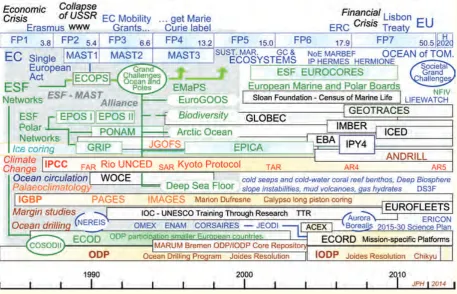
and polar environmental and life sciences, ESF’s early networks ECOD, EPOS, PONAM and GRIP, launched between 1986 and 1990, would broaden transnational access to large infrastructures such as vessels and drilling tools. These networks would become the cradle of the 1994 Grand Challenges (Figure 1.3).
Only the sizable resources of the European Commission, however, could foster some level of sta-bility in transnational access to large infrastructures. Thirteen years after the creation of ESF, in 1987, the European Single Act, the first major revision of the 1957 Treaty of Rome, had set the European single market as a target for 1992. By the same token, sci-ence became a Community responsibility. This context clarifies the steady intertwining of science and economic considerations in EC programmes: for the EC, science is part of a strategy of economic development. From 1987 onwards and for more than 20 years, the subtle balance of cooperation and competition between bottom-up, broadband, curios-ity-driven science with a global vision embodied by ESF, and top-down, policy-driven science supported by the EC for strengthening the economic interests of the European Union, would give an unprece-dented boost to European science and technology.
This boost was timely: on a background of col-lapse of the former Soviet Union, the perspective of growth of the single market had sparked the ambi-tions for a more global role for Europe. Moreover, the period between 1986 and 1990 saw a remarkable global mobilisation towards ocean and polar science, which had no equivalent since the International Geophysical Year of 1957-58. The birth of the World Wide Web in 1989 came no doubt in support of global communication and collaboration. The World Ocean Circulation Experiment (WOCE, 1990-98) was to be the first truly global-scale investigation of the role of the oceans in climate. The International Geosphere-Biosphere Program (IGBP) was founded in 1986 and the Joint Global Ocean Flux Study (JGOFS), launched in 1987, would clarify how ocean biological processes responded to Climate Change. As to IPCC, launched in 1988, it would soon confront Man with an inconvenient truth.
Some major phases in this development are dis-cussed below. For obvious reasons, this overview cannot be complete. It focuses on two questions, clarified further under the heading of the Cascais Initiative:
• What can we learn from past Climate Changes, documented in marine sediments and ice cores? • How will Climate Change impact on ecosystems,
Sailing through Changing Oceans 12
Peering into the climates of deep
time: ocean and ice shelf drilling
As soon as the Deep Sea Drilling Project (DSDP) had started its operations in 1967 on board of Glomar Challenger, month by month its discoveries revolu-tionised our ideas about Earth’s ocean and climate history: the youth of the ocean basins, the drying up of the Mediterranean, the overall Cenozoic cooling trend revealed by oxygen isotopes, etc. In addition, cores recovered from the South Atlantic provided convincing support to the still infant plate tectonic hypothesis.
Quite a few European scientists had informally joined DSDP cruises upon invitation from US col-leagues. In the years 1972-74, plans were made for internationalisation: DSDP moved in 1975 into its International Phase of Ocean Drilling (IPOD). Some veterans believe now they should have copy-righted the acronym. The partners France, USSR, Germany, United Kingdom and Japan each con-tributed an equal sum, while NSF concon-tributed two-thirds of the funding, thereby retaining ulti-mate control.
When the end of DSDP (1983) was in sight, the Carter administration first considered a US Ocean Margin Drilling (OMD) initiative as successor: an academia-industry programme, to explore the
petro-leum potential of the US continental margin (Hay 2013). When none of the targeted partners proved enthusiastic – for varying reasons – a Conference on Scientific Ocean Drilling (COSOD) was convened in 1981 in Austin, Texas, to draft the outline of a new, international Ocean Drilling Program (ODP). The vessel would become the JOIDES Resolution. The considered term was 20 years, from 1983 to 2003 – a declaration of intent Europeans currently can only dream of. The Russian partner having mean-while been excluded by the Reagan administration, there was a financial gap, and an opportunity for the smaller European Countries to move in, to join France, Germany and the United Kingdom. The ESF Network ECOD (European Science Foundation Consortium for Ocean Drilling) was readily forged, with Belgium, Denmark, Finland, Iceland, Ireland, Italy, The Netherlands, Norway, Portugal, Spain, Sweden and Switzerland being members. A second Conference on Scientific Ocean Drilling (COSOD II) was attracted to Strasbourg in 1987, within the scheme of ESF conferences. The proceedings, which highlighted the first successes of ocean drilling, set the stage of well documented position documents, readily usable as handouts in higher education.
But ambition was in the air. Yves Lancelot from CEREGE, close to Marseille, who had enthusias-tically sailed on Glomar Challenger, proposed to
Sailing through Changing Oceans 13
IFREMER the design of a European drilling ves-sel ‘light’: NEREIS. The concept was visionary: a flexible, multi-purpose vessel with removable rig, capable of drilling in water depths confined to 6,000 m – a choice allowing relatively reasonable dimensions and operational costs. NEREIS could readily turn into a platform for the deployment and recovery of automated vehicles and seabed observa-tories, through the sizable moon pool. A NEREIS
Conference organised with EC MAST support in Brussels in 1990 attracted a vast and thrilled sci-entific audience. Nick Shackleton (Cambridge) chaired the palaeoceanography panel, which gen-erated a convincing recommendation. Alas, while
NEREIS was depicted as an ideal companion to
Joides Resolution, quite a few supporters of ODP rather identified her as a competitor, and they fiercely combated the ‘French ship’. After several years of vain efforts to rally broad European sup-port, the project was discontinued. NEREIS had in many aspects been conceived ahead of her time, on the wrong continent.
The ECOD scheme under ESF, however, oper-ated smoothly. Soon, the power of proposal of European scientists involved in ocean drilling science, supported in their exploratory efforts by MAST and national funding, significantly ampli-fied. Sites urging for groundtruthing multiplied along the European margins, as evidenced in the preparatory meetings of the Bremen Grand Challenge Conference. European proposals deal-ing with palaeoceanography and palaeoclimatology, geofluids and Geosphere-Biosphere coupling pro-cesses, slope instabilities, polar margin evolution, etc. were piling up in the ODP system.
At the Bremen Grand Challenge Conference, the plan was phrased to meet the rising demand in a flexible way by ad hoc chartering of a geotech-nical drilling vessel. A pilot exercise, based on an open call for letters of intent, documented a pos-sible scenario comprising two multi-project sweeps along the European margins: an Atlantic leg and a Mediterranean leg. The FP4 coordination action CORSAIRES would not straightforwardly obtain the EC funds for chartering a vessel, but it was able to promote in international conferences and workshops the concept of science drilling with mission-specific platforms, as well as some novel scientific themes and relevant technologies.
The concept of mission-specific platform operations, as a European strategy within ODP, further ripened within the FP5 project JEODI (Joint European Ocean Drilling Initiative). Efforts to raise substantial long-term EC support for the participation of European teams in ODP under
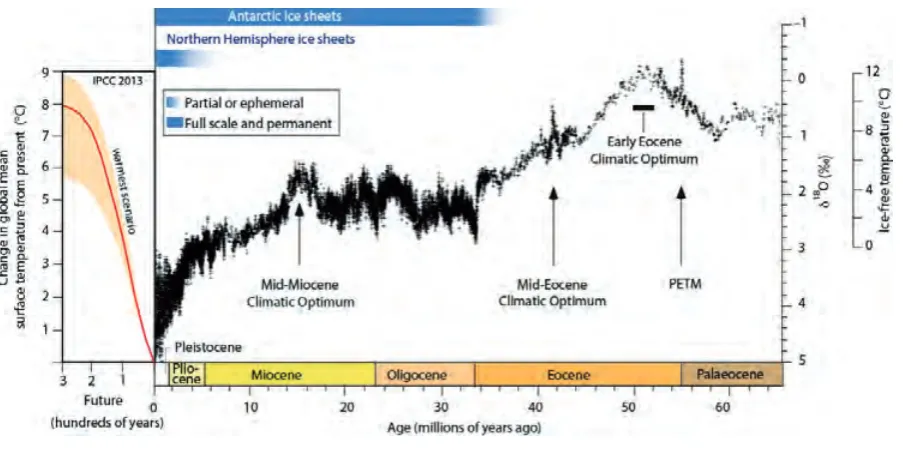
EC Art. 185 proved vain. Mission-specific platform drilling was finally concretised in 2004 as core business of ECORD (European Consortium for Ocean Research Drilling) – the European com-ponent of the Integrated Ocean Drilling Program (IODP). Europe’s position in ocean drilling science had meanwhile been further strengthened by the opening of the MARUM ODP Core Repository in Bremen in 1994, which would soon act as a hub for core research and science training (summer schools). ECORD started with panache: in an impressive exercise of operational coordination and ice man-agement, project ACEX (Arctic Coring Expedition) mobilised in August 2004 three icebreakers – the Vidar Viking (with a purpose-built drill rig), the Oden and the Sovetskiy Soyuz – to drill the Lomonosov ridge at barely 250 km from the North Pole, in heavy sea ice. Five drill holes unveiled the Arctic’s role in the development of the Palaeogene greenhouse, some 40 to 60 million years ago (Figure 2.1), and the Neogene icehouse, which we entered some 12 million years ago. In 2013, Russia would move back into the international ocean drilling community, as member of ECORD.
As a counterpart in the Antarctic, the ANDRILL project tracks the earliest glacial history of the Antarctic continent. No icebreakers are required there: the drill rig is built on the ice shelf. ANDRILL builds upon the successes of the McMurdo Ice Shelf Project (2006-07) and the Southern McMurdo Sound Project (2007-08). Two new drillings are planned in 2016-18 on the seaward edge of the Ross Ice Shelf, to further document the Palaeogene to Lower Miocene history of Antarctica, between some 65 million and 15 million years ago.
In 2002, a concept study was started in Germany for an icebreaker with drilling capacity, the Aurora Borealis. The final design and budget estimate, in 2008, led the German Science Council to revise pri-orities, putting the construction of a successor of the icebreaker Polarstern upfront. In parallel, the exten-sion of the drilling capacity of MARUM’s robotic sea floor corer MeBo to a depth range of 200 m opens a vast range of opportunities in palaeoclimate stud-ies. The evoked option of a couple of years of parallel operations of the existing and the new Polarstern in the northern and southern hemisphere might create a unique polar research momentum. In the UK, the BGS Rockdrill is another robotic seafloor drill rig, and a commercial ice-strengthened drill ship, the
Sailing through Changing Oceans 14
Peering into recent climate
variability: seabed and ice coring
When the French research and Antarctic supply ves-sel Marion-Dufresne was launched in 1995, equipped with the unique 60 m long Calypso piston corer, she already allowed a vast number of objectives of the palaeoclimate community to be addressed, well coordinated within the IMAGES programme (PAGES, IGBP). IMAGES (International Marine Aspects of Past Global Changes) closely dovetails with the CLIVAR programme (Climate Variability and Predictability) of the World Climate Research Program (WCRP).
The full unraveling of the recent glacial history of our planet, however, results from the coordinated analysis of seabed cores and ice cores. The ESF net-work GRIP (Greenland Ice Coring Project), funded by 8 European partners and the EU, successfully cored over 3,000 m of ice on the Summit site, cen-tral Greenland (1989-1992), providing the detailed northern hemisphere record of Earth’s climate over the past 250,000 years. It would be relayed in 1999-2003 by the North Greenland Ice Coring Project (NGRIP).
Building upon that experience, the ECOPS Grand Challenge project EPICA drilled at Dome Concordia in Antarctica, from 1996 to 2005, again with support of the EC and national contributions. When drilling was completed, about 5 m above the bedrock, some 3,270 m of ice cores revealed a full sequence of eight glacial cycles, spanning 740,000 years, a record substantially longer than VOSTOK (which extended back to 420,000 years ago). Air bubbles in the ice revealed that atmospheric carbon dioxide levels remained below 275 ppm over this entire interval. In May 2013, the monitoring station at Mauna Loa recorded that CO2 in our atmosphere, fueled by man-made emissions, had passed the threshold concentration of 400 ppm.
Margin process studies
in the MAST era and FP5
The ESF Polar North Atlantic Margins Network (PONAM) contributed to increasing our under-standing of the Late Cenozoic history of the European Arctic bordering the Norwegian and Greenland Seas, both in marine and terrestrial environments. It is among the first collaborative programmes in Europe showing the flag of ‘mar-gins’ research. The Grand Challenges on the Arctic Ocean and the Deep Sea Floor further were concre-tised in a range of integrated projects under MAST
2 (FP3). No fewer than eight projects rallied to the common objective of the study of exchange pro-cesses at the continent-ocean margin in the North Atlantic. Among them the very large integrated project OMEX (Ocean Margin Exchange), ENAM (European North Atlantic Margin: Sediment Pathways and Fluxes), SEEP (fluid seepage along the continental margin) and STEAM (Sediment Transport on European Atlantic Margins), of which some would continue in MAST 3 (ENAM II, OMEX II, FP4). This effort did not remain unnoticed across the Atlantic: the considerable momentum in European margin exchange process studies had achieved an integration that went beyond the level established in the United States, and they were chal-lenging US scientific leadership in this topical area (Mooers et al. 1996).
The momentum indeed continued through MAST 3 and even increased in the subsequent Sustainable Marine Ecosystems Key Action of the 5th Framework Programme (FP5). In the latter, a
number of clusters of funded research projects were formed, such as OMARC (Ocean Margin Deep-Water Research Consortium, 13 projects), ELOISE (European Land-Ocean Interaction Studies, as con-tribution to the LOICZ Core Project of IGBP, 25 projects under FP5, 54 projects since its inception), IMPACTS (Impacts of pollutants on the marine environment, 16 projects), EUROHAB (Harmful Algal Blooms, 8 projects under FP4-FP5), the Marine Biodiversity Cluster (12 projects) and the Operational Forecasting Cluster (23 projects). The projects under OMARC, of which many were rooted in the Grand Challenge of the Deep Sea Floor, are listed in Box 1.1. Some of them, such as COSTA, had started interacting with industry, in particular oil companies.
The goals set by ESF and the EC for the four ECOPS Grand Challenges, to achieve an impact on European ocean and polar life and environmen-tal sciences for a period of 6-10 years, mobilising budgets of over 50 MECU each, had clearly been achieved. The OMARC cluster alone represents an EU contribution of 25 M€.
The rise of collaborative global
studies in ecosystems, biodiversity
and biogeochemistry
Sailing through Changing Oceans 15
Today, scientific shipboard parties on European vessels represent as a rule a spectrum of nation-alities. This little revolution in Europe can be once more pinpointed to the magic turn of the 1980s into the 1990s. Two initiatives contributed in concert: (a) the start of the Marine Science and Technology (MAST) programme, which requested transna-tional collaboration to get EC funding, and (b) an Antarctic cruise leg on R/V Polarstern offered by the Alfred-Wegener-Institute for Polar and Marine Research in collaboration with ESF, the latter pro-viding the networking funds in the framework of the European Polarstern Study – EPOS.
The EPOS Weddell Sea Ecology Study 1988-89 for the first time invited in a competitive context science proposals from all over Europe: for many European young scientists having otherwise no
access to ships, and certainly not to the Antarctic, a dream came true. EPOS could not have made a bet-ter promotion for the dawn of the MAST years, and considering the success, the operation was repeated with EPOS II in 1991 on the European Arctic shelf.
While the theme of biodiversity had been pre-pared as a potential Grand Challenge, eventually it was not promoted as such at the Bremen 1994 Conference. This would not prevent ecosystems and biodiversity moving en force onto the agenda of European ocean and polar sciences in subsequent years. In FP5, all relevant marine research would be put under the Sustainable Marine Ecosystems Key Action, and in FP6 under Sub-Priority Global Change and Ecosystems. As a matter of fact, under FP5 and FP6, life and environmental sciences in the marine and polar realm in general moved forward in integrated, multidisciplinary projects.
The world of ecosystems in the deep sea and on continental margins indeed became much more diverse than anyone could ever have anticipated. In the early 1990s, ODP had revealed a totally unexpected ‘Deep Biosphere’, a microbial world extending over 700 to 800 m below the seabed. Cold seeps in the Black Sea, mud volcanoes from the Nile delta to the Norwegian margin and seafloor brine lakes on the Mediterranean Ridge turned hot-spots of microbial communities. Calving ice shelves uncovered unexpected ecosystems. Cold-water coral reefs, most of them known to fishermen for years, were re-discovered in the spotlights of remotely operated vehicles in depth ranges between 300 and 1,200 m, off Norway, Scotland and Ireland, in the Bay of Biscay and on many sites in the Mediterranean. Deep water canyons turned out to be important refuges, and conservation issues came high on political agendas: deep water marine pro-tected areas came into being.
In the direct post-MAST times, under FP5, it was still the environment that was the unify-ing theme of many projects (slopes, sedimentary systems, canyons, seeps and gas hydrate systems, mounds, deltas, etc., cfr. Box 1.1). From the large integrated projects and networks of excellence of FP6 onwards, ecosystems and biodiversity took the driver’s seat, with, in particular, the large Network of Excellence MARBEF (Marine Biodiversity and Ecosystem Functioning) and the suite of large-scale Integrated Projects HERMES (Hot Spot Ecosystems Research on the Margins of European Seas) in FP6 and HERMIONE (Hotspot Ecosystem Research and Man’s Impact on European Seas) in FP7.
The evolution towards large-scale integrated projects and networks was not only strategic, it was also a pure management necessity for the European
Box 1.1. 5th Framework Programme,
Sustainable Marine Ecosystems Key Action
Cluster OMARC (Ocean Margin Deep-Water Research Consortium)
ACES – Atlantic Coral Ecosystem Study
ANAXIMANDER – Exploration and
Evaluation of the Eastern Mediterranean Sea Gas Hydrates and the Associated Deep Biosphere
COSTA – Continental Slope Stability
DEEPBUG – Development and Assessment
of new Techniques and Approaches for Detecting Sub-Seafloor Bacteria and their Interaction with Geosphere Processes
ECOMOUND – Environmental Controls
on Mound Formation along the European Margin
EURODELTA – European Coordination on
Mediterranean Prodeltas
EUROSTRATAFORM – European Margin
Strata Formation
GEOMOUND – The Mound Factory –
Internal Controls
HYDRATECH – Techniques for the
Quantification of Methane Hydrate in European Continental Margins
METROL – Methane Fluxes in Ocean
Margin Sediments: Microbiological and Geochemical
PROMESS – Profiles across Mediterranean
Sedimentary Systems
STRATAGEM – Stratigraphic Development
Sailing through Changing Oceans 16
Commission. The marine projects enumerated earlier in the clusters of the Sustainable Marine Ecosystems Key Action of FP5 come to a total of 126. Rather than clustering a posteriori individual research projects (some of them already sizable) as under FP5, the policy of FP6 was to forge a priori
large Integrated Projects – like HERMES – and Networks of Excellence (e.g., MARBEF). Even doing so, the EC was confronted with a total of 479 marine related science and technology projects in FP6, representing some 3.3% of the total of 10,490 funded projects (FP6 budget: 17.9 B€). It is not unex-pected that with the further budget rise of FP7 and Horizon 2020 to respective levels of 50.5 and close to 80 B€, the overall enlargement of project scale is here to stay. The last call of FP7 addressing ocean sciences, ‘The Ocean of Tomorrow’ (2010-2013) – announced as ‘Joint Research Forces to Meet Challenges in Ocean Management’ – came to sup-port some 31 projects, many counting between 20 to 38 participating teams. In such development, attention may have to be paid to the impact of this enlargement of scale on opportunities for univer-sity research units to take a fair lead in projects and secure the valorisation of their intellectual property, a crucial element for the sustainable generation of Europe’s brainpower.
The momentum achieved through Europe’s framework programmes shaped increased oppor-tunities for European teams to join international efforts or overseas initiatives. Many European teams contributed to the Census of Marine Life project (CoML), funded by the US Sloan Foundation for a term of 10 years. This would become an important stimulus for biodiversity research. The concept of CoML would find some continuity in Europe from 2013 onwards, for marine and continental life, in the ESFRI E-Science LifeWatch project: a European Infrastructure for Biodiversity and Ecosystems Research.
At the beginning of the 21st century, ecosystems
research also penetrated more deeply into global ocean circulation and Climate Change studies, which formerly had been dominated by physical and chemical oceanographers. A Global Ocean Ecosystem Dynamics study (GLOBEC), conceived in 1990 and integrated as IGBP Core element in 1995, was implemented from 2000 to 2010. In 2005, it branched into the IGBP-SCOR programme IMBER (Integrated Marine Biogeochemistry and Ecosystem Research), which studies the sensitivity of marine biogeochemical cycles and ecosystems to global change. European teams would take an important role in these programmes, as in related programmes in the Southern Seas, which were
stirred by the dynamics of the 4th International
Polar Year (2007-08). ICED – Integrating Climate and Ecosystem Dynamics in the Southern Ocean – and EBA (Evolution and Biodiversity in the Antarctic), a SCAR scientific umbrella programme (Box 1.4), are representative examples.
A major support programme for the study of bio-geochemical cycles and ecosystem exposure to global change is GEOTRACES, which since 2006 resumes the strategy of geochemical cross sections pioneered in particular in the early 1970s by Wally Broecker in the GEOSECS programme (Geochemical Ocean Sections Study). GEOTRACES is an international programme which aims to improve our under-standing of biogeochemical cycles and large-scale distributions of trace elements and their isotopes in the marine environment. It groups 35 nations and has already published some spectacular biogeo-chemical 3D maps in Nature.
Peering into the near future: IPCC
as the star of the fin de siècle
The World Meteorological Organization (WMO) and the United Nations Environment Programme (UNEP) established the Intergovernmental Panel on Climate Change (IPCC) in 1988 under the umbrella of the World Climate Research Program (WCRP) with the assigned role of assessing the scientific, technical and socioeconomic information rele-vant to understanding the risk of human-induced Climate Change. The IPCC does not directly sup-port new research or monitor climate-related data, but the process of synthesis and assessment has often inspired scientific research which would lead to new findings (Le Treut and Somerville, coord., 2007).
The IPCC has three Working Groups and a Task Force. WG I assesses the scientific aspects of the climate system and Climate Change, while WG II and III respectively assess the vulnerability and adaptation of natural or socioeconomic systems to Climate Change, and the mitigation options for limiting greenhouse gas emissions. The Task Force is responsible for the IPCC National Greenhouse Inventories Program. Obviously, the actions of WG I are closest to ocean and polar life and environmen-tal sciences, and they have introduced a new concept in these sciences: the assessment and description of uncertainty.
Sailing through Changing Oceans 17
(FAR) in 1990, the second one (SAR) in 1995, the third one (TAR) in 2001, the fourth one (AR4) in 2007 and the fifth one (AR5) in 2014. The WG I SAR, under Bert Bolin as IPCC Chair, provided a key input to the negotiations that led to the adop-tion in 1997 of the Kyoto Protocol.
Horizon 2020 would become the first EC Framework Programme to provide explicit support to IPCC, in the context of its first Work Programme 2014-2015.
Human Resources and
Infrastructure for European Ocean
and Polar Sciences
The pioneering EPOS Weddell Sea Ecosystem Study in 1988-89 exemplifies what young researchers need in Europe to move into ocean and polar research: (1) a fair opportunity of transnational access to a research vessel, (2) some mobility support for trav-elling to and from the vessels and the European research labs where the analytical work can be started, when not in the home institution, and (3) a research grant, either PhD or postdoctoral, to sup-port them in the years of exploitation of the results. Such opportunities need to be made available year after year, as each year a new promotion of young graduates stands eager to sink their teeth into a legitimate share of the science cake, and as society needs a steady input of new brains, for innovation and development.
In the EPOS network, the ship was provided by the public research organisation AWI and the
mobility support by the ESF. In the early years of European collaborative research, the sources for PhD grants were mainly the national research agencies. The postdoctoral system was still in its infancy. As the EC Framework Programmes devel-oped, increasing opportunities were shaped within research projects, and not least within a mobility scheme which soon become well known under the label of Marie Curie fellowships. It is but recently that Maria Sklodowska’s legitimate recognition of identity has been met by the EC.
The provision of networking funds in a flexible way would become a trademark of the European Science Foundation. Yet, in those same magic years of the end of the 1980s, the EC launched in 1987 the programme which qualifies to become its trade-mark: Erasmus. From the very first year onwards, BSc to MSc students moved around universities, marine institutions, ships and summer schools in Europe, with support of Erasmus grants.
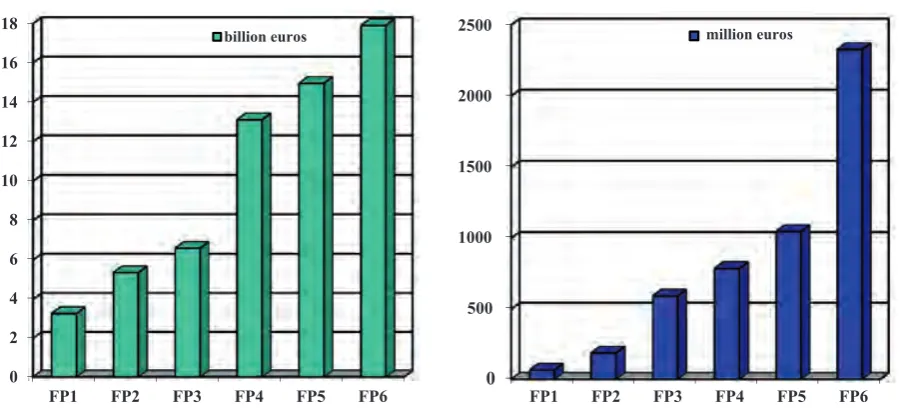
As framework programmes geared up, so did the educational and training grants, both in the Marie Curie scheme and those built into the research grants. Some dedicated research and training networks were also created with EC sup-port. An example in marine ecosystem research and margin studies was the FP5 network EURODOM (European Deep Ocean Margins). The budgets for education and training, however, did not faith-fully follow the growth of the overall framework programmes (Figure 1.4), in particular in FP4 and FP5. The increase in budget for training and educa-tion was, however, very significant in FP6, in the years 2003 to 2007. The many young researchers
Figure 1.4. Evolution of the Framework Programme budgets and the EC budgets for training and education from FP1 to FP6 (source: European Commission).
0
500 1000 1500 2000
2500 million euros
0 2 4 6 8 10 12 14 16 18
FP1 FP2 FP3 FP4 FP5 FP6 FP1 FP2 FP3 FP4 FP5 FP6
Sailing through Changing Oceans 18
who obtained a grant in that period would become available for science and society with the full benefit of that training some four to five years later, in the period 2008 to 2012.
The absolute star in the European individual research grant system is, however, the European Research Council (ERC). Officially launched in 2007 for a period of seven years, in 2013 it entered a second phase in Horizon 2020, as a major compo-nent of the ‘Excellent Science’ pillar.
Besides the vessels made available in Europe at the pace of EC research programmes by national agencies, one externally driven scheme would gain fame: the Training Through Research scheme (TTR, also known as ‘Floating University’, 1991-2010) under the leadership of Professor Mikhael Ivanov from Moscow State University, on board the large Russian research vessel Professor Logachev. This unique scheme, under the umbrella of IOC-UNESCO, functioned through bottom-up financing of European universities and research laboratories, coordinated by Royal-NIOZ in The Netherlands. For a few years, it also got support from an ESF net-working grant. A total of 18 two- to three-month long cruises over a period of 19 years, each compris-ing several legs, would provide to over a thousand young scientists an unforgettable and rigorous training in marine acquisition techniques, from cor-ing and dredgcor-ing to sidescan sonar and reflection seismics. Many discoveries or follow-up studies of mud volcanoes, carbonate mounds and cold-water coral reefs, slope instabilities, gas hydrate fields and methane venting sites along the European continen-tal margins can be credited to TTR. IOC-UNESCO provided the publication scheme of professional annual reports, which faithfully followed each large-scale post-cruise meeting and research conference. Another scheme that deserves attention is the FP7 EUROFLEETS programme, ‘Towards an Alliance of European Research Fleets’. It is a call-driven programme which provides transnational access to a wide range of European vessels and tools. The successful EUROFLEETS I programme (2009-2013) was followed by EUROFLEETS II (2013-2017).
The Cascais Initiative
Exactly 20 years after the joint declaration of Umberto Colombo and Paulo Fasella, on 10 February 2011, a panel of scientists who all have taken the lead in ESF Collaborative Research Programmes (EUROCORES) (Box 1.2) or in international pro-grammes or commissions committed to ocean and polar life and environmental sciences convened
in Cascais (Portugal) under the auspices of the European Science Foundation and the European Polar Board to reflect on long-term and widely mul-tidisciplinary collaborative opportunities. The venue couldn’t have been better chosen: a small but inter-esting museum close to the seashore vividly evokes the oceanographic research carried out between 1896 and 1907 by Dom Carlos de Bragança (King Carlos of Portugal) on board four dedicated yachts – Amelia I to Amelia IV (Saldanha 1980, Carpine-Lancre 2001).
The year 2011 was a crucial milestone for the conclusion of several EUROCORES and Research
Box 1.2. EUROCORES
The EUROCORES Programme was launched by ESF in 1999 to enhance the ESF’s abil-ity to leverage the collective expertise and resources of its 65 Member Organisations. A EUROCORES is a science programme that addresses a topic that is best tackled on a European multinational basis. The topic emerged from the scientific community but, as a first step, it needed to be ratified by the ESF Member Organisations (i.e., those hav-ing interest in the topic) through fundhav-ing commitments. The next stage was the issu-ing of a common call followed by a thorough peer review of the proposals. The outcome of the reviewing formed the basis for Member Organisations to allocate funds to their own national research groups. In that sense the cost was meant to be generally neutral in overall terms. Partnership arrangements were meant to be important, and targeted in particular the European Commission (Banda 1999). This goal was reached in the 6th Framework Programme, when the EUROCORES Programme was granted 20 M€ from the EC ERA-NET Programme.