Reconsidering a digital learning commons in a
distance teaching and learning environment
Brenda van Wyk
1and Irvine Kadzenga
2[email protected] ORCID: orcid.org/0000-0003-3898-7042
[email protected] ORCID: orcid.org/0000-0001-6583-2674
Received: 30 October 2017 Accepted: 3 February 2018
This case study reports on observations and outcomes after the first phase of a digital learning commons implementation project at a private higher education institution and offers solutions to improve this information service. The paper asks whether the learning commons framework by Faber (2012) used during the first phase of the project is sufficient for the implementation of a successful digital learning commons; what is required to equip and skill librarians and information specialists to interact meaningfully and to support teaching and learning sufficiently on technological, informational and academic levels; and whether the digital librarian and information specialists in the digital learning commons could benefit from further insights informed by pedagogic, andragogic and heutagogic frameworks to address issues such as digital resistance. The methodology used for this paper includes a literature review on recent research on digital learning commons, the exploration of teaching and learning frameworks, as well as reporting on the digital learning commons project. With a better understanding of teaching and learning frameworks, information services could be planned, aligned and integrated with active learning objectives. Key success factors for a learning commons supporting learners in an online environment were identified.
Keywords: Learning commons, digital resistance, distance learning library services
1 Introduction
A private higher education institution in South Africa piloted its first digitally-enabled campus in 2015. Also known as a ‘connected campus’, the campus was designed to cater for distance learners, but with the added benefit of their being able to attend scheduled contact sessions too. After opening its doors to new cohorts in January 2016, the campus reported that this model of teaching and learning had been successfully received and implemented. Based on the success of the campus, a further two campuses have been accredited and will roll out along similar lines in 2018. Instead of implementing traditional library services for the digitally-connected campus, a new concept of a ‘digital learning commons’ was researched, designed, and implemented, tailored for the specific teaching and learning requirements of the connected campus. In this model, the digital library offers a range of services such as embedded information sources on the Learning Management System (LMS), access to the latest full-text e-books, online videos and how-to guides for plagiarism prevention and referencing, software downloads and more, all via single sign-on authentication on the official library webpage.
This digital learning commons concept sets new trends in higher education in Southern Africa for supporting learner and academics’ information needs. Faber (2012) defines a learning commons as the space where the physical and virtual environments integrate, thereby enabling teaching and learning for both staff and learners, and resulting in the co-creation of knowledge. It offers a digital solution for a digital generation. With the implementation of the digital learning commons and embedded digital library service at the first digitally-enabled campus, and with plans for new campuses, the implementation of the first phase of digital library services was evaluated to determine the way forward for the next phase.
2 Background
At the time of writing this paper, there were 117 private higher education institutions in South Africa, all accredited by the Council of Higher Education (CHE) to offer certificate, diploma and degree qualifications, compared to the twenty-six public universities. The private higher education institution in this case study offers a range of undergraduate and postgraduate degree programmes. Use is made of a learning management system which includes an embedded digital library service. The distance teaching and learning programmes require specialised information support for learners and academics alike
and for them to have the necessary skills to navigate the digital environment. The mode of teaching and learning on the campus follows a new trend in digital and distance learning. As a result, traditional library and information support roles have changed to include inter-departmental collaboration and new and dual roles for the library service, academic departments and Information and Communications Technology (ICT) department. Incorporating cyber centres into physical library spaces changed the business model of the library which developed into a collaborative space designed for enhanced electronic access to information. New skills and duties are required from the digital librarian to embed information services for the digital campus in the learning management system of the institution. This paper explores the topic of the digitally embedded library through a literature review on recent research on digital learning commons, a discussion on teaching and learning frameworks, as well as a report on a case study of a digital learning commons project.
3 Literature review
Terms such as ‘learning commons’, ‘knowledge commons’, ‘research commons’ and ‘media commons’ have been developed and defined by Library and Information Science (LIS) scholars since 2004: Mestre Lori (2013: 3) referred to the definition used by Beagle et al. (2006) where a learning commons was described as, “a cluster of network access points and associated IT tools situated in the context of physical, human, and social resources organised in support of learning”. It is clear that they view a learning commons slightly differently from an information commons. Mestre Lori (2013: 3), however, prefers the use of the term ‘media commons’ while Dewey (2008: 2) prefers the term ‘learning commons’, thereby focusing on the goals and not the resources. For the purpose of this study, the digitally-enabled learning spaces on a connected campus can be described as spaces with both a demarcated physical and a virtual space where collaboration and sharing of expertise takes place between IT, instructional designers, information specialists and lecturers for the benefit of the learner (Van Wyk and Kadzenga 2016).
4 Theoretical frameworks for new teaching and learning models
The objective of this section is to consider recent research on digital learning commons models, issues around digital resistance and gaining an understanding of teaching and learning theories in higher education.
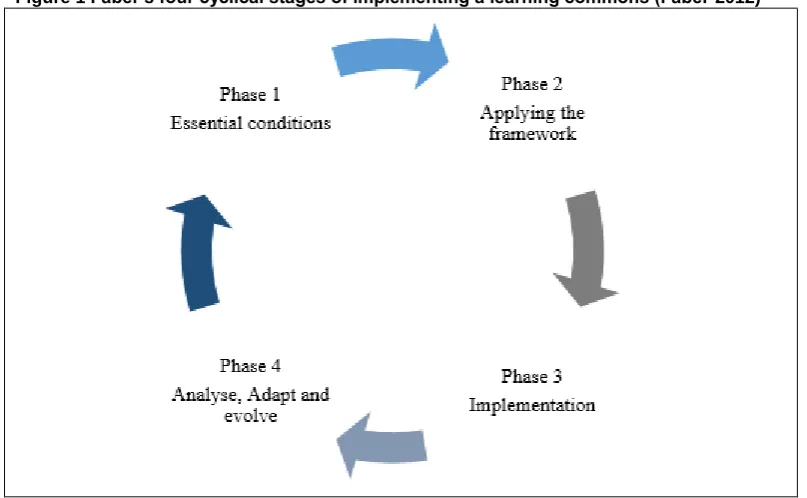
According to Faber (2012), the learning commons philosophy is contextual, iterative and evolving and there are four cyclical stages which need to be taken into consideration during implementation (Figure 1). During phase one of implementing a digital learning commons, an understanding and a shared vision among the campus community, learners, academics and staff members is required. During the period of establishing the digital learning commons at the higher education institution in this case study, the management team of the institution involved every stakeholder in order to receive input in designing the learning commons. Important factors taken into consideration during this first phase were the vision and leadership of the institution, its research activities, available resources, the professional learning that would take place, time constraints and community engagement.
The learning commons conceptual framework identifies four learning spaces, namely open commons, the virtual commons, the physical commons and the investigative commons (Faber 2012); adopting the four elements of learning commons is a crucial part of success. The campus in this case study offers a welcoming, technologically rich, flexible space for individuals, small groups and large groups. The entire campus is Wi-Fi enabled and the library has secure charging stations for laptops, smartphones and tablets. The campus has an area with moveable tables, chairs and work stations that can adapt to changing needs during the year. The digital librarian manages the campus library as well as the adjoining cyber centre, which opens up into a collaborative learning space for discussions and group work. The digital learning commons has to keep up with ever-changing technological developments to stay relevant, which requires the project team to be proactive and open to new ideas and technological advances. Going forward, the management will evaluate the effectiveness of the learning commons in supporting teaching and learning. The digital commons is a dynamic environment, designed to support the needs of learners, lecturers and the learner support teams. The progress will be investigated during the post-project monitoring phase.
4.1 Pedagogic and andragogic approaches
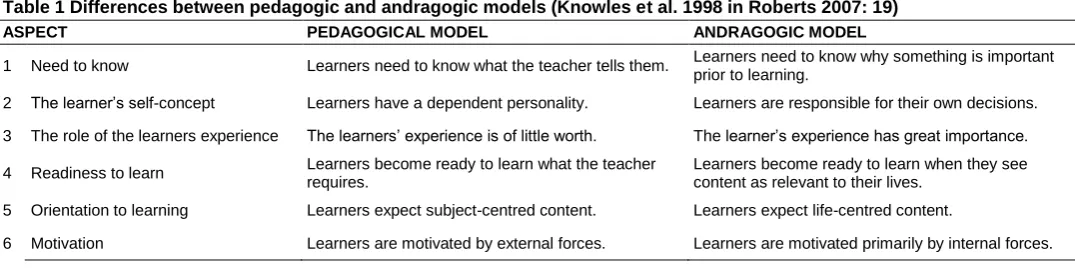
Many of the learners who enrol for distance education programmes are mature learners. Their expectations and learning styles may differ from learners who recently completed their schooling. Generally, distance learners need to be self-driven, determined and motivated, even more so for learners who have to balance work and studies. The second phase of the project therefore, considered different learning styles and paradigms to inform the nature of library support services, selection of online resources and the approach that library orientation sessions would follow. For the second phase, implementation plans considered combined andragogic, pedagogic, and heutagogic frameworks. Andragogy refers to the art of adult learning (Kearsley 2010). Table 1, below, shows the differences between pedagogical and andragogic models according to Knowles et al. (1998) as cited in Roberts (2007: 19). Drawing from these insights, it was decided that distance students on the digitally-enabled campus need to be approached using an andragogic paradigm when introduced to library services. Learners in the higher education institution in this case study were aware, in advance, that the distance mode offering would be different from the traditional face-to-face classroom offering.
Table 1 Differences between pedagogic and andragogic models (Knowles et al. 1998 in Roberts 2007: 19)
ASPECT PEDAGOGICAL MODEL ANDRAGOGIC MODEL
1 Need to know Learners need to know what the teacher tells them. Learners need to know why something is important prior to learning.
2 The learner’s self-concept Learners have a dependent personality. Learners are responsible for their own decisions. 3 The role of the learners experience The learners’ experience is of little worth. The learner’s experience has great importance. 4 Readiness to learn Learners become ready to learn what the teacher requires. Learners become ready to learn when they see content as relevant to their lives. 5 Orientation to learning Learners expect subject-centred content. Learners expect life-centred content.
6 Motivation Learners are motivated by external forces. Learners are motivated primarily by internal forces.
4.2 Strengths and weaknesses of the andragogic model
According to Knowles (1989 in Roberts 2007), andragogic models have various strengths including their flexibility, broad applicability and the fact that they take into consideration the expectations and perspectives of learners. For example, librarians must teach information and digital literacy skills to learners whose IT skills and information seeking skills are limited. In order for these skills to be properly transferred to learners, librarians must teach them using learner-focused approaches. The andragogic model also relates to other learning theories. It aligns to Bloom’s taxonomy, constructivism and transformational theory. Bloom’s taxonomy encourages higher levels of thinking, proposing that learners are capable of self-direction. Like the andragogic model, constructivism and the transformation theory recognise the influence of an individual’s experience on learning (Roberts 2007: 21). The weakness of the andragogic paradigm is that it does not address programmatic goals, it only takes into consideration the characteristics of the adult learner (Roberts 2007). Mature students start their studies with many years of prior life experience and knowledge. Therefore, a heutagogic approach may be considered to address these shortcomings.
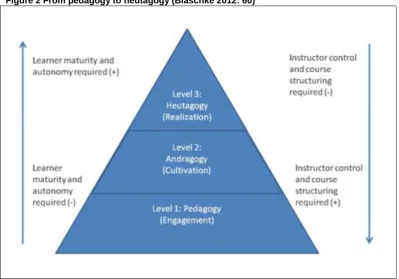
4.3 A heutagogic approach
within a fast-changing technological world (Blaschke 2012). Heutagogical theory is based on humanistic and constructivist principles and it combines various early learning theories into a composite picture of learning that is suitable for – and required – in current educational systems (Blaschke and Hase 2016). Canning (2010 in Blaschke 2012) sees a heutagogic approach as a progression from pedagogy to andragogy and then to heutagogy, where learners become more mature over time and succeed in studying independently. Figure 2explains this process.
Figure 2 From pedagogy to heutagogy (Blaschke 2012: 60)
Heutagogy extends the andragogic approach to form a continuum with andragogy (Blaschke 2012). In Table 2, Blaschke (2012) compares and explains how heutagogy builds on and extends andragogy. The distance learning environment, such as the one reported in this case study, is very different from the traditional classroom setting, in that teaching methods support self-directed learning (Blaschke 2012). Here the lecturer often plays the role of facilitator and the learners need clearly to understand what is expected of them. For instance, in double-loop learning, the learner is required to think deeply, to reflect on content of course material and to ask questions. It is a process to develop the learner’s own capacity, instead of only developing competencies. It is here that the assistance of a digital librarian is required: to support the learner to find answers during this process. Library orientation sessions and digital literacy sessions should follow the same methodology as the rest of teaching and learning.
Table 2 Self-directed versus self-determined learning (Blaschke 2012)
ANDRAGOGY (SELF-DIRECTED) HEUTAGOGY (SELF-DETERMINED)
Single-loop learning Double-loop learning
Competency development Capability development
Linear design and learning approach Non-linear design and learning approach Instructor-learner directed Learner-directed
Getting learners to learn (content) Getting learners to understand how they learn (process)
4.4 Digital resistance
academics resist change and fail to use educational technology in lecturing, communication and research (Khalil 2013). Khalil (2013: 153) refers to Moerchell’s (2009) statement explaining resistance as:
a limited vision of the future, in the comfort zone with the way things are, lack of knowledge in information and communication, the individual’s nature to be uncooperative and the excuse of not having the skills to execute assigned duties by the superior.
One of the major challenges of digital resistance in education is that many learners do not have the digital literacy skills required to perform assigned tasks. It could further be that their schooling did not prepare them sufficiently to engage with new educational technologies. Therefore, many learners enrol to study through distance learning without possessing the level of technological skills required by programmes, leading to high dropout statistics. The role of the digital librarian is to close this gap by facilitating and offering digital skills training and be a recognised and trusted port of call when the learner needs assistance. This role can be hugely successful where there is a culture of collaboration, mutual understanding and alignment between the librarian and the lecturer, which will enable the librarian to offer support that addresses the just-in-time information needs of the learner in a meaningful way.
Haymes’s (2008) ‘Three-E Strategy’ for overcoming resistance to technological changes in an educational environment sets out to improve acceptance among learners when they are introduced to new technology. According to the model, learners must be able to understand that new technologies are:
evident;
easy to use; and
essential.
Learners and lecturers must have the opportunity to engage with these new developments in a meaningful and practical manner; at the same time, the new technology must be seen as a useful, necessary and enjoyable experience.
For the library in this case study, the Three-E strategy was considered and measures to address it were built into all library guides, interactive literacy sessions and one-on-one reference interviews with the librarian to avoid learners feeling ill-equipped and overwhelmed when using new technologies. Overcoming digital resistance was not only essential for the success of the digital learning commons, but also for the use of the LMS. Using the LMS is compulsory for courses on the digitally-enabled campus across all programmes. Lecturers and librarians are all trained and skilled in the use of the LMS. Learn Guides (LMS study guides) for all programmes offered are developed centrally by the relevant academic team consisting of subject matter experts and instructional designers. One of the challenges in overcoming digital resistance is the lack of a suitable and uniform e-book platform on the market, with the variety and complexity of e-platforms from various suppliers and publishers frustrating both learners and lecturers.
For librarians at the institution in this case study, with knowledge and understanding of how mature adults learn, they were able to better understand and address challenges and fears experienced by their adult learners. Digital resistance and an unfamiliarity with digital sources and technology were addressed by means of interactive academic and information literacy sessions offered by the digital librarian. It is of the utmost importance to have digitally skilled librarians, but also the cooperation of IT staff and academics in this team effort.
5 The connected campus in context: a case study
The mode of provision in distance learning is based on designing programmes where the lecturer and the learner may be separated either entirely or at certain intervals. The CHE guidelines (2014: 12) make provision for single, dual and mixed modes for distance education. The University of South Africa (Unisa) provides distance education mostly in a single mode, while some of the private higher education institutions, to date, have offered a mixed mode of delivery. In this mode, courses are offered via contact sessions, with digital learning support including online access to relevant information, and independent learning via the LMS (Van Wyk and Kadzenga 2016). According to the CHE document on distance learning (2014: 15), distance education providers adopted new technologies and digital trends much earlier than traditional institutions of higher education. The five generations, or phases of development, of technology used in education are explained as:
1st – electronic mailing systems such as announcements, sending of accounts;
2nd – electronic storage and despatch of learner material, results and records;
3rd – two way communication in learner support via learner portals;
5th – the forming of communities of learning including learning management systems (LMS) and virtual learning environments (CHE 2014: 11).
The digitally connected campus model has progressed to the fifth generation
.
5.1 Roles and responsibilities
The higher education institution in this case study embraces the concept of technology-enabled learning, which places it in the fifth generation of distance learning. Agherdien (2015), an LMS instructional designer, describes this form of learning as “social beings engaged in complex intellectual, social and psychological processes that happen in a fluid space” (“Technology enabled learning ...” 2015: 3). The advocacy, planning and implementation of a digital learning commons to cater for the academic information needs of the brand new campus add information and information technology components to this definition, playing out in a multi-disciplinary environment of cooperation. The higher education institution in this case study started offering distance education in 2013 with a Bachelor of Business Administration degree. In 2016, a new learning management model was developed called Learn, making use of the Blackboard LMS for all distance offerings and, increasingly, for full-time offerings. Learners have fixed schedules for contact lectures and tutoring times and complete their Online Learning Engagement (OLE) activities via the learning unit/s on the LMS in a prescribed time frame (Van Wyk and Kadzenga 2016). Learners are equipped for this new mode of teaching and learning in a face-to-face session called a preparation lecture, as follows:
The preparation lecture is a face-to-face session where the learners are given guidance on what to focus on during their OLE time as well as activities that need to be completed for that cycle. Letters to prepare are given to the learners.
Online engagement makes up 10% of a course’s notional hours; access is on campus, off campus or from the cyber centre.
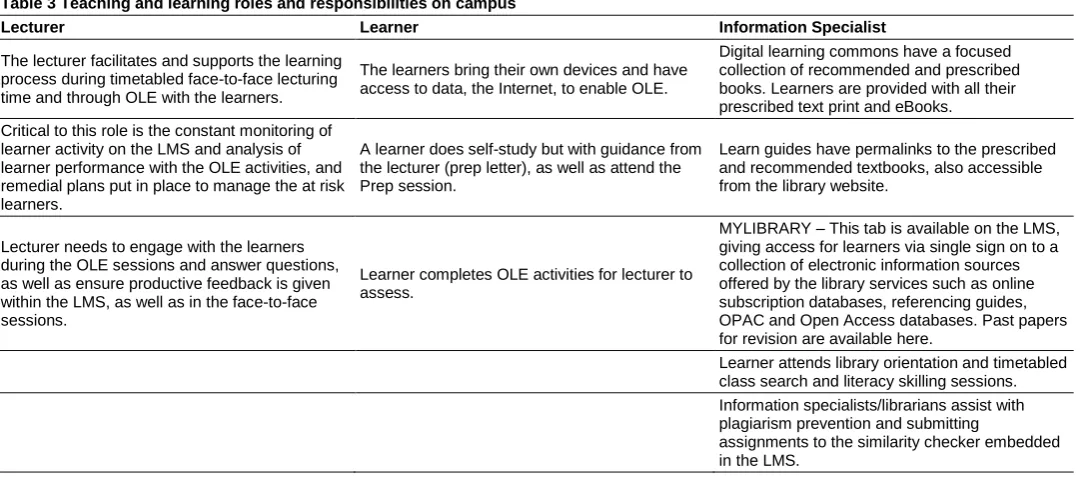
Lecturers evaluate learners’ engagement and activities daily. The roles and responsibilities of team members appear in Table 3.
Table 3 Teaching and learning roles and responsibilities on campus
Lecturer Learner Information Specialist
The lecturer facilitates and supports the learning process during timetabled face-to-face lecturing time and through OLE with the learners.
The learners bring their own devices and have access to data, the Internet, to enable OLE.
Digital learning commons have a focused collection of recommended and prescribed books. Learners are provided with all their prescribed text print and eBooks. Critical to this role is the constant monitoring of
learner activity on the LMS and analysis of learner performance with the OLE activities, and remedial plans put in place to manage the at risk learners.
A learner does self-study but with guidance from the lecturer (prep letter), as well as attend the Prep session.
Learn guides have permalinks to the prescribed and recommended textbooks, also accessible from the library website.
Lecturer needs to engage with the learners during the OLE sessions and answer questions, as well as ensure productive feedback is given within the LMS, as well as in the face-to-face sessions.
Learner completes OLE activities for lecturer to assess.
MYLIBRARY – This tab is available on the LMS, giving access for learners via single sign on to a collection of electronic information sources offered by the library services such as online subscription databases, referencing guides, OPAC and Open Access databases. Past papers for revision are available here.
Learner attends library orientation and timetabled class search and literacy skilling sessions. Information specialists/librarians assist with plagiarism prevention and submitting
assignments to the similarity checker embedded in the LMS.
6 Improving the digital learning commons on the connected campus
The long-term vision of the digitally-enabled model and its library services is to develop the digital learning commons in the connected campus into a 3.0 library (Van Wyk and Kadzenga 2016). According to Kwanya, Stillwell and Underwood (2015), progressing to a 3.0 library model implies that a library service and its institutional decisions are moving away from traditional library services and towards electronic services. Here, library services are user-centred, and intelligent libraries have librarians as apomediators, being skilled and experienced in playing a supportive role in knowledge and technological skills transfers (Kwanya, Stillwell and Underwood 2015: 59). Apomediation is a socio-technical concept. At the case study library, skilled librarians, as apomediators, act as intermediaries, assisting learners and academics to retrieve relevant information from the internet and relevant databases. Services offered include sophisticated systems combining federated information search capabilities, discovery services and library management systems capable of dealing with virtual services. Collaboration across all related teaching and learning activities is critical to the success of this service. The planning and implementation of the campus digital learning commons spaces were important factors in the connected campus project plan. The project team comprised of the institution’s project manager, academic manager, head librarian and the group’s national librarian, general manager, financial manager, IT manager, operations manager and consultants.
Information technologies in the 21st century are changing and growing rapidly. Globally, these changes influence every facet of library and information services in public, academic, and special libraries. There are new opportunities and challenges that the library professionals must face to play important roles in the knowledge society of higher education institutions (Pawar and Kaur n.d.). The digital library staff at a digitally-enabled campus are required to have all the skills and competencies of a Web 3.0 librarian as explained by Kwanya, Underwood and Stillwell (2015). These skills, include,
inter alia, information retrieval and resource knowledge and competencies, legal competencies for copyright and DRM compliance, and research competencies. For the case study campus, the digital librarian’s job description was written and advertised to reflect these skills and competencies. With these skills and competencies, the digital librarian at the digitally-enabled campus works independently in managing the new concept of digital information systems professionally, adapting to change continually.
Library services must be included and synchronised with new systems such as the LMS. Embedded librarianship is defined as a distinctive innovation that moves the librarian out of the physical library space and creates a new model of library and information work (Dene 2011: 225). Embedded librarianship emphasises the importance of forming an integrated and collaborative working relationship between the librarian and the academic team. For embedded librarianship to succeed on the connected campus in the case study, the head librarian of the group worked with the developers of the academic modules to make sure that some of the textbooks to be used by learners and lecturers were going to be available as e-books. A good working relationship between the national librarian, the digital librarian and academic team ensured that the digital learning commons were rolled out in time before the classes commenced. Post-project monitoring will be conducted to evaluate library services and standards, and surveys will be done among learners and academics to evaluate and monitor performance, and to inform improvement plans.
Traditional library orientation sessions, such as information literacy training, plagiarism prevention and referencing workshops, providing library guides and other services had to be adapted to prepare learners for the changed teaching and learning model. Library orientation and training sessions are not only conducted once a year. Following the principle of just-in-time information access, librarians also have scheduled in-class visits with learners before assignment due dates where they conduct refresher training and guide students in finding specific information to complete their assignments. Lecturers undergo separate training to introduce them to the available online databases. Links in course material give learners direct access to full-text information for independent learning and further reading. Sessions with learners and lecturers cover:
learning information retrieval and database search skills;
training sessions to understand intellectual integrity, plagiarism prevention and consequences of plagiarism as set out in the group’s intellectual integrity policy;
introduction to study skills and assignment writing skills;
sessions to explain how to use plagiarism prevention software, SafeAssign; how-to videos are also available on the library website;
assistance with downloading e-books and e-reader software;
assistance with creating user profiles to save searches and search results;
advice on how to make use of permanent links in course development, story boards and in assignments.
orientation took place where the librarian conducted information literacy training on using the various databases. These sessions continue throughout the semester and are rolled out to both learners and academic staff.
6.1 Library resources
Collection building principles for a digital learning commons are different from traditional academic collection building principles and practices, and require extensive product knowledge from the library team to ensure that databases and electronic resources are selected correctly. In this case study library, e-resources are accessible on and off campus through a central EZproxy authentication. A hosted Online Computer Library Centre (OCLC) EZproxy service agreement was entered into and implemented centrally, and is now available at all campuses via the library website. EZproxy services are defined as “access and authentication software that allows your library to deliver secure online e-content simply and effectively” (OCLC 2016). The EZproxy enables single sign-on to various e-resources using campus credentials such as learner number and password. The EZproxy provides access both on and off campus and learners only need one password to access various services and sources.
While the print collection is small in size and is mainly for use on the campus as core reference material (print services also include intra- and interlibrary loans facilities should additional material be required), electronic resources present the important component of the collection building activities of libraries. According to Johnson et al. (2012), “electronic resources refer to those materials that require computer access, whether through a personal computer, mainframe or handheld mobile device”. The various e-journals, e-books and full-text databases were selected in line with the identified information needs for the programmes offered at the campus in this case study. Various trial databases were sourced and evaluated. Feedback from academics and content developers was considered before e-resources and new databases were selected. The library acquired academic database packages and subscriptions from EBSCOhost, Sabinet, Emerald and ERIC for books, e-journals and e-databases. According to Armstrong, Edwards, and Lonsdale (2003), as cited by Vassiliou and Rowley (2008), an e-book is
any piece of electronic text regardless of size or composition (a digital object), but excluding journal publications, made available electronically (or optically) for any device (handheld or desk-bound) that includes a screen.
On average, each course being offered on this connected campus has two prescribed e-books. Additional and recommended reading materials are available as e-resources and accessed on open access sources such as Project Gutenberg, Directory of Open Access Books and Open Access Journals, Google Scholar and BookBoon. The library website has a number of free software download links. Electronic devices are not supplied to learners, but the library has work stations as well as loading stations where devices can be charged. The institution’s open access research repository is also available for further research. Advantages of open access are that it improves the speed, efficiency and efficacy of research because researchers and scholars will no longer need to spend time looking for papers and articles to which the library does not subscribe (Hunt and Swan 2012).
The digital environment brings new challenges for copyright compliance. Digital rights of suppliers and authors receive special consideration. According to the American Library Association (2012),
Digital Rights Management (DRM) is any system used by producers, publishers and vendors to embed technological controls on what users can do with electronic files such as e-books.
At the case study institution, the entire academic team is informed of the importance of understanding copyright issues, especially on the matter of distributing electronic materials to learners. The campus has a transactional license from The Dramatic, Artistic and Literary Rights Organisation (DALRO), meaning that each instance of copying outside of the fair dealing allowances of section 12 of the Copyright Act, Act no. 98 of 1978, as amended requires written permission via DALRO, and fees are levied for both electronic and print copies.
7 The importance of an integrated library management system and technical support
during power cuts. The digital librarian constantly collaborates with the technical support team in order to monitor and upgrade the system for the provision of effective services to the learners.
8 Preparing for second phase improvements and the new sites
What follows are lessons learned from the implementation of a digital learning commons, looking ahead to the roll-out of the two new campuses.
When the digital library was established, it had five computers, with an additional four computers in the learning common and a cyber centre with thirty computers. Since the cyber centre was also used as a lecturing venue, the nine computers available during the day were not sufficient. The digital learning commons, which had four computers, was converted into a cyber centre with twenty work stations in order to mitigate the demand.
The availability of network facilities such as WI-FI and plug-in network points in order for learners and lecturers to access online resources seamlessly is of great importance. Currently, the institution has excellent bandwidth without any network challenges.
Collaboration among the academic, library, IT and operations departments was of utmost importance in that each department had to share their unique duties and responsibilities to support learners and lecturers. This led to regularly scheduled meetings among the teams, where they would update each other and collaborate.
More space for electrical points for internet access for learners with electronic devices needs to be provided.
Collaboration spaces for learners needs to be provided as the content they work on encourages team work.
The digital campus had to invest more in e-resources, as prescribed materials in e-format and new database subscriptions were acquired for use on and off campus for both learners and lecturers.
The digital librarian presents digital literacy skilling workshops. Learners need on-going digital literacy skills training to keep up with changes taking place in the digital world.
Provision of software downloads from the library website is a necessity for learners when they are off campus.
There is a need for constant support from lecturers and digital librarians should a learner struggle with online content and need to ask questions. This support is available during office hours and late into the evening.
Over and above in-house training offered, the digital librarian was formally trained in using the LMS, encouraged to read articles and attend webinars on learning theories, copyright developments and advances in Library 2.0 and 3.0.
All library orientation sessions and literacy and plagiarism workshops are practical, hands-on, interactive and collaborative. The in-class sessions are timed just before students have to work on assignments, which adds to purposive and meaningful self-directed learning.
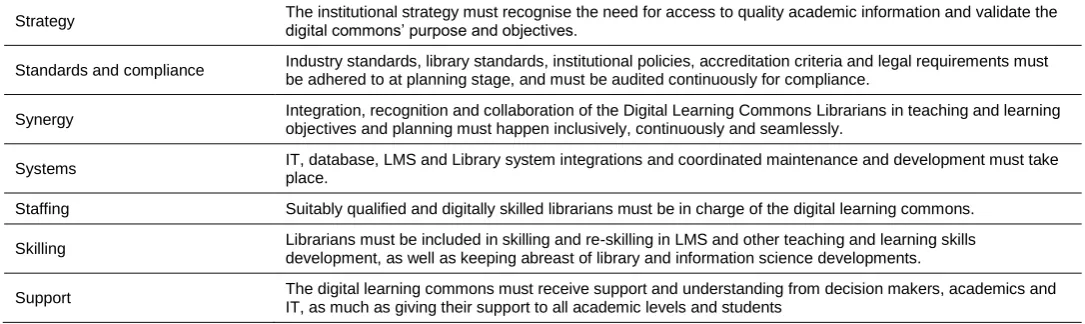
The importance of sound management and administration of libraries and digital learning commons cannot be over-emphasised. Collection building and management of information sources such as online databases subscriptions, open access databases and the technology and tools to access these sources form the foundation of a successful learning commons. There is a danger that a digital learning commons may function in a silo after implementation, which will impede the real educational value it should offer. It is imperative that the digital learning commons forms an inclusive and integrated part of all teaching and learning in higher education institutions. Based on the feedback received and evaluations completed after the first phase implementation of the library digital commons, key success factors, were identified as requirements for success. These are in addition to librarians managing the library on a day to day basis. The key success factors outlined in Table 4 will ultimately determine the impact that a digital learning commons has on education.
Table 4 Key success factors for a digital learning commons
Strategy The institutional strategy must recognise the need for access to quality academic information and validate the digital commons’ purpose and objectives.
Standards and compliance Industry standards, library standards, institutional policies, accreditation criteria and legal requirements must be adhered to at planning stage, and must be audited continuously for compliance.
Synergy Integration, recognition and collaboration of the Digital Learning Commons Librarians in teaching and learning objectives and planning must happen inclusively, continuously and seamlessly.
Systems IT, database, LMS and Library system integrations and coordinated maintenance and development must take place.
Staffing Suitably qualified and digitally skilled librarians must be in charge of the digital learning commons.
Skilling Librarians must be included in skilling and re-skilling in LMS and other teaching and learning skills development, as well as keeping abreast of library and information science developments.
9 Conclusion and recommendations
The digital learning commons forms the heart of the connected campus discussed in this article. The planning and development of this service was initially informed by models such as Faber’s (2012) four cyclical stages of implementing a learning commons. During the second phase of evaluation and improving the service, the need was identified to elaborate and build on this model. Studying teaching and learning theories and frameworks assisted in gaining a better understanding of the support learners require from the digital learning commons. With these insights, information sources, workshops and services were aligned with teaching and learning objectives. Although a firm foundation in pedagogy is found in teaching and learning at higher education institutions, a better understanding of how adult learners study and learn best in an online environment is required in an environment where self-determined learning needs to be supported. Studying andragogic and heutagogic frameworks equipped librarians with this background information and assisted in creating a better understanding of the changed needs of academics and learners alike. In addition, to fulfil the role of apomediators, librarians had to attend courses such as Blackboard Certification courses, database training, and advanced plagiarism checking courses. The Three-E Strategy by Haymes (2008) assisted librarians to adapt library workshops and presentations so that they would be seen as necessary, enjoyable and valuable. With interactive digital literacy sessions, online library guides and support from the digital librarian, learners are able to adapt to the challenges of distance learning, finding and downloading electronic information and overcoming digital resistance. The library systems and LMS links were improved and adapted to give support both on and off campus and to give access to information anytime, anywhere and from any device.
References
Akerlind, G and Trevitt, C. 2011. Enhancing learning through technology: when students resist the change. In
Proceedings of the Seventh Australian Society for Computers in Learning in Tertiary Education Conference (ASCLITE '95). 3-7 December 1995. Melbourne: ASCILIT.
American Library Association. 2012. Digital Rights Management Library Education Tip Sheet. [Online].
http://connect.ala.org/files/94226/DRM%20Library%20Education%20Tip%20Sheet_DEFINITIVE_7_11_12.pdf (29 January 2018).
Blaschke, L.M. and Hase, S. 2016. Heutagogy: a holistic framework for creating twenty-first-century self-determined learners. In The Future of Ubiquitous Learning: Lecture Notes in Educational Technology. B. Gros & M.M. Kinshuk, Eds. Springer, Berlin.
Blaschke, M. L. 2012. Heutagogy and lifelong learning: a review of heutagogical practice and self-determined learning.
The International Review of Research in Open and Distance Learning. 13(1): 56-71. [Online]. http://files.eric.ed.gov/fulltext/EJ979639.pdf (29 January 2018).
Council on Higher Education (CHE). 2014. Distance Higher Education Programmes in a Digital Era: Good Practice Guide.
Pretoria, Council on Higher Education.
Dene, J. 2011. Embedded librarianship at the Claremont Colleges. In Embedded librarians: moving beyond one-shot instruction. C. Kvenild & K. Calkins, Eds. Chicago: Association of College and Research Libraries. 219-228. Dewey, B.I. 2008. Social, intellectual, and cultural spaces: creating compelling library environments for the digital age.
Journal of Library Administration, 48(1). DOI:10.1080/01930820802035059.
Faber, C. 2012. Library to learning commons implementation guide. Calgary: Calgary Board of Education. [Online]. http://www.cbeilc.info/l2lc/files/2013/05/Library_Learning_Commons_Implementation_Guide.pdf (25 January 2016). Haymes, T. 2008. The Three-E strategy for overcoming resistance to technological change. Educause Quarterly. 4.
[Online]. http://er.educause.edu/~/media/files/articleownloads/eqm08411.pdf (19 July 2017). Hunt, H. and Swan, A. 2012. Briefing paper: open access. [Online].
http://www.pasteur4oa.eu/sites/pasteur4oa/files/resource/Open%20Access%20-%20basic%20briefing%20.pdf (29 January 2018).
Johnson, S, Evensen, OL, Gelfand, J, Lammers, G, Sipe, L and Zilper, N. 2012. Key issues for e-resources collection development: a guide for libraries. The Hague: International Federation of Library Associations and Institutions. [Online]. http://www.ifla.org/files/assets/acquisition-collection-development/publications/electronic-resource-guide-2012.pdf (29 January 2018).
Kearsley, G. 2010. Andragogy (M.Knowles). The theory into practice database. [Online]. http://www.instructionaldesign.org/about.html (29 January 2018).
Khalil, S.M. 2013. From resistance to acceptance and use of technology in academia. Open Praxis, 5 (2): 151–163.
Kwanya, T; Stilwell, C. and Underwood, P. 2015. Library 3.0: intelligent libraries and apomediation. Kidlington: Elsevier. Mestre Lori, S. 2013. Media Commons: the process and value of centralizing services. Library Hi Tech, 31(4): 669-687.
DOI:10.1108/LHT-04-2013-0044.
Online Computer Library Centre (OCLC). 2016. EZproxy connects library users to e-content with a single sign-in. [Online]. https://www.oclc.org/content/dam/oclc/services/brochures/213330usf_ezproxy.pdf (29 January 2018).
Pawar, S.S. and Kaur, P. n.d. Need of change in library and information science education in India and skills in the changing knowledge era: a study. [Online].
Roberts, M.S. 2007. Applying the andragogical model of adult learning: a case study of the Texas comptroller’s fiscal management division. Master’s thesis Texas State University.
Technology enabled learning must prepare students for the workplace. 2015. The Mighty Pen, (1)6: 3. [Online]. http://themightypen.co.za/doc/TMP_Aug_2015_WEB.pdf (29 January 2018).
Van Wyk, B and Kadzenga, I. 2016. Breaking the mould: a case study of a digital learning commons project. Paper presented at the 22nd Standing Conference of Eastern, Central, Southern African Library and Information Associations (SCECSAL). 25-29 April 2016. Ezulwini, Swaziland.