Original Research Article
Socio-demographic factors affecting utilization of toilet among peoples
attending tertiary care hospital at Bilaspur, Chhattisgarh
Shailesh K. Kawale
1, Hemlata Thakur
1, Vivek Sharma
1*, Anmol Minz
2INTRODUCTION
By the end of 2011 there were 2.5 billion people, over one third of the world’s population, living without safe, adequate sanitation and hygiene. The lack of access to this essential service holds back social and economic development through its negative impacts on health, education and livelihoods. It is the principal cause of diarrhea, the second biggest killer of the children worldwide and it contributes significantly to malnutrition, stunting and overall global burden of disease.1
World nations have been working for the past two decades to double the number of people who have access to improved sanitation by 2015.2 The progress in sanitation has witnessed a spurt, since the launch of the Swachh Bharat Mission. In the first year of the Mission i.e. from 2.10.2014 to 2.10.2015, 8.8 million toilets were constructed, against an expected outcome of 6 million. Since the launch of Swachh Bharat Mission more than 11.5 million toilets have already been constructed in the rural areas. The sanitation coverage, which stood at 40.60% as per the National Sample Survey Organization (NSSO) has increased to around 48.3%. There is a focus
ABSTRACT
Background: By the end of 2011 there were 2.5 billion people, over one third of the world’s population, living without safe, adequate sanitation and hygiene. The government of India is working towards making an open defecation free communities all over the India through Swachh Bharat Mission. So present study was conducted with the objective to find out toilet utilisation and its associated socio-demographic factors among study population.
Methods: A cross sectional, hospital based study was conducted among peoples attending tertiary care hospital of our medical college CIMS, Bilaspur. Total 384 individuals were interviewed during June 2017 to November 2017 by using predesigned and pretested questionnaire after taking written informed consent.
Results: Among the total 384 study participants 75.8% ware male, maximum participants were in age group 30-49 years (i.e. 44.5%), 72.4% were married and 88.4% were literate. 62.8% study participants were residing in rural area, 55.4% were having kuccha house, 56.5% were having more than 5 members in their family and 27.6% were having under 5 year children in their family. Among study participants 83.9% were utilize toilet. Gender of study participant, residence, marital status, presence of under 5 years child in family and type of house of study participants are significantly associated with toilet utilization (p<0.05).
Conclusions: Though overall toilet utilization is good but focus should be given to male population and especially peoples residing in rural area to achieve open defecation free India under Swachh Bharat Mission.
Keywords: Toilet, Utilization, Socio-demographic factors, Tertiary care hospital
Department of Community Medicine, 1Chhattisgarh Institute of Medical Science, Bilaspur, 2Government Medical College, Raigad, Chhattisgarh, India
Received: 13 January 2018
Accepted: 10 February 2018
*Correspondence:
Dr. Vivek Sharma,
E-mail: [email protected]
Copyright: © the author(s), publisher and licensee Medip Academy. This is an open-access article distributed under the terms of the Creative Commons Attribution Non-Commercial License, which permits unrestricted non-commercial use, distribution, and reproduction in any medium, provided the original work is properly cited.
on village sanitation and achievement of open defecation free (ODF) communities. Despite the comprehensive measures more than 50% of Indians, especially in the rural areas peoples continue to go for open field defecation.3
Having a latrine at home is found to be protective factor for communicable diseases.4,5 But only construction of latrine will not assure their utilization. Utilization of latrine is dependent on complex nature of individual, social and environmental factors.6 Also to implement nationwide programme in developing countries where resource are limited you need to decide the priorities to get maximum output in limited inputs. This type of priority factors for toilet utilisation can be found out through research studies. So, present study was conducted with the objectives to estimate the percentage of toilet utilisation and its associated socio-demographic factors among study population.
METHODS
A cross sectional study was conducted among peoples attending tertiary care hospital of our medical college CIMS, Bilaspur. This tertiary care hospital is situated in the heart of city which is the only government referral centre in nearby 100 km distance, so peoples also come from nearby rural and tribal area. The study was conducted during June 2017 to November 2017 for a total period of 6 months. Sample size of 384 was calculated by taking expected probability of toilet utilization as 86.8% which was observed in study conducted by Yimam et al with 95% confidence interval, 2 as a design effect and 10% non-response rate.7 The sample of 384 individuals were selected from the hospital randomly those who are willing to participate in study and age more than 18 years. They were interviewed to collect information by using predesigned and pretested questionnaire after taking written informed consent.
Questionnaire consist of demographic information of respondent (age, sex, marital status, residence, education and occupation), family details (family size, presence of under 5 year children and old age person in family) and information regarding regular utilization of toilet by informant.
Data was entered in Microsoft Excel software and analysed using Epi Info 7 version 7.2.2.2. The latrine utilization was expressed using descriptive data analysis. The odds ratio was utilized to determine the strength of association of latrine utilization with the independent variables.
RESULTS
In the present study total 384 participants were interviewed, among which 3/4th were male (i.e. 75.8%) and only 1/4th were female (i.e. 24.2%). The mean age of the respondents was 36.2±12.8 with range from 18 to 72
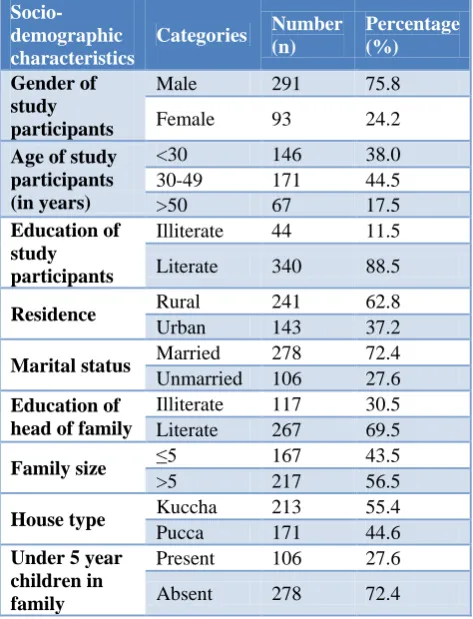
years. Maximum study participants ware from age group 30 to 49 years. Among the study participants majority were literate and only 11.5% were illiterate. Illiteracy is more among the head of family, 30.5% families were having illiterate person as family head. Among the study participants 72.4% were married and 55.4% were living in kuccha house. 62.8% participants were reside in rural area, 56.5% were living in a family having more than 5 members and only 27.6% families were having under 5 year child in their family (Table 1).
Table 1: Socio-demographic characteristics of the study participants.
Socio-demographic characteristics
Categories Number (n) Percentage (%) Gender of study participants
Male 291 75.8
Female 93 24.2
Age of study participants (in years)
<30 146 38.0 30-49 171 44.5 >50 67 17.5
Education of study participants
Illiterate 44 11.5
Literate 340 88.5
Residence Rural 241 62.8
Urban 143 37.2
Marital status Married 278 72.4
Unmarried 106 27.6
Education of head of family
Illiterate 117 30.5 Literate 267 69.5
Family size ≤5 167 43.5
>5 217 56.5
House type Kuccha 213 55.4
Pucca 171 44.6
Under 5 year children in family
Present 106 27.6
Absent 278 72.4
In this study, 83.9% were utilizing toilet for defecation while 16.1% were not utilize the toilet and go for open field defecation (Table 2).
Table 2: Utilization of toilet by the study participants.
Utilization of toilet Number (n) Percentage (%)
Yes 322 83.9
No 62 16.1
Total 384 100
3.90–31.06), peoples who are unmarried (OR 2.20, 95% CI 1.07–4.52), people living in a family having more than 5 members (OR 1.08, 95% CI 0.62–1.87), living in a pucca house (OR 6.91, 95% CI 3.19–15.00) and family not having under 5 year children (OR 2.18, 95% CI 1.24– 3.84) were having more toilet utilization.
Gender, literacy status of individual, literacy status of head of family, residential status, marital status of individual, type of house and not having under 5 year child in family were found to be significant factors associated with the utilization of toilet. Age of the individual and family size was not associated with the utilization of toilet.
Table 3: Association of toilet utilization with socio-demographic factors of study participants.
Socio-demographic
characteristics Categories
Utilization of toilet Odds ratio
(95% CI) Yes (%) No (%)
Gender of study participants
Male 235 (80.7) 56 (19.3) 1.0
Female 87 (93.5) 6 (6.5) 3.45* (1.43 – 8.30)
Age of study participants (in years)
<30 132 (90.4) 14 (9.6) 2.05 (0.89 – 4.73) 30-49 135 (78.9) 36 (21.1) 0.81 (0.39 – 1.68) >50 55 (82.0) 12 (18.0) 1.0
Education of study participants
Illiterate 32 (72.7) 12 (27.3) 1.0
Literate 290 (85.2) 50 (14.8) 2.17* (1.05 – 4.50)
Residence Rural 183 (75.9) 58 (24.1) 1.0
Urban 139 (97.2) 4 (2.8) 11.01* (3.90 – 31.06)
Marital status Married 226 (81.2) 52 (18.8) 1.0
Unmarried 96 (90.5) 10 (9.5) 2.20* (1.07 – 4.52)
Education of head of family Illiterate 87 (74.3) 30 (25.7) 1.0
Literate 235 (88.0) 32 (12.0) 2.53* (1.45 – 4.41)
Family size ≤5 139 (83.2) 28 (16.8) 1.0
>5 183 (84.3) 34 (15.7) 1.08 (0.62 – 1.87)
House type Kuccha 159 (74.6) 54 (25.4) 1.0
Pucca 163 (95.3) 8 (4.2) 6.91* (3.19 – 15.00)
Under 5 year children in family
Present 80 (75.4) 26 (24.6) 1.0
Absent 242 (87.0) 36 (13.0) 2.18* (1.24 – 3.84)
* Significant association
Females were 3.45 times more likely utilize toilet than male. Literate people were 2.17 times more likely utilized toilet than illiterate similar findings were found with families headed by literate person, as they were 2.53 times more likely utilized toilet than illiterate. Peoples living in urban area were 11.01 times more likely utilized toilet than rural. Unmarried people were 2.20 times more likely utilized toilet than married. People living in pucca house were 6.91 times more likely utilized toilet than people living in kaccha house (Table 3).
DISCUSSION
Present study was conducted with the objectives to find the magnitude of toilet utilization and associated socio-demographic factors among peoples of Bilaspur, Chhattisgarh.
The finding in present study revealed that the rate of toilet utilization in Bilaspur district was 83.9%, similar finding of 94.3% toilet utilization in Budhathoki et al, 92.1% toilet utilization was found in study conducted by Kema et al in Mtwara district of Tanzania, while found higher than the findings of Gedefaw et al community study having 51.7% toilet utilization and Yimam et al having 61.2% toilet utilization among rural people.7-10
This higher rate in present study may be due to difference in residential status. The study findings also coincide with the finding in Swachhta status report 2016, published by national sample survey office (NSSO) regarding toilet utilization of 98.7% in urban area.11
study done by Yimam et al where married utilize toilet more than unmarried people.7 People living in pucca house utilize toilet significantly more than people of kuccha house, this may be because of socioeconomic difference of these peoples.
Families not having under 5 year child, utilize toilet significantly more than those family having under 5 children in their family, such type of similar finding were also find out in study conducted by Biran et al and study conducted by Yimam et al.7,12
Regarding the association of family size with toilet utilization, this family size was not found associated with toilet utilization in present study and similar finding is also seen in study conducted by Budhathoki et al and study conducted by Koyra et al.8,14
CONCLUSION
Based on the finding of this hospital based study conducted at tertiary care hospital, overall toilet utilization rate was satisfactory and is 83.9%. This toilet utilization is poor among male, illiterate and old age person. Toilets were less commonly utilized by people who were living in rural area, living in kuccha house and having under 5 year children in their family. These are the significant factors for utilization of toilet. Age of person and family size were not significant associated factors for utilization of toilet.
Recommendations
Based on the study findings, attention should be given to males, old age peoples, peoples living in rural area and in kuccha houses to improve the rate of toilet utilization which will finally help to make India free from open defecation and to reach ultimate goal of Swachh Bharat Mission.
ACKNOWLEDGEMENTS
We are thankful to the entire study subject and students of MBBS 2012 batch from our institute who help in research study for their full co-operation and help. We are also thankful to all members of institutional ethical committee CIMS Bilaspur for their prompt response and co-operation.
Funding: No funding sources Conflict of interest: None declared
Ethical approval: The study was approved by the Institutional Ethics Committee
REFERENCES
1. WaterAid. We can’t wait: A report on sanitation and hygiene for women and girls. Available at http://worldtoilet.org/wp-content/uploads/2014/02/ WecantWait1.pdf. Accessed on 27 December 2017.
2. USAID (2006) Achieving the Millennium Development Goals: The Contribution of Fulfilling the Unmet Need for Family Planning. Available at http://pdf.usaid.gov/pdf docs/PNADM175.pdf. Accessed on 25 December 2017.
3. Country Paper India, SACOSAN VI Dhaka, 11-13 January 2016. Available at http://www.mdws.gov.in/sites/default/files/india%2 0country%20paper.pdf. Accessed on 25 December 2017.
4. Courtright P, Sheppard J, Lane S, Sadek A, Schachter J, Dawson CR. Latrine ownership as a protective factor in inflammatory trachoma in Egypt. Br J Ophthalmol. 1991;75(6):322-5.
5. Rabiu M, Alhassa MB, Ejere HO. Environmental sanitary interventions for preventing active trachoma. Cochran Database Syst Rev. 2007;4:CD004003.
6. Dreibelbis R, Winch PJ, Leontsini E, Hulland K, Ram PK, Unicomb L, et al. The integrated behavioral model for water, sanitation and hygiene: a systematic review of behavioral models and a framework for designing and evaluating behavioral change interventions in infrastructure-restricted setting. BMC Public Health. 2013;13(1015):1-13. 7. Yimam YT, Gelaye KA, Chercos DH. Latrine
utilization and associated factors among people living in rural areas of Denbia district, Northwest Ethiopia, 2013, a cross sectional study. Pan African Medical J. 2014;18:334.
8. Budhathoki SS, Shrestha G, Bhattachan M, Singh SB, Jha N, Pokharel PK. Latrine coverage and its utilization in a rural village of Eastern Nepal: a community based cross sectional study. BMC Res Notes. 2017;10:209.
9. Kema K, Semali I, Mkuwa S, Kagonji I, Temu F, Ilako F, et al. Factors affecting the utilization of improved ventilated latrines among communities in Mtwara Rural District, Tanzania. Pan African Medical J. 2012;13(Supp 1):4.
10. Gedefaw M, Amsalu Y, Tarekegn M, Awoke W. Opportunities and Challenges of Latrine Utilization among Rural Communities of Awabel District, Northwest Ethiopia, 2014. Open J Epidemiol. 2015;5:98-106.
11. National sample survey office (NSSO), Ministry of statistics and programme implementation, Government of India. Swachhta status report 2016.
Available at
http://mospi.nic.in/sites/default/files/publication_rep orts/Swachhta_Status_Report%202016_17apr17.pdf . Accessed on 20 December 2017.
12. Biran A, Jenkins MW, Dabrase P, Bhagwat I. Patterns and determinants of communal latrine usage in urban poverty pockets in Bhopal, India. Trop Med Int Health. 2011;16(7):854-62.
Community Based Cross Sectional Study. J Community Med Health Educ. 2015;5:338.
14. Koyra HC, Sorato MM, Unasho YS, Kanche ZZ. Latrine utilization and associated factors in rural community of Chencha District, Southern Ethiopia: a community based cross sectional study. American J Pub Health Res. 2017;5(4):98-104.