Original Research Article
Prospects of diabetes registry in suburban community of Nigeria:
experience at a private general practice
Anthonia C. Okwelum
1, Eunice O. Igumbor
1, Otovwe Agofure
1, Pleasant C. Ndubueze
1,
Kenneth Aninze
2, Ezekiel U. Nwose
3*
INTRODUCTION
The importance of a diabetes register is not clearly emphasized upon although diabetes register is useful for healthcare professionals to track diabetes patients including the compliance of the patients to treatment programs and it is also useful for healthcare policy
makers to ascertain budgetary costs and/or needs. In the agenda for development of diabetes register, the private general practice is one of the focus.1-3
Delta state comprises 25 local government areas including Ndokwa West, which has an area of about 816 Km2 and population of 149 325 during 2006 census; with Kwale as headquarter for the local government; and Abbi
ABSTRACT
Background: As part of series of advocacy on development of diabetes register, one of the target health facilities is private general practices. In suburban Kwale community Delta State, Donak hospital was chosen to study the process of developing and implementing diabetes register program. Specific objectives include to evaluate the extent of completeness of data for patients follow-up, diabetes services within the private practice based on data collection, prevalence of high blood pressure, and patients‟ compliance with medical appointments.
Methods: The study followed a clinical observational method and after necessary ethical considerations, medical information was gotten from the record unit Donak Hospital, Kwale. The patients identified as potential diabetes or prediabetes were contacted for follow-up and 113 (65 females and 48 males) participants consented, all adults. Data collection were those required for a diabetes register proforma and were analyzed using Microsoft Excel Analysis Tool-pack.
Results: There was no dedicated diabetes register per se except for usual medical records. The private practice has 100% record of contact details and blood pressure completeness for the participants. The scope of service offered to the patients was basically primary healthcare services. Over 50% of the participants have high blood pressure. On the patients‟ compliance with medical check-up; only 23% of the participants complied with check-up appointments.
Conclusions: The development of diabetes register in private practices can improve services. These services include documentation of appointments to enable follow-up strategies to encourage compliance to medical check-ups and a record diabetes education that may be provided.
Keywords: Diabetes register, Documentation of records, Medical check-up, Patient compliance
1Department of Public and Community Health, Novena University, Nigeria 2Donak Hospital Kwale, Delta State, Nigeria
3Department of Community Health, Charles Sturt University, NSW, Australia
Received: 15 October 2019
Revised: 28 November 2019
Accepted: 02 December 2019
*Correspondence:
Dr. Ezekiel U. Nwose, E-mail: [email protected]
Copyright: © the author(s), publisher and licensee Medip Academy. This is an open-access article distributed under the terms of the Creative Commons Attribution Non-Commercial License, which permits unrestricted non-commercial use, distribution, and reproduction in any medium, provided the original work is properly cited.
as another big rural town. The entire local government is serviced by a government secondary healthcare level general hospital. As in most countries, people prefer private healthcare facilities to state facilities and since endocrinologists are limited most patients are managed by the general private practitioners.
Given the „kick-off‟ experience at the Catholic Hospital Abbi, focus was on Kwale community as a suburban town and local government headquarter. For this study, Donak Hospital Kwale, was the private health practice discretionally chosen, after approval by the Medical Director. Methods were as described in the kick-off experience (#2 article in this series). The main aim of this research was therefore to develop a diabetes register in a private health facility. Specific objectives are to ascertain availability of diabetes register, completeness of data for patient‟s follow-up, diabetes services within the private practice based on data collection, prevalence of high blood pressure, and patients‟ compliance with medical appointments.
METHODS
Study design
The study followed a clinical observational method and after necessary ethical considerations with the authority.
Study setting
Donak Hospital Kwale, Delta State Nigeria
Selection criteria
The population of this study includes type 2 diabetes mellitus patients including both genders that are patients of the private health practice. The population also included patients that reside in Kwale and neighboring communities like Ashaka, Emu and Ogume. The patients identified as potential diabetes or prediabetes were contacted for follow-up. 81 participants (46 males and 35 females) case file was examined for the second, third and fourth objectives while the fifth objective included additional 56 participants (31 females and 25 males). Hence „N=115‟ for the evaluation of compliance with medical check-up.
Data collection
Medical information was gotten from the record unit Donak hospital in suburban Kwale community of Delta State. For this report, data were collected between October 2018 and April 2019.
Statistical analysis
Data collection were those required for a diabetes register proforma and were analyzed using Microsoft Excel Analysis Tool-pack.
RESULTS
Availability of a diabetes register in the private health facility
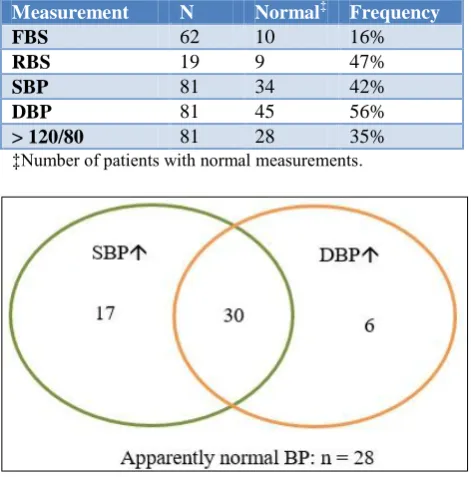
There was no dedicated diabetes register per se, except for the usual private practice medical records. Attempt was therefore made to develop a register with the diabetes patients identified in the medical records (N = 81: 46 females and 35 males). Data available for evaluation of CVD complication was blood pressure only and none of the patients has cholesterol profile results. The cohort‟s clinical indices show that 84% and 53% had abnormal levels fasting blood sugar and random blood sugar, respectively (Table 1). While 35% presented with normal diastolic and systolic blood pressure levels, the rest had both abnormal levels systolic and/or diastolic blood pressure (Figure 1).
Table 1: Descriptive statistic of patients entered into the register.
Measurement N Normal‡ Frequency
FBS 62 10 16%
RBS 19 9 47%
SBP 81 34 42%
DBP 81 45 56%
> 120/80 81 28 35%
‡Number of patients with normal measurements.
Figure 1: Distribution of blood pressure readings.
Level of completeness of data for patients follow-up
patients don‟t have) phone numbers, only 2% are missing both address and phone number of patients.
Figure 2: Frequency of incomplete contact details.
Scope of services at the private health facility
In this study, quality service was defined by percentage of „necessary basic‟ primary level diabetes care services available. The necessary basic services were in turn defined by the list of clinical measure that constitute standard of care from the World Diabetes Foundation. Results show 100% assessment of blood glucose and blood pressure, while assessment of BMI was absent (Table 2).
Table 2: Quality of service assessment.
Test Measures* Completeness
Blood
pressure Stethoscope 100%
Sphygmomanometer 100%
Blood
sugar level Glucometer 100% Renal
function Urine strips Variable
†
Others
Weigh scale
0% Height measure
Measuring tape
*Reference 4, †Albumin/creatinine ratio also recommended, but urinalysis is routinely performed.
Percentage of persons with probable high blood pressure and/or uncontrolled diabetes
All participants (i.e. N = 81) have clinical diagnosis of „type 2 diabetes mellitus‟. Probable high blood pressure was defined by reading above both 120 mmHg systolic and 80 mmHg diastolic. It is acknowledged that > 140/90 mmHg may be queried as diagnostic for hypertension yet the absolute normal level is ≤ 120/80. Hence, the terminology „probable high blood pressure‟, which is not definitive hypertension. Evaluation showed that 28/81 presented with normal diastolic systolic blood pressure (Table 1), while 35% had both abnormal level at 120/80 mmHg. In the absence of HbA1c, uncontrolled diabetes
was implied from FBS ≥ 110 mg/dL (6.1 mmol/L) or RBS ≥ 200 mg/dL (11.1 mmol/L) (Figure 3).
Figure 3: Percentage of participants with high BP and uncontrolled DM.
Table 3: Gender distribution and compliance with medical appointment.*
Schedule Invitation
(N) Attendance
Compliance (%)
1st 55 12 11%
2nd 62 21 29%
3rd 68 14 28%
4th 68 9 24%
Average 63 14 23%
Female Male Subtotal
1st 7 5 12
2nd 13 8 21
3rd 6 8 14
4th 5 4 9
Total 31 25 56
*Based on four schedules.
The extent to which diabetics comply with medical appointments/visit for check-up
For this analysis, patients were re-invited to the clinic for further clinical assessments, especially BMI, lipid profile and physical activities of daily living. Breakdown by gender indicate 31 females and 25 males attended their appointments out of the original 81 participants. Compliance was calculated as percentage of those who attended the appointments relative to number of invitations and the results show average of 23% (Table 3). Further analysis to determine the gender group that is more compliant shows higher proportion of men than women (Figure 3).
tendency to miss information that exist on the medical records and a call for vigilance.
Figure 3: Proportions of gender groups that complied with medical appointment.
DISCUSSION
This report contributes to the capacity to develop diabetes registry, and a highlight the level of medical records quality that needs to be improved. Although, a dedicated diabetes register has yet to be considered in the private general practice, the private GP has a general register. Therefore, for behavioral change wheel to establish diabetes register in the facility, the need and knowledge-based capacity as well as opportunity for practiced are present, but motivation is warranted. This observation advances the previous expository review that “the task to reduce diabetes risk and improve self-management will benefit from establishment of registers in all health facilities”.5
The second evaluation show some incompleteness of data, which mainly indicate service availability at the health facility. However, the third really shows the capacity of private GPs in Nigeria to offer standard diabetes care. For instance, the evaluation of fourth objective indicate prevalence and record of high blood pressure that is comparable with services at tertiary health facility.6
On the fifth study objective, which is on compliance with medical appointment, this report adds to empirical
epidemiological data on adherence to medical
appointment in the kick-off project from rural community. The 23% response rate to medical appointment translates to 77% „no show‟ and compared to report of non-adherence to medical appointment from international community e.g. from South Africa, and the United States;8 this is observation is higher.7 It may be misleading to take absolute number of attendance as observed to conclude that women attend the clinic more than men. The result shows that the proportion of men that kept appointments were more than women. It has been debatable whether women seek medical care more than men.9,10 Thus, while the observation reported here is not in agreement with the report that investigated the use of health care services by men and women, it is noteworthy from the findings of an Australian study that
men and women may show higher levels of adherence to different perspectives and it will be inductive fallacy of generalization to claim that a specific gender is less adherent.11,12 Indeed, it is known that different factors are at play for either gender group.13
CONCLUSION
Given the level of completeness of medical records and observation that clinicians often give appointments for next medical visit without documentation albeit because of non-adherence attitude. Suffice to conclude that the agenda of improving patient care by developing diabetes register need to be developed starting with completeness of data records. The necessary regard for patients‟ adherence to appointments can be logically addressed as a second agenda.
ACKNOWLEDGEMENTS
This is part of the project “development of diabetes register in low-mid income country”, which was done under the aegis of ethical approval granted to global
medical research and development organization
(GMRDO) in collaboration with public and community health department, Novena University. Okwelum and Ndubueze participated in the work as part of their academic research works. The support of staff at Novena University Health Centre is highly appreciated. Christabel Ogbolu, Godswill Adoh, Chinedu Obodo and Fortunatus Gbeinbo are hereby acknowledged for support during data collection in this collaborative work.
Funding: No funding sources Conflict of interest: None declared
Ethical approval: Ethical approvals for this project included Novena University as well as Ndokwa West local government both in Delta State Nigeria
REFERENCES
1. Cook JA. Using a diabetes register to improve care and outcomes. Collaborative support Programs of
New Jersey Wellness Symposium: Diabetes
prevention and wellness self-management. Edison, NJ; 2012.
2. Ballotari P, Ranieri SC, Vicentini M, Caroli S, Gardini A, Rodolfi R, et al. Building a population-based diabetes register: an Italian experience. Diabetes Res Clin Pract. 2014;103:79-87.
3. Health Service Executive. Setting up a diabetes register using GP practice management system,
2017. Available at:
https://www.hse.ie/eng/health/hl/living/diabetes/Dia betesregister.html. Accessed on 15th April 2019. 4. World Diabetes Foundation. List of standard
medical and laboratory equipment for type 2
diabetes clinics. Available at:
ry%20equipment.docx. Accessed on 30th October 2017.
5. Otovwe A, Oyewole OE, Igumbor EO, Nwose EU. Diabetes care in delta state of Nigeria: An expository review. Diabetes Updates. 2018;4(1):1-8.
6. Nwose EU, Ekotogbo B, Ogbolu CN,
Mogbusiaghan M, Agofure O, Igumbor EO. Evaluation of ADL and BMI in the management of diabetes mellitus at secondary and tertiary health
facilities. Diabetes Metab Syndr Obes.
2019;13:2266-71.
7. Frost L, Jenkins LS, Emmink B. Improving access to health care in a rural regional hospital in South Africa: Why do patients miss their appointments? Afr J Prim Health Care Fam Med. 2017;9:e1-e5. 8. Kaplan-Lewis E, Percac-Lima S. No-show to
primary care appointments: why patients do not come. J Prim Care Community Health. 2013;4:251-5.
9. Hunt K, Adamson J, Hewitt C, Nazareth I. Do women consult more than men? A review of gender and consultation for back pain and headache. J Health Serv Res Policy. 2011;16:108-17.
10. Hunt K, Ford G, Harkins L. Are women more ready to consult than men? Gender differences in family practitioner consultation for common chronic conditions. J Health Serv Res Policy. 1999;4:96-100.
11. Mesa MS. Health care disparities between men and women with type 2 diabetes. Prev Chronic Dis. 2018;15:E46.
12. Noon CT, Nwose EU, Breheny L. Evaluation of gender differences in exercise adherence for low back pain: case reviews and survey. Eu J Physiother. 2018:1-7.
13. Kapur N, Hunt I, Lunt M, McBeth J, Creed F, Macfarlane G. Primary care consultation predictors in men and women: a cohort study. Br J Gen Pract. 2005;55:108-13.