Published by Oriental Scientific Publishing Company © 2019
This is an Open Access article licensed under a Creative Commons license: Attribution 4.0 International (CC-BY).
ICRODI: Image Compression of Region of Diagnostics
Interest (RODI) using Layer Segmentation and Wavelet
S.M. Vijaya1 and K. Suresh2
1Research Scholar, RRCE, Bengaluru - 560074, India.
2Principal, SEA College of Engineering & Technology, Bengaluru - 560049, India.
*Corresponding author E-mail: [email protected] http://dx.doi.org/10.13005/bpj/1730
(Received: 27 March 2019; accepted: 12 June 2019)
Robotic guided medical system requires efficient mechanism of compression of Region of Diagnostics Interest (RODI) in medical images to overcome the tradeoff among efficiency and time which is a computationally challenging task. This task involves the requirement of suitable noise filtering, segmentation, critical feature selection especially at corners of RODI and encoding process. This paper proposes a framework namely ICRODI to evaluate a hybrid approach of compression for region of diagnostic interest in Brain MRI as well as for rest of the region. The approaches used are median filter, thresholding as pre-processing and fuzzy c-mean clustering, Harris corner detection, s-shape fuzzy for segmentation and feature point selection optimization. Further alpha hull of the convex hull is used for getting the volume of the mass and finally the wavelet co-efficient based compression is applied. The effectiveness of the proposed ICRODI is validated by evaluating MSE and PSNR for both RODI and Non-ROSI. The average value of the PSRN for RODI is found approximately 49 % higher as compared to the RODI and MSE of the RODI is reduced by approximately 33% as compared to the non-RODI after simulating the process on a numerical simulation platform. The achieved results are quite promising and could be optimized for the VLSI implementation in future.
Keywords: Medical image Processing, Medical Robotics, Image Coding, Brain MRI, Region of Interest Compression.
In the world of ubiquitous computing many advanced medical systems have been visualized on
the basis technologies such as robotics, artificial
intelligence, advanced communication and Network system etc., along with digital image
processing1,2. There exist limitations of bandwidth
to transfer a high dimension data of real-time
medical images. Therefore, an efficient technique
to be developed to transfer only region of diagnostic interest (RODI) through the communication channel without losing its essential features. The
first requirement towards achieving this goal is
to adopt a suitable noise reduction method for the Brain-MRI which improvises the signal to noise (SNR) by keeping both spatial and contrast resolution optimal. The suitable noise reduction
method ultimately improvises the significance of
critical diagnostics3. The work of Majumdar et
al8 have developed different models of noises for
realization of the filtering as well as extraction of
be enhanced for the better vision. The automatic segmentation is an open research problem for the brain MRI as it a quite challenging task due to heterogeneity into the geometric contour of tumor tissues as well as the overlapping similarity
among even normal tissues and tumor4,5. In past
many semi-automatic and automatic method for the segmentations are proposed where mostly a technique of global thresholding is used which
exhibit potential error6,7. To overcome these error
the methods of active contour (AC) is used9,10,11.
In order to extract the critical mass RODI, these methods exploit the primary contours, whereas the accurate positioning of these contour is of high importance due to non-alignment tendency of the energy release. To overcome this the contour is localized to the approximation of the RODI and avoid the wrong edge which might be arises due to various artifacts as well as the noises. The proposed ICRODI, in this paper is motivated by the work by Jiyo et al (2016),12 for the automatic segmentation
mainly for bone critically from the CT-images used in the diagnostic of spine disorders. Like12, ICRODI
extract features from the Brain-MRI to build the initial level of contour which is further converted into fuzzy corner metric (FCM) on the basis of the intensity of the Brain MRI input image data. The ICRODI uses s-Shape convex hull as Alpha hull
for the corners detection optimization and finally
wavelet based image coding is done to get optimal PSNR and MSE for the RODI as compared to the non-RODI region as these regions are not very critical from the view point of diagnosis.
The proposed framework for the ICRODI
takes the advantages of median filtering for the
noise reduction and uses thresholding technique for the contrast enhancement. The segmentation and feature selection is optimized by exploiting the optimality of the fuzzy c-mean clustering for layered segmentation which is further optimized for the corner point feature selection using Harris corner detection followed by the s-shaped fuzzy corner optimization to get the critical mass of the RODI by getting alpha hull of convex hull and finally the compression process of image encoding is adopted using wavelet. The section 2.0 provides details of the related work in the same
filed, section 3.0 illustrates the process model of
ICRODI, section 4.0 describes the algorithms used in ICRODI, section 5.0 provides the results
and analysis of the ICRODI for a given dataset to compute performance metrics of the model such as PSNR and MSE, followed by section 6.0 a conclusion, which also discuss the future scope of the work.
Related Work
The effective mechanism of compression of the region of interest with critical diagnosis of the particular region in different medical images are a critical topic of research to have advantages for the optimal uses of the disk storage, transmission of the image data through a constraints bandwidth channels as well as for many advance medical systems [Cite Madam Previous work if nay else cite a paper which talks importance of the work].Few recent work on the compression of region of interest is takes here to under the current line of research in the related domain. The approach of ROI localization and then compression
approach is studied by Liaghati et al (2016) for
hyperspectral image to meet the challenges pose by the communication channels constraints. They have proposed lossless compression mechanism for the ROI by adopting bi- level block maping to get most probable blocks using optimized Huffman coding technique. Their method promises
significant improvement over JBIG2 and JPEG
2000 when applied on ROI maps13. Apart from
another image the study has been carried out on
the medical image. The work of Dong et al(2016)
claims to have a GUI based tool where the ROI can
be extracted from the slide images and provision lossless compression to the extracted ROI as well claims 40 times higher compression ratio. The model was validated by block matching approach for detecting malaria cells from the whole slide images and exhibits better result as compared to
Bzip2, Shape- Adaptive Jpeg 2000(SAJPEG2)
which provides new vision for the medical images to intact the complex geometry14. Yee et al (2017)
have focused on the compression requirement of growing amount of medical images from the storage view point manageability. They have proposed a new format called “Better Portable
Graphics (BGP)”. They divide the input image into ROI and Non-ROI then apply lossless BPG to ROI then by combining they create a final image
and found improvement approx. 10 to 25% in the compression as compared to the traditional method
especially Brain-MRI tumor detection then Tumor region compression along lack in the literatures,
whereas few significant primary work is found into
work of Vilas et al (2016)16 and many other details
is found towards tumor analysis in brain MRI in
the work of Bauer et al (2013)17. The section 3.0
explain the process flow of the prosed model of
ICRODI.
Process Model of ICRODI
The methodology adopted for the proposed image compression process for the region
of diagnostic interest is shown in the fig x in as
block by block operations performed.
The component wise processing blocks
of the ICRODI is shown in the fig.2 below, which include the operations of non-linear digital filtering of the input Brain-MRI images using median filter
for the noise reduction followed by the contrast enhancement using thresholding.
For the dimension reduction an approach of layer segmentation is adopted with customized function development. The most critical aspect of handling fuzzy ness and principal components of the features on the corner a Harris corner point detection mechanism is used followed by the optimization using Fuzzy Corner Point is used to consider the important points which are not taken into previous steps of feature extraction/
selection and finally the Alpha Hull Based Active
Contour System optimization is performed. Finally, compression and reconstruction are done using wavelet. Section 5.0 illustrates the values of PSNR and MSE for the test Brain MRI images.
Algorithms used in ICRODI
This section describes overall implementation algorithm of the proposed ICRODI system from Brain-MRI input stage till image compression and reconstruction. The 2-D median
filtering uses the eq. (1), and the value of PSNR is
computed using eq. (2).
...(1)
( )
∑
∑
(
)
∑
∑
=− =−− = − =
+ + ×
= 1
1 1
1 1
1 1
1
, _ 1 1
1 ,
i j i j
filtered x y I I x i y j
I
...(2)
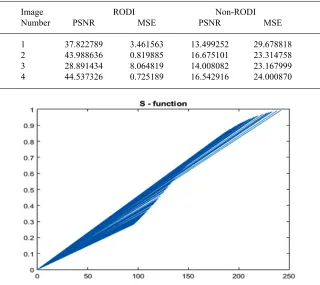
The S -Shaped membership function while optimization of the feature points is a mapping on vector I. The parameter x and y locate the extreme of the sloped portion of the curve. The
Fig. 1. Block wise operation of ICRODI
Fig. 3. S-Shaped Membership function
eq. (3) is used for the same.
...(3) The optimization of the active contour
method is motivated by the work of12, which is to
minimize the following energy in eq. (4).
...(4)
The typical corner detection includes the cornerness evaluation using Hariss corner, where the fuzzy approach is used to optimize the corner matrix and further convex hull is created. This convex hull is optimized for handing sharp converters in the tumor region in BrainMRI.
Results and Analysis
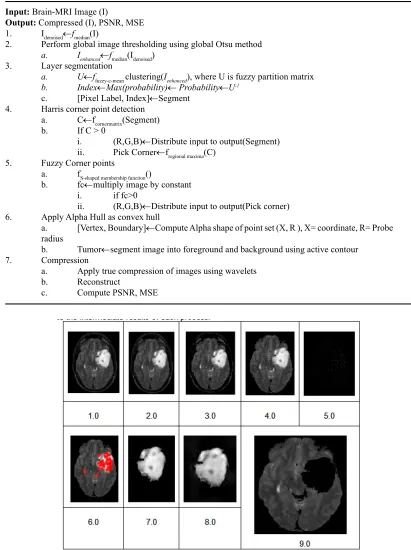
In order to evaluate the effective of the performance of the ICRODI two performance metrics are taken into consideration 1) Peak Signal to noise ratio (PSNR) and 2) Mean square error (MSE). The average of the PSNR and MSE of both RODI and non-RODI is tabulated in the table 1 and
the fig. 2 illustrates the intermediate results of each
process.
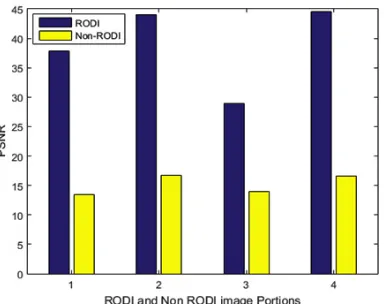
The fig 3 and fig 4 shows the comparative
graph of both RODI and non-RODI portion of Brain MRI for PSNR and MSE respectively.
It is found that the average of PSNR values of RODI from four different images is 155.24 and of Non-RODI is 25.04, that means the improvement into image quality after compression
Table 1. Observation of PSNR and MSE for RODI and Non-RODI region after compression and reconstruction
Image RODI Non-RODI
Number PSNR MSE PSNR MSE
1 37.822789 3.461563 13.499252 29.678818
2 43.988636 0.819885 16.675101 23.314758
3 28.891434 8.064819 14.008082 23.167999
Algorithm for RODI compression
Input: Brain-MRI Image (I)
Output: Compressed (I), PSNR, MSE 1. Idenoised←fmedian(I)
2. Perform global image thresholding using global Otsu method a. Ienhanced←fmedian(Idenoised)
3. Layer segmentation
a. U←ffuzzy-c-mean clustering(Ienhanced), where U is fuzzy partition matrix
b. Index←Max(probability)← Probability←U-1 c. [Pixel Label, Index]←Segment
4. Harris corner point detection a. C←fcornermatrix(Segment)
b. If C > 0
i. (R,G,B)←Distribute input to output(Segment)
ii. Pick Corner←fregional maxima(C)
5. Fuzzy Corner points
a. fS-shaped membership function()
b. fc←multiply image by constant
i. if fc>0
ii. (R,G,B)←Distribute input to output(Pick corner) 6. Apply Alpha Hull as convex hull
a. [Vertex, Boundary]←Compute Alpha shape of point set (X, R ), X= coordinate, R= Probe radius
b. Tumor←segment image into foreground and background using active contour 7. Compression
a. Apply true compression of images using wavelets b. Reconstruct
c. Compute PSNR, MSE
Fig. 4. Intermediate outputs of the processed Brain-MRI of proposed ICRODI, 1.0 input MRI- image, 2.0 Median
filter, 3.0 ROI(enhanced), 4.0 Layer segmentation, 5.0 Harris corner point, 6.0 Fuzzy corner point, 7.0 Alpha Hull,
for RODI is approximately 620% which is quite acceptable as lossless image quality.
The MSE values of the individual images are 3.4 in place of 29,6, 0.81 in place of 23.31, 8.06 in place of 23.16 and 0,72 in place of 24.0 for image 1, 2, 3 and 4 respectively for RODI and non RODI which is quite consistatnt and the standard deviation is quite low.
The method proposed here can be optimized further to evalaute the bit per pixel to meet the channel contrainst so that without
loosing more significant bit teh data can travelk
with the limited bandwidth and can truley satisfy the need to RODI image lossless compression. In order to see its realization in real time syncronized
application an approach of field programmable gate array(FPGA) approach is planned in the future
work as an extension, where the optimization of power and time will be the prime objective function along with the BPP, PSNR and MSE.
COnClusIOn
This paper mainly focuses on the effective compression mechanism on the Brain-MRI images especially on the region of interest which are important from the diagnostic view point by
exploiting the optimal method noise filtration,
segmentation and feature detection. The method is evaluated for the many Brain-MRI images which having tumor into it by computing the value of PSNR and MSE and found that it exhibits better result to be promising as lossless characteristic. In
future a very large scale integrated circuit (VLSI) implementation of the method is planned with
FPGA realization with an objective of optimal
fast computation to make it synchronized with the real-time advance medical operations.
ACknOWleDgeMenT
The author is deeply grateful to Hon.A.C.Shanmugam Chairman MCET and Hon.S.Vijayanand Executive Director, and Dr.Balakrishna Principal, Rajarajeswari College of Engineering Bangalore for their kind encouragement and help during the progress of this work.
ReFeRenCe
1. C. Hennersperger, B. Fuerst, S. Virga, O. Zettining, B. Frisch, T. Neff, N. Navab.
Towards MRI-Based Autonomous Robotic US
Acquisitions: A First Feasibility Study. IEEE Transactions on Medical Imaging, 36(2): pp. 538-548 (2017).
2. N. Nouri, D. Abraham, J. M. Moureaux, M. Dufaut, J. Hubert and M. Perez. Subjective
MPEG2 compressed video quality assessment:
Application to Tele-surgery.IEEE International Symposium on Biomedical Imaging: From Nano to Macro, Rotterdam, 2010; pp. 764-767. 3. M. A. Ertürk, P. A. Bottomley and A. M. M.
El-Sharkawy. Denoising MRI Using Spectral
Subtraction. IEEE Transactions on Biomedical Engineering, 60(6), pp. 1556-1562 (2013). 4. S. R. Telrandhe, A. Pimpalkar and A. Kendhe. Fig. 5. Comparative values of PSNR for four different
Detection of brain tumor from MRI images by using segmentation & SVM. World Conference on Futuristic Trends in Research and Innovation for Social Welfare (Startup Conclave) Coimbatore, pp. 1-6 (2016).
5. N. Behzadfar and H. Soltanian-Zadeh.Automatic segmentation of brain tumors in magnetic resonance images. Proceedings of IEEE-EMBS International Conference on Biomedical and Health Informatics, Hong Kong, pp. 329-332 (2012).
6. M. Soltaninejad, G. Yang, T. Lambrou.Automated
brain tumour detection and segmentation using super pixel-based extremely randomized trees in FLAIR MRI. International Journal of Computer Assisted Radiology and Surgery, Springer, 12(2): pp 183–203 (2017).
7. M.A. Balafar, A.R.Ramli, M.I.Saripan and S. Mashohor. Review of brain MRI image segmentation methods. Artificial Intelligence
Review, 33(3), pp.261-274 (2010).
8. V.K. Raj, A. Majumder. Bayesian
Regularization-Based Classification for Proposed Textural and Geometrical Features in Brain MRI. Artificial
Intelligence Trends in Intelligent Systems; pp 343-353 (2017).
9. B. F. Zohra, B. Nacéra and T. A.Abdel Malik. Adjustment of active contour parameters in Brain MRI segmentation using evolution strategies.4th International Conference on Electrical Engineering (ICEE), Boumerdes, pp. 1-7 (2015).
10. J. l. Liu. The approach of T1 weighted brain MRI image segmentation. Proceedings of the 33rd Chinese Control Conference, Nanjing, pp. 4860-4865 (2014).
11. O. Freifeld, H. Greenspan and J. Goldberger.
Lesion Detection in Noisy Brain Images using
Constrained GMM and Active Contours. 4th IEEE International Symposium on Biomedical Imaging: From Nano to Macro, Arlington, pp. 596-599 (2007).
12. J.S. Athertya and G.S. Kumar. Automatic
segmentation of vertebral contours from CT images using fuzzy corners. Computers in biology and medicine, 72: pp.75-89 (2016). 13. A. L. Liaghati, H. Shen and W. David Pan. An
efficient method for lossless compression of
bi-level ROI maps of hyperspectral images. IEEE Aerospace Conference, Big Sky, MT2016; pp. 1-6.
14. Y. Dong, H. Shen and W. David Pan.An interactive tool for ROI extraction and compression on whole slide images. IEEE-EMBS International Conference on Biomedical and Health Informatics (BHI), Las Vegas, pp. 224-227 (2016).
15. D. Yee, S. Soltaninejad, D. Hazarika, G.
Mbuyi, R. Barnwal and A. Basu. Medical image compression based on region of
interest using better portable graphics (BPG).
IEEEInternational Conference on Systems, Man, and Cybernetics (SMC), Banff, AB, pp. 216-221 (2017).
16. H. R. Vilas, S. N. Kulkarni, H. Chiranth and M. Bhille. Segmentation and compression of 2D
brain MRI images for efficient tele radiological
applications. InternationalConference on Electrical, Electronics, and Optimization Techniques (ICEEOT), pp. 1426-1431 (2016). 17. S. Bauer, R. Wiest, L.P. Nolte and M. Reyes. A