E-ISSN 2308-9830 (Online) / ISSN 2410-0595 (Print)
Decrease Interference Using Adaptive Modulation and Coding
Osman Mudathir Elfadil1, Y. M. Alkasim2 and Rayan. A. Ali3
1, 2, 3
Department of Electrical and Electronics Engineering, Omdurman Islamic University
E-mail: [email protected], [email protected], [email protected]
ABSTRACT
The limitations of channel bandwidth, time varying channel and fading are significant and fundamental problem in wireless communication, which leads to the difficulty of providing high Quality of Service. The traditional wireless communication systems are designed to provide good quality of services at the worst channel conditions. Wherein any attempts to increase the channel bandwidth, interference arises along with these attempts. And result in inefficient utilization of the full channel capacity. One of the efficient techniques to overcome to these problems is known as adaptive modulation and coding (AMC). This paper was prepared as simulation study of interference decreasing using AMC algorithm where a comparison between ordinary modulation techniques is compared to Multicarrier Modulation MCM and adaptive modulation, results of the simulation was observed and compared for above scenarios.
Keywords:MCM, SCM, OFDM, AMC, BER, AWGN, Rayleigh.
1 INTRODUCTION
Communication bandwidth is the range of frequencies passed by a wireless or wired medium, the bitrate supported is generally proportional to the bandwidth, and spectral efficiency is the ratio of bitrate to bandwidth. On these media spectral efficiency is limited by interference. In wireless radio any user’s communications typically share the same radio channel one user’s communication becomes unwanted interference to another user’s legitimate communication user’s cannot simply increase their transmitted power to overcome this interference because is increase interference as much as the wanted signal. One of the promising approaches to 4G is adaptive OFDM (AOFDM). In AOFDM, adaptive transmission scheme is employed according to channel fading condition with OFDM to improve the performance.
In this paper we consider the use of AMC to decrease the interference and enhance data rate and bit error rate performance. The paper lies in five sections. In section 2 SCM is compared to MCM and investigating MCM and OFDM as MCM which maximum spectral efficiency obtained due to the use of orthogonality. Section 3 contains AMC
block diagram and model the received signal and measured SNR for feedback purposes. The simulation was introduced in section 4 with simulation parameters and flow chart for AMC algorithm achieved, results obtained from the simulation was introduced and compared in figures and tables. The conclusion of the paper in section 5.
2 MULTI CARRIER MODULATION
In this section, multi carrier modulation has been discussed. In single carrier modulation, data is sent serially over the channel at a bound rate of symbols per second. The data is then 1/ . The time dispersion can be significant compared to the symbol period, in a multipath fading channel which results in inter symbol interference ISI. A complex equalizer is then needed to compensate for the channel distortion.
Fig. 1. SCM and MCM frequency spectra.
Instead of transmitting the data symbols in serial way, at a bound rate , a multicarrier transmitter partitions the data stream into blocks of data symbols that are transmitted in parallel by modulating the carrier. The symbol duration for a multicarrier scheme is = / , as shown in Fig. 2.
In its most general form the multicarrier signal can be written as set modulated carriers:
( ) = ∑ ∑ , ( − ) (1)
where , is the data symbol modulating the subcarrier in the signaling interval, is the waveform for the subcarrier.
The symbol duration can be made long compared to the maximum excess delay of the channel, or ≫ , by choosing sufficiently high. At the same time the bandwidth of the sub bands can be small compared to the coherence bandwidth of the channel ( > / ).
Fig. 2. Multi Carrier Modulation Block diagram
The sub bands then experience flat fading, which reduces equalization to a single complex multip-lication per carrier.
Increasing thus reduces the ISI and simplifies the equalizer into a single multiplication. However the performance in time variant channels is degraded by long symbols. If the coherence time of the channel is small compared to , the channel frequency response changes significantly during transmission of one symbol and reliable detection of the transmitted information becomes
impossible as a consequence the coherence time of the channel defines an upper bound for the number of subcarriers, together with the condition for flat fading with in the sub bands a reasonable range for
can be derived as / ≪ ≪ .
To assure a high spectra efficiency, the sub channel waveforms must have overlapping transmit spectra. They need to be orthogonal for enabling simple separation of these overlapping sub channels at the receiver. MCM that fulfill these conditions are called Orthogonal Frequency Division Multiplexing OFDM system.
A general set of orthogonal waveforms, is given by:
( , )=
∈ [0, ]
0 ℎ
(2)
with = + ; = 0,1, … , − 1
The demodulation is based on this orthogonality of the subcarriers and consists of a bank of matched filters that implement the relation,
, = ∫ ( ) ∗( − )
( )
(3)
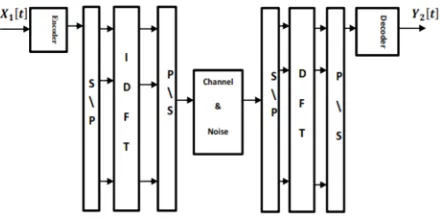
Complete block diagram of OFDM system shown in fig. 3. [1].
3 ADAPTIVE MODULATION
Is a term used in wireless communications to denote the matching of the modulation, coding and other signal and protocol parameters to the conditions on the radio link. Adaptive modulation systems invariably require some channel state information at the transmitter. This could be acquired in time division duplex systems by assuming the channel from the transmitter to the receiver is approximately the same as the channel from the receiver to the transmitter. Alternatively, the channel knowledge can also be directly measured at the receiver, and fed back to the transmitter.
In an OFDM transmission system, each subcarrier is attenuated individually under the frequency-selective and fast fading channel. The channel performance may be highly fluctuating across the subcarriers and varies from symbol to symbol. If the same fixed transmission scheme is used for all OFDM subcarriers; the error probability is dominated by the OFDM subcarriers with highest attenuation resulting in a poor performance.
Therefore, in case of frequency selective fading the error probability decreases very slowly with increasing average signal-to-noise ratio (SNR). This problem can be mitigated if different modulation schemes are employed for the individual OFDM subcarriers. Adaptive OFDM schemes have to be adapted to the SNR of the individual subcarriers. This will substantially improve the performance and data throughput of an OFDM system.
In sub band adaptive OFDM transmission, all subcarriers in an AOFDM symbol are split into blocks of adjacent subcarriers referred to as sub bands. The same mode is employed for all subcarriers of the same sub band. The choice of the modes to be used by the transmitter for its next OFDM symbol is determined by the channel quality estimate of the receiver based on the current OFDM symbol. The instantaneous SNR of the subcarrier is measured at the receiver. The channels quality varies across the different subcarriers for frequency selective channels.
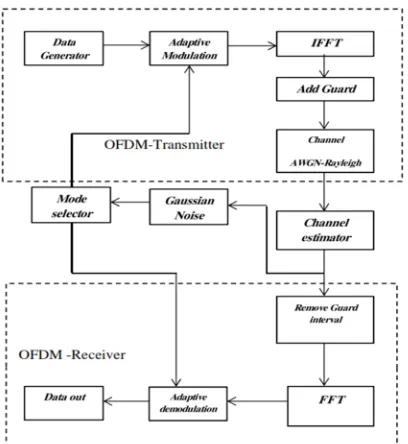
The block diagram in fig.4 demonstrate the adaptive modulation performing in the OFDM system.
Fig. 4. Illustrate the Block diagram of OFDM adaptive modulation system.
The received signal at any subcarrier can be expressed as:
= + (4)
where the channel coefficient at any subcarrier, is the transmitted symbol and is the Gaussian noise samples. So the instantaneous SNR can be calculated using:
= (5)
In this model the adaptation is done frame by frame. The channel estimation and mode selection are done at the receiver side and the information is sent to the transmitter using a feedback channel. The channel estimator is used to estimate the instantaneous SNR of the received signal. Based on the instantaneous SNR calculated, the best mode will be chosen for the next Transmission frame. This task is done by the mode selector block.
At the transmitter the adaptive modulator block consists of different modulators which are used to provide different modulation modes. This task is done by the mode selector block. The switching between these modulators will depend on the instantaneous SNR this block diagram is used to describe two types of adaptive modulation schemes which is based on MQAM and MPSK scheme. The goal of adaptive modulation is to choose the appropriate modulation mode for transmission in each sub band, given the local SNR, in order to achieve good trade-off between spectral efficiency and overall BER.
4 SIMULATION RESULTS
In this section, MATLAB based program was developed to simulate AMC systems uses different modulation schemes (BPSK, QPSK, 16QAM and 64QAM), the simulation developed according to the block diagram shown in fig. 5 with simulation parameters shown in table 1.The aim of simulation is to measure the performance of the AMC system (BER).
Table 1: Simulation parameters.
Parameter Specification
EbNo 0 – 30 dB
Modulation type BPSK, QPSK, 16QAM and 64QAM Channel model AWGN and Rayleigh
No. of sub carriers 100
Cyclic prefix length 40
No. of FFT points 100
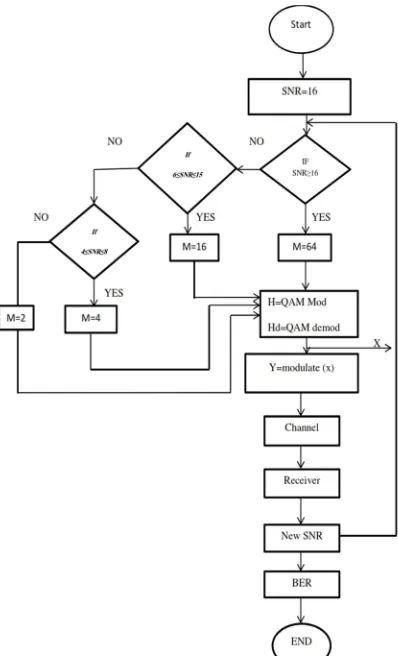
Modulation types switched based on the value of SNR fedback from the receiver to the transmitter, the values of SNR which define the modulation types shown in table 2.
Table 2: lookup table for AMC
SNR value Modulation scheme
SNR ≥ 16 64QAM
6 ≤ SNR ≤ 15 16QAM
4 ≤ SNR ≤ 8 QPSK
SNR ≤ 3 BPSK
Simulation flow chart shown in fig. 6 defines the process of AMC that was achieved using MATLAB based program to obtain the results. The program generate random values for SNR and repeat the algorithm in fig. 6 for all SNR values, then calculate the mean value of BERs measured for
each SNR value. Fig. 6. Illustrate the flow chart of AMC simulation
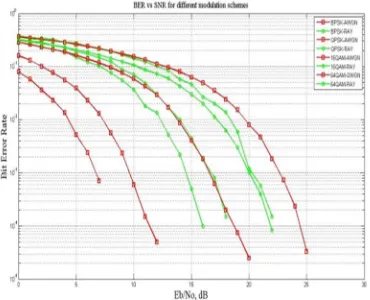
Measuring BER for different modulation schemes over AWGN and Rayleigh channels without using of OFDM and with using OFDM has been shown in fig. 7, fig. 8 and fig. 9, where fig. 7 shows the BER over AWGN channel without OFDM, fig. 8 shows BER over Rayleigh channel and fig. 9 shows BER over AWGN and Rayleigh with using OFDM, it’s observed that there is no great enhancement using OFDM over AWGN but measurable enhancement over Rayleigh channel, thus the use of AMC will be over Rayleigh channel.
Fig. 7. BER vs. EbNo over AWGN channel without using OFDM
Fig. 8. BER vs. EbNo over Rayleigh channel without using OFDM
Fig. 9. BER vs. EbNo over AWGN and Rayleigh channels with using OFDM
AMC change the modulation scheme continuously with changing SNR of the channel fed back from the receiver, so the average BER was calculated and for single carrier modulation also. Table 3 shows the average BER for different modulation schemes and AMC scheme.
Table 3: average BER
Average BER Modulation
0.0012 AMC
0.0130 BPSK
0.0249 QPSK
0.0314 16QAM
0.0553 64QAM
From table 2 it’s observed that AMC has BER better than BPSK and of course data rate better than 16QAM.
Table 4: Available data rate
Average Data rate (Mbps)
Modulation scheme
3.3351 AMC
2.6031 BPSK
2.6397 QPSK
2.7637 16QAM
2.8310 64QAM
5 CONCLUSION
In this paper AMC has been simulated and performance analyzed using MATLAB based programs, simulation has been achieved over AWGN and Rayleigh channels for different modulation schemes, single carrier and MCM for the purpose of comparison.Adaptive modulation systems improve bit error rates performance and data rates, by exploiting the channel state information that is present at the transmitter. Especially over fading channels which model wireless propagation environments, adaptive modulation systems exhibit great performance enhancements compared to systems that do not exploit channel knowledge at the transmitter.
6 REFERENCES
[1] Marc Engels. “Wireless OFDM Systems” Springer, Volume 692 2002.
[2] J.Faezah1, and K.Sabira. “Adaptive Modulation for OFDM Systems” Centre for Foundations Studies and Extension Education, Multimedia University, Vol. 1, No. 2, August 2009
[3] A Survey HAITHAM J. TAHA and M. F. M. Salleh. “Multi-carrier Transmission Techniques for Wireless Communication Systems” School Electrical and Electronic Engineering University Sains Malaysia (USM) SeriAmpangan,14300 NibongTebal, Pulau Pinang MALAYSIA.
[4] SangeetaJajoria, Sajjan Singh, S. V. A. V. Prasad. “Analysis of BER Performance of OFDM System by Adaptive Modulation”. International Journal of Recent Technology and Engineering (IJRTE) ISSN: 22773878, Volume-1, Issue-4, October 2012.
[5] Peng Hui Tan, Member, IEEE, Yan Wu, Student Member, IEEE, and Sumei Sun, Member, IEEE. “Link Adaptation Based on Adaptive Modulation and Coding for Multiple-Antenna OFDM System”.
[6] Yong Soo Cho, Jaekwon Kim, Won Young Yang, and Chung G. Kang, MIMO-OFDM
WIRELESS COMMUNICATIONS WITH
MATLAB, copyright _ 2010 John Wiley & Sons (Asia) Pte Ltd, 2 Clementi Loop, # 02-01, Singapore 129809.
[7] Marc Engels, Wireless ofdm systems how to make them work.