Variation in Morphometric Characters in Four Sand Crab (Albunea symmysta) Populations Collected from Sumatra and Java Island, Indonesia
Febi Ayu Pramithasari, Nurlisa Alias Butet and Yusli Wardiatno∗
Department of Aquatic Resources Management, Faculty of Fisheries and Marine Sciences, Bogor Agricultural University (IPB), Kampus FPIK-IPB, Dramaga, Bogor 16680, Indonesia
Published Online: 31 January 2017
To cite this article: Febi Ayu Pramithasari, Nurlisa Alias Butet and Yusli Wardiatno. (2017). Variation in Morphometric Characters in Four Sand Crab (Albunea symmysta) Populations Collected from Sumatra and Java Island, Indonesia. Tropical Life Sciences Research 28(1): 103–115. https://doi.org/10.21315/tlsr2017.28.1.7
To link to this article: https://doi.org/10.21315/tlsr2017.28.1.7
Abstract: Variation in morphometric characters in four sand crab (Albunea symmysta) populations from four intertidal areas in Sumatra (Aceh and Bengkulu) and Java (Cilacap and Yogyakarta) were studied. Crabs collected from the four sites were measured to obtain 10 morphometric characters, i.e., carapace length (CL), carapace width (CW), ocular peduncle length and width (LOP and WOP), telson length and width (LT and WT), merus length (ML), carpus length (CaL), propodus length (PL), and dactylus length (DL). Allometric relationships were established among three morphometric characters (CW, PL, and DL) for each site, in which CL was fixed on the abscissa as a reference variable. The analysis of covariance showed that population from Yogyakarta had a greater carapace width and the Aceh population had a longer dactylus length. In terms of propodus length, the Aceh population had a longer dactylus length than the Bengkulu population. Two group populations were detected by cluster analysis with 10 morphometric characters, i.e., the Sumatra population and the Java population.
Keywords: Allometric Relationships, Anomura, Cluster Analysis, Decapoda, Hippoidea
INTRODUCTION
The superfamily Hippoidea is one of the crab-like groups within the infraorder Anomura and is commonly referred to as mole or sand crabs. These hippoids are specialized to live buried in sandy substrates or fine sediment from the intertidal to offshore zones (Boyko, 2002; Osawa et al. 2010; Wardiatno & Mashar 2013). Wardiatno et al. (2015a) reported seven genera of superfamily Hippoidea distributed in Indonesian waters, including Albunea symmysta. This superfamily can be found along the west coast of Sumatra (Aceh, Bengkulu) and the south coast Java (Cilacap, Yogyakarta). Ecologically, sand crabs have an important role as components of the macrofaunal community in tropic and subtropic sandy beaches (Lastra et al. 2002). They also contribute to benthic secondary productivity (Subramoniam & Gunamalai 2003).
Most of the morphometric characters of crustaceans have been used in taxonomical studies to illustrate and describe morphometric usable characters
∗
displayed by adult, juvenile or larvae stages of genera or species of various organisms found in certain areas [e.g., for thalassinidean shrimps: Manning and Tamaki (1998), Wardiatno and Tamaki (2001), Dworschak (2003), Marin (2013); for copepods: Suárez-Morales and Fuentes-Reiné (2015a, 2015b); for crabs: Guerao et al. (1998), Komatsu and Takeda (2007); etc.]. For taxonomists, morphometric characters can be useful features to establish phylogenetic relationships among species placed in monotypic genera with clear familial or ordinal placement. In addition, morphometric analysis provides a powerful complement to genetic and environmental stock identification approaches (Cadrin 2000). Wardiatno and Tamaki (2001) studied the morphological characters of two Japanese ghost shrimps, Nihonotrypaea japonica and N. harmandi, to separate the two species by identification. Some researchers have used morphological characters to show sexual dimorphism in decapod crustaceans using their chelipeds (e.g., Shimoda et al. 2005; Claverie & Smith 2010; Trevisan et al. 2012), which was believed to be a consequence of the common male habits of combat, contest, and courtship (e.g., Hartnoll 1974).
Studies of the crustacean biology in Indonesia have been increasing recently, e.g., the occurrence of lobsters as a first record (Wardiatno et al. 2016), the biology of mantis shrimp (Wardiatno & Mashar 2010, 2011; Wardiatno et al. 2012; Wardiatno & Mashar 2013), the biology of blue swimming crabs (Hamid 2011; Hamid & Wardiatno 2015; Hamid et al. 2015a,b; Zairion et al. 2014; Wiyono & Ihsan 2015; Zairion et al. 2015a, b), as well as the biology of mole/sand crabs (Mashar & Wardiatno 2013a,b; Sarong & Wardiatno 2013; Wardiatno et al. 2014; Mashar et al. 2014, 2015; Santoso et al. 2015; Wardiatno et al. 2015a,b; Muzammil et al. 2015). Of the numerous studies on Indonesian mole/sand crabs, there has been no published work as yet on the morphometric variations of albuneid crab populations in Indonesia.
A comparison of the variation in morphometric characters of the same genera or species among several localities would be of interest to aquatic biologists (e.g., Wardiatno & Tamaki 2001; Spivak & Schubart 2003; Samaradivakara et al. 2012; Qonita et al. 2015). Therefore, this study was aimed at assessing the morphological variation in A. symmysta populations from two locations in Sumatra (Aceh and Bengkulu) and from two locations in Java (Cilacap and Yogyakarta).
MATERIALS AND METHODS
Sample Collection
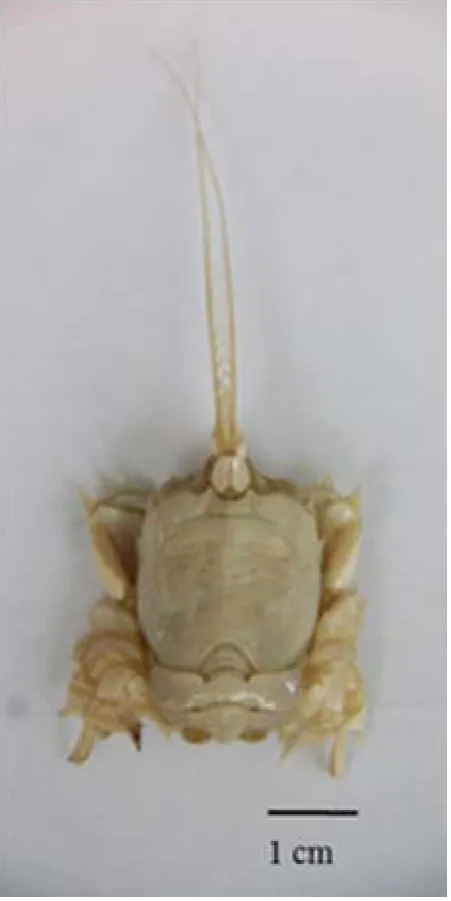
The last four characters were measured on both the left and right sides. Measurements were made to the nearest 0.1 mm using a calliper. Detailed information on the crabs used in this study is presented in Table 1.
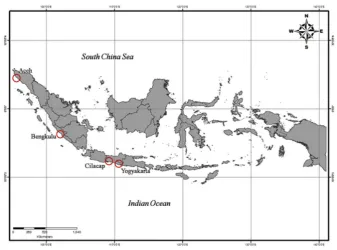
Figure 2: Sampling locations of Albunea symmysta in Sumatra and Java Island. Red circles indicate the sandy beaches where the sand crabs were collected. (Source: Indonesia topographical map in http://www.bakosurtanal.go.id)
Table 1: Information on the size and sex of specimens measured from each site in this study.
Site Number of
females
Number of males
Total Number
Size range (mm-CL) of both sexes
Sumatra Island
Aceh 37 13 50 10.30–21.60
Bengkulu 14 16 30 12.70–21.80
Jawa Island
Cilacap 27 35 62 10.30–21.60
Data Analysis
Allometric relationships were established among three morphometric characters (CW, PL, and DL) for each site, in which CL was fixed on the abscissa as a reference variable. The significance of the differences between the two sites (concerning slopes and intercepts) was tested by analysis of covariance (ANCOVA). To determine the similarity of Albunea symmysta populations among these sites, cluster analysis was performed based on 10 morphometric characters. Data from both sexes are combined in all analyses.
RESULTS
Allometric Relationships
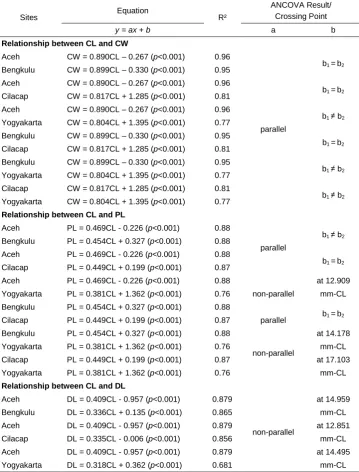
The relationships among carapace length and carapace width, propodus length, and dactylus length are presented in Table 2. A simple regression analysis of CL-CW showed significant differences in intercept values between A. symmysta from Yogyakarta with individuals from Bengkulu, Cilacap, and Yogyakarta. A. symmysta from Yogyakarta had a greater carapace width than the others (p<0.05).
Table 2 shows that population from Yogyakarta had a greater carapace width than other sites. Regression analysis between CL and PL for Cilacap vs. Yogyakarta showed a significant difference slope (p<0.05). In contrast, the comparisons of A. symmysta from Aceh vs. Cilacap, Aceh vs. Bengkulu, Bengkulu vs. Cilacap, and Bengkulu vs. Yogyakarta showed no differences in either slope and intercept, indicating that propodus length does not significantly differ between individuals of the same length (p<0.05). However, a comparison between Aceh and Bengkulu showed significant differences in intercept values; the Aceh population showed a greater propodus length than the Bengkulu population at the same carapace length (p<0.05).
Table 2: Linear regression equations for four morphometric variables (CL is the reference variable) in Albunea symmista collected from Sumatra (Aceh and Bengkulu) and Java (Cilacap and Yogyakarta), with the ANCOVA results to determine the difference between two respective sites.
Sites Equation R²
ANCOVA Result/ Crossing Point
y = ax + b a b
Relationship between CL and CW
Aceh CW = 0.890CL – 0.267 (p<0.001) 0.96
parallel
b1 =b2
Bengkulu CW = 0.899CL – 0.330 (p<0.001) 0.95
Aceh CW = 0.890CL – 0.267 (p<0.001) 0.96
b1 =b2
Cilacap CW = 0.817CL + 1.285 (p<0.001) 0.81
Aceh CW = 0.890CL – 0.267 (p<0.001) 0.96
b1 ≠ b2
Yogyakarta CW = 0.804CL + 1.395 (p<0.001) 0.77
Bengkulu CW = 0.899CL – 0.330 (p<0.001) 0.95
b1 =b2
Cilacap CW = 0.817CL + 1.285 (p<0.001) 0.81
Bengkulu CW = 0.899CL – 0.330 (p<0.001) 0.95
b1 ≠ b2
Yogyakarta CW = 0.804CL + 1.395 (p<0.001) 0.77
Cilacap CW = 0.817CL + 1.285 (p<0.001) 0.81
b1 ≠ b2
Yogyakarta CW = 0.804CL + 1.395 (p<0.001) 0.77
Relationship between CL and PL
Aceh PL = 0.469CL - 0.226 (p<0.001) 0.88
parallel
b1 ≠ b2
Bengkulu PL = 0.454CL + 0.327 (p<0.001) 0.88
Aceh PL = 0.469CL - 0.226 (p<0.001) 0.88
b1 =b2
Cilacap PL = 0.449CL + 0.199 (p<0.001) 0.87
Aceh PL = 0.469CL - 0.226 (p<0.001) 0.88
non-parallel
at 12.909
Yogyakarta PL = 0.381CL + 1.362 (p<0.001) 0.76 mm-CL
Bengkulu PL = 0.454CL + 0.327 (p<0.001) 0.88
parallel b1 =b2 Cilacap PL = 0.449CL + 0.199 (p<0.001) 0.87
Bengkulu PL = 0.454CL + 0.327 (p<0.001) 0.88
non-parallel
at 14.178
Yogyakarta PL = 0.381CL + 1.362 (p<0.001) 0.76 mm-CL
Cilacap PL = 0.449CL + 0.199 (p<0.001) 0.87 at 17.103
Yogyakarta PL = 0.381CL + 1.362 (p<0.001) 0.76 mm-CL
Relationship between CL and DL
Aceh DL = 0.409CL - 0.957 (p<0.001) 0.879
non-parallel
at 14.959
Bengkulu DL = 0.336CL + 0.135 (p<0.001) 0.865 mm-CL
Aceh DL = 0.409CL - 0.957 (p<0.001) 0.879 at 12.851
Cilacap DL = 0.335CL - 0.006 (p<0.001) 0.856 mm-CL
Aceh DL = 0.409CL - 0.957 (p<0.001) 0.879 at 14.495
Yogyakarta DL = 0.318CL + 0.362 (p<0.001) 0.681 mm-CL
Table 2: (continued)
Sites Equation R²
ANCOVA Result/ Crossing Point
y = ax + b a b
Bengkulu DL = 0.336CL + 0.135 (p<0.001) 0.865
parallel
b1 ≠ b2
Cilacap DL = 0.335CL - 0.006 (p<0.001) 0.856
Bengkulu DL = 0.336CL + 0.135 (p<0.001) 0.865
b1 =b2
Yogyakarta DL = 0.318CL + 0.362 (p<0.001) 0.681
Cilacap DL = 0.335CL - 0.006 (p<0.001) 0.856
b1 =b2
Yogyakarta DL = 0.318CL + 0.362 (p<0.001) 0.681
Cluster Analysis
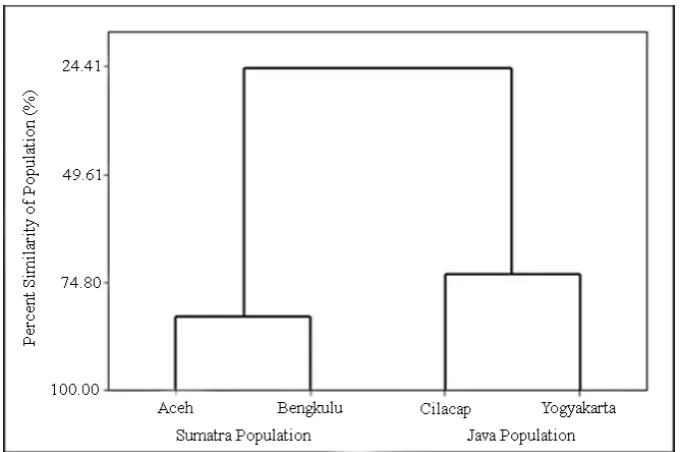
A dendrogram constructed using 10 morphometric characters showed that A. symmysta from the four sites could be classified into two groups, i.e., the Sumatra (Aceh and Bengkulu) and the Java (Cilacap and Yogyakarta) populations. The similarity values were 82.74% and 72.86% for each group, respectively (Fig. 3).
DISCUSSION
Many morphometric studies of decapod crustaceans have shown significant relationships among some morphometric characters to carapace or total length (e.g., Oh & Hartnoll 1999; Sampedro et al. 1999; Conan et al. 2001; Wardiatno & Tamaki 2001; Mashar & Wardiatno 2013a,b; Wardiatno & Mashar 2013; Muzammil et al. 2015). Widely used allometric relationships have been used mostly to quantify the relative growth of body parts expressing secondary sexual characters in crustaceans (Hartnoll 1978, 1982). White and Gould (1965) found that at molt before maturity, the slope of the allometric relationship undertakes an impulsive transformation.
Variations of some morphometric characters within the same species from different sites or different species from the same family at the same site would be interesting and useful from a biological or taxonomical perspective. Wardiatno and Tamaki (2001) revealed that variations in the size of the cornea and rostrum angle of Nihonotrypaea japonica and N. harmandi were effective characters to separate the two species. Wardiatno and Mashar (2013) speculated that variations in claw size between two mantis shrimp species (Harpiosquilla raphidea and Oratosquillina gravieri) may be a factor behind their competitive abilities.
In this study, the analyses of covariance were able to detect size variations in the carapace widths and dactylus lengths at the same size of carapace lengths among populations of Albunea symmista collected from two sites in Sumatra and two sites in Java (see Table 2). Some researchers have indicated that the variation in morphometric characters of any species may be caused by various factors, such as geographic region (Hepp et al. 2012) including elevation and latitude, environmental conditions (Waldman et al. 1988; Hausch et al. 2013, Wahidah et al. 2015), as well as genetic factors (Waldman et al. 1988; Bissaro et al. 2012). Qonita et al. (2015) showed that variations in morphology were due to environment conditions in the pile ark cockle (Anadara pilula), and this finding strengthened the argument of Barria et al. (2011) who hypothesized that morphological variations were brought about by adaptive responses to environmental conditions.
CONCLUSION
Morphometric variations in four populations of A. symmysta collected from Aceh, Bengkulu, Cilacap and Yogyakarta were detected, and these variations were used to cluster these populations into the following two groups: the Sumatra population and the Java population. The cluster pattern was likely determined by the local environmental conditions and the geographical distances between sampling sites. Further biological evidence (biomolecular approach) is necessary to strengthen the argument for subdividing these two A. symmysta populations.
ACKNOWLEDGEMENTS
The authors are indebted to Agus A. Hakim, Yuyun Qonita, Wahyu Muzammil, Dewi Masitoh, and Quratul Edritanti for their help during sampling in the field and in the laboratory. The research was partially funded by Indonesian Government through the Directorate General of Higher Education, Ministry of Education in fiscal year 2013 contract No: 7/IT3.41.2/L1/SPK/2013 with MAK code: 2013.089.521219, especially for field work in Cilacap, Yogyakarta and Bengkulu.
REFERENCES
Barría E M, Sepúlveda R D and Jara C G. (2011). Morphologic variation in Aegla Leach (Decapada: Reptantia: Aeglidae) from central-southern Chile: interspecific, sexual dimorphism, and spatial segregation. Journal of Crustacean Biology 31(2): 231–239. https://doi.org/10.1651/10-3324.1
Bissaro F G, Gomes-JR J L and Di Benedito A P M. (2012). Morphometric variation in the shape of the cephalothorax of shrimp Xiphopenaeus kroyeri on the east coast of Brazil. Journal of the Marine Biological Association of the United Kingdom 93(3): 683–691. https://doi.org/ 10.1017/S0025315412000409
Boyko C B. (2002). A worldwide revision of the recent and fossil sand crabs of the Albuneidae Stimpson and Blepharipodidae, new family (Crustacea: Decapoda: Anomura: Hippoidea). Bulletin of the American Museum of Natural History no. 272, 1–396. https://doi.org/10.1206/0003-0090(2002)272<0001:awrotr>2.0.co;2 Cadrin S X. (2000). Advances in morphometric identification of fishery stock. Review in
Fish Biology Fisheries 10(1): 91–112. https://doi.org/ 10.1023/A:1008939104413 Claverie T and Smith I P. (2010). Allometry and sexual dimorphism in the chela shape in
the squat lobster Munida rugosa. Aquatic Biology 8(2): 179–187. https://doi.org/10.3354/ab00233
Conan G Y, Comeau M and Moriyasu M. (2001). Are morphometrical approaches to establish size at maturity for male American lobster, Homarus americanus? Journal of Crustacean Biology 21(4): 937–947. https://doi.org/10.1651/0278-0372 Dworschak P C. (2003). A new species of ghost shrimp from the Gulf of Aqaba, Red Sea
(Crustacea: Decapoda: Callianassidae). Annalen des Naturhistorischen Museums in Wien 104B: 415–428.
Hamid A. (2011). Conditions of blue swimming crab in the Lasongko Bay Buton Regency Southeast Sulawesi Province. Jurnal Mitra Bahari 5: 75–86 [in Indonesian]. Hamid A and Wardiatno Y. (2015). Population dynamics of the blue swimming crab
(Portunus pelagicus Linnaeus, 1758) in Lasongko Bay, Central Buton, Indonesia. AACL Bioflux 8(5): 729–739.
Hamid A, Wardiatno Y, Lumban Batu D T F and Riani E . (2015a). Fecundity and gonad maturity stages of ovigerous female blue swimming crab (Portunus pelagicus) in Lasongko bay, Southeast Sulawesi. Bawal 7(1): 43–50 [in Indonesian].
———. (2015b). Changes in proximate and fatty acids of the eggs during embryo development in the blue swimming crab, Portunus pelagicus (Linnaeus 1758) at Lasongko bay, Southeast Sulawesi, Indonesia. Indian Journal of Science and Technology 8(6): 501–509. https://doi.org/10.17485/ijst/2015/v8i6/62337
Hartnoll R G. (1974). Variation in growth pattern between some secondary sexual characters in crabs (Decapoda, Brachyura). Crustaceana 27(2): 131–136. https://doi.org/10.1163/ 156854074X00334
———. (1978). The determination of relative growth in Crustacea. Crustaceana 34(3): 281–293. https://doi.org/10.1163/156854078X00844
———. (1982). Growth. In L G Abele (ed.). The Biology of Crustacea Volume 2: Embryology, Morphology, and Genetics. New York, USA: Academic Press, 111– 196.
Hausch S, Shurin J B and Matthews B. (2013). Variation in body shape across species and populations in a radiation of diaptomid copepods. PloS ONE 8(6): e68272. https://doi.org/10.1371/journal.pone.0068272
Hepp L U, Fornel R, Restello R. M, Trevis A and Santos S. (2012). Intraspecific morphological variation in a freshwater crustacean Aegla plana in Southern Brazil: effects of geographical isolation on carapace shape. Journal of Crustacean Biology 32(4): 511–518. https://doi.org/ 10.1163/193724012X630660 Ingole B S, Sreepada R A, Ansari Z A and Parulekar A H. (1998). Population
characteristics of the mole crab, Hippa adactyla Fabricius, in the intertidal sediment at Kavaratti atoll, Lakshadweep Islands. Bulletin of Marine Science 63(1): 11–20.
Komatsu H and Takeda M. (2007). First record of leucosiid crabs (Crustacea: Decapoda: Brachyura) from the Kermadec Islands, with description of a new species. Bulletin of the National Museum of Nature and Science, Series A Zoology 33(2): 61–66.
Lastra M, Dugan J E and Hubbard D M. (2002). Burrowing and swash behavior of the pacific mole crab Hippa Pacifica (Anomura, Hippidae) in tropical sandy beaches. Journal of Crustacean Biology 22(1): 53–58. https://doi.org/10.1651/0278-0372 Manning R B and Tamaki A. (1998). A new genus of ghost shrimp from Japan (Crustacea:
Decapoda: Callianassidae). Proceedings of the Biological Society of Washington 111(4): 889–892.
Marin I. (2013). A new species of callianassid ghost shrimp of the genus Nihonotrypaea Manning & Tamaki, 1998 (Crustacea, Decapoda, Axiidea, Callianassidae) from southern part of the Russian coast of the Sea of Japan. Zootaxa 3694(5): 434– 444. https://doi.org/10.11646/zootaxa. 3694.5.2
Mashar A and Wardiatno Y. (2013a). Growth aspect of the mole crab, Emerita emeritus of Kebumen District sandy beach. Jurnal Biologi Tropis 13(1): 29–38 [in Indonesian].
Mashar A, Wardiatno Y, Boer M, Butet N A and Farajallah A. (2014). The diversity and abundance of sand crabs in south coast of Central Java. Ilmu Kelautan 19(4): 226–232 [in Indonesian].
Mashar A, Wardiatno Y, Boer M, Butet N A, Farajallah A and Ardika P U. (2015). First record of
Albunea symmysta (Crustacea: Decapoda: Albuneidae) from Sumatra and Java,
Indonesia. AACL Bioflux 8(4): 611–615.
Muzammil W, Wardiatno Y and Butet N A. (2015). Carapace length-width ratio, growth pattern, condition factor, and relative condition factor of the sand crab (Hippa adactyla) in sandy beach of Cilacap and Kebumen. Jurnal Ilmu Pertanian Indonesia 20(1): 78–84. [in Indonesian].
Oh C W and Hartnoll R G. (1999). Size at sexual maturity, reproductive output, and seasonal reproduction of Philocheras trispinosus (Decapoda) in Port Erin Bay, Isle of Man. Journal of Crustacean Biolology 19(2): 252–259. https://doi.org/10.2307/1549231
Osawa M, Boyko C B and Chan T-Y. (2010). Part I. Hiipoidea (Mole crabs). In A Chan T-Y (ed.). Crustacean fauna of Taiwan: Crab-Like Anomurans (Hippoidea, Lithodoidea, and Porcellanidae). Keelung (Taiwan): National Taiwan Ocean University, 1–40.
Qonita Y, Wardiatno Y and Butet N A. (2015). Morphological variation in three populations of the pill ark cockle, Anadara pilula (Mollusca: Bivalve) of Java, Indonesia. AACL Bioflux 8(4): 556–564.
Rosenberg M S. (2002). Fiddler crab claw shape variation: a geometric morphometric analysis across the genus Uca (Crustacea: Brachyura: Ocypodidae). Biological
Journal of the Linnean Society 75(2): 147–162. https://doi.org/10.1046/j.1095-8312.2002.00012.x
Samaradivakara S P, Hirimuthugoda N Y, Gunawardana R H A N M, Illeperuma R J, Fernandopulle N D, De Silva A D and Alexander P A B D. (2012). Morphological variation of four Tilapia populations in selected reservoirs in Sri Lanka. Tropical Agricultural Research 23(2): 105–116. https://doi.org/10.4038/tar.v23i2.4642 Sampedro M P, González G E, Freire J and Muiño R. (1999). Morphometry and sexual
maturity in the spider crab Maja squinado (Decapoda: Majidae) in Galicia, Spain. Journal of Crustacean Biology 19(3): 578–592. https://doi.org/10.2307/1549263 Santoso J, Hanifa Y N, Indariani S, Wardiatno Y and Mashar A. (2015). Nutritional values
of the Indonesian mole crab, Emerita emeritus: are they affected by processing methods? AACL Bioflux 8(4): 579–587.
Sarong M A and Wardiatno Y. (2013). Habitat and morphological characteristics gratus nest sea (Albunea) in the Leupung littoral coastal zone, Great Aceh District]. Jurnal EduBio Tropika 1(1): 1–60 [in Indonesian].
Shimoda K, Wardiatno Y, Kubo K and Tamaki A. (2005). Intraspecific behaviors and major cheliped sexual dimorphism in three congeneric callianassid shrimps. Marine Biology 146(3): 543–557. https://doi.org/10.1007/ s00227-003-1237-y
Spivak E D and Schubart C D. (2003). Species status in question: a morphometric and molecular comparison of Cyrtograpsus affinis and C. altimanus (Decapoda, Brachyura, Varunidae). Journal of Crustacean Biology 23(1): 212–222. https://doi.org/10.1651/0278-0372
———. (2015b). Record of Kelleria reducta (Copepoda: Poecilostomatoida: Kelleriidae) from the Caribbean coast of Colombia. Revista Mexicana de Biodiversidad 86(1): 28–33. https://doi.org/10.7550/ rmb.48345
Subramoniam T and Gunamalai V. (2003). Breeding biology of the intertidal sand crab Emerita (Decapoda: Anomura). Advances in Marine Biology 46: 91–182. https://doi.org/10.1016/S0065-2881(03)46003-3
Trevisan A, Marochi M Z, Costa M, Santos S and Masunari S. (2012). Sexual dimorphism in Aegla marginata (Decapoda: Anomura). Nauplius 20(1): 75–86. https://doi.org/10.1590/S0104-64972012000100008
Wahidah, Shariffudin Bin Andy Omar, Trijuno D D and Nugroho E. (2015). Morphometric variance of South Sulawesi’s freshwater prawn Macrobrachium rosenbergii and Macrobrachiumidae. International Journal of Scientific Research 5(4): 1–5. Waldman J R, Grossfield J and Wrigin I. (1988). Review of stock discrimination techniques
for striped bass. North American Journal of Fisheries Management 8(4): 410– 425. https://doi.org/10.1577/1548-8675
Wardiatno Y and Tamaki A. (2001). Bivariate discriminant analysis for the identification of Nihonotrypaea japonica and N. hardmani (Decapoda: Thalassinidea: Callianassidae). Journal of Crustacean Biology 21(4): 1042–1048. https://doi.org/10.1163/20021975-99990196
Wardiatno Y and Mashar A. (2010). Biological information on the mantis shrimp, Harpiosquilla raphidea (Fabricius 1798) (Stomatopoda, Crustacea) in Indonesia with a highlight of its reproductive aspects. Journal of Tropical Biology and Conservation 7: 65–73.
———. (2011). Population dynamics of the Indonesian mantis shrimp, Harpiosquilla raphidea (Fabricius 1798) (Crustacea: Stomatopoda) collected from a mud flat in Kuala Tungkal, Jambi Province, Sumatera Island. Ilmu Kelautan 16(2): 111–118. ———. (2013). Morphometric study of two Indonesian mantis shrimp (Harpiosquilla
raphidea and Oratosquillina gravieri). Buletin PSP 21(1): 19–30.
Wardiatno Y, Santoso J and Mashar A. (2012). Biochemical composition in two populations of the mantis shrimp, Harpiosquilla raphidea (Fabricius 1798) (Stomatopoda, Crustacea). Ilmu Kelautan 17(1): 49–58.
Wardiatno Y, Nurjaya I W and Mashar A. (2014). Habitat characteristics of the mole crabs (Family Hippidae) in sandy coast, Cilacap District. Jurnal Biologi Tropis 14(1): 1– 8 [in Indonesian].
Wardiatno Y, Ardika P U, Farajallah A, Butet N A, Mashar A, Kamal M M, Renjaan E A et al. (2015a). Biodiversity of Indonesian sand crabs (Crustacea, Anomura, Hippidae) and assessment of their phylogenetic relationships. AACL Bioflux 8(2):224–235.
Wardiatno Y, Ardika P U, Farajallah A, Mashar A and Ismail. (2015b). The mole crab Hippa marmorata (Hombron et Jacquinot, 1846) (Crustacea Anomura Hippidae): A first record from Indonesian waters. Biodiversity Journal 6(2): 517–520.
Wardiatno Y, Hakim AA, Mashar A, Butet NA, Adrianto L and Farajallah A. (2016). First record of Puerulus mesodontus Chan, Ma & Chu, 2013 (Crustacea, Decapoda, Achelata, Palinuridae) from south of Java, Indonesia. Biodiversity Data Journal 4: e8069. https://doi.org/ 10.3897/BDJ.4.e8069
White J F and Gould S J. (1965). Interpretation of the coefficient in the allometric equation. American Naturalist 99(904): 5–18. https://doi.org/10. 1086/282344
Wiyono E S and Ihsan. (2015). The dynamic of landing blue swimming crab (Portunus pelagicus)
catches in Pangkajene Kepulauan, South Sulawesi, Indonesia. AACL Bioflux 8(2): 134–
141.
Zairion, Wardiatno Y, Boer M and Fahrudin A. (2015a). Reproductive biology of the blue swimming crab Portunus pelagicus (Brachyura: Portunidae) in east Lampung waters, Indonesia: fecundity and reproductive potential. Tropical Life Sciences Research 26(1): 67–85.
Zairion, Wardiatno Y and Fahrudin A. (2015b). Sexual maturity, reproductive pattern and spawning female population of the blue swimming crab, Portunus pelagicus (Brachyura: Portunidae) in east Lampung coastal waters, Indonesia. Indian Journal of Science and Technology 8(6): 596–607. https://doi.org/10.17485/ijst/