VOLUME 13 | ISSUE 2 | 2018 | 455
Influence of an exercise programme on level of
coordination in children aged 6 to 7
IVAN ČILLÍK, TOMÁŠ WILLWÉBER1
Department of Physical Education and Sports, Faculty of Arts, Matej Bel University, Banska Bystrica, Slovakia
ABSTRACT
The paper presents changes in the level of coordination in children (6 – 7), as a result of an exercise programme within the frame of the IAAF (International Association of Athletics Federations) Kids' Athletics project. The monitoring period lasted for 5 months, during which the members of the experimental group went through 37 training sessions (2 training sessions for 60 minutes a week). The exercise programme consisted of preparatory athletic and gymnastic exercises and cardio games. Versatility training was focused on the development of all fitness abilities, coordination abilities, and articulated mobility. The experimental group consisted of 24 children (17 boys and 7 girls), aged 6.62 ± 0.31 years. The control group consisted of 31 children (22 boys and 9 girls), aged 6.78 ± 0.3 years. Measured indicators of physical development were height, weight and BMI. Tests used to determine the level of coordination were: precision standing long jump, precision kneeling overhead throw, rhythmic lateral line jumps with the aid of a metronome, run to targets, reaction speed of lower extremities, static balance on dynamometric plate. The experimental group showed statistically significant changes (p < 0.05) in these disciplines the precision kneeling overhead throw. The effect size was medium. The rhythmic lateral line jumps test with the aid of a metronome showed no statistically significant changes. The effect size was small. We have observed statistically significant changes (p < 0.01) during these tests: the precision standing long jump, run to targets, reaction speed of lower extremities and static balance on dynamometric plate. The effect size of the precision standing long jump reached medium, run to targets reached medium, the reaction speed of lower extremities showed a large effect and the test of static balance showed a small effect. The results show that children involved in the IAAF Kids' Athletics project had larger improvements in their level of coordination as opposed to kids who were not
1Corresponding author. Department of Physical Education and Sports, Faculty of Arts, Matej Bel University, Tajovského 40, 974
01 Banská Bystrica, Slovakia.
E-mail: [email protected] Submitted for publication November 2017 Accepted for publication March 2018 Published March 2018
JOURNAL OF HUMAN SPORT & EXERCISE ISSN 1988-5202 © Faculty of Education. University of Alicante
456 | 2018 | ISSUE 2 | VOLUME 13 © 2018 University of Alicante involved. This contribution is a part of the research project VEGA 1/0571/16. Key words: KID’S ATHLETICS,
COORDINATION ABILITIES, YOUNG SCHOOL-AGE.
Cite this article as:
VOLUME 13 | ISSUE 2 | 2018 | 457 INTRODUCTION
Coordination is one of the most important skills in human's relationship with the environment, alongside others such as endurance, strength and flexibility (Monleón et al., 2015). Bonaccorso (2001) defines coordination as the ability to plan, control and regulate our movement in order to reach an objective.
On one hand, the importance of the development of coordination in pre-school and young school-age children is emphasized by many authors (Haywood and Getchel, 2005; Thies and Travers, 2006; Meinel and Schnabel, 2007). On the other hand, they highlight certain age and growth-related peculiarities which need to be respected (Use appropriate exercises, develop versatility, respect physical and psychic development).
Additionally, Šimonek (2004) states that the current generation of children enters sport training with far lower
fitness and coordination, than that seen 15 – 20 years ago. It is a consequence of changes in lifestyle, sedentary activity, low spontaneous movement activity. Development and diagnostics of fitness and coordination is therefore crucial, mainly in pre-school and young school-age children.
Time concordance between fitness and coordination development during growth does not exist. The body is
biologically predisposed to development of coordination, rather than fitness (Doležajová, 2004), but because
they are interlinked both need to be developed simultaneously. Also, fitness becomes superfluous if coordination is not good enough. Individual coordination abilities are closely interlinked. According to authors Sabau et al. (2013), subjective factors such as improvement of stereotyped movements, higher fatigue resistance, better motor coordination etc., often indicate the individual training experience of children.
Given the increasing movement complexity during growth it is crucial to develop coordination during young school-age. Motor games and activities in the form of games are an effective teaching method to increase psychomotoric coordination (Thies and Travers, 2006). An effective training program for children and adolescents must take into account the psycho-physical particularities of each age range, in order to focus on and to exploit to the maximum the specific age-related motor learning abilities (Ricotti, 2011). Additionally,
children’s development through physical activities positively influences their basic motor function,
performance and socialization (Kosel, 2001).
General training programmes often do not include enough coordination focused exercises. The share of coordination focused exercises should be at least 50% compared to fitness-oriented exercises. Locomotor games and competitions are favoured. Determining the level of coordination is another issue. The lower the age, the harder it is to determine coordination abilities of children. Doležajová and Lednický (2010) also state
that determining the standardized coordination abilities consistently shows new relevant information and problems in the fields of physical training and sports.
This contribution is a part of research project VEGA 1/0571/16 The impact of training on physical abilities, physical and functional development of 5-6-years-old children.
MATERIAL AND METHODS
458 | 2018 | ISSUE 2 | VOLUME 13 © 2018 University of Alicante initial somatic characteristics were: body height 124.81 ±4.85 cm, body weight 24.87 ±4.27 kg and body mass index 15.88 ±1.76 kg.m-2.
Measures
The experimental factor was the exercise programme within the IAAF Kids’ Athletics project. The
experimental period lasted for 5 months and participants undertook 37 training sessions. Children attended 2 training sessions per week, lasting for 60 minutes each. The training was focused on the optimal development of fitness and coordination. Training equipment was provided by IAAF Kids' Athletics. The ratio of general and special preparatory training was approximately 80-70%: 30-20% (figure 1).
Figure1. Ratio of general and special preparatory training during the experimental period.
Procedures
When determining coordination levels we followed age-specific methods. Kinaesthetic-differentiation of lower extremities was determined by a precision standing long jump (Hirtz, 1985). The tested subject had to jump into a marked spot (75% of maximal power). Evaluations were based on the average deviation of three attempts from the marked spot.
Kinaesthetic-differentiation of upper extremities was determined by a modified precision kneeling overhead
throw (Šimonek, 2015). A light volleyball was used to match the strength of the children instead of the heavier medicine ball (1 kg) and the body position was changed from stand to kneel in order to isolate upper limbs. Subject had to throw a volleyball ball into a marked spot (50% of maximal power). Evaluations were based on the average distance of three attempts from the marked spot.
A modified version of Raczek et al. (2002) rhythmic jumps with aid of a metronome was used to determine rhythmic abilities. Subjects jumped laterally 20 times across the line at 1 second intervals. Evaluations were based on time difference between 20 rhythmic lateral line jumps without the aid of a metronome and 20 rhythmic lateral line jumps with the aid of a metronome.
Run to targets was used to examine spatial orientation (Hirtz, 1985). Considering the age of subjects, simple pictures were used instead of numbers.
Reaction time of lower extremities was measured by FiTRO agility check device (FiTRONiC, Bratislava, Slovak Republic). The system consists of four 35 centimetres contact switch mattresses, which measure
subject’s reaction speed on every side. The mattresses are 0.4 meters apart and the objective is to 78.58 %
71.43 %
21.42 % 28.57 %
0 10 20 30 40 50 60 70 80 90
October November December January February March
General
VOLUME 13 | ISSUE 2 | 2018 | 459
accomplish foot contact with the mattress corresponding with the position of visual reaction stimulus in one of the four corners of the screen. The two best reaction times in every direction were used to make evaluations (Zemková, 2008; Zemková and Hamar, 2015).
Static balance was determined with a FiTRO sway check dynamometric plate (FiTRONiC, Bratislava, Slovak Republic). The subject looks at a fixed point straight ahead, while he/she stands barefoot on the plate with hands next to the body. Every test consisted of two 30 second repetitions and the better one was evaluated
(Štefániková and Zemková, 2008). The most reliable measuring technique is average shifting speed of centre
of gravity (Zemková and Hamar, 2002).
Analysis
Basic mathematical and statistical indicators were applied to calculate the arithmetic average, standard deviation, minimum and maximum. Normal distribution of the data was calculated using the Shapiro-Wilk test. Evaluation of the statistically significant differences between input and output data included the usage of the Dependent t-test for related samples and the Wilcoxon signed-rank test, as well as the t-test and Mann Whitney U test. Calculation of statistical significance was set at the level p < 0.05 and p < 0.01. Cohen’s ‘d’ coefficient and correlation coefficient ‘r’ quantified the effect’s size.
RESULTS
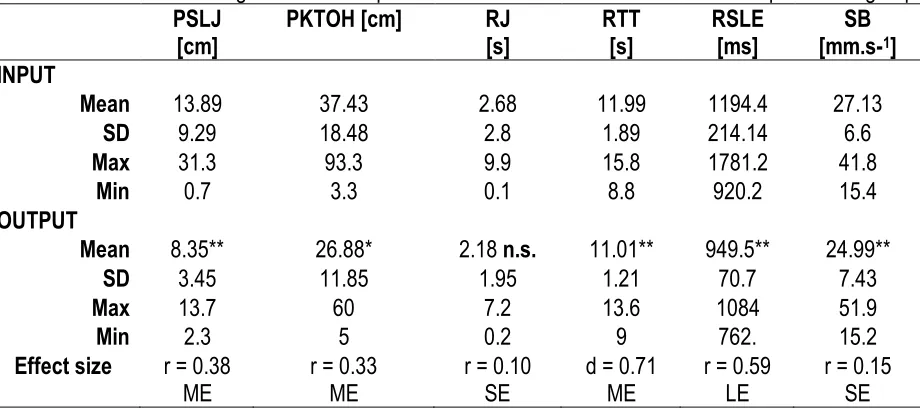
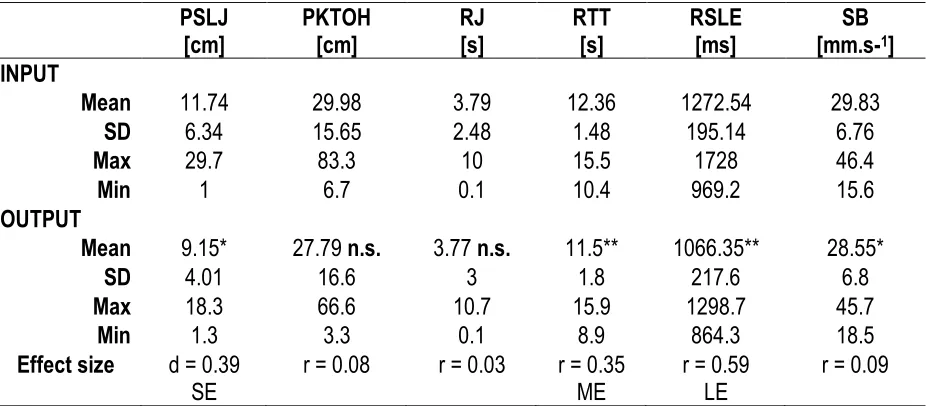
Physical development and coordination were measured in experimental and control groups. After comparing initial values of measured parameters, no statistically significant disparities were found. Levels of coordination were tested in experimental and control groups in order to determine the efficiency of the exercise programme (Table 1, Table 2).
Table 1. Initial and final testing of the somatic parameters and movement skills within the experimental group.
PSLJ
[cm] PKTOH [cm] RJ [s] RTT [s] RSLE [ms] [mm.s-SB 1]
INPUT
Mean 13.89 37.43 2.68 11.99 1194.4 27.13
SD 9.29 18.48 2.8 1.89 214.14 6.6
Max 31.3 93.3 9.9 15.8 1781.2 41.8
Min 0.7 3.3 0.1 8.8 920.2 15.4
OUTPUT
Mean 8.35** 26.88* 2.18 n.s. 11.01** 949.5** 24.99**
SD 3.45 11.85 1.95 1.21 70.7 7.43
Max 13.7 60 7.2 13.6 1084 51.9
Min 2.3 5 0.2 9 762. 15.2
Effect size r = 0.38
ME r = 0.33 ME r = 0.10 SE d = 0.71 ME r = 0.59 LE r = 0.15 SE
Legend: SD – standard deviation; PSLJ – precision standing long jump; PKTOH – precision kneeling overhead throw; RJ – rhythmic jumps; RTT – run to target; RSLE – reaction speed of lower extremities SB – static balance; * – statistical significance p<0.05; **
460 | 2018 | ISSUE 2 | VOLUME 13 © 2018 University of Alicante Table 1. Initial and final testing of the somatic parameters and movement skills within the experimental group.
Legend: SD – standard deviation; PSLJ – precision standing long jump; PKTOH – precision kneeling overhead throw; RJ – rhythmic jumps; RTT – run to targets; RSLE – reaction speed of lower extremities SB – static balance; *– statistical significance p<0.05; **
– statistical significance p<0.01; n.s. – not significant; SE – small effect; ME – medium effect; LE – large effect.
An average value 13.89 ±9.29 cm was measured in the precision standing long jump. The exercise was designed to test kinaesthetic-differentiation of lower extremities. The average output performance of subjects was 8.35 ±3.45 cm. There was an observed improvement of 5.54 cm (39.9 %) and statistically significant disparities. The effect size showed a medium effect (T = 52, Z = -2.62, n = 24, p < 0.01, r = 0.38).
The precision kneeling overhead throw, designed to test kinaesthetic-differentiation of upper extremities, showed an average initial performance 37.43 ±18.48 cm and average output performance 26.88 ±11.85 cm, which showed an average improvement of 10.55 cm (28.19 %). We recorded a statistically significant difference and a medium effect size (T = 56.5, Z = -2.273, n = 24, p < 0.05, r = 0.33).
In the rhythmic lateral line jump test, focused on the rhythmical ability, the experimental group achieved the following results: average input performance 2.68 ±2.8 s and output performance 2.18 ±1.95 s, which represents an improvement in average performance of 0.5 s (18.74%). This difference was not statistically
significant. A correlation coefficient quantified the effect’s size as small (T = 114.5, Z = -0.715, n = 24, r = 0.10).
In the run to targets test, focused on spatial orientation, the experimental group achieved the following results: average input performance 11.99 ±2.8 s and output performance 11.01 ±1.21 s, which represents an improvement in average performance of 0.98 s (8.18%), with statistically significant difference and medium effect (t = 3.495, p < 0.01, d = 0.71).
Within the reaction speed of lower extremities test, the experimental group achieved the following results: average input performance 1194.4 ±214.14 ms and average output performance 949.5 ±70.7 ms which represents a significant improvement of average performance of 244.9 ms (20.5%). The effect size showed a large effect and significant disparities for statistical purposes (T = 8, Z = -4.057, n = 24, p < 0.01, r = 0.59).
PSLJ
[cm] PKTOH [cm] RJ [s] RTT [s] RSLE [ms] [mm.s-SB 1]
INPUT
Mean 11.74 29.98 3.79 12.36 1272.54 29.83
SD 6.34 15.65 2.48 1.48 195.14 6.76
Max 29.7 83.3 10 15.5 1728 46.4
Min 1 6.7 0.1 10.4 969.2 15.6
OUTPUT
Mean 9.15* 27.79 n.s. 3.77 n.s. 11.5** 1066.35** 28.55*
SD 4.01 16.6 3 1.8 217.6 6.8
Max 18.3 66.6 10.7 15.9 1298.7 45.7
Min 1.3 3.3 0.1 8.9 864.3 18.5
Effect size d = 0.39
VOLUME 13 | ISSUE 2 | 2018 | 461
In the test of static balance the experimental group achieved the following shifting speeds of centre of gravity: input speed 27.13 ±6.6 mm.s-1 and output speed 24.99 ±7.43 mm.s-1. The average performance was improved by 2.14 mm.s-1 (7.89 %) which is considered as small effect and statistically significant difference (T = 49, Z = -2.886, n = 24, p < 0.01, r = 0.15).
Within the precision standing long jump test, the control group achieved the following results: average input performance 11.74 ±6.34 cm and output performance 9.15 ±4.01 cm. The average performance increased by 2.58 cm (21.99%) which is considered statistically significant with a small effect (t = 2.194, p < 0.05, d = 0.39).
Within the precision kneeling overhead throw test, the control group achieved an average initial performance 29.98 ±15.65 cm and an average output performance 27.79 ±16.6 cm which represents an improvement in average performance of 2.19 cm (7.32%). It does not represent a statistically significant difference (T = 188.5, Z = -0.627, n = 31, r = 0.08).
In the rhythmic lateral line jump test, the control group achieved the following results: average input performance 3.79 ±2.48 s and output performance 3.77 ±3.0 s. The achieved improvement in average performance of 0.02 s (18.74%) is not statistically significant (T = 237, Z = -0.216, n = 31, r = 0.03).
In the run to targets test, the control group achieved an average input performance 12.36 ±1.48 s and output performance 11.5 ±1.8 s. Improvement in average performance of 0.86 s (6.99%) is statistically significant and effect size reached medium effect (T = 108, Z = -2.744, n = 31, p < 0.01, r = 0.35).
In the reaction speed of lower extremities test, the control group achieved the following results: average input performance 1272.54 ±195.14 ms and average output performance 1066.35 ±217.6 ms. The average improvement of 206.19 ms (16.2%) represents large effect and statistical significance (T = 10, Z = -4.664, n = 31, p < 0.01, r = 0.59).
In the test of static balance, the control group achieved: input average shifting speed of the centre of gravity 29.83 ±6.76 mm.s-1 and output speed of 28.55 ±6.8 mm.s-1. The difference of 1.28 mm.s-1 (4.3 %) is considered as statistically significant. The effect size was not recorded (T = 120, Z = -2.209, n = 31, p < 0.05, r = 0.09).
DISCUSSION
Based on the results of the tests, we can state, that the experimental group achieved a significant improvement compared to the control group, which affirms the propositions about this sensitive period for development of coordination in young school-age children (Hirtz, 1985, Gallahue and Ozmun, 2002,
Hynes-Dusel, 2002, Šimonek, 2014, Altinkök, 2016).
462 | 2018 | ISSUE 2 | VOLUME 13 © 2018 University of Alicante For comparison, on one hand, Zapletalová (2002) recorded average performance of 7-year-old children in run to targets tests with the following results: boys 10.69 ±1.23 s, girls 10.82 ±1.27 s, which are slightly better than the results of our tested groups.
On the other hand, according to guidelines for 7-year-olds (Horváth et al 2015), our experimental group achieved times significantly above the average. The guidelines are: <11.05 (significantly above average), 11.15-13.25 (above average), 13.35-15.35 (average), 15.45-17.4 (below average), >17.5 (significantly below average)
Altinkök (2016) researched the influence of a 12-week long coordination programme of children of pre-school age. A total of 78 children participated in the experiment (38 in the experimental group and 40 in control group). Statistically significant disparities were found between both groups in every performed test. The agility test showed a statistically significant difference (p < 0.01). Tennis ball throwing, running coordination and Static balance tests showed statistically less significant differences (p < 0.05). The experimental group showed a statistically significant (p < 0.01) improvement in all performed tests. The results showed that pre-school and young pre-school-age children who had undergone coordination focused exercise programme can improve their fundamental motor movements. The experimental group of this research achieved a statistically significant difference in all tests except for the rhythmic jumps.
Based on research with children aged 5-6 to 10 years we recommend developing coordination abilities in the pre-school and younger school-age with an increased stress on the development of courage through increasing the risk-taking in a given motor task, increased changing of conditions of exercises and rhythm
(Šimonek, 2014).
According to the precision standing long jump guidelines (Šimonek, 2015) we can state that 7-year-old boys perform better in this discipline than girls. The guidelines for 7-year-old boys: <4.19 cm (significantly above average), 4.2-5.83 cm (above average), 5.84-7.48 cm (average), 7.49-9.11 cm (below average), >9.12 cm (significantly below average). The guidelines for 7-year-old girls: <4.27 cm (significantly above average), 4.28-9.02 (above average), 9.03-13.82 (average), 13.83-18.57 (below average), >18.58 cm (significantly below average). The results of the boys in our tested groups were below average and the results of the girls were average compared with the guidelines.
Reaction speed gradually slows down until adulthood and decrease in reaction time can be divided into three phases. There is rapid decrease in reaction time from the7th to 10th year (27.1%). The first study of Reactive Agility Test (Zemková and Hamar, 2014) determined reaction time of 7-year-old children of 891 ±85.4 ms. Our experimental group achieved time 949.5 ±70.7 ms and control group achieved 1066.35 ±217.6 ms. Both times are slower but improvements of 20.5% in experimental group and 16.2% in control group are significant.
Shifting speed of centre of gravity decreases linearly from the 6th to 10th year of life. Range of centre of pressure (COP) decreases with age and maximal values were recorded during the 8th year of life. Both parameters were reduced and constant which signals that the processes responsible for optimal postural stability are fully developed after the 6th year of life (Rival et al. 2005). Keeping a stable body posture requires coordination between the activity of the visual organ as well as the vestibular and proprioceptive systems (Żurek et al. 2015).
The research of Štefániková and Zemková (2008) was focused on detecting the impact of exercises based
VOLUME 13 | ISSUE 2 | 2018 | 463
The 10 week visual feedback-based balance training on a stable platform found a statistically significant (p < 0.01) decrease in reaction time by 1.4 mm.s-1. A statistically significant (p < 0.01) decrease in reaction time was achieved after 8 weeks when visual feedback-based balance training on an unstable platform was used. A statistically significant (p < 0.05) decrease was achieved also in the control group: input data (21.1 ±4.7 mm.s-1), output data (20.7 ±4.9 mm.s-1). When comparing the input data of our research groups (27.13 mm.s -1 a 29.83 mm.s-1) and the research data of Štefániková and Zemková (2008), significant disparities are observed, but our research did not focus only on balance and participants were younger (6 – 7). That is why the resulting improvements are much smaller. Based on the improvement of our experimental group we can claim that our study provides generally applicable results.
Rhythmic and balance abilities have lower usage in sports games, athletics and gymnastics than exercises focused on kinaesthetic-differentiation and reflexes.
CONCLUSION
The experimental group performed significantly better in all tests than the control group. The research confirmed that an exercise programme in the 6th and 7th year of life is beneficial for the development of coordination The IAAF Kids’ Athletics project provided positive effects on the improvement of average
performances in all tests applied.
The results of the experimental group showed statistically significant changes (p < 0.05) in test of precision kneeling overhead throw. The effect size was medium. The test of rhythmic jumps with the aid of a metronome showed no statistically significant changes. The effect was small. We have observed statistically significant changes (p < 0.01) during tests of: run to targets, reaction speed of lower extremities and static balance on dynamometric plate. The effect sizes were: precision standing long jump, medium effect; run to targets, medium effect; reaction speed of lower extremities, large effect; and the static balance test showed a small effect.
The control group showed statistically significant changes (p < 0.05) in: precision standing long jump and static balance on dynamometric plate. The effect size of precision standing long jump showed a small effect. The results of the precision kneeling overhead throw and rhythmic jumps showed no effect size and no statistical significance. We have observed a medium and large effect and statistically significant changes (p < 0.01) during the run to targets and reaction speed of lower extremities tests. The whole training programme was designed to develop kinaesthetic-differentiation, spatial orientation, reflexes and rhythm.
The research confirmed that applying an athletic programme for 5 months (2 training sessions for 60 minutes a week) can achieve positive changes in the level of coordination among children aged 6 to 7 years. The physical program was versatile, including movement games (63.37%), athletics (18.44%) and gymnastics (18.18%).
REFERENCES
Altinkök, M. (2016). The Effects of Coordination and Movement Education on Pre School Children's Basic Motor Skills Improvement. Universal Journal of Educational Research, 4(5), 1050-58.
464 | 2018 | ISSUE 2 | VOLUME 13 © 2018 University of Alicante Bonaccorso, S. (2001). Coaching Soccer 10 – 15 Years Olds : planing technical and tactical training.
Milan: Editoile Sport Otalia.
Doležajová, L. (2004). Osobitosti rozvoja koordinačných schopností u detí predškolského a mladšieho školského veku. Zborník prednášok zo vzdelávacích aktivít Národného športového centra. 33-37.
Doležajová, L., & Lednický, A. (2010). Ako ďalej v diagnostike koordinačných schopností? Zborník
recenzovaných vedeckých príspevkov, Pohybová aktivita v živote človeka – Pohyb detí. 140-145. Gallahue, D.L., & Ozmun, J.C. (2002). Understanding motor development: Infants, children, adolescents,
adults. Boston: McGraw-Hill.
Haywood, K.M., & Getchel, N. (2005). Life span motor development. Champaign, IL: Human Kinetics. Hirtz, P. (1985). Koordinative Fähigkei ten im Schulsport. Berlin: Sportverlag.
Horváth, R., Bernasovská, J., Boržíková, I., & Sovičová, A. (2010). Diagnostika motorickej výkonnosti a genetických predpokladov pre šport. Prešov: Vydavateľstvo Prešovskej univerzity v Prešove.
Hynes-dusel, J. (2002). Motor development in elementary children. Strategies, 15(3), 30-34.
https://doi.org/10.1080/08924562.2002.10591541
Kosel, A. (2001). Schulung der bewegungskoordination. Schorndorf: Hofmann.
Ljach, V. I. (1989). Koordinacionnyje sposobnosti školnikov. Minsk: Polymnja.
Meinel, K., & Schnabel, G. (2007). Bewegungslehre - Sportmotorik: Abriss einer Theorie der sportlichen Motorik unter pädagogischem Aspekt. Aachen: Meyer & Meyer Verlag.
Monleón, C., Pablos, A., Carnide, F., Martín, M., Veloso, A., & Pablos, C. (2015). Validity of bodily-rhytmic coordination field test for obese people. Journal of Human Sport and Exercise, 10(2), 629-637.
https://doi.org/10.14198/jhse.2015.102.10
Raczek, J., Mynarski, W., & Ljach, W. (2002). Kształtowanie i diagnozowanie koordynacyjnych zdolności
motorycznych. Katowice: AWF.
Ricotti, L. (2011). Static and dynamic balance in young athletes. Journal of Human Sport and Exercise, 6(4), 616-628. https://doi.org/10.4100/jhse.2011.64.05
Rival, Ch., Ceyte, H., & Olivier, I. (2005). Developmental changes of static standing balance in children. Neurosci Lett., 376(2), 133-136. https://doi.org/10.1016/j.neulet.2004.11.042
Sabau E., Niculescu G., Gevat C., & Elena, L. (2013). Perceptual-motor Development of Children in Elementary School. Procedia – Social and Behavioral Sciences, 114, 632-636.
Šimonek, J. (2004). Význam koordinačných schopností a ich rozvoj v športe. Zborník prednášok zo vzdelávacích aktivít Národného športového centra. 24-33.
Šimonek, J. (2014). Coordination Abilities in Volleyball. Warsaw: De Gruyter Open.
https://doi.org/10.2478/9783110370317
Šimonek, J. (2015). Testy pohybových schopností. Nitra: Pandan s.r.o.
Štefániková, G., & Zemková, E. (2013). Vplyv rôznych foriem balančného tréningu na parametre rovnováhových schopností detí mladšieho školského veku. In Šport a rekreácia 2013. (pp. 10-16).
Nitra: Univerzita Konštantína Filozofa v Nitre.
Thies, K.M., & Travers, J.F. (2006). Handbook of human development for health care professionals. Mass.: Jones and Bartlett Publishers.
Winter, R. (1984). Zum Problem der Sensiblen Phasen im kindes- und Jugendalter. Körpererziehung, 34(8/9), 342-358.
Zapletalová, L. (2002). Ontogenéza motorickej výkonnosti 7 – 18 – ročných chlapcov a dievčat Slovenskej republiky. Bratislava: Slovenská vedecká spoločnosť pre telesnú výchovu a šport. Zemková, E. (2008). Diagnostika koordinačných schopností. Bratislava: Peter Mačura – PEEM.
VOLUME 13 | ISSUE 2 | 2018 | 465
Zemková, E., & Hamar, D. (2015). Toward an understanding of agility performance – Second arranged and amplified edition. Boskovice: František Šalé – Albert.
Żurek, P., Rynkiewicz, M., Wójciak, P., Morawin, B., & Rynkiewicz, T. (2015). The ability to maintain
static balance in younger school children and its relation to the stability of a posturographic surface. Journal of Sports Research, 2(2), 52-61. https://doi.org/10.18488/journal.90/2015.2.2/90.2.52.61