Examining the correlation website status and the e-commerce system success:
An Australian Study
Jahjah Hallal (Corresponding Author) Southern Cross University- Australia
Jun Xu
Southern Cross University- Australia
ABSTRACT
Acknowledging that, by using e-commerce systems, firms can deliver information about their products and services, their vision, policy and many others related issues to their existence and potential customers. Typically, the applications that underlie e-commerce systems determine the nature of the product or service offering, the reaction of the customers and the revenue flux accrue to businesses. This designates that the value added by a firm’s website system is a critical concern to both existence and potential customers. Based on the DeLone and McLean’s (1992, 2002, 2003) theory of information system success model, a dichotomous dimensional model for classifying e-commerce website applications/status was developed. The proposed model was tested via surveying small businesses in Australia. The results of this study indicate that the proposed dichotomous classifications of the e-commerce website are meaningful, and unveil that e-commerce success and benefits accrue to firms are determined by the environmental context of the website system applications.
Keywords: E-commerce System Success, Website Status, Small Enterprises, Static Website, Active Website, Quantitative Approach, Structural Equation Model.
1. INTRODUCTION
accrued to SEs. Produce a model that reflects the characteristics of the e-commerce system in small businesses milieu. Bridge the gap that currently exists in the literature by investigating the implications of e-commerce system in Australian SEs, and providing SEs the framework, they must follow, when they decide to embrace the online activities or enhance existent e-commerce systems.
2. LITERATURE REVIEW
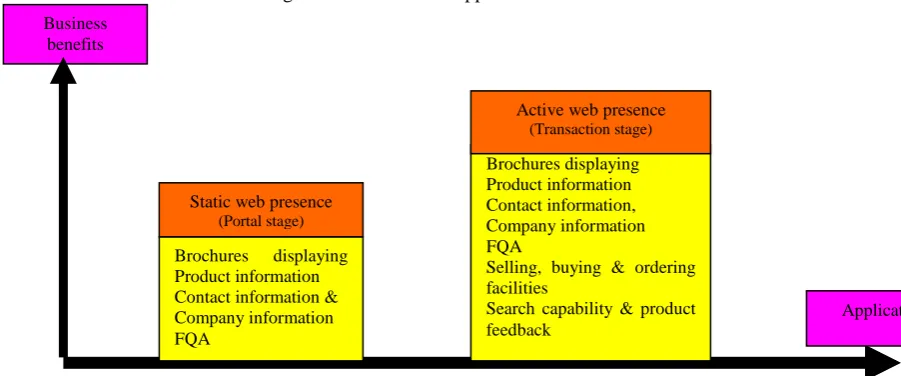
An e-commerce system can be defined as a computer-based information structure designed to provide customers purposeful information with a simple and easy way to navigate, search, and inquiry to get sufficient relevant answers about the enterprises goods and services in an attractive pleasant atmosphere. This kind of business practice (the internet-based business) has experienced a great expansion since the late of 1990s, because of the rapid development in innovation of information and communication technology. In this study, the website status is defined as the extent of use of the e-commerce system for several different business activities, such as advertising, sales, marketing, information sharing, and other functions (Kraemer, Gibbs, & Dedrick, 2002). Prior studies indicated that the firms’ engagement with e-commerce technology is sequential and progressive (Straub & Klein, 2001; Taylor & Murphy, 2004; Venkatraman, 1994, as cited in Daniel & Wilson, 2002). Moving from a simple structure website, to customer service and personalised models (Hoffman, Kalsbeek, & Novak, 1996; Karagozoglu & Lindell, 2004; Reynolds, 2000). The portal stage, transaction stage and integration stage are the main sequential stages of website level of capability that can be identified. The portal stage begins with simple Internet access for the purpose of communication and web presence. In this stage, organisations treat their website operations as a means of directing traffic to their fundamental business (Evans & Wurster, 1999). The focus of this stage is concerned with attracting new customers (O’Connor & O’Keefe, 1997, as cited in Rao, Metts, & Mora-Monge, 2003), cost cutting, and increasing productivity. The transaction stagebegins with establishing an active web presence equipped with the ability to sell and buy, and offering customers a payment facility in a secure environment. The focus here is shifted to improve customers’ services, expanding the customers’ base and managing the supply chain. Integration stage starts when the organisation implements more sophisticated system that enable it to integrate activities, such as, supply chain management and managing the relationships with customers. The organisation aim is to obtain a competitive advantage, by integrating e-commerce into its overall business strategy. During this stage, the new business model will be created with full immersion into the technology, reflecting greater complexity and risk (Straub & Klein, 2001). Nonetheless, in this paper a dichotomy model has been proposed to investigate the interactions between the organisation website capability and the e-commerce success model. Figure 1 below summarises the main criteria of the dichotomous model of the website status that the analysis will be based on.
Figure 1: The Website Application
Source: developed for this study based on Martin and Malay (2001); Rao, Metts, and Mora Monge (2003); Sekhar (2001); Straub and Klein (2001); Taylor and Murphy (2004)
3. THEORETICAL BACKGROUND
In spite of the fact that the e-commerce system is considered as one of the information systems type. The applicability of the traditional models of information systems success required from researchers to consider the additional business functions that can be performed using e-commerce systems in contrast to traditional information systems (Cunliffe, 2000). Particularly, with the existence of obvious differences between the
Business benefits
Brochures displaying Product information Contact information & Company information FQA
Static web presence (Portal stage)
Brochures displaying Product information Contact information, Company information FQA
Selling, buying & ordering facilities
Search capability & product feedback
Active web presence (Transaction stage)
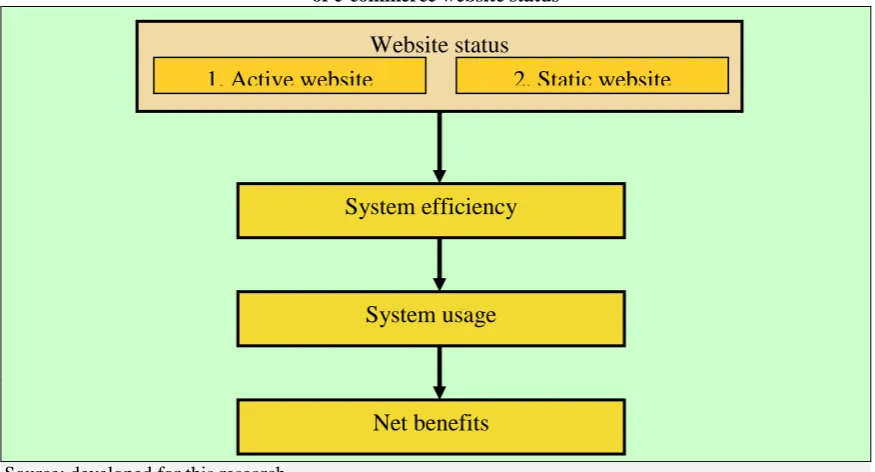
information systems models and the e-commerce success models, in regard of their view for the success in terms of the system objectives and the system focus. Hence, to examine the potential influence of the website status on the e-commerce system success among small enterprises, a model that is based on the information systems success has been proposed. The model outlines the main parts of the theoretical framework that are involved in manifesting the potential influence of e-commerce system implemented on small organisations performance. It mainly adopts the basic structure of the Information System Success Model, and modified it to comply with the common perspective of e-commerce system applied by SEs. It is doing that based on the Delone and Mclean (1992, 2002, 2003) theory of information system success model and other studies in this field, which conducted by Kraemer, Gibbs, and Dedrick (2002), Hoffman, Kalsbeek, and Novak (1996), Karagozoglu and Lindell (2004), Reynolds (2000), and Taylor and Murphy (2004). The proposed model was customised by adding two constructs related to the e-commerce website status, which represented in the static website and the active website (Figure 2). The model combined the first layer of the DeLone and McLean's model, regarding the system quality, content quality, and service quality, to form one factor called system efficiency, and combined the second layer of the model (regarding the system use and user satisfaction, to form one factor called system usage. The researcher's objective was to produce a model that reflected the characteristics of the e-commerce system in small businesses context. Besides achieving the goal that this study is willing to achieve regarding assessing the influence of the website status on the small enterprise performance. Figure 2 below summarises the main constructs of the proposed model.
Figure 2: The proposed theoretical framework of the influence of e-commerce website status
Source: developed for this research
4. HYPOTHESES
The following hypotheses are linked to the website status, system efficiency, system usage, and net benefits. Based on literature, the website status refers to the level of utility of the e-commerce website for several different business activities (Kraemer, Gibbs, & Dedrick, 2002). This study advocates that two main sequential stages of website applications can be identified with regard of SEs, which are represented in static website presence and active website presence. Static or passive website refers to the basic Internet access for the use of communication and passive web presence. This stage entails the initial steps that organisations take to get involved in a digital environment, such as: (1) displaying product brochures and services offered (Timmers, 2000); (2) contact information; (3) and other relevant information in a static manner. It also allows organisations to present information about their businesses and other related frequent questions and answers. In fact, the portal websiteoffers organisations the opportunity to have a ‘window to the web' (Barry, 2000, as cited in Rao, Metts, & Mora-Monge, 2003), and provides SEs an opportunity to expand their market base (Evans & Wurster, 2000). On the other hand, active website refers to more improved website presence, that is, equipped with the capability to sell and buy, by offering customers payment facility in a secure environment. Active website is accommodating with the facilities to conduct online transactions and services. It allows firms to offer additional function than the static website, by
Net benefits
System usage
System efficiency
Website status
offering the firms opportunities for: (1) selling, buying, and ordering facilities; (2) searching capability and product feedback; (3) and linking information with inventory data. Therefore, based on the prior studies’ findings (Raymond, 2001; Rosenzweig, Roth, & Dean, 2003), it has been suggested that the active website is more likely to influence e-commerce success than the static website. This will lead us to state hypothesis H1 of e-commerce website status.
H1: Active websites are more likely to positively influence the efficiency of the e-commerce system than its counterpart the static website.
Hypothesis linked to e-commerce system efficiency
The hypothesis related to the e-commerce system efficiency is based on the conceptual foundation provided by DeLone and McLean (2002) reformulated model. According to that model, e-commerce system efficiency is conceptualised at three different issues related to system quality, content or information quality and service quality. System quality is related to the system operational effectiveness. It is concerned with the function provided by the website, such as accessibility, ease of navigation, access to information and ability to load quickly, appearance attractiveness, secure and privacy policy, system design and accessibility (Han & Noh, 1999; Turban & Gherke, 2000). Content or information quality refers to the characteristics and manifestation of information of the system (Cunliffe, 2000; Dedhia, 2001; Savin & Silberg, 2000; Von Dran, Zhang, & Small, 1999). It is concerned with the information logical organisation, easy to comprehend, accurate, comprehensive and reliability and clarity, relevance and currency. Service quality refers to the system use in delivering the adequate performance to enhance the business operation. It is particularly concerned with responsiveness, prompt assistance when needed, follow-up services, quality of responses to frequently asked questions and tracking orders. Hence, based on the prior studies’ findings (Evans & Wurster, 2000; Iacovou, Benbasat, & Dexter, 1995; Raymond, 2001; Rosenzweig, Roth, & Dean, 2003; Schuete, 2000; Scupola, 2001; Warrington, Abgrab, & Caldwell, 2000; Watson, 2002) and the theoretical framework model proposed for this study. It has been suggested that a better efficiency of the e-commerce system quality is more likely to lead to a better e-e-commerce system usage. This will guide us to state hypothesis H2 of e-commerce system competency, which is devoted to assess the correlation between the e-commerce website efficiency and the usage of the e-commerce system applied.
H2: The more efficient the e-commerce system, the more likely it will positively influence the e-commerce system usage.
Hypothesis linked to usage of the e-commerce system
Usage of the e-commerce system in this research includes two key variables related to the system actual use and customer's satisfaction due to the use. The use terminology in this study is related to customers' behaviour regarding the number of website visits, the length of stay at a particular site, the number of purchases completed, and retrieval and execution of a transaction. It is mainly, concerned with the use of the output of the e-commerce website by customers. Use represents one of the most critical factors employed to evaluate the success of information and e-commerce systems (Young & Benamati, 2000). Meanwhile, user/customer satisfaction refers to the valuation of the reaction or feeling of a customer. It related to his/her experience with all aspects of an e-commerce system put in place by an organisation to market its products and services (Seddon, 1997; Spreng & Mackoy, 1996). User satisfaction is completely connected to improve the wealth of the organisation (Meuter, Ostrom, Roundtree, & Bitner, 2000; McColl, Kennedy, & Schneider, 2000; Naumann, Jackson, & Rosenbaum, 2001), as use and user satisfaction are influencing the organisation's net benefits. Net benefits refer to positive or negative effects of the implemented system on the organisation efficiency and operational productivity, from the perception of the system adopter (DeLone & McLean, 1992; Jarvenpaa & Ives, 1991). This construct is measured through various variables related to the organisations context, which directed toward assessing the actual achievement or net benefits. Hence, based on the prior studies’ findings (e.g. Evans & Wurster, 2000; Raymond, 2001; Rosenzweig, Roth, & Dean, 2003; Schuete, 2000; Scupola, 2001; Warrington, Abgrab, & Caldwell, 2000; Watson, 2002), and the theoretical framework model proposed for this study, it has been suggested that, the more usage of the e-commerce system is more likely to affect positively the net benefits. This will guide us to state hypothesis H3 of e-commerce system usage, which is devoted to assess the correlation between the usage, and the net benefits.
H3: The more the usage of the commerce system the more likely it will positively influence the e-commerce system success and subsequently the organisation's net benefits.
Figure 3: The proposed research model of e-commerce website net benefitsand its related hypotheses
Source: developed for this research
5. RESEARCH METHODOLOGY
Recognising that, the appropriateness of a research approach is driven by the nature of the social phenomena to be explored (Easterby-Smith, Thorpe, & Lowe, 2002). The aim of this study to obtain a broad perspective of the SEs managers' beliefs and attitude towards e-commerce website application, will be explored by testing existing theories, such as the social cognitive theory ‘self-efficacy beliefs’ (Bandura, 1991, 2001) and the information system success model (DeLone & McLean, 1992, 2002, 2003). It achieves that, with a quantitative approach, relying entirely on primary data, and utilises the questionnaire survey, as the most appropriate tool that can offer an explanation of the research methods. The questionnaire was designed to gather information of attitudes and perceptions of the participants’ organisations about various statements related to e-commerce system impact. All items were measured with a seven-point Likert scale. A convenience sampling method was employed in this research, participants’ SEs were randomly selected from the Australian Yellow Pages. The mail survey was selected as being the most suitable method for collecting original data describing a large population (Babbie, 1990). This method is considered a practical tool in gathering information related to the beliefs, values, attitudes and perceptions of the respondents (Hair, Bush, & Ortinau, 2003). It also has an efficient mechanism for data collection when the researcher knows exactly what is required and how to measure the variability of interest (Sekaran, 2000). The questionnaires were distributed to managers of the selected small enterprises. Data collected from the questionnaires was then edited, coded, entered into the statistical program ‘ Statistical Package for Social Sciences' (SPSS), and then cleared. To ensure that the data obtained is complete, accurately entered and arranged to facilitate analysis operation. Inferential analysis was conducted to find out the relationship between e-commerce website status as two separated dependent variables and the predictors independent variables. The main inferential statistical technique employed to test the hypotheses is structural equation modeling.
Net benefits
Status of the e-commerce website applied
Static website presence
Active website presence
System efficiency
System usage
H3
H1
The overall level of e-commerce website efficiency, usage and e-commerce system success are measured against various criteria based on prior studies by Bellman (2001), Deeter-Schmelz and Kennedy (2004), Fellenstein and Wood (2000), Hassan and Li (2005), Joseph, Cook, and Javalgi (2001), Kalakota and Robinson (2001), Kambil (1995), Karagozoglu and Lindell (2004), Karayanni and Baltas (2003), Korper and Ellis (2001), Pavlou (2003), Riquelme (2002), Schneider and Perry (2000), Schuete (2000), Sekhar (2001), Straub and Klein (2001), Straub, Limayem, and Karahanna-Evaristo (1995), and Warrington, Abgrab, and Caldwell (2000). Evaluation of e-commerce system quality was based on: (1) accessibility, ease of navigation, access to information, ability to load quickly; (2) appearance – attractive; (3) secure; (4) privacy policy. Evaluation of e-commerce information quality was based on: (1) appropriate information logically organised; (2) easy to understand; (3) accurate, adequate, comprehensive, reliable, concise, and clear; (4) relevant; (5) current/currency. Evaluation of e-commerce service quality was based on: (1) responsiveness, receive assistance and follow-up services promptly; (2) answer frequently asked questions; (3) track orders. Evaluation of e-commerce system use was based on: (1) number of customer purchases completed; (2) number of customer navigations. Evaluation of e-customers satisfaction was based on: (1) customers’ satisfaction with information provided by the company’s website: (2) customers’ satisfaction with services offered by the company’s website; (3) customers’ overall satisfaction with company’s website. Evaluation of e-commerce system net benefits was based on criteria of: (1) increase customers’ base; (2) decrease transactions’ cycle time; (3) cost reductions (search cost, communication, time saving); (4) improve trading relationships; (5) increase sales; (6) increase business’s competitive position; (7) increase business’s profits; (8) increase business’s staff productivity, change in working hours, change in number of workers; (9) decrease inventory investment; (10) and improve customers’ service. Evaluation of the passive or portal website was based on: (1) display company information; (2) display brochure and product information; (3) display contact information and feedback. Evaluation of the active or transaction integration website was based in addition to having all portal stage characteristics on the ability to: (1) sell and buy online, utilise ordering, and payment facilities; (2) receive product feedback; (3) utilise search capabilities; (4) and provide after-sales customer service and support.
6. TESTING OF HYPOTHESES
A structural equation model (SEM) method is used to analyse the potential interrelationship of proposed model constructs. This method is considered a good tool to examine models containing complex relationships when a set of structural linear equations exist, irrespective of whether the variables in the equations are observed or latent (Garson, 1998, 2008, 2009). SEM is a theory-based approach that is governed by hypothesis rather than experiment (Hair, Black, Babin, Anderson, & Tatham, 2006). The tested model contained four independent factors (static website, active website, system efficiency, and system usage), and one dependent factor (net benefits). Each of these factors was represented in a cluster of predictors.
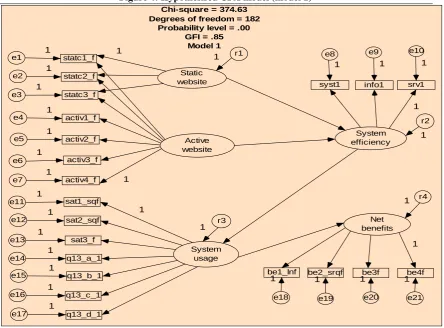
Collected data have passed various tests to make sure that they are suitable and ready for inferential analysis. The assumption of multivariate normality and linearity were evaluated through SPSS using the techniques described by Tabachnick and Fidell (2007). This was completed by calculating z-scores or standard scores for each item on those variables, and calculating mahalanobis distance for each factor using data from variables of each set of the four factors. The issue of missing data was addressed and a replacement of the missing data was applied using series mean method. Ultimately, using data from 201 respondents, a confirmatory factor analysis, was performed using AMOS (Analysis of Moment Structures) on the twenty one sub-tests of the website function. The hypothesised model (model 1) is shown in Figure 4, where circles represent latent variables and rectangles represent measured variables. The measurement errors are enclosed by smaller circles and indicate that some portion of each observed variable is measuring something other than the hypothesised factor. The following abbreviation sub-tests serves as indicators of: (1) the static website factor (statc1_f, statc2_f and statc3_f); (2) the active website factor (statc1_f, statc2_f, statc3_f, activ1_f, activ2_f, activ3_f, and activ4_f); (3) the system efficiency factor (syst1, info1 and srv1); (4) the system usage factor (sat1_sqf, sat2_sqf, sat3_f, q13_a_1, q13_b_1, q13_c_1 and q13_d_1); (5) the net benefits factor (be1_lnf, be2_srqf, be3f, be4f). The four factors hypothesised to be connected with single head arrows imply a hypothesised direct effect.
Model estimation (model 1)
difference test indicated a significant improvement in fit between the independence and the hypothesised model. The model p value is less than .05, so the test agrees in rejecting the null hypothesis at the .05. Nonetheless, since the RMSEA for this model is .07 > .06, the tucker-Lewis index is .92 < .95 and the comparative fix index = .85 < 90, the model does not fit well according to the accepted measures of fit recommended by Hu and Bentler (1995, 1999).
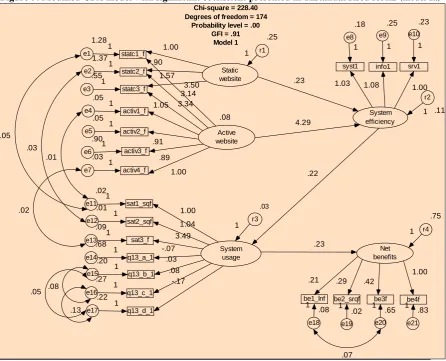
The next task was to identify any area of misfit in the model as recommended by Joreskog (1993). In this regard, two types of the model output information, the standardised residuals covariance and the modification indices were examined, to detect any possible misspecification. Consequently, post hoc model modifications (model 1a) were preformed in an attempt to develop a better fitting and possibly more parsimonious model (Figure 5). The model 1a, X2 (172, N = 201) = 228.40, p = .001, with a ratio of 1.31 < 2 represent an adequate fit (Byrne, 1989). The root mean square residual (RMR) = .03 < .05, indicates a good fitting model, which means that the model explained the correlations within an average error of .03 (Hu & Bentler, 1995). The goodness of fit index (GFI) = .91, which is close to 1 indicate a good fit (Hu & Bentler, 1995). The comparative fit appendix CFI = .98 .95, is considered representative of a well-fitting model (Hu & Bentler, 1999).
Figure 4: Hypothesised CFA model (model 1)
Source: created for this research
Root mean square error of approximation RMSEA of .04 .06, indicate a good fit (Hu & Bentler, 1999), the Tucker-Lewis Index TLI = .98 .95, indicates of good fit (Hu & Bentler, 1999). The noncentrality parameter NCP = 54.40 with a confidence interval of 19.29 and 97.62 indicates that we can be 90% confident that the population value of the noncentrality parameter lies between 19.29 and 97.62. The default model (1a) expected cross-validation index (ECVI) of 1.71, the saturated model (ECVI) of 2.31 and the independence model of (ECVI) of 15.73. Given the lower ECVI value for the default model (1a) compared with the saturated model and the independence model, we conclude that it represents the best fit to the data. The expected cross-validation index (ECVI) is considered as a means of assessing in a single sample the likelihood that the models cross-validates across similar-sized samples from the same population (Brwone & Cudeck, 1989, 1993 as cited in Schumacker & Lomax, 2004, p. 240- 254; Byrne, 2001, p. 86). A Chi square difference test indicated that the model1a was significantly improved by addition of those paths, X2diff (8, N =201) = 146.23, p =.001. Because post hoc model modifications were performed, the squared multiple correlation among the model (1a) factors and the hypothesised model factors were inspected,
Static website statc1_f e1 1 statc2_f e2 1 System usage r3 System efficiency syst1 e8 info1 e9 1 srv1 e10 sat1_sqf e11 1 sat2_sqf e12 1 sat3_f e13 1 r2 1 Active website activ4_f e7 1 activ3_f e6 1 activ2_f e5 1 activ1_f e4 1 Net benefits be3f e20 1 be2_srqf e19 1 be1_lnf e18 1 r4 1 statc3_f e3 1 q13_a_1 e14 1 q13_b_1 e15 1 q13_c_1 e16 1 q13_d_1 e17 1 1 1 1 r1 1 be4f e21 1 1 1 1 1 1
Chi-square = 374.63 Degrees of freedom = 182
Probability level = .00 GFI = .85
where parameter estimates were hardly changed despite modification of the model. The size of the correlated error associated with items is considered substantially large. In addition, testing the standardised and unstandardised values of the factor loading estimates revealed that both are mainly substantively reasonable and statistically significant. The only exception for this rule was static website and system usage. Variance and covariance estimates were statistically significant as well as substantively reasonable.
7. FINDINGS
The values associated with each path in Figure 5 are unstandardised regression coefficient. These values represent the amount of change in the dependent variable per single unit change in the predictor. As shown in Figure 5, the unstandardised regression coefficient of the static website variable was 0.23. This result suggests that for every single unit of increase in the static website level, the system efficiency increases by 0.23 units in the small business population. The unstandardised regression coefficient of the active website variable was 4.29. This result suggests that for every single unit of increase in the active website level, the system efficiency increases by 4.29 units in the small business population. The unstandardised regression coefficient of the system efficiency variable was 0.22. This result suggests that for every single unit of increase in the system efficiency, the usage increases by 0.22 units in the small business population.
Meanwhile, the unstandardised regression coefficient of the system usage was 0.23. This result suggests that for every single unit of increase in the system usage, the net benefit increases by 0.23 units in the small business population. Consequently, both the static website and active website were seen to have had an unequal impact on system efficiency. The SEM results indicate that: (1) the static website has a considerably lesser significance impact on system efficiency, than the active website; (2) system efficiency has a considerably significant impact on system usage; (3) and the system usage in it turn, has a considerably significant impact on system net benefits. This means, the more functions the e-commerce system (website status) can offer, the more impact on the system efficiency, system usage and subsequently net benefits the organisation will gain.
Figure 5: Modified CFA model with significant coefficient presented in unstandardised forms(model 1a)
Source: created for this research
Static website statc1_f 1.28 e1 1 statc2_f 1.37 e2 1 System usage .03 r3 System efficiency syst1 .18 e8 info1 .25 e9 1 srv1 .23 e10 sat1_sqf .02 e11 1 sat2_sqf .01 e12 1 sat3_f .09 e13 1 .11 r2 1 .08 Active website activ4_f .03 e7 1 activ3_f .90 e6 1 activ2_f .05 e5 1 activ1_f .05 e4 1 Net benefits be3f .65 e20 1 be2_srqf .02 e19 1 be1_lnf .08 e18 1 .75 r4 1 statc3_f .55 e3 1 1.08 q13_a_1 .68 e14 1 q13_b_1 .20 e15 1 q13_c_1 .27 e16 1 q13_d_1 .22 e17 1 -.17 .08 .03 1.00 1.04 -.07 3.49 .90 1.05 .29 .21 1.03 1.00 1.57 1.00 .25 r1 be4f .83 e21 1.00 1 1
Chi-square = 228.40 Degrees of freedom = 174
Probability level = .00 GFI = .91
The result of the analysis of the website status revealed support for hypotheses H1, H2, and H3 as detailed in Figures 5. It reveals that hypotheses: (1) H1 was found that the active website has a higher significant impact on the system efficiency than its counterpart the static website (refer to Figures 5); (2) H2 was found that the system efficiency has a significant impact on the system usage (refer to Figures 5); (3) and H3 was found that the system usage has a significant impact on the net benefits (refer to Figures 5).
8. DISCUSSIONS
The findings of this study revealed that system efficiency was significantly influenced by the status of the implemented website (whether it is static or active) and its various applications. System efficiency in terms of system quality, information quality and services quality was found to be a significant predictor in influencing the system usage. System usage was found to be a significant predictor in influencing the organisational net benefits (Figure 5). These finding is correspondent with prior studies, which suggested that: (a) a strong association had been identified between the stages of Internet use and the organisation performance and subsequently the input the Internet adds to organisation bottom line (e.g. Raymond, 2001; Rosenzweig, Roth, & Dean, 2003); (b) system efficiency contributes to achieve higher visibility, better advertising and promotion activities, and enhances customer’s services (Fellenstein & Wood, 2000); (c) a strong association had been identified between the stages of the Internet usage and its performance (e.g. Raymond 2001; Rosenzweig, Roth, & Dean, 2003). This result verified the literature claims that sale growth and profitability can be adversely affected by websites that do not function properly, that is, businesses can lose as much as 40 percent of ‘repeat end-user traffic' (Fellenstein & Wood, 2000). As long as, potential customers will judge the organisation's e-commerce website they visit, by the ability of the website to offer the most convenient functions that satisfy their needs (Savin & Silberg, 2000). As the table (5) shows the results of the unstandardised regression coefficient analysis of the active website is 4.29, the static website is 0.23. These results clearly showed that the active website has a considerably higher positive significance influence on system efficiency than its counterpart the static website. The system efficiency has a significant influence on the system usage, and in turn, the system usage has a significant influence on the net benefits that the organisation can achieve.
The findings of this study affirm that the e-commerce website status is playing the key role as a determinant for the success of the e-commerce system in small enterprises. The research's findings have offered an empirical support on a national level among Australia for the influence of the website status on the system efficiency, the system efficiency on the system usage, and the system usage on the net benefits. The findings of this study unearth that the better the level of improvement of the website status of the e-commerce system, the better results regarding usage and net benefits, and subsequently a better opportunity of success for the e-commerce system. This study as well, offered a practical support for the creation of model that clarifies the impact of the website status on the system success. The model tested in this study can serve up as a reference source for practitioners and academics alike in better understanding of impact of the e-commerce system applications, and grant them the appropriate recommendations based on the empirical findings. It clarifies the overall picture of how the status of website can affect the expected outcomes of the implemented e-commerce system, and presents small enterprises useful information for enhancing their understanding of e-commerce and its anticipated results. It also provides insightful information about the pathway that small enterprises must be followed to yield the desirable benefits, with respect of the sales and net revenue.
The findings of this study has outlined the path that policy makers, and business practitioners must be observed when developing future strategy/ies to promote e-commerce within SEs. The findings show clearly that implementing the appropriate website system by means of: (1) a clear developed online strategy; (2) a relevant website that reflects the business's strategy; (3) the website should be frequently updated and present current information about the SE's products and services. Would offer SEs the opportunity to achieve their desires, which is to survive in increasing tough competitive marketplace. The findings of this study can be used as a basic background that offers ongoing advice and support to developing future strategy/ies to establish, promote, and enhance e-commerce adoption and implementation.
9. CONCLUSION AND SUGGESTIONS
response bias, which could exist because of the participants' tendency to respond to questions in a certain way, might misrepresent or misconstrue facts (Zikmund, 2003). This problem would attribute to the characters of the SEs' decision makers being busy people, and so they have limited time to answer the survey questions accurately. Likewise, because we are unable to determine the person who completed the survey is? This also adds problems to the accuracy of the research’s findings. Besides, SEs mainly owned and operated by family members who might possess high professional skills with little or no formal education might make them unable to interpret the actual outcome of e-commerce system. Also, the sample method utilised to identify the SEs who participated in this research was not based on a strictly random sample, due to the absence of complete list accounting for all Australian SEs. The selected sample of participants’ SEs was based on a convenience sample method, where the selection here is purely subjective and arbitrary. This non-probability sampling method suffers from problems of extreme bias, which raised the question concerning its appropriateness, and how equitable the results would be in representing the entire SE population. Nonetheless, various procedures have been applied to ease and/or diminish the effect of these limitations. Those procedures are reflected in selection of the most appropriate paradigm for this study, selection of the quantitative research approach, sampling process, questionnaire design, determination the data needed and construct operationalisation, determination of measurement scale applied, and the judgment of the quality of the survey research method by constructing validity and reliability. Consequently, we believes that the research has projected and examined a number of significant factors that affect e-commerce system success.
The findings of this study shows how the functions that the website can provide will determine the success of the implemented e-commerce system in bringing small enterprises the benefits they desire. SEs must be aware that: (1) the website system quality must be accessible, ease of navigation, attractive and secure; (2) the website information quality must be accurate, comprehensive, reliable and clear, relevance and current; (3) the website service quality must be responsiveness, prompt, offering follow-up services and excellence of responses to frequently asked questions. Accordingly, SEs who have adopted e-commerce or on the brink to adopt e-commerce should be fully understood that the website status of the e-commerce system adopted will contribute significantly to the net benefits they expected from adopting e-commerce. Thereby, SEs should have the precise answers on the following questions:
What system quality might make their websites effective and attractive? What information quality is ideal to be presented for their websites? What services quality the website should provide to satisfy customers needs?
Still, this study demonstrated that the website of e-commerce system is an inevitable phenomenon that the businesses of all types should be aware about its impact. For that reason, to be able to gain the most benefits of e-commerce, businesses in general and SEs in specific should think through the following suggestions:
Implement the e-commerce system that suits your business activities. Constantly update your website capability.
Monitor the development in e-commerce innovation and how it can be leveraged, if possible to improve the current business practice.
Nonetheless, further research efforts are required to shed more light on the influence of website status on the e-commerce system efficiency, usage and subsequently the overall success of the e-commerce system. Likewise, this study has illuminated the effect of the website status of the e-commerce system on a limited extent, by investigating two categories of the website status (active and static). Extending the examination of any future research on website status to include other categories, such as the integration stage would help to clarify the influence of the website status on the e-commerce success. This research has assessed the influence of the website of e-commerce system in Australian SEs based on the perception of SEs manages/owners. Future studies that look into the influence of the website of e-commerce system in Australian SEs based on customers’ perception, would be of great benefits in supporting the result of this research. Besides, various opportunities are exist for future studies to address the above mentioned limitations, by trying to avoid them or as many as possible are emerging. Additional empirical investigates that illuminate further the impact of the website status on the e-commerce system success are required for validating the findings of this study. Whether, the results of such studies are support or refute the claims of this research, they will provide further theoretical and practical contributions to the knowledge of e-commerce and website applications.
REFERENCES
1. A.B.S. (2002). 1321.0 Small businesses in Australia. Retrieved from
http//www.abs.gov.au/Ausstats/[email protected]/e8ae5488b598839cca25682000131612/97452f3932f440 31ca256c5b00027f19!OpenDocument/
2. Bandura, A. (1991). Social cognitive theory of self-regulation. Organizational Behavior and Human Decision Processes, 50(2), 248-287.
3. Bandura, A. (2001). Social cognitive theory: An agentic perspective. Annual Review of Psychology, 52, 1-26
4. Bellman, M.L. (2001). Bricks and mortar: 21st century survival. Business Horizons, 44, (3), 21-8. 5. Byrne, B.M. (2001). Structural Equation Modeling With AMOS: Basic Concepts, Applications,
and Programming. Mahwah, NJ: Lawrence Erlbaum Associates.
6. Cunliffe, D. (2000). Developing usable Web sites - a review and model. Internet Research: Electronic Networking Applications and Policy, 10 (4), 295-308.
7. Daniel, E., & Wilson, H. (2002). Adoption intentions and benefits realised: a study of E-commerce in UK SMEs. Journal of Small Business and Enterprise Development, 9(4), 331-348. 8. Dedhia, N.S. (2001). E-commerce quality. Total Quality Management, 12 (3), 397-406.
9. DeLone, W.H., & McLean, E.R. (1992). Information Systems Success: The Quest for the Dependent Variable. Information Systems Research, 3 (1), 60-95.
10. DeLone, W.H., & McLean, E.R. (2002). Information Systems Success Revisited. Paper presented at the 35th Annual Hawaii International Conference, Systems Sciences.
11. DeLone, W.H., & McLean, E.R. (2003). Model of Information Systems Success: a ten-year Update. Journal of Management Information System, 19 (4), 9-30.
12. DeLone, W.H., & McLean, E.R. (2004). Measuring e-Commerce Success: Applying the DeLone and McLean Information Systems Success Model. International Journal of Electronic Commerce, 9(1), 31.
13. Deeter-Schmelz, D.R., & Kennedy, K.N. (2004). Buyer-seller relationships and information sources in an E-commerce world. Journal of Business and Industrial Marketing, 19(3), 188-196. 14. Evans, P., & Wurster T. (2000). Blown to bits: How the new economics of Information transforms
strategy. Boston, MA: Harvard Business School Press.
15. Evans, P., & Wurster, T. (1999). Getting real about virtual commerce. Harvard Business Review, November/December, 85-94.
16. Easterby-Smith, M., Thorpe, R., & Lowe, A. (2002). Management Research: An Introduction. London: Sage Publications.
17. Fellenstein, C., & Wood, R. (2000). Exploring E-commerce, Global E-business and E-Societies. Englewood Cliffs, NJ: Prentice-Hall.
18. Garson, G.D. (1998, 2008, 2009). Structural Equation Modeling. Retrieved from http://www2.chass.ncsu.edu/garson/pa765/structur.htm/
19. Han, K.S., & Noh, M.H. (1999). Critical failure factors that discourage the growth of electronic commerce. International Journal of Electronic Commerce, 4(2), 25-43.
20. Hoffman, D., Kalsbeek, W., & Novak, T. (1996). Internet and www use in the United States: baselines for commercial development. Retrieved from
http://ecommerce.vanderbilt.edu/baseline/Internet.demos.july9.1996.html
21. Hair, J.F., Black, W.C., Babin, B.J., Anderson, R.E., & Tatham, R.L. (2006). Multivariate data analysis. Upper Saddle River, NJ: Prentice-Hall.
22. Hair, J.F, Bush, R.P., & Ortinau, D.J. (2003), Marketing research: within a changing information environment. Boston: Irwin/McGraw-Hill.
23. Hassan, S., & Li, F. (2005). Evaluating the Usability and Content Usefulness of Web Sites: A Benchmarking Approach. Journal of Electronic Commerce in Organizations, 3(2), 46-67.
24. Hu, L.T., & Bentler, P.M. (1995). Evaluating model fit. In R.H. Hoyle (Ed.), Structural equation modeling: Concepts, issues, and applications. Thousand Oaks, CA: Sage Publications.
25. Hu, L., & Bentler, P.M. (1999). Cutoff criteria for fit indexes in covariance structure analysis: Conventional criteria versus new alternatives. Structural Equation Modeling, 6(1), 1-55.
26. Iacovou, C., Benbasat, I., & Dexter, A. (1995). Electronic data interchange and small organizations: adoption and impact of technology. MIS Quarterly, 19(4), 465-485.
27. Jarvenpaa, S.L., & Ives, B. (1991). Executive Involvement and Participation in the Management of Information Technology. MIS Quarterly, 15(2), 205-228
28. Joreskog, K.G. (1993). Testing structural equation models. In K.A. Bollen & J.S. Long (eds), Testing Structural Equation Models. Newbury Park, CA: Sage Publications.
30. Kalakota, R., & Robinson, M. (2001). E-Business 2.0: Road-map for Success. Harlow: Addison-Wesley.
31. Karagozoglu, N., & Lindell, M. (2004). Electronic commerce strategy, operations, and performance in small and medium-sized enterprises. Journal of Small Business and Enterprise Development, 11(3), 290-301.
32. Karayanni, D.A., & Baltas, G.A. (2003). Web site characteristics and business performance: some evidence from international business-to-business organizations. Marketing Intelligence and Planning, 21(2), 105-114.
33. Kambil, A. (1995). Electronic commerce: Implications of the Internet for business practice and strategy. Business Economics, 30(4), 27-33.
34. Korper, S., & Ellis, J. (2001). The E-Commerce Book. San Diego, CA: Academic Press.
35. Kraemer, K.L., Gibbs, J., & Dedrick, J. (2002). Impacts of Globalization on E-Commerce Adoption and Firm Performance: A Cross-Country Investigation. Center for Research on Information Technology and Organizations, University of California. Retrieved from http://www.crito.uci.edu/publications/pdf/gec/JIBS.pdf/
36. Marshall, P., Sor, R., & McKay, J. (2000). Electronic Commerce and Car Retailing: An Industry Case Study. International Journal of Electronic Commerce Research, 1, (1).
37. Martin, L., & Malay, H. (2001). “Blanket” approaches to promoting ICT in small firms: some lessons from the DTI ladder adoption model in UK. Internet Research: Electronic Networking Application and Policy, 11(5), 399-410.
38. Meuter, M.L., Ostrom, A.L., Roundtree, R.I., & Bitner, M.J. (2000). Self-service technology: Understanding customer satisfaction with technology-based service encounters. Journal of Marketing, 64(3), 50-65.
39. Molla, A., & Licker, P.S. (2001). E-Commerce Systems Success: An Attempt to Extend and Respecify the Delone and MaClean Model of IS Success. Journal of Electronic Commerce Research, 2(4), 131-141.
40. Naumann, E., Jackson, D.W., & Rosenbaum, M.S. (2001). How to Implement a Customer Satisfaction Program. Business Horizons, Jan-Feb, 37-46.
41. Pavlou, P.A. (2003). Consumer acceptance of electronic commerce: integrating trust and risk with the technological acceptance model. International Journal of Electronic Commerce, 7(3), 101-134.
42. Rao, S.S., Metts, G., & Mora-Monge, C.A. (2003). Electronic commerce development in small and medium sized enterprises: A stage model and its implications. Business Process Management Journal, 9(1), 11-32.
43. Raymond, L. (2001). Determinants of Web site implementation in small businesses. Internet Research: Electronic Networking Applications and Policy, 11(5), 411-424.
44. Reynolds, J. (2000). The Complete E-Commerce Book. Berkeley, CA: Publishers Group West. 45. Riquelme, H. (2002). Commercial Internet adoption in China: comparing the experience of small,
medium and large businesses. Internet Research: Electronic Networking Applications and Policy, 12(3), 276-286.
46. Rosenzweig, E.D., Roth, A.V., & Dean, J.W. (2003). The influence of integration strategy on competitive capabilities and business performance: an exploratory study of consumer products manufacturers. Journal of Operations Management, 21(4), 437-456.
47. Savin, J., & Silberg, D. (2000). There is more to e-business than point and click. Journal of Business Strategy, 21(5), 11-18.
48. Schumacker, R.E., & Lomax, R.G. (2004). A beginner’s guide to structural equation modeling. Mahwah, NJ: Lawrence Erlbaum Associates.
49. Schneider, G.P. & Perry, J.T. (2000). Electronic Commerce. Cambridge, MA: Course Technology. 50. Seddon, P.B. (1997). A Respecification and Extension of the DeLone and McLean Model of IS
Success. Information Systems Research, 8(3), 240-253.
51. Sekaran, U. (2000). Research Methods for business: A Skill Building Approach. New York: John Wiley and Sons.
52. Sekhar, S.C. (2001). E-commerce and two popular business-level typologies: a comparative analysis. Global Competitiveness, 9(1), 525-543.
53. Scupola, A. (2001). A stage model of adoption of internet commerce in SMEs. Proceedings of the Nordic Workshop on Electronic Commerce 2001.
54. Spreng, R.A., & Mackoy, R.D. (1996). An Empirical Examination of a Model of Perceived Service Quality and Satisfaction. Journal of Retailing, 72, (2).
56. Straub, D., & Klein, R. (2001). E-competitive transformations. Business Horizons, 44, (3), 3-12. 57. Tabachnick, B.G., & Fidell, L.S. (2007). Using multivariate statistics. Boston, MA: Pearson
Eductions Inc.
58. Taylor, M., & Murphy, A. (2004). SMEs and e-business, Journal of Small Business and Enterprise Development, 11(3), 280-289.
59. Turban, E., & Gehrke, D. (2000). Determinants of e-Commerce website. Human Systems Management, 19, 111-120.
60. Timmers, P. (2000). Electronic Commerce- strategies and models for business-to-business trading. New York: John Wiley and Sons.
61. Von Dran, G.M., Zhang, P., & Small, R. (1999). Quality Websites, An application of the Kano model of Website Desing. Paper presented to the Fifth AMCIS, Association for Information Systems, 13-15 August, 898-901.
62. Warrington, T.B., Abgrab, N.J., & Caldwell, H.M. (2000). Building trust to develop competitive advantage in e- business relationships. Competitiveness Review, 10(2), 160-168.
63. Watson, R.T. (2002). Data Management: Databases and Organisations. New York: John Wiley. 64. Yellow Pages (2010), Australia’s most comprehensive business directory, available at:
<http://www.yellowpages.com.au.
65. Young, D., & Benamati, J (2000). Differences in public web sites: The current state of large U.S. Firms. Journal of Electronic Commerce Research, 1, (3).