http://www.ijcmph.com pISSN 2394-6032 | eISSN 2394-6040
Original Research Article
Early initiation of breastfeeding among recently delivered mothers in a
rural area of Moradabad, India
Neha Goyal*
INTRODUCTION
Globally three-fifth proportion of new-borns wait for more than one hour to begin breastfeeding, which is distressing when early initiation provides new-borns the best chance for survival, growth and development.1 Early initiation of breastfeeding is defined by World Health Organization as initiation of breastfeeding within one hour of birth.2 And this is important as the babies are ready to suck right at birth with spontaneous attachment to breast and their suckling reflex allow them to suck immediately, which becomes difficult with delay.3 Early initiation also helps in establishing breastfeeding over the long term too and makes exclusive breastfeeding possible.4 Despite of these facts, early initiation rates in different parts of India are still low discouragingly, with
little improvement of 1.8 fold from 24.5% in 2006 to 44.6% in 2014.5
Even in facilities providing maternity and newborn services in India, the adherence to Baby-friendly Hospital Initiative (BFHI) steps for successful breastfeeding is poor indeed which further is responsible for delay in initiation.1-3 India contributes more than quarter to global neonatal deaths, and breastfeeding initiation between 2-23 hours after birth bears a 33% greater risk of neonatal mortality compared to initiation within an hour of birth, early initiation therefore should be one of focused measures to further reduce neonatal mortality.1,6 With this context, study was conducted to find the proportion of early initiation of breastfeeding and associated factors among recently delivered mothers in a rural area.
ABSTRACT
Background: Early initiation of breastfeeding defined by World Health Organization as initiation of breastfeeding within one hour of birth, provides new-borns the best chance for survival, growth and development. Yet the rates of early initiation are still low (41.5%), varying widely in different parts of India. Present study was done to find the proportion of early initiation of breastfeeding and associated factors in a rural area.
Methods: This cross-sectional study was conducted among 73 recently delivered mothers residing in a rural area of Moradabad, who were interviewed using a semi structured questionnaire with early initiation of breastfeeding as outcome variable. For statistical analysis Chi-square and Fisher’s exact tests were used.
Results: 61.64% recently delivered mothers responded that they had initiated breastfeeding within one hour of delivery. Early initiation was significantly lower among working mothers as compared to housewives. No significant differences in timely initiation have been found with mother age, religion and type of family. However significant association of early initiation was found between full antenatal care (ANC) and breastfeeding counselling.
Conclusions: More than sixty percent mothers initiated breastfeeding within an hour of delivery. Full ANC and breastfeeding counselling can help in improving rates of early initiation.
Keywords: Breastfeeding, Early initiation, Rural, India
Department of Community Medicine, Teerthanker Mahaveer Medical College and Research Centre, Teerthanker Mahaveer University, Moradabad, Uttar Pradesh, India
Received: 25 August 2019
Accepted: 03 October 2019
*Correspondence:
Dr. Neha Goyal,
E-mail: [email protected]
Copyright: © the author(s), publisher and licensee Medip Academy. This is an open-access article distributed under the terms of the Creative Commons Attribution Non-Commercial License, which permits unrestricted non-commercial use, distribution, and reproduction in any medium, provided the original work is properly cited.
METHODS
This cross-sectional study was conducted to study early initiation of breastfeeding among recently delivered mothers residing in a rural area of Moradabad, during August 2016. Early initiation and recently delivered mother, were respectively defined in this study as initiation within one hour of birth and woman of reproductive age who had delivered a live baby within the past 12 months prior to start of study. In large scale national surveys for assessing early initiation usually the children born in the past 24 months are studied, however in this study, mothers delivered during past 12 months considered, which has minimised recall bias and results however are still comparable with simultaneous change in denominator. Recently delivered mothers were purposively selected from study area after taking informed verbal consent and were assured of confidentiality of information provided by them. Among exclusions were the mothers who had not breastfed their babies, had experienced delivery complications, preterm deliveries, baby was sick soon after birth or had not given consent.
Finally 73 recently delivered mothers were included in study and were thoroughly interviewed using a semi structured questionnaire with independent variables including maternal age, education, occupation (housewives were women engaged in household duties but doing no other work to augment family income), family type, full antenatal care (ANC) (at least four
antenatal visits, at least one tetanus toxoid injection and iron folic acid tablets or syrup taken for 100 or more days), breastfeeding counselling, place of delivery, skilled attendance at birth, type of delivery, postnatal assistance for breastfeeding, birth order and birth weight of infant. Dependent outcome variable was early initiation specifically and other breastfeeding practices were not taken into consideration in this study. Finally the data collected was analysed using SPSS v21. For statistical analysis Chi-square and Fisher’s exact tests were used and the two-tailed p value less than 0.05 were considered significant.
RESULTS
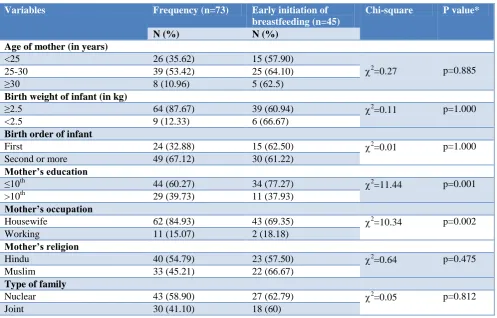
Of the 73 recently delivered mothers, 45 (61.64%) responded that they had initiated breastfeeding within one hour of delivery. Majority of mothers in this study, 39 (53.42%) were between 25 to 30 years of age, 26 (35.62%) mothers were below 25 years and remaining 8 (10.96%) were 30 years and above. 44 (60.27%) of mothers in study sample were educated till 10th or below and majority 62 (84.93%) were housewives. 43 (58.90%) belong to nuclear families and majority 40 (54.79%) were Hindus. Delivery was institutional in 53 (72.6%) of selected mothers and remaining 20 (27.4%) delivered at home. Type of delivery was vaginal in 62 (84.93%) and 11 (15.07%) had delivered by caesarean. Skilled attendance at birth was provided only to 66 (90.41%) mothers in this study.
Table 1: Determinants of early initiation of breastfeeding among respondent mothers.
Variables Frequency (n=73) Early initiation of breastfeeding (n=45)
Chi-square P value*
N (%) N (%)
Age of mother (in years)
<25 26 (35.62) 15 (57.90)
2=0.27 p=0.885
25-30 39 (53.42) 25 (64.10)
≥30 8 (10.96) 5 (62.5)
Birth weight of infant (in kg)
≥2.5 64 (87.67) 39 (60.94) 2=0.11 p=1.000
<2.5 9 (12.33) 6 (66.67)
Birth order of infant
First 24 (32.88) 15 (62.50) 2=0.01 p=1.000
Second or more 49 (67.12) 30 (61.22)
Mother’s education
≤10th 44 (60.27) 34 (77.27) 2
=11.44 p=0.001
>10th 29 (39.73) 11 (37.93)
Mother’s occupation
Housewife 62 (84.93) 43 (69.35) 2=10.34 p=0.002
Working 11 (15.07) 2 (18.18)
Mother’s religion
Hindu 40 (54.79) 23 (57.50) 2=0.64 p=0.475
Muslim 33 (45.21) 22 (66.67)
Type of family
Nuclear 43 (58.90) 27 (62.79) 2=0.05 p=0.812
Variables Frequency (n=73) Early initiation of breastfeeding (n=45)
Chi-square P value*
N (%) N (%)
Place of delivery
Home 20 (27.40) 12 (60) 2
=0.03 p=1.000
Institutional 53 (72.6) 33 (62.26)
Skilled attendance at birth
Provided 66 (90.41) 42 (63.64) 2=1.15 p=0.417
Not provided 7 (9.59) 3 (42.86)
Type of delivery
Vaginal 62 (84.93) 41 (66.13) 2=3.50 p=0.092
Caesarean 11 (15.07) 4 (36.36)
Breastfeeding counselling
Received 57 (78.08) 39 (68.42) 2=5.05 p=0.040
Not received 16 (21.92) 6 (37.50)
Full ANC
Received 50 (68.49) 35 (70) 2
=4.68 p=0.040
Not received 23 (31.51) 10 (43.48)
Postnatal assistance for breastfeeding
Provided 14 (19.18) 9 (64.29) 2=0.05 p=1.000
Not provided 59 (80.82) 36 (61.02)
*2 sided exact significance (Fisher’s exact test).
24 (32.88%) infants have first birth order and birth weight of 9 (12.33%) infants was below 2.5 kg. Full ANC was provided to 50 (68.49%) and breastfeeding counselling was received by 57 (78.08%) mothers. 14 (19.18%) mothers had received postnatal assistance for breastfeeding (Table 1). Early initiation was found to be higher among mothers between 25 to 30 years age, 24 (64.10%) as compared to mothers less than 25 or greater than 30 years of age. Although age was not significantly associated with early initiation rate in present study. 34 (77.27%) of mothers with education level 10th or below, initiated breastfeeding within one hour of delivery as compared to 11 (37.93%) with education above 10th class has statistically significant difference. Early initiation was significantly higher among housewives as compared to working mothers. However, no significant differences in rates of early initiation have been found with religion and type of family. 33 (62.26%) mothers among those delivered at health facility initiated timely breastfeeding as compared to 12 (60%) mothers delivered at home. And the place of delivery was not significantly associated with early initiation of breastfeeding. Early initiation was comparatively lower among caesarean deliveries as compared to vaginal deliveries with no statistically significant difference in this study. Skilled attendance at birth was also not associated with better rate of timely initiation. However significant association was found between full ANC and early initiation of breastfeeding. 39 (68.42%) mothers who had received counselling on breastfeeding, initiated it at recommended time as compared to 6 (37.5%) who had not received any breastfeeding counselling. In present study early initiation rates have not significantly varied with birth weight and birth order of infants. Postnatal assistance for
breastfeeding was not significantly associated with early initiation of breastfeeding (Table 1).
DISCUSSION
Early initiation of breastfeeding provides new-borns the best chance for survival, growth and development. Delaying initiation can lead to life-threatening consequences and longer the new-borns are left waiting, greater the risk is.1 Early initiation also helps in establishing breastfeeding over the long term too and makes exclusive breastfeeding possible.4 It has been revealed in a review that initiation between 2-23 hours after birth bears a 33% greater risk of neonatal mortality compared to initiation within an hour of birth.6 Despite of these facts, only 42% new-borns were put to breast within first hour of birth globally in 2017 (data however is unavailable for high income countries).1 And leading barriers to early initiation include traditional feeding practices, lack of information or support and milk insufficiency, as revealed by Sharma et al in South Asia region.7 Similarly Aruldas et al in Uttar Pradesh, India found that most common reason for delay was breast milk not produced immediately.8 However milk production can be enhanced by early initiation itself as it best triggers the prolactin release and hence milk production.1 Although stress too may interfere with production of milk but simultaneous early skin to skin contact helps in relieving stress and also helps in regulating body temperature of newborn besides enhancing milk production.1,9
study 61.64% recently delivered mothers had initiated breastfeeding within one hour of delivery. However considerably lower rates 39.6% and 21.3% have been found by Mani et al in Chhattisgarh and Vyas et al in Uttarakhand respectively.10, 11 Contrary to present study findings, a large scale survey from rural Uttar Pradesh revealed that only 19% women initiated breastfeeding within one hour of birth.8 Sarkar et al in West Bengal found 68.5% of tribal infants were breastfed within an hour of birth.12 Similar findings are reported by Adhikari et al in Nepal where 66.4% mothers initiated breastfeeding timely.13 Comparatively lower rates found by Alzaheb et al in a review of studies from middle east where only 34.3% new-borns put to breast within an hour of birth.14 Studies from Africa revealed wide variation in early initiation rates from 39.6% to 87.2% among mothers who had ever breastfed.15,16
Maternal age and education can be expected to have positive influence on early initiation but have been found to be associated inconsistently in previous studies. In present study early initiation was significantly higher among housewives as compared to working mothers, similar findings are reported in studies from middle east.14 Furthermore there are no remarkable differences observed in rates of initiation by sex of child, rural or urban residence or socioeconomic status globally.1 However in a study from rural Niger poverty was found to be negatively associated with early breastfeeding initiation.17 ANC has consistently been found to increase the probability of early initiation globally and in present study full ANC is significantly associated with early initiation. Counselling on breastfeeding helps in preparing mothers for early initiation of breastfeeding and is significantly associated with early initiation in present study. Similar findings reported in previous studies and women were two times more likely to adopt early initiation if advised.8,18 Place of delivery was not significantly associated with early initiation in present study, however Aruldas et al found significantly higher percentage of mothers delivered in a health facility initiated breastfeeding early as compared to those delivered at home.8 Skilled attendance at birth can provide sustenance for early initiation but was not associated with better rate of timely initiation in this study.
Breastfeeding initiation is consistently delayed when infants are born by caesarean and in present study too rate was lower among caesarean deliveries as compared to vaginal deliveries but difference was not significant statistically. Takahashi et al revealed the same in secondary analysis of global data.19 In present study early initiation rates have not significantly varied with birth weight and birth order of infants. Studies have reported that mothers are less likely to initiate breastfeeding early for first birth order child and higher parity is positively associated with early initiation.7,14 A study in Indonesia found that low birth weight neonates had 2.9 times greater risk of mortality if breastfeeding not initiated
within an hour.20 Postnatal assistance for breastfeeding is important as mothers need adequate support and guidance to bring new-borns to breast and positioning. However in this study no significant association was found between postnatal support and early initiation.
Limitation
Study was done in a small sample of recently delivered mothers which is its limitation, but still has revealed factors associated with early initiation of like mother occupation, full ANC and breastfeeding counselling. Also the recall bias was minimised by including mothers delivered during previous 12 months.
CONCLUSION
Promotion of early initiation is a priority which holds the potential to reduce neonatal mortality. Full ANC and breastfeeding counselling can help in improving rates of early initiation.
Funding: No funding sources Conflict of interest: None declared
Ethical approval: The study was approved by the Institutional Ethics Committee
REFERENCES
1. UNICEF, WHO. Capture the Moment- Early
initiation of breastfeeding: The best start for every newborn. New York: UNICEF; 2018.
2. World Health Organisation. Fact sheet: e-Library of
Evidence for Nutrition Actions (eLENA)
interventions, 2018. Available at:
http://www.who.int/elena/titles/early_breastfeeding/ en/. Accessed on August 2019.
3. WHO. Guideline: protecting, promoting and
supporting breastfeeding in facilities providing maternity and newborn services. Geneva: World Health Organization; 2017.
4. NEOVITA Study Group. Timing of initiation, patterns of breastfeeding, and infant survival: prospective analysis of pooled data from three randomised trials. Lancet Glob Health; 2016: e266-275.
5. Aguayo VM, Gupta G, Singh G, Kumar R. Early initiation of breast feeding on the rise in India. BMJ Global Health. 2016;1:e000043.
6. Smith ER, Hurt L, Chowdhury R, Sinha B, Fawzi W, Edmond KM. Delayed breastfeeding initiation and infant survival: A systematic review and meta-analysis. PLoS One. 2017;12(7):e0180722.
7. Sharma IK, Byrne A. Early initiation of
breastfeeding: a systematic literature review of factors and barriers in South Asia. Int Breastfeeding J. 2016;11:17.
9. Mugadza G, Mathilda Z, Felicity, Gumbo FZ, Babill SP, Haruzivishe C, et al. Early breastfeeding initiation (EBFI). Int J Nurs Midwifer. 2016;8(10):81-5.
10. Mani C, Lal PK, Kumar L. Cross sectional study on newborn care practices in a rural area. Int J Community Med Public Health. 2019;6:1000-3. 11. Vyas S, Sharma P, Kandpal SD, Semwal J,
Srivastava A, Nautiyal V. A community based study on breastfeeding practices in a rural area of
Uttarakhand. Nat J Community Med.
2012;3(2):283-7.
12. Sarkar TK, Bhattacherjee S, Mukherjee A, Saha TK, Chakraborty M, Dasgupta S. Early initiation of breast feeding in tribal children. Int J Community Med Public Health. 2016;3:3081-5.
13. Adhikari M, Khanal V, Karkee R, Gavidia T. Factors associated with early initiation of breastfeeding among Nepalese mothers: further analysis of Nepal Demographic and Health Survey, 2011. Int Breastfeeding J. 2014;9:21.
14. Alzaheb RA. Review of the factors associated with the timely initiation of breastfeeding and exclusive breastfeeding in the Middle East. Clin Med Insights: Pediatric. 2017;11:1-15.
15. Liben ML, Yesuf EM. Determinants of early initiation of breastfeeding in Amibara district, North-eastern Ethiopia: a community based cross-sectional study. Int Breastfeeding J. 2016;11:7.
16. Hassan AA, Taha Z, Ahmed MAA, Ali AAA, Adam
I. Assessment of initiation of breastfeeding practice in Kassala, Eastern Sudan: a community-based study. Int Breastfeeding J. 2018;13:34.
17. Horii N, Allman J, Martin-Prevel Y, Waltisperger D. Determinants of early initiation of breastfeeding in rural Niger: cross-sectional study of community based child healthcare promotion. Int Breastfeeding J. 2017;12:41.
18. Galiano JM, Rodriguez MD. Early initiation of breastfeeding is benefited by maternal education program. Rev Assoc Med Bras. 2013;59(3):254-7. 19. Takahashi K, Ganchimeg T, Ota E, Vogel JP, Souza
JP, Laopaiboon M, et al. Prevalence of early initiation of breastfeeding and determinants of delayed initiation of breastfeeding: secondary analysis of the WHO Global Survey. Scientific Reports. 2017;7:44868.
20. Berkat S, Sutan R. The effect of early initiation of breastfeeding on neonatal mortality among low birth weight in Aceh Province, Indonesia: an unmatched
case control study. Advan Epidemiol.
2014;7:358692.