Membership of the Library and Information Association of South Africa
(LIASA) among library and information science workers in KwaZulu-Natal
Musa Khomo
1Library and Information Studies Programme, Durban University of Technology, South Africa
Jaya Raju
2Library and Information Studies Programme, Durban University of Technology, South Africa
[email protected] or[email protected]
Received: 10 October 2008 Accepted: 6 November 2009
A study was undertaken in 2007 among library and information service (LIS) workers in KwaZulu-Natal (KZN) to investigate LIASA membership trends. The objectives of the study were to investigate: 1) the extent to which workers in library and information services in KwaZulu-Natal are members of LIASA; and 2) the reasons for non-membership, if there are substantial numbers of LIS workers who are not members. The purpose of this paper is to report on the main findings of this study. The study surveyed three types of library services in KwaZulu-Natal, namely, academic, public and special libraries with 330 LIS workers participating in the study. A census was done of LIS workers in special libraries and in academic libraries of public higher education institutions in KZN. Simple random sampling was used to select public libraries in KZN for participation in the study. All staff in the selected sample of public libraries were surveyed. A self-administered questionnaire was used to gather the required data from the target population. It was established that a significant number of LIS workers in all three types of libraries surveyed in KZN are not members of LIASA for various reasons. LIASA has been unable to draw significant membership from the support staff category in LIS services despite its constitution claiming to embrace all LIS workers. The study recommends that LIASA market itself more aggressively to increase membership levels particularly in the public library sector and among support staff in all LIS services. It also recommends that LIASA should consider involving itself in the industrial concerns of the LIS sector.
Keywords: Library and Information Association of South Africa (LIASA); professional associations
1 Introduction
A professional association is important both for promoting the profession in question and for preserving its status as a profession (Joint & Wallis 2005:213). It is a powerful source representing the voice of the professional community to solve problems in the profession related to welfare, status, working conditions, physical facilities, education and training, including research and development activities (Karisiddappa 2002). The Library and Information Association of South Africa (LIASA) itself claims that it strives to unite and empower all individuals in the library and information field to develop it into an organization that provides dynamic leadership in transforming, developing and sustaining library and information services for all the people of South Africa (LIASA 2000:4). However, a limited study by Khomo (2005), the LIASA leadership itself (Matthee as cited by Moerat 2004:3; LIASA 2006:2; Webster 2006) and others (Kagan 2002:5) point to membership difficulties for South Africa’s only library and information services professional body.
A study was undertaken in 2007 among library and information service (LIS) workers in KwaZulu-Natal (KZN) to investigate LIASA membership trends. The objectives were to investigate: 1) the extent to which workers in library and information services in KwaZulu-Natal are members of LIASA; and 2) the reasons for non-membership, if there are substantial numbers of LIS workers who are not members.This paper reports on the main findings of this study, the first formal study to be conducted on LIASA membership.
2 Literature review
While a review of literature revealed that there has not been a previous study on the same or similar topic, it was still important to review literature related to the study and which also served to provide necessary background information on the topic. Literature on professional bodies revealed that although the central purpose of professional associations has always been to serve the needs and to protect the interests of a professional community, they also strive to broaden their purpose and to serve the over-all needs of the nation (Karisiddappa 2002). Very much in keeping with this theme, Raju’s (2005)3 study on the unionization of LIS workers revealed that two-thirds of the tertiary education sector LIS workers
1. Musa Khomo is a lecturer in the Library and Information Studies Programme, Durban University of Technology, South Africa. 2. Jaya Raju (PhD) is an Associate Professor in the Library and Information Studies Programme, Durban University of Technology, South
surveyed in South Africa were of the opinion that it is necessary to have an organization to address the industrial concerns in library and information services. Organizations do address the industrial concerns of their profession, for example, the South African Democratic Teachers’ Union (SADTU). SADTU aims to fight for better remuneration and working conditions for educational workers while promoting the professional aspirations of educators (South African Democratic Teachers’ Union (SADTU) 2007). Another example is the American Nurse’s Association which was founded in 1896. One of this association’s roles is to improve working conditions for nurses in America (Vessey 2003). This association has a large number of members. So does SADTU. LIASA currently does not involve itself with the industrial concerns of LIS workers (Raju, Stilwell & Leach 2006:213). Could this be a factor discouraging LIASA membership? The study attempted to interrogate this.
Poor membership of professional bodies seems to be a universal challenge. According to Wilson (1997:49), writing in the marketing context, “associations have been losing members which in turn has inhibited them from fulfilling their roles effectively”. In his 2001 report Bernard Naylor, the then president of the Chartered Institute of Library and Information Professionals (CILIP) of the United Kingdom (UK) claimed that the only comparator the UK has in terms of size of membership is the American Library Association (ALA) (Naylor 2001:3). CILIP is the world’s second-largest LIS professional body with a total membership in 2001 of 22 939, the largest being the ALA (Naylor 2001:21). Not many other national contexts can boast similar figures, but nevertheless membership issues need to be addressed within the context of national needs and requirements. For example, some of the American Library Association’s goals are to ensure that librarians and other LIS personnel are paid equitable and attractive salaries. It also ensures that librarianship recruits a racially and ethnically diverse group of high caliber persons (Our Association 2007:46). LIS workers in South Africa generally believe that there is a need for an organization in the profession to represent both professional and industrial concerns of the LIS profession (Raju, Stilwell & Leach 2006:216; Raju & Stilwell 2007:15). Like the ALA does, should LIASA not respond to this need?
Ghosh (2006:45), writing in the Asian context where India is also grappling with a LIS membership problem, believes that in order to avoid losing membership, professional associations should better demonstrate the benefits they can deliver. Membership seems to be a universal challenge affecting even the International Federation of Library Associations and Institutions (IFLA) which reported a drop in membership in 2002: “...the total number of IFLA’s membership decreased slightly during the reporting period” (IFLA 2002). For this reason, Wilson (1997:51) stresses the use of marketing strategies by professional associations and how the proper adoption of marketing techniques can retain members and increase membership involvement within the association. He argues that cost-effective marketing activities are possible for all kinds of professional associations but cautioned that there must be a will to devise, implement and monitor marketing in a cohesive, comprehensive and continuous manner. He further suggests that any marketing campaign has to be integrated into the total developmental plan of the association. Library professions are indeed facing a crisis and there is an urgent need to modernize the professional associations and make them more effective and caring about their members. Marketing of LIASA then is a must to attract and retain membership.
Coming closer home to Africa, membership issues are indeed bleak. Olden (2005:2) reports that “few library associations in Africa have more than several hundred paid-up members” and that their small size results in their income and influence being limited. Mutula (2003:336) points out that library associations within eastern, central and southern Africa remain far behind their western counterparts in a number of ways:
The associations are characterized by a small membership base, limited financial resources, lack of adaptation to changes within their environments and lack of visibility. The image of most associations is poor and they suffer from membership apathy and identity crises. Most have not adopted business strategies in the promotion of their image, neither have they adapted to reflect the tremendous changes within the environments in which they exist.
Kawooya (2001:48) believes that a problem common to many professional associations in Africa is the desire to be all things to all categories and sub-categories of members. As a result, many projects are undertaken without sufficient staffing. LIASA, Kawooya claims, has taken steps to address this with positive outcomes. Rosenberg (2006:110-111) explains that unlike most library associations in Africa, LIASA “has a funded secretariat” financed via a grant from the Carnegie Corporation of New York. Hence, LIASA does seem to be in a better position to encourage membership
compared to other African LIS associations which rely largely on volunteers to take on tasks that are demanding in terms of time and effort (Olden 2005:2-3).
Mutula (2003:340) makes reference to “unqualified clerks”… “who run many libraries in government ministries in Botswana, yet there are many unemployed trained library and information workers in the country who could be employed in these positions”. He also makes reference to library support staff who feel isolated by the Botswana Library Association (Mutula 2003:338). These are also issues affecting the South African LIS context and which this study interrogated.
LIASA has its beginnings way back in the 1930s when the South African Library Association was formed, this being one of the recommendations of Pitt and Ferguson of the Carnegie Corporation of New York in their report on library conditions in South Africa (Musiker 1986:263; Walker 2007:179). In 1962 “as apartheid tightened its iron fist” (Walker 2006:27), SALA took the decision to restrict its membership to whites only and to form separate library associations for the other race groups, such as the African Library Association of South Africa (ALASA). This decision, many believe, tainted the professional body and to this day plagues it especially with regard to membership, despite it opening its membership to all race groups in 1980 under the new name of the South African Institute for Librarianship and Information Science (SAILIS). The new organization focused on professionalization of librarianship with members required to hold approved qualifications in library and information science or to be registered students in this field. This opened the organization to the criticism of being elitist in that it did not cater for the many LIS support staff in the sector and this, amongst other reasons, prompted the formation of the alternative LIS organization, Library and Information Workers’ Organization (LIWO), which actively encouraged membership by all library workers (Syphus 1995:2). As a wave of democracy and hope swept the country in the mid-1990s, a process of unification towards a unified LIS association unfolded, culminating in the launch of LIASA in 1997. LIWO chose to remain outside of the unification process as it anticipated domination by SAILIS and its conservative values, this being the largest and strongest of the LIS organizations (Kagan 2001:15). As LIWO attempted to extend itself from KZN to other parts of the country, its membership declined (Merrett 2001:32), eventually leading to its demise. Interestingly, here too membership seems to have been a telling factor in sustaining the strength and growth of an energetic and forceful LIS organization.
LIASA (2000:4) aims to “unite all persons engaged or interested in library and information work and to actively safeguard and promote their dignity, right and socio-economic status”. LIASA is a voluntary association which “represents persons engaged or interested in library and information services in South Africa” (LIASA 2000:4). The LIASA constitution clearly embraces all LIS workers. Hence this study focused on all LIS workers, professional (those holding recognized professional LIS qualifications) as well as support workers. Unlike SAILIS, LIASA has opened its membership to include all persons working in the library and information environment (Raju 2005:171). The mission of LIASA is to “advocate and support the provision of efficient, user-orientated and excellent library and information services that aspire to equitable access to information for all communities (literate and illiterate) in South Africa”. To this end, the Association represents the interests of and promotes the development and image of library and information workers in South Africa (LIASA 2000:4). While it is difficult to estimate the total number of LIS workers in South Africa, and therefore potential LIASA members, one can confidently say that this number would run into many thousands due to the many hundreds of library and information services in the country.
However, LIASA has expressed concerns about slow membership growth (LIASA 2007). The leadership acknowledges that it is facing challenges as it “strives to realize its dream and its members” (LIASA 2007). There has been a very slow growth in LIASA membership from its birth in 1997 to 2007. On the 10th of December 1998 LIASA had 1068 paid-up members (Walker 2007:190) and in 2007 around 1400 (Haasbroek 2007:2). This study attempted to uncover some reasons for this slow growth in membership.
Interestingly, Raju (2005:173) points out that the LIS sector generally accepts LIASA as the body representing the sector despite the fact that LIASA has a relatively small membership compared to the universe of possible members, considering the many hundreds of library and information services in the country. However, Raju’s study claims that there are also those who do not see LIASA as a “sufficiently professional organization because it is open to all”. In a similar line of thinking, Kagan’s (2002:17) study indicates that “new responsible organizational structures within or in addition to LIASA are needed.” Kagan (2002: 10) also points out that some within the profession feel that LIASA is “the extension of the old SAILIS” and that “LIASA has not attempted transformation and it is silent on major issues”. This study took up some of these issues and empirically investigated how LIS workers view this organization.
recruitment strategies relevant to junior and non-professional staff of libraries in order to reach this sector. Raju, Stilwell and Leach (2006:213) have pointed out that while trade unions in South Africa play a significant role in looking after the interests of support staff in LIS services, the vehicle through which support staff could launch their lobbying campaigns need not only be trade unions, but also the professional body, LIASA. The study reported in this paper has attempted to interrogate this issue.
It was in the context of such issues from the literature relating to the South African LIS professional body and professional body membership that the study investigating LIASA membership in KZN was carried out.
3 Methodology
A self-administered questionnaire was used to collect data from LIS workers drawn from special, public and academic libraries in KZN. Items included in the design of the questionnaire flowed from the objectives of the study and the literature reviewed for the study was a useful source to draw from in the design of the instrument. The questionnaire design also ensured that the instrument was “adequate in terms of both reliability and validity” (Bless & Higson-Smith 2004:135) so as to be able to collect the required data. A pre-test was also done to assist in this process. At the time of conducting the study it was established and verified, through a lengthy process of consultation of websites, contact with Special Library Interest Group members, lists of libraries from inter-library loan divisions of major libraries, lists from major public library services in the province and telephone and other enquiries, that there were 211 public libraries, 90 special libraries and five academic libraries in KZN. School, college and private higher education institution libraries were not included in the study as it was felt that the public university and university of technology (UoT) libraries adequately represented academic library services in KZN.
The study surveyed all LIS workers in special libraries and academic libraries in KZN. While there were 90 special libraries in KZN, the staff numbers in these libraries tend to be small (one or two staff) and hence a census here was not unmanageable. With regard to academic libraries in public universities and UoTs, there were only five in KZN. The only LIS sector that had to be sampled was the public library sector (211 libraries). In keeping with Sekaran’s (2003:294) estimation that for a population of 210 an acceptable sample size is 136, a table of random numbers was used to randomly select 136 public libraries from the 211 for inclusion in the sample. A combination of techniques was employed to establish the number of staff members in the three types of libraries included in the survey. These included contacting relevant secretaries, consulting websites and even personal visits to certain libraries. At the time of conducting the study there were 423 staff in the 136 public libraries sampled, 104 staff in the 90 special libraries, and 281 staff in the five academic libraries in KZN. Thus the study’s total target population of LIS workers from KZN was 808.
Data collection took place over a period of five months (March to July 2007) and took much perseverance to secure the return of as many questionnaires as possible. Targeting ‘whole libraries’ ensured that all levels of staff, that is, from library assistant up to head of the service, were included in the survey. While many difficulties, especially from the public library sector, were experienced in distributing and securing return of questionnaires, eventually an adequate return rate was secured for purposes of analysis and reporting: 156/423 (37%) from public libraries, 39/104 (38%) from special libraries and 138/281 (48%) from academic libraries. In total the study achieved a 333/808 (41%) return rate. However, three of the returned questionnaires were spoilt (they were returned incomplete or blank) giving an effective return rate of 330 out of the 808 (41%) questionnaires distributed.
This study used both qualitative and quantitative data analysis as the questionnaire included both closed and open-ended items. Microsoft Access was used to capture and analyze the data. The qualitative data from the unstructured items were analyzed using content analysis. Descriptive analyses of quantitative data, such as percentage distributions, were captured in graphs and tables (where possible). Through trends and patterns revealed in this quantitative reduction of data as well as from the qualitative reduction of data resulting from the content analysis, findings were interpreted in the context of the literature reviewed and conclusions and recommendations were presented in terms of the objectives of the study.
4 Discussion of findings
The main findings are discussed in terms of the objectives of the study.
4.1 LIASA membership among workers in library and information services in KZN
then shares a similar characteristic with other African LIS professional associations, that of having a small membership as Mutula (2003:336) and Olden (2005:2) indicated. The South African LIS association is aware of its membership challenge (LIASA 2007) as indicated earlier.
LIASA seems to have difficulty in retaining its members. Matthee (the LIASA president at the time of the study) announced that 2005 statistics showed that there were 422 new members. In June 2006 LIASA had 1740 paid-up members including 99 new members (South Africa country report 2004-2006 2006). Haasbroek (2007: 2) estimated that LIASA membership in mid-2007 was around 1400. These figures show that there had been a drop in membership. Reports cited indicate that LIASA does manage to recruit new members, but the total number of members does not increase, perhaps because of non-renewal of membership. This study revealed that a significant 12% of the 330 respondents had at some stage not renewed their membership. Many of them cited financial constraints4 as a reason for non-renewal and also reasons associated with not benefiting5 from being members. Furthermore, a significant 29% of the 97 respondents who were at the time members of LIASA stated that they were not satisfied members with many of these respondents indicating that they were unsure whether to renew their membership and some emphatically stating that they will not renew. LIASA, like its counterparts in other parts of Africa, is characterized by small membership, unlike its western counterparts such as the ALA and CILIP.
4.1.1 Professional and support staff
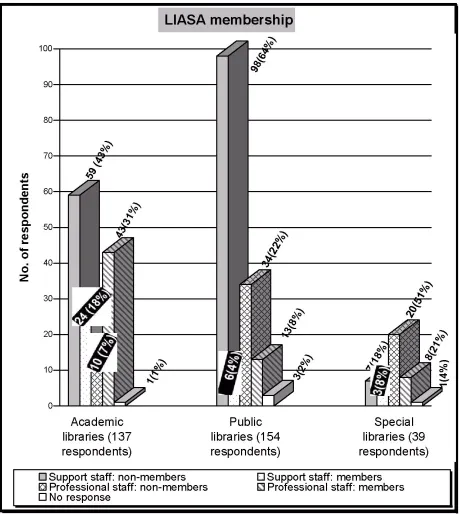
The study drew respondents from three types of library services (refer to Figure 1) and from all categories of staff. There were 201 (61%) support staff and 129 (39%) professional staff. This roughly 60/40 split is a reflection of the general distribution of professional and support staff in most LIS services.
LIASA aims to represent the interests of and promote the development and image of all library and information workers in South Africa (LIASA 2000:4). However, the majority of support staff who, as indicated above, form the bulk of staff complements in most LIS services, tend not to see LIASA as their professional body. A large percentage (72%) of those who were not LIASA members (228) emanated from this category. Many of these support staff indicated that “LIASA is for librarians only” and that “it cares only for the professionals” and not for support staff. Yet Mnisi (1999) emphasized that LIASA must reach out to non-professional staff in LIS services, otherwise it would be limiting its own muscle power. This large group of support staff must be embraced by LIASA if it wants to broaden its membership base. Interestingly, as mentioned earlier, there are also professional staff who are reluctant to join LIASA. Some professional staff do not see LIASA as being professional enough because it is open to all LIS workers (Raju 2005:173) while other professional staff are reluctant to join because they view LIASA as an extension of the erstwhile conservative SAILIS (Kagan 2002:10) – old wine in a new bottle. These perceptions gleaned from the literature, together with the findings from the study being reported here, seem to indicate that LIASA is failing both professional and support staff.
4.1.2 Expectations
The findings indicated that respondents expect more from LIASA and that the professional body is not meeting their expectations. For example, LIASA needs to serve the interests of all LIS workers, including support staff and it needs to address industrial concerns in the LIS work place such as qualification issues, job gradings, conditions of service, etc. The American Library Association, a professional body with a large membership base, has amongst its goals to ensure that librarians and other LIS personnel are paid equitable and attractive salaries (Our Association 2007:46). Perhaps LIASA needs to draw from such best practice. LIASA could avoid losing membership by demonstrating the benefits it can deliver and by researching the changing needs of LIS workers, as Ghosh (2006:45) suggests. The trend shown in Raju’s (2005) study that two-thirds of tertiary level LIS workers surveyed in South Africa were of the opinion that it is necessary to have an organization to address the industrial concerns in library and information services, was also revealed by this study. Of the 330 respondents, a large majority (85%) believe that the professional body must address industrial concerns of the LIS sector. Of the 280 respondents who want the professional body to address industrial concerns, 60% emanated from among the support staff - the same group amongst whom a number of LIS workers are not members of LIASA. Perhaps this is an area that LIASA needs to focus on if it wants to broaden its membership base. This becomes particularly relevant in view of the fact that both the literature (Raju, Stilwell & Leach 2006:216; Raju & Stilwell 2007:15) as well as the current study have indicated that LIS workers want the LIS professional body to represent both the professional and industrial concerns of the LIS profession.
4. At the time of the survey the annual membership fee was R210.00 (currently R250.00 p.a.).
Figure 1 (N = 330)
4.1.3 LIASA membership in academic library services in KZN
4.1.4 LIASA membership in public library services in KZN
Of the 154 public library respondents (refer to Figure 1), 132 (86%) were not members of LIASA. Ninety-eight (64%) of them were support staff and 22% were professional staff. Eighty-six percent is a very high percentage of LIS workers who are not members of the only LIS professional body in South Africa. Only 19 (12%) of LIS workers from the public libraries in KZN surveyed were members of LIASA. Of the 19 respondents who were members, 68% emanated from the professional staff category. This shows that even though the findings reflect poor LIASA membership in public libraries, the little support that LIASA has from this sector, is from the professional staff. There seems to be a difference in terms of LIASA membership between academic and public library services. Membership levels are poorer among public libraries. This may be attributed to the nature of the service offered and geographic location of these libraries. Academic libraries are generally located in urban centres where there is easier access to information and more networking opportunities, while many public library services are located in outlying rural areas where flow of information and general communication may be problematic. Furthermore, it is the opinion of the authors based on many years of involvement with public and academic libraries in KZN that, compared to public library staff, academic library staff by nature of the environment in which they are located, tend to more academically qualified and more in touch with professional and other issues. This could account for the relatively higher levels of membership in the academic library environment.
Like in academic libraries, most of the LIS workers surveyed from the public libraries (51%) believe that LIASA should not restrict itself to addressing professional concerns of the LIS sector. Industrial concerns, they believe, should also be addressed. Of the 79 respondents against the restriction, 70% were from the support staff. Again, it becomes evident that industrial related issues are an area that LIASA could hone in on to reach this category of LIS workers.
4.1.5 LIASA membership in special library services in KZN
Twenty-seven (69%) of the 39 LIS workers surveyed from special libraries in KZN were not members of LIASA. Interestingly, in the special library sector, the large number of non-members emanated from the professional staff category as 20 (51%) of the non-members were professional staff. Again here, the nature of the service is different from that of public and academic libraries. Only 11 (28%) of the 39 special library workers in KZN surveyed, were members of LIASA. Unlike in academic and public libraries, LIS qualification level and type in special libraries generally do not determine whether the LIS worker is regarded as professional or support staff. Special libraries, often located in the corporate world, tend not to be very particular about LIS qualification types and levels. Furthermore, the findings revealed that LIS workers from special libraries often belong to other associations, for example, OSALL (Organization of South African Law Libraries). Notwithstanding this, a large percentage of the LIS workers surveyed from special libraries (79%) were against the idea of LIASA restricting itself to professional concerns of the LIS sector.
In summary, it is clear that a significant percentage of LIS workers surveyed in KZN are not LIASA members. Membership growth has been slow largely because of non-renewals arising from financial constraints and reasons associated with not benefiting from being members. While support staff is the dominant category in terms of numbers in most LIS services, LIASA has not been able to draw significant membership from this category of LIS workers. Overall as well as in each of the three types of library services surveyed, LIS workers tend to believe that LIASA should address both the professional and industrial concerns of the LIS sector, with support staff in particular feeling very strongly about this. While there are slight differences in the membership patterns among the three types of library services surveyed, all three have shown low membership levels, with public libraries, a very large LIS sector, being particularly problematic in terms of professional body membership.
4.2 Possible reasons for non-membership
the challenges facing library associations in Africa, encourage improving communication as “it is usually held against library associations that they do not send information [to LIS workers]”.
Wilson (1997:51) encouraged the use of marketing strategies for a professional body to attract and retain members and to increase membership involvement in the association. Such a marketing strategy on LIASA’s part would need to take into account that of the 234 respondents who stated that they would like more information about LIASA, 123 (53%) indicated that they would like this information communicated via face-to-face contact with LIASA officials at branch, national or interest group level. Marketing and promotion of the professional body should also take into account the role of employers (as represented by heads of LIS services and other managers) in encouraging staff to become members of LIASA as findings reveal this to be a significant factor in the extent to which staff involve themselves in LIASA activities. While respondents generally felt that they were not discouraged by their employers to join LIASA, 232 (71%) of the 330 respondents indicated that they were not encouraged either. Also noteworthy for marketing and promotion purposes is the finding that while a large percentage of the 330 respondents (48%) had not attended LIASA activities previously (the large majority of these being support staff), a significant 69% of these respondents (again, the majority being support staff) indicated that they would like the opportunity to participate in LIASA activities. Significantly, the majority of those respondents who had previously participated in LIASA activities (61%), including both professional and support staff, wanted to participate further because of the benefits they had gained from such participation. Clearly then, this points to room for potential promotion of the professional body among LIS workers not currently involved with the organization. After-all, as mentioned earlier, LIASA does enjoy a “funded secretariat” (Rosenberg 2006:110-111) to co-ordinate such promotion and marketing. Rosenberg (2006:110-111) purports that library associations elsewhere in Africa “see a permanent funded secretariat as something that would solve many of the challenges they face”.
There was also a feeling among some of those who were not LIASA members (228) that the membership fee is too high as 16 (7%) of the respondents indicated such. Perhaps if LIASA demonstrated more benefits and meeting of expectations of LIS workers, these workers would not see the membership as being “too expensive” and that it is worth becoming a member. This is important in view of the fact that 120 support staff (36%) and 68 professional staff (21%) of the 330 LIS workers surveyed felt that LIASA has no benefits for them as LIS workers. There was also a strong feeling among support staff that LIASA is biased towards professional staff, as already mentioned. In fact a significant 118 of the 330 respondents (36%) indicated that they do not regard LIASA as a body for all LIS workers, yet the LIASA constitution claims to embrace all LIS workers: LIASA aims to “unite all persons engaged or interested in library and information work and to actively safeguard and promote their dignity, right and socio-economic status” (LIASA 2000: 4). To counter factors such as membership costs and perceptions of “no benefits” and encourage membership, perhaps LIASA needs to build on the many positives about the organization put forward by satisfied LIASA members, for example, LIASA provides “a good platform to network and interact on common interests”, it “widens knowledge of the LIS sector”, LIS workers “learn about new developments in the profession” and LIASA promotes “professional growth”. Further, while not in the majority there was nevertheless a significant percentage of respondents for whom financial constraints prevent them from becoming LIASA members. Findings reveal that many in this group are of the opinion that a monthly payment option for subscription fees would encourage them to become paid-up members of LIASA. It would do LIASA good to look into alternative payment options so as to ease the financial burden on LIS workers and hence encourage membership.
LIS workers, particularly support staff, which is a potential growth area for LIASA membership, indicated dissatisfaction with the fact that LIASA does not attend to industrial concerns of the LIS sector such as different gradings of staff used in different libraries, the tension between professional and paraprofessional staff qualifications and the issue of traditional university LIS degrees versus university of technology LIS degrees in the LIS work environment. In fact even LIASA members who claimed to be dissatisfied members also cited lack of attention to industrial concerns as a major reason for being dissatisfied.
5 Conclusions
The main objectives of the study were to investigate the extent to which LIS workers in KZN are members of LIASA and to reveal the reasons for non-membership if a substantial number of LIS workers are not members. Based on the above discussion the study concluded the following about the extent to which LIS workers in KZN are members of LIASA:
• Only a small percentage of about 30% of LIS workers in KZN are members of LIASA, while a large percentage of about 70% are not members;
• While there were varying percentages reflecting LIASA membership and non-membership in academic, public and special library services in KZN, the common trend was that in each of these types of library services, the majority of LIS workers were not LIASA members, with the situation of non-membership being particularly problematic in the public library sector which is the largest of the three LIS sectors; and
unable to draw significant membership from this category of LIS workers despite its constitution claiming to embrace all LIS workers.
The study concluded the following regarding the reasons for non-membership of LIASA as well as for non-renewal of membership which seems to be largely responsible for the slow membership growth:
• Lack of awareness of the existence of the professional body and its activities and lack of interest (apathy) in LIASA arising largely from poor marketing, promotion of and communication about the professional association, especially in the public library sector;
• The LIASA membership fee is considered to be too high resulting in financial constraints discouraging membership; • A perception among many that LIASA does not offer any benefits to them as LIS workers;
• A strong feeling, especially among support staff, that LIASA is biased towards professional staff and that it is not an organization for support staff; and
• LIASA does not address industrial concerns of the LIS sector (with support staff feeling particularly strongly about this).
6 Recommendations
Based on the above discussions and conclusions, the study made the following recommendations:
• LIASA needs to engage a more aggressive and rigorous marketing and promotion strategy to increase membership levels particularly in the public library sector and among support staff in all LIS services, the latter revealing itself in the study as being a potential growth area for LIASA to broaden its membership base;
• LIASA could perhaps counter “high membership fees” and financial constraints discouraging membership by seeking alternative payment options to ease the financial burden on LIS workers and thus encourage membership;
• LIASA needs to find creative ways of addressing the perception of “no benefits” possibly through education programmes on how one can derive qualitative benefits by actively participating in the professional body and/or its activities. Such education programmes should draw on the many positives about the organization and qualitative benefits derived that are voiced by satisfied LIASA members;
• LIASA needs to creatively reach out to support staff and tangibly demonstrate to them that it is a body embracing all persons engaged in library and information work and is not just for professional LIS staff;
• LIASA needs to consider involving itself with the industrial concerns of the LIS sector, notably, the role of
paraprofessional qualifications in the LIS work place, traditional university LIS degrees versus university of technology LIS degrees in the LIS work environment, issues relating to LIS job gradings, etc.; and
• While this study researched LIASA membership trends in the province of KwaZulu-Natal (South Africa) which it is hoped gives some indication of membership trends nationally as well, it would be useful if similar studies are carried out in other provinces of the country to ascertain if the trends reflected in this study are indeed applicable to South Africa generally.
References
Bless, C. & Higson-Smith, C. 2004. Fundamentals of social research methods: an African perspective. 3rd ed. Cape Town: Juta. Dione, B. & Séne, H. 2005. National library associations in French-speaking Africa: challenges and concerns. Innovation: Journal
of Appropriate Librarianship and Information Work in Southern Africa, 31:9-16.
Ghosh, M. 2006. The emerging role of national and regional associations in library development: an Indian perspective. Library Review, 55(1): 45-58.
Gruen, T.W., Summers, J.O. & Acito, F. 2000. Relationship between marketing activities, commitment, and membership behaviours in professional associations. Journal of Marketing, 64(July):34-49.
Haasbroek, N. 2007. Membership news. Liasa-in-touch, 8(3):2. IFLA. 2002. IFLA 2002 annual report. Hague: IFLA.
Joint, N. & Wallis, J. 2005. Information literacy and the role of national library and information associations. Library Review, 54(4): 213-217.
Kagan, A. 2001. Living in the real world: a decade of progressive librarianship in the USA and in international organizations. Innovation: Journal of Appropriate Librarianship and Information Work in Southern Africa, 22:11-19.
Kagan, A. 2002. The transformation of South African librarianship: survey results and analysis of current opinions. Innovation: Journal of Appropriate Librarianship and Information Work in Southern Africa, 25:1-17.
Karisiddappa, C.R. 2002. Role and importance of national and state level associations in library development in India. Paper presented at the 68th IFLA Council and General Conference, Karnataka, India, 18-24 August 2002.
Kawooya, D. 2001. Management prospects and challenges of library associations in Africa: the case for the Uganda Library Association and the Library and Information Association of South Africa. World Libraries, 11(1&2):39-55.
Khomo, M.P. 2005. An investigation into membership of LIASA among LIS workers in the Durban area. B.Tech. research project. Durban Institute of Technology, Durban.
LIASA. 2000. Constitution. [s.l.]: LIASA.
LIASA. 2006. National office news. Liasa-in-touch, 7(2):2.
LIASA. 2007. LIASA annual report: October 2006 to August 2007 (presented at the 2007 AGM). Durban: LIASA.
Mnisi, E. 1999. Library advocacy and lobbying in South Africa: getting junior and non-professional staff on board. Paper presented at the LIASA conference in Cape Town, 1999.
Moerat, N. 2004. Liasa elects new president. Liasa-in-touch, 5(4): 3.
Musiker, R. 1986. Companion to South African libraries. Johannesburg: Ad. Donker.
Mutula, S. 2003. Issues on library associations in Eastern, Central and Southern Africa: the case of the Botswana Library Association (BLA). The Electronic Library, 21(4):335-351.
Naylor, B. 2001. Annual report: moving forward… in the information society. London: The Library Association.
Olden, A. 2005. Library associations in Africa: past and present. Innovation: Journal of Appropriate Librarianship and Information Work in Southern Africa, 31:1-8.
Our Association. 2007. [Online]. http://www.ala.org/ourassociationdocs/policymanual/mission.htm. Accessed 20/07/2007.
Raju, R. 2005. Unionising library and information staff in the tertiary sector: a feasibility study. PHD thesis. University of KwaZulu-Natal, Pietermaritzburg.
Raju, R. & Stilwell, C. 2007. From adversarialism to cooperation: key implications of the new South African labour dispensation for the library and information sector. Mousaion, 25(1):1-20.
Raju, R., Stilwell, C. & Leach, A. 2006. The feasibility of unionising LIS workers: a case study of the tertiary education sector in South Africa. South African Journal of Libraries and Information Science, 72(3):208-217.
Rosenberg, D. 2006. Book review: A. Olden and A. Mcharazo (eds.). Revitalizing library associations in Africa. Focus on International Library and Information Work, 37(3):110-111.
Sekaran, U. 2003. Research methods for business: a skill-building approach. 4th ed. USA: John Wiley & Sons. South Africa country report 2004-2006. 2006. [Online]. www.scecsal.org/sliasacr06.html. Accessed 19/07/2007.
South African Democratic Teachers’ Union (SADTU). 2007. The educator’s voice. [Online]. http://www.sadtu.org.za. Accessed 09/10/2007.
Syphus, M. 1995. Towards a LIS association for all: a critical assessment of the position of SAILIS with regard to a unified profession. South African Journal of Library and Information Science, 63(1):1-8.
Vessey, J.A. 2003. Nursing. [Online]. http://www.accessscience.com. DOI 10.1036/1097-8542.462100. Accessed 25/09/2007. Walker, C.M. 2006. Library associations in South Africa, 1930-2005. Library Management, 27:26-27.
Walker, C.M. 2007. LIASA 1997-2007: background and recent history. In: Bothma, T., Underwood, P. & Ngulube, P. (eds). Libraries for the future: progress and development of South African libraries. Pretoria: LIASA, pp. 179-197.
Webster, L. 2006. Liasa @ KZN news, 6:1.