Original Research Article
Assessment of knowledge, attitudes and practices toward prevention of
hepatitis B virus infection among medical students in
Geetanjali Medical College, Udaipur
Sachin Sharma*, Mukul Dixit, Hemlata Mittal, Jyoti Jain, Divya Jain, Anmol Khandelwal
INTRODUCTION
Hepatitis B virus (HBV) infection is one of the major public health problems in the world. According to the recent estimates, about one-third of the world population is infected with HBV.1 All HBV infections do not have symptoms, which mean that people who are contagious are at a risk without knowing it. In nearly all adults, 90% of the infection heals and they become healthy. But 90% in infants and 30%–50% among young children are at a risk of lead to chronic infection.2 The prevalence of chronic HBV infection greatly varies worldwide (0.5–
20%), due to differences in age at the time of infection and mode of acquisition. Despite the availability of HBV vaccination since 1982, which gives 90%–100% protection against HBV infection, nearly two billion people in the world have been infected with HBV, of which 350 million are chronic carriers. As a consequence of this, approximately 600,000 die every year from HBV-related liver disease or hepatocellular carcinoma in the world.2
It is highly contagious and is 50–100 times more infectious than HIV. It is transmitted through blood,
ABSTRACT
Background: Hepatitis B virus (HBV) infection is one of the major public health problems in the world. According to the recent estimates, about one-third of the world population is infected with HBV. Health care workers (HCWs) are at high risk of HBV infection in the health care settings. The prevalence rate of HBV in HCWs is about 2–10 times higher than the general populations in the world.
Methods: A cross sectional study was conducted at GMCH, Udaipur from March 2017 to August 2017 on a pretested, precoded and prestructured self administered questionnaire included sections on knowledge, attitude, and practice toward hepatitis B after having oral/ written consent among 200 medical Students.
Results: There were 144 (72.0%) males and 56 (28.0%) females participated as study subjects, more than 80.00% of the study subjects knew about the causative agent, vertical transmission, and vaccine prevention and after effects of HBV infection, 151 (75.50%) agreed for health education for STD’s in the schools, 42 (21.00%) of the study subjects had experienced the needle stuck injury.
Conclusions: Although more than 80% students had scientific knowledge about HBV but still there are gaps in the knowledge of Medical Students about Hepatits B infection. Sensitization of the medical students to the various aspects of disease through an active health education programme is crucial to control the spread of Hepatitis B.
Keywords: Health Care workers, Hepatitis B, Sensitization
Department ofCommunity Medicine, Geetanjali Medical College, Udaipur, Rajasthan, India
Received: 04 December 2017
Revised: 17 February 2018
Accepted: 19 February 2018
*Correspondence:
Dr. Sachin Sharma,
E-mail: [email protected]
Copyright: © the author(s), publisher and licensee Medip Academy. This is an open-access article distributed under the terms of the Creative Commons Attribution Non-Commercial License, which permits unrestricted non-commercial use, distribution, and reproduction in any medium, provided the original work is properly cited.
semen, vaginal fluid, and mucous membranes most commonly by unprotected sexual contact, contaminated blood transfusions, unsafe use of needles, from mother to child at birth, close household contact, and among
children in early childhood. While horizontal
transmission in childhood appears to be a major route of transmission, the role of vertical transmission is probably underestimated. Blood transfusion and unsafe therapeutic injections continue to be important modes of transmission of HBV. It has been confirmed that HBV transmission occurs from exposure to saliva and gingival crevicular fluid.3,4
In the Middle East and the Indian subcontinent, an estimated 2–5% of the general population is chronically infected. For HBV infection, India comes under intermediate endemic zone with prevalence between 2% and 10% among the studied population. India has HBV carrier rate of about 4.0% with a high prevalence rate in the tribal population which amounts to a total of 36 million carriers contributes to a large proportion of this HBV burden in a population of 1.25 billion.5,6
Health care workers (HCWs) are at high risk of HBV infection in the health care settings. The prevalence rate of HBV in HCWs is about 2–10 times higher than the general populations in the world. The risk factors for HBV infection are percutaneous or mucosal exposure to infected blood or body fluids, using inadequately sterilized medical equipment or contact with non-intact skin.7 The average risk for acquiring HBV infection after percutaneous exposure to infected blood has been estimated to be 6–30%; whereas it is about 0.3% for
human immunodeficiency virus.8 The risk of
occupational exposure to HBV infection is highly prevalent among HCWs in developing countries, where the prevalence of HBV is high in general population, and the health settings are poor could be attributed to the prevailing careless handling of contaminated objects, reuses of inadequately sterilized medical equipment, and an improper waste disposal system.9
Apart from the HCWs, trainees in the health care professions are also exposed to an equal magnitude of occupational risk of HBV, as they work in the same health care delivery system. In fact, the risk for accidental exposure among the trainees could be higher due to their lack of experience, insufficient training, duty overload, and fatigue. However, studies have indicated that there is a clear gap of knowledge among trainees of health profession towards the risks of occupational exposure to HBV infection. It has been used as a useful study tool to design public health policies by taking into account the awareness, beliefs, and health seeking behavior of the at-risk population.
Knowledge, attitude, and practices study measures key knowledge, feelings, tendencies, or skills commonly shared by a community on particular issues. It has been used as a useful study tool to design public health policies
by taking into account the awareness, beliefs, and health seeking behaviour of the at-risk population.
Objective
This study is conducted:
1. To assess the knowledge among medical students.
2. To assess the attitude among medical students. 3. To assess practices toward prevention of hepatitis B
virus infection medical students.
METHODS
A cross sectional study was conducted at Geetanjali Medical & Hospital, Udaipur from March 2017 to August 2017 on a pretested, precoded and prestructured self
administered questionnaire included sections on
knowledge, attitude, and practice toward Hepatitis B after having oral/ written consent. 200 medical Studentswere selected randomly and those who consented to participate for the study up to the desired sample size. All the necessary approvals for carrying out the research were obtained. Study and confidentiality aspects were explained to the students. Data was entered in excel and analyzed by SPSS version 11.
RESULTS
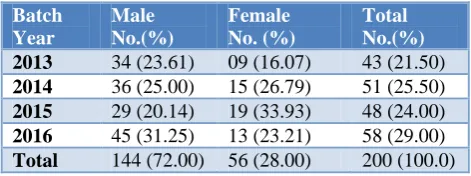
There were 144 (72.0%) males and 56 (28.0%) females participated as study subjects in this study. The maximum study subjects were observed 58 (29.00%) belonged to batch admitted year 2016 followed by batch admitted year 2014. Maximum male students 45 (31.25%) were from batch admitted year 2016 and female students (33.93%) belonged to batch admitted 2015 (Table 1).
Table 1: Distribution of study subjects with the entrance year of M.B.B.S. (n=200). Batch
Year
Male No.(%)
Female No. (%)
Total No.(%)
2013 34 (23.61) 09 (16.07) 43 (21.50)
2014 36 (25.00) 15 (26.79) 51 (25.50)
2015 29 (20.14) 19 (33.93) 48 (24.00)
2016 45 (31.25) 13 (23.21) 58 (29.00)
Total 144 (72.00) 56 (28.00) 200 (100.0)
When we accessed the knowledge for HBV we found that majority of study subjects 196 (98.0%) had heard about hepatitis B virus, 197 (98.50%) knew that the causative agent is a virus, 161 (80.50%) responded positively for vertical transmission of hepatitis B virus, while 185 (92.50%) knew that it can be prevented from vaccine and even 166 (83.00%) responded positive for the carrier state of hepatitis B. 159 (79.50%) responded for HBV causes jaundice (Table 2).
the study subjects had no objection to serve the HBV positive patients. Though 156 (78.00%) of them responded that HBV positive patients should be isolated and 192 (96.00%) were positive for need to confidentiality of HBV positive patient. 151 (75.50%) of study subjects thought that health education for STD’s should be necessary in the schools (Table 3).
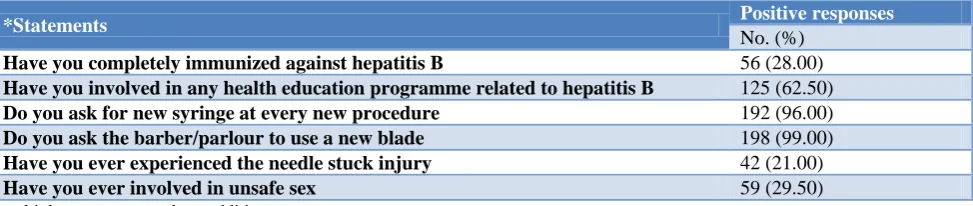
For the practice point of view, 56 (28.00%) of the study subjects had been vaccinated for HBV, while 125 (62.50%) were involved in health education programme related to hepatitis B, 42 (21.00%) of the study subjects had experienced the needle stuck injury and 59 (29.50%) had involved in unsafe sex and 198 (99.00%) had asked the barber / parlour to use a new blade (Table 4).
Table 2: Distribution of study subjects with the responses for knowledge items (n=200).
Knowledge items Positive responses
No. (%)
Heard about HBV 196 (98.00)
HB agent is a virus 197 (98.50)
HBV can be transmitted from mother to child 161 (80.50)
HBV can be transmitted with food/contaminated water 93 (46.50)
HBV can be prevented with vaccine 185 (92.50)
HBV affects liver function 178 (89.00)
HBV causes Jaundice 159 (79.50)
HBV has carrier state (patient without symptoms) 166 (83.0)
*multiple responses, total not additive.
Table 3: Attitude of the study subjects for HBV infection (n=100).
*Statements Positive responses
No. (%)
Are you on a risk to infect with hepatitis B 136 (68.00%)
Would You like to serve the HBV patient 184 (92.00%)
Need of confidentiality of the HBV positive patient 192 (96.00%)
Will you visit to health facility, If you accidentally come in contact with HBV 179 (89.50%)
Hepatitis B patients be allowed to work routinely 158 (79.00%)
Health education for STDs in the schools to be necessary 151 (75.50%)
Hepatitis B infected patients should be isolated 156 (78.00&)
*multiple responses, total not additive.
Table 4: Practices of the study subjects for HBV infection (n=100).
*Statements Positive responses
No. (%)
Have you completely immunized against hepatitis B 56 (28.00)
Have you involved in any health education programme related to hepatitis B 125 (62.50)
Do you ask for new syringe at every new procedure 192 (96.00)
Do you ask the barber/parlour to use a new blade 198 (99.00)
Have you ever experienced the needle stuck injury 42 (21.00)
Have you ever involved in unsafe sex 59 (29.50)
*multiple responses, total not additive.
DISCUSSION
The hepatitis B virus is acquired when virus enters the body due to high risk behaviour of people. The major issues exists at individual, family and societal level are social stigma and discrimination related to hepatitis B. Poor information and misconceptions and widespread ignorance play a key role. Prevention is always better than cure so the vaccination remains the only measure to prevention of disease. In India health education is not very common in the schools previously but presently
awareness about health education including sex education is coming to be an important part of school education. Media campaigns and training is also playing a major role in HBV education.
HBV infection, this finding is quite similar to the previous study by Noubiap et al from Cameroon and Abdela et al that reported a good knowledge of the study participants on HBV infection.10,11 But, it is higher than 56.2% knowledge levels at Haramaya University, Ethiopia by Mesfin et al.12 136 (68.00%) of the study subjects were aware that they were on the risk to infect with hepatitis B in coherence with a study by Al-Hazmi in Saudi Arabia.13
There were only 28.00% of study subjects fully vaccinated against HBV in coherence to 26.7% in a study by Hussain et al in Deccan Medical College, Hyderabad and 29.3% reported by Anjali et al among medical students of BJMC, Ahmedabad.14,15
The most frequent reason for not getting vaccinated might be lack of motivation, ignorance or fear of injection. These are serious issues and baseless reasons and need to be improved by education.
21.0% of medical students had experienced the needle stuck injury quite similar to a study done by Hussain et al as there was 24.0% of medical students had experienced needle stuck injury in Deccan Medical College, Hyderabad.14
The majority of the respondents were concerned for safety measures by using new syringe or new blades at barber shops which prevent them with the exposure to the danger of spreading HB infection. This might be due to HIV infection which also transmitted through blood contamination. Thus, all HB diagnosed patients should be educated for the importance of safe practice and transmitting the infection to healthy individuals. 125 (62.50%) of the participants had attended a health education programme in this study the results of which were quite similar 55.0% to a study by Baig et al in Jhalawar Medical College and this shows a lack of information about educational campaigns in these areas.16
CONCLUSION
With the above findings it has to be state that there are gaps in the knowledge of Medical Students about hepatitis B infection although more than 80% students had scientific knowledge about HBV. Additional Hepatitis B training for medical personnels seems to be necessary. Sensitization of the Medical Students to the various aspects of disease through an active health education programme is crucial to control the spread of hepatitis B.
It is well proved that HCW’s are at a very high risk of contracting HBV infection during their training due to the low HBV vaccine uptake rate and accidental exposure to blood.
Recommendations
Promotion and advertisement of adolescent friendly health services among people in order to inform and assist the young people about hepatitis B is necessary. To improve intersectoral coordination between public administrations and social protection sectors for health education programme for a better identification of vulnerable and at risk adolescents. It is necessary to make a common effort from the family, educational institutions, health institutions and mass-media regarding hepatitis B. It is recommended to attend the Educational programs mandatorily for all health care providers. Medical students should acquire knowledge to change their attitudes and influence their behavior both in the prevention of transmission of the virus during their education and clinical training as well as positive attitudes for effective caring for these patients and all students in the health profession should be vaccinated prior to their entry into professional practices.
There is also a need of reconstruction in medical curriculum programmes to ensure that the medical students have appropriate attitudes with the practices about hepatitis B.
Funding: No funding sources Conflict of interest: None declared
Ethical approval: The study was approved by the Institutional Ethics Committee
REFERENCES
1. World health organization. WHO hepatitis B.htm. WHO, Geneva. Available at: http://www.who hepatitisB.htm. Accessed on 22 June 2015.
2. WHO. Hepatitis B, 2012. Available at: http:// www.who.int/mediacentre/factsheets/fs204/en/index .html. Accessed on 22 June 2015.
3. Puri P. tackling the hepatitis b disease burden in India. J Clin Exp Hepatol. 2014;4(4):312–9.
4. Lamster IB, Ahlo JK. Analysis of gingival
crevicular fluid as applied to the diagnosis of oral and systemic diseases. Ann N Y Acad Sci. 2007;1098:216-29.
5. Dunford L, Carr MJ, Dean J, Nguyen LT, Ta TTH,
Nguyen BT, et al. A multicentre molecular analysis of hepatitis B and blood-borne virus coinfections in Vietnam. PLoS One. 2012;7(6):e39027.
6. Zuckerman AJ. More than third of world’s
population has been infected with hepatitis B virus. BMJ. 1999;318(7192):1213.
7. West DJ. The risk of hepatitis B infection among health professionals in the United States: a review. Am J Med Sci. 1984;287(2):26–33.
8. Beltrami EM, Williams IT, Shapiro CN,
9. Taneja N, Biswal M. Safe disposal of infectious
waste. Indian perspective. J Hosp Infect.
2009;62(4):525–6.
10. Noubiap JJ, Nansseu JR, Kengne KK, Ndoula ST, Agyingi LA. Occupational exposure to blood, hepatitis B vaccine knowledge and uptake among medical students in Cameroon. BMC Med Educ. 2013;13:148.
11. Abdela A, Woldu B, Haile K, Mathewos B, Deressa
T. Assessment of knowledge, attitudes and practices toward prevention of hepatitis B virus infection among students of medicine and health sciences in Northwest Ethiopia. BMC Res Notes. 2016;9:410. 12. Mesfin YM, Kibret KT. Assessment of knowledge
and practice towards hepatitis B among medical and health science students in Haramaya University, Ethiopia. PLoS ONE. 2013;8(11):79642.
13. Al-Hazmi AH. Knowledge, attitudes and practice of
dentists concerning the occupational risks of hepatitis B virus in Al Jouf Province, Saudi Arabia. Niger J Clin Pract. 2015;18:276–81.
14. Hussain SF, Ahmad SR, Muslehuddin OM,
Muslehuddin HM. Knowledge, attitude and practice regarding hepatitis B among medical students. Int J Community Med Public Health 2016;3:2977-81. 15. Anjali S, Shikha J. Prevention of Hepatitis B;
knowledge and practices among Medical students. Indian Medical Gazette. 2012;2(2):52-6.
16. Baig VN, Gupta PK, Sharma AK, Swarnkar M.
Assessment of knowledge, attitude and practice about hepatitis b among clinicians and medical students: a cross sectional study. Ntl J Community Med. 2015;6(3):415-22.
Cite this article as: Sharma S, Dixit M, Mittal H, Jain J, Jain D, Khandelwal A.Assessment of