Original Research Article
Effect of honey on nocturnal cough among children in Taif city
Hanan Al-Juaid
1*, Aljwharah AlJuaid
2, Walaa Abuharba
2, Ayman Abouhamda
3INTRODUCTION
Nocturnal cough is a common disturbing symptom experienced by children with upper respiratory tract infections (URTI). It often causes disruption of sleep for both children as well as parents. Consequently, it results in high rates of school absenteeism among the affected children. Thus, caregivers and parents usually attempt to give their children herbal regimens and over the counter (OTC) medications to relieve their symptoms even if they know that viral upper respiratory tract infections are generally self-limited.1
A variety of herbal regimens and home remedies are commonly administered to children with cough to treat their symptoms, particularly honey, lemon, liquorice, and clove.2,3 In spite of being not approved by the Food and Drug Administration (FDA), honey has been long considered a safe inexpensive demulcent that can relieve cough among pediatric population. Honey is an antioxidant with antimicrobial properties that can increase cytokine release and modulate inflammatory responses.4-6
ABSTRACT
Background: Nocturnal cough is a common disturbing symptom that affects children during upper respiratory tract infections and can have a major negative impact on child and parents’ sleep quality. Many pharmaceutical medications, herbal regimens, and non-pharmaceutical advice are prescribed to reduce nocturnal cough. The aim of this research was to study the impact of honey on nocturnal cough in children.
Methods: A descriptive study was conducted on 226 children in Taif city, KSA using a pre-prepared questionnaire to assess the cough severity and response to honey in comparison to other treatment modalities. Data collected were then analyzed using SPSS software.
Results: The study was conducted on 226 children (51.77% were females). Children who used honey were significantly older (mean age 7.64±3.8 years) than those who used medications (mean age 6.98±60) (p=0.025). Children who used honey had a higher prevalence of headache (p=0.001) and malaise (p<0.001) than children who did not receive honey. The use of honey was also significantly associated with high cough severity scores. The use of honey seemed to significantly reduce both the cough severity score and combined severity scores, with odd’s ratios of 0.46 and 0.19, respectively (p=0.020 and <0.001). However, it was associated with fewer satisfaction rates and fewer intentions to re-use in next attacks (p=0.025).
Conclusions: Honey has a beneficial effect on treating nocturnal cough in children. It decreases the severity of cough as well as the frequency of cough. It is commonly used among older Saudi children who have cough associated with malaise and fever. However, it is not satisfactory for patient and parental relief in Taif city because it doesn’t improve the sleep quality of patients or parents.
Keywords: Honey, Nocturnal cough, Children, Taif, Saudi Arabia
Department of Family Medicine, 1Taif University, 2King Faisal Hospital, Taif, Saudi Arabia
3
College of Medicine, Ibn Sina National College, Jeddah, Saudi Arabia
Received: 11 January 2018
Accepted: 29 January 2018
*Correspondence:
Dr. Hanan Al-Juaid,
E-mail: [email protected]
Copyright: © the author(s), publisher and licensee Medip Academy. This is an open-access article distributed under the terms of the Creative Commons Attribution Non-Commercial License, which permits unrestricted non-commercial use, distribution, and reproduction in any medium, provided the original work is properly cited.
The aim of this work was to study the effect of honey on nocturnal cough as well as sleep quality among Saudi children in Taif city and to compare the cough frequency and severity scores among children who were administered honey with those who did not.
METHODS
This was a cross-sectional study that was conducted on children suffering from night cough attending pediatric and family medicine outpatient clinics in King Faisal Hospital in Taif city, Saudi Arabia on October 2017 using a pre-designed questionnaire. The pre-specified questionnaire was distributed as hard copies by research collaborators. Our questionnaire was structured by a series of questions about night cough and related symptoms as well as treatment used. Honey was specifically asked about in details. The questionnaire was translated into Arabic and the questions were re-phrased in everyday language whenever needed. We measured cough severity and control with a Likert scale with maximum score of 6 for each question. The options were “Extremely”, “Very much”, “A lot”, “Somewhat”, A little”, “Not much” and “Not at all”, respectively.
Surveys were conducted by local teams at each hospital. The survey packet contained a cover letter and a questionnaire with Arabic and English versions. The survey was handed to each patient to read and decide whether to participate or not. Participants recruited to this study were all potential children suffering from night cough with no restrictions on severity, race, gender or socio-economic status.
Statistical analysis
All collected data were transferred into a spread sheet for further analysis. Standard descriptive measures were calculated for each question/item individually. For data analysis, SPSS 24 for Windows (SSPS Inc., Chicago, IL, USA) was used. Chi-square test was used to measure the significance of difference between different groups. Regression analysis was used to assess association between using honey and the severity of the disease. Independent sample t-test was used to compare mean efficacy and disease control between honey and other treatments.
RESULTS
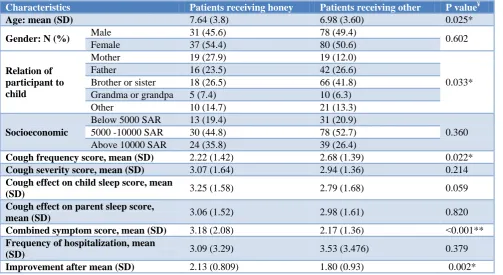
The study was conducted on 226 children suffering from nocturnal cough. Males constituted 48.23% (n=109) and females constituted 51.77% (n=117). The children were classified into two groups according to the use of honey for treatment of cough symptom. Honey was used more frequently among older children (p=0.025). The mean age of children who used honey was 7.64±3.8 years, and the mean age for those who did not use honey was 6.98±93 years. The socioeconomic status of the recruited patients was measured by the average monthly income of their caregiver (below 5000 SAR, between 5000 and 10000 SAR, or above 10000 SAR) and there was no statistically significant difference between the two-studied group (p=0.360) (Table 1).
Table 1: Baseline demographic and disease characteristics of participants.
Characteristics Patients receiving honey Patients receiving other P value¥
Age: mean (SD) 7.64 (3.8) 6.98 (3.60) 0.025*
Gender: N (%) Male 31 (45.6) 78 (49.4) 0.602
Female 37 (54.4) 80 (50.6)
Relation of participant to child
Mother 19 (27.9) 19 (12.0)
0.033*
Father 16 (23.5) 42 (26.6)
Brother or sister 18 (26.5) 66 (41.8)
Grandma or grandpa 5 (7.4) 10 (6.3)
Other 10 (14.7) 21 (13.3)
Socioeconomic
Below 5000 SAR 13 (19.4) 31 (20.9)
0.360
5000 -10000 SAR 30 (44.8) 78 (52.7)
Above 10000 SAR 24 (35.8) 39 (26.4)
Cough frequency score, mean (SD) 2.22 (1.42) 2.68 (1.39) 0.022*
Cough severity score, mean (SD) 3.07 (1.64) 2.94 (1.36) 0.214
Cough effect on child sleep score, mean
(SD) 3.25 (1.58) 2.79 (1.68) 0.059
Cough effect on parent sleep score,
mean (SD) 3.06 (1.52) 2.98 (1.61) 0.820
Combined symptom score, mean (SD) 3.18 (2.08) 2.17 (1.36) >0.001**
Frequency of hospitalization, mean
(SD) 3.09 (3.29) 3.53 (3.476) 0.379
Table 2: Symptoms difference between patients using honey vs. other treatments.
Symptoms Treatment used P value¥
Honey Other treatments
Congestion Yes 19 (27.9) 38 (24.1) 0.537
No 49 (72.1) 120 (75.9)
Fatigue and weakness Yes 29 (42.6) 51 (32.3) 0.135
No 39 )57.4) 107 (67.7)
Discharge Yes 22 (32.4) 56 (35.4) 0
No 46 (67.6) 102 (64.6)
Sneezing Yes 19 (27.9) 35 (22.2) 0.349
No 49 (72.1) 123 (77.8)
Headache Yes 22 (32.4) 22 (13.9) 0.001*
No 46 (67.6) 136 (86.1)
Wheezing Yes 44 (64.7) 105 (66.9) 0.752
No 24 (35.3) 52 (33.1)
Malaise Yes 43 (63.2) 0 (0.0) >0.001**
No 25 (36.8) 158 (100.0)
Fever Yes 16 (23.5) 32 (20.3) 0.581
No 52 (76.5) 126 (79.7)
¥
Chi-square test; *statistically significant (>0.05); ** statistically significant (>0.001).
Table 3: How often honey was used for cough.
Frequency
Gender
Male Female Total
N % N % N %
Honey times
Once 12 38.7 7 18.9 19 27.9
Twice 13 41.9 21 56.8 34 50.0
Three times 2 6.5 7 18.9 9 13.2
More than 3 4 12.9 2 5.4 6 8.8
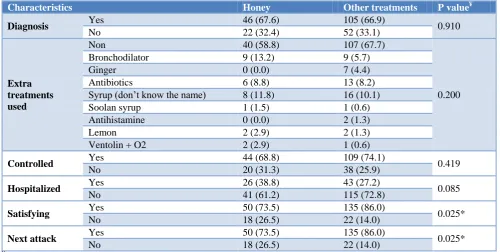
Table 4: Disease progression and control comparing honey to other treatments.
Characteristics Honey Other treatments P value¥
Diagnosis Yes 46 (67.6) 105 (66.9) 0.910
No 22 (32.4) 52 (33.1)
Extra treatments used
Non 40 (58.8) 107 (67.7)
0.200
Bronchodilator 9 (13.2) 9 (5.7)
Ginger 0 (0.0) 7 (4.4)
Antibiotics 6 (8.8) 13 (8.2)
Syrup (don’t know the name) 8 (11.8) 16 (10.1)
Soolan syrup 1 (1.5) 1 (0.6)
Antihistamine 0 (0.0) 2 (1.3)
Lemon 2 (2.9) 2 (1.3)
Ventolin + O2 2 (2.9) 1 (0.6)
Controlled Yes 44 (68.8) 109 (74.1) 0.419
No 20 (31.3) 38 (25.9)
Hospitalized Yes 26 (38.8) 43 (27.2) 0.085
No 41 (61.2) 115 (72.8)
Satisfying Yes 50 (73.5) 135 (86.0) 0.025*
No 18 (26.5) 22 (14.0)
Next attack Yes 50 (73.5) 135 (86.0) 0.025*
No 18 (26.5) 22 (14.0)
¥
Table 5: Linear regression testing association between honey use and different cough parameters.
Predictors B S.E. Adjusted OR (95% CI) † P value
Cough frequency score 0.21 ±0.25 0.1 (-0.29-0.7) 0.410
Cough effect on child sleep score 0.33 0.19 0.24 (-0.05-0.7) 0.087
Cough severity score -0.52 0.17 -0.39 (-0.86--0.17) 0.004 *
Cough effect on parent sleep score -0.01 0.18 -0.01 (-0.36-0.35) 0.966
Combined symptom score -0.96 0.78 -0.17 (-2.51-0.59) 0.220
B=Regression coefficient; S.E.=Standard error of regression coefficient; OR=Odds Ratio; CI=Confidence Interval; *statistically significant (>0.05).
Table 6: Comparison efficacy of honey and other treatments in different aspects of cough.
Predictors t S.E. Mean difference (95% CI) † P value
Cough frequency score -2.24 0.2 -0.46 (-0.86--0.05) 0.026 *
Cough effect on child sleep score 1.9 0.21 0.46 (-0.02-0.93) 0.059
Cough severity score 0.66 0.24 0.14 (-0.28-0.55) 0.513
Cough effect on parent sleep score 0.34 0.23 0.08 (-0.38-0.53) 0.735
Combined symptom score 0.84 0.05 0.19 (0.01-0.92) <0.001**
t=t statistics; S.E.=Standard error difference; CI=Confidence Interval; *statistically significant (>0.05); **statistically significant (>0.001).
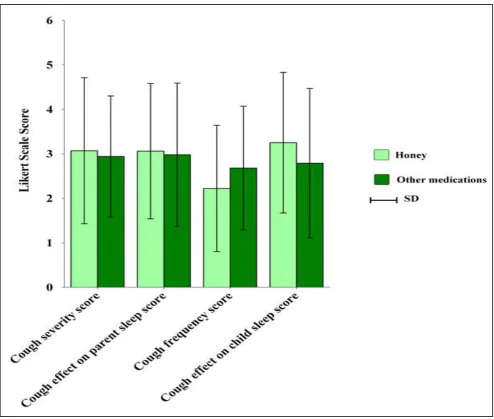
The cough frequency score among children who did not use honey was significantly higher than those who used it, with figures of 2.68 and 2.22 among the two groups, respectively (p=0.0022). Similarly, the combined symptom score was higher among patients who did not use honey (3.53) in comparison to those who used honey (3.05) with a probability value of <0.001. However, children who used honey improved slower than those who did not use honey; with a mean time to improvement of 2.43 days among those who used honey compared to 1.8 among those who did not (p=0.002). The demographic data are detailed in Table 1.
The symptoms investigated in this study included congestion, fatigue and weakness, discharge, sneezing, headache, wheezing, malaise, and fever (Table 2). Of significance, headache was more prevalent among children who were using honey (32.4%) in comparison to those who did not (13.9%) (p=0.001). Similarly, malaise was only experienced by children who used honey (p<0.001), with percentage of how often the honey was used in Table 3.
There was no statistically significant difference between patients who used honey and those who did not as regards the disease diagnosis, outcome, control, hospitalization rates, and the need for using other treatments (Table 4). However, the satisfaction rates, as well as the intention to use honey versus other medical treatments in future attacks, were significantly lower among patients who received honey in comparison to those who did not (p=0.025).
As regards the correlation of cough severity with honey use, Table 5 demonstrates that using honey was significantly correlated with the cough severity. Patients who used honey were 0.026 times vulnerable to have higher cough frequency scores than those who did not receive honey (p=0.026). On the other hand, when the impact of honey on different cough severity scores was evaluated, it was found that the use of honey had significantly reduced the cough severity score and the combined severity score (for both severity and frequency) (Figure 1). The impact of honey on several scores was evaluated including the cough frequency score, the cough severity score, the combined cough severity and frequency score, child's sleep quality, and parents' sleep quality scores. Of note, the use of honey had a significantly beneficial effect on reducing the cough severity score and the combined cough severity and cough frequency scores. The odd’s ratio of cough frequency was 0.46 (p=0.026) and that for combined severity and frequency score was 0.19 (p<0.001) (Table 6). However, there was no statistically significant difference between the two groups as regards the impact on cough effect on child’s or parents’ sleep quality, child's sleep quality, or cough severity score.
DISCUSSION
Honey has been long considered a safe, inexpensive, and popular demulcent that can relieve cough, propose anti-microbial actions, and modulate inflammatory response and cytokine release. It is a complex natural remedy that contains at least 181 different substances.7-9 Thus, parents and caregivers commonly administer it to their sick children even without seeking medical advice. This study aimed to explore the effect of honey on children’s nocturnal cough and sleep quality. Results from this study showed that Saudi parents seemed to tend to use honey in older children (p=0.025); they might have been careful about cough symptoms in younger children for fear of being more vulnerable to complications if not promptly treated with pharmaceutics. However, previous researchers did not find a statistically significant difference for using honey among children of different age groups.10-12 The difference encountered in this study may be attributed to the cultural background and knowledge about honey use as several Saudi parents worry about the risk of infantile botulism with honey use in younger children. Honey is generally not recommended to be given for infants under the age of one year for the risk of infantile botulism, but there is no consensus against its use beyond this age.13 Some researchers do not recommend the use of honey for long periods because it increases the risk for dental caries.1 Another reason behind the avoidance of honey use in young children in this study might be the fact that honey seemed to take more time to improve the child’s symptoms than medications (p=0.002), which might have lead the caregivers to use other alternatives to fasten their children recovery. The use or non-use of honey, however, did not seem to have a statistically significant impact on disease control or frequency of hospitalization.
Of note, parents used to use honey for their children when they had more severe symptoms particularly headache and malaise (p=0.001 and <0.001, respectively). However, it was not frequently used when children had higher nocturnal cough severity (OR=0.39, p=0.0041).
patients.1 Other studies had also reported similar results.11,12,14-21
In spite of the significant improvement in nocturnal cough severity and frequency among the studied sample, parents and caregivers reported less satisfaction rates (p=0.025), and fewer intentions to re-use it in future attacks (p=0.025). This may be attributed to the fact that using honey, in spite of improving the nocturnal cough frequency and severity scores, did not have a significant impact on the quality of sleep either of children or their parents. In disagreement with our results, parents used to rate honey as a favorable regimen that improves their children’s nocturnal cough and sleep quality.1,11,14,22
The difference may be attributed to different cultures, different concepts about symptom relief and expectations, different types of honey used, and different dosage and compliance.
The effect of honey on improving cough severity is probably related to its immunomodulatory actions. Honey was found to stimulate the monocytes to release cytokines and chemokines particularly inter interleukin 6, interleukin 1 beta, and tumor necrosis factor alpha (TNF-alpha).8 Given the known role of these cytokines in healing and tissue repair, honey can improve the cough symptom. Furthermore, different fractions of the honey were proved to have antioxidant properties. For instance, honey contains ascorbic acid, gluconic acid, hydroxymethylfuraldehyde, several peptides, phenolic compounds, and many enzymes such as peroxidases, catalases, and glucose oxidases which are known for their antioxidant capacity.9
Limitations of the study
The main limitation of this study was a cross-sectional study, it did not measure the impact of honey on prospective more objective follow-up basis. The scores used depended mainly on parents' memory about their children condition and their subjective judgement. Additionally, it was not blinded to reduce the bias. It focused on children and patients' subjective evaluation of their own symptoms and improvement. Finally, it was limited to one city in KSA and did recruit patients from different cities. So that, further multicenter prospective double-blinded studies are still recommended to confirm the results of this study and to be confident about generalizing the results to the Saudi community.
CONCLUSION
Honey can improve children’s nocturnal cough severity and frequency. It is commonly used among older Saudi children who have cough associated with malaise and fever. However, it didn’t improve the sleep quality of patients or parents. So that, it is associated with lower satisfaction rates and fewer intentions to be used in future attacks among Saudi individuals.
ACKNOWLEDGEMENTS
The authors would like to thank the ministry of health of Saudi Arabia and King Faisal Hospital for providing the necessary access and tools to search and complete this article.
Funding: No funding sources Conflict of interest: None declared
Ethical approval: The study was approved by the Institutional Ethics Committee
REFERENCES
1. Cohen HA, Rozen J, Kristal H, Laks Y, Berkovitch M, Uziel Y, et al. Effect of honey on nocturnal cough and sleep quality: a double-blind, randomized, placebo-controlled study. Pediatrics. 2012;130(3):465-71.
2. Sung V, Cranswick N. Cough and cold remedies for children. Australian Prescriber. 2009;32(5):122-4. 3. Ziment I. Herbal antitussives. Pulmonary Pharmacol
Therapeutics. 2002;15(3):327-33.
4. Kwakman PH, Zaat SA. Antibacterial components of honey. IUBMB Life. 2012;64(1):48-55.
5. Wahdan HA. Causes of the antimicrobial activity of honey. Infection. 1998;26(1):26-31.
6. Lusby PE, Coombes AL, Wilkinson JM. Bactericidal activity of different honeys against pathogenic bacteria. Arch Med Res. 2005;36(5):464-7.
7. Schramm DD, Karim M, Schrader HR, Holt RR, Cardetti M, Keen CL. Honey with high levels of antioxidants can provide protection to healthy human subjects. J Agricultural Food Chemistry. 2003;51(6):1732-5.
8. Tonks AJ, Cooper RA, Jones KP, Blair S, Parton J, Tonks A. Honey stimulates inflammatory cytokine production from monocytes. Cytokine. 2003;21(5):242-7.
9. Gheldof N, Wang XH, Engeseth NJ. Identification and quantification of antioxidant components of honeys from various floral sources. J Agricultural Food Chemistry. 2002;50(21):5870-7.
10. Paul IM, Beiler J, McMonagle A, Shaffer ML, Duda L, Berlin CM, Jr. Effect of honey, dextromethorphan, and no treatment on nocturnal cough and sleep quality for coughing children and their parents. Arch Pediatrics Adolescent Med. 2007;161(12):1140-6.
11. Grogan SP, Egitto EA. Honey for Acute Cough in Children. Am Family Physician. 2016;94(1):20-1. 12. Nitsche MP, Carreno M. Is honey an effective
treatment for acute cough in children? Medwave. 2016;16:e6454.
13. Cox N, Hinkle R. Infant botulism. Am Family Physician. 2002;65(7):1388-92.
15. Ayazi P, Mahyar A, Yousef-Zanjani M, Allami A, Esmailzadehha N, Beyhaghi T. Comparison of the Effect of Two Kinds of Iranian Honey and Diphenhydramine on Nocturnal Cough and the Sleep Quality in Coughing Children and Their Parents. PLoS ONE. 2017;12(1):e0170277.
16. Allan GM, Korownyk C, Kolber M. Do cough suppressants or honey help pediatric cough? Canadian Family Physician. 2011;57(4):435. 17. Ashkin E, Mounsey A. A spoonful of honey helps a
coughing child sleep. J Family Practice. 2013;62(3):145-7.
18. Cohen HA, Hoshen M, Gur S, Bahir A, Laks Y, Blau H. Efficacy and tolerability of a polysaccharide-resin-honey based cough syrup as compared to carbocysteine syrup for children with colds: a randomized, single-blinded, multicenter study. World J Pediatrics. 2017;13(1):27-33. 19. Waris A, Macharia M, Njeru EK, Essajee F.
Randomised Double Blind Study To Compare
Effectiveness Of Honey, Salbutamol And Placebo In Treatment Of Cough In Children With Common Cold. East African Med J. 2014;91(2):50-6.
20. Mulholland S, Chang AB. Honey and lozenges for children with non-specific cough. CDSR. 2009;2(2): CD007523.
21. Ahmed N, Sutcliffe A, Tipper C. Feasibility Study: Honey for Treatment of Cough in Children. Pediatric Rep. 2013;5(2):31-4.
22. Warren MD, Cooper WO. Honey improves cough in children compared to no treatment. J Pediatrics. 2008;152(5):739-40.