Original Research Article
Knowledge regarding diarrhoea and its management among mothers of
under-five children in an urban area of Amritsar, Punjab
Amanpreet Kaur*, Harpreet Kaur, Harpreet Kaur, Priyanka Devgun
INTRODUCTION
Conventionally diarrhoea is the passage of three or more loose or liquid stools per day, or more frequently than is normal for the individual. Acute diarrhoea is an attack of sudden onset, which usually lasts for 3-7 days, but may last up to 10-14 days. Diarrhoea that starts as an acute episode and lasts for more than 2 weeks is considered persistent or chronic.1
In developing countries leading cause of morbidity and mortality in children is diarrhoea. Around 1.87 million
under-five children died due to diarrhoea in 2003. 80% deaths in the first two years of child’s life occur due to diarrhoea. Every year <3 yr old child experience three episodes of diarrhoea in developing country.2
Recommended treatment (ORT with continued feeding) to prevent dehydration and worsening nutritional status is received by only 39% of <5 year children in developing countries. Lowest level of treatment coverage i.e. 35% is there in Africa whereas it is highest (55%) in East Asia and Pacific (excluding China).3
ABSTRACT
Background: Diarrhoeal diseases are a leading cause of childhood morbidity and mortality in developing countries, and an important cause of malnutrition. In 2003 an estimated 1.87 million children below 5 years died from diarrhoea. In India nearly 1.5 million under-fives are dying every year only due to acute gastroenteritis. Therefore the present study was conducted to find the knowledge about diarrhoea and its management among the mothers of under-five children.
Methods: A total of 400 mothers of under-five children were interviewed. The mothers were selected by adopting simple random sampling method. A pre-designed and pre tested questionnaire was used to collect the information. House to house survey was done to collect the information. Statistical analysis was done by using SPSS 20.0.
Results: Majority of the mothers (72.8%) were in age group of 21-30 years. Out of total 53% knew that diarrhoea is passage of three or more loose stool in a day. Education status of mother has significant relation with the knowledge about diarrhoea and its spread (p=.000). 69.5% of the mothers knew that ORS should be given in dehydration. Only 66.3% could tell the correct method of preparing ORS solution. Source of knowledge about ORS for the mothers was mass media (45%), health workers (40.7%), books (29.7%), neighbours (28.2%) and family member (22.2%). Conclusions: The study concludes that there is lack of knowledge among mothers regarding diarrhoea and its management. There is a need of health education for mothers about diarrhoea and its management. IEC activities should be increased to educate the community about the principles of environmental hygiene.
Keywords: Knowledge, Diarrhoea, Mothers, Under five, Urban
Department of Community Medicine, Sri Guru Ram Das Institute of Medical Sciences and Research, Amritsar, Punjab, India
Received: 14 September 2018 Revised: 16 October 2018 Accepted: 17 October 2018
*Correspondence: Dr. Amanpreet Kaur,
E-mail: [email protected]
Copyright: © the author(s), publisher and licensee Medip Academy. This is an open-access article distributed under the terms of the Creative Commons Attribution Non-Commercial License, which permits unrestricted non-commercial use, distribution, and reproduction in any medium, provided the original work is properly cited.
In India nearly 1.5 million under-five out of total 18 crores die every year due to acute gastroenteritis. If little care is taken with the onset of diarrhoea and oral rehydration therapy is provided timely, 90% of the deaths can be prevented.4
It is believed that diarrhoea is a normal occurrence during “teething” or it is the consequence of teething. There is a common saying that a child during teething should have bouts of loose motions, fever and red eyes. Weak tea with butter or ghee or milk and ghee is given to young children by mothers in diarrhoea. It is believed that if lot of butter or ghee is rubbed on the head it facilitate eruption of teeth.5
In the late 1970s UNICEF and WHO adopted Oral rehydration salts (ORS) and oral rehydration therapy (ORT), which is successful in managing diarrhoea among children. It is estimated that in the1990s, more than 1 million deaths related to diarrhoea may have been prevented each year, largely attributable to the promotion and use of these therapies. Today, however, knowledge and use of appropriate home therapies to successfully manage diarrhoea, including ORT, may be declining in some countries.6
Keeping in view the above statistics the current study was planned to assess the knowledge regarding diarrhoea and its management among mothers of under-five children.
METHODS
A community based cross-sectional study was conducted in the urban field practice area of the Department of Community Medicine of SGRD Institute of Medical Sciences and Research, Amritsar. The sample size required for the study was calculated as
Where n= Sample size
p= expected prevalence or proportion d= precision rate
Hereby taking
Z= 1.96 (approx. = 2, for level of confidence of 95%)
p=0.5 (considering knowledge of mothers about diarrhoea as 50%)
d= 0.05; n=384.
So a total of 400 mothers of under-five children were interviewed during the period from June to August 2018. According to the quarterly report there were 1370 under-five children in urban field practice area of Community Medicine. The mothers were selected by adopting simple
random sampling method. The mothers who gave consent were included in the study. A pre-designed and pre tested questionnaire was used to collect the information. House to house survey was done to collect information about demographic profile, knowledge about diarrhoea and its management. Statistical analysis was done by using SPSS 20.0.
Inclusion criteria
The mothers of under-five who were willing to participate were included in the study.
Exclusion criteria
The mothers who didn’t give consent and those who were not available at the time of study were excluded from the study.
RESULTS
A community based cross-sectional study was conducted in the urban field practice area of the Department of Community Medicine of SGRD Institute of Medical Sciences and Research. A total of 400 mothers of under-five children were interviewed. Out of 400 mothers, 72.8% were in age group of 21-30 years while 14.4% and 12.8% were <20 and >30 years old. 59.5% of the mothers had one child and 37.2% and 3.3% had two and three children respectively. Regarding the educational status of the mothers 43.7%, 22.5%, 15.8% and 1.8% were studied up to matric, middle school, graduation and post graduation respectively. 16.2% of the mothers were illiterate. 90.2% of the mothers were housewives and rest (9.8%) were employed. Education profile of the fathers revealed that 51.7% were educated up to matric, 20.8% up to graduation, 13.8% up to middle school, 3.5 up to post graduation and 10.2% were illiterate. Majority of the fathers (71.7%) were semiskilled worker, 18.5% were unskilled and 9.8% were skilled workers.
Table 1: Socio-demographic profile of the respondents.
Frequency Percentage (%)
Age in years
<20 58 14.4
20-30 291 72.8
>30 51 12.8
No. of children
1 238 59.5
2 149 37.2
3 13 3.3
Education status of mothers
Illiterate 65 16.2
Middle school 90 22.5
Matric 175 43.7
Graduate 63 15.8
Postgraduate 7 1.8
Occupation of mother Housewife 361 90.2
Employed 39 9.8
Education status of husband
Illiterate 41 10.2
Middle school 55 13.8
Matric 207 51.7
Graduate 83 20.8
Postgraduate 14 3.5
Occupation of father
Unskilled worker 74 18.5
Semi-skilled worker 287 71.7
Skilled worker 39 9.8
Table 2: Knowledge regarding various aspects of diarrhoea.
Various aspects of diarrhoea Frequency Percentage (%)
Cause of diarrhoea
Lack of cleanliness 241 60.2
Teething 151 37.8
Wrong food taken 153 38.2
Change of weather 127 31.7
Bad eye 80 20
Worms in stomach 133 33.2
Spread of diarrhoea
Contaminated water or food 60 15
Contaminated fingers 36 9
Both 304 76
Signs of dehydration
Excessive thirst 164 61
Sunken eyeball 80 29.7
Tearless eyes 89 33.1
Loss of stretchiness of skin 51 19
ORS preparation method (Out of 291 who said they know)
Correct 193 66.3
incorrect 98 33.7
Duration in which prepared ORS used
Correct 188 47
Incorrect 212 53
Source of knowledge about ORS
Family member 89 22.2
Neighbours 113 28.2
Health workers 163 40.7
Books 119 29.7
Mass media 180 45
Prevention of diarrhoea
Boiling/treating drinking H2O 249 62.3
Maintaining hygiene 263 65.7
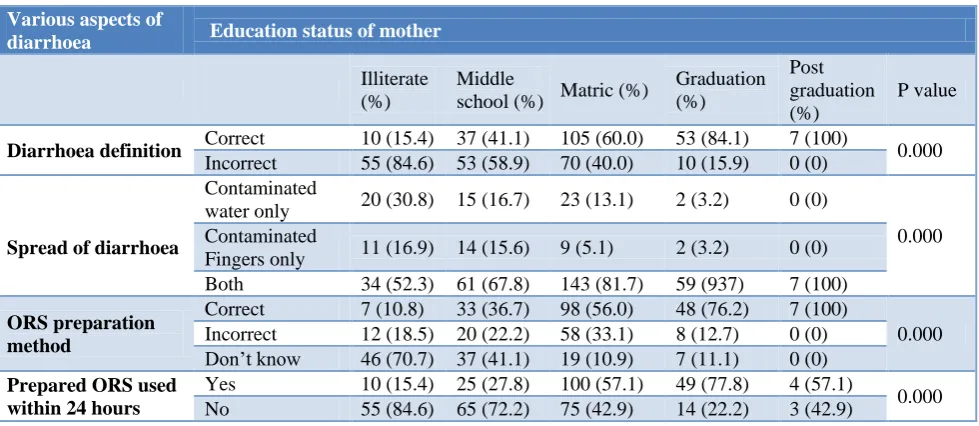
Table 3: Association of educational status of mother with knowledge about diarrhoea.
Various aspects of
diarrhoea Education status of mother
Illiterate (%)
Middle
school (%) Matric (%)
Graduation (%)
Post graduation (%)
P value
Diarrhoea definition Correct 10 (15.4) 37 (41.1) 105 (60.0) 53 (84.1) 7 (100) 0.000 Incorrect 55 (84.6) 53 (58.9) 70 (40.0) 10 (15.9) 0 (0)
Spread of diarrhoea
Contaminated
water only 20 (30.8) 15 (16.7) 23 (13.1) 2 (3.2) 0 (0)
0.000 Contaminated
Fingers only 11 (16.9) 14 (15.6) 9 (5.1) 2 (3.2) 0 (0) Both 34 (52.3) 61 (67.8) 143 (81.7) 59 (937) 7 (100)
ORS preparation method
Correct 7 (10.8) 33 (36.7) 98 (56.0) 48 (76.2) 7 (100)
0.000 Incorrect 12 (18.5) 20 (22.2) 58 (33.1) 8 (12.7) 0 (0)
Don’t know 46 (70.7) 37 (41.1) 19 (10.9) 7 (11.1) 0 (0) Prepared ORS used
within 24 hours
Yes 10 (15.4) 25 (27.8) 100 (57.1) 49 (77.8) 4 (57.1)
0.000 No 55 (84.6) 65 (72.2) 75 (42.9) 14 (22.2) 3 (42.9)
69.5% of the mothers knew that ORS should be given in dehydration. On asking about the preparation of ORS 72.8% of mothers said that they know how the ORS is prepared but out of them only 66.3% could tell the correct method of preparing ORS solution. There was a significant association between education status of mother and their knowledge about method of preparation of ORS (p=.000). 69.5% of mothers knew that ORS should be started at the time of onset of diarrhoea. The frequency of giving ORS told by mothers was as the patient desires (42.4%), every hour (24.8%), after each stool (24%), and after vomiting (8.8%). Out of total mothers, 56.2% said that ORS replenish the water loss, 26.2% said it stops diarrhoea and rest (17.6%) didn’t know about how ORS works. Correct duration in which the prepared ORS should be used was known to 47% of mothers. On asking about how long ORS should be used 49.5% of mothers said that it should be used until diarrhoea stops while 20.5%, 15.2%, 14.8% said to use for three, one and seven days respectively.
About the availability of ORS 36.2% said it is available from medical stores, 20.2% said from Government health centres while 43.6% knew about its availability from both. Source of knowledge about ORS for the mothers was mass media (45%), health workers (40.7%), books (29.7%), neighbours (28.2%) and family member (22.2%). About the breast feeding in diarrhoea 60.8% said it should be continued in diarrhoea. Preventive measures known to the mothers were boiling /treating drinking water (63.2%), maintaining personal hygiene (65.7%), eating fresh foods (72.3%).
DISCUSSION
The study was conducted in the urban field practice area of the Department of Community Medicine of SGRD Institute of Medical Sciences and Research. A total of
400 mothers of under-five children were interviewed. Majority (72.8%) were in the age group of 21-30 years. Similarly in a study done in southern Odisha 74% mothers were in age group of 21-30 years.7 59.5% of the mothers had one child and 37.2% and 3.3% had two and three children respectively. Regarding the educational status of the mothers 43.7%, 22.5%, 15.8% and 1.8% were studied up to matric, middle school, graduation and post-graduation respectively. 16.2% of the mothers were illiterate. In a study done among mothers in a tertiary care hospital it was found that 11.5% of the mothers were illiterate, 51.5% had studied up to high school level and 12.5% were graduates or post-graduates.8 In the present study 90.2% of the mothers were housewives and rest (9.8%) were employed.
69.5% of the mothers knew that ORS should be given in dehydration. On asking about the preparation of ORS 72.8% of mothers said that they know how the ORS is prepared but out of them only 66.3% could tell the correct method of preparing ORS solution. 69.5% of mothers knew that ORS should be started at the time of onset of diarrhoea. The frequency of giving ORS told by mothers was as the patient desires (42.4%), every hour (24.8%), after each stool (24%), and after vomiting (8.8%). Out of total mothers 56.2% said that ORS replenish the water loss, 26.2% said it stops diarrhoea and rest (17.6%) didn’t know about how ORS works. Correct duration in which the prepared ORS should be used was known to 47% of mothers. In a study done by Saurabh et al 78% of the mothers were aware about ORS. 76.7% knew how to prepare and administer ORS. 77.5% of the mothers who were aware of ORS knew that ORS solution should be used within 24 hours of preparation.12
Source of knowledge for the mothers was mass media (45%), health workers (40.7%), books (29.7%), neighbours (28.2%) and family member (22.2%). About the breast feeding in diarrhoea 60.8% said it should be continued in diarrhoea. Similarly in another study 58.5% mothers continued to feed their child, while 26% fed their child to some extent and remaining 15.5% stopped to feed.8
Preventive measures known to the mothers were boiling /treating drinking water (63.2%), maintaining personal hygiene (65.7%), eating fresh food (72.3%). In another study 62% mothers perceived the importance of personal hygiene and very few mothers (14.5%) knew about boiling water as a preventive method.10
CONCLUSION
The study concludes that there is lack of knowledge among mothers regarding diarrhoea and its management. There is a need of health education for mothers about diarrhoea and its management. The health care workers play an important role in creating awareness in the community about the prevention and management of diarrhoea. The workers should be trained regularly to update their knowledge about diarrhoeal diseases. IEC activities should be increased to educate the community about the principles of environmental hygiene.
ACKNOWLEDGEMENTS
We would like to thank the mothers who participated in the study and to all those who contributed to the completion of this proposal in one way or another.
Funding: No funding sources Conflict of interest: None declared
Ethical approval: The study was approved by the Institutional Ethics Committee
REFERENCES
1. Bhalwar R, Dudeja P, Jindal AK. Acute Gastoenteritis, Communicable Diseases. Textbook of Community Medicine. 2nd edition. 2018: 572. 2. The treatment of diarrhoea: A manual for physicians
and other senior health workers. WHO 2005. Available at: http://apps.who.int/iris/bitstream/ handle/10665/43209/9241593180.pdf?sequence=1 3. Diarrhoea: Why children are still dying and what
can be done. Preventing and treating childhood diarrhoea: Where we stand today. Available at:
https://7pointplan.org/preventing-treating-childhood-diarrhoea.html
4. Suryakantha AH. Epidemiology of Communicable Diseases. Community Medicine with Recent Advances. 4th edition. 2017: 402.
5. Lal S, Adarsh, Pankaj. Epidemiology of Communicable Diseases and Related National Health Programmes. Textbook of community Medicine. 4th edition. 2014: 495-496.
6. WHO/Unice Joint Statement. Clinical management of acute diarrhoea. 2004. Available at: https:// rehydrate.org/diarrhoea/pdf/acute-diarrhoea.pdf 7. Padhy S, Sethi RK, Behera N. Mother’s knowledge,
attitude and practice regarding prevention and management of diarrhoea in children in Southern Odisha. Int J Contemp Pediatr. 2017;4(3):966-71. 8. Ashraf A, Bhat MA, Mahrukh. Childhood
diarrhoea: assessment of knowledge, attitude and practices among mothers attending the tertiary care hospital – an observational analytical study. Int J Community Med Public Health. 2017;4:1219-22. 9. Merga N, Alemayehu T. Knowledge, Perception,
and Management Skills of Mothers with Under-five Children about Diarrhoeal Disease in Indigenous and Resettlement Communities in Assosa District, Western Ethiopia. J Health Popul Nutr. 2015;33(1):20-30.
10. Mumtaz Y, Zafar M, Mumtaz Z. Knowledge attitude and practices of mothers about diarrhea in children under 5 years. J Dow Uni Health Sci. 2014;8(1):3-6
11. Chaudhary P, Basu S, Dzeyie A, Gulla S, Khade S, Patel A, et al. Knowledge, Attitude and Practice of Mothers regarding Diarrhoeal Illness in Children under Five Years of Age: A Cross Sectional Study in an Urban Slum of Delhi, India. J Commun Dis. 2014;46(3):13-21.
12. Saurabh S, Shidam UG, Sinnakirouchenan M, Subair M, Hou LG, Roy G. Knowledge and Practice Regarding Oral Rehydration Therapy for Acute Diarrhoea among Mothers of Under-Five Children in an Urban Area of Puducherry, India. Natl J Community Med. 2014;5(1):100-4.