Original Research Article
Prevalence of impostor phenomenon and its association with
self-esteem among medical interns in Goa, India
Von R. Mascarenhas, Delia D’Souza*, Abhishek Bicholkar
INTRODUCTION
In recent years, a psychological entity known as Impostor Phenomenon has gained popularity in scientific literature, with an increased focus on medical professionals and other high performing individuals.1–3 The term Impostor Phenomenon (IP) was coined by psychological researchers Pauline Clance and Suzanne Imes in 1978.4
Clance defined IP as “an internal experience of intellectual phoniness that those who feel fraudulence and worthlessness have in spite of outstanding academic or professional accomplishment”.5
It is the internal experience of highly accomplished people who attribute their success to luck, feel incompetent, and consequently are constantly in fear of the possibility that others may discover their weaknesses or fraud despite their
ABSTRACT
Background: Imposter phenomenon (IP) is an internal experience of intellectual phoniness that those who feel fraudulence and worthlessness have in spite of outstanding academic or professional accomplishment. It is desirable for Medical students and interns to have high self-esteem and low impostor characteristics in order to become successful medical practitioners. This study was carried out among the medical interns of a tertiary care medical college, to determine the prevalence of Impostor Phenomenon and its association with self-esteem.
Methods: The present cross-sectional study was conducted among 150 medical interns. Clance‟s impostor phenomenon scale and Rosenberg self-esteem scale were used to assess Impostor characteristics and self-esteem respectively. Data was collected using online survey method.
Results: The majority (44.7%) of study participants had moderate IP characteristics, followed by 41.3% with high IP characteristics. Hours of sleep was found to be significantly associated with IP characteristics (p value<0.001). Self-esteem was found to be significantly and inversely correlated with age (r=-0.222), and positively correlated with hours of sleep (r=0.225). Impostor phenomenon and self-esteem were found to be moderately and inversely correlated (r=-0.519).
Conclusions: A large number of medical interns were found to have high impostor phenomenon characteristics and low self-esteem. Impostor characteristics were found to be significantly associated with sleep, suggesting a relationship between feelings of fraudulence and skewed sleep patterns. A significant negative correlation between esteem and impostor phenomenon suggests that individuals with stronger IP characteristics had lower self-esteem, and vice versa. Low impostor phenomenon characteristics and high self-esteem are favourable for efficient medical practice. Measures to increase level of confidence and self-esteem among medical students and interns should be implemented.
Keywords: Impostor phenomenon, Impostorism, Self-esteem, Medical interns Department ofPreventive and Social Medicine, Goa Medical College, Goa, India
Received: 31 October 2018
Accepted: 07 December 2018
*Correspondence:
Dr. Delia D‟Souza,
E-mail: [email protected]
Copyright: © the author(s), publisher and licensee Medip Academy. This is an open-access article distributed under the terms of the Creative Commons Attribution Non-Commercial License, which permits unrestricted non-commercial use, distribution, and reproduction in any medium, provided the original work is properly cited.
outstanding achievements.6 Traits of individuals who experience IP include: achievements in academics and at work despite a feeling of fraudulence, attribution of success to external sources such as luck, experience of transient satisfaction on meeting goals, lack of confidence in oneself, inability to acknowledge one‟s skills and abilities, fear of not meeting the expectations of others, and tendency towards perfectionism.5 IP is a personality construct, equally seen in both sexes, and has been found to affect people of different occupations such as college students, teacher/academicians, medical students, marketing managers, physicians and resident doctors.7-12 IP has several potential implications in the medical field. Those suffering from IP will be less likely to actively participate in learning activities, and may not volunteer answers during discussion, which may result in them being neglected. Furthermore, in a profession that relies heavily on decision making and experience, feelings of inadequacy and self-doubt may adversely affect their professional growth and skill development, leading to inability to manage patients and cases with reasonable logic and expertise.
Self-esteem has been defined as the measure of validity, approval, acceptance and worthiness that a person feels about himself/herself.6 It is the evaluation and experience associated with self-value, perception of self-ability and acceptance of one self which a person imbibes during the process of socialization.13 It is a trait measurable in all age groups, and is the totality of one‟s self-evaluation. High self-esteem has been found to be associated with good mental health, competence, confidence, high productivity, optimism, good problem-solving capabilities and emotional balance.14,15 Conversely, low self-esteem has been found to be associated with feelings of inferiority, sadness, depression, desperation and may even predispose to suicide.14,16 Health-care providers with high self-esteem are more likely to stimulate and induce a positive and sustainable well-being in the patient, health care team, and hospital management.17 High self-esteem can translate to better patient care services.
Accumulation of success has been stated as one of the ways to improve self-esteem.11 However, people with IP are unable to internalize and accept their achievements. Studies have shown a strong relationship between IP and low self-esteem.6,11,18 IP has also been found to be associated with psychological distress, anxiety and depression, which can be further worsened by the generally demanding nature of the medical profession, and in turn can adversely impact patient care.12,19-21 It is desirable for Medical students and interns to have high self-esteem and low impostor characteristics in order to become skilled and confident doctors, in order to positively fulfil the duties of a medical practitioner, and provide patients with optimal care. It was deemed vital to conduct this study among the medical interns at a tertiary
METHODS
The present cross-sectional study was conducted among the medical interns of Goa Medical College and government tertiary care hospital from 1st March 2018 to 1st July 2018. Each year, a batch of 150 Under-graduate students are enrolled for the M.B.B.S course. Approval to conduct the study was obtained from the Institutional Ethics Committee.
A total of 150 medical interns were included in the study using Census method. Data was collected using the online survey method. The questionnaire was shared with the study participants using email and social media platforms such as Whatsapp, Facebook and Hike Messenger. Brief information about the study and instructions on how to participate was included, and agreeing to participate in the study implied consent. The online survey questionnaire included questions on major demographic details (age, sex, socio-economic status, place of residence), important variables such as plans to pursue further studies and hours of sleep in the preceding week. Standardized self-reporting questionnaires of the Clance‟s Impostor Phenomenon Scale (CIPS) and the Rosenberg Self-Esteem Scale (RSES) were used after obtaining necessary permissions. Clance‟s Impostor Phenomenon Scale, consisting of 20 items, is a validated scale to measure impostor phenomenon. Each statement on the scale is answered on a five-point scale (Likert scoring 1-2-3-4-5) with the scoring ranging from 0-100. The higher the score, the greater the impostor characteristics.22 Self-esteem was assessed using the Rosenberg‟s Self-Esteem Scale. It is a 10-item self-reported measure of global self-esteem assessing feelings of self-worth and self-acceptance. Items are answered on a 4-point scale (Likert scoring 0-1-2-3) with the score ranging from 0 to 30. It has a strong internal reliability (α=0.79).6
Data was entered, cleaned, coded and analysed using IBM-SPSS Statistics Version 22. Descriptive statistics (mean, standard deviation, frequency and percentage) was used. Independent student „t‟ test was used to study the difference in RSES and CIPS scores among males and females, and Chi-Square test was used to determine the association between Impostor Phenomenon and study variables. Spearman‟s rank correlation was used to study the association between Impostor Phenomenon and Self-Esteem. The statistical level of significance was set at p≤ 0.05.
RESULTS
Classification. Most (86%) of the participants resided at home while the rest (14%) resided in the hostel. Majority (96%) of the participants wished to study further, while others (4%) were unsure.
Table 1: Frequency distribution of study participants as per study variables.
Variables Frequency
(n=150)
Percentage (%) Sex
Male 57 38.0
Female 93 62.0
Socio-economic status*
Upper 113 75.3
Upper Middle 28 18.7
Middle 6 4.0
Lower Middle 3 2.0
Current residence
Home 129 86.0
Hostel 21 14.0
Pursue further studies
Yes 144 96.0
Maybe 6 4.0
Hours of sleep (in the last seven days)
Less than 42 hours 59 39.3
42-56 hours 71 47.3
More than 56 hours 20 13.3
*Modified B.G. Prasad Classification.
Of the 150 medical interns, 71 (47.3%) had adequate (42-56 hours) amount of sleep in the preceding seven days, followed by 59 (39.3%) who had less than 42 hours of sleep. Around 44.7% of study participants had moderate IP characteristics, followed by 41.3% with high IP characteristics. Only 8 (5.3%) participants had intense IP characteristics, with all eight being males.
The mean Rosenberg‟s Self-Esteem Scale and Clance‟s Impostor Phenomenon Scale scores were 14.47±1.53 and 57.87±12.37 respectively. There was no significant difference in RSES value=0.962) and CIPS (p-value=0.109) scores among males and females.
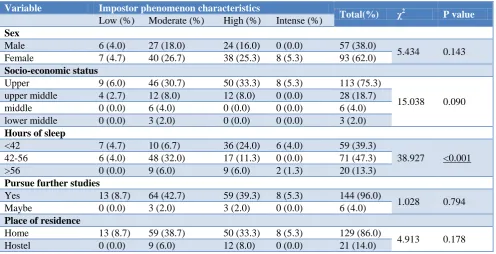
Table 2 shows the association between study variables and Impostor Phenomenon characteristics. Sleep was found to be significantly associated with IP characteristics (p-value<0.001). Sex, socio-economic status, intention to pursue further studies and place of residence were not found to be significantly associated with IP characteristics.
Table 3 represents the correlation between age, sleep, IP score and self-esteem score. Self-esteem was found to be significantly and inversely correlated with age (r=-0.222). Sleep was found to be significantly and positively correlated with self-esteem (r=0.225). Impostor phenomenon and self-esteem were found to be moderately and inversely correlated (r=-0.519), and this correlation was statistically significant suggesting that participants with higher impostor phenomenon score had lower self-esteem, and vice-versa.
Table 2: Association between study variables and impostor phenomenon characteristics.
Variable Impostor phenomenon characteristics
Total(%) χ2 P value
Low (%) Moderate (%) High (%) Intense (%)
Sex
Male 6 (4.0) 27 (18.0) 24 (16.0) 0 (0.0) 57 (38.0)
5.434 0.143 Female 7 (4.7) 40 (26.7) 38 (25.3) 8 (5.3) 93 (62.0)
Socio-economic status
Upper 9 (6.0) 46 (30.7) 50 (33.3) 8 (5.3) 113 (75.3)
15.038 0.090 upper middle 4 (2.7) 12 (8.0) 12 (8.0) 0 (0.0) 28 (18.7)
middle 0 (0.0) 6 (4.0) 0 (0.0) 0 (0.0) 6 (4.0) lower middle 0 (0.0) 3 (2.0) 0 (0.0) 0 (0.0) 3 (2.0)
Hours of sleep
<42 7 (4.7) 10 (6.7) 36 (24.0) 6 (4.0) 59 (39.3)
38.927 <0.001 42-56 6 (4.0) 48 (32.0) 17 (11.3) 0 (0.0) 71 (47.3)
>56 0 (0.0) 9 (6.0) 9 (6.0) 2 (1.3) 20 (13.3)
Pursue further studies
Yes 13 (8.7) 64 (42.7) 59 (39.3) 8 (5.3) 144 (96.0)
1.028 0.794 Maybe 0 (0.0) 3 (2.0) 3 (2.0) 0 (0.0) 6 (4.0)
Place of residence
Home 13 (8.7) 59 (38.7) 50 (33.3) 8 (5.3) 129 (86.0)
Table 3: Correlation between impostor phenomenon and self-esteem.
Variable Age Sleep Impostor phenomenon Self-esteem
Age 1 0.118 0.093 -0.222*
Sleep 0.118 1 -0.144 0.225*
Impostor Phenomenon 0.093 -0.144 1 -0.519*
Self-Esteem -0.222* 0.225* -0.519* 1
*Spearman‟s Rank Correlation is significant at 0.01.
DISCUSSION
This study sought to assess the burden of Impostor Phenomenon among medical interns, and its possible relationship with self-esteem. It is but a fact that low Impostor Phenomenon characteristics as well as high self-esteem are favourable for efficient medical practice. By extension, these remain essential and desirable traits in medical interns, in order to smoothen the transition from theoretical and practical learning under observation, to the actual practice of medical care.
It was seen that a large number of medical interns slept for less than six hours per day in the week preceding the collection of information. Duration of sleep in the present study is less than that found in another study, which concluded that medical interns had 6.93 hours of sleep per 24 hours.23 Chronic inadequate sleep is known to escalate deficits in vigilant attention, and is associated with an increased risk of errors.24Impostor characteristics were found to be significantly associated with inadequate sleep (p<0.001), thereby suggesting a relationship between feelings of fraudulence and skewed sleep patterns.
Negative correlation (r=-0.519, p=<0.001) was found between self-esteem and Impostor Phenomenon. This means that individuals with greater or stronger Impostor Phenomenon characteristics had lower self-esteem, and vice versa. The explanation for this could be that individuals with high self-esteem attribute their achievements to their internal capabilities like skills, intelligence and competency. These findings are similar to those obtained in other studies.4,6,11,25 However, they differ from those obtained in some other studies, which noted that there was no significant correlation between self-esteem and Impostor Phenomenon.26
Around 86% of study participants had moderate to high grade Impostor Phenomenon characteristics. This is much higher than a study conducted by Egwurugwu et al6 which found that 54.5% of medical students had impostor scores of 40 or less.6 A similar study conducted by Oriel et al among Family Medicine residents in Wisconsin found that one third scored as impostors, while a 1998 study by Henning et al found that among medical, dental, nursing and pharmacy students, 30% scored as
12,19
About 40% of study participants had low self-esteem (RSES score less than 15). This finding is much higher than that obtained in a study conducted among medical and dental students in Jeddah, which found that one fourth of the study participants suffered from low self-esteem.27 Low levels of self-esteem have been found to be significantly associated with depression, anxiety and psychological stress.27
CONCLUSION
It has been found that a large number of medical interns suffer from high Impostor Phenomenon characteristics and low self-esteem. They are unable to internalize their capabilities, skills and achievements, and this can translate to low levels of confidence and possibly poor decision making. Measures to increase the level of confidence and self-esteem, while reducing impostorism traits, should be implemented. This can be in the form of skill and confidence building activities, periodical assessment and counselling of interns, adoption of a high level of vigilance for any psychological signs of impostorism, depression, anxiety and stress, as well as improvement in teaching methodology to focus on boosting the confidence of medical students, which will translate to more confident interns and medical practitioners. This will result in an improvement in the quality and efficiency of medical care services, and reduce the occurrence of medical errors, ensuring that medical interns are fully capable of handling the demanding responsibilities of a medical practitioner before the completion of their training.
Limitations
Since the study was conducted only among medical interns, the findings are not representative of all medical professionals. It would be advisable to conduct a similar study with a larger sample, including resident doctors and consultants.
Funding: No funding sources Conflict of interest: None declared
Ethical approval: The study was approved by the
REFERENCES
1. Pajares F. Toward a positive psychology of academic motivation. J Educ Res. 2001;95(1):27– 35.
2. Cozzarelli C, Major B. Exploring the validity of the Impostor Phenomenon. J Soc Clin Psychol. 1990;9(4):401–17.
3. Cohen MJM, Kay A, Youakim JM, Balaicuis JM. Identity Transformation in medical students. Am J Psychoanal. 2009;69(1):43–52.
4. Clance PR, Imes S. The Imposter Phenomenon in high achieving women : dynamics and therapeutic intervention. Psychother Theory, Res Pract. 1978;15(3):211–47.
5. Clance PR. The impostor phenomenon : overcoming the fear that haunts your success. Peachtree Publishers; 1985: 209.
6. Egwurugwu JN, Ugwuezumba PC, Ohamaeme MC, Dike EI, Eberendu I, A Egwurugwu EN, et al. Relationship between Self-Esteem and Impostor Syndrome among undergraduate medical students in a Nigerian university. Int J Brain Cogn Sci. 2018;7(1):9–16.
7. Bussotti C. The impostor phenomenon : Family roles and environment. Diss Abstr Int. 1990;51(4041B).
8. Hutchins HM. Outing the Imposter: A study exploring imposter phenomenon among higher education faculty. New Horizons Adult Educ Hum Resour Dev. 2015;27(2):3–12.
9. Villwock JA, Sobin LB, Koester LA, Harris TM. Impostor syndrome and burnout among American medical students: a pilot study. Int J Med Educ. 2016;7:364–9.
10. Fried-Buchalter S. Fear of success, fear of failure, and the imposter phenomenon among male and female marketing managers. Sex Roles. 1997;37(11–12):847–59.
11. Kamarzarrin H, Khaledian M, Shooshtari M, Yousefi E, Ahrami R. A study of the relationship between self-esteem and the imposter phenomenon in the physicians of Rasht city. Eur J Exp Biol. 2013;3(2):363–6.
12. Oriel K, Plane MB, Mundt M. Family medicine residents and the Impostor Phenomenon. Fam Med. 2004;36(4):248–52.
13. Rosenberg M. Society and the adolescent self-image. Morris Rosenberg. Princeton University Press, Princeton, N.J.. Princeton University Press; 1965.
14. Maslow AH, Abraham H, Frager R. Motivation and personality. 3rd ed. New York: Harper and Row; 1987: 293.
15. Taylor SE, Brown JD. Illusion and well-being: A social psychological perspective on mental health. Psychol Bull. 1988;103(2):193–210.
16. Battle J. Relationship between self-esteem and depression among high school students. Percept Mot Skills. 1980;51(1):157–8.
17. Räty L, Gustafsson B. Emotions in relation to healthcare encounters affecting self-esteem. J Neurosci Nurs. 2006;38(1):42–50.
18. Sonnak C, Towell T. The impostor phenomenon in British university students: Relationships between self-esteem, mental health, parental rearing style and socioeconomic status. Pers Individ Dif. 2001;31(6):863–74.
19. Henning K, Ey S, Shaw D. Perfectionism, the impostor phenomenon and psychological adjustment in medical, dental, nursing and pharmacy students. Med Educ. 1998;32(5):456–64.
20. Rose P, Maureen C, O‟toole A. The Imposter Phenomenon: An internal barrier to empowerment and achievement. 1988. Available from: http://paulineroseclance.com/pdf/ip_internal_barrier _to_empwrmnt_and_achv.pdf. Accessed on 23 July 2018.
21. Bernard NS, Dollinger SJ, Ramaniah N V. Applying the big five personality factors to the Impostor Phenomenon. J Pers Assess. 2002;78(2):321–33. 22. Clance PR. Clance IP Scale. The Impostor
Phenomenon: When success makes you Feel like a fake. 1985;4:20–2.
23. Basner M, Dinges DF, Shea JA, Small DS, Zhu J, Norton L, et al. Sleep and alertness in medical interns and residents: an observational study on the role of extended shifts. Sleep. 2017;40(4):1. 24. Belenky G, Wesensten NJ, Thorne DR, Thomas
ML, Sing HC, Redmond DP, et al. Patterns of performance degradation and restoration during sleep restriction and subsequent recovery: a sleep dose-response study. J Sleep Res. 2003;12(1):1–12. 25. Kolligian Jr. J, Sternberg RJ. Perceived fraudulence
in young adults: is there an “Imposter Syndrome”? J Pers Assess. 1991;56(2):308–26.
26. Harvey JC, Katz C. If I‟m so successful, why do I feel like a fake? The impostor phenomenon. St. Martin‟s Press; 1985: 246.
27. Aboalshamat K, Jawhari A, Alotibi S, Alzahrani K, Al-Mohimeed H, Alzahrani M, et al. Relationship of self-esteem with depression, anxiety, and stress among dental and medical students in Jeddah, Saudi Arabia. J Int Med Dent. 2017;4(2):61–8.