Original Research Article
Post-menopausal osteoporosis: prevalence of risk factors
and probable symptoms
Manohar Bhatia
1*, Ashok Mishra
2, Pradeep Sukla
1INTRODUCTION
Osteoporosis has been defined as systemic skeletal disease characterized by low mass and micro-architectural deterioration of the bone tissue, with a consequent increase in bone tissue fragility and susceptibility to fracture. It has also been defined as bone mineral density below the age adjusted reference range or more than one standard deviation below the mean for a
particular age.1 According to WHO data, 30% of postmenopausal women are osteoporotic.1
With its sequelae of trauma and fracture osteoporosis jeopardizes the quality of life of many post-menopausal women.1 After menopause, a woman loses on an average 3% bone mineral density every year causing osteopenia and eventually osteoporosis and fracture of the vertebra, femur and of the wrist.2
ABSTRACT
Background: Osteoporosis jeopardizes the quality of life of many post-menopausal women due to its sequelae of fractures on trivial trauma. With a rapid increase in average life expectancy India is becoming home to a huge population at risk of osteoporosis. The aims and objectives of the study were to assess the prevalence of fractures due to trivial trauma and probable symptoms of osteoporosis and prevalence of modifiable and non-modifiable risk factors of osteoporosis in postmenopausal women
Methods: A cross-sectional study, conducted by a door to door survey in 400 post-menopausal women (below 65 yrs) in urban Gwalior city from September to December 2012. The risk factors of osteoporosis in post-menopausal women have been classified into modifiable and non-modifiable risk factors. Modifiable risk factors include exercise/physical activity and consuming milk and milk products while age of menarche, age of menopause, reproductive period and parity were categorized as non-modifiable risk factors.
Results: In our study, the overall prevalence of osteoporotic symptoms was 62.75% (251/400). Out of 400 postmenopausal women, 45.25% had backache, 55.75% had joint pain and 24.00% had fractures. Prevalence of osteoporotic fractures was much higher (39.16%) in females not consuming milk and milk products & in females who never exercised (35.22%). 60% of females who underwent hysterectomy had osteoporotic fractures.
Conclusions: The overall prevalence of osteoporotic fractures among post-menopausal females was higher in our study when compared to other studies in the same setting. Thus, a multipronged approach involving educational intervention, lifestyle modification and appropriate hormonal treatment is required. Lifestyle modification involves nutritional interventions and motivation for regular physical activity.
Keywords: Osteoporosis, Fractures, Post-menopausal women, Backache, Joint pain
Department of Community Medicine, 1Government Medical College, Datia, 2G.R. Medical College, Gwalior, Madhya Pradesh, India
Received: 12 September 2018
Revised: 14 October 2018
Accepted: 15 October 2018
*Correspondence:
Dr. Manohar Bhatia,
E-mail: [email protected]
Copyright: © the author(s), publisher and licensee Medip Academy. This is an open-access article distributed under the terms of the Creative Commons Attribution Non-Commercial License, which permits unrestricted non-commercial use, distribution, and reproduction in any medium, provided the original work is properly cited.
One out of eight males and One out of three females in India suffer from osteoporosis, making India one of the largest affected countries in the world.3 Expert groups in India peg the number of osteoporosis patients at approximately 26 million (2003 figures) with the numbers projected to increase to 36 million by 2013.4 In India the incidence of hip fracture among males and females is 1:1. In most Western countries, while the peak incidence of osteoporosis occurs at about 70-80 years of age, in India it may afflict those 10-20 years younger, at age 50-60.5
Worldwide, lifetime risk for osteoporotic fractures in women is 30-50% and in men the risk is 15-30%.6 Approximately 1.6 million hip fractures occur each year worldwide and the incidence is set to increase to 6.3 million by 2050.7
The chief symptoms of osteoporosis include backache, joint pain- particularly knee joint and fractures. Three main types of osteoporotic fractures are wrist, vertebral and hip fracture.8 The age at onset of menopause in northern India is 48 years which is about 3 years earlier than the west.9
Women are at a greater risk of developing osteoporosis particularly after menopause because of rapid decline in estrogen levels. Apart from menopause, other important risk factors of osteoporosis in females include late menarche, early menopause, parity etc. Risk factors in both the sexes include low calcium intake, low vitamin D levels, low levels of physical activity, smoking, excessive alcoholism, excessive body weight, excessive use of corticosteroids etc.10,11
The steady increase in average life expectancy among general population including women also implies that there is going to be a rapid increase of population at risk of osteoporosis which will require equivalent health services. Thus the present work has been undertaken to assess the prevalence of probable osteoporotic symptoms and prevalence of modifiable and non-modifiable risk factors as no significant work has been done on post-menopausal osteoporosis in Gwalior district.
METHODS
It was a cross-sectional study conducted by a door to door survey in 400 women in postmenopausal age group (below 65 yrs) in Gwalior city from 1st September to 30th December 2012. The study tool was a semi-structured questionnaire. The questionnaire included details of menstrual history, daily dietary intake, physical activity (exercise, morning walk) difficulty in climbing stairs, bending, squatting etc. A pilot study was carried out on 50 women to check the feasibility of questionnaire. Apart from the obstetric and gynecologic history, the questionnaire also included details of family history of Osteoporosis, history of chronic disease and long term drug intake such as OCPs, steroids etc.
To validate the questionnaire the study team reviewed the questions themselves. Along with this the face value, authenticity and trustworthiness of participants was determined through detailed notes. Details about family history, food consumption and physical activity throughout the day were gathered from the unstructured part of the semi-structured questionnaire.
The operational definition of menopause status is as follows: pre-menopause defined as having regular menstrual periods in the previous 12 months; peri-menopause as having no period in the previous 3 months, but at least one menstruation in the previous 12 months; and post menopause as having no period in the previous 12 months.12
Previous studies have suggested that prevalence of osteoporosis increases with advancing age. So to reduce the bias due to age factor a cut off age limit of 65 yrs was set.
Inclusion criteria
Postmenopausal women in the age group upto 65 yrs who have attained menopause more than one year before.
Exclusion criteria
This includedpostmenopausal women above 65 yrs,
peri-menopausal women, Women who had attained
menopause less than one year before and postmenopausal women having history of chronic disease and long term drug intake (OCPs and steroids). Pathological fractures and fractures due to major trauma were excluded from the study.
Long term intake of drugs like steroids and OCPs intake constitutes an important risk factor for osteoporosis. Hence such subjects were excluded from study to reduce bias due to drug intake.
Methodology
Primary osteoporosis represents bone mass loss that is unassociated with any other illness and is related to aging and loss of the gonadal function in women and the aging process in men. Since bone mass density measurement was not feasible in our study, the operational case definition of osteoporosis for our study was based on symptoms.13
Symptoms of osteoporosis include backache, joint pain (knee, wrist and elbow joint) and fracture on trivial trauma. For the purpose of study, presence of any of these symptoms was taken as presence of probable osteoporosis in the study subject.
products. In our study, all the subjects were sedentary workers. Calcium requirement of sedentary females is 600mg per day. 100 gms of buffalo milk provides 210 mg of calcium.14 Considering other sources of calcium in diet like pulses, dates, nuts, millets etc, 200 gms of milk five days a week was considered as regular milk consumption; less than this was considered as irregular milk consumption and the third category was no milk consumption.
Individuals over the age of 20 yrs should undertake a minimum of 30 minutes of physical activity of moderate intensity (such as walking 5-6 km/hr) on most, if not all the days of the week.14For the study purpose, women undertaking a minimum of 30 minutes of physical activity like walking, mopping floor, washing clothes etc for at least five days a week were classified as exercising regularly; less than this was irregularly exercising and the third category was no exercise.14
Age of menarche, age of menopause, reproductive period and parity were categorized as non-modifiable risk factors. Medical and surgical factors include diabetes, hypertension and hysterectomy.
Sample size
Various studies reflect that the prevalence of osteoporosis among post-menopausal women varies from 42 to 53 percent.15,16 For the purpose of this study, a median prevalence rate of 50% was taken and sample size of 400 was calculated keeping desired permissible error at 10%.
Selection of subjects
The study was conducted in urban part of Gwalior district. Gwalior city is divided into 60 wards which were numbered from 01 to 60. Simple random sampling was applied and 10 wards were selected randomly using random number table and in each selected wards, 40 eligible participants were identified using house to house visit. In each ward one colony/mohalla was selected where a fixed structure with public utility like temple, school, hand pump etc. was located. From the fixed point the participants were selected from right hand direction until the required sample size per ward was interviewed.
Informed consent was obtained from study participants and they were assured about the confidentiality of the interview. Before start of study, necessary ethical clearance was obtained from Ethics Committee, GR Medical College, Gwalior. All the data gathered was transferred to suitable statistical software and analysis was carried out by percentage, proportion and chi-square and P value was calculated utilizing EpiCalc 2000.
RESULTS
The present study was conducted in 400 postmenopausal women of whom 45.25% (181) had backache, 55.75% (223) had joint pain and 24.00% (96) had fractures. In
current study, the overall prevalence of osteoporotic symptoms among postmenopausal women was 62.75% (251/400) which was higher than some previous studies.15,16
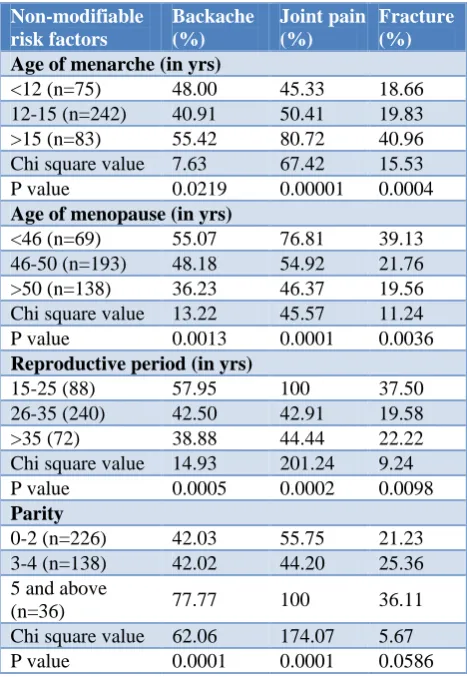
Table 1: Relation between non-modifiable risk factors and symptoms of osteoporosis.
Non-modifiable risk factors
Backache (%)
Joint pain (%)
Fracture (%)
Age of menarche (in yrs)
<12 (n=75) 48.00 45.33 18.66
12-15 (n=242) 40.91 50.41 19.83
>15 (n=83) 55.42 80.72 40.96
Chi square value 7.63 67.42 15.53
P value 0.0219 0.00001 0.0004
Age of menopause (in yrs)
<46 (n=69) 55.07 76.81 39.13
46-50 (n=193) 48.18 54.92 21.76
>50 (n=138) 36.23 46.37 19.56
Chi square value 13.22 45.57 11.24
P value 0.0013 0.0001 0.0036
Reproductive period (in yrs)
15-25 (88) 57.95 100 37.50
26-35 (240) 42.50 42.91 19.58
>35 (72) 38.88 44.44 22.22
Chi square value 14.93 201.24 9.24
P value 0.0005 0.0002 0.0098
Parity
0-2 (n=226) 42.03 55.75 21.23
3-4 (n=138) 42.02 44.20 25.36
5 and above
(n=36) 77.77 100 36.11
Chi square value 62.06 174.07 5.67
P value 0.0001 0.0001 0.0586
The mean age at menarche was calculated and the subjects were categorized in three groups viz. those attained early menarche (below12 years of age), ideal menarche (between 12 to15 years) and late menarche (above 15 years of age). Similarly, the mean menopausal age was calculated and was categorized into early menopause (below 46 years of age), ideal menopause (between 46-50 years) and late menopause (above 50 years of age). In present study, the mean age of menarche was 13.4±1.98 years, of menopause was 48.9±3.08 years and mean reproductive period was 33.8±4.33 years. Study revealed that with increase in age of menarche, prevalence of symptoms of osteoporosis increased; 18.66% and 40.96% females had osteoporotic fractures with age of menarche below 12 yrs and above 15 yrs age respectively (p=0.0004); the rates of backache and joint pain also increased with higher age of menarche (p<0.05) (Table 1).
21.76% in 46-50 yr age group and 19.56% in above 50 yrs respectively and the rates of backache and joint pain decreased with higher age of menopause (p<0.05) (Table 1).
Present study also revealed that a longer reproductive period was associated with lesser prevalence of osteoporotic symptoms; 37.50% and 22.22% females had osteoporotic fractures with reproductive age of 15-25 yrs and >35 yrs respectively while it was 19.58% in 26-35 yrs age group (p=0.001). Similarly backache and joint pain was less prevalent with a longer reproductive period (p<0.05). Results also revealed that higher parity was associated with higher prevalence of osteoporotic symptoms (p=0.001); 33.33% and 43.04% females had osteoporotic fractures with parity 0-2 and 5 & above respectively (Table 1).
Of total 400 subjects, 64.25% (257) were consuming milk & milk products daily; prevalence of fracture on trivial trauma was 15.56% among females consuming milk & milk products regularly while it was much higher (39.16%) in females not consuming milk and milk products (p=0.001) (Table 2).
Table 2: Relation between modifiable risk factors and symptoms of osteoporosis.
Modifiable risk factors
Backache (%)
Joint pain (%)
Fracture (%)
Use of milk products
Regular consumption
of milk (n=257) 40.85 49.41 15.56
Irregular consumption
of milk (n=47) 53.19 57.45 27.66
Do not use milk and
milk products (n=96) 53.13 71.87 44.79 Uncorrected Chi
Square value 5.61 14.35 33.13
P value 0.0604 0.0007 0.0000
Level of exercise/physical activity
Regular exercise
(n=116) 36.20 43.10 17.24
Irregular exercise
(n=125) 33.60 56.80 16.00
Never exercise
(n=159) 61.00 64.15 35.22
Uncorrected Chi
square value 33.68 20.54 12.61
P value 0.0001 0.0001 0.0018
Of total 400 subjects, 29.00% (116) were active (doing regular exercise and/or morning/evening walk, household tasks); 17.24% females who exercise regularly had osteoporotic fractures while it was much higher (35.22%) in females who never exercise (p=0.0002). Similarly the prevalence of backache and joint pain was much higher in females who never exercised (p<0.05) (Table 2).
Table 3: Relation between medical and surgical conditions and symptoms of osteoporosis.
Medical and surgical conditions
Backache (%)
Joint pain (%)
Fracture (%)
Diabetes mellitus
Yes (106) 74.52 69.81 63.54
No (294) 34.69 50.68 11.90
Uncorrected Chi
square value 57.92 17.04 54.49
P value 0.0001 0.0001 0.0001
Hypertension
Yes (89) 60.67 65.17 44.94
No (311) 40.83 53.05 18.00
Uncorrected Chi
square value 14.25 6.78 16.15
P value 0.0001 0.0092 0.0001
Hysterectomy
Yes (80) 61.25 75.00 60.00
No (320) 41.25 50.93 15.00
Uncorrected Chi
square value 14.49 27.70 41.47
P value 0.0001 0.0001 0.0001
Diabetes mellitus was seen in 26.50% (106) subjects of which 61.50% had osteoporotic fractures while the same in non-diabetics was 11.90% only (p=0.0001). Similarly Hypertension was seen in 22.25% (89) subjects of which 44.94% had osteoporotic fractures and the same in normotensives was 18.00% (p=0.0001). Twenty percent (80) females had undergone hysterectomy of which 60% had osteoporotic fractures while the same figure in no hysterectomy cases was 14.7% (p=0.001). Similarly the prevalence of backache and joint pain was much higher in diabetics, hypertensives and women who had undergone hysterectomy (p<0.05) (Table 3).
DISCUSSION
Hip fractures, the most serious outcome of osteoporosis, are becoming more frequent than before because the world's population is aging and because the frequency of hip fractures is increasing by 1-3% per year in most areas of the world.17 In present study also prevalence of fracture among post-menopausal women was 24% with a predominance of hip and wrist fractures.
A 2001 study on expatriate Indians in Singapore showed that the incidence of hip fracture was higher in women than in men. 15 A recent study on risk factors for low bone mass in Indians suggested lower education (defined less than class 12), duration of menopause greater than 5 years, menarche age (after 14 years), menopause age (before 45 years), parity more than 3 to be the important ones.15 Similar findings were seen in present study also.
vitamin D deficiency in different subgroups of Indian population. This includes both urban and semi-urban Indians, postmenopausal women, pregnant women, school children and newborns.18,19 Arya et al used a serum 25(OH) vitamin D level of 15 ng/ml as a cut-off, and found 66.3 per cent of subjects to be vitamin D deficient.20 In our study, the fracture rates were much lower in females consuming milk and milk products regularly. However, a major limitation of our study was that serum 25 (OH) vitamin D levels were not measured and intake of other calcium rich foods and information about sun exposure was not elicited.
A case control interview based study on postmenopausal women showed history of fracture in relatives, weight <60 kg, height <155 cm as significant risk factors for osteoporosis and regular consumption of milk, almonds, fruits as protective factors.11 A similar interview based study on patients admitted with hip fracture revealed calcium intake, increased body mass index (BMI) and higher activity levels to have a significant protective effect on hip fracture in urban north Indian population. On the other hand decreased activity increase the risk of hip fracture.21 The results of present study also suggested similar findings. However in present study no significant association of osteoporotic symptoms with family history was observed.
CONCLUSION
In our study, the overall prevalence of osteoporotic fractures among post-menopausal females was 24%.The findings of current study and previous studies clearly indicate the urgent need of collective efforts towards the growing problem of osteoporosis in postmenopausal women. A multipronged approach involving educational intervention, lifestyle modification and appropriate hormonal treatment is required to deal with this disease. Lifestyle modification involves nutritional interventions and regular physical activity like morning/evening walk, performing household tasks etc. A regular intake of foods rich in calcium like milk and its products, calcium tablets, vitamin D supplementation, soya products, almonds etc. is essential to maintain bone mass turnover.
Limitations
Bone mass density measurements have not been utilized
Funding: No funding sources Conflict of interest: None declared
Ethical approval: The study was approved by the Institutional Ethics Committee
REFERENCES
1. Harrison’s Principles of internal medicine. 16th Edition. McGraw Hill publishers; 2004: 2268-2278.
2. Howkins & Bourne Shaw’s Textbook of
Gynecology. 13th edition. Elsevier publishers; 2006: 61-62.
3. In India, 1 out of 8 men and 1 out of 3 women suffer from osteoporosis: Study. Oct 21 2012; The Indian Express. 2015. Available at: http://archive.indian- express.com/news/in-india-1-out-of-8-men-and-1- out-of-3-women-suffer-from-osteoporosis-study/1019974/. Accessed on 28 November 2015.
4. Osteoporosis Society of India. Action Plan
Osteoporosis: Consensus statement of an expert group. New Delhi, 2003.
5. Damodaran P, Subramaniam R, Omar SZ, Nadkarni
P, Paramsothy M. Profile of a menopause clinic in an urban population in Malaysia. Singapore Med J. 2000;41(9):431-5.
6. Randell A, Sambrook PN, Nguyen TV, Lapsley H, Jones G, Kelly PJ, et al. Direct clinical and welfare costs of osteoporotic fractures in elderly men and women. Osteoporos Int. 1995;5(6):427-32.
7. Cooper C, Campion G, Melton LJ. Hip fractures in
the elderly: a world-wide projection. Osteoporos Int. 1992;2(6):285-9.
8. National Instititutes of Health Osteoporosis and Related Bone Disease-National Resource Center. Available at: http://www.osteo.org. Accessed on 28 November 2015.
9. Kriplani A, Banerjee K. An overview of age of onset of menopause in northern India. Maturitas. 2005;52(3-4):199-204.
10. Risk Factors. Osteoporosis Australia. Copyright
2015. Available at: http://www.osteoporosis.
org.au/risk-factors. Accessed on 28 November 2015. 11. Keramat A, Mithal A. Risk factors for osteoporosis in urban Asian Indian women presenting for a preventive health check up. 2nd Joint Meeting of the European Calcified Tissue Society and the International Bone and Mineral Society, Geneva, 2005.
12. Jinping Xu J, Bartoces M, Neale A, Dailey R, Northrup J, Schwartz K. Natural History of Menopause Symptoms in Primary Care Patients: A MetroNet Study. J Am Board Fam Med. 2005;18(5):374-82.
13. Skugor M. Osteoporosis Cleveland Clinic
Foundation, Centre for Continuing Education. 2010. 14. Park K. Park’s Textbook of Preventive and Social Medicine. 21st Edition. Bhanot Publishers; 2012: 440-450.
15. The Asia-Pacific Regional Audit, Epidemiology, costs & burden of osteoporosis in 2013. International Osteoporosis Foundation. Available at: http://www.iofbonehealth.org/sites/default/files/med ia/PDFs/Regional%20Audits/2013-Asia_Pacific_ Audit-India.pdf pg 1-3. Accessed on 28 November 2015.
16. Aggarwal N, Raveendran A, Khandelwal N, Sen R,
Thakur J, Dhaliwal L, et al. Prevalence and related
postmenopausal Indian women. J Midlife Health. 2011;2(2):81–5.
17. Cummings SR, Melton LJ. Epidemiology and
outcomes of osteoporotic fractures. Lancet.
2002;359(9319):1761-7.
18. Harinarayan CV. Prevalence of vitamin D
insufficiency in postmenopausal south Indian women. Osteoporosis Int. 2005;16(4):397-402.
19. Harinarayan CV, Ramalakshmi T, Prasad UV,
Sudhakar D, Srinivasarao P, Sarma KVS, et al. High prevalence of low dietary calcium, high phytate consumption, and vitamin D deficiency in healthy south Indians. Am J Clin Nutr. 2007;85(4):1062-7.
20. Arya V, Bhambri R, Godbole MM, Mithal A.
Vitamin D status and its relationship with bone
mineral density in healthy Asian Indians.
Osteoporosis Int. 2004;15(1):56-61.
21. Jha R, Mithal A, Malhotra N, Brown EM. Pilot case control investigation of risk factors for hip fractures in the urban Indian population. BMC Musculo-skeletal Disorders. 2010;11:49.