http://www.ijcmph.com pISSN 2394-6032 | eISSN 2394-6040
Original Research Article
Study of morbidity profile of elderly attending urban health training
centre of Nalanda Medical College, Patna, Bihar, India
Rashmi Singh
1*, Sujit Kumar
2, A. P. K. Sinha
3INTRODUCTION
Ageing is the organic process of growing older and showing the effects of increasing age. The phenomenon of ageing in humans refers to multidimensional process of physical, psychological and social change in a person over time. In the words of Seneca, “Old is an incurable
disease”, but more recently, Sir. James Sterling Ross Commented: “You do not heal old age. You protect it; you promote it; you extend it”.1
There is no United Nation standard age classification regarding elderly person but United Nation agreed that the cut off age is 60 years and above for referring to elderly population.7-9 Worldwide 10% of the population
is elderly and it is expected to increase to 21% in the year 2051. It is likely to increase from current 600 million to 1.97 billion in 2051.1-4 According to Population Census 2011 data, 8.6% of total population is elderly, elderly female 9.0% and elderly male 8.2%. It has been expected that the elderly population will rise to 9% by the year 2016. The old-age dependency ratio climbed from 10.9% in 1961 to 13.1% in 2001.3,5,6
According to Census 2011, in Bihar, the percentage of population in the age group of 60 years and above to total population by sex and residence is 7.4%, in which male exceeds female. The rise in number of elderly population in India is bound to make a significant impact on the economy in both ways. Comparison of 2001 and 2011
ABSTRACT
Background: Ageing is the organic process of growing older and showing the effects of increasing. There is a tremendous increase in the number and proportions of the senescent population in our surrounding which created a situation of concern towards the problems of the aged population. The objective of the study was to assess the common diseases occurring among elderly population and the co-morbid conditions.
Methods: A hospital based cross-sectional study was carried out among 383 elderly patients attending Urban Health Training Centre of Nalanda Medical College, Patna, Bihar. Their socio-demographic profile and morbidity pattern were assessed by face to face interview. Data were entered into Microsoft excel 2010 spread sheet and analysed by SPSS software version 16.
Results: High percentage of elderly suffered from anemia which was 65.79% followed by urological problem which was present in 41.25% and 41.25% of elderly were underweight. Prevalence of hypertension and diabetes were 21.14% and 14.36% respectively.
Conclusions: The study shows that there is high prevalence of morbidity among elderly. There is an urgent need to develop affordable and accessible geriatric health care services.
Keywords: Geriatric, Morbidity, Urban
1
Department ofCommunity Medicine, Patna Medical College, Patna, Bihar, India
2
Department of Physiology, 3Department of Community Medicine, Nalanda Medical College, Patna, Bihar, India
Received: 05 September 2018
Accepted: 21 September 2018
*Correspondence:
Dr. Rashmi Singh,
E-mail: [email protected]
Copyright: © the author(s), publisher and licensee Medip Academy. This is an open-access article distributed under the terms of the Creative Commons Attribution Non-Commercial License, which permits unrestricted non-commercial use, distribution, and reproduction in any medium, provided the original work is properly cited.
Population Census data reveal that the average increase of elderly population among states is 1%. The number of young elderly who are still capable of participating in the economy of the country is rising so the need for healthcare infrastructure for these elderly is rising & at the same time number of old, disabled and destitute elderly is also rising. Therefore, planning has to be made keeping in mind the needs of all this group. So, the present study was conducted with the objective to assess the common diseases occurring among elderly and the co-morbid conditions among them.
METHODS Study design
A hospital based cross-sectional study was done to collect information based on the above objectives.
The duration of the study was from January 2015 to June 2016.
Place of study
The present study was conducted in the Urban Training Health Centre attached to the Department of Community Medicine, Nalanda Medical College, situated at Rajendranagar, Patna, Bihar, India
Study population and sample
The geriatric patients aged 60 years & above attending the Urban Health Training Center during the period of the study. A total of 383 elderly were selected for the study.
Eligibility of study population
Inclusion criteria
Inclusion criteria were geriatric populations aged 60 years and above of both sexes was included in this study; age was completed in completed years.
Exclusion criteria
Exclusion criteria were geriatric population who are seriously ill; those who were not willing to participate in the interview
Data collection
The data collection tool used for the study was an interview schedule that was developed at the Institute with the assistance from the faculty members and other experts. Informed verbal consent was taken from each patient before interview. A pre-designed pre-tested semi structured questionnaire was used which contained questions relating to the information on identification & socio-economicprofile of the study population, physical morbidity pattern. Interview time took approximately 20
to 25 minutes. Accordingly 3 to 4 patients were interviewed per day by systematic consecutive sampling. Every 2nd patient was interviewed. If the patient was not willing or interviewed earlier then the next patient fulfilling the inclusion criteria was selected. So during the study tenure, 383 patients were interviewed.
Analysis
The data collected were thoroughly cleaned and entered into in Microsoft Excel 2010 spread sheet & analysed by appropriate statistical methods using SPSS software version 16.
RESULTS
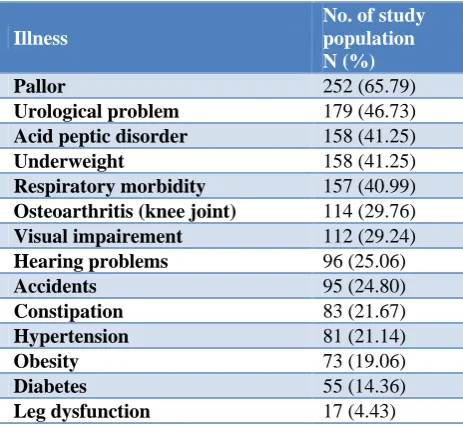
A total of 383 elderly above the age of 60 years were included in the study. The Table 1 shows the overall morbidity of the study population. High percentage suffered from anemia which was 65.79% followed by urological problem which was present in 46.73%. Acid peptic disorder was present in 41.25% and 41.25% of elderly were underweight. The total respiratory morbidity (ARI, asthma, and COPD) was also significant which 40.99%. 29.76% of study population had osteoarthritis. Visual impairment was seen in 29.24% followed by hearing problem which was seen in 25.06%. Accidents were present in 24.80%. Constipation was seen in 21.67%. Obesity was seen in 19.06%. Diabetes as was seen in 14.36% of the study population. The complaint of leg dysfunction was seen in 4.43%.
Table 1: Morbidity profile of study population (N=383).
Illness
No. of study population N (%)
Pallor 252 (65.79)
Urological problem 179 (46.73)
Acid peptic disorder 158 (41.25)
Underweight 158 (41.25)
Respiratory morbidity 157 (40.99)
Osteoarthritis (knee joint) 114 (29.76)
Visual impairement 112 (29.24)
Hearing problems 96 (25.06)
Accidents 95 (24.80)
Constipation 83 (21.67)
Hypertension 81 (21.14)
Obesity 73 (19.06)
Diabetes 55 (14.36)
Leg dysfunction 17 (4.43)
population and 11.22% suffered from both frequency and incontinence. Frequency symptom was highest in 80 years and above 36%.
The Table 4 shows a high percentage of the study population were in the stage-II hypertension group, this was 13.05%. Stage-I hypertension group and pre-hypertension constitute 8.09% & 4.17% respectively. All stages of hypertension were highest in the 80 years &
above age group. The Table 5 for respiratory morbidity shows 28.98% suffered from chronic obstructive pulmonary diseases (COPD). It was seen 8.87% of the study population had asthma. COPD and asthma both were highest in 80 years & above age group.
The Table 6 shows that osteoarthritis (knee joint) was present in 29.76% of participants. In the age group 70-79 years it was present in 48.07% participants.
Table 2: Presence of pallor in the study population (N=383).
Pallor No. of male N (%)
No. of female N (%)
Total
N (%) X
2
P value
Yes 99 (56.89) 153 (73.20) 252 (65.79)
11.2 <0.05
No 75 (43.10) 56 (26.79) 131 (34.20)
Total 174 (100) 209 (100) 383 (100)
Table 3: Urological symptoms of the study population (N=383).
Urinary problem 60-69 years N (%)
70-79 years N (%)
80 years and above N (%)
Total
N (%) X
2
P value
None 142 (55.25) 51 (49.03) 11 (50) 204 (53.26)
22.37 <0.05
Frequency 68 (26.45) 12 (11.53) 8 (36.36) 88 (22.97)
Incontinence 22 (8.56) 24 (23.07) 2 (9.09) 48 (12.53)
Frequency +
incontinence 25 (9.72) 17 (16.34) 1 (4.54) 43 (11.22) Total 257 (100) 104 (100) 22 (100) 383 (100)
Table 4: Blood pressure distribution among the study population (N=383).
Blood pressure 60 -69 years N (%)
70-79 years N (%)
80 years and above N (%)
Total
N (%) X
2
P value
Normal 196 (76.26) 82 (78.63) 8 (36.36) 286 (74.67)
21.51 <0.05
Pre-hypertension 11 (4.28) 2 (1.92) 3 (13.63) 16 (4.17)
Stage-I hypertension 19 (7.39) 5 (4.80) 7 (31.81) 31 (8.09)
Stage-II
Hyertension 31 (12.06) 15 (14.42) 4 (18.18) 50 (13.05) Total 257 (100) 104 (100) 22 (100) 383 (100)
Table 5: Respiratory morbidity of the study population (N=383).
Respiratory morbidity 60-69 years N (%)
70-79 years N (%)
80 years and above N (%)
Total N (%)
None 178 (69.26) 46 (44.23) 2 (9.09) 226 (59.00)
COPD 61 (23.73) 35 (33.65) 15 (68.18) 111 (28.98)
Asthma 13 (5.05) 16 (15.38) 5 (22.72) 34 (8.87)
Ari 5 (1.94) 7 (6.73) 0 (0) 12 (3.13)
Total 257 (100) 104 (100) 22 (100) 383 (100)
Table 6: Osteoarthritis (knee joint) in the study population (N=383).
Osteoarthritis 60-69 years N (%)
70-79 years N (%)
80 years and above N (%)
Total
N (%) X
2
P value
Present 54 (21.01) 50 (48.07) 10 (45.45) 114 (29.76) 28.6
9 <0.05
Absent 203 (78.98) 54 (51.92) 12 (54.54) 269 (70.23)
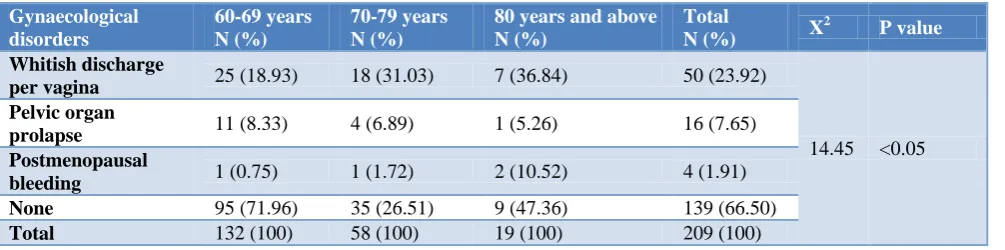
Table 7 shows that among gynaecological disorder 23.92% of female were suffering from whitish discharge per vagina and postmenopausal bleeding was present in 1.91%.
The Table 8 shows the co- morbid conditions among the study population. One illness was present in 11.74% of the study populations. Majority of the elderly were suffering from 6 or more than six illness which was about 35.24%.
Table 7: Gynaecological disorders among women of the study population (N=209).
Gynaecological disorders
60-69 years N (%)
70-79 years N (%)
80 years and above N (%)
Total
N (%) X
2
P value
Whitish discharge
per vagina 25 (18.93) 18 (31.03) 7 (36.84) 50 (23.92)
14.45 <0.05
Pelvic organ
prolapse 11 (8.33) 4 (6.89) 1 (5.26) 16 (7.65) Postmenopausal
bleeding 1 (0.75) 1 (1.72) 2 (10.52) 4 (1.91) None 95 (71.96) 35 (26.51) 9 (47.36) 139 (66.50)
Total 132 (100) 58 (100) 19 (100) 209 (100)
Table 8: Burden of comorbid conditions of the study population.
No of illness N Percentage (%)
One illness 45 11.74
Two illnesses 51 13.31
Three illnesses 49 12.79
Four illness 54 14.09
Five illness 49 12.79
Six or more illness 135 35.24
Total 383 100
DISCUSSION
This study shows that majority of the study population suffered from anemia followed by urological problem which constituted 65.79% and 46.73% of total study population respectively. Among male participant 56.89% had pallor and in case of female it was 73.20%.In this study it was found that there is statistically significant difference between male and female in terms of anemia (p<0.05) among elderly. Paul et al. found that the overall prevalence of anaemia among the study population was 38.2%. The percentage of women and men who were anaemic were 38.7% and 37.7% respectively.10
Among urological problems frequency of micturition was present in 22.97% and 11.22% were suffering from both frequency and incontinence. It was found that there is statistically significant difference between different age groups in elderly in terms of urological symptoms (p<0.05). In a study conducted by Swami et al among elderly in Chandigarh it was seen that 6.1% of rural population suffered from frequency or urgency.11
Hypertension was present in 21.14%. All stages of hypertension were highest in the 80 years & above age group. In this study it was found that there is statistically significant difference between different age groups in elderly in terms of blood pressure (p<0.05). In the study
conducted by Kalavathy et al among elderly in Kerala showed a prevalence of hypertension at 51.8% and a study conducted by Gupta et al among elderly in Delhi it was seen the prevalence of hypertension was 32.5%.12,13
About 40.99% of study population were suffering from different respiratory diseases. Among them most of them was suffering from chronic obstructive pulmonary diseases. Study conducted by Sharma et al showed that 34.2% of the study population were suffering from respiratory morbidity and Shashi et al, it was seen that the respiratory morbidity was 33.5%.14,15 Osteoarthritis (knee joint) was present in 29.76% of participants. In the age group 70-79 years it was present in 48.07% participants. It shows that there is statistically significant difference between different age groups among elderly in terms of osteoarthritis (p<0.05). Madhavi, Phani et al found that 97% of the study group were suffering from osteoarthritis.16
It was observed that 23.92% female suffered from whitish discharge per vagina, 7.65% suffered from pelvic organ prolapse and 1.91% suffered from postmenopausal bleeding. In this study, it was found that there is significant difference of gynaecological disorder in different age groups in elderly (p<0.05) Mohapatra et al conducted a hospital based study found that discharge per
gynaecological morbidities followed by prolapsed uterus 9.1%.17 Majority of the study population suffered from 6 or more than six illness which was 35.24%
ACKNOWLEDGEMENTS
The authors extend their vote of thanks to all participants for their consistent support and cooperation during the study.
Funding: No funding sources Conflict of interest: None declared
Ethical approval: The study was approved by the Institutional Ethics Committee
REFERENCES
1. Garber Park K. Preventive Medicine in Obstetrics, Paediatrics and Geriatrics. In: Park K, editor. Park's Textbook of Preventive and Social Medicine. 23rd edn. Jabalpur: M/s Banarsidas Bhanot; 2011. 2. World Health Organization. Active Aging- A policy
framework. April 2002, WHO, Geneva, Available at: http://whqlibdoc.who.int/hq/2002/WHO_NMH_ NPH_02.8.pdf. Accessed on 3 June 2018.
3. Chanana HB, Talwar PP. Implication Of
Demographic Goals In 2000 Ad For Aging Population In India Health and Population- Perspect Issues. 1986;9(2):67-79.
4. Mukherjee S, Chandakar M. Ageing and Health. Editorial. J Indian Med Assoc. 2003;101(7):4-5 5. Harrison’s Principles of Internal Medicine, 17th
edition.
6. Census report of India, 2001.
7. Sharma OP. Textbook of Geriatrics Gerontol, 3rd edition.
8. Reddy PH. The health of the aged in India. Health Transit Rev 1996;6:233-244
9. Medhi GK, Hazarika NC, Borah PK, Mahanta J. Health problems and disability of elderly individuals
in two population groups from same geographical location. J Assoc Physicians India. 2006;54:539-44. 10. Paul SS, Abraham VJ. How healthy is our geriatric
population? A community based study. J Family Med Prim Care. 2015;4(2):221-5.
11. Swami HM, Bhatia V, Dutt R, Bhatia SPS. A community based study of the morbidity profile among the elderly in Chandigarh, India. Bahrain Medical Bulletin. 2002;24(1):1.
12. Kalavathy MC, Thankappan KR, Sarma PS, Vasan RS. Prevalence, awareness, treatment and control of hypertension in an elderly community-based sample in Kerala, India. Nat Med J India. 2000;13:9-15. 13. Gupta HL, Yadav M, Sundarka MK, Talwar V,
Saini M, Garg P. A study of prevalence of health problems in asymptomatic elderly individuals in Delhi. J Assoc Physicians in India. 2002;50:792-5.
14. Sharma MK, Swami HM, Gulati.R, Bhatia V,
Kumar D. Lifestyle and morbidity profile of Geriatric population in Urban area of Chandigarh. J Indian Acad Geriatr. 2005;1(3):122-5.
15. Shashi K, Mishra P, Goswami A. Morbidity among
elderly persons residing in a resettlement colony of Delhi. Indian J Prev Soc Med. 2004;35(l,2):l-9 16. Phani KV, Madhavi B, Kumar A, Reddy BC, Ravi
BP. Morbidity pattern among the elderly population in the urban field practice area of Guntur Medical
College, Guntur. J Evol Med Dent Sci.
2013;2(52):10277-83.
17. Mohapatra A, Handoo SK, Gambhir IS, Mohapatra SC. A Study on non communicable morbidity pattern in Geriatric Patients attending a Referral Railway Hospital in Allahabad, Uttar Pradesh. National J Comm Med. 2011;2:191-5.