Original Research Article
Monitoring and evaluation of intranatal facilities at community health
centre level in Siddharth Nagar district
Surbhi Yadav
1*, Shamshad Ahmad
2, Mahendra Kumar
3, S. K. Yadav
1,
P. K. Garg
1, Roma Bhateja
4INTRODUCTION
Different challenges are posed by immediate post-partum period for the newborns. Breast milk and Intimacy between mother and child are the best gift that can be bestowed on a child by her mother. Skin to skin contact, Early initiation of breast feeding and Lactation are interconnected and plays a very crucial role in the lives of both mother and baby.1,2 Despite WHO and UNICEF are leaving no stone unturn to promote breastfeeding in
health facilities globally, there is poor status of breastfeeding in rural India till today. U.P is the most populous state of India and around 78% population is rural (2011). No wonders that in 2012, U.P had one of the poorest maternal and neonatal health outcomes in India.3 Moreover Siddharthnagar, where this study has been conducted, is one of the most backward districts in India as per GOI and is under the category of ‘Aspirational districts’.4
ABSTRACT
Background: Despite WHO and UNICEF are leaving no stone unturn to promote breastfeeding in health facilities globally, there is poor status of breastfeeding in rural India till today. in 2012, U.P had one of the poorest maternal and neonatal health outcomes in India. Assessment the implementation of practice of skin to skin contact and early initiation of breastfeeding.
Methods: It was a descriptive longitudinal study. This study was carried out in CHC Khisraha and CHC Mithwal in Siddharthnagar, over a period of 3 months. All pregnant women admitted for normal delivery during data collection period and had positive outcome was our study sample. A total of 101 samples were observed and interviewed.
Results: Most of the beneficiaries were from age group 20-22 years (46.5%). Pre-term delivery was high (26.7%) in present study. Only in 12% of cases radiant warmer were switched on 20-30 minutes before delivery. Only 3% of babies born were dried with pre-warmed towel/cloth. Practice of skin to skin contact was observed in 97% of cases. Only in 18.8% of cases babies followed breast crawl. All babies were given pre-lacteal feed. Only in 8.9% of cases initiation of breastfeeding was done within 30 minutes.
Conclusions: Supportive supervision of staff nurses for STS contact and BF initiation is needed. Counselling and training of ASHA worker about benefits of early BF and STS contact for both mother and baby.
Keywords: Skin to skin contact, Newborn, Breastfeeding
1
Amity University, Gurugram, Haryana, India
2
AIIMS, Patna, Bihar, India
3
Siddharth Nagar, Uttar Pradesh, India
4
IHAT, Lucknow, Uttar Pradesh, India
Received: 12 May 2018
Revised: 01 July 2018
Accepted: 04 July 2018
*Correspondence:
Dr. Surbhi Yadav,
E-mail: [email protected]
Copyright: © the author(s), publisher and licensee Medip Academy. This is an open-access article distributed under the terms of the Creative Commons Attribution Non-Commercial License, which permits unrestricted non-commercial use, distribution, and reproduction in any medium, provided the original work is properly cited.
Early skin to skin (STS) contact involves placing the naked baby, head covered with a dry cap and a warm blanket across the back, prone on the mother’s bare chest. Sensitive period (first 2hrs post birth) is very crucial for the development of strong bond between priming mother and infant when kept in intimate contact. Skin to skin contact giver mothers show a strong preference for similar kind of post-partum care to baby in future.2,5 STS contact should be given to newborn for at least initial first hour in an uninterrupted manner as it put positive impact on the rooting reflex.5,6
Breastfeeding behaviors are promoted by skin to skin contact. Breastfeeding initiation within the first initial hour of birth open the umbrella of protection for newborn babies from infection and thus saves lives.3 Neonatal mortality can be prevented by Early Initiation of Breast Feeding (EIBF)within initial first hour after birth. Breastfeeding is thus important for a child’s lifelong health as Colostrum or first milk is rich in protective factors.3 Immediate post-partum separation of infant from mother lead to failure of early initiation and effective breastfeeding.5 Successful lactation rely on early initiation of breastfeeding.
Evolutionary history of mankind showed that newborn survival depended on close and continuous maternal contact. But over a period of time this practice diverged. Mother-infant separation became very common practice with time.7 Putting newborn prone on the mother’s bare chest at birth or soon afterwards is the key activity of early skin to skin contact.7 It should be continued until the end of first successful breastfeeding to show an effect and to enhance self-regulation in infant.7,8
Various studies on animal model proved the need of SSC in humans.7,9 Human infants placed in a cot cried 10 times more than SSC infants.10 There is evidence that maternal behavior is related with the development of hippocampus in newborn.11 Healthy, full term newborn shows specific set of innate behavior after delivery, when SSC given by mother.2,8 Newborn localize the nipple by smell. They have very high response to maternal odour in first few hours after birth.2,12 This early odor-based recognition is an important factor in the development of infant-mother bond.12
It is a well-established fact that infants who are allowed continuous SSC soon after birth, nurse more effectively. This increases the milk production and weight gain of infants.13 Early SSC also enables mother to modulate the temperature of infants.10 In fact in one study author reported that SSC was as effective as radiant warmer in preventing heat loss in healthy full-term infants.14 SSC helps release of maternal oxytocin and reduce maternal stress level.15,16 A meta-analysis with full term infants showed that early SSC is associated with long term continuation of breastfeeding among infants.2,17 SSC mother were found to be satisfied and showed more chance to continue exclusive breastfeeding at the time of
discharge.18 Despite growing evidence in support of SSC for mother and infant, separation of newborn from their mother is very common practice everywhere, particularly in first few hours of birth. The reasons are various. But ultimately it is harmful for both mother and baby. In a study, authors assessed the association of SSC with early initiation of breastfeed using demographic and Health Survey data in Nigeria and Bangladesh. Only 10% of newborn in Nigeria and 26% newborn in Bangladesh received SSC. Author also reported a significant association of SSC with early initiation of breastfeed on both countries.19
There is no consensus about how long infants should remain in skin-to-skin contact. Improved Breastfeeding outcome reported with even 20 minutes session.20 Others recommends sessions lastly at least 1 to 2 hours long during first week of life.21,22 It is also recommended that health care worker must attend the mother while she is giving immediate SSC. Health care worker should be trained to manage SSC in hospital setup.23 In contrast, one study reported that there is no significant risk for the newborn, whether given early SSC or late SSC.24
With this background in mind, the present study was planned to assess the implementation of practice of skin to skin contact & early initiation of breastfeeding at rural healthcare setup. Assessment the implementation of practice of skin to skin contact and early initiation of breastfeeding.
To assess the infrastructure available at CHC for implementation.
To observe and assess the practices in relation to skin to skin contact immediately after birth.
To observe and assess the practices in relation to early initiation of breastfeeding.
To compare above parameters across two CHC.
METHODS
for referral, patient who opted to go to private setting, patients who had still born baby, Patients who had complicated labour.
Following parameters studied. General
Socio-demographic profile of respondents, Infrastructure of labour room, preparedness procedure before delivery, immediate post-delivery care of newborn and mother, counselling and assistance by staff nurse/ASHA. A semi-structured, pre-designed, and pre-tested proforma forma used as study tool.
Technique of study
Whole study was carried out under following steps:
Step 1 Pregnant mother admitted for delivery
during study hours
Step 2 Informed consent taken and personal details
obtained
Step 3 Patients shifted to labour room normal
delivery
Step 4 Infrastructure of labour room was observed
and noted
Step 5
Pre-delivery preparation was observed and noted like preparation of radiant warmer, pre-warmed cloth arrangement, etc
Step 6
Immediately after delivery, following parameters were observed by the researcher Early newborn care
Early initiation of breastfeeding Skin to skin contact
Step 7 After 30 minutes, mother along with
newborn, shifted to ward
Step 8
Mother was again observed for any counselling and assistance by staff nurse/ASHA for early initiation of breastfeeding and other related aspects
Step 9 Finally, mothers were interviewed
Step 10
For deliveries took place in late evening, observation could not be done and relevant information was obtained next day by patients/attendants/ASHA.
Data analysis
Data will enter in Microsoft Excel Sheet. Descriptive analysis by calculating percentages, confidence interval, mean with SD, median and range. Pearson’s chi square test and fisher exact test applied to compare categorical variables.
Ethical consideration
Informed consent was taken before the start of interview after discussing in his/her own language.
RESULTS
As evident from Table 1, most of the beneficiaries were from age group 20-22 years (46.5%). Almost 2/3rd of them were literate with 30% having intermediate and above level of education. 87.1% belongs to Hindu religion. OBC and SC/ST constitute 81% of the population. A descriptive analysis of obstetric history showed that approximately 1/4th of beneficiaries got pregnant and delivered baby within 1 year of marriage while 38% beneficiaries were pregnant after 5 years of marriage with previous history of pregnancies. Half of the beneficiaries were nullipara.
Table 1: Socio-demographic status of beneficiaries (n=101).
Variable Category Frequency %
Age group (in years)
20-23 47 46.5
24-28 33 32.6
28-30 21 20.9
Education
Illiterate 27 26.7
Primary 19 18.8
Middle 17 16.8
High School 08 7.9
Intermediate and
Diploma 21 20.8
Graduate and
above 09 8.9
Religion Hindu 88 87.1
Muslim 13 12.9
Category
General 19 18.8
OBC 54 53.5
SC/ST 28 27.7
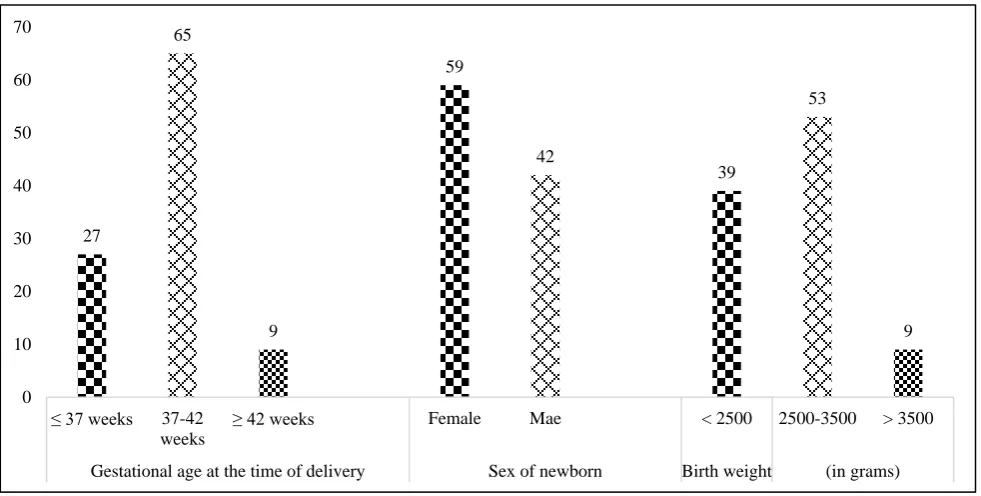
As depicted in Figure 1, pre–term delivery was high (26.7%) in present study. 58.4% of child born were female. Percentage of low birth weight also reported very high (38.6%).
An assessment of infrastructure of labour room at both CHC revealed following points.
At CHC Khishraha, two labour table was available while at CHC Mithwal three labour tables were there.
At CHC Khisraha, no screen separation of labour tables was noted during entire study period while at CHC Mithwal there were screens between labour table from initial.
Dedicated newborn care corner and functional radiant warmer was available at both CHC. Labour room was made draught free before delivery in all cases at both CHC.
hypothermia increases many folds in winter season especially in preterm birth. This protocol must be followed routinely. During intra partum period 84.2%
women were in front open gown, which was a good practice observed during this study. All babies were delivered on mother’s abdomen as per current protocol.
Figure 1: Status of present pregnancy outcome among beneficiaries (n=101).
Table 2: Newborn care immediately after birth (n=101).
Variable Category Frequency Percentage (%)
Whether baby dried with pre-warmed towel
No 98 97.0
Yes 03 3.0
Type of cloth used for drying
Cotton wool 09 8.9
Gauge Sheet 32 31.7
Normal Cloth 60 59.4
Whether baby wrapped in cotton gauze sheet
No 12 11.9
Yes 89 88.1
Whether baby head covered with cap No 101 100
Yes --- ---
Whether mother and baby covered with warmed cloth
No --- ---
Yes 101 100
In Table 2, only 3% of babies born were dried with pre-warmed towel/cloth. In 60% of cases normal clothes were used to dry baby that too were provide by patient attendant. This could be a risky practice as newborn are very prone to infection in first week of their life. Although on positive side 88.1% of newborn were wrapped in cotton/gauge sheets provide by hospitals. At no place practice of capping newborn head was observed. Head is the most sensitive area in newborn for heat loss in early life.
Figure 2, Practice of skin to skin contact was observed in 97% of cases. When further analysis was done across duration of SSC, only 37% were found practicing it for
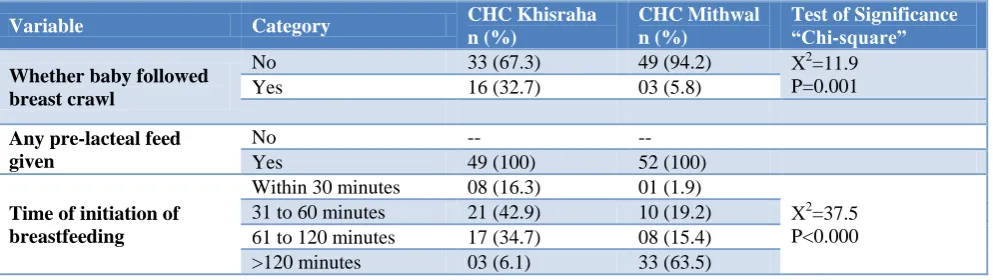
more than 10 minutes immediately after birth. As shown in above Figure 3, only in 18.8% of cases babies followed breast crawl. All babies were given pre-lacteal feed. Only in 8.9% of cases initiation of breastfeeding was done within 30 minutes. While a large proportion, 35.8% started breastfeeding after 2 hours of birth.
As mentioned in above table, only 40% of beneficiaries were assisted by staff nurse/ASHA for early initiation of breastfeeding. Although counselling for pre-lacteal feed was given to 37% of beneficiaries, but for early initiation of breastfeeding it was very poor, only 4%. None of the
mothers were communicated about benefits of
breastfeeding, position for breastfeeding and expression of breast milk, if needed.
27
65
9
59
42
39
53
9
0 10 20 30 40 50 60 70
≤ 37 weeks 37-42 weeks
≥ 42 weeks Female Mae < 2500 2500-3500 > 3500
Figure 2: Skin to skin contact for newborn immediately after birth (n=101).
Figure 3: Time of initiation of breastfeeding after delivery (n=101).
A good breastfeeding practice needs a right idea of breastfeeding attachment to the baby. This must be well communicated by health worker, immediately after delivery. In present study not even, a single mother was counselled for this.
A comparison between CHC Khisraha and CHC Mithwal showed that at both places labour room were made draught free in all cases. While radiation warmer was switched on before delivery in 18.4% cases at CHC Khisraha and 5.8% cases at CHC Mithwal. Although this difference was not statistically significant.
The above comparison showed that 91.8% mother at CHC Khisraha were in front open gown as against 76.9% in CHC Mithwal. This difference was statistically
significant. Similarly, number of draping sheets used at both CHC differ significantly.
As shown in above table, at CHC Khisraha, normal cloth was used to dry baby in 95.9% cases while at CHC Mithwal gauge sheet was used to dry baby in 57.7%. The difference of this practice was statistically significant. Similarly practice of using cotton/gauge sheet to cover baby was significantly good at CHC Mithwal.
Although SSC practices at both CHC does not reveal any significant difference. But when data was analyzed further across duration of SSC at both CHC, it showed at CHC Khisraha duration of SSC between mother and newborn was significantly higher than CHC Mithwal (Table 3).
3
98
28 32
23
15
0 20 40 60 80 100 120
No Yes Less than 5
minutes
5 to 10 minutes 10 to 20 minutes More than 20 minutes
Whether baby given STS contact If yes, Duration of STS contact
9
31
25
36
0 5 10 15 20 25 30 35 40
Table 3: Comparison of skin to skin contact for newborn immediately after birth between two CHC (Khisraha vs Mithwal).
Variable Category CHC Khisraha
n (%)
CHC Mithwal n (%)
Test of significance “Chi-square”
Whether baby given SSC contact
No -- 03 (5.8) Χ2
=2.9 p=0.08
Yes 49 (100) 49 (94.2)
If yes, Duration of SSC contact
<5 minutes 05 (10.2) 26 (50.0)
Χ2
=27.4 p<0.000
5 to 10 minutes 14 (28.6) 18 (34.6)
10 to 20 minutes 18 (37.7) 05 (9.6)
>20 minutes 12 (24.5) 03 (5.8)
Table 4: Comparison of early initiation of breastfeeding after birth between two CHC (Khisraha vs. Mithwal).
Variable Category CHC Khisraha
n (%)
CHC Mithwal n (%)
Test of Significance “Chi-square”
Whether baby followed breast crawl
No 33 (67.3) 49 (94.2) Χ2=11.9
P=0.001
Yes 16 (32.7) 03 (5.8)
Any pre-lacteal feed given
No -- --
Yes 49 (100) 52 (100)
Time of initiation of breastfeeding
Within 30 minutes 08 (16.3) 01 (1.9)
Χ2
=37.5 P<0.000
31 to 60 minutes 21 (42.9) 10 (19.2)
61 to 120 minutes 17 (34.7) 08 (15.4)
>120 minutes 03 (6.1) 33 (63.5)
A comparison of time initiation of early breastfeeding in Table 4, showed that CHC Khisraha was doing much better than CHC Mithwal. Whereas 60% of newborn initiated breastfeeding within 60 minutes at CHC Khisraha while more than 60% of newborn initiated early BF after 120 minutes at CHC Mithwal.
67.3% of mothers were assisted for BF at CHC Khisraha as against only 13.5% at CHC Mithwal. The difference was statistically significant. For other parameter related to counselling of BF, both CHC performed similar. Regarding counselling for attachment after birth, both CHC performed highly unsatisfactory.
DISCUSSION
A monitoring and evaluation study to assess the implementation of practice of skin to skin contact and early initiation of breastfeeding in all deliveries with good outcome carried out in an aspirational district Siddharth Nagar. It was a descriptive observation study. Followings were the conclusion of this study. Most of the beneficiaries were from young age group (20-22 years) and majority of them were literate. Almost 1/4th of beneficiaries got pregnant and delivered baby within 1 year of marriage. Pre-term delivery was high in our study, near about 26.7%. According to the Indian foundation for premature babies (IFPB) report on ‘Delivered Too Soon', the rate of pre-term birth in India is approximately 21% and is rising.25
Labour room infrastructure was more satisfactory at CHC Mithwal in comparison to CHC Khisraha. Although radiant warmer was functional at both the CHC but only in 12% of cases it was kept ready before delivery. All babies were delivered on mother’s abdomen as per protocol. Only in small fraction of cases pre-warmed towel used to dry up the baby. Normal clothes provided by patient’s relatives was mainly used to dry up baby at both CHC. Although initiation of skin to skin contact was observed in 97% of beneficiaries but only 15% of mother did it for sufficient time i.e. for more than 20 minutes. This finding is similar to Nigeria (10%) and Bangladesh (26%).19
Early initiation of breastfeeding within 30 minutes after birth was observed only in 8.9% of cases. Assistance by staff nurse/ASHA for early initiation of breastfeeding was also found unsatisfactory at both CHC. This is very low in contrast to average early breastfeeding rate (44.6%) as reported in a commentary of 2014.26 None of the beneficiaries were counselled by staff nurse /ASHA regarding correct attachment of baby to breast at both CHC. Labour room was made draught free at both CHC but practices for keeping radiant warmer ready before delivery was not satisfactory at both CHC. Practices in relation to immediate newborn care was more satisfactory of CHC Mithwal in comparison to CHC Khisraha.
initiation of breastfeeding was unsatisfactory at both CHC although CHC Khisraha was doing better than CHC Mithwal. Regarding various aspects of counselling for early initiation of breastfeeding, both CHC performed similarly and unsatisfactorily.
CONCLUSION
The current study endorse supportive supervision of staff nurses for STS contact and early BF initiation. Appointment of counselor for mandatory education of patients/her relative about benefits of early breastfeeding, STS contact, positioning and attachments in BF. Counselling and training of ASHA worker about benefits of early BF and STS contact for both mother and baby. Maintenance of records of duration of STS contact and BF initiation at dual level i.e. hospital level and ASHA level. Accountability of hospital administration for availability of minimum 2 draping sheets in every delivery case.
Funding: No funding sources Conflict of interest: None declared
Ethical approval: The study was approved by the Institutional Ethics Committee
REFERENCES
1. Srivastava S, Gupta A, Bhatnagar A, Dutta S. Effect of very early skin to skin contact on success at breastfeeding and preventing early hypothermia in neonates. Indian J Public Health. 2014;58(1):22–6. 2. Moore ER, Bergman N, Anderson GC, Medley N.
Early skin-to-skin contact for mothers and their healthy newborn infants. Cochrane Database Syst Rev. 2016 25;11:CD003519.
3. Takahashi K, Ganchimeg T, Ota E, Vogel JP, Souza JP, Laopaiboon M, et al. Prevalence of early initiation of breastfeeding and determinants of delayed initiation of breastfeeding: secondary analysis of the WHO Global Survey. Sci Rep. 2017;7:44868.
4. PM Award for Excellence in Public Administration. Available at: https://pmawards.gov.in/public/login. Accessed on 5 May 2018.
5. Cleveland L, Hill CM, Pulse WS, DiCioccio HC, Field T, White-Traut R. Systematic Review of Skin-to-Skin Care for Full-Term, Healthy Newborns. J
Obstet Gynecol Neonatal Nurs JOGNN.
2017;46(6):857–69.
6. Righard L, Alade MO. Effect of delivery room routines on success of first breast-feed. Lancet Lond Engl. 1990;336(8723):1105–7.
7. Moore ER, Anderson GC, Bergman N, Dowswell T.
Early skin-to-skin contact for mothers and their healthy newborn infants. Cochrane Database Syst Rev. 2012;5:CD003519.
8. Widström A-M, Lilja G, Aaltomaa-Michalias P, Dahllöf A, Lintula M, Nissen E. Newborn behaviour to locate the breast when skin-to-skin: a possible
method for enabling early self-regulation. Acta Paediatr Oslo Nor 1992. 2011;100(1):79–85. 9. Alberts JR. Learning as adaptation of the infant.
Acta Paediatr Oslo Nor 1992 Suppl. 1994;397:77– 85.
10. Michelsson K, Christensson K, Rothgänger H, Winberg J. Crying in separated and non-separated newborns: sound spectrographic analysis. Acta Paediatr Oslo Nor 1992. 1996;85(4):471–5.
11. Liu D, Diorio J, Day JC, Francis DD, Meaney MJ. Maternal care, hippocampal synaptogenesis and cognitive development in rats. Nat Neurosci. 2000;3(8):799–806.
12. Porter RH, Winberg J. Unique salience of maternal breast odors for newborn infants. Neurosci Biobehav Rev. 1999;23(3):439–9.
13. De Carvalho M, Robertson S, Friedman A, Klaus M. Effect of frequent breast-feeding on early milk production and infant weight gain. Pediatrics. 1983;72(3):307–11.
14. Christidis I, Zotter H, Rosegger H, Engele H, Kurz R, Kerbl R. Infrared thermography in newborns: the first hour after birth. Gynakol Geburtshilfliche Rundsch. 2003;43(1):31–5.
15. Winberg J. Mother and newborn baby: mutual regulation of physiology and behavior--a selective review. Dev Psychobiol. 2005;47(3):217–29. 16. Handlin L, Jonas W, Petersson M, Ejdebäck M,
Ransjö-Arvidson A-B, Nissen E, et al. Effects of sucking and skin-to-skin contact on maternal ACTH and cortisol levels during the second day postpartum-influence of epidural analgesia and oxytocin in the perinatal period. Breastfeed Med Off J Acad Breastfeed Med. 2009;4(4):207–20.
17. Bernard-Bonnin AC, Stachtchenko S, Girard G, Rousseau E. Hospital practices and breastfeeding duration: a meta-analysis of controlled trials. Birth Berkeley Calif. 1989;16(2):64–6.
18. Conde-Agudelo A, Belizán JM, Diaz-Rossello J. Kangaroo mother care to reduce morbidity and mortality in low birthweight infants. Cochrane Database Syst Rev. 2011;(3):CD002771.
19. Singh K, Khan SM, Carvajal–Aguirre L, Brodish P, Amouzou A, Moran A. The importance of skin–to– skin contact for early initiation of breastfeeding in
Nigeria and Bangladesh. J Glob Health.
2017;7(2):020505.
20. Mikiel‐Kostyra K, Mazur J, Boltruszko I. Effect of early skin-to-skin contact after delivery on duration of breastfeeding: a prospective cohort study. Acta Paediatr. 2002;91(12):1301–6.
21. Bigelow A, Power M, MacLellan-Peters J, Alex M, McDonald C. Effect of mother/infant skin-to-skin contact on postpartum depressive symptoms and maternal physiological stress. J Obstet Gynecol Neonatal Nurs JOGNN. 2012;41(3):369–82. 22. Bramson L, Lee JW, Moore E, Montgomery S,
During the Maternity Hospital Stay. J Hum Lact. 2010;26(2):130–7.
23. Stevens J, Schmied V, Burns E, Dahlen H. Immediate or early skin-to-skin contact after a Caesarean section: a review of the literature. Matern Child Nutr. 2014;10(4):456–73.
24. Kollmann M, Aldrian L, Scheuchenegger A, Mautner E, Herzog SA, Urlesberger B, et al. Early skin-to-skin contact after cesarean section: A randomized clinical pilot study. PLOS ONE. 2017;12(2):e0168783.
25. India accounts for 23.6% of global preterm births. Available at: https://www.indiainfoline.com/article
/news-corporate/india-accounts-for-23-6-of-global-preterm-births-113111804159_1.html. Accessed on 27 June 2018.
Aguayo VM, Gupta G, Singh G, Kumar R. Early initiation of breast feeding on the rise in India. BMJ Glob Health. 2016;1(2):e000043.
Cite this article as: Yadav S, Ahmad S, Kumar M, Yadav SK, Garg PK, Bhateja R.Monitoring and evaluation of intranatal facilities at community health centre level in Siddharth Nagar district. Int J