Quality Control Strategy On Crab Handling Process
By Using Analytical Hierarchy Process Method
Anita Wulandari
Polytechnic 17 Agustus 1945 Surabaya
Email:[email protected]
ABSTRACT
Crab (crab) is one of the fishery products that is generally perishable. This is likely due to poor handling that decreases the quality. This research aims to determine factors that can affect the quality of crab and recommend a priority strategy most appropriate to apply quality control on crab handling at PT Tonga Tiur Putra in expanding its business. The present research uses AHP (Analytical Hierarchy Process) method. Three decision-makers in PT. Tonga Tiur Putra were taken as respondents. Analysis factor reveals that factor affecting the quality of crab meat is transportation. The proper alternative to control the quality of crab is human resource training.
Keywords: Crab, HR, AHP
1. INTRODUCTION
Indonesia stores potential marine resources. For more than 30 waters of Indonesia is
well known as a potential fish catchment area in the world. Even in the last 20 years,
Indonesian waters are considered the world's largest fish resources after. A staff of
Department of Marine and Fisheries program supervision Banten, Lim Elfiza, MP stated that
from DKP figures (1999), Indonesia SDI is 8.2 million tons. Of this figure, at least 6.7
million tones are catchable fish. However, from 6.7 million tons per year, only 3.65 million
tons per year is managed. Indonesia is only able to meet 3.64% of the world's absorption of
fish of 18 million per year (about 655,200 tons per year). According to World Fisheries
Statistics in1995, world fish consumption reached US $ 55 billion. Indonesia contribution in
the level of US $ 2 billion is still relatively small.
Given the huge potential of Indonesia's marine resources, it is highly important to
develop fish processing industry in Indonesia. It is unfortunate if Indonesia's marine wealth
is only utilized by other countries. In addition to utilizing the wealth of marine resources, the
development of fish processing industry can be a driver of employment creators and reduce
the poverty rate that will affect the country's economy (Ali & Wulan, 2018). One of fish
potential of crab in Indonesia as well as the high demand from domestic and abroad support
this industry to be developed. One of crab stripping industry is PT Tonga Tiur Putra. PT.
Tonga Tiur Putra is located in Sebeneh Village, Bancaran Subdistrict, Bangkalan District;
Madura.PT Tonga Tiur Putra is in cooperation with existing suppliers in Bangkalan District.
However, there are often problems faced by stripping company in maintaining quality
of crab meat. This is a major problem faced by every crab stripping company. Low standard
handling on crab can cause the decreased price of crab meat. This is due to the company’s
limited knowledge on crab quality. Suwignyo (2008) argues that crabs have long been in
demand by the public both domestically and abroad, therefore the price is relatively
expensive. The benefits of crabs as a food material is in the form of high canned crab is in
its high protein. Crab is highly demanded in the form of cans (processed meat of crab). Crab
demand is higher in the form of processed meat. Thus guaranteed quality will help the crab
meat processing important to be developed in increasing the value.
In order for a company to continue to grow, it needs a proper quality control strategy
with AHP (Analytical Hierarchy Process) method. AHP method is decision making in
solving problems in terms of planning, alternative determination, priority setting, policy
selection, resource allocation, determination of needs, forecasting results, system planning,
performance measurement, optimization, and conflict resolution (Saaty, 1994).
2. RESEARCH METHODS
The researcher uses the Analytic Hierarchy Process (AHP) method which presents a
framework for solving multi-criteria situations so as to produce logical and rational
decisions. With this method, problem of quality control can be simplified in an easily
understood hierarchy structure. Because AHP can solve a complex problem by creating a
hierarchy of criteria of the problem, it can facilitate decision making in developing the
business.
The data was collected in 4 ways: interview, observation, literature study, and
company documentation. Interview was carried out by question and answer session with
company owner and management to obtain information about crab handling to control its
quality. Observation was carried out by identifying appropriate factors, objectives, and
strategies. The literature study is conducted with the aim of obtaining the theoretical
company overview data (history, production aspects, vision and mission, marketing, aspects
of the organization).
3. DISCUSSION
3.1. Determining Levels of Factors, Goals and Strategies
Determination of the level of this factor has been recommended by researchers and
approval from the company obtained from literature and brainstorming studies, there are 4
criteria: raw materials, human resources, technology, and transportation. The objective
indicators for quality control are obtained from the literature, brainstorming and as per
company agreement. PT Tonga Tiur Putra is a company that commodity of fishery product
of peeling crab. The purpose of appropriate quality control and help control the quality of
crabs, goals indicators on the processing of crabs as follows:
1. Improve quality
2. Improve power image and product competitiveness
3. Increase the yield volume
4. Streamline the flow of production
At the level of objectives for quality control, a strategy that needs to be performed include:
1. Conducting training and human resources development
2. Application of GMP to improve quality assurance and safety of marine products
processing products
3. Implementation and quality control of raw materials
4. Application of technology
3.2. Analysis of Factors, Objectives and Quality Control Strategies
In accordance with the distribution of questionnaires as much as three respondents,
respondents and in accordance with interviews and references the authors obtained the
results of factors related to quality control, level of goals and strategy re obtained. The
results of this AHP calculation is derived from the priority values between levels at each
hierarchy level that indicates the order of factor priorities, goals and strategies in
determining quality control strategies.
The hierarchy structure in the model consists of 4 levels. The first level is a focus on
quality control. The second levels of factors that must be considered include transportation,
raw materials, human resources, and technology. Factors for quality control strategy then at
improving product image and competitiveness (3) increasing yield volumes and (4)
streamlining product delivery flow. Based on the four objectives, the fourth strategy is to
develop the following strategies: (1) the procurement of human resources training, (2)
implementation of GMP, (3) application of quality control system, (4) information system
development (5) application of process technology.
Based on the selected factor level, a comparison matrix will be performed (pairwise
comparison) between the elements, thus weight for each level factor is obtained. The method
used is comparative judgment or scale of comparison in pairs, this principle means
making an assessment of the relative importance of two elements at a certain level in relation
to the above levels.
3.3. Determining the Factor Level
Weight value ranges from 1-9. The value of weight 1 represents equally important,
this means the same attribute of scale, whereas the weight value 9 represents the absolute
important attribute case compared to the others. From the calculation result in attachment 2,
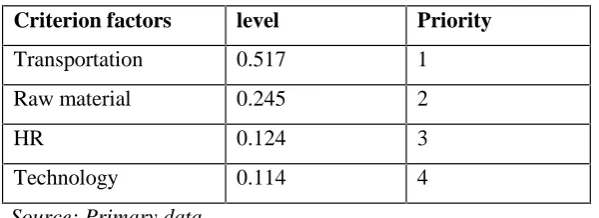
Priority factor level can be seen in Table 1
Table 1. Priority level at factor level
Criterion factors level Priority
Transportation 0.517 1
Raw material 0.245 2
HR 0.124 3
Technology 0.114 4
Source: Primary data
Based on Table 9 the priority weight of each factor levels are transportation (0,517),
raw materials (0,245), tbsp (0,124), and technology (0,114).
3.4. Transportation
According to Table 9, the factor criterion places the first position with level of
0.517. Transportation is in the first rank because transportation is a major factor in the
quality control of crab meat which affects the quality of meat that is at the time of taking
from collectors and delivery of crab meat to canning.
Until now, the vehicles used by the company are motorcycles and pick-up. Collection
with motorcycle is performed by using basket. the absence of tight cover causes
cross-contamination, closed packaging and with enclosed packaging should be carried out
to prevent the occurrence of contamination with microorganisms. Elfawati, et al (2008),
states that closed packaging can prevent direct contamination with airborne and
human-handed bacteria. Transportation with pick up is quite well maintained because the quality of
transportation is using fiber and Styrofoam given ice shavings to protect the crab.
Crab stripping results are sent to Rembang,in Central Java. It takes a long time the
fresh crab requires a long storage with cold room temperature with a variety of packaging
such as jars and Styrofoam. Shipment of crab meat products used car from companies,
however, these vehicles are often late that ice melts. Munandar, et al (2009), states that
the number of bacteria increases with the length of storage. This will affect the quality of
crab meat if ice melts. In accordance with the observation that the ice in the company used
for packing is measured based on feelings.
The ice cannot be less than one-third the weight of the fish (1: 3). The amount of ice
may still be reduced again, but not to be reduced from 1: 3 (Wibowo and Yunizal, 1998).
According to Junianto (2003), the amount of ice must be adjusted with the number of fish to
be handled to obtain optimal cooling temperature. If the amount of ice is too little compared
to the amount of fish, the cooling temperature produced is not cold enough to maintain the
freshness of the fish within the specified time. Conversely, too much ice can cause fish to be
physically damaged by the crush or pressure of the ice.
This shows the company underestimating ice packing and shipping for crab meat to
avoid the tenderness and blandness of meat from liquefy and too long storage in cold
temperatures.
The ideal comparison between the amount of ice and fish to maintain its temperature is 1:
1. The use of ice amount will be faster in lowering fish temperature so that fish quality will
be better (Yunizal and Wibowo 1998).
3.5. Determining Objectives On Transportation
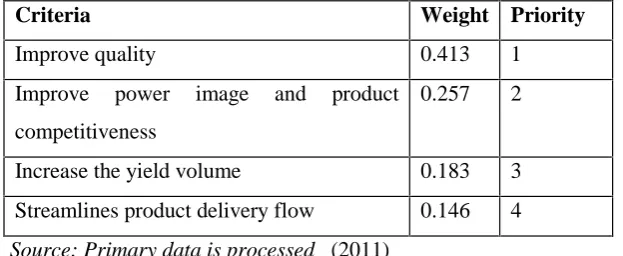
The results of calculations is in appendix 2. Based on the selected objectives then
made a comparison matrix ( pairwise comparison ) between the elements, each level of
Table 2. Level of Objectives on transportation
Criteria Weight Priority
Improve quality 0.413 1
Improve power image and product
competitiveness
0.257 2
Increase the yield volume 0.183 3
Streamlines product delivery flow 0.146 4
Source: Primary data is processed (2011)
3.6. Improve Quality
In accordance with Table 10, the objective level above corresponds to the calculation
on each variable. The level of goal is to improve quality with weight (0.43) on
transportation because the company wants the best quality to achieve the goal of the end
result.
To achieve the ultimate goal with the transport factor, quality index value based on the
standards determined by the consumer in the distribution process is used. Thus, quality
becomes the determining factor to reach the final goal (Rochman, et al, 2007). The purpose
to improve the quality of transportation is one of the quality control processes in handling
crab in mini plan. A means of transportation needs to be added to make it easier in the
process of operational activities and pay attention to handling crab from inputs to finished
products.
3.7. Improve Power Image and Product Competitiveness
Improving the image of power and product competitiveness will create products
acceptable to consumers and able to compete with other products. Addition of other fishery
product e.g in stripping of shrimp head with his body and moving on the supply of tuna or
other fish for export can be added. It should also improve strategies to improve the product's
image and competitiveness. According to Cravens (1996), utilizing a refine strategy on the
processing system will facilitate the processing and make a quality product.
3.8. Increase Yield Volume
In accordance with Table 10 increasing the yield volume places the third position with
the criterion weight of 0.183 or 18.3%. In increasing the volume of the results on
transportation, the company can improve the means of transportation by adding a car vehicle
district only. By adding crab suppliers from the outside and adding the means of
transportation will be more easily accessible and efficient carrying of crab raw materials if
by car.
3.9. Streamlining the Product Channel Flow
In accordance with the objective of streamlining production flows on transport factors
with a weight of 0.146 or 14.6% this priority is to accelerate work processes and be
motivated to work effectively and efficiently. To facilitate the flow of transportation
products for delivery, it is better to make their self-delivery without waiting for vehicles
from canning to come to pick up the crab products, this is to be more time efficient and able
to control the quality of crab meat, Delayed vehicles from canning may be due to road
congestion or vehicles experiencing road problems such as leaking tires or breaking down
vehicles.
3.10. Determining the Levels of Strategy on Transportation
Quality control strategy is planning activities to maintain, direct, maintain, and satisfy
the demands of consumers maximally. Based on the level of strategy that has been
determined company, the first quality control strategy is performed according to the
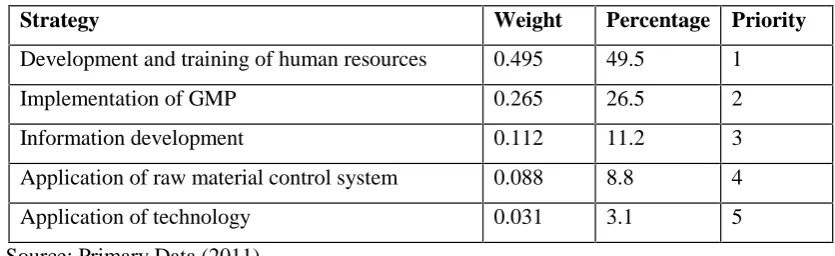
calculation with AHP method in aids with Microsoft Excel 2007 as listed Table 3. In
accordance with the calculation with a high weight can determine the existing control
strategy in crab stripping factory.
Table 3. Priority leel on strategy
Strategy Weight Percentage Priority
Development and training of human resources 0.495 49.5 1
Implementation of GMP 0.265 26.5 2
Information development 0.112 11.2 3
Application of raw material control system 0.088 8.8 4
Application of technology 0.031 3.1 5
Source: Primary Data (2011)
Dwi prabowo (2011) explains that determining a larger priority value with AHP method can
determine the data in accordance with existing conditions.
3.11. HR Development and Training Strategy
HR development and training strategy is the main priority in the implementation of
0,495 or 49,5%. This priority is an appropriate strategy for quality control in the handling
process of crabs. Training and development is the first step before doing the next
process. With human resource training, the company will run and develop business for the
next process easier. Desler (2009) argues that the development and training of human
resources is the process of teaching new employees to acquire the skills and basic skills they
need to run the work in accordance with the wishes of the company.
The purpose of the development and training of human resources is to achieve the
work efficiency of employees in achieving the results of work that has been
established. Improved work efficiency of employees can be achieved by:
1. Employee training
In employee training, employee will gain the skills and skills of employees to facilitate the
work. In accordance with transportation factors, training in driving a vehicle is
necessary. Driver in driving the vehicle can also affect the meat that can lead to rupture of
raw materials crabs due to shocks between raw materials caused by the driver lack of control
of the road.
2. Employee Discipline
Discipline will create an optimal working atmosphere and appropriate results. In the
observation, driver’s discipline was still low in terms of departure to take raw materials
crab. It is also experienced by cannery companies that often experience delays for shrimp
meat delivery. Employees with the habit of delaying working hours will hinder other jobs
and inefficient production.
This indicates that every problem in handling of crab especially on transportation. It
needs improvement of strategy with development and training of human resources in order
to create efficient and effective workforce according to company expectation. In accordance
with the factors of transportation, the development and training of human resources can
affect the quality of meat such as collisions or shocks during the trip that cannot be
controlled and too long storage caused by the delay of delivery of raw materials to canning.
3.12. GMP Implementation Strategy
In each quality control factor, the application of GMP is required. The application of
GMP is a system aimed at reducing the potential for contamination of products during
processing, from raw material to final product acceptance. Quality control factors in PT
Tonga Tiur Putra require a strategy of implementing GMP starting from raw material
The implementation strategy of GMP will achieve some objectives that are as
expected in PT Tonga Tiur Putra (Table 3). The application of GMP positioned with a
weight of 0, 265 or 26.5% can be seen in Table 3 In accordance with the existing factors
transportation becomes the main obstacle that must be controlled, the problems on
transportation are, Lack of vehicle means for transportation if raw materials are abundant
from crab suppliers, The delay for delivery of crab meat is likely due to congestion and
unwanted things such as leaking tires, breaking down and others anad Transportation of raw
material is not hygienic.
This shows that transportation has constraints in terms of delivery and transport of raw
materials, in accordance with the strategy of applying GMP, car should be added not to
inhibit the production process of crab production to canning factory and the need for vehicle
cleanliness to control the quality of meat.
3.13. Information Development Strategy
In accordance with Table 3. the development of information occupies the 3rd position
with the weight of 0.112 or 11.2%. This strategy is needed because during the trip there is no
information about the road, and so far only uses phone for problems on the road. If the
company wants to control the quality of meat during the trip, it should improve the
transportation strategy by knowing alternative ways to streamline the time. Nugroho (2008),
stated that alternative road is a journey to avoid congestion and road closures.
Other strategies on information development can also be performed by expanding the
information network on travel required coordination/good synergy and integration between
institutions / components (Bina Marga, DLLAJ, and Polantas) in overcoming transportation
problems.
3.14. Strategy of Application of Quality Control System of Raw Material Quality
The strategy of quality control system implementation of raw materials place the
fourth position where this transportation factor wants the raw material control system by
packaging raw materials during the trip. Packaging of raw materials is not optimal, The
basket used still contains dirt contained in crevices baskets. Basket should be brushed with
soap and dichlorine to avoid odor and avoid contamination, The carrying of raw materials
using open packaging such as baskets (Ali, 2015). This makes crabs contaminated with the
outside air, Despite using a basket with sealed packaging such as a bag that has 2 pockets
jars are not recommended for packing and Not using the recommended box and no spending
holes.
It shows that the quality control system in raw material is low and not in accordance
with SOP (Standard Operational Procedures). To make sure that quality of meat is good at
reaching the consumers, the following SOP that has been established, The basket used
should be completely clean and protected from dirt, Packaging in transportation must be
closed and given ice to keep freshness of raw materials, After and before the use of means
for transportation, basket should be washed and chlorinated to avoid cross contamination,
using recommended packaging in the form of a closed plastic jar, Use the recommended box
and have an outlet, Crab meat is put in a jar according to the type, The volume of meat does
not exceed the capacity of the jar, The quality of ice used in accordance with drinking water
standard and Giving ice: meat is 1: 1 and does not use used ice.
3.15. Technology Application Strategy
The last priority in the strategy is the application of technology with level of 0.031 or
3.1%. Application of technology for transportation is also needed because it is likely also
affect the quality of crab meat. Application of technology for this transportation is replacing
the vehicle by using special vehicles that functions as product cooling during the trip. This is
to preserve crab freshness. During the trip with the application of technology can be
assisted using Road Map tool. Road Map is a tool to help guide during the trip.
4. CONCLUSION
Factors affecting the process of handling crab has analyzed with the calculation of
AHP method with transport of 0.517 or 51.7% . Quality control strategy on proper handling
of crabs is on procurement and human resource training. This strategy is the first step that
must be carried out to improve control on transport factor by conducting employee training
and employee discipline.
REFERENCE
Armstrong, M. and H. Murlis. 2003. Reward Manajemen. A Hand Book Of Remuneration Strategy and Practice. Alih bahasa oleh Ramelan. Bhuana Ilmu Populer Gramedia. Jakarta.
Ali, M. (2015). PENGARUH DOSIS PEMUPUKAN NPK TERHADAP PRODUKSI DAN KANDUNGAN CAPSAICIN PADA BUAH TANAMAN CABE RAWIT (Capsicum frutescens L.). JURNAL AGROSAINS: KARYA KREATIF DAN INOVATIF, 2(2), 171– 178.
Ali, M., & Wulan, W. (2018). EFFECTS OF SAND AND SUGAR CONSENTRATION ROSELLA (Hisbiscus sabdariffaLinn) AGAINST QUALITY OF JELLY CANDY.
Teknoboyo, 2(1).
Dearbon. Grace. 1994. Quality Management. Maylands Avenue Hemel Hempstead. USA. Gaspersz, Vincent. 1998. Manajemen Kualitas Penerapan, Konsep-konsep Kualitas Dalam
Manajemen Bisnis Total. PT Gramedia Pustaka Utama. Jakarta.
Hardjosoedarmo, S. 1996. Total Quality Manajemen. Penerbit Andi. Yogyakarta.
Hariandja, M.T. 2002. Manajemen Sumber Daya Manusia ( Penggandaan Pengembangan, Pengkompensasi, dan Peningkatan Produktivitas Pegawai). PT Gramedia Widiasarana Indonesia. Jakarta.
Hidayati, Feni. 2002. Skripsi Perubahan Mutu daging Setelah Perebusan Sebagai Bahan Baku Produk Pasteurisasi Selama Penyimpanan Suhu Chilling. Universitas IPB. Bogor.http://repository.ipb.ac.id/bitstream/handle/123456789/15601/C02fhi.pdf?sequ ence=1 diakses tanggal 10 April 2011.
R. Lawrence dan Glueck.1997. Manajemen Strategis dan Kebijakan Perusahaan Edisi Ketiga. Erlangga. Jakarta.
Rahman, Abdul. 2008. Skripsi Penentuan Kriteria Yang Paling Berpengaruh Terhadap Prestasi Kerja Karyawan di CV. Rimba Setosa Sukoharjo. Universitas Muhammadiyah. Surakarta.
Sukmawati, Dkk. 2007. Jurnal Analisis Manajemen Mutu Terpadu di PT Madu Pramuka Cibubur Jakarta. Fakultas Peternakan Universitas Institut Pertanian Bogor . Bogor.
Saaty, T. L. 1993. Pengambilan Keputusan Bagi Para Pemimpin. Edisi Indonesian PT Pustaka BinamanPressindo. Jakarta.
Supriyanto dan Masruchah, I., Manajemen Purchasing: Strategi Pengadaan dan
Pengelolaan untuk Perusahaan Manufacturing, Jakarta, Gramedia, 2000.