Http://www.ijetmr.com©International Journal of Engineering Technologies and Management Research [30-34] IJETMR
COST BENEFIT ANALYSIS OF INSTALLING OF VARIOUS POWER
PLANTS USING DIFFERENT PARAMETER
Amit Kumar Kishanpuri *1, Dr. A.K.Sharma 2 *1
Research Scholar, Fourth Semester ME (High Voltage & Power System.), Jabalpur Engineering College, Jabalpur (M.P) 482011, India
2 Professor & HOD, Department of Electrical Engineering, Jabalpur Engineering College,
Jabalpur (M.P) 482011, India
DOI: 10.5281/zenodo.556418 Abstract:
There are many type power plant in India such as Thermal power plant, hydel power plant , nuclear power plant , solar power plant and wind power plant . In this paper, we are presented the renewable energy sources in order to meet an energetic demand in India with a lowest cost. These are beneficial the renewable energy sources like solar, wind, etc. This study focuses on making use renewable sources as an alternative source of energy. Renewable energy sources like solar, wind and renewable energy due to its availability, continuity and cleanness.
Keywords:
Cost Analysis; Parameter; Consumption.
Cite This Article: Amit Kumar Kishanpuri, and Dr. A.K.Sharma, “COST BENEFIT ANALYSIS OF INSTALLING OF VARIOUS POWER PLANTS USING DIFFERENT PARAMETER” International Journal of Engineering Technologies and Management Research, Vol. 4, No. 3(2017), 30-34. DOI: https://doi.org/10.29121/ijetmr.v4.i3.2017.88.
1. INTRODUCTION
Http://www.ijetmr.com©International Journal of Engineering Technologies and Management Research [30-34]
Figure 1: I-V and P-V
By operating at maximum power points, the output of solar panels can be maximized or for a given power output, the cost of solar cells can be minimized. Therefore, drive is designed so that the solar panel operates at or close to maximum power points.
Figure 2: Effect of insolation level
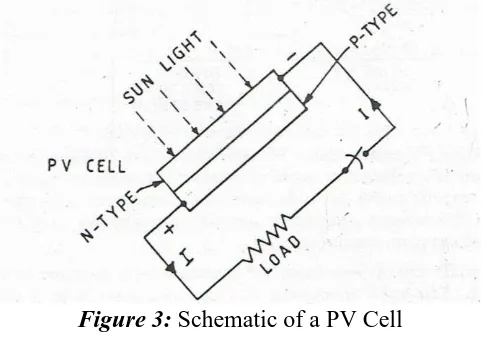
Photo-Voltaic Systems have become commercially successful during 1980s. The Solar Photo-Voltaic cells (PV cells) convert the incident solar light energy directly to electrical energy in DC form. The principles of solar energy, solar spectrum, flat plate collectors, parabolic through collectors with line focus etc.
Http://www.ijetmr.com©International Journal of Engineering Technologies and Management Research [30-34] 2. PV CELL TECHNOLOGY
PV cells which have only silicon as the base for PN junction are called homojunction' PV cells. PV cells which have two base materials (e.g. Cadmium Sulphide-Copper) are called hetero-junction PV cell.
Homojunction cells with silicon base are most successful and have following three types. 1) Amorphous silicon.
2) Polycrystalline silicon. 3) Single crystal silicon.
Merits
1) Installation Cost of long distribution lines, distribution substations etc. is eliminated 2) Suitable for portable or mobile loads e.g. radio sets, cars, buses, space-crafts. 3) Reliable service, long life (15 years).
Limitations
1) Irregular, intermittent supply 2) Need for storage batteries.
3. THERMAL POWER PLANT (2016)
Total Variable Cost per Unit:
=Cost of Specific Oil consumption + Cost of Specific Coal consumption
=Rs. (0.01 + 0.60) / kWh = Rs. 0.61 /kWh
Notes:
a) The variable cost calculated above is the variable cost of generation.
b) 6.5% of the Power generated is consumed in Auxiliary. So, in calculating Power available Ex-bus we have to subtract 6.5% of Available Power.
c) Variable cost per unit at bus bar = Variable cost per unit
1 - % Auxilliary consumption = 0.61 = Rs 0.65/kWh
1- 0.065
Nominal Tariff calculation:
Nominal Tariff = (Total Fixed Cost / Unit) + (Total variable cost (Ex-bus)/Unit)
Http://www.ijetmr.com©International Journal of Engineering Technologies and Management Research [30-34] Total = Nominal Tariff + Expenses (10% of Nominal Tariff)
=2.07 + 0.207 = Rs 2.28/Unit
4. HYDEL POWER PLANT (2016)
Initial Cost = Rs 25000000
Total cost =Initial Cost + Operating Cost (8% of Initial Cost) + Maintenance Cost (8% of Initial Cost) + Expenses (4% of Initial Cost)
Total cost =Initial Cost + (20% of Initial Cost) Total cost = 25000000 +5000000
Total cost = 30000000
Cost per KWh = 30000000/ (1X 103 X 365 X 24) Cost per KWh = Rs 3.42
5. NUCLEAR POWER PLANT (2016)
Total Cost (Rs/kWh) = Cost of Capacity cost (including O&M) Rs/kWh + cost of Heavy Water Makeup Cost (Rs/net kWh) + cost of Waste Disposal Cost (Rs/net kWh) + Expenses (40% of sum of Capacity cost Heavy Water Makeup Cost and Waste Disposal Cost )
Total Cost (Rs/kWh) = 0.65+0.13+0.38+0.02 +0.48= 1.66
6. SOLAR POWER PLANT (2016)
1) Radiation falls on Solar Panels
2) Panels convert this radiation into DC Current
3) DC Current passes through Copper Cables to reach Inverters 4) Inverters convert DC current into AC Current
5) AC Power is fed to the building electrical load.
The cost per unit of electricity generated = Rs 48400 / 16682= Rs 2.90
7. WIND POWER PLANT (2016)
The formula for calculating the power from a wind turbine is:
Where:
P = Power output, kilowatts
Cp = Maximum power coefficient, ranging from 0.25 to 0.45, dimension less (theoretical maximum = 0.59)
ρ = Air density, lb/ft3
Http://www.ijetmr.com©International Journal of Engineering Technologies and Management Research [30-34] k = 0.000133 A constant to yield power in kilowatts. (Multiplying the above kilowatt answer by 1.340 converts it to horse- power [i.e., 1 kW = 1.340 horsepower]).
The cost per unit of electricity generated = Rs 58300 / 14400= Rs 4.04
8. CONCLUSION
We are studies the various power plant such as Thermal power plant , hydel power plant , nuclear power plant , solar power plant and wind power plant . after that we are finding out the various tariff.
9. REFERENCES
[1] Kadi.L, Dakyo.B(2010), Modelling and optimization of wind energy systems, JJMIE Vol
4,No 1,143-150.
[2] Weizhou, Zhongshi Li, Lin Lu, Hongxing Yang,(2010) Current status of Research on optimum sizing of stand- alone hybrid solar-wind power generation systems, Applied Energy 87, 380-389.
[3] Deshmukha.M.K.andDeshmukhb.S.S(2008)Modelling of Hybrid Renewable Energy
Systems,Renewable and Sustainable Energy Reviews,Vol.26,235-249.
[4] HosainZaman, HamedShakouri G,(2011),A simple mathematical model for wind turbine
power maximization with cost constraints, Iraq Journal of Electrical and Electronic Engineering,Vol-7,60-63.
[5] India wind Energy Outlook (2012), Global wind Energy Council,3rd Edition, An International Conference & exhibition, Chennai.
[6] Jayabalan.P Research Associate, A study on power scenario in Tamilnadu, Center for Asia Studies,Chennai 1-55.