Shiraz University
Phytoremediation Potential of Corn and Oat for Increased
Levels of Soil Cadmium under Different Irrigation
Intervals
A. AZIZIAN
1**, S. AMIN
1*, M. NOSHADI
1*, M. MAFTOUN
2and
Y. EMAM
3*1Department of Water Engineering, College of Agriculture, Shiraz University, Shiraz, I.R.Iran 2Department of Soil Science, College of Agriculture, Shiraz University, Shiraz, I.R.Iran
3Department of Agronomy, College of Agriculture, Shiraz University, Shiraz, I.R.Iran
ABSTRACT-The present pot experiment was undertaken to investigate the phytoremediation potential of corn and oat in soil. Treatments consisted of four cadmium (Cd) levels (0, 5, 10 and 20 mg l1) and three irrigation intervals (1, 3 and
7 days), arranged in the form of a complete randomized design with three replications. Corn and oat were harvested after 75 and 90 days, respectively. Transpiration rates, shoot dry weight and shoot Cd concentration of both plants were measured. Cadmium uptake, Cd bioconcentration factor (BCF), the apparent recovery of Cd and water use efficiency were also calculated. Cadmium had negative, and in some cases stimulating effects on plant growth. Furthermore, the phytoremediation capacities of both plants were higher at the 1 day irrigation frequency. The BCF values for both plants were less than unity, indicating that the phytoremediation potentials of oat and corn were low in this study. Overall, oat was more efficient than corn in phytoremediation of Cd as it accumulated 52, 169 and 132% more Cd than corn at 1, 3 and 7 day irrigation intervals, respectively. On the average, oat also took up soil Cd about 80% more than corn. From the results reported herein, it is recommended to conduct additional experiments with different Cd levels and more irrigation intervals using different types of agronomic and horticultural crops.
Keywords: Cadmium, Corn, Irrigation interval, Oat, Phytoremediation
INTRODUCTION
The development of modern industry and agriculture has led to increased environmental contamination with diverse contaminants among which the increase of heavy metals (e.g Cd) is of prime concern (15 and 7). Although anthropogenic metallic soil pollution is not usually limited to a single metal (22), each element needs to be considered separately because of its unique soil and plant chemistry (4). Cadmium is a non-essential, toxic and dangerous pollutant (9 and 10) which contaminates foods and feeds through the
plant-animal chain (13). Therefore, Cd decontamination of soil has a high priority in environmental research. Due to high costs and difficulties in removing toxic metals from soil and water by conventional physical and chemical methods, research is presently focused on low-cost, easy and safe technologies. One such effective and promising procedure is phytoremediation (21), whereby accumulator plants are used to remove toxic metals from soil and water. For phytoremediation to be effective, plants used must have both traits of high biomass and metal accumulation capacity (5). Plants with high metal accumulation capacity usually have a low biomass and are frequently found in sites enriched with heavy metals. In contrast, high biomass plants usually show low metal accumulation capacity (2). Unfortunately, no wild plants or crops have been identified having both capabilities (20). Therefore, phytoremediation research has partly focused on using high biomass plants which can be easily established with common agricultural practice (26), as well as improving them for higher metal uptake by genetic engineering (17). Moreover, various soil factors including water status have a significant impact on phytoremediation. Soil moisture regime influences plant transpiration, which is in turn, directly related to biomass growth. Also, metal absorption by plants is increased as soil water content increases.
Disposal of industrial effluent may be continuous or periodical on nearby lands. In the present study these two situations are simulated by the application of irrigation intervals. The gradual increase in the level of a pollutant through irrigation in the root zone may also abate the problems associated with heavily contaminated soils, such as plant emergence failure, slow growth of plants and depressing the number and diversity of microorganisms, which can negatively affect phytoremediation efficacy (11 and 31).
The present pot study was initiated to evaluate the phytoremediation behavior of corn and oat to gradually elevated soil Cd through different irrigation intervals. These two crops have a valuable role in animal and human nutrition. Furthermore, their shoot abilities for Cd accumulation were reported by several researchers (e.g. 34, 20, 16 and 3). These species of plants can also be established with an agricultural management system and can be easily harvested. In this experiment, shoot dry weight, Cd concentration uptake and several other growth parameters were used to assess the phytremedical ability of these plants.
MATERIALS AND METHODS
Soil source, characteristic and preparation
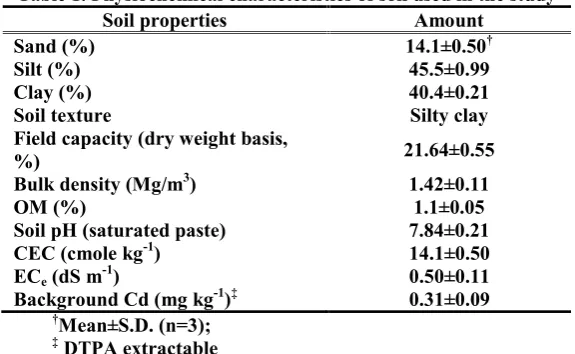
A bulk sample of the top layer (0-20 cm) of a calcareous silty clay soil (fine, mixed, mesic, Typic calcixerepts) was collected from an uncultivated field at Bajgah Agricultural Experiment Station, 16 km north of Shiraz, Fars province, I. R. of Iran. The soil was air-dried and passed through a 2 mm sieve (some physiochemical properties are shown in Table 1). The soil was mixed uniformly with 150 mg N kg-1
as urea, 50 mg P kg-1 as KH
2PO4, 5 mg Fe kg-1 as Fe-EDDHA and 5, 10 and 5 mg
determined using hanging water column and pressure plates apparatus in order to convert the soil moisture to the corresponding matric potential.
Table 1. Physiochemical characteristics of soil used in the study
Soil properties Amount
Sand (%) 14.1±0.50†
Silt (%) 45.5±0.99
Clay (%) 40.4±0.21
Soil texture Silty clay
Field capacity (dry weight basis,
%) 21.64±0.55
Bulk density (Mg/m3) 1.42±0.11
OM (%) 1.1±0.05
Soil pH (saturated paste) 7.84±0.21
CEC (cmole kg-1) 14.1±0.50
ECe(dS m-1) 0.50±0.11
Background Cd (mg kg-1)‡ 0.31±0.09 †Mean±S.D. (n=3);
‡DTPA extractable
Treatments, plants cultivar and cultivation
The seeds of corn (Zea mays L., cv single cross 704) and oat (Avena sativa L., cv Moozart) were planted in pots in a greenhouse under natural light with average day and night temperatures of 36 and 11 C, respectively. Each pot was irrigated daily with distilled water to near field capacity by weight, until 15 and 21 days after corn and oat planting, respectively. Then corn and oat were thinned to 3 and 10 plants per pot, respectively, and irrigation was started with water containing different Cd concentrations at 1, 3 and 7 day intervals. Irrigation was done by raising the soil moisture to field capacity by weight. The amounts of applied water were regarded as representative of evapotranspiration, since no water was lost by drainage. Soil moisture was measured by weighing the pots before each irrigation. The Cd levels of irrigation water were 0 (tap water), and 5, 10 and 20 mg/L, obtained by adding CdCl2.H2O to distilled water. These levels were selected to represent reasonable
amounts of Cd in raw wastewater (maximum Cd in raw wastewater reported in our country is 0.75 mg/L (Shayegan and Afshari, 2004)). The experimental design was completely randomized, arranged in factorial manner with three replications. In order to measure evaporation, pots without plants were used in each treatment. Irrigation and Cd treatments were continued 75 and 90 days after corn and oat planting, respectively.
Plant harvest and analysis
Data analysis
Cadmium uptake was calculated by multiplying shoot dry weight (DW) and shoot Cd concentration. The total transpiration (T) was obtained by cumulative applied water minus cumulative evaporation. Water use efficiency (WUE) was calculated as the ratio of DW to the total volume of T:
(1)
The efficiency of the plants for phytoremediation was evaluated by bioconcentration factor, BCF (the ratio of Cd concentration (C) in plant shoot to Cd concentration in the soil (25):
(2)
Moreover, the apparent Cd recovery was used as the relative efficiency of the two crops for Cd removal from soil as fallow:
(3)
In equation 3, T and C refer to different treatments and controls, respectively.
The data obtained was analyzed using a two-way analysis of variance (ANOVA) for the main and combined effects of irrigation intervals and Cd levels of irrigation water. The differences were statistically significant when the p-value was less than 0.05. For comparisons of means, Duncan’s multiple range test was used with a 95.0% confidence level.
RESULTS AND DISCUSSION
Soil water depletion, matric potential and Cd concentration
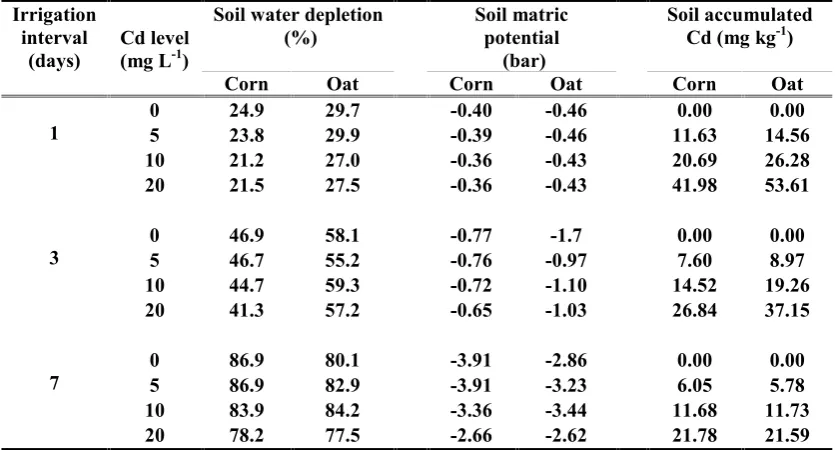
Table 2 summarizes the mean depletion of soil moisture and the produced matric potential that the plants encounter in their growing period. As expected, the maximum soil water content (i.e. minimum soil water depletion) and matric potential occurred at the 1-day irrigation interval. This Table also shows the accumulated soil Cd concentration. The values of this parameter were greater at lower irrigation intervals, because of the larger amount of water application. Despite the lower T rate (Tables 3 and 4), these values were greater for oat than corn which could be attributed to the longer growing period and consequently the need for using more water.
Plant growth
corn. As expected, the DW and T rate of both plants and their mean values significantly decreased with increasing irrigation frequency (Tables 3 and 4). However, the differences of the DW of oat plant at the 3 and 7 day irrigation interval was not significant when irrigated with 5 mg Cd L-1.
Table 2. Depletion of soil moisture, soil matric potentials and soil Cd concentrations at various irrigation interval and Cd levels of irrigation water
Irrigation interval
(days) Cd level(mg L-1)
Soil water depletion
(%) Soil matricpotential (bar)
Soil accumulated Cd (mg kg-1)
Corn Oat Corn Oat Corn Oat
1 05 24.923.8 29.729.9 -0.40-0.39 -0.46-0.46 11.630.00 14.560.00
10 21.2 27.0 -0.36 -0.43 20.69 26.28
20 21.5 27.5 -0.36 -0.43 41.98 53.61
3 05 46.946.7 58.155.2 -0.77-0.76 -0.97-1.7 0.007.60 0.008.97
10 44.7 59.3 -0.72 -1.10 14.52 19.26
20 41.3 57.2 -0.65 -1.03 26.84 37.15
7 05 86.986.9 80.182.9 -3.91-3.91 -2.86-3.23 0.006.05 0.005.78
10 83.9 84.2 -3.36 -3.44 11.68 11.73
20 78.2 77.5 -2.66 -2.62 21.78 21.59
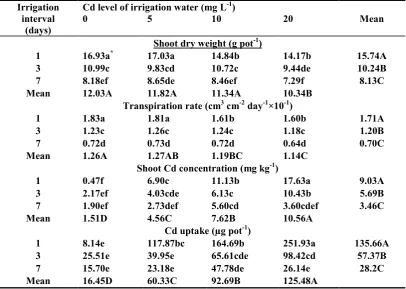
The mean DW of corn and oat decreased by increasing the Cd level of irrigation water and dropped significantly, to the minimum amount at the highest Cd level. The plants’ T rate was less than that of the control at Cd levels of 10 and 20 mg l-1. On average, the 20 mg L-1Cd caused a reduction of about 17 and 9.5% of the corn and oat T rate, respectively, as compared to the control. In the case of DW, the corresponding values were 21 and 14%. Tables 3 and 4 show that corn had greater potential for biomass production and water consumption. Plant biomass and water uptake contributed markedly to the phytoremediation potential of a given plant species (36 and 21).
Therefore, corn seems to be better for phytoremediation practice than oat. In the present study, a slight increase in DW and T rate was observed with lower doses of Cd levels (5 and 10 mg l-1) especially for oat. Marchiol et al. (23) reported a
Table 3. Shoot dry weight, transpiration rate; shoot Cd concentration and uptake of corn plant at various irrigation intervals and Cd levels of irrigation water
Irrigation interval
(days) Cd level of irrigation water (mg L
-1)
Mean
0 5 10 20
Shoot dry weight (g pot-1)
1 66.52a* 64.82a 61.63a 61.35a 63.58A
3 33.40b 30.92b 24.22c 18.02d 26.64B
7 11.50e 11.73e 10.53e 8.64e 10.60C
Mean 37.14A 35.82A 32.13A 29.34B
Transpiration rate (cm3cm-2day-1×10⁻¹)
1 2.37a 2.12b 1.90c 1.93bc 2.08A
3 1.44d 1.36d 1.27de 1.29de 1.34B
7 1.12ef 1.06fg 1.00fg 0.87g 1.01C
Mean 1.64A 1.51B 1.39C 1.36C
Shoot Cd concentration (mg kg-1)
1 0.24c 1.38abc 1.73ab 2.39a 1.44A
3 0.26c 0.94bc 1.36abc 0.82bc 0.85A
7 0.21c 1.03abc 1.96ab 1.45abc 1.16A
Mean 0.24B 1.12A 1.69A 1.55A
Cd uptake (µg pot-1)
1 15.37c 86.25b 106.52ab 145.74a 89.22A
3 8.84c 28.92c 32.68c 14.79c 21.31B
7 2.42c 12.17c 21.61c 12.53c 12.17B
Mean 8.87B 43.43A 53.60A 57.68A
*Means within each parameter followed by the same letter are not statistically different
atp≤0.05. Capital letters are used for the main effects.
Table 4. Shoot dry weight, transpiration rate, Shoot Cd concentration and uptake of oat plant at various irrigation intervals and Cd levels of irrigation water
Irrigation interval
(days)
Cd level of irrigation water (mg L-1)
Mean
0 5 10 20
Shoot dry weight (g pot-1)
1 16.93a* 17.03a 14.84b 14.17b 15.74A
3 10.99c 9.83cd 10.72c 9.44de 10.24B
7 8.18ef 8.65de 8.46ef 7.29f 8.13C
Mean 12.03A 11.82A 11.34A 10.34B
Transpiration rate (cm3cm-2day-1×10⁻¹)
1 1.83a 1.81a 1.61b 1.60b 1.71A
3 1.23c 1.26c 1.24c 1.18c 1.20B
7 0.72d 0.73d 0.72d 0.64d 0.70C
Mean 1.26A 1.27AB 1.19BC 1.14C
Shoot Cd concentration (mg kg-1)
1 0.47f 6.90c 11.13b 17.63a 9.03A
3 2.17ef 4.03cde 6.13c 10.43b 5.69B
7 1.90ef 2.73def 5.60cd 3.60cdef 3.46C
Mean 1.51D 4.56C 7.62B 10.56A
Cd uptake (µg pot-1)
1 8.14e 117.87bc 164.69b 251.93a 135.66A
3 25.51e 39.95e 65.61cde 98.42cd 57.37B
7 15.70e 23.18e 47.78de 26.14e 28.2C
Mean 16.45D 60.33C 92.69B 125.48A
*Means within each parameter followed by the same letter are not statistically different at
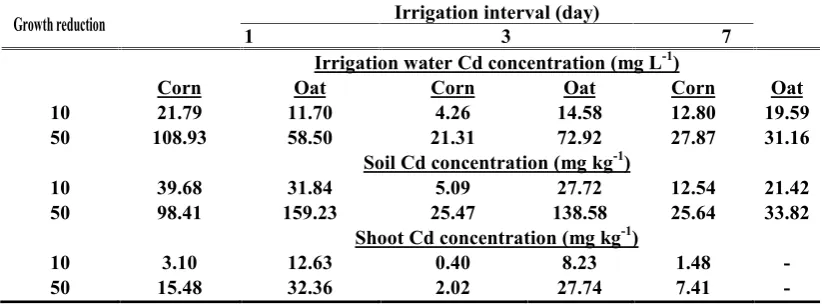
Based on the lines of best fit between yield reduction versus Cd concentration, the water and final soil (at the end of the experiment) and shoot Cd concentrations required to reduce shoot dry weight by 10 and 50% were calculated (Table 5). From the results reported in Table 5, corn was more sensitive to Cd under the 3-day irrigation interval. Sameni et al. (29) reported a 50% reduction in the shoot growth of corn at 171 mg Cd kg-1. They also observed that shoot Cd concentration associated
with 50% growth suppression was 29 mg kg-1 for corn, which was higher than our findings. In our experiment, however, corn was gradually exposed to Cd addition.
In the present study, oat behavior was more complex than corn. According to soil and plant Cd concentrations (Table 5), oat was more tolerant to Cd at the 1-day irrigation frequency. No significant relationship was found between oat growth reduction and shoot Cd concentration under the 7-day irrigation interval.
According to the data in Table 5, oat was more tolerant to Cd than corn under 3 and 7-day irrigation intervals. In general, growth reduction occurred at a higher shoot Cd concentration indicating that oat grew better than corn under Cd stress and might be a preferred candidate for the phytoremediation of Cd.
Table 5. Water, soil and plant tissue Cd concentrations for 10 and 50 % growth reduction of corn and oat at various irrigation intervals
Growth reduction 1 Irrigation interval (day)3 7 Irrigation water Cd concentration (mg L-1)
Corn Oat Corn Oat Corn Oat
10 21.79 11.70 4.26 14.58 12.80 19.59
50 108.93 58.50 21.31 72.92 27.87 31.16
Soil Cd concentration (mg kg-1)
10 39.68 31.84 5.09 27.72 12.54 21.42
50 98.41 159.23 25.47 138.58 25.64 33.82
Shoot Cd concentration (mg kg-1)
10 3.10 12.63 0.40 8.23 1.48
-50 15.48 32.36 2.02 27.74 7.41
-Cadmium concentration and uptake
50% of the absorbed Cd was stored in the roots of several plant species, it might be concluded that corn roots have a mechanism which restricts the transfer of Cd through the plant, The biomass production and the accumulation and distribution of metals in the plants’ tissue are important aspects of evaluating the role of the plant to remediate contaminated sites (28). Data on shoot dry matter and Cd uptake (Tables 3 and 4) show that despite the lower biomass production, oat accumulated 52, 169 and 132% more Cd than corn at 1, 3 and 7 day irrigation intervals, respectively. On the average, oat took up soil Cd about 80% more than corn.
WUE and BCF
The ANOVA showed that the irrigation interval was the only factor with any significant effect on the WUE of oat (p≤0.05). While in corn, only Cd levels of irrigation water had no significant impact on the WUE. In general, corn had greater WUE than oat, except under the 7-day irrigation frequency. The highest WUE was obtained at 1 and 7-day irrigation intervals for corn and oat, respectively (Table 6). Adequate plant biomass is one of the main effective factors in phytoremediation. Therefore, with a given volume of effluent supply corn may be preferred for phytoremediation under no water stress condition. Both plants had slightly higher WUE when treated with lower doses of Cd (5 or 10 mg l-1) as compared with the
control. Marchiol et al. (23) reported lower WUE for crops grown in soil contaminated with heavy metals.
Table 6. WUE and BCF of corn and oat at various irrigation intervals and Cd levels of irrigation water
Plant Irrigationinterval (days)
Cd level of irrigation water (mg L-1)
0 5 10 20 Mean
Corn WUE (g l-1water)
1 7.62b* 8.33ab 8.82a 8.96a 8.43A
3 6.28c 6.20c 5.16d 4.70d 5.59B
7 2.79e 3.02e 2.85e 2.68e 2.84C
Mean 5.57A 5.85A 5.61A 5.45A
BCF
1 0.787a 0.117b 0.080b 0.057b 0.260A
3 0.850a 0.120b 0.093b 0.030b 0.273A
7 0.667a 0.163b 0.160b 0.067b 0.264A
Mean 0.768A 0.133B 0.111B 0.051B
Oat WUE (g L-1water)
1 2.70bc 2.75b 2.71bc 2.58bc 2.69B
3 2.60bc 2.49cd 2.53bcd 2.34d 2.50C
7 3.32a 3.47a 3.45a 3.34a 3.39A
Mean 2.87AB 2.90A 2.89A 2.75B
BCF
1 1.503b 0.463b 0.423b 0.327b 0.679A
3 6.990a 0.433b 0.317b 0.280b 2.005A
7 6.130a 0.450b 0.460b 0.167b 1.802A
Mean 4.874A 0.449B 0.400B 0.258B
*Means within each parameter followed by the same letter are not statistically different
The BCF is an important plant feature in phytoremediation, which implies the uptake of pollutants, their mobilization and storage in the aerial plant parts (23). The BCF values >1 indicate that plants have good ability to take up contaminants from polluted substrate and accumulte them in their above ground tissue. In this study, The BCF of both plants was only affected by Cd treatment (p≤0.05) and was < 0.5 regardless of Cd rates (Table 6). Marchiol et al.(23) reported the BCF of some heavy metals, including Cd, in various crops. The BCF data of Cd in oat are coherent with those reported by Marchiol et al. (23). In our experiment, oat BCF was greater than that of corn. Therefore, the Cd absorption and translocation ability of oat was greater than corn. The greatest BCF was obtained at the 3-day irrigation interval (Table 6). Our results also showed that corn and oat had greater BCF values under water stress compared to the no soil moisture stress condition. This is mainly due to greater Cd accumulation in the soil resulting from greater amounts of applied water at the 1-day irrigation interval. Robinson et al. (27) also demonstrated a general decrease in the BCF of forest species with increasing soil Cd levels.
Apparent Cd recovery
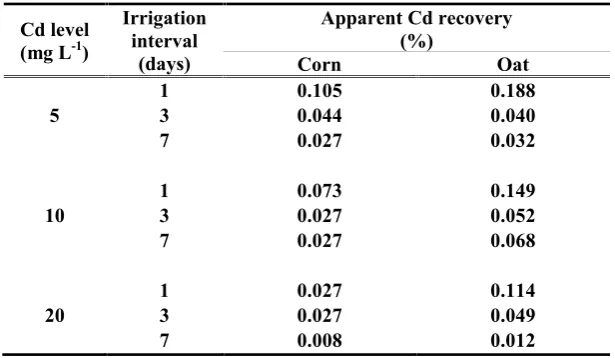
The Cd recovery percentages are shown in Table 7. According to this Table, at a given Cd level, plants generally recovered more Cd at the 1-day irrigation interval than the other two irrigation regimes. This could be attributed to the higher soil matric potential (Table 2) and consequently greater water and metal uptake and also, higher biomass production (Tables 3 and 4). The amounts of Cd recovered by corn and oat in this study are not effective in phytoremediationper se. In the other words, the recovered Cd was very low even under an optimum soil moisture regime, because of the substantial Cd accumulation in the soil. It seems that most of the Cd added to the irrigation water accumulated in the soil and became partially unavailable for plants or especially concentrated in plant roots. From Table 7, it is also clear that rises in Cd levels decreased the percentage of Cd recovery especially for corn. It could thus be realistically hypothesized that corn and oat could perform better in the case of light soil pollution. In general, Cd recovery by oat was greater than corn (Table 7). Based on the results of this study, oat may be selected for further Cd phytoremediation research using actual industrial effluent.
Table 7. Percent of recovered Cd at various irrigation and Cd treatments Cd level
(mg L-1)
Irrigation interval
(days)
Apparent Cd recovery (%)
Corn Oat
1 0.105 0.188
5 3 0.044 0.040
7 0.027 0.032
1 0.073 0.149
10 3 0.027 0.052
7 0.027 0.068
1 0.027 0.114
20 3 0.027 0.049
Other agronomic and horticultural crops should also be tested for phytoremediation under gradually increasing levels of soil Cd. In order to artificially enhance Cd uptake, soil amendments may also be used (6 and 8). Finally, the results of this phytoremediation research are recommendable and practical when the experiments are tested in the field under different site-specific and multi-contamination conditions.
CONCLUSION
From a phytoremediation perspective, the results showed that corn and oat responded to water stress by lowering DW, T rate and Cd uptake. They could therefore, perform better under no soil water stress condition, especially under light water and consequently soil Cd pollution. This is because greater metal uptake is observed at higher soil moisture contents and greater metal recovery is obtained with lower Cd levels. Moreover, the results confirm a significant difference between different species for Cd concentrating in shoots: oat seems to be more suitable than corn for Cd phytoremediation.
REFERENCES
1- Angle, J. S., A. J. M. Baker, N. S. Whiting and R. L. Chaney. 2003. Soil moisture effects on uptake of metals by Thlaspi, Alyssum, and Berkheya. Plant Soil 256: 325-332.
2- Baker, A. J. M. and R. R. Brooks. 1989. Terrestrial higher plants which hyperaccumulate metallic elements-a review of their distribution, ecology and phytochemistry. Biorecovery 1: 81-126.
3- Bjerre, G. K. and H. H. Schierup. 1985. Uptake of six heavy metals by oat as influenced by soil type and additions of cadmium, lead, zinc and copper. Plant Soil 88: 57-69.
4- Chaney, R. L., M. Malik, Y. M. Li, S.L. Brown, E. P. Brewer, J. S. Angle and A. J. M. Baker. 1997. Phytoremediation of soil metals. Current Opinion in Biotechnol. 8: 279-284.
5- Chaney, R. L., Y. M. Li, J. S. Angle, E.P. Brewer, J. P. Saunders, and A. J. M. Baker. 1998. Converting metal hyperaccumulator wild plants into commercial phytoremediation systems: Approaches and progress. In:
Banũelos, G. S., and N. Terry.(eds.),Proceeding of the Fourth International Conference on Biogeochemistry of Trace Elements. Berkeley, C. A. 623-624.
6- Chen, H. and T. Cutright.2001. EDTA and DTPA effects on Cd, Cr, and Ni uptake by helianthus annus. Chemosphere 45: 21-28.
8- Chen, Y. X., Q. Lin, Y. M. Luo, Y. F. He, S. J. Zhen, Y. L. Yu, G. M. Tian and M. H. Wong. 2003. The role of citric acid on the phtoremediation of heavy metal contaminated soil. Chemosphere 50: 807-811.
9- Dass, P., S. Samantaray and G. R. Rout. 1997. Studies on cadmium toxicity in plants: A review. Environ. Pollut. 98:29-36.
10- Ekvall, L. and M. Greger. 2003. Effects of environmental biomass-production factors on Cd uptake in two Swedish ecotypes of Pinus sylvestris. Environ. Pollut. 21:401-411.
11- Glick B. R. 1995. The enhancement of plant growth by free living bacteria. Can. J. Microbiol. 41: 109-117.
12- Haag-Kerwer, A., H.J. Schäfer, S. Heis, C. Walter and T. Rausch. 1999. Cadmium exposure in Brassica juncea causes a decline in transpiration rate and leaf expansion without effect on photosynthesis. J. Exp. Bot. 50: 1827-1835.
13- He, Z. Y., J. C. Li, H.Y. Zhang, and M. Ma. 2005. Different effect of calcium and lanthanum on the expression of phytochelating synthase gene and cadmium absorption in Lactuca sativa. Plant Sci. 168: 309-318.
14- Jarvis, S. C., L. H. P. Jones and M. J. Hopper. 1976. Cadmium uptake from solution by plants and its transport from roots to shoots. Plant Soil 44: 179-191.
15- Jiang, W. H., D. H. Liu and W. Q. Hou. 2001. Hyperacuumulation of cadmium by roots, bulbs and shoots of garlic (Allium sativum L.). Bioresour. Technol. 76: 9-13.
16- John, M. K. 1973. Cadmium uptake by eight food crops as influenced by various soil levels of cadmium. Environ. Pollut. 4: 7-15.
17- Kärenlampi, S., H. Schat, J. Vangronsveld, J. A. C. Verkleij, D. Vander Lelie, M. Mergeay and A.I. Tervahauta. 2000. Genetic engineering in the improvement of plants for phytoremediation of metal polluted soils. Environ. Pollut. 107: 225-231.
18- Kastori, R., M. Petrovic and N. Petrovic. 1992. Effect of excess Pb, Cd, Cu and Zn on water relations in sunflower. J. Plant Nut. 15: 2427-2439.
19- Kirkham, M. B. 1978. Water relation of cadmium-treated plants. J. Environ. Qual. 7(3): 334-336.
21- Licht, L. A. and J. G. Isebrands. 2005. Linking phytoremediation pollutant removal to biomass economic opportunities. Biomass Bioenergy 28: 203-218. 22- Marchiol , L., L. Leita, M. Martin, A. Peressotti and G. Zebri. 1996.
Physiological response of tow soybean cultivars to cadmium. J. Environ. Qual. 25: 562-566.
23- Marchiol, L. P. Sacco, S. Assolari and G. Zebri. 2004. Reclamation of polluted soil: phytoremediation potential of crop-related Brassica species. Water Air Soil pollut. 158: 345-356.
24- Marchiol, L., S. Assolari, P. Sacco and G. Zebri. 2004. Phytoextraction of heavy metals by canola (Brassica napus) and radish (Raphanus sativus) grown on multicontaminated soil. Environ. Pollut. 132:21-27.
25- McGrath, S. P. and Zhao F. J. 2003. Phytoextraction of metals and metalloids from contaminated soils. Current Opinion Biotechnol. 14: 277-282.
26- Raskin, I., R. D. Smith and D.E. Salt. 1997. Phytoremediation of metals: using plants to removepollutants from the environment. Current Opinion Biotechnol. 8: 221-226.
27- Robinson, B. H., T. M. Mills, D. Petit, L.E. Fung, S.R. Green and B. E. Clothier. 2000. Natural and induced cadmium-accumulation in poplar and willow: implication for phytoremediation. Plant Soil 227: 301-306.
28- Salt, D. E., M. Blaylock, P. B. A. N. Kumar, V. Dushenkov, B. D. Ensley, I. Chet and I. Raskin. 1998. Phytoremediation: a novel strategy for the removal of toxic metal from the environment using plants. Biotechnol. 13: 468-474.
29- Sameni A. M., M. Maftoun and A. Bassiri. 1987. Response of tomato and sweet corn to different cadmium levels in calcareous soils. J. Hort. Sci. 62(2): 227-232.
30- Shayegan, J. and A. Afshari. 2004. The treatment situation of municipal and industrial wastewater in Iran. J. Water and Wastewater 49: 58-69. (In Farsi) 31- Siciliano, S. D. and J. J. Germida. 1997. Bacteria inoculants of forage grasses
enhance degradation of 2-chlorobenzoiz acid in soil. Environ. Toxicol. Chem. 16: 1098-1104.
32- Van Genuchten, M. T. 1980. A closed-form equation for predicting the hydraulic conductivity of unsaturated soils. Soil Sci. Soc. Amer. J. 44: 892-898.
34- Walker, W. M., J. E. Miller and J. J.Hassett. 1977. Effect of lead and cadmium upon the calcium, magnesium, potassium, and phosphorus concentration in young corn. Soil Sci. 124(3): 145-151.
35- Jiang, W. H., D.H. Liu and W. Q. Hou. 2001. Hyperaccumulation of cadmium by roots, bulbs and shoots of garlic (Allium sativum L.) Bioresour. Technol. 76: 9-13.