Research article
International Journal of Heterocyclic Chemistry,
Vol. 8, No. 2, pp. 55-61 (Spring 2018)
© Islamic Azad University, Ahvaz Branch
http://ijhc.iauahvaz.ac.ir
Theoretical study of conformational properties and the
anomeric effect study of the 2- phosphinanes
Javad Aziziana,*, Mahdieh Entezarib, Hossein Anaraki Ardakanib,
Shahab Zomorodbakhshb
aDepartment of chemistry, Science and Reaserch branch, Islamic azad
university, Tehran, Iran, Corresponding author E-mail address:
bDepartment of chemistry, , Mahshahr branch, Islamic azad university,
Mahshahr, Iran
Abstract
Ab initio HF/6-31G* Methode was employed to calculate the bond length in 2- phosphinanes when electronegative groups was at C-2 tend axial and equatorial positions. The magnitude of the anomeric effect depends on the nature of the substituent, the effect of the substituent can be seen by comparing the bond length in 2-chloro and 2-boromo substituented phosphinanes. The effect of anomeric effect have been effected on the bond length in
2- phosphinanes.
Keywords: anomeric effect; 2- phosphinane; bond length; axial and equatorial position; Ab initio calculations
Introduction
The discussion about the origin of the anomeric effect is very old [1,6].An important feature of
the stereochemistry of tetrahydropyrans and other reduced oxygen and sulphur heterocycles is
56:: International Journal of Heterocyclic Chemistry, Vol. 8 No. 2, pp. 55-61 (Spring 2018 )
this sterically more hindered. The X-ray crystal structures of several heterocycles of these types
bearing 2-halo substituents have been determined and those axial halogen groups have bonds that
shortened [7].
Several structural factors have been considered as possible causes of the anomeric effect. In
localized valence bond terminology, it can be recognized that there will be a dipole-dipole
repulsion between the polar bonds at the anomeric carbon in the equatorial conformation. This
dipole-dipole interaction is reduced in the axial conformation.
From the molecular orbital viewpoint, the anomeric effect is described as resulting from an
interaction between the lone-pair electrons on the hetero atom and the ϭ* orbital associated with
the bond to the electronegative C-2 substituent [8]. when the C-X bond is axial, an interaction
between an occupied lone-pair electrons and the anti bonding ϭ* orbital of the C-X bond
combination is possible. This permits delocalization of the lone-pair electrons and would be
expected to shorten and strengthen the C-O bond while lengthening and weakening the C-X
bond.
Due to the biological interest associated with the six membered cyclic phosphates,
phosphorinane and phosphinanes systems have become an important structural moiety [9,11].
One aspect of 2- phosphinanes chemistry is determination of anomeric effect, we reported a
detailed Ab intio study on the bond-length in axial and equatorial conformers and reported the
effect of anomeric effect on them.
Computational details
Ab initio Hartree-Fock calculations were carried out using GASSIAN 98 program with the
standard 6-31G* basis set [12].
Results and Discussion
phophinanes can exist in tow chair conformations in which the electronegative group on
International Journal of Heterocyclic Chemistry, Vol. 8 No. 2, pp. 55-61 (Spring 2018 )
57
:: 57
PH
X
PH
X
1A 1E
Fig. 1.X in axial and equatorial position
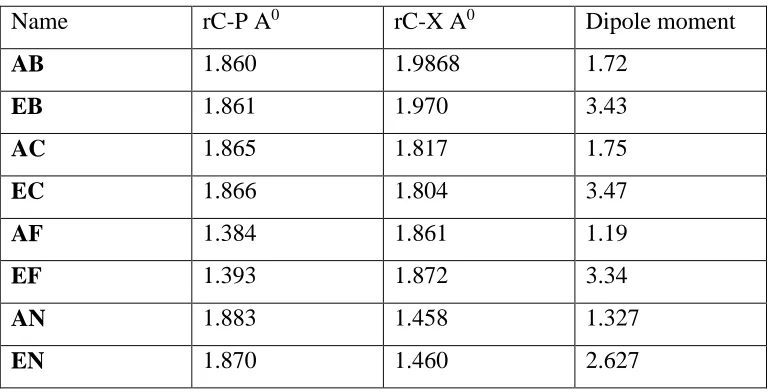
The bond length of the 2-phophinanes (Fig. 2) are calculated and determined (Table1).
PH Br PH Br PH NH2 PH NH2 PH Cl PH F PH Cl PH F
AB EB AN EN
AC EC AF EF
Fig. 2. 2-Phosphinanes with an electronegative group in 2-phophinanes
Table1. Bond length and dipole moment of 2-Phosphinanes
Name rC-P A0 rC-X A0 Dipole moment
AB 1.860 1.9868 1.72
EB 1.861 1.970 3.43
AC 1.865 1.817 1.75
EC 1.866 1.804 3.47
AF 1.384 1.861 1.19
EF 1.393 1.872 3.34
AN 1.883 1.458 1.327
58:: International Journal of Heterocyclic Chemistry, Vol. 8 No. 2, pp. 55-61 (Spring 2018 )
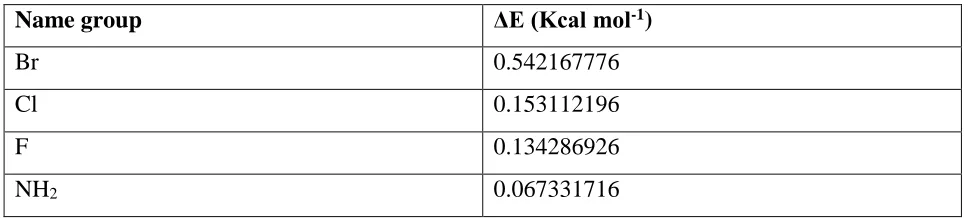
The difference of energy between axial and equatorial conformers in 2-Phosphinanes are studied
(Table2).
Table 2. ΔE between axial and equatorial conformers
Name group ΔE (Kcal mol-1)
Br 0.542167776
Cl 0.153112196
F 0.134286926
NH2 0.067331716
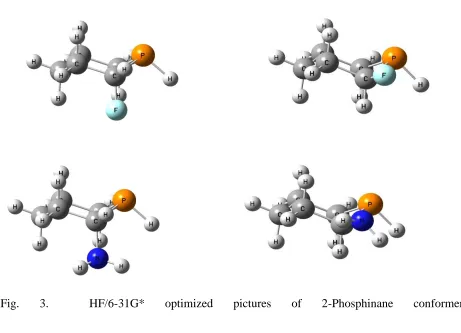
The HF/6-31G* optimized structures of 2-Phosphinane conformers are existed ( Fig.3).
International Journal of Heterocyclic Chemistry, Vol. 8 No. 2, pp. 55-61 (Spring 2018 )
59
:: 59
Fig. 3. HF/6-31G* optimized pictures of 2-Phosphinane conformers
The C-P bond length in the phophinanes with X group in axial position are shorter than those
with X group in equatorial position.
The dipole moment in phophinanes with X group in axial position are shorter than those with X
group in equatorial position.
The ΔE in phosphinanes were explained that phosphinanes with high electronegativity groups in
axial position are more stable.
The results are determined that in 2-phophinanes with X group in axial position, the transfer of
electron density from the lone pair to the ϭ* orbital, the introduction of some ᴨ-bonding
character to the C-P bond, That is strengthened, and weakening of the C-X bond.
Conclusion
Thus the anomeric effect in 2-phophinanes is existed and the electronegative groups in axial
60:: International Journal of Heterocyclic Chemistry, Vol. 8 No. 2, pp. 55-61 (Spring 2018 )
tetrahydro-2H- thiopyranes is much stronger because is existed a spatial interaction between
phosphour and X group in axial position.
Acknowledgments
The author(s) would like to acknowledge the support provided by the Research Council of
Islamic Azad University, Science and Research Branch and Mahshahr branch.
References
[1] C.L, Perrin, K. B, Armstrong, M. A, Fabian: J. Am. Chem. Soc. 116, 1994, pp. 715-722.
[2] Chu N, J. Ph.D Thesis, university of Ottawa, 1959.
[3] R. U, Lemieux, Chu, N. J. Abstracts of papers, 133th national meeting of the American
Chemical society; Washington, DC, 1958, Abstr. 31N.
[4] E, Juaristi; G, Cuevas: Tetrahedron 48 (1992) 5019.
[5] A. J Kirby: Springer Verlag, Berlin, (1983).
[6] R. U, Lemieux. In Molecular Rearrangement; P. De Mayo, Ed: Interscience, New York,
(1964), pp. 723.
[7] W. A. Szarek, D. Horton, the anomeric effect: Origin and Consequences, ACS Symposium
series no. 87, American Chemical Society, Washington D.C, (1979).
[8] S. Wolfe, A. Rauk, L. M. Tel, I. G. Csizmaida, J. Chem. Soc. B: 136 (1971). Eisenstein, W.
J. Hehre, L. salem, R. Hoffmann: J. Am. Chem. Soc: 95 (1973) 306.
[9] M J. Gallager, phosphorus 31-NMR spectroscopy in Stereochemical Analysis, edited by J G.
Verkade , L D. Quin, 1987, Chapter9.
[10] W. E. McEwen , K. D. Berlin, Organophosphorus stereochemistry part І, Orgins and p (ІІІ and ІV) compounds, 1975.
International Journal of Heterocyclic Chemistry, Vol. 8 No. 2, pp. 55-61 (Spring 2018 )
61
:: 61
[12] M. J. Frisch, G. W. Trucks, H. B. Schlegel, G. E. Scuseria, M. A. Robb, J. R. Cheeseman,
V. G. Zakrzewski, J. A. Montgomery, R. E. Stratmann, J. C. Jr. Burant, S Dapprich., J. Millam,
V. Barone, M. Cossi, R. Cammi, B. Mennucci C. Pomelli, C. Adamo, S. Clifford, j. Ochterski,
G. A. Petersson, P. Y. Ayala, Q. Cui, K. Morokuma, D. K. Malick, A. D. Rabuck, K.
Raghavachari, J. B. Foresman, j. Cioslowski, J. V. Ortiz, B. tefanovb, G. Liu, A. Liashenko, P.
Piskorz, I. Komaromi, R. Gomperts, R. L. Martin, D. J. Fox, T. Keith, M. A Al-Laham. C. Y.
Peng, A Nanayakkara., C. Gonzalez, M. Challacombe, P. M. W. Gill, B .Johnson, W.Chen, M.
W.Wong, J. L Andres, M. Head-Gordon, E. S. Replogle, J. A. Pople, GAUSSIAN 98 (Revision